Luisa Calcumil's work exemplifies how women in the Americas use performance as a system of embodied action to address those issues that affect and concern them. In her solo performance Fei C’ Mei Aihuiñ Tuhun (It's Good to Look at One's Own Shadow),Footnote 1 Calcumil, a Mapuche actress from Patagonia, Argentina, presents a series of characters that account for the challenges, old and new, faced by indigenous women. Centring on issues that are gender-specific, such as child-rearing, domestic labour, sexuality and body image, Calcumil's theatre engages in current activist discussions about the relationship between contemporary aboriginal identity and cultural roots in the face of marginalization and national indifference.
Reflexive spectatorship, the need to look, to reflect and to act on matters performed back to us, is signalled in the title of Calcumil's show, It's Good to Look at One's Own Shadow. Her title borrows the phrase from a proverb that conveys the Mapuche people's belief that shadows and dreams play an integral part in one's orientation in the world. While in Western culture shadows connote the dark side of human nature, in Calcumil's performance the image of the shadow represents the guiding power of ancestral wisdom and cultural heritage.
Calcumil creates an intercultural experience in which different performance registers – naturalistic, parodic, ritualistic – allow for diverse audiences to witness the situations endured by three generations of Mapuche women. Although the piece portrays situations of racism, misogyny, classism and neocolonialism, Calcumil's way of presenting conflict highlights the strength and resilience of Mapuche people, emphasizing Mapuche cultural values as a source of empowerment. Calcumil asserts that despite the different challenges faced by the women characters she performs – land expropriation, labour exploitation, human-rights abuses and false consciousness – they share a common resource: their cultural heritage, the grounding force of native ways of knowing that are communicated in the play through the figure of the shadow.
Calcumil has performed Fei C’ Mei Aihuiñ Tuhun for more than twenty years in spaces that range from small theatres and rural houses to international conferences. The piece premiered in 1987 in her home town, the city of General Roca, in southern Argentina, home of many Mapuche people who migrated from rural areas to the city in search of work. The Mapuche are the original dwellers of Patagonia, in what is today the south of Argentina and Chile. They resisted three centuries of Spanish invasion during colonial times, and endured the ensuing oppression by the Argentinean and Chilean states. Only recently, indigenous peoples were granted recognition of their ethnic and cultural status through a constitutional amendment, gaining the right to a bilingual education and to communal ownership of their land, and access to deliberation processes about natural resources and other matters related to economic sustainability. However, while the legal process finally honoured the demands of the Mapuche people, as well as the claims of the other eighteen first-nation peoples or pueblos originarios, hegemonic ideology determines what counts as ‘authentic’ indigenous identity and limits native cultural space to a set of practices that belong in the past, in turn foreclosing the possibility for hybrid cultural forms to retain both the contemporary and the traditional.
The current campaign for Mapuche self-affirmation, Wefkvletuyiñ (We Are Re-emerging) challenges this reductive view of indigenous selfhood, expanding indigenous political interventions beyond the politics of rights claims that fuelled the activism of the 1980s. Some groups, such as Proyecto de Teatro Mapuche (Mapuche Theatre Project) and the Taller de Comunicación MapUrbe (MapUrbe Communication Workgroup), who participate in the campaign, examine questions about identity formations and belonging through theatre and communication projects. They rehearse different understandings of Mapuche identity today from outside fixed categories. These groups, comprising mainly women in their twenties and thirties, call attention to the heterogeneous nature of identity formation and to how hybrid forms and urbanity inform the traditional practices that shape contemporary Mapuche identity. Luisa Calcumil, who became famous as the protagonist of the film Gerónima Footnote 2, is undoubtedly a strong referent, albeit from a different generation, of this cultural movement that consolidated in the first years of the twenty-first century.
Calcumil's work, vis-à-vis the productions of the new generation of cultural activists, can be thought of as a hinge, calling attention to that which should not get lost in the move from rural to urban or from traditional to contemporary takes on ‘being Mapuche’. What is the role of traditional ways of knowing in the new scenarios that come with the experience of urbanization and globalization? How can Mapuche people be ‘up to date’, joining global circuits of production and consumption without ‘selling out’? And, further, how do women's experiences account for the colonization of bodies and subjectivities that is also central to the experience of indigenous oppression?
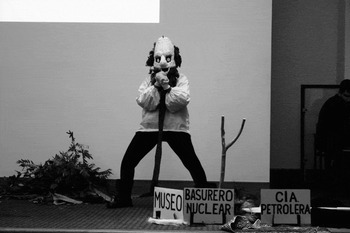
Calcumil's play, performed in Spanish and Mapuzugun, the language of the Mapuche, traverses different temporalities that help to place her argument in relation to the current discussion about Mapuche authenticity. The world of the Mapuche is introduced at the beginning of the play through the performance of a ritual which foregrounds women as the bearers of cultural tradition. The scene presents a harmonious time, one in which nature and the human are connected. This order is disrupted in the second scene: Calcumil impersonates a white male character (she puts on a full mask with black strips sticking out of the mouth), a man who destroys the ritual space set in the previous scene. This devastation of indigenous space is followed immediately by a ceremony of colonial possession. The scene alludes to the iterative nature of the scenario of conquest as the invader divides the space with wire fences and moves the debris of the ceremonial space into a corner, indexing the remnants with a sign that reads: ‘museum’. After the ‘Indians’ are thus relegated to the past and to the fixity of museum practice, the space is further territorialized by capitalist enterprises. As the white male colonizer sets up an oil exploitation firm and a nuclear dump, the capitalist ritual is complete (Fig. 1). The signs of this exploitation, set on the stage alongside the museum sign, link cultural and economic practices as equally powerful tools of subjugation. However, because Calcumil is invested in using theatre as a platform to celebrate her culture's strength instead of engaging in discourses of victimization, the rampage scene is performed in a parodic style through which the white male is ridiculed in his primitive greediness. While various concerns inform indigenous activist agendas today, land dispossession and colonial violence remain central to native political struggles, and Calcumil's performance proves politically urgent and resistant in its tactical use of parody and humour to contest the colonial forces of subjugation.
Luisa Calcumil as the White Male Colonizer. (Photograph courtesy of the UCLA Center for Performance Studies.)

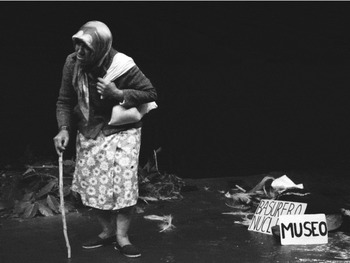
While the first part of the show situates indigenous experience within the frame of ritual and historical time, the remaining two scenes provide a chronological account of how forced migration affects indigenous women in particular. Playing Herminda (Fig. 2), Calcumil represents an elderly woman in search of her daughter who works as a cleaning lady in the city. The scene, a dialogue with the (unseen) daughter's employer, serves to reveal indigenous women's bodies as a site of subjugation and oppression. At the same time, however, as in earlier scenes, Calcumil offers humour and parody as tools to resist and to disidentify with the colonizing and marginalizing treatment of women like Herminda.
Luisa Calcumil as Herminda, an elderly Mapuche woman. (Photo courtesy of Marlène Ramírez-Cancio.)

In the final scene, Calcumil addresses issues of abuse, acculturation and the persistence of memory by interpreting a middle-aged woman, Julia (Herminda's daughter), who graduated from domestic employee to the middle classes because she was encouraged by her employer to attend school, which allowed her to marry the ‘right man’. By portraying the character in a schizophrenic, over-the-top fashion, Calcumil shows the disorientation that lies behind the image of a supposedly westernized, and thus modern, indigenous person. The exaggerated manner in which Calcumil depicts the urban Mapuche woman may at first be understood as an internal critique of the Mapuche community, especially to those who, in moving to urban settings, abandon indigenous identity as a means to survive in the metropolis. But the parodic ‘we, indigenous women’ that Calcumil uses as a mirror to reflect shattered pieces that do not coalesce into a coherent self – ‘those golden tones that are in fashion in Europe and the U.S. look great on us!’Footnote 3 – reaches a more general ‘we, the colonized’ where global, national and indigenous identifications reflect on each other:
All Argentineans say OK, OK, OK, and they still call me a shitty Indian. So, how is it so? How did it come about? What silence! How was it? What silence! Grandma, how was it, how the fuck was it?Footnote 4
As this makes clear, Calcumil's critique is directed at both native and non-native people who succumb to the lure of global trends at the expense of local forms of belonging. In this way, Calcumil calls attention to the fact that the issue of colonized bodies is a matter that concerns not only rural audiences but also urban, national and international publics.
Regardless of our ethnicity, gender and social position, Calcumil's performance interpellates us all. Performing Fei C’ Mei Aihuiñ Tuhun for over twenty years, making visible past repertoires of oppression and freedom and connecting these to present social realities, Calcumil shows that the project of ‘undoing marginalization’ is integrally linked to the process of ‘doing identities’. In her theatre, embodied practice serves to communicate cultural heritage as valuable to different ways of belonging for all those who underwent colonization – a powerful resource from which to cast complex shadows in the treacherous terrain of the global.