In early childhood, children learning different languages have developed sensitivity to discourse-pragmatic features. For example, children learning Chinese, English, Hindi, Italian, Inuktitut, Korean, and Spanish use overt arguments like nouns to indicate new referents but less overt arguments like pronouns or even null arguments to indicate given referents (e.g., Allen, Reference Allen2000; Allen & Schroder, Reference Allen, Schroder, Du Bois, Kumpf and Ashby2003; Clancy, Reference Clancy and Clark1993; Narasimhan, Budwig, & Murty, Reference Narasimhan, Budwig and Murty2005; Paradis & Navarro, Reference Paradis and Navarro2003; Serratrice, Reference Serratrice2005; So, Demir, & Goldin-Meadow, Reference So, Demir and Goldin-Meadow2010). It is interesting that children also displayed sensitivity to discourse in their gestures. Previous findings showed that English- and Chinese-speaking children produced gestures more often when indicating new referents than when indicating given referents (So et al., Reference So, Demir and Goldin-Meadow2010).
Yet recently Guerriero, Oshima-Takane, and Kuriyama (Reference Guerriero, Oshima-Takane and Kuriyama2006) reported different results. In their longitudinal study, they followed two English-speaking and two Japanese-speaking children for more than a year (from 21 to 36 months), observing spontaneous conversations between the children and their parents. They looked at the referential forms in speech as well as gestures (e.g., point to a referent) as a function of the information status of referents. The findings showed that the English-speaking children mastered discourse-pragmatic strategies as early as 24 months, whereas those produced by the Japanese-speaking children did not even as late as 36 months. Specifically, the Japanese-speaking children produced null argumentsFootnote 1 and nouns equally to convey new referents. Such result was contradictory to most of the previous findings that showed that young children speaking in different languages were sensitive to the information status of referents in discourse.
Then why did the Japanese-speaking children show delay in learning discourse-pragmatic strategies? Guerriero et al. (Reference Guerriero, Oshima-Takane and Kuriyama2006) suggested that it was possibly because their caregivers did not consistently use appropriate forms of referential expressions. When interacting with their children, the Japanese caregivers sometimes used both null arguments and nouns when representing the new information. In addition, they did not often supplement the null arguments referring to the new information with pointing gestures.Footnote 2 In contrast, the English-speaking caregivers consistently followed the discourse-pragmatic principle in their speech and gestures, using nouns more frequently than pronouns for new information and supplementing pronouns referring to the new information with pointing gestures. The findings thus suggested that the consistency of caregivers’ inputs would affect their children's development of discourse-pragmatic strategies. Children who are exposed to consistent inputs from caregivers learn discourse-pragmatic strategies earlier than those who are exposed to inconsistent inputs.
Then to what extent caregivers’ referential expressions follow discourse-pragmatic principles? Only a few studies had addressed this issue. Guerriero et al. (Reference Guerriero, Oshima-Takane and Kuriyama2006) reported that some caregivers might not use discourse appropriate strategies consistently, but Paradis and Navarro (Reference Paradis and Navarro2003)'s longitudinal study found the opposite. Paradis and Navarro (Reference Paradis and Navarro2003) followed two Spanish monolingual children from 20 to 23 months and from 20 to 31 months and one Spanish–English bilingual from 21 to 30 months, observing the spontaneous conversations between the children and their parents in Spanish. Their findings showed that both groups of the caregivers were sensitive to various discourse-pragmatic features. Specifically, they produced nouns to indicate (a) the new referents (i.e., the referents that were not previously mentioned), (b) the referents that were absent from physical context (i.e., the referents that were not visible in a here and now context), (c) the referents that were in contrast (i.e., the referents that were similar to other potential referents in the forms of physical appearance or properties), and (d) the referents that were in query (i.e., the referents that were the subjects of or responses to questions).
Thus far, previous findings have not yet reached a consensus of whether caregivers display sensitivity to discourse-pragmatic principles in their speech and gestures when interacting with their children. In addition, previous studies who have examined this issue involved small sample sizes (Guerriero et al., Reference Guerriero, Oshima-Takane and Kuriyama2006; Paradis & Navarro, Reference Paradis and Navarro2003). Hence, the present study adds to the existing literature and asks whether caregivers follow discourse-pragmatic principles during interactions with their children. We look in particular at the discourse-pragmatic feature of information status (given vs. new) of the referents being identified (Clancy, Reference Clancy and Clark1993; Greenfield & Smith, Reference Greenfield and Smith1976). A referent needs to be specified explicitly, for example, by gestures, when it was not previously mentioned. We ask here whether the caregivers would gesture the referent that was not previously mentioned when they ask their children to name it. Previous findings showed that English- and Chinese-speaking children were sensitive to the discourse-pragmatic principle of information status when they were interacting with their parents (So et al., Reference So, Demir and Goldin-Meadow2010). This study extends the previous research, examining whether their parents (i.e., English- and Chinese-speaking caregivers) follow such principle in their speech and gesture.
We also investigate to what extent the children are responsive to their caregivers’ pragmatic behaviors, particularly gestures. Imagine that a child has been talking to his mother about a puzzle piece and says, “I like this one.” Then his mother asks the child to name the puzzle piece and says, “What is it?” Even though the mother does not point to the puzzle piece (because it is given information), the child should be clear which object the mother was asking about and be able to respond to the question. Now consider another scenario in which both the child and his mother have not been talking about the puzzle but the mother asks him to name one of the pieces. Because the puzzle piece is new information, the mother says, “What is it?” and points at the puzzle piece. Being guided by the pointing gesture, the child could single out which object her mother was asking about and respond to the question by either naming the puzzle or simply saying, “I don't know.”Footnote 3 However, if the mother did not point to the puzzle piece, the child would not be able to respond to the question.
Altogether, the present study explored whether caregivers’ speech and gestures were sensitive to the information status of referents and whether their children were responsive to the caregivers’ pragmatic behaviors. To address these issues, we videotaped the Chinese-speaking caregivers in China and the English-speaking caregivers in America. Both groups of the caregivers were spontaneously interacting with their children. We looked at the utterances that involved question–response sequences. In particular, we focused on the utterances in which the caregivers asked their children to label a particular object, for example, “What is this?” (“Zhe4ge shi4 shen2me le?”) and “Tell me what it is.” (Gao4su wo3 ta1 shi4 shen2me), and the children were expected to respond to these questions.
METHOD
Participants
The participants were 10 Chinese-speaking families living in Nanjing, China, and 8 English-speaking families in Chicago, Illinois. All of them were middle-class families. The Chinese-speaking children were on average 4 years, 1 month (4;1) old (range = 2;10–5;3). Six of them were male and 4 of them were female. The English-speaking children were on average 4;2 old (range = 3;7–5;2). Four of them were male and 4 of them were female. All but two English-speaking children had school experiences. None of the children had a major sensory or hearing problem. Families were recruited from postings and were paid for their participation.
Procedure
The children participated in free-play activities and spontaneous conversations with their caregivers. For the Chinese-speaking children, five of them were interacting with their mothers, three with their fathers, and two with her grandparent. For the English children, five of them were interacting with their mothers and three with their fathers.
The caregivers were told that we were interested in studying caregiver–child interactions and they were instructed to interact naturally with the children. A standardized bag of toys, books, pictures, and puzzles was brought to each taping session to facilitate the interaction. Each session lasted for approximately 30 min and was videotaped by the experimenter who was not engaged in the conversations between caregivers and their children.
All conversations between children and caregivers were transcribed by the research assistants who were native English or Mandarin-Chinese speakers. In each language, all transcripts were then checked by a second coder who was a bilingual speaker in both English and Mandarin-Chinese. Breaths, pauses, and speech dysfluencies such as self-interruptions, self-corrections, and repetitions were included in the transcriptions. The stream of speech was segmented into utterances. Each utterance contained a verb (action verb or copular verb) and possibly a subject and/or an object. Utterances that contained yes–no questions and corresponding responses, imitations (direct imitations or immediate self-repetitions), unintelligible sounds, songs, or poems were excluded from the analyses.
Caregivers’ speech and gestures
Most of the time, the caregivers were engaged in the conversation with their children on multiple objects. For example, they were talking about various types of cars on a picture book or they were playing a toy house that was composed of various types of furniture. All the objects were visible to both the caregivers and children.
We first examined how the caregivers indicated referents in their object-identifying questionsFootnote 4 and categorized each referential expression into the following categories: pronouns (e.g., it, ta1), demonstrative pronouns (e.g., this, Zhe4ge), and nouns (e.g., animal, dong1wu1). Pronouns and demonstrative pronouns were considered as less overt arguments, whereas nouns were overt arguments because personal pronouns and demonstrative pronouns are all less explicit than nouns (e.g., Guerriero et al., Reference Guerriero, Oshima-Takane and Kuriyama2006; So et al., Reference So, Demir and Goldin-Meadow2010). The referents were further classified according to their information status: given and new (Chafe, Reference Chafe1994; Reference Chafe, Fretheim and Gundel1996). A referent was considered to be given if both caregiver and child were engaged in a conversation on this referent in the preceding 20 utterances and new if they had not talked about this in the preceding 20 utterances (Chafe, Reference Chafe and Li1976; Du Bois, Reference Du Bois1987).
We analyzed the gestures co-occurring with the object-identifying questions. We followed Özçalışkan and Goldin-Meadow (Reference Özçalışkan and Goldin-Meadow2005) in identifying gestures. Hand movements that involved direct manipulation of an object (e.g., placing a toy on a floor) or were part of a ritualized game (e.g., putting a puzzle in a puzzle slot) were not considered gestures. Gestures were of two types: (a) iconic gesture,Footnote 5 which bears a resemblance to the reference it represents (e.g., two hands form a circle as a reference to ball) or the action produced by the reference (e.g., two hands flapped at shoulders, classified as a reference to bird), and (b) deictic gesture, which refers to the object, person, or place by signaling out the reference (e.g., index finger points to a bottle or hold-up bottle,Footnote 6 classified as a reference to bottle). The proportion of referents accompanied by gestures was calculated as the total number of referents accompanied by gestures divided by the total number of referents mentioned in speech. All of the proportions were subjected to an arcsine transformation before statistical analysis.
Children's responses to the caregivers’ questions
We then looked at the responses that were given by the children immediately after the caregivers’ object-identifying questions. Based on their responses, we considered that a child identified the referent if he/she (a) named the referent in speech as requested and provided the correct answer (e.g., the caregiver was asking about the pig on the picture book and the child was saying “This is a pig”), (b) named the referent in speech as requested but provided the wrong answer (e.g., the caregiver was asking about the pig on the picture book and the child was saying “This is a dog”Footnote 7), (c) told the caregiver he/she did not know the name of the referent (e.g., the child was saying “I don't know” or simply shaking his/her head), or (d) pointed to the referent that the caregiver was asking about.
We considered that a child did not identify the referent if he/she (a) asked the caregiver for clarification (e.g., the caregiver intended to ask about the motorbike toy but the child was not sure about it (thus, the child was saying “Which one are you talking about?”), (b) gave a random guess of referent (e.g., the caregiver intended to ask about the fire truck on the picture book but the child labeled all different types of trucks on that book), or (c) simply ignored the caregiver.
We measured the proportion of time the children identified referents in their caregivers’ questions. It was calculated as the number of responses that identified the referents divided by the total number of responses to the object-identifying questions. All the proportions were subjected to an arcsine transformation before statistical analysis.
Reliability
A subset of each transcript (20%) in English-speaking and Chinese-speaking was independently coded by a second research assistant, who was a bilingual speaker in English-speaking and Chinese-speaking and was trained to code speech and gesture. Reliability was 98% for the English-speaking children (N = 120) and 97% for the Chinese-speaking children (N = 140) for identifying questions, 100% for the English-speaking children (N = 236) and 100% for the Chinese-speaking children (N = 262) for classifying referential expressions into categories (noun, pronoun, etc.), 90% for the English-speaking children (N = 236) and 93% for the Chinese-speaking children (N = 262) for determining information status of the referents, 85% for the English-speaking children (N = 236) and 84% for the Chinese-speaking children (N = 262) for identifying gestures, 95% for the English-speaking children (N = 201), and 90% for the Chinese-speaking children (N = 220) for determining types of gestures.
RESULTS
Both the Chinese-speaking and English-speaking caregivers produced similar number of speech utterances. On average, the Chinese-speaking caregivers produced 484.56 utterances (SD = 183.22) and the English-speaking caregivers produced 426.24 utterances (SD = 156.44), t (16) = 1.12, ns. We analyzed the utterances in which the caregivers asked their children to identify referents. Eighteen percent (SD = 5%) of utterances were object-identifying questions in the Chinese-speaking caregivers, whereas there were only 8% (SD = 3%) in the English-speaking caregivers, t (16) = 2.84, p = .012. Thus, during the 30-min interaction, the Chinese-speaking caregivers asked their children significantly more object-identifying questions than the English-speaking caregivers.
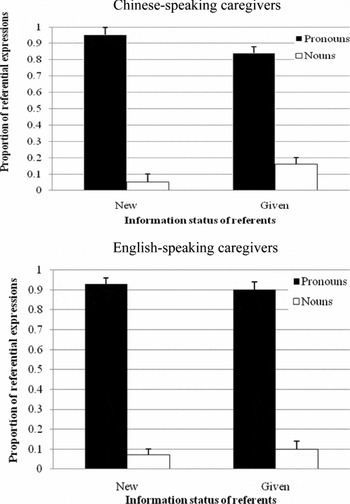
Both groups of the caregivers tended to produce pronouns or demonstrative pronouns than nouns when asking their children to identify referents. The Chinese-speaking caregivers used pronouns or demonstrative pronouns 94% of time (SD = 0.08). Likewise, the English-speaking caregivers use them 93% of time (SD = 0.06), t (16) = 0.52, ns. It is more important that the information status of referents (given vs. new) did not affect the choices of referential expressions. Figure 1 shows the proportion of pronouns and nouns for given and new referents in the Chinese-speaking and English-speaking caregivers. We conducted a repeated-measure analysis of variance (ANOVA) with the proportion of pronouns that the caregivers produced as the dependent variable and information status of referents (given vs. new) as a within-subject independent variable, and language (Chinese, English) as a between-subject independent variable. We found no effect of referential category, F (1, 16) = 0.003, ns, no effect of language, F (1, 16) = 0.72, ns, and no interaction, F (1, 16) = 0.10, ns. Because the caregivers intentionally asked their children to label the referents in the first place, it is not surprising they mainly used pronouns or demonstrative pronouns in their questions (e.g., Tell me what this is). There were only a few chances the caregivers explicitly indicated the referents in the form of nouns, for example, “What is this animal?” (“Zhe4ge dong1wu1 shi4 shen2me le?”).
The distribution of pronouns (black bars) and nouns (white bars) referring to new referents (left) and given referents (right) produced by the Chinese-speaking caregivers (top) and the English-speaking caregivers (bottom).

The goals of this study were to explore whether the caregivers’ gestures were sensitive to the discourse-pragmatic feature of information status and whether their children were responsive to the caregivers’ gestures. We first looked at the caregivers’ gestures, followed by the children's responses to those gestures.
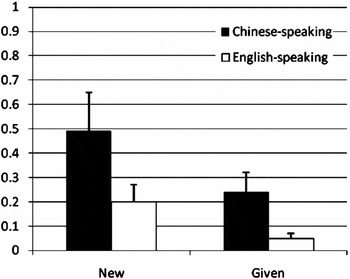
All the caregivers gestured when asking object-identifying questions. Both groups of the caregivers produced deictic and iconic gestures when identifying objects. However, deictic gestures were the most dominant type of gestures: 93% (SD = 0.07) of the gestures produced by the Chinese-speaking caregivers and 89% (SD = 0.05) of the gestures produced by the English-speaking caregivers. We then examined whether the caregivers’ gestures followed the discourse-pragmatic principle of information status. If so, the caregivers should produce more gestures when asking about the referents that were not previously mentioned than when asking about the referents that were previously mentioned. Our findings confirmed this hypothesis. Figure 2 displays the proportion of referential expressions for given and new referents that were accompanied by gestures in both groups of the caregivers. We conducted a repeated ANOVA with the proportion of expressions accompanied by gestures as the dependent variable, and the information status of referents (given vs. new) as a within-subject independent variable, and language (English, Chinese) as a between-subject independent variable. We found a significant effect of information status, F (1, 16) = 18.81, p = .001, a significant effect of language, F (1, 16) = 12.05, p = .04, and no interaction, F (1, 16) = .02, ns. Overall, the Chinese-speaking caregivers produced gestures more often than the English-speaking caregivers. Yet both groups of the caregivers produced gestures more often when asking about new referents than when asking about given referents, thus following the discourse-pragmatic principle of information status.
The proportion of referential expressions indicating given referents (right) and new referents (left) accompanied by gestures produced by the Chinese-speaking caregivers (black bars) and the English-speaking caregivers (white bars).

However, not all new referents were clearly specified in gestures by both groups of the caregivers. Around 50% and 80% of new referents were left unspecified in gestures in the Chinese-speaking and English-speaking caregivers, respectively. Then the final question we are going to address is whether the children were able to identify the referents, particularly those that were not mentioned before, in the absence of gestures.
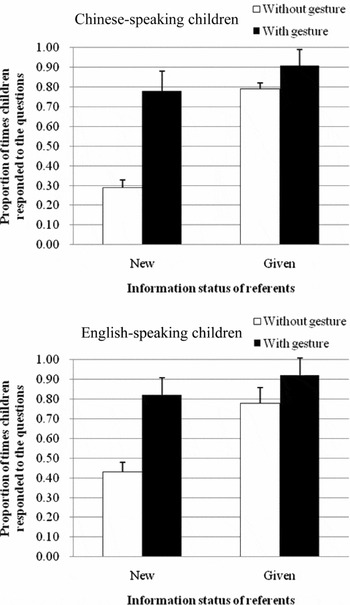
Figure 3 shows the proportion of time both groups of children identified referents. We conducted a repeated ANOVA with the proportion of time children identified referents as the dependent variable, the information status of referents (given vs. new) and gestures (presence vs. absence) as within-subject independent variables, and language (English, Chinese) as a between-subject independent variable. We found a significant effect of information status of referents, F (1, 16) = 10.65, p = .005, a significant effect of gesture, F (1, 16) = 67.59, p < .001, insignificant effect of language, F (1, 16) = 0.71, ns, a significant interaction between information status of referents and gesture, F (1, 16) = 15.85, p = .001, no interaction between information status of referents and language, F (1, 16) = 1.67, ns, and no interaction between gestures and language, F (1, 16) = .10, ns.
The proportion of times that the Chinese-speaking children (top) and English-speaking children (bottom) identified new referents (left) and given referents (right) when they were accompanied by gestures (black bars) and when they were not accompanied by gestures (white bars).

In general, both groups of the children were more able to identify given referents than new referents. The children tended to be more likely to identify given referents with gestures than given referents without gestures. However, the difference was not significant, Chinese speaking: t (9) = 1.89, ns, English speaking: t (7) = 0.18, ns. When asked about the new referents, children were more able to identify the referents that were accompanied by gestures than the referents that were not accompanied by any gestures, Chinese speaking: t (9) = 4.57, p = .001, English speaking: t (7) = 4.56, p = .003. Putting new and given referents together, both groups of children were equally able to identify new referents that were accompanied by gestures and given referents (with or without gestures). Paired sample t tests showed that the proportion of time children identified referents did not differ between new referents with gestures and given referents with or without gestures, Chinese speaking: new referents with gestures versus given referents with gestures, t (9) = 0.87, ns; new referents with gestures versus given referents without gestures, t (9) = 0.58, ns; English speaking: new referents with gestures versus given referents with gestures, t (7) = 1.75, ns; new referents with gestures versus given referents without gestures, t (9) = 2.26, ns.
To summarize, both the Chinese-speaking and English-speaking children were sensitive to their caregivers’ discourse-appropriate gestures. Specifically, they relied on those gestures to identify the new referents (but not the given referents).
DISCUSSION
Our study explored whether Chinese-speaking and English-speaking caregivers’ gestures displayed sensitivity to the discourse-pragmatic principle of information status of referents. We also examined whether children were responsive to their caregivers’ gestures when addressing the object-identifying questions. In terms of caregivers, we found that the Chinese-speaking caregivers asked their children to name the referents significantly more often than the English-speaking caregivers. Of more importance, the Chinese-speaking caregivers also produced significantly more gestures when asking those questions. However, both groups of the caregivers showed the same level of sensitivity to the information status of referents in their gestures. Specifically, they produced more gestures in their questions when asking about the new referents than when asking about the given referents. The findings also showed that the Chinese-speaking and English-speaking children were responsive to their caregivers’ gestures, particularly those accompanying the new referents. Both groups of children were more able to identify the new referents when these referents were accompanied by gestures than when they were not. However, they did not show such pattern when identifying the given referents.
Previous research has shown that Chinese-speaking caregivers always ask their children test questions about the referents like Zhe4ge4 shi4 shen2me? (What is this?; Tardif, Gelman & Xu, Reference Tardif, Gelman and Xu1999). They are also more likely to gesture the referent than the English-speaking caregivers (Goldin-Meadow & Saltzman, Reference Goldin-Meadow and Saltzman2000).Footnote 8 Our findings replicated previous research. The reason for cultural difference in gesture rate is unknown, but it is possible that Chinese-speaking and English-speaking caregivers socialize their children in different ways. Compared to the English-speaking caregivers, the Chinese-speaking caregivers might have greater interest to instruct their children. For example, one of the Chinese-speaking caregivers pointed to a bird on the book while saying “What is it?” and expected the child to label the object (bird) “on demand.” In addition, Chinese-speaking caregivers might have an explicit goal for what kinds of object names their children should have acquired. For example, another Chinese-speaking caregiver purposefully “tested” the object names her child had acquired in school. Compared to the Chinese-speaking caregivers, the English-speaking caregivers tested their children less often. Even when they asked their children to name a particular referent, they seldom pointed to it. It probably suggests that English-speaking caregivers treat their children as active learners who acquire knowledge through discovery, exploration, and play (Gardner, Reference Gardner1989).
Even though the Chinese-speaking caregivers were more likely to point to the target objects than the English-speaking caregivers, their gestures appeared to be as sensitive to the information status of referents as the English-speaking caregivers’. It shows that caregivers followed discourse-pragmatic principle of information status, despite of the cross-cultural differences in gesture frequency. Besides the information status of referents, caregivers might adjust their gestures based on other discourse-pragmatic features like contrast of referents (Clancy, Reference Clancy and Clark1993; Greenfield & Smith, Reference Greenfield and Smith1976). We expect that caregivers should produce more gestures when contrasting the target objects against the other objects than when referring to a single referent in a shared physical context. We did not investigate the feature of contrast in this study because almost all the time the caregivers were talking to their children about multiple objects. Further study should address this issue by controlling the number of objects in an experimental setting and look at whether caregivers would change their gesture behavior accordingly.
We also found that both groups of the children were responsive to their caregivers’ gestures and relied on these gestures to identify the new referents. Such finding has two theoretical implications. Gesture serves communicative purpose (Kendon, Reference Kendon2004). Previous research showed that gestures co-occurring with speech could help a listener to comprehend a message (Beattie & Shovelton, Reference Beattie and Shovelton1999a, Reference Beattie and Shovelton1999b; Driskell & Radtke, Reference Driskell and Radtke2003; Kelly & Church, Reference Kelly and Church1998). For example, when listening to a story, listeners decode the information of size and shape of objects, and direction and manner of movements in speakers’ gestures (Beattie & Shovelton, Reference Beattie and Shovelton1999a, Reference Beattie and Shovelton1999b, Reference Beattie and Shovelton2001). In addition, listeners can combine the information conveyed in speech and gestures to form an integrated message (Goldin-Meadow & Singer, Reference Goldin-Meadow and Singer2003; McNeill, Reference McNeill2005). For example, teachers combine the solutions of conservation and mathematical equivalence problems conveyed in children's speech and gestures (see review in Goldin-Meadow, Reference Goldin-Meadow2003). In the present study, we found that children picked up the semantic information from the gestures in order to identify the target objects.
After saying that gesture serves communicative purpose, the children were more attentive to the gestures when they were accompanying new referents than when they were accompanying given referents. The gestures accompanying given referents did not boost the likelihood the children responded to their caregivers. It is not surprising because the given referents were sufficiently informative for the children to identify them. Thus, the gestures did not provide further assistance to the children under this circumstance.Footnote 9 It highlights that the children were paying attention to gestures only when necessary, that is, when the referents were not mentioned before.
Our findings also have clinical implications. Some children, for example, aphasic children, might have difficulty in understanding speech. Given that gestures help normally developing children to comprehend speech, it should also help children with aphasia understand what is being said to them. In addition, previous studies have shown that children whose language development is impaired for a variety of reasons (focal brain injury, Down syndrome: Caselli et al., Reference Caselli, Vicari, Longobardi, Lami, Pizzoli and Stella1998; Sauer, Levine & Goldin-Meadow, 2009; Stefanini, Caselli, & Volterra, Reference Stefanini, Caselli and Volterra2007; Stefanini, Recchia, & Caselli, Reference Stefanini, Recchia and Caselli2008; specific language impairment: Evans, Alibali, & McNeill, Reference Evans, Alibali and McNeill2001; Fex & Mansson, Reference Fex and Mansson1998) use gestures to compensate for their communicative deficiencies. We would expect that those gestures do not only facilitate communication but also comprehension of speech among language-impaired children.
To summarize, we have found that caregivers use gesture to identify referents and do so in accordance with discourse-pragmatic principle. They gesture more often when indicating the new referents than when indicating the given referents. Moreover, their children are sensitive to the information status of referents and picking up information from the gestures to identify the new referents. Overall, gesture serves as a potential cue for both the caregivers and children to identify referents.
ACKNOWLEDGMENTS
This work was supported in part by NIH Grant R01 HD00491 (to S.G.-M.) and by National University of Singapore Provost Research Funding Grant R-581-000-074-133 (to W.C.). We are grateful to Susan Goldin-Meadow who generously shared the data. We also thank Wenping Xue, Stacy Steine, Zachary Mitchell, and Carolyn Mylander for help in collecting data in Nanjing and Chicago and Tee Can Shou Joseph, Lee Yingqi, Tan Wenlin, Elizabeth Sarah Ragen, Chew Xin Ying Ivane, and Kirrthana Krishnamoorthy for help in coding the data.