




No CrossRef data available.
The case for politeness: Pronoun variation in co-ordinate NPs in object position in English
Published online by Cambridge University Press: 25 November 2003
Abstract
The use of the nominative 1sg pronouns in co-ordinate NPs in object position, most famously between you and I, has received much attention from prescriptivists and formal linguists, but it has never been the object of a variationist study that compares its usage to that of other variants. This article seeks to fill the gap, based on a data set of co-ordinate NPs in object position, gathered through observation of everyday speech as well as in experimental sociolinguistic interviews. Arguing that the choice of NP case and of NP order is inseparably related, we identify three major patterns of co-ordinate NPs: Vernacular me and X and two post-Vernacular patterns, Standard X and me and Polite X and I. We then examine social and linguistic factors that constrain the usage of individual patterns. We conclude that all three patterns are robust and that they exist in stable ternary variation.This article, which we authored jointly, arose from a paper we presented with Cecilia Cutler and Keith Fernandes at NWAVE–XXVII in Athens, Georgia. Cece and Keith worked with us in gathering the data and participated in extensive discussion with us concerning the phenomenon under study. We are grateful to them. The NWAVE paper itself grew out of a project in a linguistic variation class at NYU. The other participants in the class project were Tiffany Dugan and Agnieszka Rakowicz, and we thank them for their help. We benefited from discussions with Arto Anttila, Jeff Parrott, and Sharon Klein and from audiences at NYU and Stanford. E. W. Gilman called our attention to several relevant articles, and Maryam Bakht-Rofheart, Erik Falkensteen, Bill Haddican, and Ken Lacy provided us with relevant examples from the media. We also thank Sandra Singler Harding, Tom Leu, Erez Levon, Pat Reilly, and Arnold Zwicky. The quotation from an Episcopal missionary appears courtesy of The Archives of the Episcopal Church USA. We thank Jennifer Peters, archivist, and her staff for their assistance.
Information
- Type
- Research Article
- Information
- Copyright
- © 2003 Cambridge University Press
INTRODUCTION
The use of nominative pronouns in co-ordinate NPs in object position is relatively common in contemporary American English. It shows up, for example, in the worlds of politicians (1) and magazine editors (2), in erudite prose (3) and newspapers (4), on television (5), and in daily speech (6).

Case-marked pronouns in co-ordinate NPs in object position do not actually occur frequently in ordinary speech, yet the use of the nominative pronoun here is salient to prescriptivists on both sides of the Atlantic and deeply abhorrent to them. As Honey (1995:4) reported:
When David Crystal studied over a hundred complaint letters to the BBC about linguistic usages in the first six months of 1981, he compiled a list of the twenty commonest points of complaint. Top of the list was usage of the type for you and I. In a similar survey five years later these again headed the top ten (Crystal, 1988:27).2
Milroy and Milroy (1991) identified the “complaint tradition” as a crucial component of standard language ideology. They noted that the identification of nonstandard usage as an indicator—and cause—of logical errors and social ills lies at the complaint tradition's heart.
For a prescriptivist, hearing the nominative where the object is ordained may be a sexual turnoff. In social psychologist Roger Brown's memoirs, in his discussion of the hiring of prostitutes from the Dream Boys escort service in Boston, he warned: “A client who cherishes his dream probably should never see any particular boy more than once. It is in conversations after the first that you get more boy and less dream…. Perhaps … the boy does drugs, fails to wash, worships Barbra Streisand, or says ‘you and I’ for ‘you and me’” (1996:77).
To Nicholson, the use of the nominative in such constructions is simply “illiterate” (quoted in Redfern, 1994:188). For Copperud, it is “inescapably a blunder” (1980:47).
This condemnation of nominative pronouns in co-ordinate NPs in object position intensifies when the offending phrase is between you and I. Thus, Bernstein wrote:
between you and i. Uncomprehending souls who have heard strictures about “It is me” tend to think of “me” as a naughty word, particularly when it is associated with “you,” which they mistake for a nominative case. Thinking they are leaning over backward to be correct, they somersault onto their faces and come up with between you and i (1965:322).
Similarly, Fowler's A Dictionary of Modern English has grown progressively harsher in repudiating it. As stated in the third edition: “The regrettable type between you and I must be condemned at once. Anyone who uses it now lives in a grammarless cavern in which no distinction is recognized between a grammatical object and a subject” (1996:373).
In keeping with the fundamentally conservative nature of prescriptivism, its advocates see the use of the nominative in this domain as a loathsome innovation. But is it an innovation? John Simon thought so in 1980. Outraged that Tennessee Williams said in a 1979 interview in Esquire, “the principal difference between he and I is stamina,” Simon wondered “why … should we, after centuries of between you and me, switch to between you and I?” (p. 18).3
Simon asserted that, by saying between he and I, Williams had “committed a grammatical error of unsurpassable grossness” (p. 18, italics in original). He continued: “To avoid adding to the already raging chaos in English usage and communication, we must urgently stop between you and I. Otherwise, it will lead us to every kind of deleterious misunderstanding” (p. 21).
I have been planning a piece on personal pronouns and the death of the accusative. Nobody says “I gave it to they,” but “me” is almost dead, and I have heard its dying screams from Bermuda to Columbus: “He gave it to Janey and I.” … Love to you and she from Helen and I. (June 25, 1956, quoted in Merriam-Webster's Dictionary of English Usage, 1994:517)
Obviously Thurber was using exaggeration to call attention to what he perceived as a growing trend in language use. If it was a “trend,” it was one that prescriptivists had already been lamenting for almost 200 years by the time Thurber made his comments. Leonard cited prescriptivists' disapproval of told my lord and I and between you and I from the 1760s (1962:52, 187).
The use of nominative pronouns in co-ordinate NPs in object position, then, is not the innovation that Simon proclaimed it. Nor have nominative pronouns entirely replaced objective pronouns as Thurber facetiously suggested. There is variation between nominative and objective pronouns in this environment, and, as noted in Merriam-Webster's Dictionary of English Usage, “The use of object forms where subject forms belong, and vice versa, has been going on for hundreds of years” (1994:778). Indeed, as Henry Sweet wrote in his 1891 New English Grammar: “In Early MnE the usage was more unsettled than it is now, the nominative being as freely substituted for the objective as vice-versa, as in such constructions as 'tween you and I” (p. 340). According to Hock and Joseph (1996), the early Modern English restriction on the use of nominative pronouns in object position was that they could not occur when “directly preceded by a verb or preposition” (p. 200). When the pronoun was not adjacent to the case assigner, the nominative was possible, as in Sweet's you and I example.
In any event, despite the continually reoccurring assertion that the use of the nominative in co-ordinate NPs in object position represents an innovation, there is ample evidence of the nominative's use in this environment across the past 400 years, as attested to by the catalogs of citations that various scholars have compiled, most notably Merriam-Webster's (1994), Redfern (1994, 1996), and Honey (1995). The second edition of Fowler's, while deploring the phenomenon as “false grammar,” acknowledged that it has “distinguished ancestry” (1965:258),4
The third edition of Fowler's asserted without elaboration that “pronouns were frequently used in earlier centuries in ways now regarded as ungrammatical. Grammatical assumptions were different then …” (1996:106).

This use of the nominative has continued not only in literary British English but in the spoken variety as well. In 1920 Wyld commented: “It is not uncommon at the present time to hear I used instead of me after a Verb or Preposition, as though the speaker wished to avoid the latter form” (1953:331). The use of the nominative was part of the King's English and then of the Queen's.

The same variation between nominative and objective shows up in American English, with both the variation itself and prescriptivist disapproval of the nominative variant going far back. Heath (1980) cited an 1829 handbook and an 1846 commencement address that criticize the use of the nominative in this environment. “H. L. Mencken remarked that Twain regularly used between you and I until William Dean Howells took him in hand” (Merriam-Webster, 1994:182). The nineteenth-century use of the nominative in co-ordinate NPs in object position shows up in the letter that future President Rutherford B. Hayes sent to his wife during the Civil War, cited in (9a), as well as in letters that American missionaries of the Episcopal Church sent back to New York from Liberia, one of which is cited in (9b).

Various attestations demonstrate that the nominative occurred in this environment across the twentieth century in American English and that it continues to be widely used.
The explanations put forward in the linguistic literature as to why the nominative shows up in co-ordinate NPs in object position together form a set of overlapping analyses, all of which rely implicitly on the fact that pronoun usage in co-ordinate NPs is far more common in subject position than in object position. The form used in subject position is then extended to other sites. Some analysts see the entire co-ordinate NP as fixed (e.g., you and I) and see it moving as an unanalyzed whole (Boyland, 2001; Honey, 1995:7; Sweet, 1891:340–341).6
We use “moving” in the sense of expanding the domain of occurrence, not in the sense of a syntactic movement operation.
Jespersen (1954:273) cited Sweet's and Fowler's analyses and observed: “But this reaction (‘hyper-correct’) does not explain everything.” He did not elaborate.
Prior to our discussion of formal analyses of case assignment of pronouns in co-ordinate NPs, it is appropriate for us to make a comment regarding grammaticality judgments. When we speak of constructions occurring frequently and when we present judgments that find nominative case forms in co-ordinate NPs in object position to be grammatical, we are aware that for many speakers such sentences are strictly ungrammatical. As a rule, any sentence that we present as grammatical is one that has been used by a native speaker of American English and that other users of the nominative in object co-ordinate NPs have designated as grammatical. We argue that there are some uses of nominative pronouns in object co-ordinate NPs that all—or virtually all—speakers would reject: for example, *told I and Kim. When we designate a sentence as ungrammatical, it is a sentence that no speaker whom we asked found acceptable and is of a type that we have not heard anyone use.8
We hold that it is possible and legitimate to distinguish between grammatical and ungrammatical uses of nominative pronouns in co-ordinate NPs in object position. Still, we acknowledge that the intensity of prescriptivist attention to pronoun choice here makes this an optimal site for profound insecurity, a situation that leads speakers to use constructions that virtually no one would consider grammatical. Thus, Arnold Zwicky (personal communication) reported hearing the following sentence on National Public Radio from a U.S. government official who was speaking in a measured, deliberate way: “This affects I and you.”
Turning to formal analyses, from Barriers (Chomsky, 1986) onward, the treatment of case has been held to be different for co-ordinate NPs than for simple NPs. (After Abney (1987), DP, determiner phrase, replaced NP in most Chomskyan analyses.) The occurrence of the nominative variant in co-ordinate phrases—not just in object position but also in subject position—has proven problematic for the Barriers framework.9
For Emonds (1986) and for Chomsky (quoted in an interview in Olson & Faigley, 1991), it is the presence of nominative pronouns in co-ordinate NPs in subject position that is the primary aberration. Emonds titled his article about such forms “Grammatically Deviant Prestige Constructions.” Chomsky, in saying of the “standard literary language” that “[m]uch of it is a violation of natural law,” illustrated his point with pronouns in co-ordinate NPs: “You don't have to teach people their native language because it grows in their minds, but if you want people to say, ‘He and I were here’ and not ‘Him and me were here,’ then you have to teach them because it's probably wrong” (in Olson & Faigley, 1991:30). As for the use of nominative pronouns in co-ordinate NPs in object position, Emonds attributed this to “overcorrection,” an extension of the “deviant” subject construction. (Emonds and, like him, Johannessen seemed to feel that labeling something “overcorrection” freed one from the obligation of having to provide a formal account of it.)
A point regarding several of the authors presented here is that they prove to be startlingly prescriptive in their own way. When Emonds termed the use of accusative pronouns in co-ordinate phrases “Normal Usage,” the selection of the nominative became abnormal. In making a plea for linguistic tolerance, he stated:
Given the state of our society today, with almost all social expenditures going for weapons and subsidies to the wealthy, it is almost impossible to imagine the funding of an appropriate and just linguistic policy. But in the absence of a political movement which could move to implement such a policy, more modest and yet politically interesting goals can be pursued individually and in small groups, with almost no expense at all:
(a) Elimination of all prestige usages that conform to no natural language dialect (e.g., prestige usage of English subject pronouns), both in personal speech and as much as possible in the public domain.)
(b) Instillation of at least an attitude of equal respect for all natural language usages …, whatever the class or ethnic group involved. (p. 125)
The use of nominative pronouns in coordinate phrases is to Emonds “deviant,” and the “instillation of at least an attitude of equal respect” does not extend to dialects that permit them.
Sobin (1994) saw UG-governed grammar as yielding the (standard) objective case form. When the nominative occurs in a co-ordinate NP in object position, it is because “an extra-grammatical agent … subverts the output of the grammar” (p. 52). He put forward what he called a Viral Theory of Grammatical Prestige (Lasnik & Sobin, 2000; Sobin, 1994, 1997). If standard English is in alignment with what Sobin saw as “natural,” his criticism cannot be of standard English and, by extension, its ideological proponents. Rather, by describing as a grammatical virus a feature of the speech of those who attempt but fail to acquire standard English, he made common cause with traditionalists. Linguistic arguments against the Viral Theory are presented in Schütze (2001) and, with specific reference to the case marking of pronouns, in Parrott (2001).
In a different direction, and quite at odds with everyone else, Johannessen (1998) stated that in Norwegian and English co-ordinate constructions containing nonstandard pronoun case (such as for both Steve and I) “are not universally accepted as good data; they are most often found in colloquial speech among not so upwardly mobile persons. They have, therefore, with a few exceptions, been regarded as marginal” (p. 2). Thus, Emonds cast aspersions on those who use nominative pronouns in co-ordinate NPs in subject position, and Emonds, Sobin, and Johannessen—for different reasons and in different ways—all cast aspersions on those who use nominative pronouns in co-ordinate NPs in object position.

As part of her analysis, Johannessen posited a default case. She departed from Barriers in also permitting case to be assigned from outside the CoP.10
Assigning nominative case to pronouns in a subject CoP is problematic for Barriers; it is not for Johannessen.
Johannessen stated: “It is unacceptable for both conjuncts in an object CoP to have nominative case” (p. 68n). Elsewhere, however, she acknowledged that object CoPs of the form he/she and I do occur in English, and she provided the following sentence in as an example: Joe wouldn't explain it to she and I (p. 63). Johannessen characterized the sentence as an “exception.”
Within the pertinent descriptive, formal, and prescriptive literature alike, most of the attention is devoted to 1sg pronouns (i.e., I/me). The emphasis on co-ordinate NPs in object position has been overwhelmingly on the nominative variant. Yet as Sobin (1994:57) pointed out and as far as we have been able to determine, every speaker who uses the nominative also uses the objective in this environment at least some of the time. In the present article, we set forth the environments in co-ordinate NPs in object position that do not permit the nominative pronoun. Then, in those instances where the objective and nominative pronouns are in variation, we seek to determine the factors, both linguistic and social, that favor particular variants.12
Our focus is on American English. It is in keeping with the long history within English of the use of nominative pronouns in co-ordinate NPs in object position that such constructions also obtain in the United Kingdom, Canada (Easson, 1998, 2000), South Africa (Fowler, 1996:373), Australia, Liberia, and undoubtedly other countries as well. Consider two Liberian examples from Monrovia:
(i) I didn't take any food to cook for he and myself to eat. (male high school graduate)
(ii) … when you like her ways, then tell her say, “Well, I want for you and I to marry.” (young man with a fourth grade education)
It is a surprising fact about the extensive literature on pronoun case in co-ordinate NPs in object position that authors pay little or no attention to the linguistic factors that affect pronoun selection. They simply focus on the mere existence of nominative pronouns in object position and then deplore it, seek to account for it formally, or both.
In the following section, we set forth the primary variants and the principles that underlie them. (Later we discuss reflexive forms and environments.) Although our quantitative focus will be strictly on 1sg variants and object position, it is necessary to consider 3sg variants and subject position as well in order to understand the patterning.
Order
English has competing orders for NPs in a co-ordinate phrase, what we term the Vernacular (11) and the Polite (12):

The first part of the order in (12) expresses “the rule of politeness which stipulates that 1st person pronouns should occur at the end of the coordinate construction” (Quirk et al., 1985:335)14
Although handbooks rarely make “the rule of politeness” explicit, their “good” and their “bad” examples of pronoun use in co-ordinate NPs conform to this rule. There are two handbooks that do make reference to it: Silverman et al. (1996) and Streicher, Kammer, and Mulligan (1996). The former stated: “Note: Put yourself last in a list” (p. 22). The latter, inaccurately confining its law to subject position, stated: “Politeness usually requires that the personal pronouns I and we be placed last in a compound subject” (p. 122). Simon, as part of his explanation for the “introduction” of between you and I into late twentieth-century American English, stated that “out of politeness (or, more probably, habituation—for if we still had politeness, we would also have grammar, which is one of its forms), we mention the other person first …” (p. 20).
Case
The principle in (13), in conjunction with the Vernacular order in (11), accounts for the vernacular treatment of co-ordinate NPs.15
The formulation in (13) is a language-specific statement of a broader principle (central to Barriers) that, when a barrier (here, the CoP) blocks case from being assigned, the default case fills in.

In American vernaculars, then, co-ordinate NPs containing 1sg pronouns, whether in subject or object position, have the form me and X. It is this pattern that children acquire first (cf. Johannessen, 1998:142).
Standard American English uses the Polite order of (12). In this variety, the choice of pronoun case is the same for a co-ordinate NP as it is for a single NP, as stated in (14).16
If one does not view the CoP as a barrier to case assignment, the identical treatment of single and co-ordinate NPs is not problematic. However, if one does assume a framework within the Barriers tradition, the formal expression of the statement in (14) becomes more complicated, and an analysis is required (like Johannessen's) that permits alternative sources of case assignment.

To the Vernacular and the Standard, we would add a third, which we term the Polite pattern. Like the Standard, the Polite pattern conforms to the Polite order. In terms of case marking in co-ordinate NPs in object position, this means that, in addition to Vernacular me and X and Standard X and me, there is also Polite X and I. As we have indicated, there is consensus in the literature (Boyland, 2001; Hock & Joseph, 1996; Pinker, 1995; Redfern, 1994) that the Polite is continually reinforced by children's overgeneralizing of adult correction of their use of the Vernacular in subject position. That is, (16a) is a double violation of the Standard, being both ungrammatical (because of pronoun case) and rude (because of NP order). Adults correcting (16a) expect children to replace it with (16b). The basis for the correction is blurred, resulting in children's hypothesis that Sasha and I is always to be preferred, not simply in subject position but everywhere (16c–d).

The distribution for 1sg pronouns in Vernacular, Standard, and Polite is given in (17):

The fourth logical possibility, *I and X, violates both the Polite order (12) and the principle of Vernacular case (13).17
*I and X cannot occur in object position and it shows up only rarely in subject position in speech, but it does show up in subject position in writing:
(i) I and a number of the committee members will be at the meeting to field your comments, concerns, criticisms, and suggestions.
(ii) In the course of studies of the speech community that began in the 1960s, I and my associates have interviewed many thousands of speakers in many English dialects and other languages (Labov, 2001:6).
Additionally, there is a fourth logical possibility in subject position, X and me. It does occur (as in (iii) from the Internet), but we leave in abeyance any discussion of its frequency and distribution.
(iii) My cousin and me are only 5 months apart in age and about the same size, actually she's a bit bigger.
A further point about the distribution in (17) is that, although me and X in subject position and X and I in object position are considered to be incorrect (or worse) in prescriptive accounts of standard English, me and X in object position is not. One of Silverman, Hughes, and Wienbroer's illustrations of their dictum to “put yourself last in a list” included a sequence of three co-ordinate NPs in object position (1996:22). Apart from that, the handbooks we examined aim strictly at the Vernacular subject and the Polite object; they leave the Vernacular object alone.
The case marking of 1sg pronouns in co-ordinate NPs in the Polite pattern is straightforward (i.e., X and I). In contrast, 3sg pronouns in the Polite pattern display greater variation. In one subpattern, 3sg pronouns cannot occur in the nominative case in co-ordinate NPs in object position; only 1sg pronouns can. This subpattern is illustrated by the sentences in (18).

The centrality of I in determining politeness—possibly because me is seen as stronger, more egotistical, and I as weaker, more self-effacing—has apparently led to the introduction of I into co-ordinate NPs in object position. However, in this subpattern, the incursion of nominative case into object position is strictly limited to 1sg pronouns.
A second subpattern for 3sg pronouns relative to the Polite does permit 3sg nominative pronouns in co-ordinate NPs in object position, but only in initial position (19).

It is possible that the introduction of the nominative into initial position in object NPs (something not permitted in Early Modern English, according to Hock & Joseph) came about precisely in instances like those in (19a–b). That is, when the other conjunct was the nominative pronoun I, the nominative case spread to the 3sg pronoun in initial position; the result was a co-ordinate NP that displayed identical case in its two conjuncts. Once she/he and I constructions in object position introduced the possibility of she/he in object position, the nominative variants use was extended to other NPs, not just ones where the other conjunct was I (19c–d).18
The procession from she/he and I to she/he and X (where X is something other than I) is carried still further in a sportcaster's extension (by analogy, presumably) from he and X in object position to the non-co-ordinate he along with X: High marks for he along with the rest of the Aggies.
Because of the positional restrictions on the use of nominative pronouns in object position, we posit the Politeness Template (20). Those speakers who use the Politeness pattern vary as to whether they permit the full template (e.g., she and I) or only permit nominative pronouns in last position (e.g., her and I).19
Speakers vary as to whether the Politeness Template holds for co-ordinate phrases only in object position (as we have framed it) or everywhere.

For those who use only the objective case in co-ordinate NPs in object position, the order of constituent NPs can be described as stylistic rather than syntactic, and one cannot really speak of an ungrammatical order for the conjuncts of a co-ordinate NP. However, as the Politeness Template shows, for those who use the nominative here, NP order is necessarily a part of syntax. For such speakers, violations of NP order produce ungrammatical utterances.
All of the occurrences of 3sg pronouns in the nominative in our data set conform to the Politeness Template. Still, although we have not heard it, other scholars have reported that X and he/she occurs.20
Co-ordinate NPs in object position of the form X and she/he exist in Shakespeare: “Yes, you have seen Cassio and she together” (Othello, IV, ii) and “There is a league between my good man and he” (Merry Wives of Windsor, III, ii). However, such examples are consistent with Hock and Joseph's characterization of the principles operating in Early Modern English, namely that the nominative variant is permitted as long as it is not adjacent to the case-assigning verb or preposition. As the examples in (19) demonstrate, adjacency is no longer a salient factor in determining where nominative pronouns can occur in co-ordinate NPs in object position.
In our Internet search for strings of the form X and he/she, we tried strings such as between John and he. There were several occurrences of the analogous string between he and John, but there were none of between John and he.

There were no attestations of *she and him or the like. Evidently, if the first pronoun in a pair is nominative, then the second one has to be as well.
This last subpattern, illustrated in (21), departs from the Politeness Template in its treatment of 3sg pronouns. However, because the third subpattern appears to occur so rarely (and because so many speakers who accept and use the other subpatterns find this one ungrammatical), we posit the general applicability of the Politeness Template—among users of the Polite pattern, that is. Whichever of the subpatterns a speaker uses when 3sg forms are involved, it is the case that, if a speaker uses the Polite pattern at all, the speaker uses it with 1sg forms (i.e., uses X and I in object position), as expressed in (22).

The Polite pattern in (22) ensures that I is selected; the Polite order in (12) ensures that I occurs in last position.
Thus far we have presented “patterns” to characterize the competing forms. In a sense, our patterns represent “poles” or “ideals” that, as we shall see, are sensitive to such sociolinguistic factors as context and speakers' sex, age, and educational level. We feel that there is clearly a case to be made for designating these patterns as either Vernacular, Standard, or Polite. At the same time, it is true that purely linguistic factors also bear upon speakers' choices. In the simplest evidence of this, no matter how Standard-leaning or Polite-leaning speakers may be, they sometimes use the Vernacular pattern. Co-ordinate NPs consisting of a pronoun and a heavy NP are a case in point. Grammatical weight is commonly identified as a factor influencing the order of constituents, with long, complex phrases being more likely to appear at the end of a clause (Wasow, 1997, 2002). In the same way, if the other NP of a co-ordinate NP is heavy, then the pronoun is likely to come first. Thus, both (23a) and (23b) are possible, but (23c) is what speakers usually say.

In sentences like those in (23), the referents' relationships to one another may play a role in determining NP order. In (23a–b), the order of references is “father, our child, mother,” with this the first mention of the child. In contrast, in (23c), the order is the more felicitous “father, mother, our child,” with the combined antecedents of “our” preceding it. Another pragmatic consideration in (23) is that the speaker likely views herself as the primary person whom Jonathan left. When there is a pragmatic focus on one of the constituents within the co-ordinate NP, it is likely to be on the first NP rather than the second. More generally, Osgood and Bock (1977:90) claimed that focused constituents “having a relatively high speaker motivation … will tend to … be earlier in the expression.”22
The Vernacular pattern can show up in highly formal prose, as the following example from the Roman Catholic bishop of Bridgeport, Connecticut, illustrates: “I am honored and privileged to be asked to serve,” Bishop [William E.] Lori said in a statement issued by the diocese. “The protection of children is of the utmost concern to me and my brother bishops…” (New York Times, May 4, 2002).
At times, as we discuss, the preference for the Polite pattern apparently arises from a syntactically motivated preference for the nominative rather than from any direct inclination to politeness. Overall, we use the word “Polite” to refer to speakers' preference for, and use of, the nominative form, whatever the motivation.
THE RELATION OF VERNACULAR TO POLITE TO STANDARD
If the opposition in pronoun selection were a simple binary one between Vernacular (me and X) and Standard (X and me), then the predictions as to the impact of social factors upon variation between the two would be straightforward. The putative distributional tendencies for such a binary division are given in (24).

That is, the Standard pattern is not a part of children's initial acquisition of English. It is learned later, if at all. In consonance with this view, we hold that younger speakers and speakers with a lesser amount of formal education are less likely to use the Standard form and, conversely, more likely to the use the Vernacular one. Similarly, there is an expected correlation between Standard and formality of setting as well as Standard and attention to speech (Labov's [1972] dimension of style). Though we do not consider it here, because writing requires attention to speech and is often more formal in its domain of use than is spoken language, writing favors the Standard whereas spoken language favors the Vernacular; the more formal the genre of writing, the greater the use of the Standard.
However, the opposition is neither binary nor uncomplicated. The existence of the third variant—the Polite pattern—makes the relationship between social factors and variant choice more complex. For the most part, the Polite pattern appears to be competing with the Standard pattern (i.e., X and I is competing more with X and me than with me and X). The competition reflects speaker uncertainty as to what prescriptive grammar holds to be “correct”: X and me or X and I.23
Anecdotal evidence that illustrates the confusion as to what is standard also shows up in an undergraduate's comment. In a class discussion of standard English in a course that is part of NYU's core curriculum, Singler asked if there were any rules of grammar that students had been taught in school that they elected not to observe. An undergraduate responded that, even though he had been taught that between you and I was correct, he routinely went ahead and said between you and me. Whether the comment arose from the student's grammar teacher's confusion or the student's own confusion (and faulty memory), it reflects a wider uncertainty about traditional correctness in this area of the grammar.
Presumably, the uncertainty about what is “correct” would be most intense in the middle of the educational cline. Those with comparatively less formal education would be expected to use the Vernacular most, if not all, of the time, whereas those with a greater amount of formal education would be more likely to recognize the prescriptively ordained Standard pattern. By extension, the same principle might hold with regard to age: that is, the oldest speakers would be the ones most likely to have acquired at some point in their lives the traditional prescriptive rules of case assignment. Taken together, these factors point to the following patterns. Everyone starts with the Vernacular, and some speakers use it exclusively. Among those who shift to other patterns, it is still the case that they continue to use the Vernacular in some syntactic environments. However, for those who acquire other patterns to use in alternation with the Vernacular, some pass through the Polite and arrive at the Standard later; others use the Polite but not the Standard; still others use the Standard but not the Polite. Members of the middle group—those old enough and/or schooled enough to use more than the Vernacular, yet not old enough and/or schooled enough to opt for the Standard over the Polite—are the primary users of the Polite pattern. It is these “in-between” speakers who seem most susceptible to “linguistic insecurity” (cf. Labov, 1982:351), and indeed Silverstein (1995:532) linked use of the Polite form directly to this notion and to speakers' class status, specifically predicting that those with “lower-to-mid middle class” status are the most frequent users of the “hypercorrect” Polite form (contra Johannessen, cf. Note 9).
QUANTITATIVE STUDY
In what follows, we present a quantitative study of case selection for 1sg pronouns in co-ordinate NPs in object position. To assess the competing forces in the selection of pronoun choice, we draw upon goldvarb, a statistical program of the varbrul family, developed by Rand and Sankoff (1990). The fundamental question is: Under what circumstances does a given pattern—Vernacular, Polite, or Standard—show up and why? While we approached this study with a set of hypotheses, we hold that, inasmuch as a quantitative study of this environment has not previously been undertaken, the simple reporting of our data provides the basis for future comparative studies.
In order to test the factors that favored individual patterns, we compiled a data set of tokens involving 1sg pronouns in co-ordinate NPs in object position. We excluded those tokens where the pronoun had a subject antecedent, on the grounds that such an environment favors the reflexive form, myself.24
The presence of a subject antecedent frequently prompts the use of the reflexive pronoun, but this is not absolute, as the following examples attest (see Reinhardt & Reuland, 1993).
(i) Could I possibly make two copies for me and Bill.
(ii) I was just paying for Maika and I.
In a limited number of cases, a fourth option is also possible, one that Quirk et al. called the independent genitive pronoun (1985:326): that is, a form like mine. The variation can be illustrated by a pair of sentences that were uttered roughly thirty seconds apart in a quasi-formal setting by a woman in her early fifties as she introduced another woman first to her nephew and then to her niece: This is Sally Jo Marchese, a sorority sister of your mother and I…. This is Sally Jo Marchese, a sorority sister of your mom and mine. The possessive option was only available in a tiny fraction of all the cases in our data set and was rarely used even in those cases where it could have been. Consequently, we have not considered it in our study.

Implicit in our discussion of patterns and of templates is the assumption that the choice of pronoun case and the choice of NP order work together. A speaker's decisions about case and NP order are not independent of each other. For that reason, we consider pronoun choice to be a five-way choice, one sensitive to order and case simultaneously rather than sequentially. This assumption seems especially well-motivated for “chunks”: that is, NP and NP sequences whose form in subject position is extended to object position. In what follows, we discuss the five-way distinction in (26) for 1sg pronouns.26
Although most co-ordinate NPs consist of two constituents, the patterns set forth account for most instances of multiple NPs as well. For multiple NPs, the Vernacular pattern still has the form me + … X, the Standard pattern is X … + me, and the Polite pattern is X … + I. Sometimes, however, there are pragmatic or prosodic reasons to place the pronoun in the middle of a string rather than at the end:
(i) It's up to you and me and everybody in the audience.
(ii) J.J. was supposed to write a special letter for Beverlee Smith, myself, and two others with diplomatic experience.
A site in the middle of a string of multiple NPs behaves like an end-site if it is immediately preceded by a conjunction. If it is not immediately preceded by a conjunction, it behaves like a beginning-site. The crucial difference between an end-site and a beginning-site is that I is only possible in an end-site. Thus, (iii) would be grammatical, but (iv) would not.
(iii) It's up to you and I and everybody in the audience.
(iv) *It's up to you, I, and everybody in the audience.
In our study's data, most of the n-nary tokens involved instances where the pronoun was placed first or last. In instances where the pronoun's antecedent was not the subject of its clause and where the pronoun was in a string of n-nary NPs but neither in first nor last position, we grouped the token with end-site tokens if the pronoun was preceded by a conjunction and with the beginning-site tokens if it was not.

The data set
As we mentioned before, pronoun choice in co-ordinate NPs in object position may be highly salient, but the actual occurrence of 1sg and 3sg pronouns in this environment is quite infrequent in spoken language. Thus, the sociolinguistic interview, the basic unit of quantitative research in a Labovian paradigm, simply yields too few instances of co-ordinate NPs in object position to be an adequate source of data.27
Data from Vernacular Liberian English serve to illustrate the point that 1sg pronouns in co-ordinate NPs in object position simply do not show up that often in sociolinguistic interviews. In interviews carried out by Singler and his research associates in the 1980s in Liberian coastal cities, 42 hours of recording yielded 42 occurrences of case-marked pronouns in co-ordinate NPs in object position (i.e., one token per hour).
Strictly speaking, Rufus contains an ambisyllabic consonant (i.e.,

). Our speakers were not linguists, and none of them objected on phonological grounds to our considering

to be a hlonipha violation of Rufus.
Our second strategy consisted simply of listening for occurrences of case-marked pronouns in co-ordinate NPs in object position in everyday speech. We did so by listening for this environment in conversations in which we participated, at the meetings at which we were in attendance, and as auditors of nonscripted radio and television programs. (Most of the radio/television tokens were from television; they are all referred to subsequently as “television” tokens.) Accumulation of data in this way has been used in Rickford, Wasow, Mendoza-Denton, and Espinoza's (1995) study of as far as constructions. With pronoun choice, there is the danger that our data set is distorted. Because nominative variants were more salient to us than the other options, it is the nominative variants that we were more likely to notice when they occurred in speech. We have tried to pay attention to all occurrences of pronouns in co-ordinate NPs in object position, but we acknowledge the likelihood that there was some inflation of the occurrence of the nominative. Most of the heard tokens, whether from day-to-day interaction or from unscripted television, were noted by one of us (Singler). He believes that he did develop an attention to the full range of possibilities, but there were other concerns as well. Although tokens were only counted if their speaker was a native speaker of American English, the people with whom a senior academic routinely interacts may not have been especially representative of American English speakers more generally.29
A “native” speaker of American English is considered to be someone whose acquisition of the variety began at age ten or earlier.
Pragmatically, not every occurrence of a token lent itself to being noted or notated. For Singler's data, productive settings were ones where Singler was as much an observer as a participant (e.g., meetings of department chairs, either among themselves or with a dean). Although such meetings tended to be relatively informal, the “vernacular” in use was that of academics in highly structured, highly hierarchical settings. This fact could only serve to heighten the problem of the data's potential unrepresentativeness.
With regard to unscripted television, “trash” television, with its focus on interpersonal relationships and its penchant for love triangles, seemed an especially likely source for tokens. Accordingly, we augmented the data set by paying graduate students to watch programs hosted by Jerry Springer, Jenny Jones, Ricki Lake, Maury Povich, and Montel Williams. (The total amount of “trash” television that we paid students to watch amounted to fewer than 25 hours.)
Given that pronoun choice in co-ordinate NPs is a contested area of the grammar and given the opprobrium heaped upon Polite pattern users by prescriptivists (and given the general infrequency of the occurrence of the environment), it could be that some speakers try to avoid the construction. In discussing a change in 3rd person subject–verb concord in Brazilian Portuguese, Naro showed that, when environments involve highly contested forms, younger speakers may devise strategies that enable them to skirt the disputed environment altogether (1981:75n). That is, they find ways not to have to choose at all. Similarly, some speakers may work to avoid having to choose among pronoun forms in co-ordinate NPs in object position whereas others may not, with the “avoiders” possibly clustering in a certain range of, say, education.
THE RESULTS
In all, we accumulated 617 1sg tokens. Of these, 549 were pronouns whose antecedent was not the subject of the clause in which they occurred. These pronouns, the ones without subject antecedents, formed the basis of our analysis. The distribution within the data set revealed a robust three-way split, with the frequencies of the three primary patterns ranging from 25% to 35%. Our inquiry focused on variation and the factors that favor particular 1sg variants. However, when the other NP in the conjoined phrase is she/he (as in the sentences in (19a–b)), then the 1sg pronoun cannot be me (i.e., *she/he and me). In our data, there were 19 she/he and 1sg tokens, all of them she/he and I. (Although she/he and myself is possible, it did not occur in the data set.) Because variation is constrained when the token is she/he and 1, we removed these tokens from the calculations that follow. Table 1 presents the results before and after these tokens' removal. (We return later to the social attributes of the she/he and I users in our data set.)
Pronoun and word order choice for 1sg pronouns in co-ordinate NPs in object position when the subject is not the pronoun's antecedent; includes frequencies for 1sg pronouns when the other NP is he/she

In addition to the Vernacular, Polite, and Standard tokens, 10% of the tokens (54/530) were untriggered reflexives. We did include such tokens in our goldvarb analyses, although we do not analyze them in the present article; for a discussion of this topic, we refer the reader to Angermeyer and Singler (2002).
As we stated earlier, it is likely that the Polite pattern was overreported in our heard data because we were most attuned to hear it, especially when we first collected spontaneous data. The “heard” tokens from everyday speech and television were not tape-recorded, but the hlonipha experiments were. As the frequencies in Table 2 demonstrate, the frequency of the Polite pattern in the hlonipha data was higher than in the tokens from “heard” everyday speech and television. This raises the possibility that our noting of tokens was not so distorted as we initially feared. On the other hand, it remains the case that a disproportionate number of speakers who provided the spoken tokens in the present data set had a far greater amount of formal education than speakers of American English more generally. Still, while we acknowledge these concerns, we feel that there is no evidence that these factors have caused a skew with respect to the linguistic and social factors that constrain variation among the three patterns.
Frequencies for the data set

In Table 2 we present a detailed breakdown of all frequencies (with the she/he and I tokens removed). We carried out parallel goldvarb runs for each of the three patterns. Table 3 lists factor groups for each pattern's run in decreasing order of statistical significance, and Table 4 lists the probabilities for each statistically significant factor group in a given run. The threshold for statistical significance was .05; in Table 4 we also list in brackets probabilities for a factor group whose value for p approached statistical significance without attaining it: specifically, a group for which p was greater than .05, but less than .10.30
For each of the patterns, we included case assignment, distinguishing between those tokens for which a verb assigned case and those for which a preposition assigned case. (We use the term “case assignment” to refer to the pre-Barriers case assigners: i.e., verbs and prepositions.) Quattlebaum (1994) elicited grammaticality judgments for formal standard English from 46 ninth-grade students prior to instruction on pronoun use in co-ordinate NPs. She found that students were more likely to select the nominative (NP and I) as being prescriptively correct after a verb than after a preposition. For our data, the distinction between verb and preposition as case licenser never reached statistical significance, though the distinction did approach it for the Polite pattern. However, it is case-licensing prepositions that favor the Polite, not verbs. Thus, our results provided no support for Quattlebaum's findings.
We evaluated social and linguistic factor groups together. We did so because, in a few cases, tokens from social categories exhibit a disproportionately high share of particular linguistic factors. For example, one of the social factor groups is the source. For television tokens the category is divided according to the speaker's role on television. One factor in the group consisted of celebrities, a combination of talk-show guests and politicians. The TV celebrities use the Vernacular pattern 29% (8/28) of the time, a rate just slightly below the overall Vernacular rate in the data set of 31%. However, of their 8 tokens, 7 occurred with the preposition between. For the entire data set, between takes the Vernacular at an extremely high rate: 49% (41/84). When a goldvarb run was carried out for social factor groups only, TV celebrities favored the Vernacular, with a probability of .525. However, when linguistic factor groups were included with the social factor groups, goldvarb took into account the celebrities' high number of tokens with between. In the run with linguistic and social factor groups combined, celebrities strongly disfavored the use of the Vernacular, with a probability of .268. It is our contention that this strongly disfavoring value (.268) better reflects the extent to which celebrities use the Vernacular pattern.
Statistically significant factor groups, in decreasing order of statistical significance

Statistically significant factor groups

SOCIAL FACTORS AND PRONOUN CHOICE
The social factors we considered included speaker's level of education, age, and sex, as well as the source of the token; “source” designated the various subsets that comprised the data set as a whole. We begin with a discussion of those factors that extend across the entire data set: speaker's educational level, age, and sex. We then consider selected subsets (sources) and their bearing on larger questions of patterning.
Speaker's education, age, and sex
Because of an extensive overlap between age and education, the two factor groups could not be used simultaneously in a goldvarb run. Education proved to be the more important of the two factors in determining pronoun pattern, so we used it and excluded age. At the same time, because there were cases where age and education did not overlap, it was possible to tease apart the correlation of each with pattern choice. A summary of the effects of education and age is given in (27).

These three statements do not specify the levels of education that form the cutoff points between patterns. In fact, as the frequencies for speaker's highest education in Table 2 shows, these levels were surprisingly high. In our data, only when speakers had attended college did the powerful push towards the Vernacular pattern recede, giving way to an equally powerful push towards the Polite. At the other end of the cline, the dominance of the Standard pattern only emerged among speakers with a doctorate.
The first statement points to a divide between Vernacular and post-Vernacular (Polite and Standard) patterns. It is only with college and post-adolescence that the post-Vernacular patterns come to be used, and the post-Vernacular pattern that shows up first to the greatest extent is the Polite. Indeed, the data reveal that speakers under 25 simply did not use the Standard pattern—of 63 tokens, only 3 were Standard (4.8%). We know from work on Internet data (Angermeyer, Cutler, Fernandes, & Singler, 1998) that the Standard pattern is part of young speakers' written language, but it is not something that young speakers say.33
Three of the tokens came from speakers aged 15 and under. At the other end of the age range, although there were a few speakers in their 80s, most of the speakers fell within the 55 to 64 range.)
The link between college education and the Polite pattern in our data set parallels the findings of Al-Banyan and Preston (1998). In a survey administered to over 4,000 university students in Michigan, they found that only 21% objected to the use of the nominative in The award was given to Bill and I, 31% found the construction acceptable in all situations, and 28% judged it as appropriate for formal speech situations (cited in Preston, 2002:144).
In light of the prescriptive pressure placed on speakers with regard to their choice of case in this environment, it is not surprising that self-correction should occur, as in the examples in (28).34
Additionally, we have one case of self-correction involving a 3sg pronoun in first position: “Somebody in the group wanted me to participate in a rededication ceremony between him and, he and his wife.” The speaker was a 30-year-old Ph.D. student. With regard to the sentences in (28), we note that some of the examples involve subject antecedents; inasmuch as the speakers' corrections involve shifts between nominative and objective forms, we do not think that the subject antecedents are relevant.

Although these are only four instances, the speaker's age appears to be germane. In the examples in (28), it was the youngest speakers who shifted from the Vernacular and the oldest speaker who shifted to the Standard.
Speaker's sex proved to be statistically significant for the Vernacular and Standard patterns: female speakers favored the Vernacular and male speakers the Standard. We do not have an explanation for this distribution. Our method of data gathering (from television, the hlonipha experiment, and heard speech in daily life) precluded more sophisticated attention to speaker's sex or gender and to appropriate models for studying its construction. Thus, although we were mindful of the limitations and problems raised by a strict differentiation on the basis of sex (see Eckert & McConnell-Ginet, 1992; James, 1996), we lacked the apparatus for a more nuanced study. Critically, we lacked extensive natural data from any one person or social group. In sum, while our results point clearly to a strong sex-based difference in pattern choice, we do not have the information necessary to account for it.
Nonetheless, a breakdown by sex and age together reveals age-based differences between female and male speakers. We hypothesized that speaker's age would matter, predicting that younger speakers would strongly favor the Vernacular, but we had no a priori sense of the specific age at which differences in linguistic behavior would be likely to manifest themselves. The frequencies that showed up pointed us to a three-way division (24 and under, 25–44, and 45 and over). Thus, it was our results rather than any hypothesis that prompted us to make a three-way division with the cutoff points we used.
To measure the differences between female and male speakers, we carried out separate runs for the female and male factors by age; those results are presented in Table 5.36
The frequencies for females and males by age are given here:

Because reflexive pronouns have not been included in the table, rows do not add up to 100%. For each goldvarb sex–age run, we used the full data set, altering only the sex–age factor group, so that the three women's age group factors were removed during the men's run and vice versa.
Probabilities for speaker's age in separate runs by speaker's sex

In setting forth correlations between particular pronoun patterns and social factors, especially education and age, we invite the question as to whether these correlations reflect age grading or change in progress. We see the shift from the Vernacular to post-Vernacular patterns as a stable, ongoing age- and education-related phenomenon. As a group, post-adolescent speakers—provided they have at least some education at the university level—acquire at least one post-Vernacular pattern. The second, more vexing question involves the competition between the Polite and the Standard. Is there a change in progress, or do the results in Tables 4 and 5 point to a second example of age- and education-grading?
Token source
We compiled our data set from tokens we heard in daily life, those we heard on radio or television, and those we obtained via the hlonipha experiment. The results in Table 4, crucially those for source, entail all of these types of data considered at once. In the discussion that follows, we focus on two populations, each of which showed a strong predilection for a single pattern; we then consider the range of television data.
Strong preferences
One type of television data consisted of tokens drawn from “trash” television. “Trash” programming displayed a powerful tendency towards use of the Vernacular pattern: 35 of the 42 “trash” tokens displayed it.37
This discussion of “trash” television refers strictly to first person pronouns in clauses where the subject is not the pronoun's antecedent. In addition, there are five “trash” tokens for which the subject is the pronoun's antecedent: I need to take care of me and my daughter first (woman, c. 27, Jenny Jones). In all five cases the speaker uses me and X.

“Guests” on trash television tend to present themselves as having had little formal education. As such, they would be expected to favor the Vernacular pattern regardless of the circumstances. We use the term “guests” cautiously because we are aware that on at least some of these shows (notably the Jerry Springer Show) they may be actors paid for their appearance. In terms of social class and education, that means that they could be middle-class individuals with tertiary education who are trying to approximate the speech of working-class people with a high school diploma or less. Whether the “guests” are who they say they are or not, all of them know that they are not expected to be polite. They are involved in highly emotional and personal situations, and the setting encourages them to be assertive, even combative. All of these factors combine to make “trash” television an environment where there is virtually no pronoun variation. Whether it is because the Vernacular pattern is their usual pronoun paradigm, or because “me first” is the apposite anti-politeness strategy, or for both of these reasons, individuals on “trash” television shows use me and X.
Another group at variance with the rest of the speakers were the participants in the hlonipha exercise. Keith Fernandes, one of the co-authors of Angermeyer et al. (1998), administered the hlonipha experiment to five people whom he knew socially, all of whom worked at the same advertising agency. These speakers displayed an overwhelming preference for the Polite pattern; in this, as the frequencies in Table 6 show, they patterned differently from other hlonipha subjects and indeed from every other group within the spoken data set.
Frequency of Polite pattern by token source

In fact, the difference between the ad agency speakers and everyone else was greater even than the numbers in Table 6 would indicate. To demonstrate this, let us consider the 3sg + 1sg tokens. In all, there were 50 such tokens in the entire spoken data set. Four-fifths of these showed up either in hlonipha or in “trash” television, suggesting that these environments particularly favored narratives and hence the extensive use of pronouns to refer to individuals other than the speaker. As we noted earlier, she/he and I is invariant (since *she/he and me is ungrammatical), and we removed such tokens from the data set for our goldvarb runs. The ad agency speakers had 7 tokens of 3sg + 1sg tokens (1 him and I and 6 she/he and I). When she/he and I tokens were added, the distribution by source type became that found in Table 7. Of 22 tokens from the ad agency speakers, 18 were Polite, 1 was Vernacular, and 3 were X and myself, where X is a lexical NP. The Standard pattern accounted for no tokens whatever. Thus, for the ad agency speakers, apart from the occasional untriggered reflexive (and a stray Vernacular token from the youngest of them), only the Polite pattern obtained.
Frequency of Polite pattern by token source, with she/he and I included

The five ad agency speakers were all college graduates: four women aged 23, 25, 29, and 36, and one man aged 33. One would want to know what their pronoun selection would be in everyday speech as opposed to a language experiment (even one conducted in the informal setting of a party, as was the case with their hlonipha); the most likely result would be greater use of the Vernacular, but not greater use of the Standard. Even allowing for their likely greater use of the Vernacular in everyday speech, the results from the ad agency raise challenging questions. To what extent is the Polite pattern a part of ad agency culture? Is it peculiar to this one agency or to Madison Avenue in general? As Labov stated, “It appears that a person's own occupation is more closely correlated with his linguistic behavior—for those working actively—than any other single social characteristic” (1972:45). While Milroy (1987) argued that social networks are strongest in the working class, she viewed the workplace as central to determining network strength. One would expect a working-class network to promote the vernacular. On the other hand, in a situation where workmates do socialize, one could adapt Labov's and Milroy's statements and posit that a middle-class workplace such as an ad agency is capable of producing a social network that acts as a “norm enforcement mechanism,” but with nonvernacular linguistic norms.
Television tokens
For the television data, only tokens that were spoken extemporaneously rather than read from a script were counted. We grouped speakers according to the significance of speaking on television to their occupation: that is, was speaking on television (a) one's job, (b) a secondary component of it (appearing in public was central), or (c) not a part of it at all? The first group, “announcers,” included newscasters, weather forecasters, sportscasters, and hosts of talk shows and “trash” shows. The second, “celebrities,” consisted of talk show guests, most often actors or musicians, and politicians.38
For politicians, we counted formal campaign debates (i), in-studio interviews (ii), and sound bites (iii).
(i) The differences between me and my opponent could not be clearer. (Senator Hillary Rodham Clinton, in a 2000 debate)
(ii) Let's lock him and I in a room together. (Minnesota governor Jesse Ventura, being interviewed on the Today show)
(iii) Certainly there won't be any friction that you will see between the Governor and I. (New York City mayor Michael Bloomberg)
LINGUISTIC FACTORS AND PRONOUN CHOICE
In the preceding sections, we have shown that variation between coordination patterns is in part determined by social factors. However, as the invariant environment she/he + 1sg demonstrates, pattern choice is also constrained by linguistic factors. In the following section, we discuss the linguistic factor groups that have an impact upon selection of the Vernacular, Polite, and Standard patterns.
The other NP
The “other NP” group displayed the greatest statistical significance of any linguistic factor group for all three patterns (see Table 3). This factor group included both pronouns and lexical NPs. If the token's other NP was a pronoun, we coded it for the pronoun's case. If its other NP was lexical, we coded it according to its number of syllables, its syntactic composition, and its semantic number. For lexical “other” NPs, we set up the following factors:

An insufficiency of tokens caused us to merge possessive and “other” NP among the plural referent NPs.39
Our data included one token of me and them, which we grouped with those tokens that had a “plural” lexical NP as the other NP, not with those that have an accusative pronoun.
We hypothesized that speakers would choose the Vernacular pattern when the co-ordinate phrase consists of a 1sg pronoun and a heavy NP (e.g., me and the guy who worked for the newspaper). This claim was supported by the goldvarb results: long lexical NPs strongly favored the use of the Vernacular pattern and disfavored the use of the Polite or Standard patterns. Many accounts in the syntactic literature ascribe heavy NP shift and related phenomena to the improved parsing it achieves (e.g., Hawkins, 1994). In contrast, Wasow (2002:49) argued that it is the benefit to the speaker, not the listener, that drives such processes: “shifting facilitates utterance planning.” We would suggest that similar logic motivates the order 1sg + NP when the NP is heavy.
Under the heading of plural nouns, we included not only overtly plural nouns (e.g., the kids), but also singular nouns that refer to a group of people (e.g., my family). Our explanation of the strength with which the plural favors the Vernacular is necessarily tentative, but we would suggest it has to do with NP order and the fact that the Vernacular is the only one of the major patterns in which the 1sg pronoun comes first.40
Note 17 presents examples of the infrequent I and X construction in subject position. In those examples and in all the I and X subject instances that we have seen, the other NP has been plural.

In contrast to long NPs and plural ones, which show a powerful preference for the Vernacular pattern, the pronoun you strongly disfavors use of this pattern. As shown in Table 4, we divided tokens where you was the other NP into two groups, depending on whether the pronoun is part of the expression between you and 1sg when it has the meaning of “confidentially.” Of all the occurrences of nominative pronouns in the environment under study, nothing has roused prescriptivists' wrath so reliably as between you and I. In fact, the speakers in our data set used between you and me most of the time (87% of all tokens); between you and I occurred in a confidential context only infrequently (13%) and between me and you not at all.41
We include in our discussion of confidential between you and me three instances where, strictly speaking, me has a subject antecedent.
(i) Also between you and me, I had a long talk in the fall with Juan Corradi.
We hold that between you and me is a fixed phrase, a chunk. Consider the difference in meaning between (ii) and (iii):
(ii) Between you and myself, I can tell you who won.
(iii) Between you and me, I can tell you who won.
For most speakers, the PP in (ii) is literal (i.e., “of the two of us”), whereas the PP in (iii) is more likely confidential than literal. These facts argue that the subject antecedent has no bearing on pronoun selection in the PPs in sentences like (i) and (iii): that is, when the PP is confidential.
Similar, though not categorical, results obtained for you when it was not part of the “confidentially” phrase; the Standard was favored strongly and the Vernacular disfavored strongly. In (12), we introduced the Polite order. In this article we have largely focused on the first of the two statements in (12). In fact, our data show that this statement is frequently violated; indeed it is violated every time the Vernacular pattern is employed with a 1sg pronoun. Perhaps surprisingly, the second statement proves to be quite robust. When the other NP was something other than you, a 1sg pronoun occurred initially 36% of the time (174/474). When it was you other than “confidentially,” the 1sg pronoun occurred initially only 15% of the time (5/33). In sum, the results suggest that, although violating the first part of the Polite order occurs quite frequently, violating both parts of it at the same time is much less common.42
The second element of the Polite order (“Place the 2nd person first”) implies that you and him is preferable to him and you. This would likely seem to be the case, but our data are insufficient to test this prediction. Our 3sg data set contains only four relevant tokens (all of them, however, you and him/her).
The question arises as to why you is so successful in maintaining the initial position. Implicit in the CoP structure posited by Johannessen and presented in (10) is the asymmetrical relationship of the two NPs in a CoP. Parker, Riley, and Meyer (1988:225) described the first position in a co-ordinate NP as syntactically more prominent. The prominence of the first NP is also implied in the rationale behind the Polite order, which judges a structure as impolite if it gives more prominence to the speaker than to other referents. The status of the “slighted” referent when the Vernacular is used is therefore likely to affect the degree of impoliteness. We may expect speakers to adhere to the Polite order more strongly if the other NP refers to the interlocutor or to a co-present third person but less strongly if it refers to a group of people who are absent or to an inanimate object incapable of being offended by the speaker's impoliteness.43
Seven tokens in our data set have an inanimate object as their other NP, and all take the Vernacular. These results raise the question as to whether variation is possible at all when one conjunct is a 1sg pronoun and the other is an inanimate NP; consider the uncertain grammatical status of the variants in (ii).
(i) There's no room between me and the door.
There's no room between the door and me/I.
In the ordering of constituents in co-ordinate NPs, we observe a hierarchy of syntactic prominence (2sg ≥ 1sg ≥ 3sg ≥ pl ≥ inanimate), which corresponds to the markedness hierarchy first discussed by Silverstein (1976). This hierarchy and others (e.g., Kuno's (1976) Empathy Hierarchy) apply primarily to semantic roles, but they may be generalized to imply a syntactic prominence of high-ranked referents (see Dixon 1994:88n), thus making them relevant to NP ordering in co-ordinate NPs as well. The primacy of first and second person (often jointly referred to as “local person”) over the other categories is generally uncontested. However, their ranking relative to each other varies cross-linguistically (Aissen, 1999:681n; DeLancey, 1981:643). Silverstein (1976:118) observed that hierarchization is driven by both “presupposing and performative forces,” with the former giving precedence to the speaker and the latter to the hearer. He predicted a ranking of 2sg > 1sg for languages that have “polite second person” forms and 1sg > 2sg for those that do not. Although English does not have a T/V-distinction (cf. Brown and Gilman 1960), it clearly has a tradition of calling attention to politeness in co-ordinate NPs.
Adherence to the Polite Order helps to explain the rejection of the Vernacular pattern in favor of 2sg + 1sg, but it makes no prediction for the choice between Standard and Polite. It seems possible that the outspoken rejection of between you and I by prescriptivists has encountered some success, as suggested already by Mencken (1921:299). The near-invariance of “confidentially” between you and me suggests that this form has become a chunk, a “conventionalized collocation” (Wasow, 1997:96). As such, it contributes to the predominance of the Standard pattern for 2sg + 1sg more generally, and a chunk-like character may hold for you and me as well, as this pattern of coordination is relatively frequent.44
In our data, you and me is the most frequent co-ordinate NP with 36 occurrences, followed by you and I (20), my brother and I (14), me and him (13), and he and I (11). Our data both lend support to Boyland's claim that you and I plays a prominent role in the extension of nominative usage from subject to object (2001:393) and corroborate her finding that you and me is the most frequent co-ordinate NP in object position.
Indeed, the frequency of a specific co-ordinate NP, irrespective of its syntactic position, seems to play a crucial role in deciding between the Standard and Polite patterns. Boyland (2001:402) argued that those co-ordinate NPs (you and I) that occur frequently in subject position may come to be represented as “pre-analyzed syntactic units … available to be recruited for new, hypercorrect contexts.”45
While we agree with Boyland's argument, we note that she based her frequency analysis on a very small set of written data sampled from usenet newsgroups. Her data contained only nine cases of nominative use in co-ordinate NPs, five of which were of you and I. Furthermore, in basing her study exclusively on a comparison of X and I and X and me, she disregarded the existence of me and X, the Vernacular pattern. This shortcoming seems particularly relevant to the results of a survey in which two groups of respondents were asked to rate sample sentences involving uses of X and I and X and me in both subject and object position (pp. 386–389). One of the groups consisted of childcare workers, whom she identified as “vernacular speakers,” in contrast to a group of “prestige speakers.” To these vernacular speakers, the absent Vernacular pattern would surely have appeared more “natural” than the two forms between which they were required to choose.
Clearly the frequency with which a co-ordinate NP is used depends strongly on the relationship between the speaker and the referent of the other NP. Among the lexical NPs, we distinguished one category in which this relationship was made explicit: namely the short possessives. As shown in Table 4, the Polite pattern was favored strongly by short possessives (.710) and somewhat by short names (.559). In our data, 94% of short possessives referred to a family member or friend (77/82), a fact that has implications for the familiarity with which the phrase is used. Short names may also refer to a person who is close to the speaker, but not with the same frequency as short possessives.46
We do not have sufficient information to define the relationship between the speaker and the referent of a short name in all cases; where we do, the NP frequently refers to a speaker's colleague, friend, life partner, or family member.
In fact, of the five short possessives that do not refer to a family member or friend of the speaker, none take the Polite pattern. By contrast, among co-ordinate phrases in our data set where the other NP has a plural referent, the Polite pattern appears only when the other NP is possessive. In most of these tokens, the other NP (5/6) refers to family members or friends (e.g., my sisters and I).

As generally infrequent as co-ordinate NPs are, speakers use set phrases like my wife and I or Rob and I (if Rob refers to the speaker's spouse, sibling, or close friend) with much greater frequency than phrases like the Pope and me or myself and the Revengers' lead guitarist. It seems legitimate to assume that the former constructions are not “assembled” on the spot in the same way as the latter are, and consequently these co-ordinate phrases can be seen as chunks. Like you and I in Boyland's analysis, phrases like my wife and I or Rob and I appear most often in subject position. Their appearance in object position (hence in the Polite pattern) represents the transfer from subject to object of a chunk, as demonstrated in (32) by two sentences uttered consecutively by one of the speakers in our hlonipha experiment. The chunk-like character of such frequently used co-ordinate NPs is particularly evident in the examples in (33) where they appear in the genitive, with the genitive morpheme taking scope over both NPs in the co-ordination.48
Whereas we heard (33a) in conversation, (33b) comes from the Internet, from a webpage maintained by a native speaker of American English. Because this use of co-ordinate NPs in the genitive may seem unacceptable to some native speakers, we tested these sentences and found that some speakers at least found them acceptable. Klein (2000) also reported examples of this usage.

In summary, our analysis of the other NP as a linguistic factor constraining the choice of co-ordination pattern has above all confirmed the observation by McDonald, Bock, and Kelly: “Word order in speech is a complex product of factors that reflect language structures (including factors linked to syntactic and metrical structures) and factors that reflect the retrievability of information from memory and general knowledge.” (1993:196, quoted in Wasow, 2002:23). We have shown that several attributes of the other NP affect the choice of co-ordination pattern, including length or syntactic complexity (heavy NPs last) and semantics (inanimate or plural referents last). In addition, pragmatic concerns matter, such as frequency of usage, familiarity of referents, and focus. These linguistic factors are independent of social connotation and demonstrate the reality of intra-speaker variation in addition to inter-speaker variation.49
An additional “other NP” factor involved “multiple NPs.” They can be divided into two types, X and Y and Z (in which the conjunction recurs) and X, Y, and Z (in which it occurs only once). Those that repeat the conjunction occur primarily with the pronoun in first position (59%, 10/17). In contrast, multiple NPs that do not repeat the conjunction tend to place the pronoun last (63%, 19/30). The latter type frequently has a list-like quality, in which the primary focus is on the other referents, not on the speaker. This is illustrated in the following example, where the choice of the Vernacular pattern would certainly cast doubt on the sincerity of the apology: I'm sorry for the embarrassment that it has caused the team, my family, and me. Further, this example is representative in that the multiple NP tokens in our data set tend to be constructed on the spot (i.e., they are not chunks). We argue that chunks favor the Polite pattern. In this case, the general absence of chunks in multiple NPs, combined with the situational need to place the pronoun last, results in the multiple NPs factor favoring the Standard and disfavoring the Polite.
Following element
For this factor group, the results show that, when a co-ordinate phrase in object position is simultaneously the subject of a lower sentence, it is more likely to show surface nominative case. Constructions of this type include instances where the co-ordinate NP is the underlying subject either of a gerund, a bare verb, or an infinitive, which may or may not be preceded by for. The examples in (34) illustrate these types.

Apart from structures like those in (34), we also singled out tokens in which the co-ordinate NP was followed by a verb phrase but was not its underlying subject, as in (35).

Finally, we classified the remaining co-ordinate phrases according to whether the co-ordinate NP was clause-internal (but not followed by a verb), clause-final (but not followed by a lower sentence of which it was the subject), or sentence-final. The factor group achieved the greatest statistical significance when there was a three-way distinction: following lower sentence (34), following verb (35), and all else. As we have indicated, the probabilities for the Polite pattern show that it is highly favored when the co-ordinate NP is the underlying subject of a lower sentence. Although formal theory contains no apparatus for acknowledging this, the results suggest that the lower sentence has some type of case-assigning effect on the co-ordinate NP. Additionally, a following verb also favors the Polite pattern. This result seems to have its basis in the grammatical “confusion” that can arise when there is a PP inside a subject phrase. Such constructions often produce agreement mismatches whereby the verb agrees in number not with its subject but with the object of the preposition, as in (36), taken from the Internet.

We are suggesting that in cases like (35) there is a kindred “confusion,” which causes the 1sg pronoun in a co-ordinate NP to take nominative case from the verb that follows it rather than objective case from the preposition that precedes it.
Prepositions
For tokens where the co-ordinate NP is the object of a preposition, we distinguished among a number of different prepositions. The size of the data set did not enable us to test all prepositions as separate factors. As shown in Tables 3 and 4, this factor group was statistically significant for the Vernacular (with between, for, and with each opposed to the remaining prepositions) and the Polite (with between vs. all the rest.) Because of the distinctly idiomatic nature of between you and 1sg “confidentially,” we excluded these tokens. (As we have noted, among the “confidentially” tokens, there were no occurrences of between me and you.)
Between strongly favored the Vernacular, with a probability of .736. This preposition is peculiar in that it requires multiple referents as its object while at the same time emphasizing their distinctness. Consequently, it frequently receives a co-ordinate NP as its object. In its core meaning, between indicates a literal or metaphorical spatial arrangement, as shown in (37).

In describing spatial relationships, there is a tendency to order constituents based on their proximity to the speaker. The location closer to the speaker is indicated first (e.g., from here to eternity), making between here and there preferable to (and less marked than) between there and here. If the spatial arrangement refers to individuals, the speaker is invariably the more proximate; this gives rise to the preference for the Vernacular pattern. The prominence of between you and me, as in (38a), would appear to contradict this claim. However, note that the use of a second person pronoun implies the presence of an addressee. You is not closer to the speaker than me, but it is nevertheless inherently proximate, in contrast to NPs with a third person referent, as in (38b).

The prepositions for and with both disfavored the Vernacular, with probabilities of .338 and .350 respectively.50
To avoid overlap with the following element factor group, in examining prepositions, we excluded from consideration those instances where for is part of a for X to S construction, as in (34d).
CONCLUSION
The final question with regard to co-ordinate pronouns in object position is whether there is a change in progress. Age-based differences in pattern choice raise questions about the relationship of language variation to language change. It is important to note that, by all accounts, children are continuing to learn the Vernacular pattern. We are aware of no one who is claiming that the Polite is replacing the Vernacular. The question at hand, then, is whether the Polite is replacing the existing Standard as the anti-vernacular form. To begin with, the Polite form is not the innovation that John Simon thought it was. And, as they have for generations, prescriptivists rail against it in their handbooks and English teachers teach against it. This battle against the Polite is not confined to a small set of rarely consulted books in the reference sections of libraries nor to habitues of English Department faculty lounges. Proscriptions against its use appear not only in academic settings but also in advice columns in newspapers (39) and even in crossword puzzles (40).

The range and virulence of the opposition to the form notwithstanding, the possibility exists that, after more than 400 years of struggle, the Polite is finally winning out. These days it is the form that celebrities like Oscar-winning director Ron Howard use when chatting on the Tonight Show. And it is the form that our data suggest college graduates use most often—as long as they have not gone on to get a Ph.D.51
Like other analysts of the Polite pattern, we link its usage to hypercorrection. In this regard, it is appropriate to apply “hypercorrection” literally and to see many Polite users—in their efforts to avoid the Vernacular—as “leaning over backward to be correct,” in Bernstein's (1965:322) phrase. The reward for their efforts to heed prescription is the prescriptivists' raging condemnation. On the other hand, the use of the Polite may have long ago ceased to arise primarily from an imperfectly understood understanding of the “correct.” Given its widespread use by celebrities, new motivations arise for its broader use in society: if the beautiful people are using it, how can it be considered ugly?
We have seen that magazine editors (2) and ad agency employees (at least young ones) use the Polite pattern in their own speech. There may be a disparity between what such individuals say and what they write, but an interview with a copy editor for the Washington Post calls that possibility into question. Asked if she would “clean up” the speech of someone who was quoted using the Polite form, the copy editor responded, “Oh, I say that.”52
Singler carried out the interview as part of a project on how newspapers deal with the usage of people whom they quote, particularly when the person being quoted has used nonstandard forms. Cameron (1995) spelled out in detail the power that copy editors have in shaping what gets printed and what does not.
We think it does. The use of the Polite form by the literati and the fashionable is not something new. The citations that we presented at the outset make it clear that educated, prominent, literary writers have been using it variably for centuries. So, too, were military officers on their way up (future president Rutherford B. Hayes) and Episcopal priests from Virginia, at a time when being an Episcopal priest was a wealthy man's calling (9). In England, royalty, the aristocracy (in fiction, if not real life: Trollope's Lady Lufton in (7i)), and others among the socially prominent have been using it for at least the past century and a half. In (7j) we cited an example of the Polite form from Greene's (1938) travelogue, Land Benighted. The Greene in question is not Graham but his cousin Barbara, who had accompanied him on a trip across Liberia in 1935. When her travelogue was re-issued in 1981 as Too Late to Turn Back, Paul Theroux's introduction refers to her as someone who, prior to the journey, had been “a rather scatty socialite” (1981:xxv). It seems clear that the Polite form has had social cachet in the United Kingdom and the United States for 100 years and possibly much more. Honey (1995) emphasized its established and ongoing use among leaders of British society; the same, we have argued, is true of the United States.53
Honey, who advocated “‘reasonable’ prescription” (p. 3), proposed that the Polite pattern be accepted as a permitted alternative to the Standard pattern. In their discussion of standard language ideology, Milroy and Milroy (1991) identified prescriptivism and standardization as leading to “suppression of optional variability.” Honey's proposal to alter a piece of passionately held prescriptivism, thereby legitimizing that which had been despised, seems inimical to the entire prescriptivist enterprise and unlikely to gain acceptance.
As a result, we see the Polite as continuing to compete with the Standard, but we do not see it winning out entirely, at least not anytime soon. We note the decline in the probability of Polite usage as a function of speaker's age among women, but we do not see that as apparent-time evidence of a change in progress. Rather, we see it as an example of ongoing variation across individual speakers' lives: from the Vernacular form that everyone learns first to the Polite that many learn next to the Standard that ultimately prevails in many older speakers' English. We have longitudinal data on one speaker (though, admittedly, only one) that maps the Polite-to-Standard part of this trajectory for her. (The shift in individual adult speakers' mental representations of co-ordinate NPs in object position is a key point in Boyland's (2001) argument.)
Linguistically, after all, there is a logic to using the Standard pattern in object position. While observing the socially motivated practice of naming oneself last, the Standard pattern simply uses the same case in co-ordinate NPs as in simple ones. External reinforcement for the Standard comes from two sources: written language, where the Standard pattern is the most common choice in co-ordinate NPs in object position, and the prescriptivists' saturation campaign against between you and I and against the Polite pattern more generally. Given that the Vernacular gets learned first and continues to predominate in some environments (when the other NP is heavy or plural or inanimate or when the co-ordinate NP occurs in a PP headed by “literal” between), and given that other circumstances strongly favor the Polite (when the co-ordinate NP is one that speakers use often or when it is also the subject of a lower S), no clear “winner” seems to be emerging. Rather, as they have apparently done for more than 400 years, the Vernacular, the Polite, and the Standard seem to be continuing in a dynamic state of stable ternary variation.
References
REFERENCES
Abney, Steven.
(1987).
The English Noun Phrase in its sentential aspect.
Doctoral dissertation,
MIT.
Aissen, Judith.
(1999).
Markedness and subject choice in Optimality Theory.
Natural Language and Linguistic Theory
17:673–711.Google Scholar
Al-Banyan, Ahmed, &
Preston, Dennis R.
(1998).
What is Standard American English?
Studia Anglica Posnaniensia
33:29–46.Google Scholar
Angermeyer, Philipp,
Cutler, Cecilia,
Fernandes, Keith, &
Singler, John Victor.
(1998).
The use of the Internet as a source of data: Case marking in
co-ordinate np's.
Paper presented at NWAVE-XXVII, Athens, Georgia.
Angermeyer, Philipp, &
Singler, John Victor.
(2002).
A quantitative analysis of untriggered reflexives in co-ordinate
np's in American English.
Paper presented at NWAV-XXXI, Stanford, California.
Bernstein, Theodore M.
(1965).
The careful writer: A modern guide to English usage.
New York:
Atheneum.
Boyland, Joyce Tang.
(2001).
Hypercorrect pronoun cases in English? Cognitive processes that
account for pronoun usage. In
Joan Bybee &
Paul Hopper (eds.),
Frequency and the emergence of linguistic structure.
Amsterdam:
Benjamins.
383–404.
Brown, Roger.
(1996).
Against my better judgment: An intimate memoir of an eminent gay
psychologist.
Binghamton, NY:
Harrington Park Press.
Brown, Roger, &
Gilman, Albert.
(1960).
The pronouns of power and solidarity. In
Thomas Sebeok (ed.),
Style in language.
Cambridge, MA:
MIT Press.
253–276.
Cameron, Deborah.
(1995).
Verbal hygiene.
London:
Routledge.
Chomsky, Noam.
(1986).
Barriers.
Cambridge, MA:
MIT Press.
Copperud, Roy H.
(1980).
American usage and style: The consensus.
New York:
Van Nostrand Reinhold.
Crystal, David.
(1988).
The English language.
London:
Penguin.
Dickens, Charles
(“Boz”).
(1840).
The old curiosity shop.
Philadelphia:
T. B. Peterson and Brothers.
Dickens, Charles
(1907).
The old curiosity shop.
New York:
Charles Scribner's Sons.
Dickens, Charles
(1908).
The old curiosity shop.
New York:
E. F. Dutton.
Dickens, Charles
(1936).
The old curiosity shop.
London:
Thomas Nelson and Sons.
Dickens, Charles
(1943).
The old curiosity shop.
New York:
Dodd, Mead.
Dickens, Charles
(1998).
The old curiosity shop.
Oxford:
Oxford University Press.
Dickens, Charles
(n.d.).
The old curiosity shop.
http://books.mirror.org/dickens/curiosity/s002.html
[Chapter 2] and
http://books.mirror.org/dickens/curiosity.txt
[entire text]
Dixon, R. M. W.
(1994.)
Ergativity.
Cambridge:
Cambridge University Press.
Easson, Gordon J.
(1998).
Variable case marking for you and I.
Paper presented at NWAVE-XXVII, Athens, Georgia.
Easson, Gordon J.
(2000).
Cross-border effects of education on ‘correct’ speech.
University of Toronto Working Papers in Linguistics
18:11–20.Google Scholar
Eckert, Penelope, &
McConnell-Ginet, Sally.
(1992).
Think practically and look locally: Language and gender as
community-based practice.
Annual Review of Anthropology
21:461–490.Google Scholar
Emonds, Joseph.
(1986).
Grammatically deviant prestige constructions. In
Michael Brame,
Helen Contreras, &
Frederick Newmeyer (eds.),
A festschrift for Sol Saporta.
Seattle:
Noit Amrofer.
93–129.
Finlayson, Rosalie.
(1981).
Hlonipha—The women's language of avoidance among the
Xhosa.
Studies in African Linguistics, Supplement 8: Précis from
the 12th Conference on African Linguistics
25–28.
Fowler, Henry W.
(1930).
A dictionary of modern English usage.
Oxford:
Clarendon.
Fowler, Henry W.
(1965).
A dictionary of modern English usage (
rev. 2nd ed.).
New York:
Oxford University Press.
Fowler, Henry W.
(1996).
The new Fowler's modern English usage (
3rd ed.),
R. W. Burchfield (ed.).
Oxford:
Clarendon.
Greene, Barbara.
(1938).
Land benighted.
London:
Geoffrey Bles.
Greene, Barbara.
(1981/1990).
Too late to turn back
[re-issue of Land benighted].
London:
Settle & Bendall.
Hawkins, John A.
(1994).
A performance theory of order and constituency.
Cambridge:
Cambridge University Press.
Heath, Shirley Brice.
(1980).
Standard English: Biography of a symbol. In
Timothy Shopen &
Joseph M. Williams (eds.),
Standards and dialects in English.
Cambridge, MA:
Winthrop.
3–32.
Hock, Hans Henrich, &
Joseph, Brian D.
(1996).
Language history, language change, and language relationship: An
introduction to historical and comparative linguistics.
Berlin:
Mouton de Gruyter.
James, Deborah.
(1996).
Women, men and prestige speech forms: A critical review. In
Victoria L. Bergvall,
Janet M. Bing, &
Alice F. Freed (eds.),
Rethinking language and gender research: Theory and practice.
New York:
Longman.
98–125.
Jespersen, Otto.
(1954).
A modern English grammar on historical principles. Part VII. Syntax.
London:
George Allen & Unwin.
Johannessen, Janne Bondi.
(1998).
Coordination.
New York:
Oxford University Press.
Klein, Sharon M.
(2000).
How might we reconsider teaching grammar? CLS 36: The Panels.
Chicago:
Chicago Linguistic Society. 223–237.
Kuno, Susumu.
(1976).
Subject, theme and the speaker's emphathy—A
reexamination of relativisation phenomena. In
Charles Li (ed.),
Subject and topic.
New York:
Academic.
417–444.
Labov, William.
(1972).
Sociolinguistic patterns.
Philadelphia:
University of Pennsylvania Press.
Labov, William.
(1966/1982).
The social stratification of English in New York City.
Washington, DC:
Center for Applied Linguistics.
Labov, William.
(2001).
Principles of linguistic change: Social factors.
Malden, MA:
Blackwell.
Lasnik, Howard, &
Sobin, Nicholas.
(2000).
The who/whom puzzle: On the preservation of an archaic
feature.
Natural Language and Linguistic Theory
18:343–371.Google Scholar
Leonard, Stirling Andrus.
(1962).
The doctrine of correctness in English usage, 1700–1800.
New York:
Russell & Russell.
[Originally published in 1929: University of Wisconsin Studies in
Language and Literature, 25.]
Liles, Bruce.
(1979).
A basic grammar of Modern English.
Englewood Cliffs, NJ:
Prentice Hall.
McDonald, J. L.,
Bock, J. K., &
Kelly, M. H.
(1993).
Word and world order: Semantic, phonological, and metrical
determinants of serial position.
Cognitive Psychology
25:188–230.Google Scholar
Mencken, Henry Louis.
(1921).
The American language: An inquiry into the development of English
in the United States (
3rd ed.).
New York:
Knopf.
Merriam-Webster's dictionary of English usage.
(1994).
E. Ward Gilman (ed.).
Springfield, MA:
Merriam-Webster.
Milroy, James, &
Milroy, Lesley.
(1991).
Authority in language: Investigating language prescription and
standardisation.
London:
Routledge & Kegan Paul.
Milroy, Lesley.
(1987).
Language and social networks
(2nd ed.).
Oxford:
Blackwell.
Naro, Anthony J.
(1981).
The social and structural dimensions of a syntactic change.
Language
57:63–98.Google Scholar
Olson, Gary A., &
Faigley, Lester.
(1991).
Language, politics, and composition: A conversation with Noam
Chomsky.
Journal of Advanced Composition
11:1–35.Google Scholar
Osgood, C. E., &
Bock, J. K.
(1977).
Salience and sentencing: Some production principles. In
S. Rosenberg (ed.),
Sentence production: Developments in research and theory,
Hillsdale, NJ:
Erlbaum.
89–140.
Parker, Frank,
Riley, Kathryn, &
Meyer, Charles F.
(1988).
Case assignment and the ordering of constituents in coordinate
constructions.
American Speech
63:214–233.Google Scholar
Parker, Frank,
Riley, Kathryn, &
Meyer, Charles F.
(1990).
Untriggered reflexive pronouns in English.
American Speech
65:50–69.Google Scholar
Parrott, Jeffrey.
(2001).
Explaining variable linear ordering asymmetries in English: A
morphological alternative.
Paper presented at the Asymmetry conference, Université
du Québec à Montréal.
Pinker, Steven.
(1995).
The language instinct.
New York:
HarperPerennial.
Plantinga, Alvin.
(1998).
Reply to McMullin. In
David L. Hull &
Michael Ruse (eds.),
The philosophy of biology.
New York:
Oxford. 734.
[Originally published in 1966: Faith and Philosophy
13:368.]
Preston, Dennis R.
(2002).
Good and bad English in the United States. In
Richard Watts &
Peter Trudgill (eds.),
Alternative histories of English.
New York:
Routledge.
134–151.
Quattlebaum, Judith.
(1994).
A study of case assignment in coordinate noun phrases.
Language Quarterly
32(3–4):131–47.Google Scholar
Quirk, Randolph,
Greenbaum, Sidney,
Leech, Geoffrey, &
Svartik, Jan.
(1985).
A comprehensive grammar of the English language.
London:
Longman.
Rand, David, &
Sankoff, David.
(1990).
Goldvarb, version 2: A variable rule application for the Macintosh.
Université de Montréal, Centre de recherches
mathématiques.
Redfern, Richard K.
(1994).
Is between you and I good English? In
Greta D. Little &
Michael Montgomery (eds.),
Centennial usage studies.
Tuscaloosa:
University of Alabama Press.
187–193.
Redfern, Richard K.
(1996).
Pronouns are highly personal.
English Journal
(November):80–81.Google Scholar
Rickford, John R.,
Wasow, Thomas A.,
Mendoza-Denton, Norma, &
Espinoza, Juli.
(1995).
Syntactic variation and change in progress: Loss of the verbal coda
in topi-restricting as far as constructions.
Language
71:102–131.Google Scholar
Silverman, Jay,
Hughes, Elaine, &
Wienbroer, Diana Roberts.
(1996).
Rules of thumb: A guide for writers (
3rd ed.).
Boston:
McGraw-Hill.
Silverstein, Michael.
(1976).
Hierarchy of features and ergativity. In
R. M. W. Dixon (ed.),
Grammatical categories in Australian languages.
Canberra:
Australian Institute of Aborginal Studies.
112–171.
Silverstein, Michael.
(1986/1995).
Language and the culture of gender: At the intersection of
structure, usage, and ideology. In
Ben G. Blount (ed.),
Language, culture, and society: A book of readings.
Prospect Heights, IL:
Waveland Press. 513–550.
[Originally published in Elizabeth Mertz & Richard
Parmentier (eds.), Semiotic mediation. Orlando: Academic.
220–259.]
Simon, John.
(1980).
Paradigms lost: Reflections on literacy and its decline.
New York:
Clarkson N. Potter.
Sobin, Nicholas.
(1994).
An acceptable ungrammatical construction. In
Susan D. Lima,
Roberta L. Corrigan, &
Gregory K. Iverson (eds.),
The reality of linguistic rules.
Amsterdam:
Benjamins.
51–65.
Sobin, Nicholas.
(1997).
Agreement, default rules, and grammatical viruses.
Linguistic Inquiry
28:318–343.Google Scholar
Streicher, Bernard J.,
Kammer, Michael P., &
Mulligan, Charles W.
(1996).
Writing handbook (
2nd ed.).
Chicago:
Loyola.
Sweet, Henry.
(1891/1900).
A new English grammar, logical and historical. Part I:
Introduction, phonology, and accidence.
Oxford:
Clarendon.
Trollope, Anthony.
(1964/1861).
Framley parsonage.
Harmondsworth:
Penguin.
Wasow, Thomas.
(1997).
Remarks on grammatical weight.
Language Variation and Change
9:81–105.Google Scholar
Wasow, Thomas.
(2002).
Postverbal behavior.
Stanford:
Center for the Study of Language and Information.
Wyld, Henry Cecil.
(1920/1953).
A history of Modern Colloquial English.
London:
Lund Humphries.

Pronoun and word order choice for 1sg pronouns in co-ordinate NPs in object position when the subject is not the pronoun's antecedent; includes frequencies for 1sg pronouns when the other NP is he/she
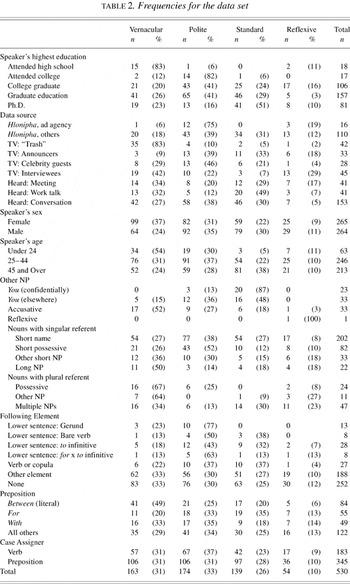
Frequencies for the data set
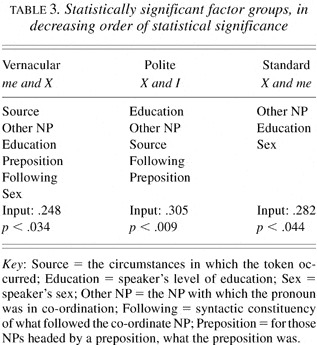
Statistically significant factor groups, in decreasing order of statistical significance

Statistically significant factor groups
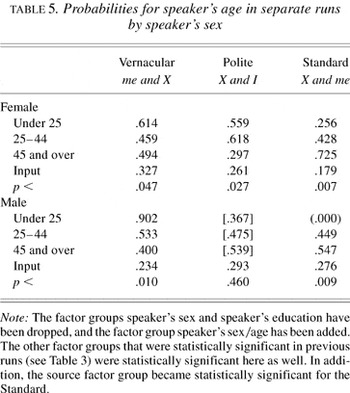
Probabilities for speaker's age in separate runs by speaker's sex

Frequency of Polite pattern by token source
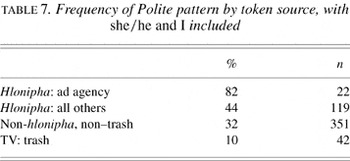
Frequency of Polite pattern by token source, with she/he and I included
 You have
Access
- 16
- Cited by