Implications
Adequate supply of essential amino acids (EAA) promotes milk protein production and reduces amino acids (AA) oxidation; however, the findings of this study indicate that the jugular infusion of methionine, lysine, isoleucine, leucine and valine did not improve milk production in heat-stressed cows.
Introduction
Heat stress (HS) continues to negatively affect the dairy industry resulting in an annual estimated cost of 1.2 billion dollars in the United States alone (Key et al., Reference Key, Sneeringer and Marquardt2014). Recent studies have indicated that a reduction of feed intake only accounts for half of the heat-stressed induced losses in milk production (Wheelock et al., Reference Wheelock, Rhoads, VanBaale, Sanders and Baumgard2010). In addition to a reduction of feed intake, shifts in metabolism of glucose, fatty acids and AA contribute to losses in milk production in heat-stressed cattle (McGuire et al., Reference Noblet, Le Bellego, van Milgen and Dubois1989; Wheelock et al., Reference Wheelock, Rhoads, VanBaale, Sanders and Baumgard2010). Indeed relative to fats and carbohydrates, an increase in catabolism of AA is associated with greater heat increment. The increase in heat increment is partially linked to deamination of AA and a greater whole-body protein turnover (Le Bellego et al., Reference Le Bellego, van Milgen, Dubois and Noblet2001; Noblet et al., Reference McGuire, Beede, DeLorenzo, Wilcox, Huntington, Reynolds and Collier2001). Thus, an increase in catabolism of AA would increase core body temperature and contribute to losses in production in heat-stressed cows.
Current research indicates that the synthesis of casein, the percentage of milk protein, and the yield of milk protein decline in dairy cows exposed to HS (Wheelock et al., Reference Wheelock, Rhoads, VanBaale, Sanders and Baumgard2010; Bernabucci et al., Reference Bernabucci, Basiricò, Morera, Dipasquale, Vitali, Piccioli Cappelli and Calamari2014). Recent work has indicated that the initiation of protein synthesis regulated by the mammalian target of rapamycin pathway (mTOR) in mammary cells was inhibited by hyperthermia (Kaufman et al., Reference Kaufman, Kassube, Baravalle and Ríus2015) suggesting a decrease in protein synthesis. In addition, the catabolism of AA increases as indicated by the increased concentration of plasma urea nitrogen (McGuire et al., Reference Noblet, Le Bellego, van Milgen and Dubois1989; Wheelock et al., Reference Wheelock, Rhoads, VanBaale, Sanders and Baumgard2010). Plasma creatinine and 3-methylhistidine are specific biomarkers of muscle degradation, both of which are elevated in heat-stressed cows, further indicating muscle catabolism (Kamiya et al., Reference Kamiya, Kamiya, Tanaka, Oki, Nishiba and Shioya2006). Collectively, the supplementation with EAA promotes protein synthesis in muscle and liver of growing animals by activating the mTOR signaling pathway (Escobar et al., Reference Escobar, Frank, Suryawan, Nguyen, Kimball, Jefferson and Davis2006; Shimomura et al., Reference Shimomura, Yamamoto, Bajotto, Sato, Murakami, Shimomura, Kobayashi and Mawatari2006). Recent reports have demonstrated that this pathway is activated by combinations and different concentrations of EAA in bovine mammary cells and muscle (Arriola Apelo et al., Reference Arriola Apelo, Singer, Lin, McGilliard, St-Pierre and Hanigan2014; Sadri et al., Reference Sadri, Giallongo, Hristov, Werner, Lang, Parys, Saremi and Sauerwein2016).
Jugular infusion of methionine, lysine and branched-chain amino acids (BCAA) to meet or exceed requirements increased protein synthesis and milk production in high-producing dairy cows in early lactation (Appuhamy et al., Reference Appuhamy, Knapp, Becvar, Escobar and Hanigan2011). Conversely, a low duodenal supply of BCAA, lysine and methionine limited milk production in high-producing cows (Rulquin and Pisulewski, Reference Rulquin and Pisulewski2006). Indeed, BCAA comprise half of the EAA present in milk protein. The provision of BCAA has been reported to consistently increase the synthesis of muscle protein in pigs (Escobar et al., Reference Escobar, Frank, Suryawan, Nguyen, Kimball, Jefferson and Davis2006; Shimomura et al., Reference Shimomura, Yamamoto, Bajotto, Sato, Murakami, Shimomura, Kobayashi and Mawatari2006) and milk protein yield in sows (Dunshea et al., Reference Dunshea, Bauman, Nugent, Kerton, King and McCauley2005). Leucine, a potent inhibitor of muscle protein degradation, has emerged as a regulator of the activity of branched-chain α-keto acid dehydrogenase complex (Harris et al., 2004). However, excessive BCAA or BCAA unbalanced diets triggered a 13% reduction of feed intake (Gloaguen et al., Reference Gloaguen, Le Floc’h, Primot, Corrent and van Milgen2013). Therefore, the supplementation to meet requirements of methionine, lysine and BCAA could alleviate the breakdown of muscle protein and increase milk protein synthesis in heat-stressed cows.
Evidence suggests that supplementing diets with lysine and methionine may increase milk protein synthesis in dairy cows (Weekes et al., Reference Weekes, Luimes and Cant2006); however, the response to supplemental EAA is not consistent (Robinson et al., Reference Robinson, Chalupa, Sniffen, Julien, Sato, Fujieda, Ueda and Suzuki2000). Compared with supplementation of low-quality protein, high-quality protein increased milk and milk protein yields in heat-stressed cows. This increase in production was associated with a greater supply of available lysine at the duodenum (Chen et al., Reference Chen, Huber, Theurer, Armstrong, Wanderley, Simas, Chan and Sullivan1993). The objectives of this study were to assess whether methionine, lysine and BCAA are limiting for milk production in heat-stressed dairy cattle and to determine the changes in plasma AA concentrations in heat-stressed cows. We hypothesized that infusion of EAA would increase milk and milk protein yields, and reduce muscle protein degradation in cows exposed to HS.
Material and methods
Animals, treatments and management
Animal procedures were approved by Institutional Animal Care and Use Committee of the University of Tennessee. In total, 12 multiparous, lactating Holstein cows (2.3 parities; 120±25 days in milk; 636±32 kg of BW; and 2.4±0.5 of body condition score) from the East Tennessee AgResearch and Education Center-Little River Dairy were used in a split-plot type cross-over design. Cows were divided into two groups (main plot; n=6 cows) and randomly assigned to individual tie stalls in one of two temperature-controlled chambers (n=3 stalls/chamber) from September 2014 to January 2015. Chambers were located at the University of Tennessee Johnson Animal Research and Teaching Unit. Cows were housed in a freestall barn when not receiving treatments, and were milked twice daily at 0700 and 1800 h.
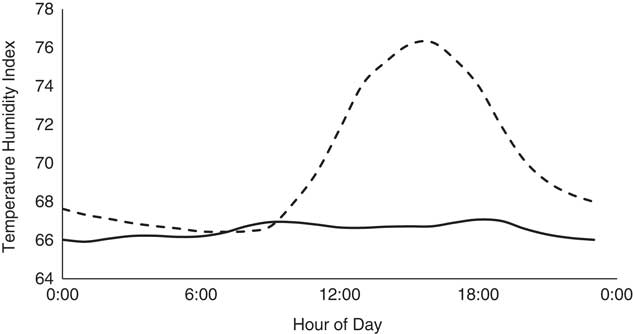
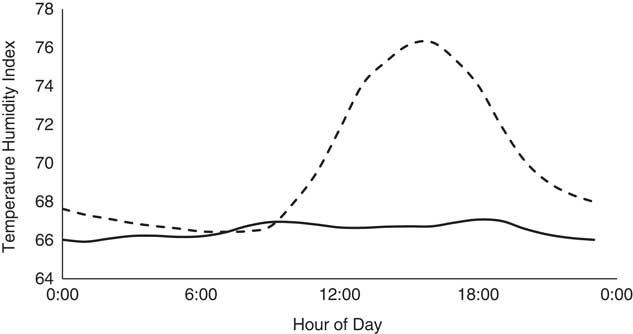
The main plot consisted of two experimental periods, each comprising of a 3-day adaptation to the chamber followed by 14 days of environmental treatments. To minimize carryover effects, experimental periods 1 and 2 were separated by a 19-day washout period. Cows were exposed to environments consisting of either thermoneutral conditions (THN; constant 20.8°C and 52.2% relative humidity (temperature–humidity index, THI=66.5; Dikmen and Hansen, Reference Dikmen and Hansen2009)) or HS conditions. Cows allocated to the HS environment received cyclical variation temperatures (to mimic diurnal changes) ranging from 21.5°C to 29.8°C (63.8% relative humidity). Between 0000 and 0800 h, the THI remained below 68; thereafter, the conditions became increasingly warm until peaking at a THI of 76 between 1300 and 1500 h. Cows housed within the HS environment were exposed on average to a THI exceeding 68 for 14 h/day (Figure 1). After peak THI, temperature gradually declined to reach a THI of 68 at 2300 h. Lights in the chambers were on at 0600 h and off at 1900 h throughout the study.
Average diurnal pattern of temperature–humidity index under experimental thermoneutral (solid line) or heat stress (dashed line) conditions (SD 3.2).
In addition to the environmental effect, the effect of EAA in cows exposed to THN and HS was tested as subplot. The negative control (NC) treatment consisted of 0 g/day infusion of EAA from days 1 to 7 of each treatment period in all cows housed in both environments. On day 6, an indwelling catheter (12 ga catheter set LA 1220; MILA International Inc., Erlanger, KY, USA) was aseptically inserted in the jugular vein. Catheter patency was maintained using a sterile heparinized 0.9% saline solution as previously reported (Ríus et al., Reference Ríus, Appuhamy, Cyriac, Kirovski, Becvar, Escobar, McGilliard, Bequette, Akers and Hanigan2010). Cows received an intravenous infusion mix of pharmaceutical-grade crystalline l-methionine (12 g/day), l-lysine (22 g/day), l-leucine (35 g/day), l-isoleucine (15 g/day) and l-valine (15 g/day) (methionine, lysine and BCAA (ML+BCAA); Ajinomoto Inc., Raleigh, NC, USA) dissolved in 0.9% saline solution from days 8 to 14 of each experimental period. The infusate for each period was prepared 2 days before administration, pH adjusted to 7.4, filter sterilized through 0.22 μm membrane filters (Millipore, Billerica, MA, USA) and stored at 4°C. The solution was infused continuously using medical peristaltic pumps (2 l/day at 84 ml/h; Plum XL IV; Abott-Lifecare, San Antonio, TX, USA). Amino acids were infused to meet or exceed predicted requirements of metabolizable protein according to Agricultural Modeling and Training Systems (AMTS LLC, Groton, NY, USA (CNCPS 6.5)). The quantity of methionine, lysine, leucine, isoleucine and valine, and the ratios of BCAA represent the mammary gland uptake of these AA for milk protein synthesis and other purposes in cows under THN conditions. The BCAA ratio was infused in the following proportions: leucine, 0.55; isoleucine, 0.22; and valine, 0.22 based on data derived from previous studies (Wohlt et al., Reference Wohlt, Clark, Derrig and Davis1977; Rius et al., Reference Ríus, Appuhamy, Cyriac, Kirovski, Becvar, Escobar, McGilliard, Bequette, Akers and Hanigan2010). The jugular infusion of the AA was implemented in this study to overcome the reduction of CP intake and the decline of the absorptive capacity in the small intestine of heat-stressed animals (McGuire et al., Reference Noblet, Le Bellego, van Milgen and Dubois1989).
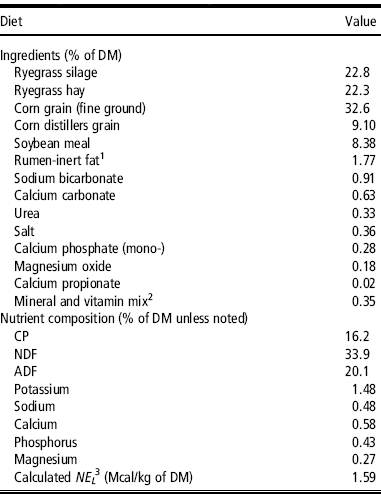
Cows were individually fed a basal total mixed ration (Table 1) provided ad libitum twice daily (0600 and 1700 h) throughout the study. The basal diet consisted of ryegrass silage and chopped hay (22.8% and 22.3% of ration dry matter), and a concentrate pellet that contained ground corn, corn distillers grain, soybean meal, urea, rumen-stable fat, minerals and vitamins. The diet was formulated to meet the requirements of a 635 kg lactating Holstein cow consuming 20 kg of dry matter and producing 36 kg of milk with 3.0% true protein and 3.8% milk fat according to the AMTS model and evaluated using the National Research Council (NRC) model (NRC 2001; table 1). Before the morning feeding, orts were recorded daily, and cows had unrestricted access to fresh water for the duration of the study.
Ingredient and chemical composition of the basal diet

DM=dry matter.
1 Berg+Schmidt Feed (Libertyville, IL, USA).
2 Contained 24 mg/kg of Co, 65 mg/kg of Cu, 4.2 mg/kg of I, 160 mg/kg of Fe, 60 mg/kg of Mn, 98 mg/kg of Zn and 0.3 mg/kg of Se; 124 IU/g of vitamin A, 31 IU/g of vitamin D and 0.56 IU/g of vitamin E.
3 Net energy of lactation (NE L ) (NRC, 2001).
Assessment of thermal stress
Body temperatures (rectal and cutaneous) and respiration rates were recorded twice daily (0700 and 1500 h). Rectal temperatures were recorded using a Sharptemp V digital thermometer (Cotran Corporation, Portsmouth, RI, USA) and cutaneous temperatures were collected on the right rear mammary glands using an IR thermal gun (TG 165 FLIR Systems Inc., Wilsonville, OR, USA). Images of the posterior surface of the right hind quarter of the udder were taken directly behind the standing animal. The posterior surface was chosen primarily for ease of measurement. The image was taken at a distance of 1.0 m, ensuring the udder image filled the image area. Respiration rates were determined by counting flank movements to determine breaths/min. Vaginal temperatures were collected by inserting a modified blank controlled internal drug release device (Zoetis, NJ, USA) with an attached data logger (DS1922L Thermochron iButton Device; Maxim Integrated, San Jose, CA, USA (Dikmen et al., Reference Dikmen, Alava, Pontes, Fear, Dikmen, Olson and Hansen2008)). Measurements were recorded continuously in 10 min intervals on days 3, 4, 5, 6, 7, 10, 11, 12, 13 and 14 within each experimental period. Measurements from 0500 to 1000 h and 1200 to 1700 h on days indicated previously were used to estimate a.m. and p.m. vaginal temperature. Throughout the study, environmental temperature and relative humidity of the chambers were recorded every 10 min using HOBO Pro v2 Series probes (Onset Computer Corporation, Bourne, MA, USA).
Sample collection and analysis
Samples of total mixed ration, orts, ryegrass silage, ryegrass hay and concentrate pellet were collected twice weekly. Samples were dried at 55°C for 48 h, ground through a 1-mm screen and analyzed for chemical and nutrient composition (Dairy One, Ithaca, NY, USA). Milk samples from each cow were collected at four consecutive milkings on days −2 and −1 relative to chamber allocation and at four consecutive milkings on days 6, 7, 13 and 14 of each experimental period. Milk samples contained a preservative (bronopol tablet; D&F Control System, San Ramon, CA, USA) and were stored at 4°C until analyzed (United Federation of DHIA Laboratory, Radford, VA, USA) for lactose, protein, fat and milk urea nitrogen (MUN) (Foss MilkoScan; Foss, Eden Prairie, MN, USA).
Blood samples were harvested by coccygeal venipuncture using sodium heparin collection tubes on days −2 and −1 relative to the start of each experiment period to determine baseline plasma concentration of metabolites and after each milking on days 6, 7, 13 and 14. Samples were centrifuged at 1200×g for 10 min at 4°C, and plasma was harvested and stored at −80°C. Plasma glucose, β-hydroxybutyrate, and non-esterified fatty acid concentrations were determined using commercially available enzymatic assays (#F5803, #P7119, #G6918; Sigma-Aldrich, St. Louis, MO, USA; #999-34691, #991-34891, #995-34791, #993-35191, #276-76491; Wako Diagnostics, Mountain View, CA, USA; #H6501, #10127841001, #N7004; Sigma-Aldrich). Concentration of metabolites were determined using a microplate spectrophotometer (BioTek Synergy H1 Multi-Mode Reader; Winooski, VT, USA). Insulin concentrations in plasma were determined using radioimmunoassay (Porcine insulin RIA EMD Millipore’s Co., St. Charles, MO, USA; 90% cross-reactivity with bovine insulin; Hammon et al., Reference Hammon, Stürmer, Schneider, Tuchscherer, Blum, Engelhard, Genzel, Staufenbiel and Kanitz2009). Intra-assay and inter-assay coefficients of variation showed a range of 5% to 9% for plasma metabolites and 4% to 6% for insulin determinations.
Plasma free AA concentrations were determined using liquid chromatography and MS, and a commercially available kit (Phenomenex EZ:faast; Danaher Corporation; Torrance, CA, USA). Plasma samples collected on 2 consecutive days were pooled to conduct AA analysis as reported previously (Ríus et al., Reference Ríus, Appuhamy, Cyriac, Kirovski, Becvar, Escobar, McGilliard, Bequette, Akers and Hanigan2010). Briefly, AA were removed from plasma using solid-phase extraction, derivatization and liquid/liquid extraction. The organic phase was injected into a 250×2.0 mm HPLC column fitted within a liquid chromatograph and MS system (Q Exactive Quadrupole-Orbitrap LC-MS; Thermo Scientific, Waltham, MA, USA). The eluent used consisted of 1 mM ammonium formate in water: 10 mM ammonium formate in methanol. Elution of AA occurred using the gradient of buffers (Ubhi et al., Reference Ubhi, Davenport, Welch, Riley, Griffin and Connor2013) with a constant flow of 0.25 ml/min. Amino acid standards were run at the beginning and end of each set of samples (n=45 samples/set) to create a six-point calibration curve (average R 2=0.96; Ubhi et al., Reference Ubhi, Davenport, Welch, Riley, Griffin and Connor2013).
Calculations and statistical analysis
Calculations for energy-corrected milk (ECM) yields were determined using the equation reported by Tyrrell and Reid (Reference Tyrrell and Reid1965). Milk production data on days 4, 5, 6, 7, 11, 12, 13 and 14 of each period were averaged and used for statistical analysis. Plasma samples for determination of insulin, metabolites and AA concentrations were pooled for each cow because the variation between consecutive days was expected to be negligible under the experimental condition of this study. The effects of environment and AA were tested in a split-plot arrangement using a cross-over design with two periods. The main effects and their interaction were analyzed using the mixed model procedure of SAS (version 9.4; SAS Institute Inc., Cary, NC, USA):
 $$\eqalignno{ Y_{{ijkl}} \,{\equals}&\,\mu {\plus}P_{i} {\plus}C_{j} {\plus}T_{k} {\plus}I_{l} {\plus}P{\times}C\left( {T{\times}I} \right)_{{ijkl}} \cr&{\plus}T{\times}I_{{kl}} {\plus}\beta \left( \chi \right)_{{ijkl}} {\plus}e_{{ijkl}} $$
where Y ijkl is the response of the variable in the ith period of the jth cow subjected to the kth environmental condition and the lth AA treatment, μ the overall mean, P i the fixed effect of the ith treatment period, C j the effect of the jth cow (assumed to be random), T k the fixed effect of the kth environment treatment, I l the fixed effect of the Ith AA treatment, β(χ) ijkl the effect of the covariate and e ijklm the random error. Milk production, milk component yield, and nutrient and dry matter intake were analyzed with repeated measures with day as the repeated measurements using an autoregression structure, as these variables were expected to change with time. Day did not affect variables of interest, therefore the effect of day and day interactions with all other effects were removed from the model. Interactions between main effects were removed from the model if these were not significant. Observations from days −2 and −1 of milk and blood parameters were averaged and included as a covariate adjustment in the model. Interaction and main effect means are reported as least squares means and standard error of mean and were considered significant at P⩽0.05. Multiple comparisons among interaction were determined using the LSD method.
Results
Throughout the study, the THN environment resulted in conditions that correspond to a 66.5 THI. The HS environment resulted in conditions that correspond to a THI above 68 from 0900 to 2300 h which peaked at 76 between 1300 and 1500 h (Figure 1). Ingredient composition of the common diet is presented in Table 1. Half of the diet was composed of corn-based ingredients and soybean meal. Although the basal diet was formulated to meet energy and metabolizable protein other than methionine, lysine and BCAA at mean dry matter intake of 20.0 kg/day, observed feed intake supplied only 90% and 89% of NRC (2001) predicted net energy for lactation and metabolizable protein requirements for cows in THN conditions. The basal diet supplied 44 g of methionine, 125 g of lysine, 167 g of leucine, 98 g of isoleucine and 109 g of valine of the daily duodenal AA flow. The ML+BCCA treatment achieved 111% of methionine, 103% of lysine, 106% leucine, 114% isoleucine and 111% of valine of metabolizable protein-predicted requirements according to AMTS. Estimates for duodenal flows of digestible lysine and methionine for the basal diet were 6.26% and 1.88% of metabolizable protein. The ML+BCCA treatment predicted duodenal flows of digestible lysine and methionine of 7.30% and 2.45%, respectively (NRC, 2001).
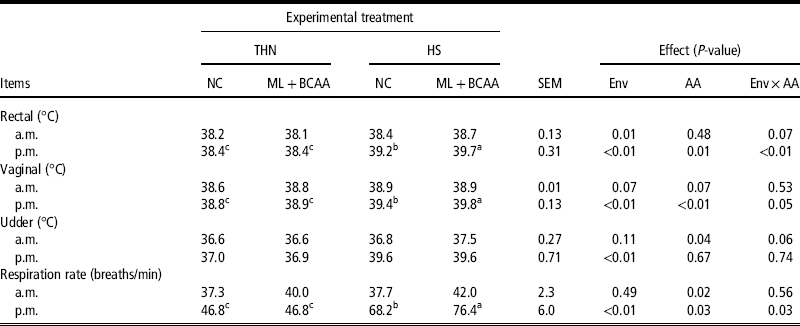
Compared with the THN environment, the HS environment (P<0.01) increased afternoon cutaneous temperature measured in the udder by 2.7°C (Table 2). Infusion of ML+BCAA increased (P<0.05) morning respiration rates from 37.5 to 41.0 breaths/min, relative to NC. An environment by AA interaction was detected (P<0.05) as afternoon rectal and vaginal temperatures, and respiration rates increased (0.5°C, 0.4°C, and 8 breaths/min) in response to ML+BCAA treatment during HS exposure. Amino acid treatment did not modify afternoon rectal and vaginal temperatures, or respiration rates during the THN environment. However, we detected a trend for an environment by AA interaction (P=0.07) for morning rectal and udder temperatures increasing in response to ML+BCAA treatment during HS, relative to NC.
Rectal, vaginal and udder temperatures, and respiration rates of lactating Holstein cows exposed to a thermoneutral (THN) or heat stress (HS) environment with or without intravenous infusion of essential amino acids (AA)
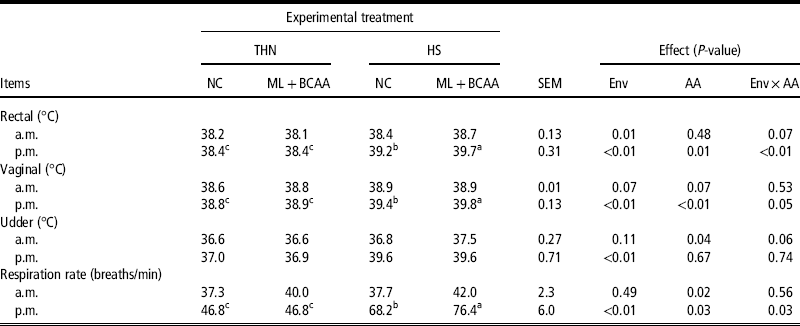
NC=negative control; ML+BCAA=methionine, lysine and branched-chain AA; Env=environment.
Least square means±SEM.
a,b,cLeast square means within a row with differing superscripts differ (P<0.05).
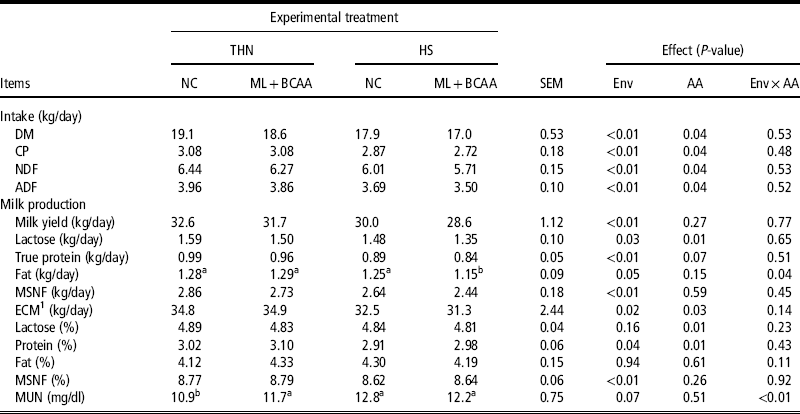
Heat stress conditioning decreased dry matter intake by 1.5 kg/day (P<0.01; Table 3), relative to THN. Compared with the NC treatment, the ML+BCAA treatment decreased (P<0.05) dry matter intake by 0.70 kg/day. The HS environment reduced (P<0.05) yields of milk (2.8 kg/day), ECM (3.0 kg/day), lactose (0.22 kg/day), protein (0.10 kg/day) and milk solids non-fat (0.26 kg/day), relative to THN. Heat stress had no effect on milk fat content but decreased (P<0.05) protein content. Compared with the NC treatment, the ML+BCAA treatment reduced (P<0.05) yields of lactose (0.11 kg/day) and ECM (0.55 kg/day). Treatment ML+BCAA increased (P<0.01) milk protein content by 0.08%. There was a significant environment by AA interaction (P<0.05) on milk fat yield such that, compared with the NC treatment, the ML+BCAA treatment reduced fat yield in the HS environment (1.25 v. 1.15 kg/day) but had no effect during THN exposure. There was a significant environment by AA interaction (P<0.01) for MUN levels such that, compared with the NC treatment, the ML+BCAA treatment increased MUN only in the THN environment (10.9 v. 11.7 mg/dl) compared with the HS environment (12.8 v. 12.2 mg/dl).
Intake and milk production outcomes of lactating Holstein cows exposed to a thermoneutral (THN) or heat stress (HS) environment with or without intravenous infusion of essential amino acids (AA)

NC=negative control; ML+BCAA=methionine, lysine and branched-chain amino acids; Env=environment; DM=dry matter; MSNF=milk solids non-fat; MUN=milk urea nitrogen.
Least square means±SEM.
a,bLeast square means within a row with differing superscripts differ (P<0.05).
1 ECM=energy-corrected milk (Tyrrell and Reid, Reference Tyrrell and Reid1965); ECM=[0.327×milk yield+12.95×milk fat yield+7.65×milk protein yield].
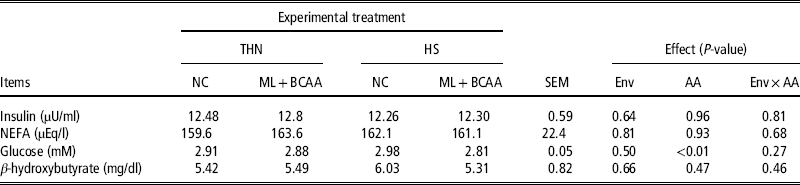
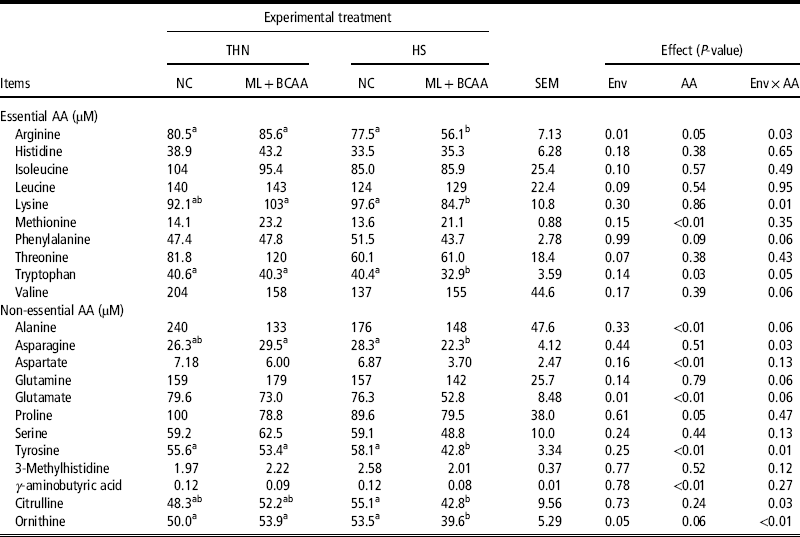
Treatments did not affect the plasma concentrations of non-esterified fatty acids, β-hydroxybutyrate or insulin (Table 4). The interactions between main effects was not significant for these variables. Although environment did not influence plasma glucose concentrations, ML+BCAA treatment reduced (P<0.01) plasma glucose levels, relative to NC. Heat stress conditioning decreased plasma glutamate concentrations compared with the THN environment (76.3 v. 64.5; Table 5). Treatment ML+BCAA decreased (P<0.05) plasma glutamate concentrations by 15.1 µM. In a similar manner, ML+BCAA treatment decreased (P<0.05) plasma alanine, aspartate, proline and γ-aminobutyric acid concentrations by 16% to 32% compared with the NC treatment. Conversely, ML+BCAA treatment increased (P<0.01) plasma methionine concentrations by 60%. An environment by AA interaction (P<0.05) was observed for plasma concentrations of arginine, lysine, tryptophan, asparagine, tyrosine, citrulline and ornithine such that, infusing ML+BCAA did not change the concentration of these AA on the THN environment but decreased their concentrations under HS condition. Treatments had no effect on plasma concentrations of isoleucine, valine, histidine, leucine, phenylalanine, threonine, glutamine, serine and 3-methylhistidine.
Plasma metabolite and insulin concentrations of lactating Holstein cows exposed to a thermoneutral (THN) or heat stress (HS) environment with or without intravenous infusion of essential amino acids (AA)

NC=negative control; ML+BCAA=methionine, lysine and branched-chain amino acids; Env=environment; NEFA=non-esterified fatty acids.
Least square means±SEM.
Plasma amino acid concentrations of Holstein lactating cows exposed to a thermoneutral (THN) or heat stress (HS) environment with or without intravenous infusion of essential amino acids (AA)

NC=negative control; ML+BCAA=methionine, lysine and branched-chain amino acids; Env=environment.
Least square means±SEM.
a,bLeast square means within a row with differing superscripts differ (P<0.05).
Discussion
In our study, exposing lactating cows to environmental HS above the thermal comfort zone resulted in marked hyperthermia. By design, temperature in the HS treatment followed a daily fluctuation to mimic THI conditions reported previously (Collier et al., Reference Collier, Beede, Thatcher, Israel and Wilcox1982; Wheelock et al., Reference Wheelock, Rhoads, VanBaale, Sanders and Baumgard2010). Cows exposed to HS conditions increased parameters of body temperature. Indeed, the HS environment increased morning rectal temperature (0.40°C) indicating that hyperthermia was maintained overnight throughout the 14-day experimental period. In further support of our experimental design, compared with the THN environment, HS conditioning increased p.m. udder temperature (2.65°C). The diurnal change of core body temperature of heat-stressed cows followed a similar pattern in comparison with previous studies. However, in our study cows averaged 39.7°C rectal temperature which is 1.10°C lower than previously reported (Wheelock et al., Reference Wheelock, Rhoads, VanBaale, Sanders and Baumgard2010). Unexpectedly, ML+BCAA treatment resulted in higher p.m. rectal and vaginal temperatures (0.50°C and 0.40°C) in heat-stressed cows. The combination of HS conditioning with ML+BCAA elicited an afternoon respiration rate of 76.4 breaths/min, which is 14.0 breaths/min less than previously reported in heat-stressed cows (Settivari et al., Reference Settivari, Spain, Ellersieck, Byatt, Collier and Spiers2007; Wheelock et al., Reference Wheelock, Rhoads, VanBaale, Sanders and Baumgard2010). This difference in respiration rate between studies is associated with THI observed in this and previous work (mild-to-moderate HS v. moderate-to-severe HS). Nonetheless, a respiration rate above 75.0 breaths/min is indicating the need for HS abatement. Indeed, others have proposed that respiration rate is a better indicator of HS than changes in core body temperature (Settivari et al., Reference Settivari, Spain, Ellersieck, Byatt, Collier and Spiers2007). Collectively, changes in core body temperature and respiration rate indicate that HS conditioning promoted moderate HS in our experimental cows.
Reducing dietary CP in heat-stressed animals has received attention because the metabolism of proteins and AA is associated with greater heat increment when compared with the metabolism of fats and carbohydrates (Noblet et al., Reference McGuire, Beede, DeLorenzo, Wilcox, Huntington, Reynolds and Collier2001). The increase of heat increment is partly linked to deamination of AA and a greater whole-body protein turnover (Le Bellego et al., Reference Le Bellego, van Milgen, Dubois and Noblet2001). The resulting dietary-induced thermogenesis can further compromise the capacity to regulate body temperature. Conversely, some studies reported that, compared with non-infusions, infusions of pharmacological doses of AA increased the body temperature between 0.34°C and 1.30°C of rats (Yamaoka et al., Reference Yamaoka, Doi, Nakayama, Ozeki, Mochizuki, Sugahara and Yoshizawa2006) and humans (Wu et al., Reference Wu, Zhang, Yang, Ge and Xue2015) by promoting hypothalamic thermoregulation. In the current study, the thermoregulatory mechanism of HS cows was impaired because these animals exhibited elevated respiration rate and core body temperature during ML+BCAA infusion. Unfortunately, these cows were unable to dissipate the additional heat load associated with extra supply of EAA indicated by higher respiration rate, and rectal and vaginal temperature measurements in the afternoon. The industry would benefit from a better understanding of the role of EAA on heat-stressed animals.
In the current study, HS reduced dry matter intake by 8.0% (1.4 kg/day), which is similar to that reported previously in lactating dairy cows experiencing moderate HS (Ominski et al., Reference Ominski, Kennedy, Wittenberg and Mushtagi Nia2002). These authors also reported a decrease in milk yield of 2.4 kg/day, which agrees with the decline observed in the present study (2.8 kg/day). The reductions in feed intake and milk production confirm that the HS environment elicited the expected negative effects on cattle performance (Collier et al., Reference Collier, Beede, Thatcher, Israel and Wilcox1982; Settivari et al., Reference Settivari, Spain, Ellersieck, Byatt, Collier and Spiers2007; Wheelock et al., Reference Wheelock, Rhoads, VanBaale, Sanders and Baumgard2010; Bernabucci et al., Reference Bernabucci, Basiricò, Morera, Dipasquale, Vitali, Piccioli Cappelli and Calamari2014). It is clear, therefore, that the HS environment elicited moderate hyperthermia as indicated by the magnitude of the changes in respiration rates, core body temperature, feed intake and milk production.
The main objective of this study was to assess the effect of increased supply of plasma methionine, lysine and BCAA on performance of cows exposed to HS. The infusion of ML+BCAA increased plasma methionine concentrations by 60% confirming the effectiveness of this treatment. Plasma lysine concentration, however, was increased by ML+BCAA in the THN environment but reduced during HS condition. The ML+BCAA treatment reduced dry matter intake and yields of ECM and lactose. In agreement with our study, Robinson et al. (Reference Robinson, Chalupa, Sniffen, Julien, Sato, Fujieda, Ueda and Suzuki2000) infused methionine in excess (i.e. 135% of requirements), and reported a similar reduction of dry matter intake and milk yield. Harper et al. (Reference Harper, Benevenga and Wohlhueter1970) concluded that the increase of one or more EAA in plasma depressed feed intake, and the low concentration of one EAA, causing AA imbalance, would further exacerbate the depression of feed intake. For example, excess of leucine in the diet of growing pigs and lactating sows resulted in AA imbalance and reduced dry matter intake (Gloaguen et al., Reference Gloaguen, Le Floc’h, Primot, Corrent and van Milgen2013). In the present study, ML+BCAA treatment was designed to meet or exceed requirement of AA; however, the reduced intake and milk production observed could be the result of imbalanced supply of AA.
In the current study, plasma glucose concentrations were reduced by the infusion of ML+BCAA. The lower glucose circulation could indicate that glucose removal was increased in peripheral tissues (e.g. muscle or adipose). Reports indicate that BCAA promote adipocyte growth and differentiation, glucose uptake and fatty acids synthesis (Wu, Reference Wu2013). In addition, BCAA are lipogenic AA and account for as much as 30% of the acetyl-CoA pool in mature adipocytes (Wu, Reference Wu2013). It has become increasingly clear that adipose tissue is a significant depot for systemic BCAA homeostasis (Wu, Reference Wu2013). Collectively, BCAA may have promoted glucose and BCAA removal in support of adipose metabolism and BCAA homeostasis.
Infusion of ML+BCAA did not increase MUN content in the HS environment. Milk urea nitrogen concentration is a useful tool for monitoring nitrogen-use efficiency of dairy cows (NRC, 2001; Weekes et al., Reference Weekes, Luimes and Cant2006). A steady concentration of MUN is indicative of improved whole-body nitrogen-use efficiency indicating that more AA were captured to sustain protein synthesis (NRC, 2001; Appuhamy et al., Reference Appuhamy, Knapp, Becvar, Escobar and Hanigan2011). A decreased MUN concentration combined with an increased milk protein concentration in the ML+BCAA treatment, relative to NC, suggests that infusion of EAA supported whole-body protein synthesis of cows exposed to the HS environment. Infusion of ML+BCAA did not increase plasma concentrations of BCAA (Table 5) suggesting that these AA were removed and metabolized by peripheral tissues or used for synthesis of whole-body and heat shock proteins (Wheelock et al., Reference Wheelock, Rhoads, VanBaale, Sanders and Baumgard2010; Bernabucci et al., Reference Bernabucci, Basiricò, Morera, Dipasquale, Vitali, Piccioli Cappelli and Calamari2014). Alternatively, the observed decline of dry matter intake could have contributed to the unchanged plasma concentration of BCAA. The potential increase in protein synthesis in response to ML+BCAA could presumably be associated with increased muscle protein (Escobar et al., Reference Escobar, Frank, Suryawan, Nguyen, Kimball, Jefferson and Davis2006).
Plasma AA concentrations reflect the balance between AA supply and utilization. For example, arginine serves as a precursor of the intermediates of the urea cycle (i.e. ornithine and citrulline). A decline in plasma concentrations of arginine, ornithine and citrulline in the ML+BCAA treatment under the HS environment suggests a reduction in the synthesis of urea, although plasma urea concentrations were not measured (Wu, Reference Wu2013). The plasma 3-methylhistidine concentration is used as a marker of muscle breakdown because it is formed by methylation of histidine residues in actin and myosin (Blum et al., Reference Blum, Reding, Jans, Wanner, Zemp and Bachmann1985). Plasma 3-methylhistidine concentrations were not affected by treatments in our study. However, there was a numerical reduction of plasma 3-methylhistidine for the ML+BCAA treatment, relative to NC, in cows exposed to HS. Although muscle breakdown was not measured in the current study, plasma AA results suggest that the ML+BCAA treatment reduced muscle catabolism in HS cows.
Conclusions
The current research demonstrates that HS elicited the expected changes in body temperature and losses in milk production. A reduction of feed intake and ECM yield coupled with an increase of body temperatures and respiration rates in cows receiving the ML+BCAA treatment indicated that infusion of EAA failed to improve the productivity of heat-stressed cows. The infusion of ML+BCAA probably supported whole-body protein synthesis and reduced protein catabolism in cows exposed to HS. The study of the metabolism of AA should receive attention to improve the current recommendations of dietary CP and AA to heat-stressed cows.
Acknowledgments
The authors would like to acknowledge the funding for this project provided by the University of Tennessee-Knoxville Animal Science Department and the donation of AA provided by Ajinomoto USA Inc. Moreover, the time and effort of the East Tennessee AgResearch and Education Center-Little River Dairy staff, the Johnson Animal Research and Teaching Unit staff and the Dairy Herd Improvement Association laboratory located at University of Tennessee was greatly appreciated. The authors are also grateful for the assistance of R. Ordway, D. Anderson and M. Prado.