This article reinterprets the iconography of a ceramic vessel collected from the site of Los Naranjos, Honduras, 70 years ago by Danish archaeologist Jens Yde. The relatively more naturalistic representation of the figures on the vessel allows us to offer an identification of the enigmatic category of motifs called “dancing figures.” With this identification, we attempt to relate the artistic production of the entire genre of “dancing figures” to a well-documented corpus of Mesoamerican origin mythology.
Our analysis, however, seeks to go beyond simply the interpretation of the meaning attached to the iconography on ceramic vessels. We shift our focus to the site of Los Naranjos to suggest that the area surrounding the site contains a complex of topographic features surrounding Lake Yojoa that are associated throughout Mesoamerica with the place of the earth's creation. If Lake Yojoa carried such a connotation then it is likely that the Cave of Tauleve was considered by the inhabitance of the region to be the place of human emergence onto the earth.
DISCOVERY OF THE YDE VESSEL
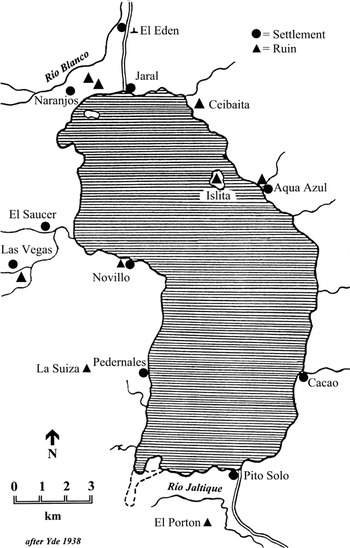
In 1935 Frans Blom, then director of the Department of Middle American Research at Tulane University, and his compatriot Jens Yde of the National Museum of Denmark conducted an archaeological reconnaissance in Northwestern Honduras. At that time little archaeological investigation had been done in Honduras outside of Copan and the Ulua Valley, so the expedition was designed to collect archaeological as well as ethnographic specimens and to locate sites suitable for future excavations (Yde 1938:1). One of the areas focused on by Blom and Yde was the Lake Yojoa region (Figure 1), particularly ruins at the northern end of the lake that had been reported to the Department of Middle American Research by T. A. Ballard in 1926. Eight years later Doris Z. Stone surveyed the ruins and named the largest complex Los Naranjos (Stone 1934).

Map of the Lake Yojoa area with Los Naranjos at northwestern end of the lake (after Yde 1938).
Blom and Yde spent four days at the ruins making a survey of the core area including several large mounds over 20 m high. They also contacted former Harvard botanist J. B. Edwards, who had carried out excavations at the site in 1934 and 1935. Edwards excavated what Yde (1938:67) described as:
inconspicuous mounds … most of them so flat that they barely raise their backs over the field. These mounds are burial mounds … [but] … No traces of skeletons have been found in the burial mounds at Jaral…. Yet the burial character is revealed by the enormous contents of high-grade pottery which, upon examination, presents itself as deliberately deposited in nests containing a number of complete pots and bowls.
Yde and Blom accompanied Edwards in a small “exacavation” of one of the mounds where, in just one hour, they recovered 15 polychrome vessels (Yde 1936:6). Edwards had also amassed what Yde (1936:6) characterized as, “one of the most wonderful collections of polychrome pottery ever produced by a single site within the Maya area.” From this collection, Yde purchased several specimens for the Danish National Museum, including the large and extraordinary vessel fragment under discussion here (Yde 1935:147).
Yde renamed the site “Jaral,” so as not to create confusion between the new site and other Maya sites with the same or similar names (Yde 1938:29). However, when William Duncan Strong began large-scale excavations of the ruins in 1936 (see Strong et al. 1938) he returned to the name given by Stone, as did Claude Baudez and Pierre Becquelin when they undertook work at the site from 1967 to 1969 (Baudez and Becquelin 1973). This article will also use Los Naranjos as the generally accepted name.
DESCRIPTION OF THE YDE VESSEL
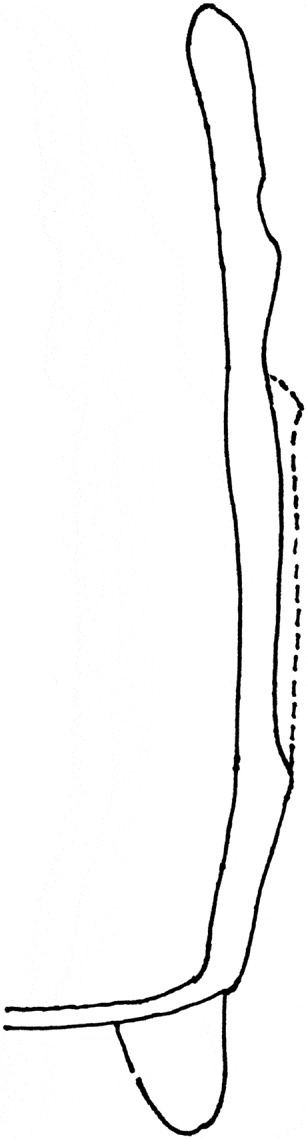
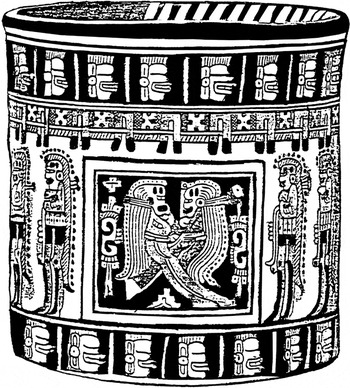
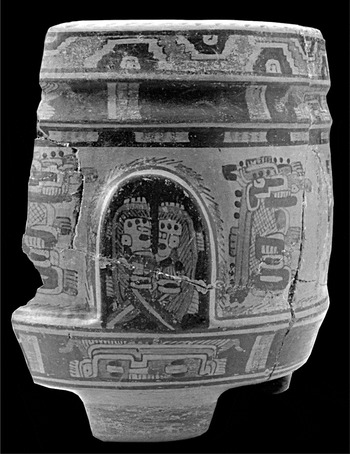
The Yde vessel is approximately one half of a large cylindrical vase 24.4 cm high and with a reconstructed rim diameter of approximately 23 cm. This makes it larger than the average recorded for Robinson's sample of Ulua polychromes (Robinson 1978:14). The vessel appears to have had three hollow, rectangular supports, of which two remain. The vessel interior has a light-orange-to buff slip with a 5.4-cm-wide red band encircling the vessel, 1.5 cm below the rim. The rim is exterior thickened with another raised area on the exterior just below the rim (Figure 2). The base is also thickened, which creates raised frames both above and below and makes a decorative panel, 10.5 cm high, in the center of the vessel. The principal iconographic element within the panel, however, was further accentuated by being painted on raised medallions, a not uncommon feature of this ceramic group (Joyce 1993a:260). Our measurement of the spacing of the two remaining medallions on the fragment in the museum indicates that the intact vessel once had three. The repetition of decorative elements three, rather than four, times appears to be common on other vessels in the Yde Collection. Decoration is painted in red and black on the buff/orange slip. The vessel corresponds to what is classified as Babilonia Polychrome (Viel 1977), a type produced during the Yojoa Phase (a.d. 525–925) (Baudez and Becquelin 1973). Within Joyce's (1993a) system, the vessel would be placed in the Red group, Contador type and Melizo variety.

Profile of the Yde vessel.
ICONOGRAPHY
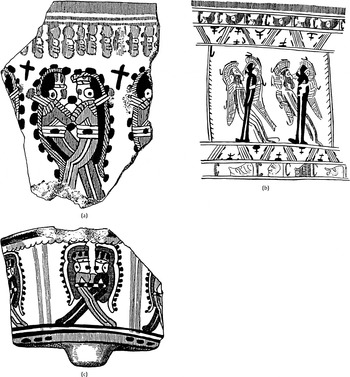
The Yde vessel has been mentioned in passing and illustrated by Yde (1935, 1938:78:Figure 55), Robinson (1978), and Kennedy (1987), but it has received detailed treatment only by Stone (1966/67). The principal iconographic elements are pairs of seated, crossed-leg individuals that belong to the widely recognized category of motifs called “dancing figures” (Sapper 1898:135; Lehmann 1910:736–738; Strong 1948:89; Stone 1957:Figure 47c; Baudez 1970:Figure 33; Joyce 1993a:260:Figure B.2; 1993b:70–71) (Figure 3). Glass (1966:168) notes that:
The designs of this class (Mayoid) suggest that they are part of a definite and fixed repertory of ritual iconography. If any vessel can be said to be typical of the class, it is the cylindrical flat-bottomed vase with a central band of “dancing” figures drawn as isolated figures in a processional sequence, in facing pairs, seated, or within circular medallions.

“Dancing figures” drawn from: (a) Sapper (1898:135); (b) Lehmann (1910:736); and (c) Lehmann (1910:738).
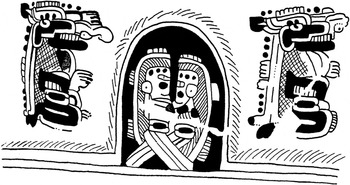
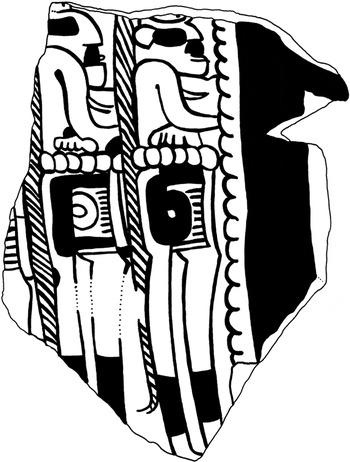
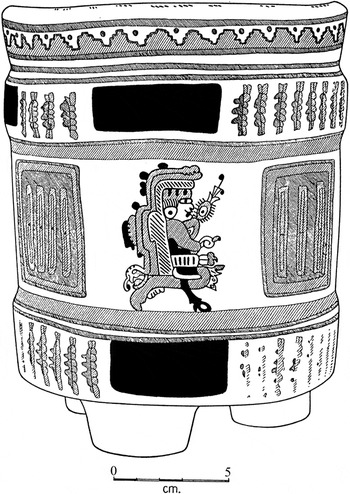
As Glass notes above, the so-called dancing figures appear in a number of standardized positions, with the processional sequence and the facing pair being the most common. Because they are so standardized, we would argue that it is helpful to adopt a thematic approach, as developed by Christopher Donnan (1975) in his analysis of Moche art. Donnan notes by way of example that a large percentage of the symbols used in Christian art could be reduced to a limited number of themes drawn from the life of Christ. The theme itself could be complex and contain a number of elements or scenes so that an artist dealing with the crucifixion theme, for instance, might draw from any of the incidents in the “Stations of the Cross.” The actual depiction might be highly stylized as well, and might allude to the theme by reference to any of a large array of symbols. For example, while the cross is the most common element used to represent the crucifixion theme, it could also be referenced by depicting a set of nails within a crown of thorns, and the cross itself could be omitted altogether. It is important to recognize this because “the complete inventory of symbolic elements is rarely found in a single representation” (Donnan 1978:158). Furthermore, the thematic approach places great importance on representations that are more complete, less abstract, and less highly stylized. We would argue that the portrait on the Yde vessel and on several sherds from other vessels in the Danish National Museum collection are more naturalistic and less ambiguous and thus allow us to bring a fresh perspective to the issue. The two raised, oval medallions on the Yde vessel each contain a crossed-leg pair of individuals painted against a black background (Figure 4). The shape of the medallions and black background convey the message that they are seated in a cave. Around the sides and top of the medallions are short black strokes that appear to represent grass or vegetation. This once again reinforces the identification of the setting as a cave because caves frequently are shown with vegetation growing around them, as in Monument 7 at Chalcatzingo. The “couple in the cave” appears to be a standard scene within the “dancing figure” theme. A similar couple on a raised medallion is portrayed on another sherd (0.7450) (Figure 5) in the Danish National Museum collection. The identification of the cave as an element in the theme in these more naturalistic renderings allows us to recognize the motif in other, more stylized versions. For example, a couple is simply painted within a flat, black square on a vessel in the Tulane University collection (Mason 1943: Plate LVI) (Figure 6). Once the elements in the theme are accounted for, it is possible, as Donnan has shown, to recognize the theme even when major elements, such as the cave, for instance, are omitted.

One set of figures from the Yde vessel (drawing by J. Nielsen).

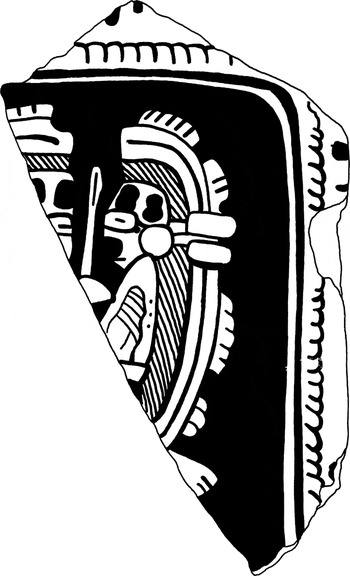
A sherd (0.7450) in the Danish National Museum showing part of a crossed-leg couple on a raised medallion (drawing by J. Nielsen).

A crossed-leg couple is painted within a flat, black square on a vessel in the University Museum at the University of Pennsylvania. (Mason 1943: Plate LVI). Applying a thematic approach, the black square can be seen to represent a cave based on analogy to the Yde vessel.
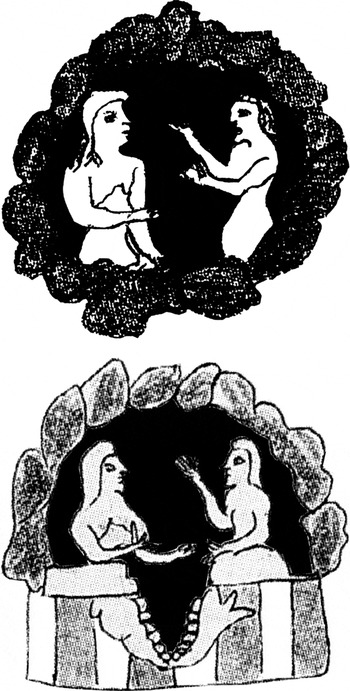
The representation of individuals in a cave is a well-established Mesoamerican motif relating to group genesis. The depiction appears to be analogous to images from the Codex Vaticanus A showing couples in caves where the rendering of the caves make their identification unmistakable (Figure 7). In each case the couple is saved from the destruction of one of the previous worlds and becomes the progenitors who repopulate the earth. A very similar depiction is found in the Tlatelolco mural, in which the primordial pair, Oxomoco and Cipactonal, are painted inside a “red receptacle” (Guil'liem Arroyo 1991:24) that is clearly a cave. The Historia de los Mexicanos por sus Pinturas says, “Then they made a man and a woman. The man they called Uxumuco and the woman Cipactonal, and they were sent to work the earth and she to spin and weave. And from them were born the macehuales …” (Garibay 1973:25). Interestingly, the Codex Borbonicus depicts this primordial pair inside a red rectangle. Thus, the stylization of the naturalistic cave as a rectangle appears as a convention in other areas of Mesoamerica as well. Because all these scenes appear to relate to group genesis, we call this the Origin Theme.

Figures from the Codex Vaticanus A depicting individuals in a cave, a well-established Mesoamerican motif relating to group genesis (after the Códice Vaticano Ríos 1992).
While the standing, crossed-leg, facing pairs have been labeled “dancers,” it appears that few scholars actually believe that the figures are, in fact, dancing. Lehmann (1910:740) asserts that the couples are copulating and Yde (1938:80) accepts this interpretation. Stone (1957:27) says, “It is possible that these vessels were used in fertility ceremonies as the figures are highly stylized with crossed legs suggesting copulation.” Strong et al. (1938:51) differ and maintain that, “In light of Palacio's information regarding the ceremonial importance of the mutilation of male genitalia among the Pipil and Lenca, we rather incline to connect this widespread design with phallic rather than procreative rites.” Baudez (1970:240) refers to them as “interlinked figures” without offering an interpretation. Robinson (1978:56), however, maintains that the figures are so stylized that there is not enough detail to determine what they are doing and so prefers to call them simply “crossed” figures. In summary, it appears that there is little consensus within the field concerning the identity and meaning of these images, and more recent treatments have moved away from the earlier interpretation that the figures are copulating.
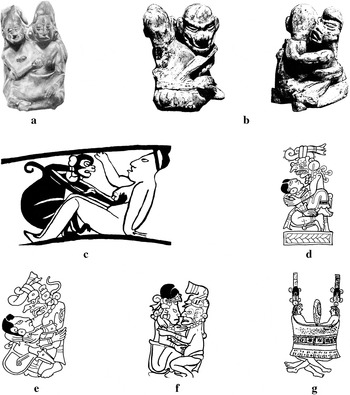
We feel that lack of agreement on what the figures are doing is a result of the failure to analyze the iconography carefully in relation to similar images in other parts of Mesoamerica. On the Yde vessel, one figure is clearly depicted as seated on the lap of the other and their legs cross. The position is very reminiscent of certain Jaina figurines that portray a young woman seated on the lap of an old man or god. In some of the Jaina examples, the old man is fondling the woman's breast (Figure 8a), leaving no doubt about the intimacy of the relationship (Anton 1973:Illustration 88; Robicsek and Hales 1981:192, Figure 67). This theme appears to be both ancient and widespread in Mesoamerica, as demonstrated by an Early/Middle Formative figurine from Las Bocas, Puebla (Figure 8b). In noting the similarity to the Jaina figurines, Coe et al. (1995:318) describe the scene as, “An old man, his mouth contorted into a leer, embraces a young woman. Straddling her open thighs, he thrusts his left hand under her belt to grab her buttocks as if to draw her closer.” It should be noted that while the legs cross, the man's legs are clearly outside of the woman's.

Figures drawn from different areas of Mesoamerica exhibiting a crossed-leg position and thought to imply sexual intercourse: (a) Jaina figurine; (b) Las Bocas figurine; (c) plate from Uaxactun; (d) Dresden Codex, p. 68; (e) Dresden Codex, p. 19, (f) Dresden Codex, p. 21; (g) Codex Vaticanus A.
The crossing of the legs is seen again in relation to sexual activity in Classic Maya art on the Uaxactun Plate (Figure 8c), where a monkey's legs cross those of a nude, reclining woman and the monkey is grabbing the woman's breast. Both of the monkey's legs are clearly behind, rather than between, the woman's legs. The crossed-leg pose appears as well in the Postclassic in a number of depictions of the moon goddess in the Dresden Codex. On page 68, Thompson (1972: 84) comments, “Chac holds the moon goddess on a mat; their postures suggest coition, as does the mat symbol of marriage (even without benefit of clergy)” (Figure 8d) and in another case (page 38a), “Chac holding squatting moon goddess who embraces him (sexual act?)” (Figure 8e). On page 21, the figures' crossed legs lead Thompson (1972:59) to suggest, “The moon goddess and the Bacab with tun headdress in scene representing coition” (Figure 8f) (Thompson 1972:59) and on page 19, “Moon goddess seated opposite the young God H (Zimmerman classification) with interlocked legs surely to represent coition” (1972:56). It should be noted that on page 68 of the Dresden Codex both of the moon goddess's legs are shown to one side of Chac's body, while on pages 19 and 21, one leg of each of the males is depicted as being outside her legs.
The crossed-leg motif was used in Central Mexico in the Codex Vaticanus A (Codex Vaticanus 1979), where a couple is depicted as lying under a blanket with their crossed legs protruding below (Figure 8g). The motif of a couple under a blanket representing marriage and sexual intercourse also appears in the Codex Zouche-Nuttall with Lord 12 Wind, Smoking Eye and Lady 3 Flint (Anders et al. 1992:128). It is interesting that in the depiction in the Codex Vaticanus one of the man's legs is between the woman's legs but the other is not.
We have pointed out the consistent placement of the individuals' legs because reviewers have objected that the figures on the Yde vessel are in positions that are impossible for sexual intercourse, or that, lacking depictions of the male clearly positioned between the woman's legs, it is not possible to be sure what is being represented. We strongly object. Every society has it own conventions for representing sexual intimacy, and these cannot be ignored simply because they do not conform to Western standards of explicitness. We have presented a range of representations that have been recognized by different scholars as representing sexual activity. The motif of crossed-legs is used to signal that intimacy. The fact that the original artists so consistently avoided depicting the man as lying between the woman's legs suggests that such a representation would have moved the image by indigenous cannons from the realm of the artistic into the pornographic. In spite of this, the intent should be clear because the motif is frequently combined with others to reinforce the point. In the Codex Vaticanus, the couple is under a blanket, in the Las Bocas figurine the man is grabbing the woman's buttocks, and in the Jaina figurines and on the Uaxactun Plate, the women's breasts are being fondled. Thus, by comparing the pose of the Honduran “dancing figures” to scenes from elsewhere in Mesoamerica, it becomes fairly clear, as Lehmann, Yde, and Stone suggested, that the depiction suggests a sexual union. Given the fact that the legs of the standing figures cross in much the same way as in the seated figures on the Danish Museum vessel, we would argue that all should be interpreted as copulating.
We would argue, furthermore, that all the depictions are deliberately sexually suggestive precisely because they relate to the Origin Theme. As Thompson (1970:204) says, “The notion of a single creator god is out of keeping with the prevalent Middle American concept of a pair of creators who populate the world by sexual intercourse.” This is in keeping with Tarn and Prechtel's (1986:173) observation that among the modern Maya, “it would appear that Atiteco thought conceives of male and female as aspects of one original unit and that no unit can be other than both male and female. Certainly, nothing complete, nothing fully fulfilling its function in the world, can be other than this.” Eva Hunt (1977:107) further notes, “Sexual imagery was and is also used to speak of the places of origin of ethnic groups, which were identified with caves or wombs, original vaginas from which came forth the ancestors of the pre-Hispanic nations.” This strong sexual connotation is attached to caves throughout Mesoamerica and is widely recognized as relating to themes of fertility and procreation (Brady 1988; Heyden 1991). The placement of the couple within the cave and in a highly sexual pose suggests to us that they represent the primal or ancestral couple.
Doris Stone (1966/67:341) interprets the couple as a direct representation of Central Mexican mythology stemming from the divine ancestral pair, Omecihuatl and Ometecuhtli. It is known that the worship of this ancestral pair was extremely important. Victor and Edith Turner suggest that they were the focus of the original cult at the important pilgrimage site of Chalma, which centered on caves. The Turners note, “The ancient Otomí, and presumably the related Ocuiltec, worshiped among their gods a pair called Old Father (Mixcoatl-Otonteuctli, “Cloud Serpent”) and Old Mother (Xochiquetzal-Nohpytecha, “Most Precious Flower”). These gods were considered the ancestors of all human beings. The Otomí believed that these two gods arose from caves” (Turner and Turner 1978:54).
We would suggest that it is not necessary to posit a direct link to central Mexico because the “ancestral pair” is a pan-Mesoamerican motif (Miller and Taube 1993:40–41). The pair is still widely recorded in Maya ethnography (Guiteras-Holmes 1961:292; LaFarge 1947:128; Tarn and Prechtel 1986:194). After discussing the Q'eqchi' belief, Wilson (1995:80) concludes, “The “Father-Mother” gods are widespread in Mesoamerica and are part of the cosmogony of nearly all Mayan groups. Thompson (1970:201) concurs that the concept of the divine pair is found throughout the Maya area and points to the presence of E Quaholom, “Begetter of Children” and E Alom, “Conceiver of Children,” in the Popol Vuh as evidence of its pre-contact origin. Recently, Stuart (1997:16) has noted Classic Period evidence for the couple in the iconography of a stela from El Peru,
Perhaps the most interesting features of this hill spirit are the small people inside the eyes of the mountain. I am quite convinced from parallel imagery that one figure is always male and one is always female. We have here, again visually represented, the idea of male/female ancestors within the mountain, corresponding to the totil me'il of Zinacanteco cosmology. These are the mother/father characters who define the ancestral spirits of that Tzotzil community. At El Peru they seem to be shown as the quintessential ancestors, living inside the mountain and peeking out from the eyes of the mountain spirit.
In Honduras, it is known that this couple was important in Lenca religion at the time of the conquest. Both Herrera (1947:VI:18) and Torquemada (1969:I:336) mention idols representing “el Gran Padre; y … la Gran Madre.”
Particular vessels allow us to relate the facing pairs of figures with the standing “processional” figures. Robinson (1978:58) has also argued for a close identification of the two based on similar headdress accouterments and the fact that on one vessel both the crossed-leg and the processional figures are shown with two dots on their foreheads. On the Tulane University vessel referred to above, the pair within the black square is flanked on either side by processional figures. On another sherd (0.7451) (Figure 9) in the Danish National Museum collection, several processional figures are shown facing the dark oval. The “cave,” rather than being placed on a raised medallion, is a darkened area separated from the light area by a gouged border. There are several possible interpretations of these processional figures. They may be descendants of the primal pair leaving the cave. Similar scenes of group exodus are depicted in Central Mexican sources. Alternatively, they could represent later people returning to the cave as pilgrims. We would note that the figures face the cave rather than having their backs to it. The directionality may be providing a clue to the meaning here.

A sherd (0.7451) in the Danish National Museum collection shows processional figures facing the dark oval (drawing by J. Nielsen).
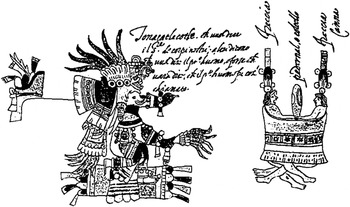
Having laid out a general identification of the figures and their significance, let us now examine particular features in greater detail. On each side of the medallions are portraits of a crocodilian earth monster (Yde 1938:78) (Figure 10). This is a fairly common depiction, which forms the central element of one of Robinson's (1978:60, 98–99) motif categories (Figure 11). In Central Mexican belief, this crocodilian figure, known as Cipactli, was related to earth, fertility, and the calendrical day sign Cipactli, the first day in the 260-day ritual calendar. Tonacatecuhtli (the god of abundance or sustenance), the Aztec patron deity of the day-sign Cipactli, is often depicted with caiman or crocodilian traits, and in the codices he is accompanied by couples, some of them clearly engaged in some sort of sexual activity (Lehmann 1920:1014; Seler 1902–1923:I:418–419; Taube 1992:40) (Figure 12). According to Miller and Taube (1993:172) Tonacatecuhtli is identified with the miracle of procreation, and they state that, “As a god of creations and beginnings, it is appropriate that he is the patron of Cipactli.” Tonacatecuhtli's importance is reflected in the fact the Aztecs had set up his likeness on top of the Pyramid of the Sun at Teotihuacan (Heyden 1998:20), which the Aztecs considered to be the most ‘venerable place of beginnings’ (Boone 2000).

On each side of the medallions are portraits of a crocodilian earth monster (Yde 1938:78).

The crocodilian earth monster is a common motif on Ulua Polychromes (from Strong et al. 1938:59).

Tonacatecuhtli the patron of the day-sign Cipactli, is accompanied by couples, some of them clearly engaged in sexual activity (Codex Vaticanus A).
Imix, the Maya equivalent of the day Cipactli, has the same general pattern of associations as Cipactli. The day-sign Imix is associated with creations and beginnings (Miller and Taube 1993:49). After a lengthy discussion of this day-sign, Thompson (1950:70) concludes, “Imix, therefore, was the earthmonster, the crocodile whose back formed the surface of the earth; the water lily was probably his symbolic form; abundance his aspect and earth his domain.” He also demonstrates that the day is sometimes associated with the tree of creation, which is of interest since the Cordemex Dictionary says that Imix is the esoteric name for the ceiba tree, and that it symbolizes the duality of earth and water and the origin of life (Barrera Vásquez 1980:268).
At the turn of the century, Seler (1902–1923:I:379–381) identified Itzamnaaj as the Maya equivalent of Tonacatecuhtli. Karl Taube (1992:40), in his discussion of Itzamnaaj, concludes:
Both Itzamna and Tonacatecuhtli are aged creator gods associated with earth and heavens, birth, creation, fire, and maize. Like Itzamna, Tonacatecuhtli was also identified with trees: On Borgia page 9 and Vaticanus B page 28 Tonacatecuhtli appears with a flowering tree sprouting from the top of the head…. The concept of Tonacatecuhtli as a sacred tree may well relate to the most striking trait shared between the Mexican and Maya gods: the earth caiman … [T]he Post-Classic Yucatec conception of the earth caiman was very similar to that of highland Mexico. In both regions, the aged god also appears as a personified tree, quite probably the axis mundi. Because of the many specific parallels, the Maya Itzamna and the Mexican Tonacatecuhtli should be regarded as historically related entities … .
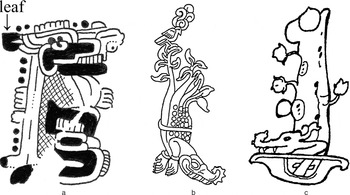
We believe that Seler and Taube are correct in their assessment that Itzamnaaj and Tonacatecuhtli represent a similar set of beliefs. The iconography of the Yde vessel supports and strengthens this identification. First, the earth monster portrayed on the vessel conforms to descriptions of Itzamnaaj and Tonacatecuhtli. The main part of the body is “cross-hatched,” most likely to represent reptilian scales. The highly stylized head appears to have a long protruding snout, below which is a row of white, squarish elements that suggest teeth, and we would argue that these elements are sufficient to identify this figure as a crocodile or caiman. Another significant motif in our identification of the figure with Itzamnaaj is the leaf-like element at the back of the head. Very similar representations of leaves (and branches) with the caiman form can be seen on Izapa Stela 26 and on painted ceramics (see Freidel et al. 1993:136) (Figure 13). While it is notable that we do not have any iconographic representations of Itzamnaaj with copulating couples, the clearly related story of Zipacna in the Popol Vuh is now known to have a highly sexual content (Tedlock 1983). This discussion suggests that a clearly identifiable set of core beliefs associated with a creator deity had a continuous distribution over much of Mesoamerica. In analyzing the iconography of the ceramics around Lake Yojoa, what is interesting is the recognition of a Mesoamerican root concept centered on a “crocodile/tree” deity associated with creation and fertility, the ancestral couple, and caves.

Representations of leaves and branches sported by the earth monster on (a) the Yde vessel; (b) Izapa Stela 26; and (c) a Maya ceramic vessel (drawing by J. Nielsen, after Freidel et al. 1993:136).
A series of faces were painted on the borders both above and below the central panel of the Yde vessel. Stone (1966/67:341) interpreted these as “a full face upper half head of an owl … with short feathers extending from the sides and top.” She saw a connection between the supposed “owl deity” and Teotihuacan influence in the Lake Yojoa region. We believe that the faces represent the “mountain or earth monster,” known to Mayanists as the “Witz-Monster.” The frontal squarish faces with huge, lidded eyes and prominent teeth are marked with a cleft in the forehead. This cleft is a diagnostic feature of the Maya iconographic representation of a mythical mountain associated specifically with creation and the birth of the Maize God (Schele and Mathews 1998:43, 417). From this cleft or split in the earth, maize and the first people emerged. Illustrative Classic Maya examples of the frontally depicted cleft-headed, heavy eye-lidded Witz-Monster are found on Bonampak Stela 1 and the Tablet of the Foliated Cross from Palenque. Openings in the earth in the form of a V-cleft are also depicted in the Mixtec Codex Vindobonensis Mexicanus 1 with several examples of humans emerging from it. The motif may date back to the Olmec and be part of what Peter Furst (1981:157) has called a Mesoamerican core concept or “master myth.” The feather-like elements that adorn the head of the faces on the Yde vessel do not occur in the Maya region. The cleft-headed, personified mountains occur on borders elsewhere in the corpus of polychromes from northwestern Honduras, although in contexts that are as yet poorly understood (e.g. Strong et al. 1938: Pl. 8d). The mouth of the earth monster was also understood to be a cave.
The borders above and below the central panel may contain mountains as a way of conveying the message that the event depicted between the borders is taking place in the earth and more specifically, within the mythical mountain of creation. The fact that the earth monster faces in the lower border were placed directly under the couples and the caves on the raised medallions strongly suggests this. The vessel as a whole represents the mountain of creation in which the two creator gods dwell. They are shown in the cave from whose opening the couple's offspring, the first humans, will emerge. This is being overseen by the god of fertility, beginnings, and caves.
LAKE YOJOA AS THE “PLACE OF CREATION AND ORIGIN”
As already noted, the “dancing figures” form one of the most common motifs on Ulua polychrome vessels and have been shown to relate to the theme of group genesis and cave emergence. An obvious question is why this motif is so common. Creation is a great cosmological event of central importance in many religions. In attempting to explain which types of societies practice large-scale religious landscape modification, geographer Erich Isaac has proposed that cross-culturally there are two basic religious orientations, which might be considered ideal polar opposites. The first orientation seeks the justification of human existence in the act of creation, and the second finds it in a divine charter or covenant. Ritual in the second type of religion will repeatedly reference the covenant, and landscape modifications will be minimal. In societies that see human existence justified by the act of creation, Isaac (1962: 12) says, “the attempt will be made to reproduce the cosmic plan in the landscape with greater or lesser effect upon the land, depending on the elaborateness of reproduction attempted.” Our earlier discussion of the ubiquity of the creator pair is but one indication that Mesoamerica cosmology definitely focuses on the act of creation.
That such events should be celebrated in art is hardly surprising. Dorie Reents-Budet (1994:234) notes that a major category of Maya vase painting consists of depictions of “supernatural characters or deities and … transcendent events,” especially the creation epic related in the Popol Vuh. Thus, the direct association of a landmark with the place of creation would be a matter of such great importance that it could easily have structured artistic production.
A similar structuring of representations in another artistic medium has been documented by Carlos Rincón Mautner around local origin myths in Oaxaca:
The Coixtlahuaca codices extol place and place-making by referring to the earth's creation, especially to two unique landforms found in the Basin considered to be evidence for this event. Allusions to these two landforms occur over and over in the Coixtlahuaca sixteenth-century painted documents. Their eventual appropriation, in a reenactment of creation, appears to be of central importance to the foundation of the Chocho villages in the Coixtlahuaca Basin (Rincón Mautner 1997:135–136).
The two features referred to by Rincón are, not surprisingly, a mountain and a cave. We suggest that the act of creation might have held special significance for the region because it may have been thought to have occurred at Lake Yojoa. Unfortunately, there is no direct evidence for the association of Lake Yojoa with the place of creation in the form of recorded mythologies, because even ethnohistoric documentation from this area is “strangely lacking” (Stone 1957:62). Although Lake Yojoa is the only large lake in Honduras, Squier (1860:59) notes that it did not appear on maps of Central America until 1850. Given the dearth of documentary and ethnographic evidence from this region, our conclusion about the ancient significance of the lake has been pieced together from a number of lines of evidence.
The physical landscape was of enormous importance to Mesoamerican peoples. Ethnohistorical sources document that throughout Mesoamerica, terrain that conformed to models described in Mesoamerican cosmovision were sought out as locations for the founding of new settlements. These features were of such importance that groups would often bypass areas that were more richly endowed ecologically but lacked these features (García-Zambrano 1994:217). García-Zambrano (1994:217–218) says:
Essentially, Mesoamerican migrants searched for an environment with specific characteristics that comprised several symbolic levels…. Such a place had to recall the mythical moment when the earth was created: an aquatic universe framed by four mountains with a fifth elevation protruding in the middle of the water. The mountain at the core had to be dotted with caves and springs, and sometimes surrounded by smaller hills. A setting like this duplicated, and forever would freeze, the primordial scene when the waters and the sky separated and the earth sprouted upwards.
Areas closely modeling this ideal cosmological landscape might have been seen as particularly desirable, precisely because they represented the place where the world was created. As Eliade (1958:378) notes, all the major creative events occur at the center of the cosmos. Since the center is, par excellence, the place of power and prestige, people cross-culturally lay out their communities to define it as the cosmic center. What better way to do this than to appropriate a physical setting that already carried such a connotation? Schele and Mathews suggest that the concern with relating specific natural topographic features with mythological and cosmological events is very ancient, and they point out that the Olmecs were probably the first to set out this pattern. They note that:
… the Tuxtla Mountains with their volcanoes and Lake Catemaco are the perfect natural model for the Place of Reeds and Snake Mountain. These volcanic mountains rise precipitously from the encircling swamps and the three highest volcanoes surround a huge crater lake called Catemaco. In a crevice leading into the crater of the tallest volcano, San Martín Pajapan, explorers found an Olmec statue of a deity raising a tree, and on Tenaspi Island in Lake Catemaco, there was a sculpture of an egg with a human face emerging from its side. The statues depict the Olmec equivalents of raising the World Tree and the birth of humanity. The Olmecs clearly thought of this mountain and the lake at its base as places of Creation (Schele and Mathews 1998:39–40).
What is interesting is that the explorers referred to by Schele and Mathews were Frans Blom and Olivier La Farge and the importance of the location was not lost on them. They noted that:
The island lies in a position where it can be seen from every mountain pass leading into the Catemaco Basin, and it is also visible from every place on the lake shore. A more excellent and dominating location could hardly be found on which to build a place of worship (Blom and La Farge 1926:25).
Ten years later in Honduras, Blom recognized the same pattern that he had seen at Lake Catemaco with its two “sacred” islands (Tenaspi and Agualtepec) in the island of Islita in the northeastern part (originally there was also another island in the southern part) of Lake Yojoa. Of Islita, Yde notes that it:
… can be seen from everywhere on the lake, which led Mr. Blom to think, that it must have been a place of some importance in those days when the region was densely populated, and therefore distinguished in some way or other (Yde 1938:36).
Blom apparently hypothesized that, as on the island of Tenaspi in Lake Catemaco, Islita would hold some kind of architecture and was proven correct when the top of the island was found to be artificially leveled to form a wide terrace (Yde 1938:36). At the top, Blom and Yde discovered a very naturalistic, half-meter-long serpent head that could relate to a widely distributed belief in a Coatepec or “Serpent-Mountain.” Joyce and Henderson (2002) identify some of the stone sculptures from Los Naranjos, including this serpent head, as dating to the Early/Middle Preclassic, and argue that they reflect Olmec influence. One wonders if the Olmecs were drawn to the area because they also recognized the similarity to Lake Catemaco.
It is interesting to note how closely the physical landscape around Lake Yojoa conforms to the conceptual landscape described earlier by García-Zambrano as the place of the world's creation. The watery environment supplied by the lake is surrounded by mountains. But García-Zambrano gives an even more detailed description of the ideal landscape:
This mountainous system accentuates the profile of a horseshoe valley with the deep end toward the hills and the opening toward the lower lands that will be called rinconada. In pre-Columbian Postclassic thought, the rinconada appears to have marked the edges between the human or urban landscape and the natural world presided over by the deities…. In the middle of the rinconada, a natural cave had to contain water or be surrounded by it…. The grotto alluded to the mythological place of origin that preceded all intent of migration: Chicomoztoc, Apoala, Tulan Zuyua, and Chalchiuitlapazco. These cavities, when ritually dedicated to the divinities, became the pulsating heart of the new town, providing the cosmogonic referents that legitimized the settlers' rights for occupying that space and for the ruler's authority over that site (García-Zambrano 1994:218).
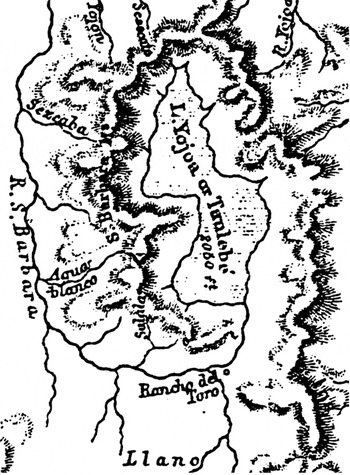
Here again, there is a close correspondence between the horseshoe-shaped Yojoa Valley with its principal settlement at the northern or closed end and the ideal landscape (Figure 14). We will return to the issue of the rinconada and the cave in a moment. Within the valley, smaller hills appear to have been incorporated into the sacred landscape and were marked by the presence of stone mounds. The site of Los Naranjos itself is built against several hills, important features to Mesoamerican peoples.

The horseshoe-shaped Yojoa Valley, with its principal settlement at the northern or closed end, conforms to the ideal landscape described by García-Zambrano (1994) (map taken from Squier 1860).
Since the place of the world's creation defines the cosmic center, it must also be the place of human creation, as that likewise occurs at the center. As mentioned in the discussion of iconography, this act is generally considered throughout Mesoamerica to have occurred in a cave, or at least the first appearance of a group on the surface of the earth is after their emergence from a cave. In the section quoted above, García-Zambrano states explicitly that the cave in the ideal landscape represents the cave of origin. We would argue again, based on several lines of evidence, that the cave of creation at Lake Yojoa and, therefore, the one depicted on the Yde vessel and other vessels, is the Cave of Tauleve, located some 20 km south of the lake. Our assertion is based very simply on the fact that the Cave of Tauleve appears to have been a feature of overriding importance. Lake Yojoa, even in the nineteenth century (Martínez López 1930:37; Squier 1860), was known as Lake Tauleve, and the Lenca people in the area were known as the Taulepa (Strong et al. 1938:10). It is not unusual for a cave to give its name to an area or people. It has already been noted in the Maya region that settlements frequently take their names from a cave in the immediate area (Brady 1997). Furthermore, it is fairly certain in this case that it is the cave that gives its name to the area and not vice versa. Lehmann (1910:724–725) has shown that the name Tauleve derives from the Lenca words t'au or tauq (house) and lepa or leba (jaguar) and thus means “house of the jaguar” (Lehmann 1920:624), a clear cave reference.
The few data available suggest that the cave was of enormous religious importance. While Chapman (1986:162–163) was primarily interested in the modern-day Catholic cult to San Gaspar associated with the cave, she suggests that Tauleve was important in pre-Hispanic times. Stone (1948: 215) noted that the cave was a major pilgrimage destination, which drew people from all parts of the Lenca area for ceremonies beginning on April 24. After attending mass at La Misión, the pilgrims conducted ceremonies at the cave, remaining for two to four days. Tauleve is known to have held a large cache of copper bells similar to that reported by Blackiston (1910), and these may have been offerings brought by pilgrims (Stone 1957:63). The cave's huge chambers (Miller 1980) are similar to those found at other pilgrimage caves such as Naj Tunich, and the cave as a whole conforms to the observation that pilgrimage sites cross-culturally occupy places of “geographical splendor” (Morinis 1992:5). These points are significant in allowing us to state with some confidence that Tauleve was an important regional pilgrimage center whose roots clearly extend back into the pre-contact era. Although we do not know the focus of the cult celebrated there, the nature of pilgrimage centers cross-culturally tells us that the mythical event or belief had to have been of transcendent importance to draw believers from such a wide area. The archaeological and iconographic evidence suggests that the event may have been the creation of the world and the appearance of the first human beings.
CONCLUSIONS
Our reexamination of the Yde vessel has drawn attention to the rendering of a couple seated in a cave. By applying a thematic approach, we have proposed that the well-known catagory of ceramic decoration known as “dancing figures” relates to important Mesoamerican myths surrounding the creation of the world and the origin of the first people. Our interpretation is supported by the presence of a crocodilian figure flanking the cave. This individual has been shown to represent the southeastern periphery equivalent of Tonacatecuhtli/Itzamnaaj, the deity that presided over creation, fertility, abundance, and the origin of the human race. Doris Stone has pointed out the particularly close resemblance to Central Mexican mythology, whereas we have attempted to demonstrate that the iconography is actually pan-Mesoamerican.
We then extended our interpretation beyond the iconography to propose that the prevalence of the origin theme in the ceramics of this region reflects the fact that the event may have been seen to have occurred at Lake Yojoa. The point is a significant one because it firmly connects the Lake Yojoa region to the growing appreciation of the importance of landscape in pre-Columbian cosmology and to the growing body of literature that suggests that sacred landscape played an active role in determining settlement patterns. García-Zambrano's description of the ideal landscape drawn from ethnohistoric data has been presented, and the close correspondence of the actual landscape at Lake Yojoa has been laid out. The archaeological importance of Los Naranjos may in part be a reflection of the contribution of ideology to site development, and it argues for the need to identify other such primordial “places of creation” in Mesoamerica. The appropriation of such places of cosmological importance clearly had economic and political implications. Finally, we suggest that the cave depicted on the ceramics may have been understood to be the Cave of Tauleve.
RESUMEN
Este artículo analiza la iconografía de una vasija de cerámica encontrada hace más de 70 años por el arqueólogo danés Jen Yde en el sitio de Los Naranjos, Honduras. La relativamente más acentuada representación naturalista en la escena de la vasija nos permite reconocer dos figuras, frecuentemente llamadas “figuras bailantes,” sentadas con las piernas cruzadas en una cueva. Al comparar la posición de piernas cruzadas con representaciones similares del arte mesoaméricano, está claro que los dos individuos parecen estar copulando. Nosotros relacionamos la escena al bien documentado cuerpo sobre la mitología de origen mesoaméricano la cual habla de la pareja primordial quien produjo a los primeros seres humanos. Nuestra atención, por lo tanto, se fija en el sitio de Los Naranjos y documenta el hecho de que el área del lago Yojoa refleja cercanamente el paisaje idealizado mesoaméricano asociado con el lugar de la creación de la tierra. Al combinar esta percepción con la representación en la vasija Yde, sugerimos que la cueva de Tauleve pudo haber sido considerada como el lugar de la creación humana ó el lugar del aparecimiento humano.
ACKNOWLEDGMENTS
The authors thank Berete Due, former curator of the American Indian Collections at the Danish National Museum, for her assistance and encouragement in studying the Yde vessel, and John Lee, Museum photographer, for providing us with photographs of the vessel and other sherds. This project was begun while Brady was a visiting professor in the Department of American Indian Languages and Culture at the University of Copenhagen, and he is deeply appreciative to Una Canger for providing this wonderful opportunity. The paper benefitted from suggestions by Ricardo Agurcia, Claude Baudez, Una Canger, Maria Krabbe Hammershøy, Rosemary Joyce, Toke Sellner Reunert, René Viel and Søren Wichmann. Eugenia Robinson deserves special thanks for providing the authors with a copy of her thesis and for undertaking a very detailed critique of the paper. Marilyn Beaudry-Corbett also should be singled out for her numerous valuable suggestions and for her sharp editorial eye that improved our manuscript immeasurably.