Introduction
Pinus is the largest genus in family Pinaceae. Over 100 species are known, mostly from the northern hemisphere (Price et al. Reference Price, Liston, Strauss and Richardson1998). The genus is widespread in boreal, temperate, and subtropical regions, but its distribution is rather limited in the tropics.
Two pine species, Pinus merkusii Jung et de Vriese and Pinus kesiya Royle ex Gordon, are known widely from tropical Asia (Whitmore Reference Whitmore1984; Ashton Reference Ashton2014). In the continental part of the Asian tropics, where the climate is seasonal with distinct dry seasons, pine-deciduous dipterocarp forests often develop in mountainous areas where forest fires occur periodically (Santisuk Reference Santisuk1988). P. merkusii has a so-called grass stage of seedlings, that is considered to be fire-resistant during the initial period of regeneration (Keeley & Zedler Reference Keeley, Zedler and Richardson1998). In the humid tropics of the Malaysian region, where the climate is aseasonal, the distribution of pine species is limited to xeric, poorly vegetated sites where frequent fires occur in Philippines and Sumatra (only P. merkusii).
Other tropical pines, Pinus krempfii Lecomte and Pinus dalatensis Ferré, can be found along the southern part of the Annamite Range, Vietnam, where the climate is orographically very humid. In contrast to the distribution of P. merkusii and P. kesiya, these pine species are limited to quite small areas (Hiep et al. Reference Hiep, Loc, Luu, Thomas, Farjon, Averyanov and Regalado2005). P. krempfii is endemic to the Da Lat Plateau, the southernmost part of Annamite Range. P. dalatensis also grows only on the Da Lat Plateau and several nearby areas to the north. Both species are known from fewer than 10 locations and are listed as vulnerable on both global and national red lists (Hiep et al. Reference Hiep, Loc, Luu, Thomas, Farjon, Averyanov and Regalado2005).
Population genetics studies (Phong et al. Reference Phong, Lieu, Hien and Hiep2015; Wang et al. Reference Wang, Mahani, Ng, Kasumi, Phi, Inomata, Wang and Szmidt2014) have been performed for P. krempfii. Genetic differentiation among populations at nuclear loci was extremely low in comparison with other pine species. Its small population sizes and low genetic diversity suggest that the extinction risk of P. krempfii is very high. For P. dalatensis, small population size and scarce regeneration are becoming a major threat to the survival of this species through the loss of genetic diversity (Truong et al. Reference Truong, Tien, Trieu, Giang, Anh, Nghia and Truong2019), but further genetic studies are necessary.
Ecological information on P. krempfii and P. dalatensis is scarce. Neither pine species grow in xeric deciduous forests; both grow in moist evergreen broad-leaved forests where forest fires are rare. Thus, the regeneration processes of P. krempfii and P. dalatensis are expected to be quite different from those of P. merkusii and P. kesiya. P. krempfii is a unique pine having flat needles like Podocarpaceae, and its juveniles appear to be shade-tolerant, based on the physiological features of the leaves (Brodribb & Field Reference Brodribb and Field2007).
To conserve these endangered pine species in situ, it is important to understand the regeneration process of their natural populations. To elucidate these regeneration processes, vegetation studies are important. Such studies can help us to understand the habitat and community dynamics of these pine forests. However, to date, there have been few studies on mountain vegetation in Vietnam, including on these pine species. Averyanov et al. (Reference Averyanov, Loc, Heap and Harder2003) described the floristic composition of mountain vegetation in Vietnam at the macroscale. P. krempfii and P. dalatensis are seen in the same geographical area, but information on vegetation at the forest stand level is lacking. Therefore, we aimed to determine whether there are differences in stand structure and floristic composition between P. krempfii forests and P. dalatensis forests.
In the present study, in order to clarify the regeneration process of these tropical pine species, we examined the floristic composition and stand structure of tropical pine forests containing P. krempfii and P. dalatensis. Juvenile occurrence of these pines on the forest floor was also examined. We asked the following questions: (1) What are the structural and floristic differences between these two types of pine forests; and (2) Does the regeneration process of these pine species differ?
Methods
Study area
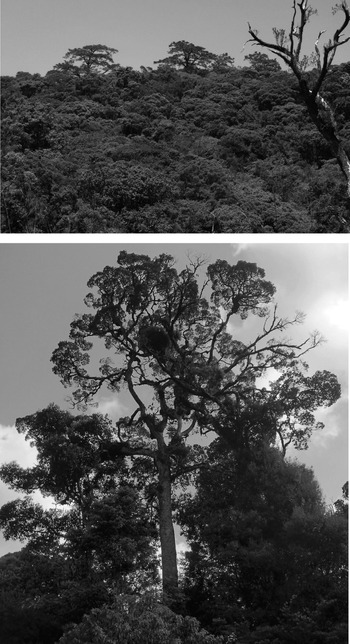
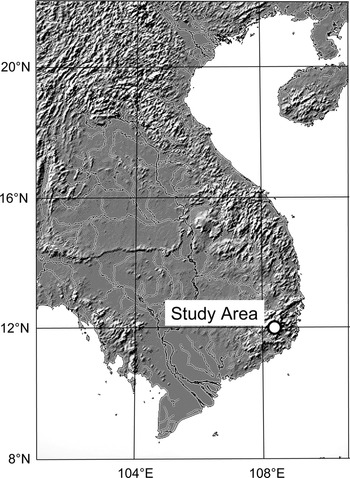
Field surveys were conducted at Bidoup Nui Ba National Park in Lam Dong District, Vietnam. Bidoup Nui Ba National Park was established in 2004 and is one of the five largest national parks in Vietnam. The park area is mostly covered with mountain evergreen broad-leaved forests with coniferous species (Figure 1, upper). The park is located on the Da Lat Plateau, in the southern part of the Central Highlands (Figure 2).
Upper, forests in Bidoup Nui Ba National Park. Note emergent pine trees of which crowns spread over continuous forest canopy of evergreen broad-leaved trees; Lower, tree form of Pinus krempfii.

Location of the study area. Base map is modified from Topographic30deg N0E90.png (https://commons.wikimedia.org/w/index.php?curid=166887).

The Da Lat Plateau is a hilly region, lying mostly at elevations from 1,200 m to 2,200 m, the highest peaks of the Nation Park being Bi Doup (2,287 m) and Nui Ba (2,167 m). The geology of the plateau is rather complex with a mixture of granites, dacites, and sedimentary rocks.
In Da Lat City (1513 m a.s.l.), the mean annual temperature is 18.2°C and the mean annual rainfall is 1865 mm, with a summer rain peak and several months of a dry winter period with <50 mm rainfall (Averyanov Reference Averyanov, Loc, Heap and Harder2003). However, in the mountainous area, morning condensation as dew and frequent heavy, foggy mists are very common and the amount of rainfall increases with altitude.
The Da Lat Plateau has been recognised as a core area of biodiversity conservation in tropical Asia (Davis et al. Reference Davis, Heywood and Hamilton1998). The area also harbours rich coniferous flora, including relict, endangered species such as Fokienia hodginsii (Dunn) A. Henry and H. H. Thomas, Glyptostrobus pensilis (Staunt.) K. Koch, and Keteleeria evelyniana Mast (Hiep et al. Reference Hiep, Loc, Luu, Thomas, Farjon, Averyanov and Regalado2005).
Study species
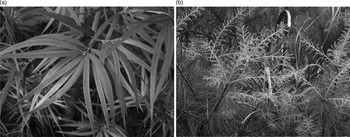
P. krempfii is a two-needle pine, morphologically quite unique in having two flat, podocarp-like needles (Figure 3 left). There have been discussions on the taxonomic position of the species, but it is broadly recognised as being included in the genus Pinus, subgenus Strobus, subsection Krempfianae based on analyses of chloroplast DNA (Gernandt et al. Reference Gernandt, López, Garcia and Liston2005). It is thought to be an ancient relict and is the only extant species in subsection Krempfianae.
Branches of target pine species. Left, Pinus krempfii; Right, P. dalatensis.

P. dalatensis is a five-needle pine (Figure 3, right) that also belongs to subgenus Strobus. This species was previously known only from several locations in the Central Highlands, Vietnam, but was recently discovered on the Lao side of the Annamite range (Thomas et al. Reference Thomas, Sengdala, Lamxay and Khou2007). Several infraspecific taxa are distinguished, var. bidoupensis (in the study area), var. dalatensis, and subsp. procea (Businsky Reference Businsky1999).
Field methods and data analysis
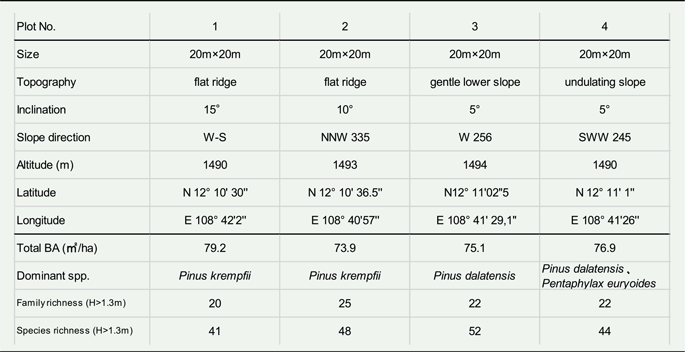
In March 2018, four vegetation plots of 20 m by 20 m were established in an evergreen forest at approximately 1500 m above sea level, two for P. krempfii-dominant stand and two for P. dalatensis-dominant stand. The plots were situated within a small area, and the distances between plots were <1.5 km. The topography of the study area was gentle. Elevations of the plot were similar for all plots (Table 1). In terms of topography, Plots 1 and 2 were located on gentle convex slopes and Plots 3 and 4 were on gentle concave slopes.
General features of plots.

Each plot was divided into four subplots of 10 m by 10 m, and trunk diameter and tree height were measured for every tree >1.3 m in height in one subplot. In the remaining three subplots, the same measurements were made for trees >5 cm in trunk diameter. Species identification was performed for every tree measured. When species identification in the field was difficult, branch samples were taken to the laboratory and the species was confirmed there. Species identification was made primarily by Trường Thanh Hoàng. Furthermore, the height of every pine seedling in the whole plot was measured.
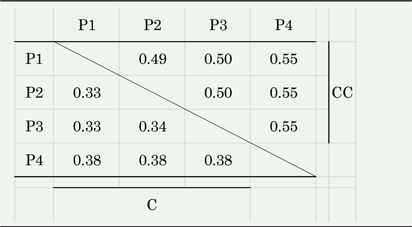
Coefficients of floristic similarity C by Jaccard (Reference Jaccard1901) and CC by Sørensen (Reference Sørensen1948) were calculated among plots.
Nomenclature follows the Angiosperm Phylogeny Group (APG IV 2016).
Results
Floristic composition of plots
In total, 92 species were found in the plots (Appendix). Species richness in each plot was relatively high; 20–25 families and 41–52 tree species were identified in each plot. The highest species richness at the family level was shown by Lauraceae (12 spp.), followed by Fagaceae (9 spp.), Symplocaceae (6 spp.), Elaeocarpaceae (5 spp.), Ericaceae (5 spp.), and Rubiaceae (5 spp.). The most common species occurring in every plot were Castanopsis chinensis, Engelhardia roxburghiana, Neolitsea cambodiana, Magnolia annamensis, Ardisia crenata, Syzygium zeylanicum, Lasianthus condorensis, Euodia lepta, Symplocos adenophylla, Pyrenaria jonqueriana, and Ternstroemia japonica.
Floristic similarities among plots were rather low (Table 2), indicating that ß diversity was high among plots. Distinguishing between P. krempfii forest (Plots 1 and 2) and P. dalatensis forest (Plots 3 and 4) was difficult in terms of overall floristic composition based on the presence/absence of species.
Coefficients of floristic similarities among plots. C, index by Jaccard (Reference Jaccard1901); CC, index by Sørensen (Reference Sørensen1948).

Relative basal area
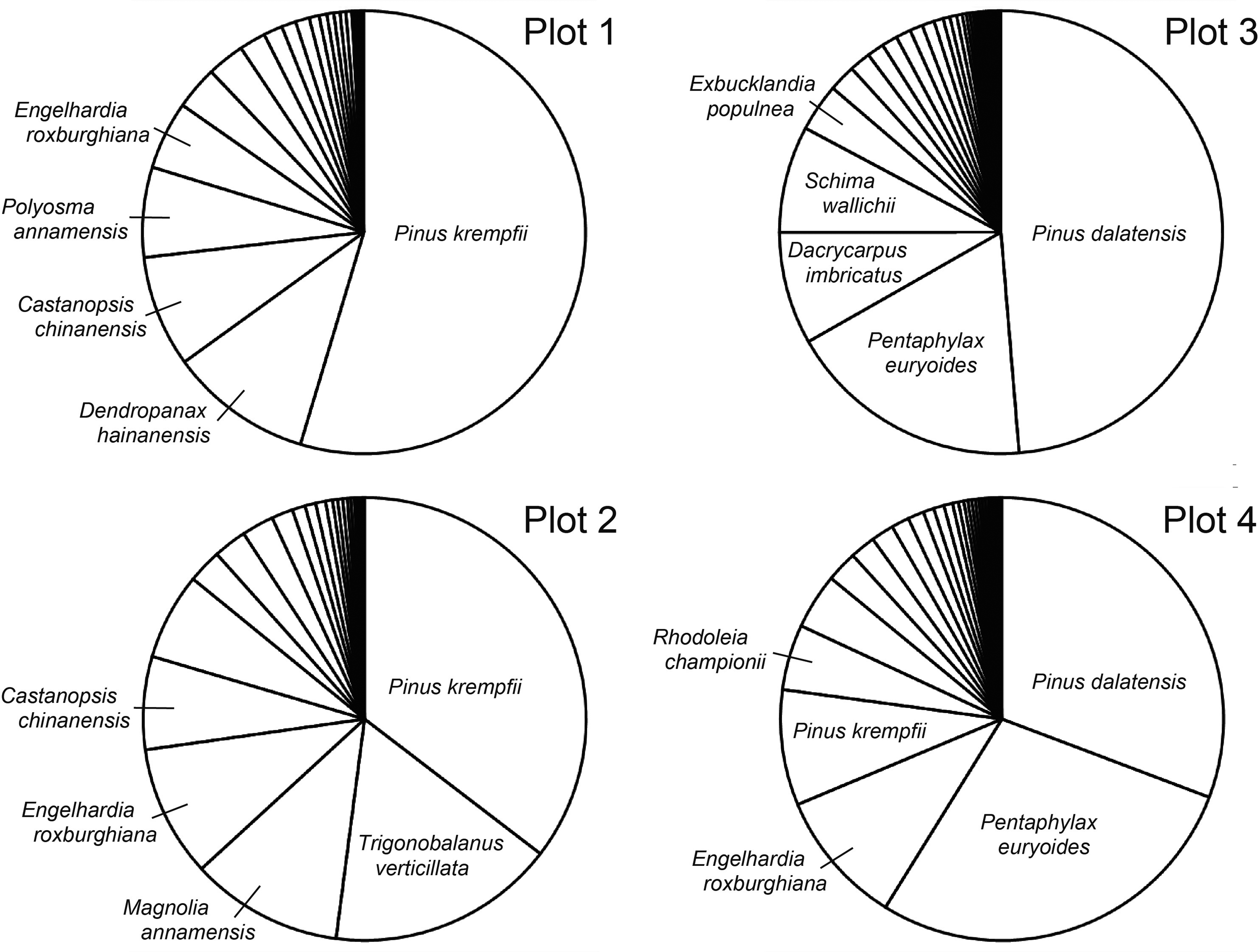
The sum of the basal area was >70 m2/ha in each plot because of the large pine trees included in the plots (Table 1). In terms of relative basal area (RBA), pine species were dominant in every plot: P. krempfii in Plot 1 and Plot 2 and P. dalatensis in Plot 3 and Plot 4 (Figure 4). In P. krempfii forest, the RBA of Fagaceae species such as C. chinensis and Trigonobalanus verticillata was relatively high and Fagaceae showed the second largest share of basal area at the family level: 10.3% in Plot 1 and 22.5% in Plot 2. On the other hand, in P. dalatensis forest, the share of Fagaceae species was very low, <3.0%, and the share of pioneer/seral species, such as Pentaphylax euoryoides and Schima wallichii, was higher. Although the species richness of Lauraceae was highest at the family level, the RBA of Lauraceae species was low in every plot (<2.5%).
Relative basal area of component species in each plot. Species names of upper five rank in each plot are indicated.

Stand structure and floristic composition
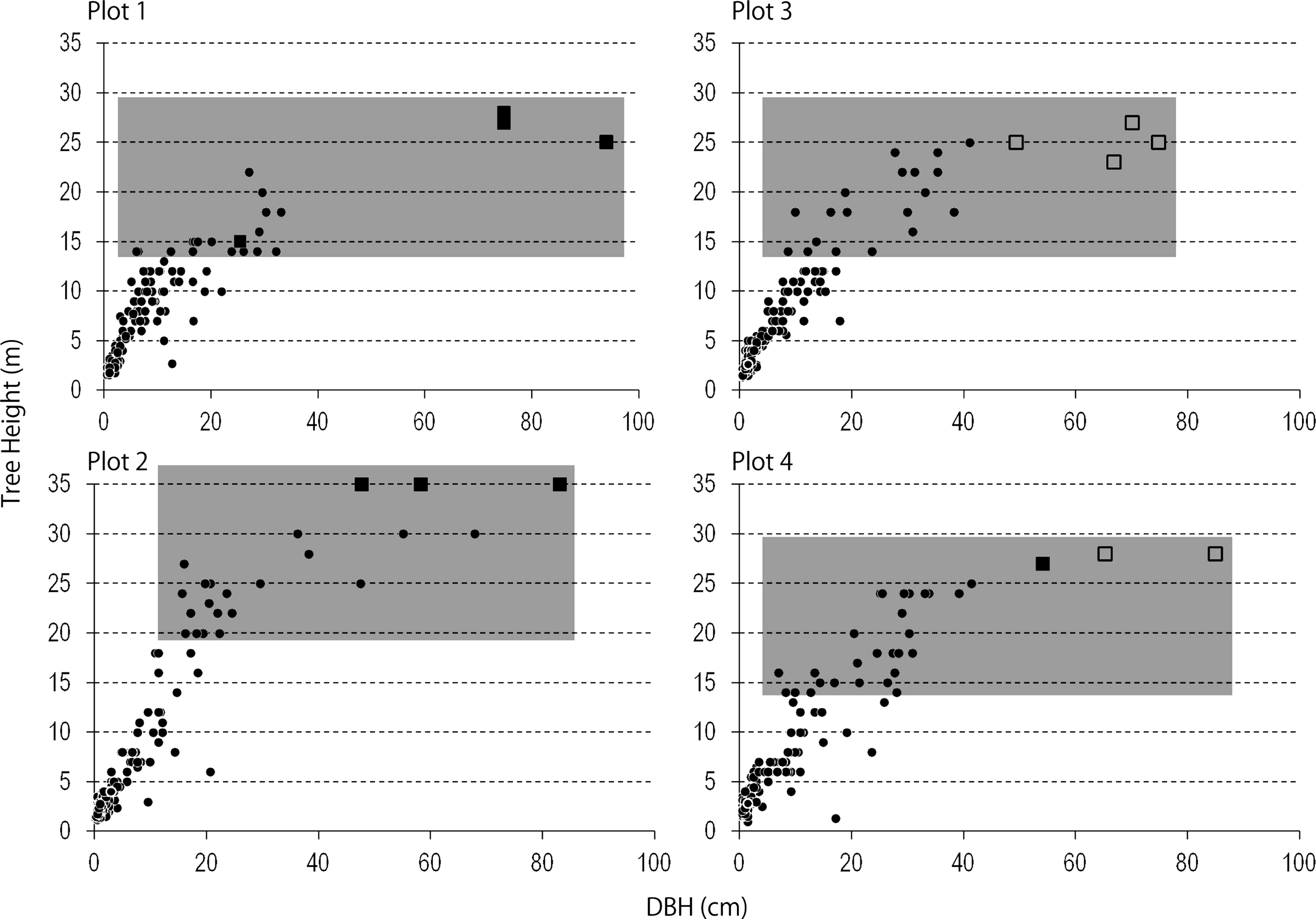
Both pine species grew as emergent trees in the evergreen broad-leaved forest. The stem of both pine species is straight and tall, with a broad, umbrella-like crown (Figure 1, lower). The lowest branches of a crown originate from the upper part of the main stem, usually around 15 m above the ground. In the plots, both species reached heights >25 m and spread their crowns over the main canopy layer (Figure 5). The stem diameters of the pine species also exceeded those of most other trees.
Relationships between stem diameter and tree height in each plot. Filled square, Pinus krempfii; open square, Pinus dalatensis. Shaded areas indicate the range of which floristic composition was presented in Table 3.

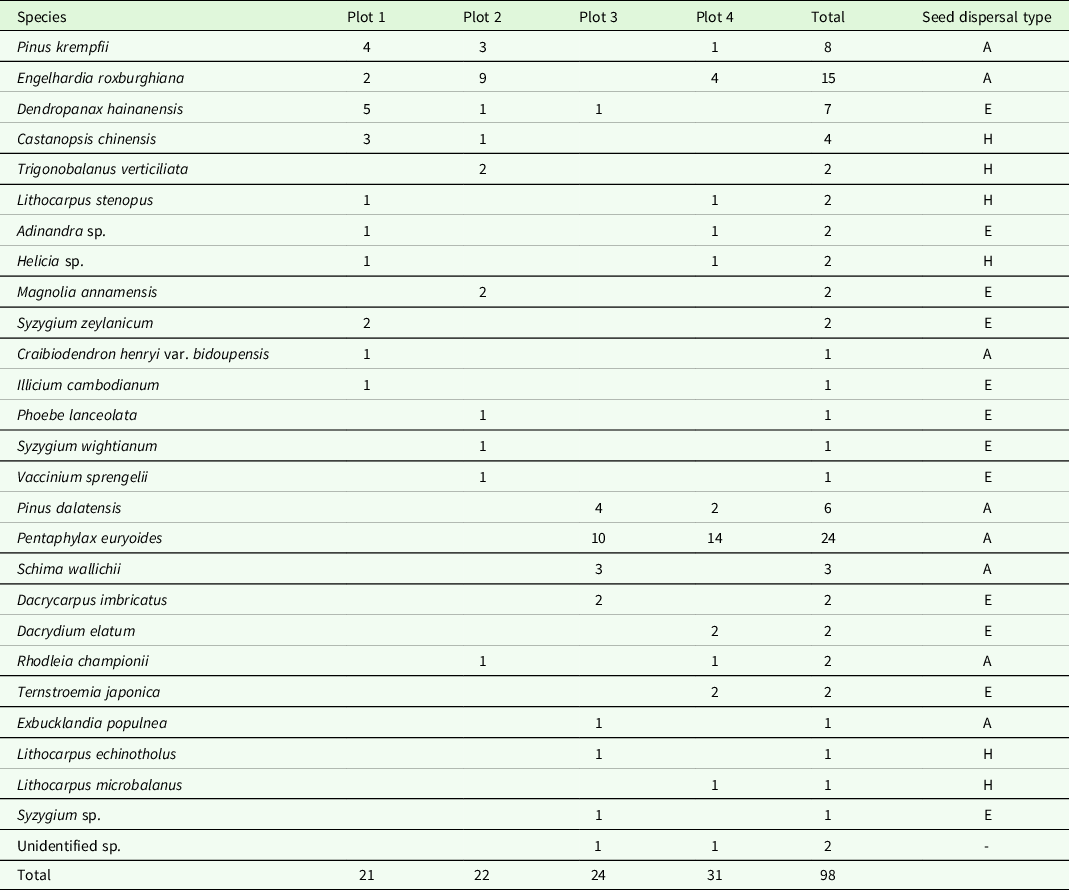
The floristic composition of the main canopy layer clearly differed between P. krempfii forest (Plots 1 and 2) and P. dalatensis forest (Plots 3 and 4), as shown in Table 3. In P. krempfii forest, Fagaceae species (C. chinensis and T. verticillata), E. roxburghiana, and Dendropanax hainanensis constituted main canopy layer. In contrast, in P. dalatensis forest, Pentaphylax euryoides was common in main canopy layer. Pioneer species such as S. wallichii and Exbucklandia populnea and gymnosperms such as Dacrycarpus imbricatus and Dacrydium elatum were also found. Although two Fagaceae trees (Lithocarpus echinotolus, L. microbalanus) were also found in plots of P. dalatensis forest, those were confined to the lowest part of the main canopy layer. Broad-leaved species bearing small, winged seeds dispersed by wind (anemochory) were prevalent in P. dalatensis forest, while broad-leaved species bearing fruits dispersed by animals (endozoochory and hoarding dispersal) were prevalent in P. krempfii forest.
Floristic composition of the canopy layer in each plot. Refer Fig. 5 for size of trees included in the calculation; Plot 1, Plot 3 and Plot 4, H>=14m; Plot 2, H>=20m. A, Anemochory; E, Endozoochory; H, Hoarding dispersal.

In the understory, a variety of shrub and small tree species were found, in addition to saplings and sprouts of various tree species (Appendix). L. condorensis (Rubiaceae), Polyosma annamensis (Escalloniaceae), and N. cambodiana (Lauraceae) were found in every plot and were the most abundant.
Juveniles of pine species
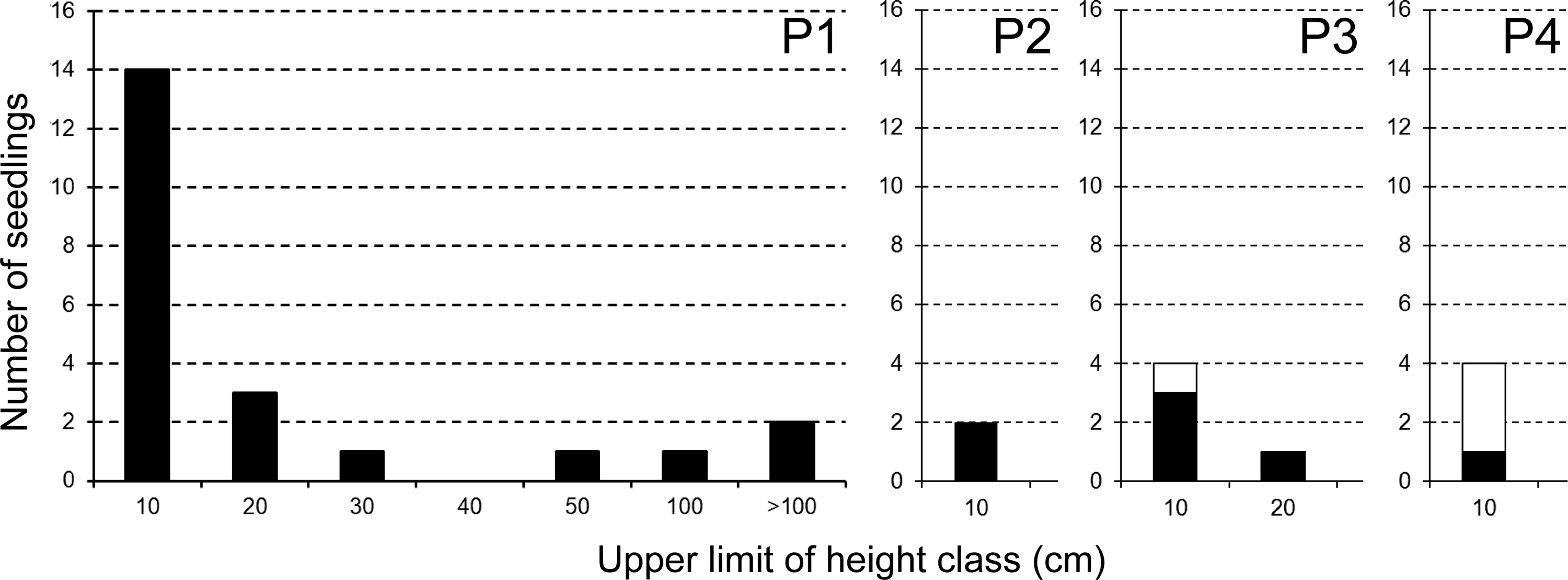
Juveniles of P. krempfii occurred in every plot. In Plot 1, in particular, many juveniles were observed and some reached heights >50 cm (Figure 6). There was a small canopy gap formed by an uprooted tree, just near Plot 1. Few juveniles of P. dalatensis were found, and these were confined to the smallest height class.
Juveniles of pine species in each plot. Solid bar indicates juveniles of P. krempfii and open bar those of P. dalatensis.

Discussion
Phytogeography of the forests
From a phytogeographical viewpoint, forest vegetation in Vietnam has a close affinity with forests in several adjacent areas (Averyanov et al. Reference Averyanov, Loc, Heap and Harder2003). In lowlands with humid climates, forests have many floristic affinities with wet evergreen forests in Malaysian region, which is characterised by the presence of many tropical families such as Dipterocarpaceae, Apocynaceae, Burseraceae etc. In southwestern Vietnam with tropical monsoonal climates, forests have many floristic affinities with semi-evergreen, semi-deciduous, or deciduous forests in Myanmar, Thailand, Cambodia, and Laos, which are characterised by deciduous Dipterocarpaceae, Lithraceae (Lagerstroemia), Fabaceae, etc. (Rundel Reference Rundel1999; Schmid Reference Schmid1974).
However, the change in flora and vegetation from lowland to mountain areas is marked in Vietnam. Tropical families such as Dipterocarpaceae, Anacardiaceae, Euphorbiaceae, etc. rapidly decrease above 1,200 m in altitude, and plant families dominant in subtropical regions, such as Fagaceae, Lauraceae, Theaceae (in broad sense; Pentaphylaceae and Theaceae in narrow sense), etc., increase in species richness and dominance. Mountain forests in Vietnam are a type of Lauro-Fagaceous forest that is distributed broadly in the subtropical and warm-temperate regions of East Asia, from Himalaya to Japan through southern China. The Da Lat Plateau, which is located in the southernmost part of the Annamite Range, is actually a southern range limit of this type of forest. Mountain flora in Vietnam has a close affinity with that of Yunnan and Guangxi in southwestern China. For example, among nine species of Fagaceae in the plots, six are common to Yunnan and two, Lithocarpus microbalanus and Lithocarpus stenopus, are endemic to Vietnam. The flora of P. krempfii and P. dalatensis forests in this study (Appendix) probably fall within the floral range of Lauro-Fagaceous forests in the area, although pine species are dominant in the overstory.
Another feature of mountain forests in Vietnam is that they harbour many relict, primitive taxa. For example, T. verticillata, which was recently found in Vietnam and in southern China (Ng & Lin Reference Ng and Lin2008; Zhu & Zhou Reference Zhu and Zhou2017), is a basal, extant species of Fagaceae that was previously known only from tropical mountains in Malaysia. For Hamamelidaceae, two genera found in the plots, Exbucklandia and Rhodoleia, form the most basal clade in the family (Li et al. Reference Li, Bogle and Klein1999; Magallón. Reference Magallón2007). Among the conifers, 6–9 species are endemic to Vietnam and ancient relictual genera such as Xanthocyparis, Glyptostrobus, Pseudotsuga, etc. occur.
Structural and floristic differences between P. krempfii and P. dalatensis forests
In both P. krempfii and P. dalatensis forests, pine species grow as emergent trees, spreading their crowns over the continuous canopy formed by evergreen broad-leaved species. Straight, massive trunks and long, laterally spreading crowns characterise the tree forms of these pine species. This growth form is a very important trait that allows pine species to coexist with surrounding evergreen broad-leaved trees in the forest overstory. However, the growth process that produces this tree form is not obvious. A rapid initial growth capable of outcompeting the surrounding broad-leaved trees and the subsequent, rapid development of a large spreading crown can be predicted; however, further study is necessary on this point.
Notably, the floristic composition of the main canopy layer just below the pine crowns clearly differed between P. krempfii and P. dalatensis forests. This might reflect the difference in regeneration processes of the two forest types as below.
In the main canopy layer of P. krempfii forest, shade-tolerant species such as Fagaceae, C. chinensis, T. verticillata, and D. hainanensis were abundant. These broad-leaved species are major components of the canopy of Lauro-Fagaceous forests, which are climax forests in the study area (Schmid Reference Schmid1974). C. chinensis and Dendropanax species were also abundant in the understory. Thus, forest stands with P. krempfii in the canopy can be expected to reach the mature stage, from the viewpoint of successional development of a forest stand.
Conversely, the main canopy of the P. dalatensis forest was mostly composed of pioneer species having small winged seeds, including S. wallichii, E. populnea, P. euryoides, and Rhodoleia championii, or was composed of conifers, D. imbricatus and D. elatum. Pioneer species with small seeds usually cannot regenerate in mature forests, but require disturbed sites. Thus, it is suggested that P. dalatensis forest is generally established after a larger disturbance and is a successional stage to a mature forest stand.
Among the pioneer/seral species occurring in P. dalatensis forest, S. wallichii and E. populnea are known widely as pioneer species in Asian lower mountain forests of tropical and subtropical regions (Khan et al. Reference Khan, Rai and Tripathi1987; Rao et al. Reference Rao, Barik, Pandey and Tripathi1990). Both species regenerate well at disturbed sites and grow rapidly in open conditions (Zhang & Xu Reference Zhang and Xu2004; Bhat et al. Reference Bhat, Singha, Satapathy, Sharma and Bujarbaruah2010), but are often seen in mature forests as large remnant trees.
Ecological information on P. euryoides is limited. This species is a shrub or small tree that occurs widely in lower to upper montane forests in southern China, Indochina, the Malay Peninsula, and northern Sumatra. In Malaysia, it is abundant on rocky ridges near the summit of Gunung Ulu Kali at 1758 m a.s.l. (Chua & Saw Reference Chua and Saw2001) and in upper montane forests with a thick layer of dry peat on Gunung Kob, 1266 m a.s.l. (Yao et al. Reference Yao, Kamarudin, Chew and Kiew2009). This species has primitive, xeromorphic to mesomorphic wood anatomy features and can grow in a wide range of habitats (Carquist Reference Carlquist1984). Interestingly, P. euryoides and Schima remotiserrata are codominant in forests of another endangered pine, P. kwangtungensis, which occurs from northern Vietnam to Southern China (Wang et al. Reference Wang, Miao, Wu, Xue and Jin2008).
Ecological information on R. championii is also limited. This species is a shrub or small tree belonging to the Hammamelidaceae and occurs widely in lower to upper montane forests in southern China, Indochina, the Malay Peninsula, and Indonesia. Regeneration is evident along roads and in open places, but it often becomes a codominant species in tropical lower montane forests (Averyanov et al. Reference Averyanov, Loc, Heap and Harder2003).
There have been a few studies on the regeneration of D. imbricatus and D. elatum. Kitayama et al. (Reference Kitayama, Aiba, Ushio, Seino and Fujiki2011) found that in Borneo, Podocarpaceae trees (D. imbricatus and Dacrydium gracile) regenerate under well-lit conditions in nutrient-limited soils where nutrient-demanding pioneer species (e.g. Macaranga and Ficus species) cannot grow well. Another study (Akkarasedthanon et al. Reference Akkarasedthanon, Chuea-Nongthon and Grote2017) examined factors affecting the size structure and sapling occurrence of Podocarpaceae species in tropical montane forests of central Thailand. They reported that small seedlings of D. elatum were prevalent in the forest, but saplings were few and were seen only on top ridges and cliffs with plenty of light because seeds of this species need well-lit conditions to germinate.
Regeneration of pine species
Two pine species, P. krempfii and P. dalatensis, were found in the same area, both as emergent trees in evergreen broad-leaved forests. However, the regeneration process was quite different between the two species, as described below.
Juveniles of P. krempfii were prevalent on the forest floor. As shown in Plot 1, juveniles sometimes reached heights >50 cm near small canopy gaps. Brodribb & Field (Reference Brodribb and Field2007) examined the photosynthetic and hydraulic physiology of P. krempfii leaves and clarified that this species shows relatively high shade tolerance. They suggest that this species can grow in tropical evergreen forests by acquiring the ability to compete with evergreen species.
The floristic composition of the main canopy layer of P. krempfii forest suggests that the forest stand had reached a late successional stage in which Fagaceae species are dominant. It is thought that P. krempfii can regenerate in small canopy gaps created by death of a single or a few canopy trees because it has seedling banks on the forest floor.
Conversely, few juveniles of P. dalatensis were found in the forest interior, and the main canopy layer of P. dalatensis forest was mostly composed of pioneer/seral species and conifers. Fagaceae species that are common in mature forests were scarce in this type of forest. This suggests that P. dalatensis requires the open conditions created by large disturbances coupled with the death of multiple canopy trees. Factors causing large disturbances are unknown, but strong winds brought by typhoons might be responsible.
Another possible explanation for the different regeneration patterns of the two pine species is different requirements of soil conditions. Although no soil surveys were performed in this study, we have some preliminary field observations. We observed brown forest soil in P. krempfii forest, but white, strongly leached soil, a kind of Podozol, in the P. dalatensis forest. P. dalatensis forest might be a kind of tropical heath forest, or Kerangas. Stunted heath forest in which D. elatum and D. imbricatus dominate is reported from the Bokor Plateau (ca. 1,000m a.s.l.) in the Elephant Mountains of Cambodia, where the shallow soils and water-logged depressions are common (Rundel & Middletown Reference Rundel and Middleton2017). On Mt. Kinabalu in Malaysia, lower montane kerangas in which D. elatum, D. imbricatus, and S. wallichii are included develop on podzolised soil of sedimentary rock origin (Aiba & Kitayama Reference Aiba and Kitayama1999; Ashton Reference Ashton2014; Kitayama et al. Reference Kitayama, Aiba, Takyu, Majalap and Wagai2004). This forest resembles to P. dalatensis forest viewed from soil condition and floristic composition of stand. The study area is geologically composed of complexes of granites, dacites, and sedimentary rocks. Different soil conditions related to the underlying geology might increase the vegetation diversity of the area.
Acknowledgements
This study was supported by Pro Natura Foundation Japan’s 28th Pro Natura Fund to TTV. The authors would like to thank Enago (www.enago.jp) for the English language review.
Appendix
Floristic composition of plots.