

Adolescence is a critical developmental period for mental health, with symptoms of lifelong mental illness typically developing prior to age 25 years (Call et al., Reference Call, Riedel, Hein, McLoyd, Petersen and Kipke2002). Current reported rates of mental health problems among adolescents are high, with prevalence estimates reported to be 40.3% over 12 months and 23.4% over the past 30 days (Kessler et al., Reference Kessler, Avenevoli, Costello, Georgiades, Green, Gruber and Merikangas2012). Almost 20% of young people reporting mental health problems report three or more problems (Heneghan et al., Reference Heneghan, Stein, Hurlburt, Zhang, Rolls-Reutz, Fisher, Landsverk and Horwitz2013). Such problems are more prevalent in rural areas as a result of psychosocial, behavioural and demographic variables that differ from those in urban areas (see Australian Bureau of Statistics, 2012). The Australian landscape makes such issues especially salient for professionals working in the country. The imposing burden on society in terms of the individual, families, and the health, justice and welfare systems as a consequence of mental health problems that arise in childhood and adolescence are well documented (Heckman, Reference Heckman2012), making adolescence a critical time for developing positive mental wellbeing.
Undeniably, positive mental wellbeing has emerged as an important protective factor against mental health issues (Gargiulo & Stokes, Reference Gargiulo and Stokes2009) and a range of other health outcomes (Australian Bureau of Statistics, 2008). Consequently, because of its major implications for health and social outcomes and psychological functioning (Linley & Joseph, Reference Linley and Joseph2004; Stewart-Brown et al., Reference Stewart-Brown, Tennant, Tennant, Platt, Parkinson and Weich2009), and for its contribution to public health and policy issues (Dolan, Laylard, & Metcalf, Reference Dolan, Layard and Metcalf2011), positive mental wellbeing has received attention worldwide. In many countries, promoting positive mental wellbeing among teenagers has become a national priority (Clarke et al., Reference Clarke, Friede, Putz, Ashdown, Martin, Blake and Platt2011), particularly as a preventive and population-based complement to the treatment of psychopathology (Jacka et al., Reference Jacka, Reavley, Jorm, Toumboiurou, Lewis and Berk2013; Perry, Presley-Cantrell, & Dhingra, Reference Perry, Presley-Cantrell and Dhingra2010).
Considered by many to be a complex construct, positive mental wellbeing covers both hedonic (i.e., happiness, subjective wellbeing) and eudemonic (i.e., positive functioning) aspects of wellbeing (Clarke et al., Reference Clarke, Friede, Putz, Ashdown, Martin, Blake and Platt2011; Ryan & Deci, Reference Ryan and Deci2001; Tennant, Hiller et al., Reference Tennant, Hiller, Fishwick, Platt, Joseph, Weich and Stewart-Brown2007), both of which together comprise the broad concept of mental wellbeing (Clarke et al., Reference Clarke, Friede, Putz, Ashdown, Martin, Blake and Platt2011). It has also been argued that it takes a combination of these for one to be considered mentally healthy (Keyes, Reference Keyes2007). However, regardless of the increased interest in positive mental wellbeing, there is a dearth of appropriate measures (Hu, Stewart-Brown, Twigg, & Weich, Reference Hu, Stewart-Brown, Twigg and Weich2007), particularly for adolescents. Consequently, surveys and intervention evaluations have relied on measures of mental illness (e.g., prevalence of depression or anxiety) as their ‘marker’ of mental wellbeing (Hu et al., Reference Hu, Stewart-Brown, Twigg and Weich2007), even though mental wellbeing is conceptualised as more than the absence of mental illness (Clarke et al., Reference Clarke, Friede, Putz, Ashdown, Martin, Blake and Platt2011).
One instrument that has shown promise and may be particularly useful for school, educational, and developmental psychologists is the 14-item Warwick-Edinburgh Mental Well-being Scale (WEMWBS: Stewart-Brown et al., Reference Stewart-Brown, Platt, Tennant, Maheswaran, Parkinson, Weich and Clarke2011; Tennant, Hiller et al., Reference Tennant, Hiller, Fishwick, Platt, Joseph, Weich and Stewart-Brown2007). This covers both hedonic elements of positive mental wellbeing (nine items covering happiness, joy, contentment; e.g., ‘I've been feeling cheerful’, ‘I've been feeling optimistic about the future’, ‘I've been feeling relaxed’) and eudemonic elements of positive mental wellbeing (five items covering psychological functioning, autonomy, positive relationships with others, sense of purpose in life; e.g., ‘I've had energy to spare’, ‘I've been thinking clearly’, ‘I've been able to make up my own mind about things’). For a description of its development, see Tennant, Hiller et al. (Reference Tennant, Hiller, Fishwick, Platt, Joseph, Weich and Stewart-Brown2007) and Tennant, Joseph, and Stewart-Brown (Reference Tennant, Joseph and Stewart-Brown2007). However, the data supporting its use comes almost exclusively from adults: Cronbach alphas of α = 0.87–0.93 and significant correlations with other scales measuring components of affect or wellbeing (Clarke et al., Reference Clarke, Friede, Putz, Ashdown, Martin, Blake and Platt2011; Lloyd & Devine, Reference Lloyd and Devine2012; Tennant, Hiller et al., Reference Tennant, Hiller, Fishwick, Platt, Joseph, Weich and Stewart-Brown2007), including using the shorter seven-item version (Vaingankar et al., Reference Vaingankar, Subramaniam, Chong, Abdin, Edelen, Picco and Sherbourne2011), significant age and gender effects (Tennant, Hiller et al., Reference Tennant, Hiller, Fishwick, Platt, Joseph, Weich and Stewart-Brown2007), and test–retest reliability 0.66–0.83 (Clarke et al., Reference Clarke, Friede, Putz, Ashdown, Martin, Blake and Platt2011; Tennant, Hiller et al., Reference Tennant, Hiller, Fishwick, Platt, Joseph, Weich and Stewart-Brown2007). Two studies employing the Rasch model (Rasch, Reference Rasch1960, Reference Rasch1980) have also found support for the unidimensionality of the WEMWBS, but in the form of a shortened seven-item version (Bartram, Sinclair, & Baldwin, Reference Bartram, Sinclair and Baldwin2012; Stewart-Brown et al., Reference Stewart-Brown, Tennant, Tennant, Platt, Parkinson and Weich2009). Finally, Maheswaran, Weich, Powell, and Stewart-Brown (Reference Maheswaran, Weich, Powell and Stewart-Brown2012) report that the WEMWBS is sensitive to a range of interventions across a number of different populations. Thus, items in the WEMWBS appear suitable for measuring the latent trait of positive mental wellbeing in adults.
To date, however, the administration of the WEMWBS with adolescents has been scarce, with it seems only one study conducted. Employing confirmatory factor analysis (CFA) with data from 1,650 13- to 16-year-olds, Clarke et al. (Reference Clarke, Friede, Putz, Ashdown, Martin, Blake and Platt2011) reported excellent fit statistics (GFI = 1.000, RMSEA = 0.003). Although there was strong support for a single underlying construct for the 14-item WEMWBS, follow-up single-sex focus group interviews with 80 of the adolescent participants identified issues pertaining to: definition and understanding of items, potential for misinterpretation of items, items possibly causing embarrassment, and variable interpretation where items referred to a more holistic reflective approach to oneself. Although some of the participants thought there ‘might be some redundancy which could be removed through amalgamation of items’ (Clarke et al., Reference Clarke, Friede, Putz, Ashdown, Martin, Blake and Platt2011, p. 7), the authors provided no indication of which items the participants were referring to.
The promotion of mental wellbeing in adolescents is a high priority globally, but is hindered by the dominance of measures of mental illness and poor psychological wellbeing. While the WEMWBS with its orientation towards protective factors for mental wellbeing (Stewart-Browne et al., Reference Stewart-Brown, Platt, Tennant, Maheswaran, Parkinson, Weich and Clarke2011) is a promising exception, there is a need to trial it in different populations (Vainganker et al., Reference Vaingankar, Subramaniam, Chong, Abdin, Edelen, Picco and Sherbourne2011) and to test its validity in other countries where concepts of mental wellbeing may be unique and culturally specific (Tennant, Hiller et al., Reference Tennant, Hiller, Fishwick, Platt, Joseph, Weich and Stewart-Brown2007).
Aims and Objectives
Our main objective was to test the fit of the factor structure (the full 14-item scale and the shortened seven-item scale) of the WEMWBS with a sample of Australian adolescents. Specific aims were to assess: (1) the extent to which the measure is equivalent across males and females and across three adolescent school stages, and (2) the effects of these two variables (gender, school stage) on the measure's scores. As the result of a rigorous evaluation of the WEMWBS, school, educational, and developmental psychologists may have access to an instrument that measures positive mental wellbeing in young people.
Method
Participants and Settings
The sample comprised 829 adolescents aged from 13 to 16 years randomly selected from seven separate high schools. Of the 829 students, 391 (196 males, 195 females) were in Grade 8 (age 13 years), 290 (131 males, 159 females) in Grade 9 (age 14 years), and 138 (66 males, 72 females) in Grade 10 (age 15–16 years). All participating high schools (n = 7) were located across different socio-economic status (SES) areas as indexed by their postal codes from the Socio-Economic Indexes for Areas within Western Australia (Australian Bureau of Statistics, 2008). Two were in a high SES area, two in middle SES areas and one in a low SES area, located in the metropolitan area of the Western Australian capital city of Perth. Of the remaining two schools, one was a district high school located on the boundaries of the metropolitan and rural regions in a middle SES area and the other was located in a rural area.
Instrumentation
The Warwick-Edinburgh Mental Well-being Scale (WEMWBS: Tennant, Hiller et al., Reference Tennant, Hiller, Fishwick, Platt, Joseph, Weich and Stewart-Brown2007; Tennant, Joseph et al., Reference Tennant, Hiller, Fishwick, Platt, Joseph, Weich and Stewart-Brown2007) was specifically developed to assess positive mental wellbeing at a general population level. It comprises 14 positively worded items to which participants respond using a 5-point Likert scale (scored 1, none of the time; 2, rarely; 3, some of the time; 4, often; 5, all of the time), thereby providing a total score of 14 to 70. Responses are based on a participant's feelings over the previous 2 weeks. Higher levels of positive mental wellbeing are indicated by higher scores.
Procedure
Permission to conduct the research was initially obtained from the Human Research Ethics Committee of the administering institution and the Western Australian Department of Education. It adhered to all legal requirements of the study country. Following this, 12 schools were randomly selected from a mix of socioeconomic and metropolitan/rural areas. Specifically, three schools in each of the high SES, middle SES and low SES locations were randomly identified from the Western Australian Department of Education schools’ online website. Two rurally located schools were also randomly selected, along with one district high school. The principal of each of these schools was then contacted by telephone to ascertain their interest in participating in the research. Information sheets explaining the research, along with consent forms for parents, were delivered to the eight schools agreeing to participate in the study. One rural school subsequently decided not to participate, leaving seven schools. The participating metropolitan-based schools were all within 30 kms of the city, while the district high school was approximately 50 kms away, and the rural school was some 2,000 kms out of the city. The sample of 829 students represented an affirmative return rate of 69%.
The WEMWBS was administered to the participants in groups of approximately 20–25 students during their regular class time by school personnel who had been nominated by the principals to liaise with the researchers. Each scale administrator was provided with a written set of instructions to ensure standardisation of administration. Prior to completing the instrument, participants were informed of the nature of the research and were assured of the anonymity of their responses.
Results
Confirmatory factor analyses were conducted to examine the fit of the full single-factor 14-item scale and the shortened single-factor 7-item scale. AMOS 21.0 was used to perform these analyses, and we used four indices to assess the goodness of fit of a first-order measurement model: the comparative fit index (CFI and TLI: above .95 indicates good fit, above .90 indicates adequate fit), the root mean-square error or approximation (RMSEA: .05 or less indicates good fit, .08 or less indicates adequate fit), standardised root mean square residual (SRMR: .08 or below indicates good fit), the CMIN/DF (lower than 2–3 indicates good fit; Carmines & McIver, Reference Carmines, McIver, Bohrstedt and Borgatta1981; Keith, Reference Keith2006) and chi-square (non-significant values represent good fit). Once the best fitting measurement model was identified, the measurement invariance of this was compared across gender and age using the change in CFI and by investigating the RMSEA statistics and associated 90% confidence intervals. Finally, age differences in participants’ scores were evaluated.
Evaluation of Full 14-Item and Shortened 7-Item Scales
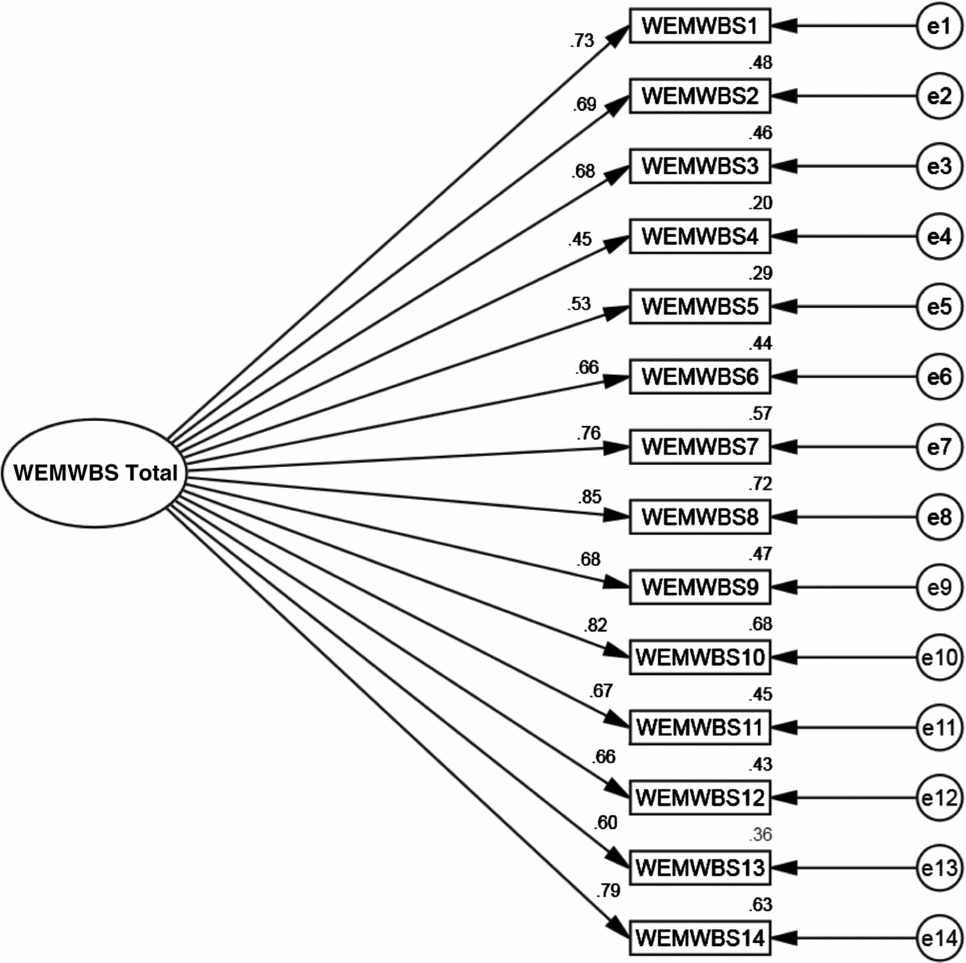
The full 14-item measurement model demonstrated marginal fit: χ2(df = 77) = 492.33, p < .001, CMIN/DF ratio = 6.39, CFI = .93, TLI = .92, RMSEA = .080 [90% CI: .074, .087], SRMR = .041. See Figure 1 for standardised estimates. Examination of modification indices suggested that correlating the errors for items 7 (‘I've been thinking clearly’) and 12 (‘I've been feeling loved’) would make the largest difference to model fit. However, we could see no conceptual justification for correlating these items, and doing so made little difference to the fit anyway, χ2(df = 76) = 475.25, p < .001, CMIN/DF ratio = 6.25, CFI = .94, TLI = .92, RMSEA = .079 [90% CI: .072, .086], SRMR = .040.
Standardised estimates for the 14-Item WEMWBS.

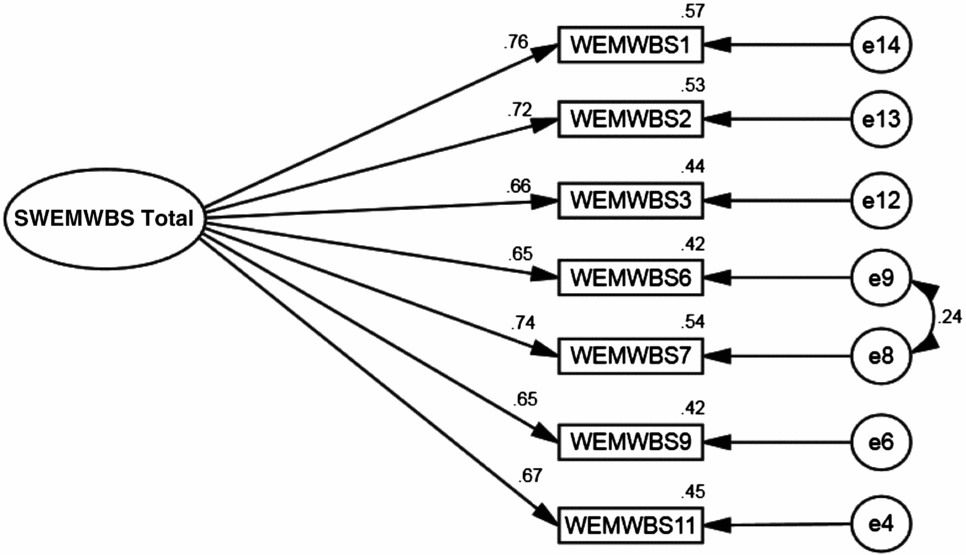
The seven-item model demonstrated better fit: χ2(df = 14) = 64.99, p < .001, CMIN/DF ratio = 4.64, CFI = .98, TLI = .97, RMSEA = .066 [90% CI: .050, .083], SRMR = .027. Modification indices suggested that the errors for items 6 (‘I've been dealing with problems well’) and 7 (‘I've been thinking clearly’) should be correlated, and based on face content there appeared to be some conceptual justification for making such a modification. This change resulted in a good fitting model: χ2(df = 13) = 30.75, p = .004, CMIN/DF ratio = 2.37, CFI = .99, TLI = .99, RMSEA = .040 [90% CI: .022, .059], SRMR = .020, and was accepted as the final model. Internal reliability (Cronbach's alpha) of the scale was .87, indicating good internal reliability. See Figure 2 for standardised estimates.
Standardised estimates for the seven-item SWEMWBS.
Invariance of the Seven-Item Scale Across Gender and School Stage
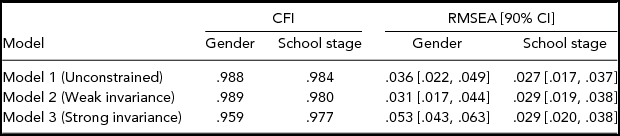
To assess factorial invariance, we compared three models. The first model was the unconstrained model in which the same factor structure was present for the competing groups, but no further constraints were placed upon the model. The second model was the weak factorial model, where the addition of constraints upon the factor loadings was added. Finally, the third model was the strong factorial model and included the additional constraint that indicator intercepts also be equal. Strong factorial invariance indicates that slopes and intercepts are equal across groups and that the factor scores are comparable across groups (Little, Card, Slegers, & Ledford, Reference Little, Card, Slegers, Ledford, Little, Bovaird and Card2007). Following Little et al. (Reference Little, Card, Slegers, Ledford, Little, Bovaird and Card2007), we did not use change in chi-square as an indicator of invariance because of its documented sensitivity to sample size. Rather, we used change in CFI (∆CFI) as one indicator of invariance (∆CFI > -.01 indicates violation of invariance) and whether the invariance model's 90% RMSEA confidence intervals included the RMSEA of the unconstrained model.
For gender, these analyses indicated support for weak factorial invariance but not strong factorial invariance (see Table 1). In contrast, there was support for strong invariance with respect to school stage.
Fit Indices Used for Assessing Factor Invariance Across Gender and School Stage

These results indicate that the seven-item SWEMWBS may be used to compare developmental trends in positive mental wellbeing from Grades 8 to 10, but that its psychometric properties do not support use of the measure for investigating gender differences.
Effect of School Stage on Seven-Item SWEMWBS Score
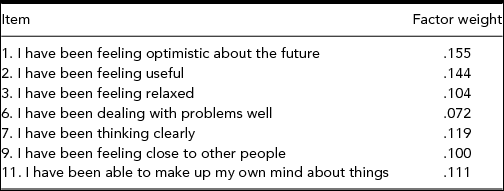
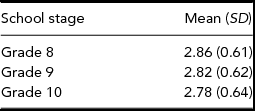
Using the formula W = BS−1, where B is the matrix of covariances between the unobserved and observed variables, and S is the matrix of covariances among the observed variables, AMOS 21.0 calculated factor score weights for each of the items based on the accepted measurement model. To use these, each participant's score on each item was multiplied by the factor score weight for that item, and this was then added to a similar score for the following item, and so on. Factor score weights are shown in Table 2, and factor score means and standard deviations are shown by school stage in Table 3.
Factor Score Weights

Means (and Standard Deviations) by School Stage
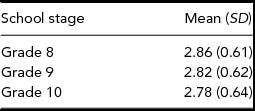
To examine the effects of school stage, a one-way independent ANOVA was conducted. This was not significant, F(2,823) = 1.08, p = .341, indicating that there are no differences in SWEMWBS scores across Grades 8 to 10.
Discussion
Valid measures of positive mental wellbeing that can be used with adolescent populations are needed. They need to be tested in different cultural contexts to enhance their generalisability. The primary aim of this research was to test the fit of the factor structure (the full 14-item scale and the shortened 7-item scale) of the WEMWBS with Australian adolescents. There has been only one published study and this was undertaken with Scottish teenagers.
More specifically, the study aimed to assess: (1) the extent to which the measure is equivalent across males and females and across three adolescent school stages, and (2) the effects of these two variables (gender, school stage) on the measure's scores. To date, limited psychometric data exist on measures of positive mental wellbeing in mainstream community adolescents. This is an important issue to be addressed given that adolescence is an important formative developmental stage that lays the groundwork for wellbeing and mental health in adulthood (Ford, Goodman, & Meltzer, Reference Ford, Goodman and Meltzer2003). Mental wellbeing has the potential to improve quality of life, prevent mental and physical illness, and reduce the use of health services (Keyes, Reference Keyes2007; Keyes, Dhingra, & Simoes, Reference Keyes, Dhingra and Simoes2010). There is clearly a need for validated measures that can be used in adolescent level studies.
Given the dearth of adolescent population studies employing measures for positive mental wellbeing, comparisons with the present data are difficult to undertake. Unlike the study conducted with 13- to 16-year-old adolescents by Clarke et al. (Reference Clarke, Friede, Putz, Ashdown, Martin, Blake and Platt2011; fit statistics: GFI = 1.000, RMSEA = 0.0032), which supported a single underlying construct for the 14-item WEMWBS, the model fit in the present study, while acceptable, was not so supportive (CFI = .93, RMSEA = .080).
Even though Clarke et al. (Reference Clarke, Friede, Putz, Ashdown, Martin, Blake and Platt2011) obtained excellent model fit statistics, issues of item redundancy still arose. The issue of less than perfect model fit has arisen in a number of studies employing CFA and Rasch model analysis, but these studies were with adult populations in different countries (Gremigni & Stewart-Brown, Reference Gremigni and Stewart-Brown2011; Lloyd & Devine, Reference Lloyd and Devine2012; López et al., Reference López, Gabilondo, Codony, García-Forero, Vilagut, Castellví and Alonso2013; Tennant, Hiller et al., Reference Tennant, Hiller, Fishwick, Platt, Joseph, Weich and Stewart-Brown2007). Taken together, these studies demonstrate the importance of examining the psychometric properties of an instrument in different populations and in different settings (see Vaingankar et al., Reference Vaingankar, Subramaniam, Chong, Abdin, Edelen, Picco and Sherbourne2011).
While it has been proposed that mental wellbeing is unique and culturally specific (Tennant, Hiller et al., Reference Tennant, Hiller, Fishwick, Platt, Joseph, Weich and Stewart-Brown2007), it is not yet clear why results from the present study with Australian adolescents returned different results to Clarke et al.’s (Reference Clarke, Friede, Putz, Ashdown, Martin, Blake and Platt2011) Scottish and English sample. One difference between the current study and Clarke et al.’s is that our study intentionally sampled from rural areas whereas Clark et al. sampled from two cities. This may be pertinent because (in Australia at least) the experiences of rural and urban groups appear to differ in terms of educational, recreational and employment opportunities. Lack of opportunity may contribute toward greater risk-taking behaviour among young people from rural areas (Quine et al., Reference Quine, Bernard, Booth, Kang, Usherwood, Alperstein and Bennett2003), possibly leading to greater focus upon hedonic rather than eudemonic aspects of wellbeing. Such differences in life chances may therefore impact upon the ways in which happiness and wellbeing are conceptualised in these groups. Future research should seek to investigate this issue further.
Tennant, Hiller et al. (Reference Tennant, Hiller, Fishwick, Platt, Joseph, Weich and Stewart-Brown2007) suggested that although the 14-item WEMWBS was short, acceptable and meaningful to general population groups, it ‘could be shortened further’ (p. 10). Thus, in the present study we also tested the fit of the seven-item short version of the WEMWBS (i.e., the SWEMWBS; see Bartram et al., Reference Bartram, Sinclair and Baldwin2012; Stewart-Brown et al., Reference Stewart-Brown, Tennant, Tennant, Platt, Parkinson and Weich2009), and this demonstrated superior model fit to the 14-item version. Although Bartram et al. (Reference Bartram, Sinclair and Baldwin2012) and Stewart-Brown et al. (Reference Stewart-Brown, Tennant, Tennant, Platt, Parkinson and Weich2009) also found improved fit using the shortened version, the latter raised the point that most of the items retained in the shortened version represented aspects of psychological and eudemonic wellbeing, with fewer covering hedonic wellbeing or affect. This is in contrast to the broad consensus that mental wellbeing is a complex construct covering both hedonic and eudemonic wellbeing (Clarke et al., Reference Clarke, Friede, Putz, Ashdown, Martin, Blake and Platt2011; Ryan & Deci, Reference Ryan and Deci2001; Tennant, Hiller et al., Reference Tennant, Hiller, Fishwick, Platt, Joseph, Weich and Stewart-Brown2007). The SWEMWBS may therefore be assessing a narrower conceptualisation of positive mental wellbeing than the full WEMWBS, one which reflects a focus upon general wellbeing rather than a subjective happiness based on accumulated moments of pleasure (see Ryan & Deci, Reference Ryan and Deci2001).
The present study one-factor model represented by seven items was invariant across school stage. This indicates that the meaning and interpretation of scale scores is equivalent across Grades 8 to 10. We also found that actual scale scores were not different for young people across this grade range. We were unable to examine gender differences on scale scores because the measure was not sufficiently psychometrically robust to permit such an analysis. There was a clear drop in fit when considering strong factorial invariance, indicating that factor scores for boys and girls cannot be considered to be comparable (Wu & Zumbo, Reference Wu, Li and Zumbo2007). This is a weakness of the SWEMWBS, and may call into question results from previous studies that have reported gender differences in positive mental wellbeing (Clarke et al., Reference Clarke, Friede, Putz, Ashdown, Martin, Blake and Platt2011; Davoren, Fitzgerald, Shiely, & Perr, Reference Davoren, Fitzgerald, Shiely and Perry2013; Tennant, Hiller et al., Reference Tennant, Hiller, Fishwick, Platt, Joseph, Weich and Stewart-Brown2007). Future research should seek to identify new items, or modify the existing items, so that the measure allows better investigation of potential gender differences. The results from Clarke et al.’s (Reference Clarke, Friede, Putz, Ashdown, Martin, Blake and Platt2011) focus groups may help guide such work as these identified items which girls and boys felt more confident answering, as well as items that young people felt could be ambiguous (e.g., ‘I've been feeling close to other people’ could be understood as referring to romantic or sexual relationships).
In Australia (Dobia & O'Rourke, Reference Dobia and O'Rourke2011; Scott, Reference Scott2011) and beyond (Clarke et al., Reference Clarke, Friede, Putz, Ashdown, Martin, Blake and Platt2011), the importance of attending to young people's positive mental health as well as reducing levels of negative wellbeing is increasingly emphasised. Despite the limitations noted above, the SWEMWBS is likely to prove a useful tool for educational, developmental and school psychologists, and for other professionals working in this area. The measure reported here allows professionals to assess levels of wellbeing using a reliable measure and to compare levels of wellbeing across, at least, Grades 8 to 10. Care should be taken when comparing boys’ and girls’ scores because differences between them may be misleading.
It must be acknowledged that our results are based solely on self-report data. Corroborative information such as file data and observations might enhance reliability. However, there is clear evidence that self-report is an effective means of obtaining an accurate insight into the subjective dispositions (such as positive mental wellbeing) that can be difficult to obtain from third parties such as teachers and parents (see Frick, Barry, & Kamphaus, Reference Frick, Barry and Kamphaus2009). Moreover, the validity of self-report on psychopathology and personality tends to increase from childhood to adolescence whereas the validity of parental and teacher reports decreases for this period (Essau, Sasagawa, & Frick, Reference Essau, Sasagawa and Frick2006). There was no demonstration of convergent and discriminant validity in the present study. This must be a focus of future research if the 7- and 14-item versions of the WEMWBS are to be used as indicators of the mental wellbeing of adolescents for monitoring population level changes in mental wellbeing, and as an outcome measure in interventions.
In conclusion, the 14-item WEMWBS shows marginal model fit with adolescents. The shortened version (i.e., 7-item SWEMWBS) demonstrates improved fit, along with high levels of internal reliability and strong factor invariance across Grades 8 to 10. The weakness of the short form was that its factor structure was not invariant across gender. Positive mental wellbeing has the potential to improve quality of life and prevent mental and physical illness (Keyes, Reference Keyes2007; Keyes et al., Reference Keyes, Dhingra and Simoes2010). Given the need for validated measures of positive mental wellbeing that can be used in adolescent population level studies, the present findings indicate that the SWEMWBS is a concise and suitable measure.
Acknowledgments
The authors would like to extend their thanks to all the young people who so willingly took part in this study. We would also like to thank the schools and staff in those schools for their help and support throughout data collection.
Financial Support
This research was funded in part by the Western Australian Health Promotion Foundation (Healthway) and The Australian Research Council. The Warwick-Edinburgh Mental Well-being Scale was funded by the Scottish Executive National Programme, commissioned by NHS Health Scotland, developed by the University of Warwick and the University of Edinburgh, and is jointly owned by NHS Health Scotland, the University of Warwick and the University of Edinburgh.
Conflicts of Interest
None of the authors have any conflicts of interest to declare.
Ethical Standards
The authors assert that all procedures contributing to this work comply with the ethical standards of the relevant national and institutional committees on human experimentation and with the Helsinki Declaration of 1975, as revised in 2008.