I. INTRODUCTION
Spinels comprise a wide range of materials characterized by useful properties from the technological point of view. They are widely used in various branches of industry: refractory materials, electro-technical ceramics, electronics, abrasive materials, plastics, nuclear power industry, chemical industry, jewellery, and many others.
The spinel structure is based upon a cubic closed-packed structure of oxygen and cations distributed in tetrahedral and octahedral sites, Fd3m space group. In normal two cation spinels 2:3 type AB 2O4 8−A 2+ cations are distributed in 8/64 tetrahedral sites and 16−B 3+ cations are distributed in 16/32 octahedral sites. In the inverse spinel structure, 8/64 tetrahedral sites are occupied by 8−B 3+ cations and 16/32 octahedral sites are occupied by both 8−A 2+ and 8−B 3+ cations. In practice, greater number of spinels have mixed type of structure in which cations A 2+ and B 3+ can occupy both sites partially (A 1− x ,B x )(A x ,B 2− x )O4. In three cation solid solution spinels an additional C 2+ or C 3+ cation may be located in one or both tetra and octahedral sites. Despite their deceptively simple structure, spinels exhibit disordering phenomena, which have serious consequences for their thermochemical and physical properties.
For example, cation sublattice ordering in spinel catalysts and catalyst carriers plays a key role and directly translates into the calalytic properties of a material surface. It is similar in the case of spinel electrotechnical ceramics, where the distribution of cations in particular sites in a crystalline lattice influences their mutual impact and directly translates into the material's magnetic properties. Working out an effective method to investigate cation sublattice ordering in spinels is becoming an important stage of research on these materials, which enables obtaining the highest possible amount of detailed information about spinel crystalline structure during the order–disorder transformation, so that the obtained information can be related to the observed changes in the examined material's properties. A certain limitation of the method presented in this work is the fact that it can only be used for investigating two- and three-cation spinels, but in most cases such spinels are used in many areas of technology and science.
The aim of this paper is to present the X-ray diffraction (XRD) method of investigating the order–disorder phase transformation in three-cation spinel solid solutions.
II. EXPERIMENTAL
A. Spinels synthesis
Synthesis of stoichiometric spinel samples was based on the method of precursor precipitation from sulphate water solutions according to the following chemical reaction:
 $$\eqalign{& {R^{3+}}2{\lpar {\hbox{S}{\hbox{O}_4}} \rpar _3}\cdot n{\hbox{H}_ 2}\hbox{O}+{R^{2+}}\hbox{S}{\hbox{O}_4}\cdot 7{\hbox{H}_ 2}\hbox{O}+4{\lpar {\hbox{N}{\hbox{H}_4}} \rpar _2}\hbox{C}{\hbox{O}_3} \cr & \quad \to \; \hbox{Mg}{R_ 2}{\hbox{O}_4}\cdot n{\hbox{H}_ 2}\hbox{O}+4{\lpar {\hbox{N}{\hbox{H}_4}} \rpar _2}\hbox{S}{\hbox{O}_4}\; + 4\hbox{C}{\hbox{O}_2}\; +n{\hbox{H}_ 2}\hbox{O}}$$
where R 3+ stands for Al or Fe and R 2+ stands for Mg, Co or Ni.
The so-obtained precursors were subjected to calcinations at a temperature of 1200 °C. Next, they were formed into pellets and fired: (Mg0.85Co0.15)Al2O4 and (Mg0.85Ni0.15)Al2O4 at 1650 °C and Mg(Al0.5Fe0.5)2O4 at 1450 °C. This method was successfully used in previous works concerning the behaviour of spinels at high temperatures (Podwórny et al., Reference Podwórny, Wojsa and Piotrowski2004, Reference Podwórny, Piotrowski and Wojsa2008; Podwórny, Reference Podwórny2013).
A PANalytical XPERT PRO MPD X-ray diffractometer, equipped with an X-ray tube with Cu anode, an X'Celerator RTMS detector and a high-temperature chamber – Anton Paar HTK 2000 were used in the investigations. The investigations were carried out within an angular range of 16–140 °2Θ and at temperatures ranging from 25 to 1100 °C, with a variable step dependent on inversion temperature. The FullProf_Suite software package was applied to determine the oxygen positional parameter u(T), the lattice parameter a(T), and the cation site occupancies Occ(T) in each temperature by the Rietveld method. The cation–anion distances in tetrahedral TO(T) and octahedral MO(T) coordination in each temperature were calculated by means of Bond_Str program, belonging to the same FullProf_Suite package (Rodríguez-Carvajal, Reference Rodríguez-Carvajal1993; Rodriguez-Carvajal and Roisnel, Reference Rodriguez-Carvajal and Roisnel1998; Roisnel and Rodríguez-Carvajal, Reference Roisnel and Rodríguez-Carvajal2001).
The results obtained in this way were used to calculate the degree of inversion in the structure of investigated spinels, using the approach presented below.
B. Theoretical background of the method
Determining the degree of inversion X in a three-cation spinel solid solution defined as the fraction of three-valent cations on the tetrahedral site requires a combination of two analytical approaches: calculation of changes of diffraction lines intensity because of changes in fractional site occupancies by cations with different atomic scattering factors ƒ i and determination of linear relationship of cation–anion distances in tetrahedral TO and octahedral MO coordination depending on the average cation concentration in those sites c i ,2+, c i ,3+. This method of investigating the cation sub-lattice ordering in the structure of a three-cation spinel can be applied if two requirements are fulfilled:
-
1. At least one cation “C” differs considerably from the other two in terms of its atomic scattering factor:
The concentration of cations C in tetrahedral c i , T and octahedral c i , M sites is determined from the fractional site occupation number Occ i , T , Occ i , M by Rietveld refinement routine. The concentrations of the remaining two cations A and B c i , T and c i , M are calculated from the cation–anion distances in tetra-TO and octahedral MO sites. $${\,f_A} \approx {\,f_B} \ne {\,f_C}$$
-
2. Cations A and B with comparable atomic scattering factors differ considerably in their ionic radii.

The cation–anion distances in tetrahedron TO and octahedron MO in the spinel structure vary from the linear contribution of each chemical species (O'Neill and Navrotsky, Reference O'Neill and Navrotsky1983; Della Giusta et al., Reference Della Giusta, Carbonin and Ottonello1996):
 $$TO=\sum {{c_{i\comma T}}{r_{i\comma TO}}} \quad MO=\sum {{c_{i\comma M}}{r_{i\comma MO}}} $$
The definition equation [Eq. (1)] can by written as (Carbonin et al., Reference Carbonin, Martignago, Menegazzo and Dal Negro2002):
 $$TO = T{O_T}+\Delta TO\lpar \Delta x\rpar \;\hbox{or }MO = M{O_T}+\Delta MO\lpar \Delta x\rpar $$
where TO and MO are the total cation–anion distance measured in tetrahedral and octahedral coordinations, dependent on the temperature T and occupancy x,
TO T and MO T are parts of the distance related to thermal expansion:
 $$T{O_T}= T{O_0}\lpar 1 +\alpha \Delta T\rpar \quad \hbox{or}\quad M{O_T}= M{O_0}\lpar 1 +\alpha \Delta T\rpar $$
TO 0 and MO 0 are the initial values of TO and MO,
α is the thermal expansion coefficient determined from the lattice parameters
 $$\alpha=\displaystyle{{\Delta a} \over {{a_0}\Delta T}}$$
ΔTO(Δx) and ΔMO(Δx) are parts of the distance related to a change in the occupancy of tetra- and octahedral sites, respectively.
Next, two systems of equations are built for tetra- and octahedral sites:
 $$T{O_0}= {c_{A\comma T}}{r_{A\comma TO}}+{c_{B\comma T}}{r_{B\comma TO}}+{c_{C\comma T}}{r_{C\comma TO}}$$
 $${c_{A\comma T}}+{c_{B\comma T}}+{c_{C\comma T}}=1$$
 $$M{O_0}={c_{A\comma M}}{r_{A\comma MO}}+{c_{B\comma M}}{r_{B\comma MO}}+{c_{C\comma M}}{r_{C\comma MO}}$$
 $${c_{A\comma M}}+{c_{B\comma M}}+{c_{C\comma M}}=2$$
where c A , T , c B , T , c C , T and c A , M , c B , M , and c C , M : concentration of cations A, B, C in tetrahedral T and octahedral M sites, respectively
r A , TO , r B , TO , r C , TO , and r A , MO , r B , MO , r C , MO : published cation–anion distances of cations A, B, C in tetrahedral T and octahedral M sites, respectively.
The solution to Eqs (5) and (6) allow finding the values of X 0 (initial temperature value of the degree of inversion):
 $${c_{B\comma T}}=\displaystyle{{T{O_0} - {r_{A\comma TO}}+{c_{C\comma T}}\lpar {{r_{A\comma TO}} - {r_{C\comma TO}}} \rpar } \over {{r_{B\comma TO}} - {r_{A\comma TO}}}}\!\comma$$
 $${X_0}={c_{B\comma T}}\lpar {\hbox{if}\, \, A\, \, \hbox{and}\, \, C\, \, \hbox{are }2+\comma \; B\, \, 3+} \rpar $$
 $${c_{B\comma M}}=\displaystyle{{2M{O_0} - 2{r_{A\comma MO}}+{c_{C\comma M}}\lpar {{r_{A\comma MO}} - {r_{C\comma MO}}} \rpar } \over {{r_{B\comma MO}} - {r_{A\comma MO}}}}\!\comma$$
 $${X_0}=2-{c_{B\comma M}}$$
Refinement routine requires using of chemical constraints to avoid unstable calculations and under or overestimation of fractional site occupancies. During refinement only changes of fractional site occupancies between tetra- and octahedral sites were allowed. The sum of particular cation concentration in spinel structure according to its stoichiometric composition should be fixed.
C. Examples of equation solutions that enable finding inversion degree X for different spinels
A change of the degree of inversion Δx is found by developing the definition Eq. (1), taking into consideration the direction of transformation, “ − ” for a cation vacating a particular site, “ + ” for a cation occupying a particular site, for example.
For spinel Mg0.85Co0.15Al2O4 with a normal structure (Co2+ have tetrahedral preferences):
 $$\Delta X=\Delta {c_{B\comma T}}=\displaystyle{{\Delta TO\lpar {\Delta x} \rpar - \Delta {c_{C\comma T}}\lpar {{r_{A\comma TO}} - {r_{C\comma TO}}} \rpar } \over {{r_{B\comma TO}} - {r_{A\comma TO}}}}$$
 $$X\lpar T\rpar = {X_0}+\Delta {c_{B\comma T}}$$
 $$\Delta X=\Delta {c_{B\comma M}}=\displaystyle{{2\Delta MO\lpar {\Delta x} \rpar +\Delta {c_{C\comma M}}\lpar {{r_{A\comma MO}} - {r_{C\comma MO}}} \rpar } \over {{r_{A\comma MO}} - {r_{B\comma MO}}}}$$
 $$X\lpar T\rpar = {X_0}+\Delta {c_{B\comma M}}$$
For spinel Mg0.85Ni0.15Al2O4 with a mixed structure (Ni2+ have octahedral preferences):
 $$\Delta X=\Delta {c_{B\comma T}}=\displaystyle{{\Delta TO\lpar {\Delta x} \rpar +\Delta {c_{C\comma T}}\lpar {{r_{A\comma TO}} - {r_{C\comma TO}}} \rpar } \over {{r_{B\comma TO}} - {r_{A\comma TO}}}}$$
 $$X\lpar T\rpar ={X_0}+\Delta {c_{B\comma T}}$$
 $$\Delta X=\Delta {c_{B\comma M}}=\displaystyle{{2\Delta MO\lpar {\Delta x} \rpar - \Delta {c_{C\comma M}}\lpar {{r_{A\comma MO}} - {r_{C\comma MO}}} \rpar } \over {{r_{A\comma MO}} - {r_{B\comma MO}}}}$$
 $$X\lpar T\rpar ={X_0}+\Delta {c_{B\comma M}}$$
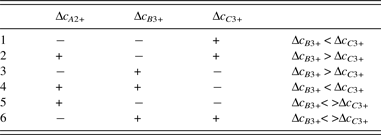
Very interesting cases are solid solutions of normal and inverse spinels with two 3+ cations, which include Mg(Fe0.5Al0.5)2O4. The specific character of such spinels lies in the fact that 3+ cations, which by definition determine the degree of inversion, have opposite preferences with regard to the occupancy of spinel crystalline lattice sites and opposite directions of moving after the transformation has been initiated. In such cases the systems of equations can have a few solutions, and the choice of a particular one should be based on additional knowledge about the investigated spinel or on calculations carried out for all possible combinations of equations, while checking which of them ensures a coherent solution for all the equation components. From a purely mathematical point of view, the equations can have six solutions, two of which can most frequently be eliminated owing to the mutual direction of cation movement. The multitude of possible equations is influenced by the difference of Δc B 3 + and Δc C 3 + , determining the direction of Δc A 2 + cations' movement. Possible cases have been presented in Table I, where the direction of a particular cation's movement into the tetrahedral coordination site has been marked with “ + ”, and the direction of a cation's movement into the octahedral coordination site has been marked with “ − ”. Such a case includes Mg(Fe0.5Al0.5)2O4 spinel, in which Mg2+ and Fe3+ cations have preferences for occupying the sites in tetrahedral coordination T. Al3+ cations have preferences for occupying the sites in octahedral coordination M. It has been assumed that Mg2+ is cation A, Al3+ is cation B, Fe3+ is cation C, the contents of which in particular sites are determined by the Rietveld method, from fractional site occupancy number. The order–disorder transformation run bidirectional: Fe3+ cations move to octahedral sites, and Al3+ cations move in the opposite direction, occupying the tetrahedral sites (cases 3 and 4 from Table I). Therefore, depending on the value of Δc B 3 + and Δc C 3 + , there are two possible solutions. In this spinel, Δc Al3 + > Δc Fe3 + , as a result of which the Mg2+ cations move into octahedral coordination sites (case 3 from Table I). The form of equations determining a change in the degree of inversion ΔX will be the same as for Eqs (9) and (10). The degree of inversion, X, in this example will be determined by Eqs (13) and (14).
 $${X_0}={c_{B\comma T}}+{c_{C\comma T}}$$
or
 $${X_0}=2 - {c_{B\comma M}} - {c_{C\comma M}}$$
Rules for choosing the “ + ” or “ − ” mark, depending on preferences for tetrahedral site occupation by cations: “ + ” means that the cation concentration increases during the order–disorder phase transformation, while “ − ” means that it decreases.

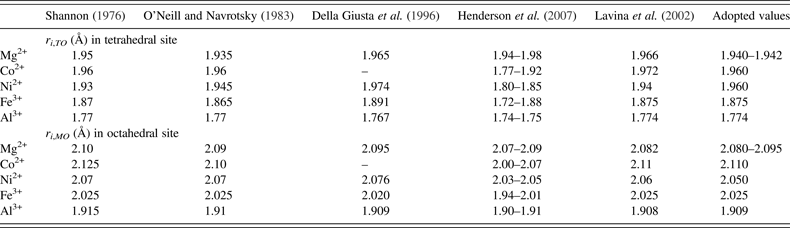
The fact that the equations for calculating X 0 and ΔX from tetrahedral sites TO and octahedral sites MO are equivalent, the results obtained from them should be consistent. The method for determining the degree of spinel inversion adopted in the work turned out to be very sensitive to the cation–anion distances, r i , TO and r i , MO , adopted in the calculations. Table II contains a comparison of literature values of cation–anion distances in spinel with the values used for calculations in the presented work. Owing to the fact that the calculations were based on the values presented in Table II, r i , TO and r i , MO , it was possible to obtain consistent results for the degree of inversion calculated from the tetrahedral site T and octahedral site M. The values r i , TO and r i , MO adopted for calculations were each time similar to ones quoted in literature. Using the values quoted by only one of the authors (Shannon, Reference Shannon1976; O'Neill and Navrotsky, Reference O'Neill and Navrotsky1983; Della Giusta et al., Reference Della Giusta, Carbonin and Ottonello1996; Lavina et al., Reference Lavina, Salviulo and Della Giusta2002; Henderson et al., Reference Henderson, Charnock and Plant2007) causes differences in the calculated degrees of inversion X for tetra- and octahedral sites ranging from 5 to 10%. This poses a certain problem in the evaluation of the obtained results' correctness. If tetrahedral sites are based only on calculations, the obtained result might be understated or overstated by the above mentioned 5 and 10%. Therefore, performing calculations from equations for both tetrahedral and octahedral coordination simultaneously enables verification of the obtained results.
A comparison of the reference cation–anion distances in tetrahedral r i , TO with octahedral r i , MO sites in spinels according to several authors (i denotes cation type).

D. Uncertainty of the method
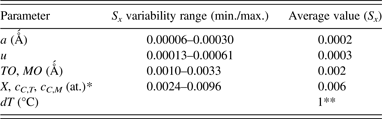
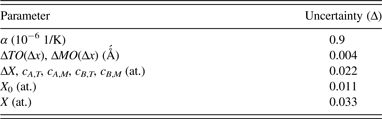
Uncertainty of determination of α, ΔTO(Δx), ΔMO(Δx), ΔX, c A , T , c A , M , c B , T , c B , M , X 0, X values based on partial derivatives calculation were carried out. As uncertainty of intermediate parameters needed for calculation, e.g. a, u, TO, MO, X, c C , T , c C , M the standard deviations S x reported in result files of Rietveld refinement and distances calculation were used. As presented in Table III mean values were calculated based on 66 results for each parameter (22 different spinels and three randomly chosen temperatures for each spinel).
Standard deviations S x of the parameters used for calculating the uncertainty of the inversion degree determination.

* Directly determined parameters from site occupancy numbers.
** Adopted value from technical documentation of high-temperature chamber producer.
Comparison of values presented in Tables III and IV gives important information about uncertainty of parameters determined directly from Rietveld refinement, e.g. X, c C , T , c C , M (0.006) which are much more precisely determined than calculation based on cation–anion distances: c A , T , c A , M , c B , T , c B , M (0.022), and X (0.033).
Uncertainty of the derived parameters calculated by the method of partial derivatives.

III. RESULTS AND DISCUSSION
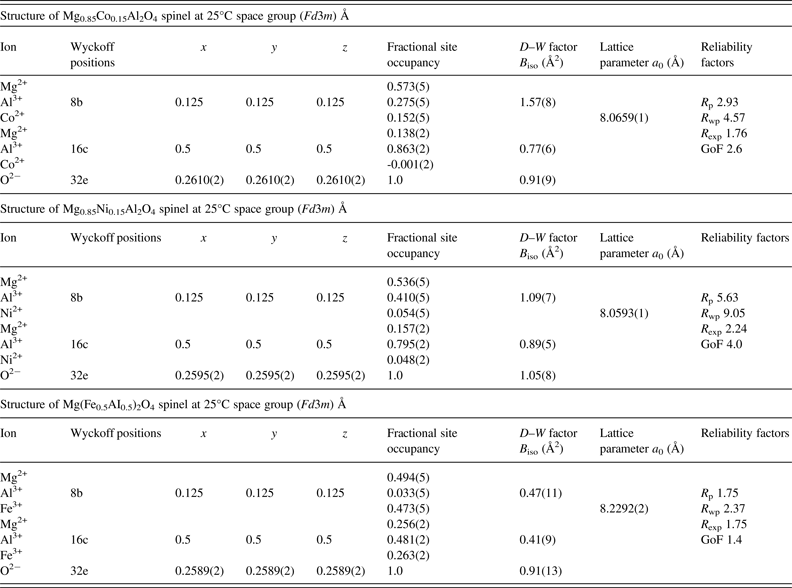
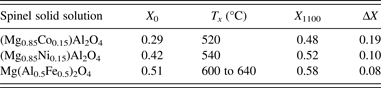
Three spinel solid solutions: (Mg0.85Co0.15)Al2O4, (Mg0.85Ni0.15)Al2O4, and Mg(Al0.5Fe0.5)2O4 were tested in this work. Each of them was MgAl2O4 solid solution containing Co2+, Ni2+, or Fe3+ cations. Pure MgAl2O4 spinel has a partially inverted structure. In natural spinel ca. 20% of Al3+ is located in tetrahedral sites (X = 0.2). In synthetic MgAl2O4 spinel even 40% of Al3+ can be located in tetrahedral sites (X = 0.4). In the presented work spinel solid solutions containing Co2+, Ni2+, or Fe3+ also have Al3+ initially located in tetrahedral sites. Table V presents initial structure parameters of the tested spinels solid solutions: Mg0.85Co0.15Al2O4, Mg0.85Ni0.15Al2O4, and Mg(Fe0.5Al0.5)2O4 obtained at 25°C. Table VI presents its initial degree of inversion X 0, inversion temperature T x , degree of inversion at 1100 °C, X 1100, and a range of changes in the degree of inversion ΔX. Figures 1–3 present temperature dependences of all derived parameters u(T), TO(T), MO(T), X(T), c i , TO , c i , MO a(T), and α(T) for each investigated spinel solid solutions.
Temperature dependences of u(T), TO(T), MO(T), degree of inversion X(T), Mg2+, Al3+, and Co2+ concentration in tetra- and octahedral sites, lattice parameter a(T), and thermal expansion coefficient α(T) for (Mg0.85Co0.15)Al2O4.

Temperature dependencies of u(T), TO(T), MO(T), degree of inversion X(T), Mg2+, Al3+, and Ni2+ concentration in tetra- and octahedral sites, lattice parameter a(T), and thermal expansion coefficient α(T) for (Mg0.85Ni0.15)Al2O4.

Temperature dependencies of u(T), TO(T), MO(T), degree of inversion X(T), Mg2+, Al3+, and Fe3+ concentration in tetra- and octahedral sites, lattice parameter a(T), and thermal expansion coefficient α(T) for Mg(Al0.5Fe0.5)2O4.

Initial structure parameters of Mg0.85Co0.15Al2O4, Mg0.85Ni0.15Al2O4, and Mg(Fe0.5Al0.5)2O4 spinels solid solutions at 25°C.

Initial degree of inversion X 0, inversion temperature T x , degree of inversion at 1100 °C, X 1100, and a range of changes in the degree of inversion in spinel solid solutions, ΔX.

After the beginning of the order–disorder phase transformation (inversion), the concentration of Al3+ cations in tetrahedral sites increases (Figures 1–3). Co2+, according to its preferences, up to the temperature at the beginning of the order–disorder transformation (520 °C) was located only in tetrahedral sites. Over this temperature ca. 3% of Co2+ moves into octahedral sites (Figure 1). Ni2+, also according to its preferences, occupies both sites; approximately one-third of the total number of cations was located in tetrahedral sites and ca. 2/3 in octahedral sites. Ni2+ practically does not change its position during the order–disorder phase transformation (Figure 2). The order–disorder transformation in Mg(Al0.5Fe0.5)2O4 solid solution runs in both directions: from the normal into the inverse structure, because of Al3+ direction of movement (from octahedral into tetrahedral sites), and from the inverse to the normal structure, because of Fe3+ moving from tetrahedral into octahedral sites. Al3+ and Fe3+ cations have different preferences for tetrahedral and octahedral sites occupation. The number of Al3+ cations changing their positions is prevailing (Δc Al3+ > Δc Fe3+). As a result, the degree of inversion increases like in the transformation from the normal into the inverse structure.
At 500 °C Fe3+ begins to move into octahedral sites, and at a temperature of ca. 640°C Al3+ starts moving into tetrahedral sites. Up to the temperature of 1100 °C, the content of Fe3+ in T site decreases from 47 to 40% at., whereas Al3+ increases from 3 to 18% at. Transformation from the normal to the inverse structure prevails owing to a larger number of Al3+ cations changing their positions in the spinel lattice. Mg2+ relocations are the results of Fe3+ and Al3+ relocations. The resulting degree of inversion at a temperature ranging from 25 to 1100 °C changes from 51 to 58%, and corresponds to a difference of the changes in Fe3+ and Al3+ contents in the tetrahedral site.
At a temperature ranging from 600 to 640 °C a deviation is observed from the typical direction of movement of Al3+. It is also visible in the changes of T and M site occupancies by Mg2+. Within this temperature range Al3+ moves in the same direction as Fe3+ (to octahedral voids). At temperatures exceeding 640°C Al3+ cations start moving in the direction opposite to that of Fe3+ cations. In consequence, a fault is visible on the graph of X(T) dependence within this temperature range. A similar effect at a temperature ranging from 550 to 650 °C has been observed in the investigations into Mg(Al,Fe)2O4 solutions containing 14 and 20%at. of Fe3+ quoted in works (Redfern et al., Reference Redfern, Harrison, O'Neill and Wood1999; Martignago et al., Reference Martignago, Andreozzi and Dal Negro2006), where it was explained by the phenomenon of relaxation reposition of Al3+ cations, which aim for achieving the state of thermodynamic equilibrium.
IV. SUMMARY
The presented XRD method of determining cation distribution vs. temperature in the structure of three-cation spinel solid solutions gives valuable numerical data connected with the preferences and concentration of particular cations in spinel crystal lattice.
The method was based on Rietveld refinement routine and two particular approaches:
-
• Determination of the occupation number in tetrahedral and octahedral sites of a cation differing in its atomic scattering factor from the other two cations;
-
• Determination of cation–anion distances in tetra- and octahedral sites in spinel crystal lattice.
The advantage of the presented method is the possibility of investigating the order–disorder transformation in spinel solid solutions from the normal into the inverse structure as well as from the inverse into the normal structure and in both directions at the same time.
Another advantage is related to the general accessibility of the method because of the widespread use of X-ray diffractometers in material testing laboratories.
The disadvantage of the method lies in the fact that its application remains limited to three-cation spinels.
ACKNOWLEDGMENT
This study was financially supported from the project (grant no. NN508629240) founded by Polish National Science Centre (NCN)