Introduction
Disabled children are significantly more likely to grow up in poverty than their non-disabled peers (Blackburn et al., in press; Emerson, in press; Emerson and Hatton, Reference Emerson and Hatton2007; Parish et al., Reference Parish, Rose, Andrews, Grinstein-Weiss and Richman2008). The association between poverty and child disability is of concern as it indicates that disabled children are significantly more likely to live under conditions that have been shown to impede development, educational attainment and adjustment, and increase the risk of poor health, additional impairment and social exclusion (Bradshaw, Reference Bradshaw2001; Brooks-Gunn and Duncan, Reference Brooks-Gunn and Duncan1997; Power et al., Reference Power, Atherton, Strachan, Shepherd, Fuller, Davis, Gibb, Kumari, Lowe, Macfarlane, Rahi, Rodgers and Stansfeld2007; The Marmot Review, 2010). Consequently the association between poverty and child disability represents a major challenge to social policies directed at improving the life chances of disabled people and family carers (Cabinet Office, 2005; Department for Education and Skills, 2003; Disability Rights Commission, 2006, 2007; Her Majesty's Treasury, 2007).
While socio-economic gradients in the prevalence of child disability have been repeatedly documented, less is known about the causal processes that underlie these gradients. Existing evidence points to the operation of three potential pathways.
First, the presence of a disabled child in a family may increase the chances of descending into, and reduce the chances of escape from, poverty. Such an assertion is supported by the results of research that has documented the additional direct and indirect costs associated with raising a disabled child (Carers UK, 2007a; Dobson et al., Reference Dobson, Middleton and Beardsworth2001; Tibble, Reference Tibble2005). Direct costs include the additional costs associated with transport, child care, equipment and wear and tear on clothing and furnishings (Baldwin, Reference Baldwin1985; Lukemeyer et al., Reference Lukemeyer, Meyers and Smeeding2000; Newacheck and Kim, Reference Newacheck and Kim2005). Indirect costs include the financial impact of reduced rates of maternal employment among families with a disabled child (Carers UK, 2007b; Parish et al., Reference Parish, Seltzer, Greenburg and Floyd2004; Porterfield, Reference Porterfield2002). If these additional costs are not compensated for by receipt of welfare benefits, other forms of support (e.g. informal support from the extended family, support from charitable organisations) or reduced costs in other areas of child care, it is plausible to assume that they will have an impact on the incidence and duration of episodes of poverty. The assumption that child disability leads to poverty has dominated recent policy debates in the UK and elsewhere (Carers UK, 2007a; Council for Disabled Children, 2006; Disability Rights Commission, 2006, 2007; Inclusion Europe, 2006; Inclusion International, 2006).
In contrast, a parallel body of social epidemiological research has suggested that growing up in poverty is associated with increased exposure to a range of material and psychosocial hazards (e.g. premature birth, low birth weight, exposure to a range of toxins and teratogens, poorer nutrition, poor housing conditions, exposure to less than optimal parenting, poorer educational opportunities, injury and accidents) that may increase the risk of a range of health conditions or cognitive, behavioural and/or physical impairments associated with disability (Bolte et al., Reference Bolte, Tamburlini and Kohlhuber2010; Braubach and Fairburn, Reference Braubach and Fairburn2010; Laursen and Nielsen, Reference Laursen and Nielsen2008; Shonkoff et al., Reference Shonkoff, Boyce and McEwen2009).
Finally, there is the possibility that in some instances the association between family poverty and child disability may reflect the influence of unmeasured ‘third factors’, leading independently to an increased risk of both family poverty and child disability. For example, health conditions or impairments with a hereditary component are likely, through a process of social exclusion, to increase the risk of family poverty and, in the absence of effective support, to increase the risk of child disability (IASSID Special Interest Research Group on Parents and Parenting with Intellectual Disabilities, 2008).
Research in this area also suffers from two major limitations relating to the use of: (1) cross-sectional analyses of the association between poverty and child's disability; and (2) short-term estimates of income as the sole indicator of poverty. The reliance of much poverty research on cross-sectional analyses serves to disguise the dynamic aspects of poverty (Bradbury et al., Reference Bradbury, Jenkins and Micklewright2001; Smith and Middleton, Reference Smith and Middleton2007). This is important as: (1) for most people poverty is a relatively transient experience (Bradbury et al., Reference Bradbury, Jenkins and Micklewright2001; Jenkins et al., Reference Jenkins, Rigg and Devicienti2001; Smith and Middleton, Reference Smith and Middleton2007); and (2) evidence suggests that the negative outcomes associated with poverty are related more strongly to exposure to persistent poverty rather than the experience of poverty per se (Lynch et al., Reference Lynch, Kaplan and Shema1997; McLeod and Shanahan, Reference McLeod and Shanahan1996; Petterson and Albers, Reference Petterson and Albers2004; Smith and Middleton, Reference Smith and Middleton2007). As such, it is important to determine from longitudinal analyses the extent to which specific groups are exposed to different poverty trajectories (e.g. transient, recurrent or persistent poverty) and the factors associated with variation in the probability of poverty transitions. The existing evidence suggests that higher rates of poverty persistence are found among children in lone-parent families and workless households, children belonging to minority ethnic groups and younger children (Bradbury et al., Reference Bradbury, Jenkins and Micklewright2001; Smith and Middleton, Reference Smith and Middleton2007).
These observations are particularly relevant to the present study as many of these factors are also related to the risk of child disability (Blackburn et al., in press; Emerson, in press; Emerson and Hatton, Reference Emerson and Hatton2007; Gordon et al., Reference Gordon, Parker, Loughran and Heslop2000). As a result, it is imperative that any comparisons between families supporting a disabled child and other families with children take account of the effect of such potential ‘confounding’ variables (Emerson and Hatton, Reference Emerson, Hatton, Glidden and Seltzer2010). Indeed, a growing body of research suggests that many of the differences between families who are or are not supporting a disabled child appear to be related to aspects of the socio-economic position of families, rather than the presence in the family of a disabled child per se (Clarke and McKay, Reference Clarke and McKay2008; Emerson et al., Reference Emerson, McCulloch, Graham, Blacher, Llewellyn and Hatton2010; Hatton et al., Reference Hatton, Emerson, Graham, Blacher and Llewellyn2010).
There is also growing consensus that short-term estimates of income serve as a relatively insensitive measure of poverty. The effects of low income are moderated by the extent to which the family can buffer the impact of low income through spending savings, accruing debt and through the effects of ‘in-kind’ support from friends and relatives. These effects are likely to be particularly influential in moderating the impact of short-term poverty spells (Adelman and Cebulla, Reference Adelman, Cebulla, Apospori and Millar2003; Magadi and Middleton, Reference Magadi and Middleton2005). As a result, increasing attention has been paid to the direct measurement of aspects of material and social hardships arising from economic disadvantage (Gordon et al., Reference Gordon, Levitas and Pantazis2005; Mack and Lansley, Reference Mack and Lansley1985; Nolan and Whelan, Reference Nolan and Whelan1996; Saunders et al., Reference Saunders, Naidoo and Griffiths2007) and financial strain (Headey, Reference Headey2006).
The aim of the present paper is to contribute to untangling the relative contribution of the above pathways to observed socio-economic gradients in child disability. This is critical for both deepening our understanding of the issue and for supporting the development of ‘evidence-based’ social policies (Emerson et al., Reference Emerson, Madden, Robertson, Graham, Hatton and Llewellyn2009). Importantly, the hypothesis that child disability may lead to poverty has not been directly tested. That is, while the additional costs of raising a disabled child have been estimated (and contrasted with compensatory welfare receipt), it has yet to be empirically demonstrated that these differentials are actually associated with differences in the risk of entering into or exiting from poverty when other aspects of family circumstances are taken into account. While analyses of the relationship between adult disability and poverty dynamics have reported that disability and long-term illness are associated with significantly reduced poverty exit rates and significantly increased poverty entry rates for both income poverty and deprivation (Adelman and Cebulla, Reference Adelman, Cebulla, Apospori and Millar2003; Gannon and Nolan, Reference Gannon and Nolan2007; Jenkins and Rigg, Reference Jenkins and Rigg2004; Smith and Middleton, Reference Smith and Middleton2007), to date no study has examined the impact of child disability on the dynamic aspects of poverty.
The primary objective of the study was to examine, while controlling for the effects of potential confounding factors, the longitudinal association between the presence/absence of child disability in families and: (1) the proportion of yearly intervals households spend in poverty; and (2) the probability of households transitioning into and out of poverty. We specifically hypothesised that households supporting a disabled child, when compared with equivalent households that are not supporting a disabled child, will: (1) spend a significantly greater proportion of yearly intervals in poverty; (2) have a significantly increased probability of entering poverty; and (3) have a significantly reduced probability of exiting poverty.
Methods
Sample
We undertook secondary analysis of data collected in Waves 3–7 (2001–2005) of the UK Families and Children Study (FACS) (Hoxhallari et al., Reference Hoxhallari, Conolly and Lyon2007; Lyon et al., Reference Lyon, Mangla, Tait and Scholes2007). These data contain a wide array of variables relating to income poverty and other indicators of socio-economic deprivation (Emerson and Hatton, Reference Emerson and Hatton2007). Relevant data files and supporting documentation for Waves 3–7 of FACS were obtained from the UK Data Archive. FACS employs an annual refreshed panel of approximately 7,000 British families supporting approximately 12,000–13,000 dependent children. The first two waves (1999 and 2000) focused solely on lone-parent families and low/moderate income couple families. Subsequent waves were enlarged to be representative of all British families with dependent children. The initial sample was drawn from child benefit records. Sampling procedures for subsequent years were based on the follow-up of existing panel members supplemented by a booster sample of new families in order to ensure sample representativeness. FACS involves a face-to-face computer assisted personal interview (CAPI) with a primary informant (typically the child's mother), a 15 minute CAPI with their partner (where available) and in recent years a self-completion questionnaire for children aged 11–15.
Identifying disabled children
We identified a child as being disabled if the informant replied in the affirmative to either of the following two questions: (1) ‘Does [name of child] have any long-standing illness or disability? By long-standing I mean anything that has troubled [name of child] over a period of time or that is likely to affect [child's name] over a period of time?’; (2) ‘Has [name of child] been identified at school as having a Special Educational Need (SEN)?’. In addition the informant had to reply in the affirmative to either of the following two questions related to impact: (1) ‘Do/Does/Will this problem/any of these problems affect [name of child] ability to attend school or college regularly?’ or (2) ‘Do/Does/Will this problem/any of these problems cause you to spend more time caring for [name of child] compared with a fully fit child of similar age?’
This approach identified 10–13 per cent of dependent children as being disabled at any given wave, and 17–23 per cent of families with dependent children as caring for a disabled child. These prevalence estimates are toward the middle of the range of prevalence rates (3–16 per cent) reported in previous UK studies of child disability.
Indicators of poverty and hardship
We use three indicators related to poverty: income poverty (based on equivalised household income); hardship (based on access to assets and resources); and financial strain (based on the adult informants’ appraisal of the degree of financial strain experienced).
Income poverty: FACS contains information from which equivalised household income (both before and after the deduction of housing costs) can be calculated. Following common practice, we used a relative definition of income poverty: equivalised household income before the deduction of housing costs falling below 60 per cent of the national median for the reference year in question (Shaw et al., Reference Shaw, Galobardes, Lawlor, Lynch, Wheeler and Davey Smith2007).
Hardship: FACS contains information on the number of items/activities that the family ‘would like but cannot afford’ out of a list of 34 items that are deemed necessary or customary components of British family life (Pantazis et al., Reference Pantazis, Gordon and Levitas2006). Items included access to basic material resources (e.g. a weatherproof coat for each child) and social activities (e.g. a celebration, with presents, for friends and family at special occasions such as birthdays). We created a hardship score based on the number of items the family reported that ‘we would like to have this, but cannot afford it at the moment’ with each item being weighted by the proportion of the sample that did have this item. This procedure gave greater weight to being unable to afford items of activities that were more commonly possessed by British families with dependent children.
Financial strain: FACS contains five questions related to the adequacy of financial resources, the ability to save and extent of worry regarding financial matters. These items were all moderately inter-correlated (Wave 4 r = 0.41–0.61). We defined strain as reporting difficulties in response to two or more items.
Analysis
At each wave for which data were available, each family was classified as being in/out of poverty, the poverty history of each family being represented by a sequence of binary outcomes. The poverty persistence of each family was defined by the sum of such outcomes. For each successive year of the cohort we calculated, for families who were and were not raising a disabled child, the conditional probability matrices describing transitions in and out of poverty between year t and years t+1, t+2, until the end of the series (t+5 when t = 2001, t+4 when t = 2002, etc). These simple descriptive analyses serve to quantify the strength of the crude association between the presence/absence of child disability in families and the probability of entering into and exiting out of poverty states within a one-year period.
As noted above, however, such analyses may be misleading as many of the factors that are known to be associated with variation in risk of poverty transitions are also related to the risk of child disability. As a result, these simple descriptive analyses were supplemented by statistical modelling, for the purposes of which the variable – whether a family supports a disabled child (coded 1) or not (coded 0) – was regarded as the binary explanatory variable of primary interest. Differences in the probability of poverty at t+1 (controlling for poverty status at t) were tested using unconditional and conditional binary logistic regression models. In the conditional models, data were stratified by poverty status at year t. With longitudinal data, such as the FACS data, the effect of unmeasured ‘third factors’ can be taken into account by extending this model by incorporating a family-specific random effect into the modelling framework. Models were fitted using the Sabre 6.0 statistical software package (http://www.sabre.lancs.ac.uk/).
These unconditional and conditional binary logistic random effects models were used to investigate the extent to which differential rates of transition could be attributed to between-group differences in family demographics and socio-economic position. The general approach taken in this modelling was, in the first instance (Model 1), to determine the strength and statistical significance of the association between child disability status and the poverty indicator of interest (income poverty, hardship, financial strain). Following this (Model 2), we determined the strength and statistical significance of the association between child disability status and the poverty indicator of interest (income poverty, hardship, strain) once the effects of between-group differences in potential ‘confounding’ variables were taken into account.
The potential ‘confounding’ variables investigated were: household composition (lone-parent or couple-headed family, number of dependent children); informant age and sex; informant self-report of general health status (good, fairly good, not good), presence of limiting long-standing illness or disability (yes/no), current smoking status (yes/no); home tenure (owned, mortgage/bank loan, council housing, private rent, rent-free, other); household current occupational status (managers/professionals/associated professional/technical, administrative/secretarial/skilled trade/personnel, process/plant operative, elementary/none(unemployed)); household academic attainment (none, GCSE grade D–G and equivalent, GCSE grade A–C and equivalent, GCE A-level/SCE higher grades, first degree, higher degree, other); neighbourhood deprivation quintile (Noble et al., Reference Noble, McLennan, Wilkinson, Whitworth, Barnes and Dibben2008). In couple-headed families, the household variables (occupational status, academic attainment) were based on the highest level of attainment/status of either partner.
For each of the three indicators of poverty (income poverty, hardship, strain), binary logistic random effects models were used to investigate the extent to which differential rates of one-year transition could be attributed to between-group differences in family demographics and socio-economic position: (1) for all families; (2) for families who at time 1 were experiencing poverty; (3) for families who at time 1 were not experiencing poverty. In the modelling, all potential explanatory variables were fitted in the model one at a time and their contribution to explaining the variation in data in terms of the change in deviance was noted. Those variables whose effect was not statistically significant were dropped. The variables with the largest effect were included in the model and the remaining explanatory variables were tested in this new model one at a time.
Results
The three indicators of poverty were all moderately inter-correlated (income poverty – hardship tau-B = 0.30, p < 0.001; income poverty – strain tau-B = 0.21, p < 0.001; strain– hardship tau-B = 0.48, p < 0.001). The strengths of these associations were very similar for families who were and who were not supporting a disabled child.
Bivariate associations between child disability and poverty transitions
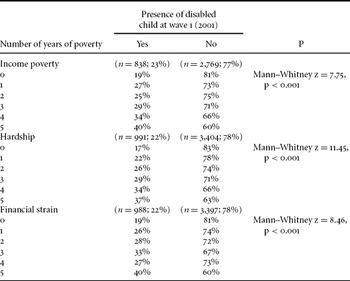
Initial analyses indicated that, as expected, families supporting a disabled child were significantly more likely to be exposed to recurrent or prolonged episodes of poverty than other families. Table 1 presents illustrative data on income poverty, hardship and financial strain for families for whom complete data were available across all five years. As can be seen, while families supporting a disabled child accounted for 23 per cent of all families for whom complete data on income poverty were available, they accounted for 19 per cent of families never exposed to income poverty compared to 40 per cent of families exposed to income poverty in all five years.
Number of years of poverty 2001–2005 by child disability status in 2001

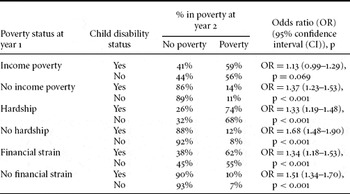
Initial analyses also indicated that, as expected, families supporting a disabled child were significantly more likely to transition into poverty and less likely to escape from poverty than other families (Table 2). It should be noted that: (1) the differences between families with and without a disabled child were statistically significant (p < 0.05) for five of the six comparisons; (2) the effect sizes for the association between child disability status and transitions were consistently greater for hardship and strain than for income poverty; (3) a significant minority (25–45 per cent) of families did escape from poverty within a one-year period.
Poverty transitions by child disability status

Statistical modelling
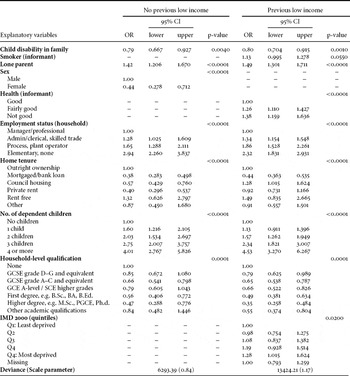
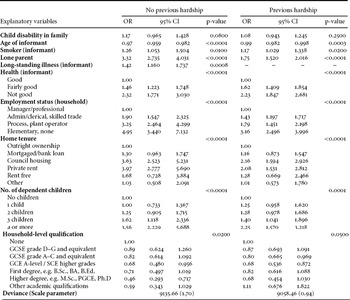
The final conditional models for the binary outcomes (poverty/no poverty) are shown in Tables 3–5. Tables of the unconditional models are available from the corresponding author.
Income poverty transitions conditioned on previous poverty state

Hardship transitions conditioned on previous hardship state

Financial strain transitions conditioned on previous strain state

Income poverty: When controlling for income poverty at t and potentially confounding characteristics, families supporting a disabled child were significantly less likely to experience income poverty at time t+1 (Table 3). Increased risk of income poverty at t+1 was independently associated with being a lone-parent, poorer informant self-rated health, lower occupational status, less secure home tenure, lower levels of educational attainment and higher levels of area deprivation. The association between child disability and reduced risk of income poverty was apparent for families who were and who were not in poverty at t.
Hardship: When controlling for hardship at t and potentially confounding characteristics, families supporting a disabled child were significantly more likely to experience hardship at time t+1 (Table 4). Increased risk of hardship at t+1 was also independently associated with younger informant age, informant being a current smoker, being a lone parent, informant having a long-standing illness/disability, poorer informant self-rated health, greater number of dependent children, lower occupational status, less secure home tenure, lower levels of educational attainment and higher levels of area deprivation. When analyses were conditioned on hardship status at t, the association between child disability and increased risk of hardship was no longer statistically significant. However, there was a trend (p = 0.08) for families supporting a disabled child to be more likely to descend into hardship.
Financial strain: When controlling for financial strain at t and potentially confounding characteristics, families supporting a disabled child were significantly more likely to experience financial strain at time t+1 (Table 5). Increased financial risk of strain at t+1 was also independently associated with younger informant age, informant being a current smoker, being a lone parent, informant having a long-standing illness/disability, poorer informant self-rated health, greater number of dependent children, lower occupational status, less secure home tenure, lower levels of educational attainment and higher levels of area deprivation. When analyses were conditioned on financial strain status at t, the association between child disability and increased risk of financial strain was only statistically significant for families experiencing strain at t. However, the risk of remaining in financial strain was markedly attenuated.
Discussion
Principal findings
When compared to other families, families supporting a disabled child are more likely to be exposed to persistent or recurrent poverty, less likely to escape from an episode of poverty and more likely to descend into poverty. However, statistically controlling for the effects of salient family characteristics either attenuates, eliminates or reverses these associations. That is, when compared to other families with similar levels of personal and social resources, families supporting a disabled child are no more likely to escape from or descend into poverty than other families.
Strengths and limitations of the study
The main strengths of the study are: (1) the use of a relatively large sample of British families; (2) the use of three robust measures of poverty; (3) the use of transition models fitted to longitudinal data; and (4) an approach to modelling that takes account of the effects of a range of potential confounding variables. The main limitations of the study are: (1) the operational definition of child disability employed; and (2) the relatively short period (five years) for which longitudinal data were available.
Current approaches to defining disability stress the role of social and environmental conditions in determining whether particular bodily or psychological variations (‘health conditions’ or ‘impairments’) result in disability (World Health Organization, 2001, 2007). As such, disability is not a characteristic of people, but of the interaction between health conditions or impairments and prevailing social norms, attitudes, expectations and accommodations which lead to the social exclusion of people with particular health conditions or impairments (Shakespeare, Reference Shakespeare2006; Thomas, Reference Thomas2007). While this poses difficulties for survey research which seeks to identify and count the number of disabled people (Fujiura and Rutkowski-Kmitta, Reference Fujiura, Rutkowski-Kmitta, Albrecht, Seelman and Bury2001; Tossebro and Kittelsaa, Reference Tossebro, Kittelsaa, Tossebro and Kittelsaa2004), one can attempt to identify people (in this case children) with health conditions or impairments that are likely (given the nature of the society in which they are living) to result in them becoming disabled.
There are, however, two limitations that arise from our approach to identification. First, identification was solely dependent on informant (nearly always maternal) report of long-standing illness/disability or school-based identification of SEN. There is, of course, room for error in either question. While informant report of disability is likely to capture significant physical health conditions and sensory impairments, informants may not consider their child's emotional, behavioural or learning difficulties to be an ‘illness’ or ‘disability’. Similarly, while informant report of SEN is likely to identify children with a Statement of SEN, informants may not be aware of SEN identified at earlier stages in the school-based assessment of SEN.
Second, it was not possible within the available data to derive an index of the severity of the child's impairment. Clearly, the group of children identified will have been a very heterogeneous group of children with different impairments of differing severity. It is plausible to assume that the overall pattern of results may not necessarily hold up across all salient subgroups (e.g. children with very severe or multiple impairments).
Finally, while our study is the first, to our knowledge, to examine the association between child disability and poverty transitions, it is possible that five years is simply too short a time span for the effects of child disability on the socio-economic position of families to become apparent (Seltzer et al., Reference Seltzer, Greenberg, Floyd, Pettee and Hong2001).
Implications
The main result of the study suggests that the impact of child disability per se on the poverty trajectory of families is significantly weaker than has been commonly argued (Carers UK, 2007a; Council for Disabled Children, 2006; Disability Rights Commission, 2006, 2007; Inclusion Europe, 2006; Inclusion International, 2006). This is not, however, the only evidence to call into question the presumed causal impact of child disability on family socio-economic position. For example, in the area of intellectual or developmental disabilities, social gradients in the prevalence of independently ascertained cognitive impairments are much stronger for less severe impairments, with profound multiple intellectual impairments (and autistic spectrum disorders) showing little or no association with family socio-economic position (Emerson, in press; Newschaffer et al., Reference Newschaffer, Croen, Daniels, Giarelli, Grether, Levy, Mandell, Miller, Pinto-Martin, Reaven, Reynolds, Rice, Schendel and Windham2007). This is, of course, the opposite of what would be expected if the costs associated with child disability were the primary driver of social gradients in prevalence. While this could reflect the targeting of effective services at children with more severe disabilities, the very early emergence of such differential gradients and the widespread concerns voiced about the reach and effectiveness of support services for families supporting disabled children suggest otherwise (Her Majesty's Treasury, 2007).
Rather, our results are consistent with two alternative hypotheses: (1) that lower socio-economic position increases the incidence and prevalence of impairments and health conditions associated with child disability; (2) the association between family poverty and child disability may reflect the operation of unmeasured factors (e.g. parental health, education) leading possibly independently to an increased risk of both family poverty and child disability. These hypotheses are not, of course, mutually exclusive in that lower socio-economic position is also likely to decrease the personal or social resources of parents, an association which (especially in countries with low levels of social mobility) may significantly contribute to the intergenerational transmission of poverty (Cabinet Office, 2008, 2009; Fabian Commission on Life Chances and Child Poverty, 2006; Graham, Reference Graham2007; National Equality Panel, 2010; Nunn et al., Reference Nunn, Johnson, Monro, Bickerstaffe and Kelsey2007). Our results also contribute to the growing body of research that suggests that many of the differences between families who are or are not supporting a disabled child appear to be related to aspects of the socio-economic position of families, rather than the presence in the family of a disabled child per se (Clarke and McKay, Reference Clarke and McKay2008; Emerson and Hatton, Reference Emerson, Hatton, Glidden and Seltzer2010; Emerson et al., Reference Emerson, McCulloch, Graham, Blacher, Llewellyn and Hatton2010; Emerson et al., in press; Hatton et al., Reference Hatton, Emerson, Graham, Blacher and Llewellyn2010).
Whatever the specific processes underlying these relationships, our results suggest that the use of welfare benefits to cover the additional costs of supporting a disabled child may be a necessary but far from sufficient policy response to addressing the social and health inequalities faced by families supporting a disabled child. In addition, it is likely to prove necessary to invest in strengthening the resources available to and capabilities of parents of disabled children and of disabled children themselves. Specifically, this may require a strengthened commitment to such issues as: addressing disablism; delivering intensive early intervention for pre-school children with, or at risk of, significant disabilities or early cognitive delay; ensuring that sustainable high-quality childcare is available for all disabled children and that benefit regulation ensures that the availability of childcare actively supports opportunities for the parents of disabled children to enter employment; the introduction of health checks for family carers; and reviewing the housing needs of families with disabled children in order to develop specific policies to significantly improve the quality of such housing and develop systems for monitoring progress toward such a goal (Beresford and Rhodes, Reference Beresford and Rhodes2008; Department of Health, 2008; Emerson et al., Reference Emerson, Madden, Robertson, Graham, Hatton and Llewellyn2009; Every Disabled Child Matters, 2008; McQuaid et al., Reference McQuaid, Fuertes and Richard2010).
Unanswered questions and future research
As noted above, our analyses included a heterogeneous group of disabled children over a relatively short time span (five years). Priorities for future research in this area would be: (1) the identification of specific subgroups of children and families with different poverty trajectories; and (2) the replication of these methods using data over longer periods of time.
Acknowledgement
The research reported in this paper was funded by grant RES-000-22-2874 from the UK's Economic and Social Research Council.