


Introduction
In one of the most influential philosophical essays of the 20th century, Peter Singer argued that “if it is in our power to prevent something very bad from happening, without thereby sacrificing anything morally significant, we ought, morally, to do it” (Singer Reference Singer1972). He asserted that if someone sees a child drowning in a shallow pond, they should effect a rescue: getting muddy clothes is insignificant when compared to saving the life of a child. This illustrates what is sometimes referred to as the “duty of easy rescue” (Savulescu Reference Savulescu2007). It is only a small conceptual step to substitute a wild animal that is suffering or in danger for the child, if it can be rescued at no great cost. Such assistance, as we will explore, may not always be based on ideas about producing the best consequences; rescuers may be motivated by compassion, driven by the notion that animals in need have a right to help, or motivated by a desire to compensate for human harm. Together, these ethical motivations underpin the practice of ‘wildlife rescue’, understood as actions taken by humans to save individual wild animals from dangerous or difficult situations.
Around the same time as Peter Singer published his essay, organised wildlife rescue efforts were beginning to emerge. While not directly connected, they reflect the same spirit of an expanding sphere of concern and care. The International Wildlife Rehabilitation Council was founded in 1972 in California (International Wildlife Rehabilitation Council 2025) and a number of wildlife rescue facilities were established in the UK in the late 1970s and early 1980s (Tiggywinkles n.d.; Wildlife Aid Education 2014). Today, many regions and countries have dedicated wildlife rescue services, typically operated by charities or private initiatives, to help wild animals in distress and the people who come across them. In New South Wales, Australia, for example, hundreds of cases are reported daily to volunteer-based rescue organisations (NSW Government 2024).
While an intervention to help a wild animal may initially appear compelling, when viewed in a broader context, determining the right thing to do may turn out to be ethically complex. In fact, one catalyst for the establishment of formal rescue and rehabilitation groups was growing concern that well-intentioned interventions, in the absence of professional standards, could cause more harm than good (Ormrod Reference Ormrod1986). Notably, such interventions may conflict with values linked to conservation. Indeed, ethical discourse on wildlife rescue has often since been framed as a dichotomy, where caring for the welfare of suffering wild individuals potentially diverts resources from, or even undermines, conservation objectives, for instance by introducing disease to wild populations (Kirkwood & Sainsbury Reference Kirkwood and Sainsbury1996; Estes Reference Estes1998; Menkhorst et al. Reference Menkhorst, Clemann and Sumner2016; Paterson et al. Reference Paterson, Carstairs and Davy2021).
In broader wildlife management settings, interdisciplinary approaches that attempt to resolve conflicts between welfare and conservation have been proposed, including conservation welfare (Beausoleil Reference Beausoleil, Mellor, Baker, Baker, Bellio, Clarke, Dale, Garlick, Jones, Harvey, Pitcher, Sherwen, Stockin and Zito2018), compassionate conservation (Wallach et al. Reference Wallach, Bekoff, Batavia, Nelson and Ramp2018) and welfare biology (Soryl et al. Reference Soryl, Moore, Seddon and King2021), and both theoretical and practical high-level frameworks have been developed (Smith et al. Reference Smith, Tantillo, Hale, Decker, Forstchen, Pomeranz, Lauber, Schiavone, Frohlich, Lederle, Benedict, Hurst, King, Siemer and Baumer2024; Latombe et al. Reference Latombe, Arbieu, Bacher, Canessa, Courchamp, Dullinger, Essl, Glaser, Jarić and Lenzner2025). While these address where priorities could or should lie (Beausoleil Reference Beausoleil2020) and support deliberation to varying degrees, individual animal rescues sit at their margins and are not systematically theorised or operationalised. As such, the challenges of on-the-ground triage and rehabilitation decision-making for easy, and especially not so easy, rescues persist.
Triage here describes the process of determining the type and urgency of assistance that should be provided (e.g. euthanasia, hospitalisation for intensive care, short-term supportive care or targeted treatment) (Mullineaux Reference Mullineaux2014). This may occur in the field, for instance by a wildlife rehabilitator (McRuer Reference McRuer2021), or in a clinic, by veterinary staff while conducting an initial assessment on an animal already removed from the wild (Bewig & Mitchell Reference Bewig, Mitchell, Mitchell and Tully2009). Decisions at this point will typically be made by individuals using locally developed triage workflows (Hill Reference Hill2025) that are based on immediately apparent animal welfare concerns and a range of other factors (Mullineaux Reference Mullineaux2014). These factors include prognosis, logistics, human safety, regulatory requirements, and, because demand may exceed capacity, resources such as available expertise, funds, facilities, and time (Meredith Reference Meredith, Mullineaux and Keeble2016; Willette et al. Reference Willette, Rosenhagen, Buhl, Innis and Boehm2023). However, important though they are, these are not the only ethically relevant matters.
Wild birds, mammals and reptiles comprise the majority of animals for whom rescue services are sought (Kelly & delBarco-Trillo Reference Kelly and delBarco-Trillo2020; Costa et al. Reference Costa, Pinto da Cunha, Hagnauer and Venegas2024; Massie et al. Reference Massie, Kuskoff, Paterson and Fuller2025). While these are sentient beings, and therefore widely thought to be of moral relevance in themselves, as individuals (Setola Reference Setola2025), each one is a member of a population, a species, an ecosystem and, in its broadest sense, the natural world. Interventions to relieve or treat the immediate suffering of an individual may affect the integrity or conservation of these broader environmental entities (Ford Reference Ford, Ali, Colla, Cooke, Lamb, Pittman, Shiffman and Singh2021; Katz Reference Katz2026), as well as the welfare of other individual animals (Flies et al. Reference Flies, Flies, Fountain-Jones, Musgrove, Hamede, Philips, Perrott and Dunowska2023), and the welfare of the rescued animal itself in the longer term (Willette et al. Reference Willette, Rosenhagen, Buhl, Innis and Boehm2023).
Interventions may also affect wildness. Here, we take ‘wildness’ to be a property of animals that have not been selectively bred, are not typically subject to human control, that exhibit natural behaviours, and that remain untamed; even wildlife living in highly modified landscapes generally maintain some of these features. Similarly, places not designed, managed or controlled by humans may also be thought of as wild. Given this, the rescue and treatment of wild animals may be seen as reducing or threatening wildness value, both of the animals themselves and the places they inhabit (Palmer Reference Palmer2016; Bernat Reference Bernat2023).
Wildlife care providers often maintain that they are concurrently motivated by a sense of compassion and concern for animal welfare, a desire to help animals by compensating for human harms, and a willingness to be environmental stewards (Dubois Reference Dubois2003; Englefield et al. Reference Englefield, Candy, Starling and McGreevy2019b; Paterson et al. Reference Paterson, Carstairs and Davy2021). However, these multiple motivations may themselves create problems. For instance, one motivation might constrain another, either because they are not easily compatible or because they compete for limited resources. Equally, due to resource constraints, the treatment of one animal might preclude the treatment of one or many others. These difficulties and forced choices can lead to personal and interpersonal ethical conflict, a recognised issue in the sector (Coose et al. Reference Coose, Thomsen, Dodsworth, Eckl, Thomsen, Such, Guardia-Uribe, Villar and Gosler2025).
One source of conflict is the very common decision to end a rescued animal’s life. Discussions about the judgements that lead to such decisions are complicated, and in some cases obstructed, by the variable definitions and use of the term euthanasia (Lorenzini Reference Lorenzini2020; Persson et al. Reference Persson, Selter, Neitzke and Kunzmann2020; Quain Reference Quain2021). The prevailing view in many Western wildlife rescue settings is that euthanasia (understood as inducing death with the minimum of pain, fear or distress and in accord with the animal’s interests) is an appropriate response to severe suffering that cannot be alleviated. However, some decisions to end life are not in the animal’s immediate welfare interests, but rather in future predicted welfare interests, or not in their interests at all, but follow from other ethically relevant factors. In these cases, although the term euthanasia is frequently used in practice and policy, we will here use the term humane killing, a process that is technically identical to euthanasia for incurable suffering, but with different ethical justification.
This paper examines three rescue scenarios, drawn from the contemporary Australian wildlife care landscape, but of wider relevance, as a foundation for exploring the following questions:
-
1. What are the possible short-, medium- and long-term implications of rescue for animal welfare and other values of importance from different animal ethics perspectives?
-
2. What are the potential impacts on biodiversity, wildness and other values of importance in environmental ethics?
-
3. Can these issues be articulated and integrated into wildlife triage decision-making?
Our aim is to advance the ethical discourse about wildlife rescue beyond an individual-vs-population approach to a broader account of the potential values and ethical principles at stake. This is a necessary step toward developing an ethically coherent decision-making framework and promoting an ongoing respectful discussion about ethical priorities in wildlife rescue and rehabilitation.
Example wildlife scenarios
Each example presented describes a wildlife rescue intervention driven initially by concern for an animal’s welfare, against a backdrop of different contextual factors and competing concerns. The examples will assist in exploring the immediate and longer-term risks, benefits and conflicts regarding wildlife rescue. We will use these examples to raise questions that will be explored further in the Discussion.
Intervention 1: Hand-rearing an orphaned Australian magpie (Gymnorhina tibicen) chick
A solitary Australian magpie (Gymnorhina tibicen) chick is found in a yard at the base of a tree. There are no obvious injuries. The bird is still wholly dependent on parental care. No other magpies are observed nearby over the course of an afternoon. Therefore, it is presumed the chick has been abandoned or orphaned. If removed from the wild, the chick’s short-term survival will depend on supervision and the provision of nutrition by a parental surrogate.
The Australian magpie is a medium-sized, ground-feeding, abundant passerine species present throughout urban, suburban and rural areas in Australia (Rollinson & Jones Reference Rollinson and Jones2002). Chicks fledge the nest at about four weeks of age but remain with their parents for at least several months. Many juvenile magpies die because of adverse weather conditions, predation or lack of food (Murray Reference Murray2024). They are the most prevalent species reported in the rescue category of ‘dependent young’ in New South Wales rehabilitation records (NSW Government 2024).
Even in the absence of immediate welfare compromise, without intervention a truly orphaned or abandoned pre-fledgling magpie is likely to soon succumb to predation, starvation, exposure, or infection. While this would almost always involve a degree of suffering for the chick, it would likely also provide a meal for a scavenger or predator.
All things going well, hand-rearing an orphan saves an otherwise doomed life and, according to the formal goals of wildlife rehabilitation, promises to return an animal to the wild following a period of temporary care (Paterson et al. Reference Paterson, Carstairs and Davy2021). But the process is not without risk, given the need for an artificial diet and environment, and close and regular contact between an orphan and the surrogate parent (usually a human). If not implemented carefully, long-term animal welfare concerns can arise. For instance, an inappropriate diet during the rapid juvenile growth phase can result in metabolic bone disease, with the potential for pathological fractures of the wings and legs and long-term impacts on mobility (Tangredi et al. Reference Tangredi2007). Magpies are especially prone to this condition (Ladds Reference Ladds2009) and although it can be managed if diagnosed early, it can render a bird unreleasable due to permanent impairment of flight (Cousquer et al. Reference Cousquer, Dankoski and Patterson-Kane2007). Furthermore, hand-reared birds readily become human-imprinted and permanently dependent (Miesle Reference Miesle and Miesle2022). Intergenerational learning is important in the acquisition of skills necessary to forage, navigate, socialise and reproduce in the wild (Mota-Rojas et al. Reference Mota-Rojas, Marcet-Rius, Domínguez-Oliva, Buenhombre, Daza-Cardona, Lezama-García, Olmos-Hernández, Verduzco-Mendoza and Bienboire-Frosini2023). For most avian species, it remains unknown to what extent the lack of natural parental care during hand-rearing affects these abilities, and therefore, survival (Engler et al. Reference Engler, Sens, Lundberg, Delor, Stelter, Tschertner, Feyer, Zein, Halter-Gölkel, Altenkamp and Müller2025).
If such concerns mean that release is not possible or desirable, the bird may be kept in human care, effectively becoming a pet. Given that this is a widespread and abundant species, this will have a negligible effect at a population level; but inevitably, given that the bird will be tame, some natural behaviours lost, and some human control exerted, aspects of the animal’s wildness will be diminished or lost.
This rescue, then, raises some critical questions. Which action will result in the best outcome for the chick, the people involved, the local magpie population and any potential scavenger? What would define success from hand-rearing: survival to adulthood? Release back to the wild? Survival post-release to a particular time-point or reproductive milestone? A positive welfare state regardless of release status? A sense of rescuer or caregiver satisfaction that a good deed has been done? If abnormal social bonds, behaviours or physical differences develop despite efforts otherwise, and wildness is lost in the process, does this matter? Is the bird’s welfare best served by long-term captive care, even as a pet, compared with release or humane killing? Are there hidden population-level implications of individual captive care?
Intervention 2: In-field treatment of sarcoptic mange in a bare-nosed wombat (Vombatus ursinus)
Our second case is a bare-nosed wombat (Vombatus ursinus) with presumed sarcoptic mange. The animal is visibly unwell (underweight, out of its burrow during the day and has large, fissured scabs over its body). It is suggested that treating this animal with a topical ectoparasiticide would be relatively easy.
Sarcoptic mange (‘mange’ hereafter) is a globally distributed zoonotic skin disease caused by the burrowing mite Sarcoptes scabiei (Astorga et al. Reference Astorga, Carver, Almberg, Sousa, Wingfield, Niedringhaus, Van Wick, Rossi, Xie, Cross, Angelone, Gortazar and Escobar2018). It affects a wide range of species and severity depends, at least in part, on host immune function (Wilkinson et al. Reference Wilkinson, Richards, Carver, Naesborg-Nielsen, Cray and Rossi2024b; Martin et al. Reference Martin, Isasi-Catalá, Salgado-Caxito, Gallegos, Hostos-Olivera, Colchao-Claux, Smith, Beltran-Saavedra, Dougnac, Germana, Montoya, Carver, Cross and Walzer2026). Transmission occurs via animal-to-animal contact, or from the environment, as the mite can survive off the host for some time (e.g. in burrows, that are regularly shared and swapped by wombats) (Martin et al. Reference Martin, Ricardo, Tompros, Fraser, Polkinghorne and Carver2019; Burgess et al. Reference Burgess, Richards, Driessen, Wilkinson, Amin and Carver2023). Thus, an infestation/reinfestation cycle can persist. It is believed that S. scabiei was introduced to Australia by European colonisers and their dogs, and as such, is a parasite with which wombats have not co-evolved (Fraser et al. Reference Fraser, Charleston, Martin, Polkinghorne and Carver2016).
Mange can significantly compromise the welfare of individual animals causing intense itching, self-trauma, skin thickening, hair loss, changes in daily routine and behaviour, secondary bacterial infections, increased metabolism and inefficient thermoregulation (Campbell-Ward Reference Campbell-Ward, Vogelnest and Portas2025). Affected animals with heavy infestations can die slow, painful deaths, many months after initial signs of disease appear (Skerratt Reference Skerratt2003).
Treatment of mange with acaricidal agents in combination with supportive care (e.g. intravenous fluids, antimicrobials for secondary infections, high-calorie nutrition; as reviewed by Rowe et al. Reference Rowe, Whiteley and Carver2019) can be effective for individuals in the short-term. But bringing wombats into temporary captivity for treatment is challenging. They are large, fossorial and destructive, field capture by those without specific training can pose occupational safety and other risks, and capture, transport, hospitalisation and intensive treatment exposes wild wombats to major stressors (Jackson et al. Reference Jackson, Johnson, Bryant, Janssen, Taggart and Jackson2025a).
Strategies that facilitate treating and ‘caring’ for an affected wombat without removing it from the wild are clearly appealing and, in the case of wombats, there is demonstrated community demand for them (Carver et al. Reference Carver, Naesborg-Nielsen, Pulscher and Mounsey2025). One method involves approaching wombats with signs of mange and pouring topical acaricidal drugs (moxidectin or fluralaner) directly on their backs via a long-handled pole. An alternative, less direct method involves installing flaps at the entrance to wombat burrows with a small drug-containing cup attached that pours the liquid medication over an animal as it passes through (Old et al. Reference Old, Skelton and Stannard2021; Leary et al. Reference Leary, Kaye, Chin, Phoon and Phalen2025).
The topical agents alone can be effective at reducing mite burden and even, if repeated often enough, achieve clinical resolution for mild to moderate mange cases; noting that reinfestation post-treatment is very likely (Wildlife Center of Virginia 2024; Leary et al. Reference Leary, Kaye, Chin, Phoon and Phalen2025). However, in one study of wombats treated in care, most of whom had severe mange and were malnourished, only around 40% survived despite treatment (Mounsey et al. Reference Mounsey, Harvey, Kefford, Brawata, Holme, Vermaak and Vandenberg2025). It was not uncommon for wombats to appear to make an initial recovery as the acaricide killed the mites, but then clinical deterioration occurred 5–7 days later. A lack of long-term efficacy and safety data has also been raised as an issue for both in-field treatment methods (pouring pole and burrow flap) (Moroni et al. Reference Moroni, Valldeperes, Serrano, Lopez-Olvera, Lavin and Rossi2020; Mounsey et al. Reference Mounsey, Harvey, Wilkinson, Takano, Old, Stannard, Wicker, Phalen and Carver2022; Wilkinson et al. Reference Wilkinson, Richards, Burgess, Næsborg-Nielsen, Gutwein, Vermaak, Mounsey and Carver2024a) and there is evidence that moxidectin absorption is significantly less efficient via the transdermal route than alternatives (Stott et al. Reference Stott, Skerratt, Whittem, Leeming, Pillay, Doran, Gardner, Lynch, Klein, Holz, Chen, Hufschmid and Woodward2026). Furthermore, these methods bypass the usual triage process of veterinary assessment and reassessment, they preclude supportive care, and dosing is much less precise than in a clinic or rehabilitation centre, risking potential adverse consequences for dosed individuals, other animals (e.g. non-target animals passing under flaps) and the population. Inaccurate dosing increases the risk of acaricidal resistance, and repeat dosing of target individuals at optimal times or at all is not guaranteed, posing an ongoing transmission risk to other wombats locally (Moroni et al. Reference Moroni, Valldeperes, Serrano, Lopez-Olvera, Lavin and Rossi2020; Mounsey et al. Reference Mounsey, Harvey, Wilkinson, Takano, Old, Stannard, Wicker, Phalen and Carver2022).
Concerns have also been raised regarding the potential for ecotoxicity and adverse long-term impact on the environment and other species. These drugs are known to be highly toxic to aquatic organisms, and some unmetabolised chemicals will be present in wombat dung, altering the faecal flora and resulting in chemical transfer to the environment (Arcadis 2024). The techniques used are prone to spillage and with some wildlife carers using excessively high doses (Old et al. Reference Old, Skelton and Stannard2021; Mounsey et al. Reference Mounsey, Harvey, Wilkinson, Takano, Old, Stannard, Wicker, Phalen and Carver2022), the risk of direct environmental contamination increases. The environmental consequence of such contamination is incompletely understood (Mounsey et al. Reference Mounsey, Harvey, Kefford, Brawata, Holme, Vermaak and Vandenberg2025).
Questions raised here include: Is this ‘in the field’ approach to treatment justified if it is less effective at achieving resolution or more difficult to monitor than hospital-based care? And if so, is that because the animal can remain free-living and/or because it empowers people to provide active care relatively easily? Even if effective at an individual level, is justification for this approach dependent on a concurrent neutral or positive population level effect? At what level of disease is euthanasia or humane killing kinder or fairer? And is there an obligation to consider the impact on other species in the environment or the integrity of the ecosystem before proceeding with treatment?
Intervention 3: Rescuing an injured koala (Phascolarctos cinereus) from a megafire
Our third case is the rescue of a koala (Phascolarctos cinereus) with apparent fire-related injuries in the aftermath of a megafire – an intense, exceptionally large and ecologically destructive wildfire, made more likely by climate change and altered land use (Penman et al. Reference Penman, Clarke, Gibson, Collins, Nolan, Rumpff, Legge, van Leeuwen, Wintle and Woinarski2023). The proposed intervention involves the removal of the animal from the wild for assessment and, if appropriate, treatment.
Without intervention, an animal that is seriously injured in a megafire will perish or fail to heal adequately while attempting to survive in a catastrophically altered environment. Disasters such as megafires can invoke profound community concern for, and direct fervent media attention toward, the welfare of some affected species (Sherwen et al. Reference Sherwen, Campbell-Ward, Woods, Rumpff, Legge, van Leeuwen, Wintle and Woinarski2023). As a cultural icon, koalas are especially favoured (Woinarski et al. Reference Woinarski, Garnett and Zander2024). Therefore, although there will be countless animal victims across the taxonomic spectrum, there’s likely to be strong public pressure for intervention in the case of affected koalas.
In some jurisdictions koalas are formally listed as endangered (Lott et al. Reference Lott, Frankham, Eldridge, Alquezar‐Planas, Donnelly, Zenger, Leigh, Kjeldsen, Field and Lemon2024). Elsewhere, they may be considered locally abundant or overabundant and strategies such as fertility control and translocation may be employed to manage over-browsing, tree dieback, and subsequent koala starvation (Drijfhout Reference Drijfhout2019).
For an animal with significant injuries, for example burns and smoke inhalation, thorough veterinary assessment to determine prognosis and treatment options usually necessitates capture, if that is feasible. Euthanasia will typically be the preferred action from a welfare perspective, if the animal has such severe injuries that any attempt at treatment is considered futile (Vogelnest Reference Vogelnest, Vogelnest and Portas2025). Ideally, such decisions are made promptly (Mullineaux Reference Mullineaux2017) and, if safe to do so, euthanasia is performed at or near the site of rescue, before the animal undergoes transport and holding. However, capture may be undertaken by those without welfare assessment training or the necessary permissions to euthanase (Campbell-Ward et al. Reference Campbell-Ward, Wicker, Spielman, Tobias and Vitali2025).
Suppose the koala has been captured and transferred to a triage unit for veterinary assessment. Burn injuries are confirmed but at a level that can initially be treated. While this may alleviate immediate suffering (thereby negating the obligation to consider urgent euthanasia), a decision-maker will need to take a longer-term view too. What will treatment involve? For how long? What measures will indicate that alleviation of suffering has been effective − especially given that koalas are pharmacologically unique and the impact of most drugs in them is uncertain (Govendir Reference Govendir, Vogelnest and Portas2025)? Are permanent impairments expected that may preclude release? If so, would humane killing be considered an acceptable alternative triage outcome?
In addition to the challenges of carefully managing and monitoring pain, stress and infection risk in a behaviourally cryptic species, simply feeding a koala in care could create another dilemma. Koalas need a daily supply of fresh eucalyptus leaves (Hume & Esson Reference Hume and Esson1993) as commercially produced maintenance food substitutes are unavailable. Some facilities maintain plantations to feed koalas in their care (Jackson et al. Reference Jackson, Nilsson, Eccleston, Gillett, Johnston, Lunney, Booth and Jackson2025b), but these may be damaged following a fire or the drought that preceded a fire. If browse is sourced instead from remnant unburnt bushland where unharmed koalas are present, this will deprive remaining free-living koalas of scarce food resources necessary for their survival.
If the short- to medium-term welfare of our rescued koala can be improved with appropriate analgesia, wound care and species-relevant husbandry, additional questions are raised. What does longer-term welfare look like in a post-catastrophe environment? Is release within a reasonable time-frame feasible and will translocation to an unfamiliar environment be necessary? If so, how will that transition be managed? Euthanasia may be considered if health complications arise, but will humane killing on the grounds of food scarcity or the exorbitant cost of care be considered ethically acceptable?
The cost of intensively treating koalas with extensive injuries in the 2019–2020 megafires was retrospectively calculated at $AUD16,000 per koala per week with some animals requiring many months of care (Sherwen et al. Reference Sherwen, Campbell-Ward, Woods, Rumpff, Legge, van Leeuwen, Wintle and Woinarski2023). Is this cost justified if the outcome is a fully recovered animal released back to the wild and thriving in a locality where they are endangered? What if the koala originated from a population determined to be locally overabundant pre-fire, where relative food scarcity was causing welfare concerns? And would it matter if that food scarcity was due to anthropogenic influences, e.g. habitat fragmentation restricting dispersal or climate impacts on food trees?
Discussion
The three interventions described represent a tiny fraction of the myriad wildlife triage decisions made daily worldwide. And it’s clear that, on close inspection, none of these scenarios is truly an easy rescue. They all involve trying to make complex ethical decisions in a situation of competing interests and conflicting values. To think about this more carefully, we will return to the three questions we raised in the Introduction regarding:
-
• The possible implications for animal welfare and other values of importance in animal ethics;
-
• The potential impacts on biodiversity, wildness and other environmental ethics concerns; and
-
• The feasibility of effective integration of all these issues into decision-making.
1. Implications of rescue for animal welfare and other values of importance from different animal ethics perspectives
Beyond immediate relief from pain, hunger or physiological instability, there are important welfare implications for rescued animals. Adopting the Five Domains model (Mellor et al. Reference Mellor, Hunt and Gusset2015; Harvey et al. Reference Harvey, Beausoleil, Ramp and Mellor2020), animal welfare is understood to be an animal’s affective state (Domain 5), shaped by nutrition, environment, health, and behavioural interactions (Domains 1–4) (Mellor et al. Reference Mellor, Beausoleil, Littlewood, McLean, McGreevy, Jones and Wilkins2020). However, this contemporary understanding does not help us draw a definitive line between acceptable and unacceptable welfare, nor is it reflected in legislation.
Regulatory standards for the temporary captive care of wildlife, where they exist, are highly variable, underdeveloped and poorly enforced (Finn Reference Finn2019; Rodriguez Ferrere Reference Rodriguez Ferrere2022). Thus, those involved in rescued wildlife care are often left to establish and maintain what they consider to be appropriate species-relevant welfare standards, and to make judgements on their own capacity to meet these, which is especially challenging when there is limited knowledge about the needs of the species.
Short-term animal welfare considerations – the individual
One short-term issue of especial ethical importance concerns attempts to rescue the most severely debilitated animals (Molony et al. Reference Molony, Baker, Garland, Cuthill and Harris2007) which may, after all, be those who can most easily be approached and captured. Severity of injury or illness is negatively correlated with survival prospects; attempts to treat such animals may prolong suffering. For an emaciated wombat that is effectively blind from severe facial mange, euthanasia will typically be considered a more reasonable course of action than attempting therapy with a high welfare cost to the animal and a very high risk of treatment failure (Skerratt et al. Reference Skerratt, Death, Hufschmid, Carver and Meredith2021). Nevertheless, euthanasia of wildlife casualties, including those that are relatively easy to rescue or treat, is not universally accepted and expert decisions and policy that support euthanasia are often questioned (White et al. Reference White, Hänninen, Sainmaa and Valros2024), which can lead to a protracted period of very poor welfare prior to death. We will return to this later.
When treatment is pursued in less severe cases, short- and medium-term improvements in welfare are not always assured. Further welfare risks stem from rescue practices, captivity itself or ineffective treatments (Wood Reference Wood2022; Funnell et al. Reference Funnell, McLelland, Kokosinska, Stephenson, Dunstan, Turner and Speight2025), heightened when rescuers lack training or resources, or when facilities fail to meet species-specific needs. Poor nutrition, especially in juveniles, can cause permanent deformities, while inappropriate housing may lead to injury, social stress, or secondary disease (Hanson et al. Reference Hanson, Hollingshead, Schuler, Siemer, Martin and Bunting2021).
Capture, transport, and confinement are inherently stressful for most wild animals (Fischer & Romero Reference Fischer and Romero2019; Soulsbury et al. Reference Soulsbury, Gray, Smith, Braithwaite, Cotter, Elwood, Wilkinson and Collins2020), raising questions about whether in-field vs hospital-based treatments are preferable. Even when eliminating the stress of capture from the equation, welfare may still be compromised by close human contact when animals are too weak to escape and suffering could be prolonged due to misdiagnosis, undertreatment or treatment failure.
Veterinary and husbandry techniques for wildlife are advancing, improving diagnostic accuracy and treatment outcomes, and potentially welfare and release prospects (Ahn et al. Reference Ahn, Ro, Bae, Shim, Jeong, Choi, Shin, Choi and Kim2024; Aparna Reference Aparna2024). Yet critical evaluation of these advances is needed before universally adopting them. They pose the risk of overtreatment, a concern also raised in human and companion animal medicine (Grimm et al. Reference Grimm, Bergadano, Musk, Otto, Taylor and Duncan2018; Gupta et al. Reference Gupta, Gupta and Koul2020). Additionally, therapeutic protocols developed for people or domestic animals, even for identical medical problems, may not be well tolerated or practical for a wild animal, resulting in negative affective states and ongoing suffering, despite concerted care efforts, making such protocols difficult to justify ethically from a range of perspectives.
Longer-term animal welfare considerations – the treated individual
Survival to release is a commonly cited metric for success in wildlife rescue (Cope et al. Reference Cope, McArthur, Dickman, Newsome, Gray and Herbert2022), but it offers limited insight into long-term welfare (Dutton-Regester Reference Dutton-Regester2025). Many agree that how well the animal fares post-release is what really matters (Goldenberg et al. Reference Goldenberg, Parker, Chege, Greggor, Hunt, Lamberski, Leigh, Nollens, Ruppert, Thouless, Wittemyer and Owen2022). Individuals that are unfit, incompletely treated, diagnosed with long-term conditions or maladapted may suffer chronic stress, illness or pain, social isolation, predation, disease recurrence, or starvation due to impaired foraging or hunting abilities (Cope et al. Reference Cope, McArthur, Dickman, Newsome, Gray and Herbert2022). Rigorous physical and behavioural assessments are therefore recommended prior to discontinuation of care and subsequent release (Houser et al. Reference Houser, Boast, Somers, Gusset and Bragg2011; Guy et al. Reference Guy, Curnoe and Banks2013). For instance, koalas with distal limb burns should be screened for progressive digital necrosis, a delayed-onset condition that can result in the eventual loss of nails and damage to phalangeal bones necessary for climbing (Vitali et al. Reference Vitali, Reiss, Jakob-Hoff, Stephenson, Holz and Higgins2023).
In the magpie example, we saw that hand-rearing can prevent immediate threats like starvation and predation. However, if imprinting on humans or other species occurs, it can lead to behavioural maladaptation. Hand-reared wild individuals often fail to develop a normal species-specific behavioural repertoire, may have different personality traits compared to their wild-reared counterparts, and are generally not provided the opportunity to develop a cognitive map of their future habitat while in care (Englefield et al. Reference Englefield, Blackman, Starling and McGreevy2019a; Mella et al. Reference Mella, Gillies, McArthur, Webb, Herbert and Webb2022). These animals may approach rather than evade humans and predators and fail to recognise social cues and defensive behaviours (Fàbregas et al. Reference Fàbregas, Fosgate, Ganswindt, Bertschinger, Hofmeyr and Meyer2020). Occasionally, they pose risks to people, especially when aggression or other aberrant behaviours emerge during sexual maturity or when humans are perceived as sources of food or companionship (Miesle Reference Miesle and Miesle2022). Such animals may be deemed nuisances or even public hazards (Sleeman Reference Sleeman2007).
Post-release monitoring data for hand-reared wildlife are limited but concerning. Failure rates can be high. In one study, 45% of released hand-reared brushtail possums (Trichosurus vulpecula) either died or were returned to care within two weeks (Mella et al. Reference Mella, Gillies, McArthur, Webb, Herbert and Webb2022). Some of those recaptured required veterinary treatment or were unable to forage independently, repeatedly seeking human contact and exposing themselves to further harm. Nonetheless, other studies show improved outcomes, particularly when human-imprinting is minimised (e.g. promoting species-appropriate socialisation) and when soft-release techniques are employed, such as providing food, water, and shelter for a transitional period (Ellis et al. Reference Ellis, Gee, Hereford, Olsen, Chisolm, Nicolich, Sullivan, Thomas, Nagendran and Hatfield2000; Fozzi et al. Reference Fozzi, Brogi, Cavazza, Chirichella, De Rosa, Aresu, Cerri, Apollonio and Berlinguer2023). However, research gaps remain for many commonly orphaned species.
A recurring dilemma arises when animals fail or are predicted to fail pre-release assessment and require ongoing or even lifelong care that may be impossible to provide in a free-living setting. Unreleasable animals of certain species − those with suitable temperaments and no chronic pain − may adapt well to captive environments tailored to their needs (Fischer & Romero Reference Fischer and Romero2019). They may be kept for education or research purposes, often under licensing arrangements (Mo & Oliver Reference Mo and Oliver2020). Globally, charities and volunteers manage facilities for unreleasable animals of selected species (Speiran Reference Speiran2025), but capacity can be quickly overwhelmed and operations can be expensive. If resources become too stretched, a decline in welfare and biosecurity standards and commercial exploitation may result, potentially undermining the original goal of rescue.
Some unreleasable wild animals are kept privately, effectively as pets, a practice that is often prohibited (Englefield et al. Reference Englefield, Blackman, Starling and McGreevy2019a). Whether legal or illegal, evidence from the exotic pet sector suggests that welfare of such animals is often compromised unless owners possess the necessary expertise, resources, and commitment to provide appropriate housing, diet, social interaction, and veterinary care (Grant et al. Reference Grant, Montrose and Wills2017). In large-scale disasters, such as megafires, where dozens of koalas, kangaroos, and possums may be deemed unreleasable post-treatment, the ethical question becomes unavoidable: in the absence of species-specific, available, legal and high quality long-term care, which is the least harmful option − substandard captive care, premature release, or humane killing?
Longer-term animal welfare considerations – other animals
Rescue efforts for one individual can affect the welfare of other individuals within populations. Saving an animal that is a mother or part of a bonded pair can eliminate the welfare impact of their loss on those that rely on them. Effective treatment can reduce the risk of pathogen exposure. Conversely, animals subjected to close contact with other species (including humans) or certain treatments may transmit pathogens or antimicrobial resistance genes, posing a potential disease risk to others (Chaves et al. Reference Chaves, Montecino-Latorre, Alcázar and Suzán2021; Sánchez-Ortiz et al. Reference Sánchez-Ortiz, Blanco Gutiérrez, Calvo-Fernandez, Mencía-Gutiérrez, Pastor Tiburón, Alvarado Piqueras, Pablos-Tanarro and Martín-Maldonado2024). Inadequate treatment also risks further direct disease transmission to others, and as in the wombat case, plausibly creates conditions conducive to the development of drug resistance.
Moreover, welfare consequences extend beyond conspecifics. Resource constraints and species bias can result in disproportionate attention to charismatic or culturally valued animals (Raña Reference Raña2024), diverting support from others with equal or greater need. In disaster response scenarios, this tension becomes acute and the resulting trade-offs can challenge the values and moral motivations of many rescue workers and community members (Every et al. Reference Every, Due, Thompson and Ryan2016).
Animal welfare – expectations and perspectives regarding death
For lay rescuers, there may be misalignment between expectation and reality, with most (68%) believing that the majority of rescued wild animals survive (Massie et al. Reference Massie, Kuskoff, Paterson and Fuller2025). Yet data show that most wildlife arriving at triage facilities and clinics die, are euthanased or are subject to humane killing (Kwok et al. Reference Kwok, Haering, Travers and Stathis2021; Cope et al. Reference Cope, McArthur, Dickman, Newsome, Gray and Herbert2022). Unrealistic expectations that all individuals can be saved can lead to poor welfare outcomes as some animals are subjected to protracted, stressful treatment. In the 2019–2020 megafires, euthanasia of animals with a poor prognosis was sometimes delayed or actively avoided, especially when untrained and inexperienced personnel did not appreciate the suffering of animals undergoing treatment (Sherwen et al. Reference Sherwen, Campbell-Ward, Woods, Rumpff, Legge, van Leeuwen, Wintle and Woinarski2023). This was exacerbated by an incomplete appreciation of medium- and long-term risks to animal welfare and, sometimes, objections to the humane killing of animals that were perceived to be treatable.
Different ways of understanding the welfare implications of an animal’s death are also important here. One view is that death is a welfare-neutral state: there is simply no further welfare post-death, whether good or bad. Other views hold that death may be understood as depriving an animal of the potential for future positive welfare (Kasperbauer & Sandøe Reference Kasperbauer, Sandøe, Višak and Garner2015). If current severe suffering is unequivocal and future welfare highly compromised, then arguments about a lost future seem nugatory, since such a future is not available. But if there’s a chance that a rescued animal could have good welfare in the future, humane killing seems to be a deprivation of that possibility (and, for some people, such deprivation, other things being equal, would be unethical).
Nevertheless, there are still cases where it can be argued, at least from some ethical perspectives, that even if the animal could have a positive future, humane killing may be ethically justified. This may be so perhaps in cases where the killing serves the interests of many other animals (e.g. by protecting the remaining wild population from disease), or frees up funding that could save many other lives. However, such decisions may be disputed. For instance, on rights views that we will discuss later, any life that could potentially be saved carries an inherent moral claim, regardless of regulatory constraints, negative impacts on other animals or opportunity costs.
Other values of importance in animal ethics
For those who base ethical views on care and connection, relationships with local wild animals can be deeply significant. These relationships reflect a broader ethical orientation that values sympathy, empathy, and kinship with non-human life. Increasingly, a duty of care traditionally reserved for captive animals is being extended to wild ones (Kuznetsov & Koi Reference Kuznetsov and Koi2025), both ethically and legally. In regions with rising urbanisation, education, and affluence, societal attitudes towards wildlife are shifting, correlating with increased rescue efforts (Andrade et al. Reference Andrade, Bateman, Larson, Herzog and Brown2022). Surveys indicate a move from traditional domination values, emphasising human control and wildlife use, toward mutualism, which promotes coexistence and views wildlife as fellow beings deserving of compassion and care (Manfredo et al. Reference Manfredo, Sullivan, Don Carlos, Dietsch, Teel, Bright and Bruskotter2018, Reference Manfredo, Teel, Don Carlos, Sullivan, Bright, Dietsch, Bruskotter and Fulton2020). Caregivers often describe their work as deeply fulfilling, with meaningful bonds formed during rehabilitation (Perry & Averka Reference Perry and Averka2020), and in a process referred to as ‘veterinarisation’ (Broz et al. Reference Broz, Arregui and O’Mahony2021), veterinary expertise has increasingly assumed a more significant role in mediating these kinds of contemporary human-animal relations.
In times of crisis, actions driven by compassion may reflect moral values such as dignity, solidarity, and reverence for life, even when the broader consequences remain uncertain. During disasters marked by collective grief and anxiety, some individuals may feel that helping vulnerable animals offers emotional relief, validation and hope, outweighing adherence to legislation or peacetime welfare-oriented protocols (Sturman et al. Reference Sturman, Celermajer, MacDonald, Verlie, Heenan and Schlosberg2025). Similarly, the desire to offer an animal a chance at survival, even when prognosis is poor, can be a powerful motivator, making euthanasia or humane killing feel ethically untenable.
In contrast, rights-based ethics centres on the rights of animals as subjects of lives or as interest-bearers, independent of their utility to humans, their ecological function, or how humans feel about them (Regan Reference Regan2023). These rights may include the right to life, liberty, bodily integrity, and the capacity to flourish in accordance with their biological nature (Scholtz Reference Scholz2024). These rights are generally understood negatively (Sommer & Ferraro Reference Sommer and Ferraro2022) – for example, an animal’s right to life should be taken to mean that the animal has a right that a moral agent – a human being – not kill them. This does not, however, imply that the animal has a right to be rescued from dying when the threat arises from natural causes. This understanding means that rights-based approaches may diverge from other responses to the three cases.
So, for instance, unless the magpie chick had been orphaned by a human action, there is no duty to provide care at all. On a rights view, the chick does not have a positive right to be saved. In the wombat case, since mange in Australia appears to have been introduced by humans, it might be argued that wombats’ rights not to be severely harmed or killed have been violated and that they should be helped as a matter of reparative justice (Luther Reference Luther2021), provided doing so does not further violate their rights. The megafire raises similar issues, assuming it was caused (at least to some degree) by humans: efforts to triage and treat burnt koalas can be seen as a way of trying to correct anthropogenic harms.
However, magpies, wombats and koalas cannot provide consent (Janssens Reference Janssens2024), and when treatment is futile or causes further suffering, or captivity is not tolerated, euthanasia may better honour their interests in avoiding suffering and prolonged distress. Even a rights view, with some nuanced variations, can justify euthanasia as being in the best interests of the individual concerned (Yeates & Main Reference Yeates and Main2011). These scenarios underscore the complexity of rights-based reasoning in this area, since so often it is unclear whether an animal has been harmed anthropogenically (and so whether its rights are at stake at all), and how far helping one animal might contribute to violating the rights of others.
Indeed, questions about how far any harm to an animal is anthropogenic are of significance beyond a rights view, because it’s widely argued that ethical obligations to intervene are amplified when human actions have causally contributed to animal suffering (Fraser & MacRae Reference Fraser and Macrae2011; Taylor-Brown Reference Taylor-Brown, Booth, Gillett, Mealy and Ogbourne2019; Macdonald Reference Macdonald2023). The difficulty, however, for those engaged in wildlife rescue triage, is identifying whether, and how far, any human activity is implicated where any particular animal is concerned. Obviously, an animal hit by a car or affected by anticoagulant poison has been anthropogenically harmed; but what about wildfires and floods, or parental stress-related abandonment, in a time of anthropogenic climate change and habitat degradation? Or secondary harms due to the conditions of temporary captivity? Concerns like these, as we discuss below, make decisions in wildlife care especially difficult.
2. Biodiversity, wildness and other environmental ethics concerns
Historically, wildlife rescue, treatment, and rehabilitation have been considered irrelevant to mainstream conservation initiatives, largely due to their frequent focus on species classified as least concern (Pyke & Szabo Reference Pyke and Szabo2018). However, perceptions are changing. Enhanced data collection has demonstrated that rescue work increasingly intersects with conservation priorities. Between 2013 and 2019, 21.3% of 469,553 rescued wild animals in New South Wales were listed as threatened under the NSW Biodiversity Conservation Act 2016, encompassing mammals, birds and reptiles (Kwok et al. Reference Kwok, Haering, Travers and Stathis2021). Furthermore, rehabilitation efforts have yielded measurable conservation outcomes, particularly for vulnerable taxa, such as turtles, marine mammals, and bats, especially when these interventions complement rather than compromise in situ threat mitigation strategies (Paterson et al. Reference Paterson, Carstairs and Davy2021; Willette et al. Reference Willette, Rosenhagen, Buhl, Innis and Boehm2023). So, there is at least some scope for concerns about wild animal welfare and species/biodiversity conservation to overlap in the context of wildlife rescue.
Yet concerns remain. Reintroducing rehabilitated animals could potentially disrupt local intra- and inter-species ecological interactions, alter species dynamics, and interfere with natural processes, such as ageing and the selective removal of less fit genotypes and less healthy phenotypes. Application of acaricides or other pharmaceuticals in a field setting raises concerns about unintended harm to non-target, less visible species and drug resistance. The escalating public expectation for rescue efforts during environmental extremes or disasters (Jones et al. Reference Jones, Herbert, Finnerty, Kennedy, Lykins, Martin, McManus, Raubenheimer, Shaw and McGreevy2023) may also create competition for precious resources, complicate ecological outcomes by shifting conservation priorities, and impede ecosystem recovery.
Further, the broader ecological context of an individual rescue is often poorly understood. For example, the removal of magpie chicks, performed at scale, could disrupt trophic dynamics, affecting food webs and nutrient cycling (Hampton et al. Reference Hampton, Newsome, Dickman and Sandøe2025). In addition, the circumstances preceding rescue, and how much danger a wild animal is truly in, are not always apparent and intervention may not have merit. For example, not all juvenile wild birds found alone are in trouble. The young of some species, like megapodes, are precocious and independent from hatching (Göth & Vogel Reference Göth and Vogel2003), while others gain independence through exploration away from the nest or are left temporarily while a parent is away foraging (Radford & Ridley Reference Radford and Ridley2006; Mock Reference Mock2022; Mota-Rojas et al. Reference Mota-Rojas, Marcet-Rius, Domínguez-Oliva, Buenhombre, Daza-Cardona, Lezama-García, Olmos-Hernández, Verduzco-Mendoza and Bienboire-Frosini2023).
For highly endangered species, rescuing and hand-rearing an orphan could contribute positively to population viability (Tschudin et al. Reference Tschudin, Retter, Watson, Clauss and Hammer2010). However, such interventions carry inherent risks; for example, hand-reared individuals may exhibit reduced fertility, as observed in the kakapo (Strigops habroptilus) (Digby et al. Reference Digby, Eason, Catalina, Lierz, Galla, Urban, Le Lec, Guhlin, Steeves, Dearden, Joustra, Lees, Davis and Vercoe2023). If released individuals transmit deleterious genetic traits, this could undermine the long-term sustainability and adaptive potential of small populations (Robinson et al. Reference Robinson, Kyriazis, Yuan and Lohmueller2023).
While retaining hand-reared individuals in captivity may appear to eliminate environmental risk, it introduces an indirect threat that warrants attention, i.e. that wild animals are turned into pets. A shift in public perception whereby wild animals become viewed as suitable pets may be considered a form of petification, a term that has been used in other contexts (Perez Reference Perez1986; Meyer et al. Reference Meyer, Forkman, Fredholm, Glanville, Guldbrandtsen, Ruiz Izaguirre, Palmer and Sandøe2022). As previously discussed, threats to wildness arising from rescue include selective breeding, human control, unnatural behaviours, and tameness. Human-imprinting and prolonged captivity can compromise behavioural integrity through dependency, developmental disruptions, and adaptation to captive environments. The widespread sharing of images depicting pet-like interactions between wildlife and humans or other animals, including potential predators, on social media platforms can significantly influence public attitudes and social norms (Buckanoff & Williams Reference Buckanoff and Williams2024; Freund et al. Reference Freund, Cronin, Huang, Robinson, Yoo and DiGiorgio2024), potentially promoting petification. This may escalate demand for wild species, incentivising poaching and selective breeding, which in turn can erode genetic fitness and jeopardise conservation outcomes. Even when well-intentioned, such trends risk commodifying wildlife, distorting perceptions about the species and undermining their ecological roles.
This form of petification also raises broader concerns about the ways in which wildlife rescue may lead to a loss in wildness value. So far, we have thought about this primarily in terms of the wildness of individual animals (becoming tame or losing natural behaviours). However, in many places, wilder landscapes – those that are less influenced or managed by people – are of special value (as described, for instance, in the US Wilderness Act) (Nelson & Vucetich Reference Nelson and Vucetich2013). Intervention to assist wildlife, at least at scale, may lead to the perception that such value is being lost – that wild lands are now being managed by people to improve wild animal welfare in ways that, for instance, interfere with spontaneous ecological and evolutionary processes (Sandler & Palmer Reference Sandler and Palmer2025). Even without focusing on outcomes, there may be a principled objection to human interference in wild lives.
Globally, diseases such as mange are frequently monitored in wildlife or affected animals are subject to selective euthanasia rather than actively treated, either due to perceived infeasibility of treatment in certain species or because the disease is considered endemic and a natural selective pressure. Conventional recommendations for mange management have typically adopted ecological or population-level approaches, prioritising intervention only during active outbreaks in species of conservation concern, such as mountain gorillas (Gorilla beringei beringei) (Kalema-Zikusoka et al. Reference Kalema-Zikusoka, Kock and Macfie2002), or in contexts of anthropocentric relevance, such as when infected wildlife pose a threat to people or valuable domestic animals. For wombats, very intense treatment (of all burrows and essentially all wombats in a given area over a prolonged period) has been shown to be temporarily effective at a population level (Leary et al. Reference Leary, Kaye, Chin, Phoon and Phalen2025). However, the conservation impacts of treating one or a small number of individuals are far from clear in the absence of pragmatic assessments of local disease dynamics (Moroni et al. Reference Moroni, Valldeperes, Serrano, Lopez-Olvera, Lavin and Rossi2020).
One further issue deserving of mention here, related to moral consistency and fairness, is the treatment of non-native animals, since this is potentially an area of conflict between concerns for welfare and concerns for biodiversity. In Australia, for instance, after intense wildfires, while koala rescue is widely pursued, non-native wild animals are largely left to die. If welfare was the only consideration, non-native animals would be just as deserving of assistance as native animals. However, in the case of non-native animals, there is a worry that their activities are disturbing ecological and evolutionary processes by competition with, or overconsumption of, native fauna or flora. The same worry exists for some overabundant native populations, whereby rescue and culling of a species can occur simultaneously at the same location. Here, there is high potential for ecological choices to constrain actions to promote welfare concerns, or at least for decisions about wildlife rescue to become more complex and contested (especially where the non-native or overabundant native species is beloved in some quarters – such as in the case of feral cats, horses or kangaroos).
3. Can these issues be effectively integrated into triage decision-making?
Spelling out different ethical frameworks is often the first step in helping guide decisions and interpret diverse value-based judgments. Consequentialism (especially utilitarianism) prioritises outcomes, supporting actions that maximise overall welfare (animal and human). Care ethics values empathy and relationships, aligning with many rescuers’ motivations. A related and broader ethical framework is so-called virtue ethics, which focuses on morally relevant character traits, such as compassion and integrity (Beauchamp & Childress Reference Beauchamp and Childress2013). Finally, rights approaches, as we have seen, aim to protect animals’ lives and most basic interests from human violations, and offer restorative support when such violations have occurred.
Sometimes, these frameworks will converge on the best way forward. However, they may also diverge. For instance, a utilitarian may support humane killing to conserve resources for more survivors, while a rights-based ethicist will oppose killing unless clearly in the individual’s best interests (Regan Reference Regan2023). Others make their judgement based on which action feels most compassionate. Even within the same framework there can be disagreement: for example, utilitarians may disagree about the degree of suffering caused by an intervention. And alongside these ethical approaches are ones that give priority to ecological systems and species, which provides yet another lens through which to interpret any particular decision about rescuing and treating an animal.
As we have demonstrated, wildlife triage, treatment and rehabilitation requires complex, multifaceted decisions (Figure 1). It is unsurprising that practitioners often feel the ‘right’ decision is elusive, and that conflict is common. To date, attempts to assist the decision-making process have generally relied on reductionist workflow decision trees or rigid criteria applied at the initial point of contact. They frequently fail to outline clearly the underlying assumptions that have been made and do not satisfactorily acknowledge the uncertainty or empirical gaps that handicap ethical judgements or provide guidance on dealing with them. Triage policies are often underwritten by an unspoken prevailing utilitarian ethic (Joyner Reference Joyner2022). Yet it is evident that this does not align with the views of many in the community, including those drawn to rescue work who give moral weight to duty of care, animal rights, or virtuous actions. This incongruity may underlie sector-wide unease and undermine confidence, leading to inconsistent and narrow legal frameworks, reactive media narratives, and political pressures driving decisions. In the process, the interests of animals, ecosystems, and responders may be sidelined.
Decision-making in wildlife rescue, triage and rehabilitation. Three case studies highlight the value of ethical reflection throughout all stages, rather than being restricted to the current focal point of triage. Interventions, treatments, rehabilitation, release, post-release monitoring and determining the fate of unreleasable animals involves multiple and sometimes competing ethical considerations that may differ depending on which lenses are applied. The banner at the bottom outlines suggested strategies for improved navigation of the complexities.
Figure conceptualised by authors after drafting of text and illustrations. ChatGPT (OpenAI) 5.5 model then used for generative image development and iterative graphic refinement, with substantial author-directed editing and curation. Final edits were made to the image with Microsoft Designer®. All authors confirmed the accuracy and integrity of the final illustration.
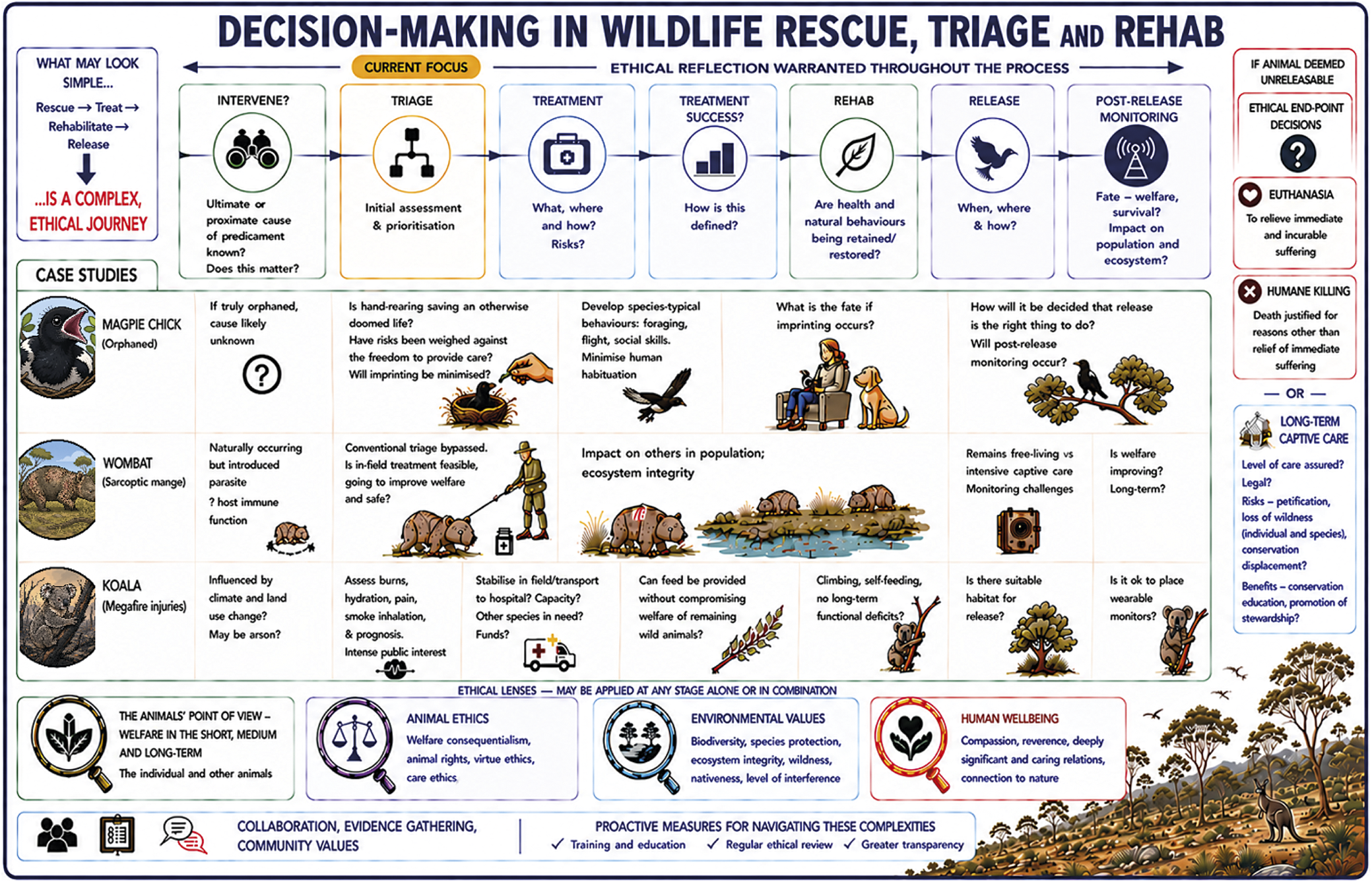
Figure 1 Long description
The figure depicts ethical decision-making as it relates to wildlife rescue, triage and rehabilitation. A series of connected boxes across the top of the figure represent key decision points: whether to intervene, how to triage, treat, determine treatment success, rehabilitate, release and conduct post-release monitoring. A banner spanning these stages emphasises that ethical reflection is warranted throughout the process, rather than being confined to the point of triage, the current focus.
Three case studies illustrate how ethical considerations differ according to context. The first follows an orphaned magpie chick and highlights questions about hand-rearing, imprinting, development of natural behaviours and release decisions. The second follows a wombat with sarcoptic mange treated in the wild, highlighting questions about in-field treatment, impacts on other wombats and ecosystem integrity, and challenges of monitoring outcomes. The third follows a koala injured in a megafire, highlighting questions about human responsibility, allocation of resources, sourcing feed, habitat suitability for release and the use of monitoring devices.
At the bottom of the figure, four ethical lenses are shown as perspectives that may be applied at any stage, alone or in combination: the animals’ point of view (welfare in the short, medium and long term), animal ethics, environmental values and human wellbeing. Along the right-hand side, pathways for animals deemed unreleasable include euthanasia, humane killing and long-term captive care, each associated with distinct ethical considerations. The figure concludes by emphasising collaboration, evidence gathering, community values, training and education, regular ethical review and transparency as measures for navigating these complexities.
The questions posed by the three case examples presented here demonstrate that to make justifiable decisions, the modern rehabilitation sector would benefit from pausing to consider different values and ethical frameworks (Rushton Reference Rushton2009) and whether they are acknowledged in current processes, as difficult as that may be in high wildlife caseload settings. Consideration of all decision-relevant factors will require explicit recognition and acknowledgement of the hidden values, such as long-term welfare, ecological processes, and wildness, and ways of weighting these values, whether they are embedded in consequentialist or non-consequentialist frameworks. For those responding to requests from the public to intervene to help wildlife, tensions created by attempts to reconcile these competing values and ethical principles are not theoretical: they influence life-and-death decisions, how these are communicated, and whether people remain committed to the wildlife rescue arena.
Rather than adhering strictly to one framework, we suggest that a pluralist approach, drawing on multiple ethical positions as ‘lenses’ through which to interpret a situation, may be a better starting point for dealing with particular cases and may be the only way that effective decision-making is possible. This more clearly recognises potentially conflicting values but, of course, does not eliminate the need for tough choices and regular review.
Let us consider the most common and contentious of decisions: death as a recommended intervention. In each of the three scenarios explored, euthanasia or humane killing (rather than rearing or treatment) could be considered ethically acceptable, depending on one’s position. Example justifications for favouring humane killing or euthanasia over initiating or continuing treatment in a generic version of each scenario and the potential sources of disagreements are outlined in Table 1. Understanding, acknowledging and documenting these tendencies, values and areas of disagreement is foundational to progressing the field.
Examples of generic wildlife rescue scenarios where ending the life of an animal may be considered acceptable to some – classified as either ‘euthanasia’ or ‘humane killing’ based on the ethical justification. Sources of potential disagreement are outlined.
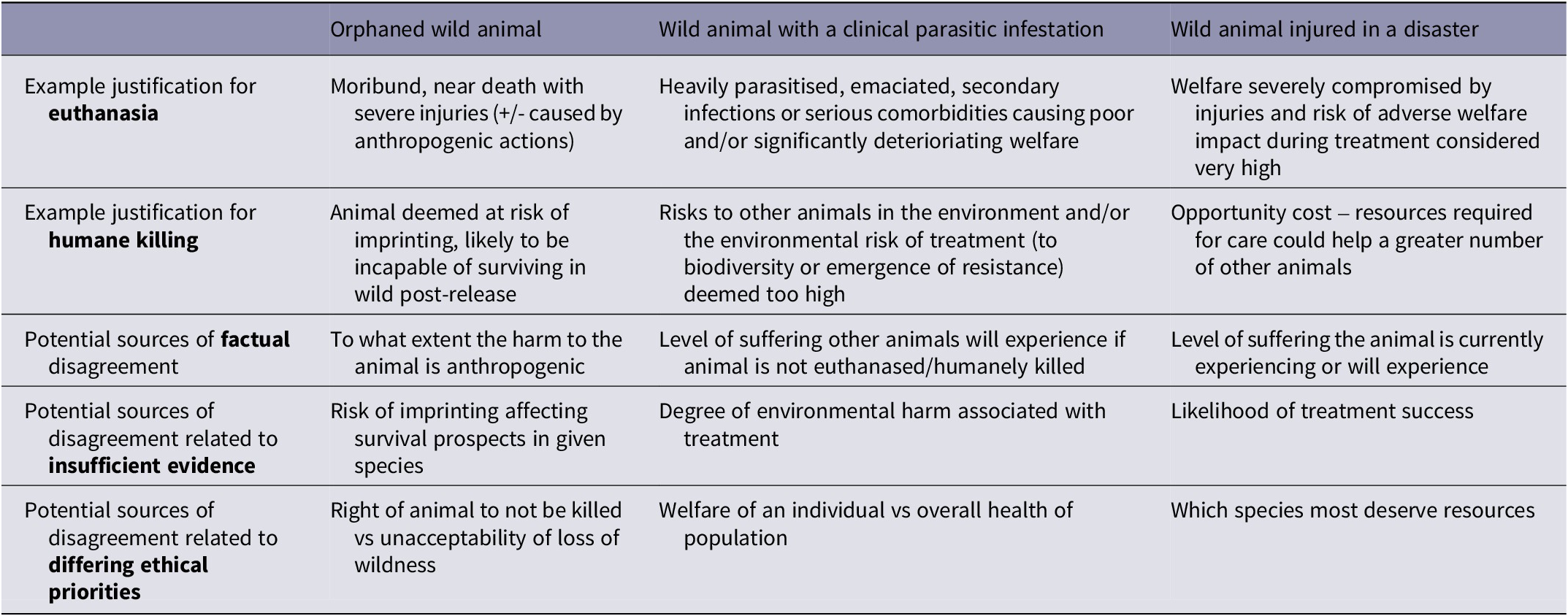
Table 1. Long description
The table outlines three wildlife rescue scenarios (orphaned animals, animals with parasitic infestations, and disaster-injured animals) and compares situations where euthanasia (based on severe welfare compromise) versus humane killing (based on broader considerations) may be justified. It provides examples such as moribund animals, heavy parasitism with poor condition, or severe injuries for euthanasia, and risks of imprinting, environmental harm, or limited resources for humane killing. The table also highlights sources of disagreement, including factual uncertainty (e.g. level of suffering or causes of harm), insufficient evidence (e.g. likely treatment efficacy or ecological impact), and differing ethical priorities (e.g. loss of wildness, individual welfare versus population health, or conservation resource use).
If the outlook for an animal is uncertain, some would prefer to err on the side of humane killing, rather than risk placing the animal in a situation where treatment fails and suffering progresses. Others will err on the side of commencing care and treatment with a view that the decision can be reviewed later, a process challenged by the human-animal relationships that may subsequently develop in care and the limitations of implementing effective post-release monitoring programmes (Guy et al. Reference Guy, Curnoe and Banks2013). Keeping previously wild animals as pets is wholly unacceptable to some who favour humane killing to long-term captive care, while others argue that there is merit in promoting caring attitudes toward native species via their incorporation into domestic settings (Chapple et al. Reference Chapple, Cooney, Doornbos, Jackson, Merson, Brown and Cooney2012). The caring-killing paradox, a phenomenon well described in animal care shelters, likely prevails on either side of this ethical fence and may influence the psychological well-being of decision-makers (Reeve et al. Reference Reeve, Rogelberg, Spitzmüller and Digiacomo2005; Andrukonis et al. Reference Andrukonis, Hall and Protopopova2020).
Welcome developments in the sector include collaborations between rehabilitation practitioners and ecologists and the early development of baseline datasets of welfare indicators for wild species. However, even if progress in these activities reduces the levels of uncertainty significantly, it will not completely eliminate the inherent ethical challenges. As such, we propose three complementary proactive measures that could assist responders in navigating their way through them:
-
• Facilitate training and education in ethical reasoning and decision-making that will aid animal and situational assessments across contexts, inform public communication strategies, and support personnel experiencing moral distress.
-
• Extend beyond the current focus on decision-making at triage, to promote ethical reflection throughout the process from initial rescue through first evaluation to treatment, rehabilitation and beyond.
-
• Foster greater transparency regarding what ‘saving’ wildlife in the context of rescue actually means as well as the ethical justification for euthanasia, humane killing and value prioritisation when decisions are made.
We began this paper with Peter Singer’s idea of an easy rescue: if you pull out the drowning child from the pond, and the only cost is that your clothes get muddy, you have a moral obligation to do so. As our discussion has shown, in the case of wildlife, easy rescues are few and far between. Performing a seemingly easy wild animal rescue might not only not save them but might draw out their suffering; it might harm others or prevent you from rescuing many more; and the costs might be far higher than muddy clothes. The world of wildlife rescue and rehabilitation is a complex place, demanding much more ethical attention than it has so far received.
Animal welfare implications and Conclusion
Wildlife rescue is a morally motivated practice that seeks to alleviate suffering in free-ranging, predominantly native, wild animals. However, as illustrated in our examples, actions to help individual animals in circumstances that might appear simple can have far-reaching and sometimes unintended consequences, not least for animal welfare. The cases described involve a complex set of animal welfare concerns. Firstly, it has to be decided whether the rescue effort can ensure an acceptable level of animal welfare for the animal(s) in the short term. Secondly, there may be serious concerns about the welfare effects in the longer run both for the affected animal and other animals. Thirdly, there may be indirect effects, e.g. via ‘petification’, to consider. Finally, there are thorny issues relating to death via euthanasia or humane killing in a welfare context. In addition, environmental, relational and other values linked to human well-being should be considered. To navigate these complexities, there is a need to move beyond simplistic individual vs population models and develop reflective ethical reasoning skills that support a more longitudinal consideration of animal welfare and other relevant values and that will allow transparent, evidence-based and context-sensitive decision-making. With escalating environmental threats and increasing public support, wildlife rescue and rehabilitation are no longer fringe activities and are poised to become more professionalised and impactful. To prepare for future challenges, it is crucial that decisions made in the field and in clinics are ethically justifiable, or at least transparent in regard to their ecological soundness and their impact on the interests of affected animals.
Acknowledgements
No funding was received for this work. Generative AI (ChatGPT) was used to create Figure 1 with subsequent editing in Microsoft Designer® as described in the Figure caption. AI was not used for any other aspect of the research or writing of the manuscript.
Competing interests
None.
Ethical considerations
No animals were required for this desk-based study.


 Open access

