

Much research focuses on the barriers for women working in areas dominated by men. However, what happens if they not only work in a male-dominated environment but also in a precarious job? We study the police because in many countries a career in policing often represents an opportunity for upward social mobility, usually based on better salaries and benefits, as it offers a stable job in public service. However, in most of Latin America this is not the case (Reference Casas, González and MesíasCasas, González, and Mesías 2018), and the Mexican police force is a clear example of this. The aspiration of stable employment is a key motivation for applying to the police: in 2017, 36.5 percent of police officers indicated that need for money and a job were the main reasons for entering the police force, while 13.9 percent said that it was their best option for economic stability (INEGI 2017). However, the tacit promise of social mobility is usually broken by what turns out to be a relatively precarious job. We argue that this situation interacts with preexisting gender structural discrimination against women—who must combine their broader family and home responsibilities with the demands of their paid work. While these inequalities could be either reduced or exacerbated by work life (even when their domestic situation does not change), we show that a precarious job, such as with the police force, exacerbates these inequalities.
Even though in recent years there has been unprecedented access for women to professions usually reserved for men (Reference Campbell and Mínguez-VeraCampbell and Mínguez-Vera 2008; Reference Powell, Bahilhole and AndrewPowell, Bahilhole, and Andrew 2009; Reference Malone and IssaMalone and Issa 2013; Reference Seierstad, Warner-S⊘derholm, Torchia and HuseSeierstad et al. 2017; Reference Axelsdóttir and HalrynjoAxelsdóttir and Halrynjo 2018) as well as in a variety of occupations in the public sector, police forces remain an exception (Reference Baron, Mittman and NewmanBaron, Mittman, and Newman 1991). This is striking since public organizations have sought to minimize the salience of gender through merit hiring, strict position classification systems and laws (Reference Cáceres-RodríguezCáceres-Rodríguez 2011). It is true that this tendency is changing—examples of this change can be seen in a wide range of countries, for example, allowing the incorporation of women in combat (Reference BarryBarry 2013), as well as allowing LGBTQ population to enroll in the US military (Reference Alford and LeeAlford and Lee 2016), identifying women as vital agents in conflict and security and designing reforms aim to achieve equal representation of women and men in the security sector (Reference Huber and KarimHuber and Karim 2018). However, defense and law and order have traditionally been spaces that are inhospitable to women and these crucial works still leave a void because they do not shed light on the actual experiences of women once they become part of these organizations. The case of Mexico is particularly interesting as employment in the police is one of the more precarious in Latin America (see the Appendix Table A1).
To fill this void, we conducted an in-depth study of the preventive police in Mexico at three levels of government: federal police, state police and municipal police. We found that gender shapes organizational life in profound ways. First, we measure the degree of job precariousness to identify if there are formal differences between men and women. Although at first glance conditions seem similar (we measured precarious working conditions and found that 78.4 percent of police officers experience this in some way in the form of low salaries, limited social benefits, employment instability, long and discretionary working hours and insufficient work equipment), there is an important difference in two aspects: first, regarding social benefits, the National System of Public Security Law establishes that police officers should share the rights of all public employees (Cámara de Diputados 2019). However, article 45 of the same law, restricts those rights to budget sufficiency. This may imply that they do not obtain rights such as maternity or paternity leave, which impact men and women differently. Evidence is clear on this: 43.8 percent of police officers say they do not have maternity or paternity leave, and 78.6 percent say they do not have access to daycare (INEGI 2017). Female police officers who are single and have children (approximately 30 percent) thus face greater precariousness because daycare does not form part of their benefits. Men, however, are generally in a better position to deal with the job precariousness as they are released from domestic responsibilities. This is most noticeable in couples who are both police officers: since schedules are unpredictable, there is no control over the length of the workday nor which days they will have to work. While this has an impact on everyone, it is felt more severely by women, as they are also responsible for the domestic burden: the unpredictability of working hours means that they cannot even plan their domestic load, making their burden more onerous and stressful. Second, even when legal and practical obstacles to defend collective interests are shared by all, women tend to feel that their opinions are not taken into account. This hinders the possibility of having an informal influence or bargaining power, which are the only possible avenues to improve their everyday life, considering the legal restrictions.
The second step of the paper was a qualitative analysis and it showed that this precariousness experienced by both gender manifests qualitatively different for policewomen because of the masculinization of its tasks (Reference Arteaga BotelloArteaga Botello 2000). We show women face several additional obstacles: they face difficulties in being integrated and accepted in a predominantly male job, which worsen the everyday experience in their already precarious job; they face gender bias in task assignments, rather than capacity, which isolated them for the actual “job description” and the possibility of having a promotion; they face discriminatory promotion practices—the so-called glass ceiling; and above all, they face greater difficulty in reconciling family and work lives and a difference in time usage due to the impossibility of planning activities and distributing time as a result of a work that is carried out in emergency contexts (men also share the instability, but they do not suffer domestic consequences for that).
Women Working in Masculine Environments and Job Precariousness
We define precarious employment as the presence of insufficient wages, absence or reduction of work benefits, insecurity in the duration of the employment relationship, the presence of several employers, and legal and practical obstacles to join a union and bargain collectively (Reference MoraMora 2006; Reference RubioRubio 2010; ILO 2016a).
Belonging to an almost exclusive “men’s club” seems to be a punishment rather than an achievement for women. Men “resist” the integration of women by denying them information, excluding them from decision making (Reference Morash and HaarrMorash and Haarr 1995; Reference Morash, Kwak and HaarrMorash, Kwak, and Haarr 2006) or delegating them administrative tasks (Reference Rabe-HempRabe-Hemp 2008; Reference AquinoAquino 2014). Moreover, there is a problem of adapting the uniform to the female body—for example, skirts (Reference AquinoAquino 2014)—and equipment made for men often hurts women’s bodies, such as bulletproof vests (Reference RamírezRamírez 2014; Reference EllisEllis 2017). Finally, regarding the challenge of balancing private and public life, evidence shows that the sexual division of work (Reference ConnellConnell 2002) comes into play for policewomen on both their working days and on their days off (Reference Tena and LópezTena and López 2017).
Job precariousness and police
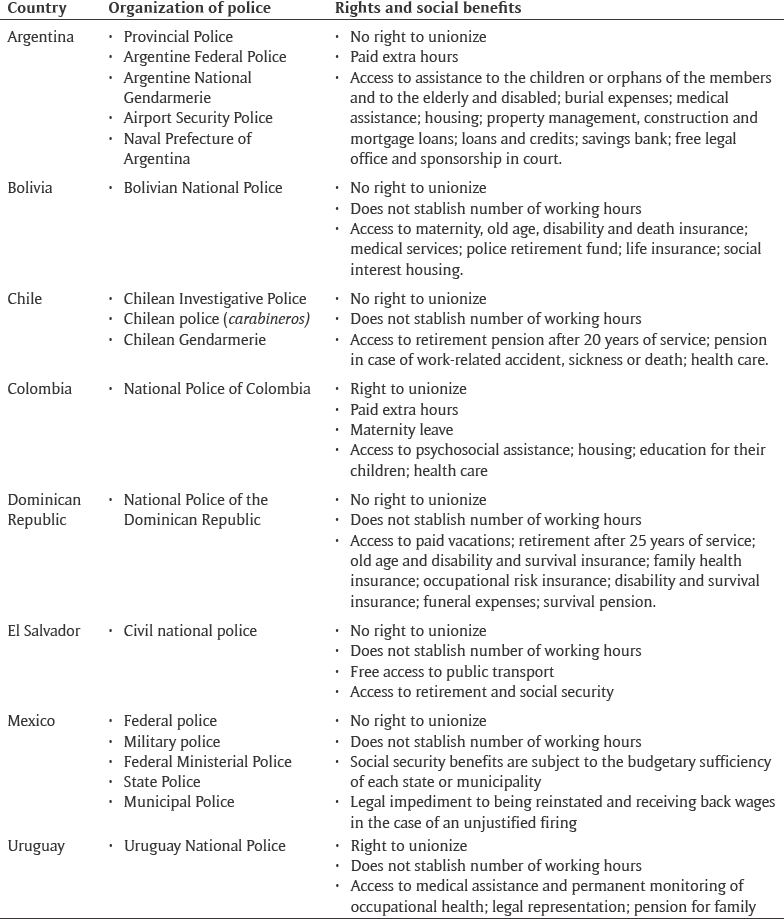
In almost all Latin American countries, violence and crime pose the greatest challenges to governments. To face these challenges, many countries in the region—with similar precarious police legislation (see the Appendix Table A2)—have passed ambitious reforms, considerably increased their police apparatuses, and changed the organizational structures and doctrinal guidelines of the police institution (Reference DammertDammert 2005; Reference Casas, González and MesíasCasas, González, and Mesías 2018). However, this was not the case in Mexico (Reference Asch, Burger and FuAsch, Burger, and Fu 2011; Reference SabetSabet 2012), where the precariousness of the police has its origins in legislation that differentiates between the security forces and the rest of the federal public administration. Both Article 123 of the Constitution and the Federal Law for Workers contain a series of labor and social protection rights that do not apply to the police, military and marine forces.Footnote 1 For example, the police do not have the right to unionize and there is no maximum limit on the number of hours they can work per shift, which is a serious obstacle to overtime pay (CDHDF 2009; SESNSP 2017; Causa en Común 2017).
The Mexican police force constitutes a precarious job in the public service, which is paradoxical given that it is responsible for maintaining the security of citizens within a context of violence and crime: Latin America has the highest homicide rate in the world—19.7 per 100,000 population compared to the global average of 7.2—(UNODC 2019), with Mexico’s even higher at 29.3 (INEGI 2018). The police need benefits and equipment that not only compensate for the level of risk they face on a daily basis, but that also help them face this risk. For example, in Mexico, police officers often do not have the weapons they need, bulletproof vests, or legal defense in the event of an accusation against them (Causa en Común 2017). Moreover, the number of police deaths in the line of duty increased 20 percent between 2017 and 2018 (INEGI 2018) and rose further in 2017 (Causa en Común 2017). In many cases, police officers are targeted by criminal groups: they have been ambushed, tortured and killed (Reference FryFry 2020; Reference ChakrabortyChakraborty 2019; Reference MalkinMalkin 2019). Precarious conditions for the police are the result of a state that fails to provide security to those responsible for ensuring the safety of others. This is even worse for policewomen, as they are also victims of crime and violence at their workplace. Data show that women are mostly victimized by superiors, colleagues, and men who are detained (Reference OchoaOchoa 2018). In Mexico, 39.6 percent of policewomen have been victims of discrimination, theft, threats, injuries, extortion, and even sexual assault from colleagues and detained men (INEGI 2017).
Male-dominated jobs
There is no academic consensus on how to define a male-dominated job (Reference Meyerson and FletcherMeyerson and Fletcher 2000). Ultimately it depends on the number of men and women who work in each place, how many are in decision-making positions and if there are barriers to entrance and discrimination based on gender (Reference Baron, Mittman and NewmanBaron, Mittman, and Newman 1991; Reference StiversStivers 2002). However, affirmative action legislation has led to a practical agreement: the commonly used cutoff point to define a male-dominated job is when women are roughly less than a third of those employed in a particular occupation. Research shows that women face discrimination at the workplace (Reference Martin and BarnardMartin and Barnard 2013). This applies to all jobs, but there is an increasing concern about how women can both break “the walls” and persist in male-dominated jobs (Reference ShinarShinar 1975; Reference Beggs and DoolittleBeggs and Doolittle 1993).
The adverse situation of women is not only explained by their status as a minority group (Reference KanterKanter 1977a, Reference Kanter1977b), since women comprise around 20 percent of the Mexican police force (INEGI 2017), but also by the reaction they face when their numbers increase. Evidence shows that when underrepresented or marginalized groups—racial minorities, members of the LGBTQ+ community and women—increase their presence in legislatures they face a backlash or negative reaction (Reference Haider-MarkelHaider-Markel 2007; Reference Heath, Schwindt-Bayer and Taylor-RobinsonHeath, Schwindt-Bayer, and Taylor-Robinson 2005). Within the police force, more women may cause in a backlash, resulting in them being increasingly confined to low prestige positions as their rising numbers threaten men’s positions. However, when their presence supports men’s status, there is no objection—for instance, when they occupy secretarial positions for male managers (Reference EpsteinEpstein 1997). Male colleagues also know that women perform most domestic chores, which generates skepticisms about women’s professionalism and availability (Reference Burke, Kumra, Simpson and BurkeBurke 2014; Reference RamírezRamírez 2014; Reference Tena and LópezTena and López 2017).
Furthermore, women who work in traditionally male environments have been found to face structural barriers to the performance of their work tasks and greater obstacles to entry and promotion (Reference Bagilhole, Kumra, Simpson and BurkeBagilhole 2014). Organizations are not gender neutral and often impose stereotypes on the organization of work, through definitions of femininity or masculinity, structures of hierarchies, building gender cultures, and defining “adequate” jobs for men or women. In this way, descriptions of positions, contracts, structures and practices are established in ways that are detrimental to women (Reference AckerAcker 1990; Reference HeilmanHeilman 2012). In particular, women face the so-called glass ceiling, which refers to the invisible barriers that prevent women from rising to the highest levels of a hierarchy or leadership within organizations (Reference Cáceres-RodríguezCáceres-Rodríguez 2011). For example, in the Mexican police force, only 1.9 percent of women occupy command ranks (INEGI 2017). Hence, women are constrained by both the glass ceiling and the so-called sticky floor, which refers to societal organization that prevents women from moving vertically within organizations (Reference Cukrowska-TorzewskaCukrowska-Torzewska 2017; Reference Kolb and McGinnKolb and McGinn 2009).
The image of police work as a masculine profession is entrenched in almost every country. Policewomen are under greater scrutiny and must adapt to masculine stereotypes for daily survival (Reference Shelley, Morabito and Tobin-GurleyShelley, Morabito, and Tobin-Gurley 2011; Reference Dodge, Valcore and KlingerDodge, Valcore, and Klinger 2010; Reference EllisEllis 2017). Studies on police institutions refer to the existence of a “police culture” strongly related to a male worker ideal that reinforces the division of tasks in which women are confined to administrative tasks and away from “important” missions (Reference GarcíaGarcía 2003; Reference Rabe-HempRabe-Hemp 2008). For instance, in Mexico, 52 percent of women are limited to administrative tasks, while this applies to only 19.9 percent of men (INEGI 2017). To justify the low numbers of women in senior and specialist policing roles, male police officers have used the argument that women are physically unsuitable for police work (Reference Dodge, Valcore and KlingerDodge. Valcore, and Klinger 2010; Reference SilvestriSilvestri 2003). These requirements continue to exist despite the fact that studies have shown that physical strength is not predictive of police effectiveness (Reference Lonsway, Moore, Harrington, Smeal and SpillarLonsway et al. 2003).
Gender and precarious employment
Precarious employment is defined as forms of employment involving atypical employment contracts, limited social benefits and statutory entitlements, job insecurity, low job tenure, low earnings, poor working conditions and high risks of ill health (Reference Cranford, Vosko and ZukewichCranford, Vosko, and Zukewich 2003). However, Cranford, Vosko, and Zukewich (Reference Cranford, Vosko and Zukewich2003) state that the notion of precarious employment must also emphasize the quality of employment and that to speak of the “gendering” of a phenomenon is to focus attention on the process whereby sex differences become social inequalities. Usually, men and women do not have equal opportunities to invest in their careers, because of women’s traditional role in the domestic sphere (Reference YoungYoung 2010; Reference Pérez and LlanosPérez and Llanos 2017). This means that it is key to not only quantitatively measure their presence but also examine how women and men experience the same work scheme. Gender division of labor is defined as the way in which production and consumption are arranged along gender lines, including the gendering of occupations and the division between paid work and domestic labor (Reference Connell and WoodConnell and Wood 2005). Gender stereotypes associated with the masculinization of the police work reflect and promote sex segregation in employment. In turn, sex segregation makes the already precarious job even worse for women. Evidence from studies of the police shows that there are gendered schemas and sex stereotypes that assign greater worth to male characteristics and work tasks regardless of their prevalence or applicability for effective employment (Reference Shelley, Morabito and Tobin-GurleyShelley, Morabito, and Tobin-Gurley 2011; Reference HusuHusu 2005).
Case Selection, Method, and Data
We present a descriptive research design that combines qualitative and quantitative evidence. The selection of cases provides information for the three levels of territorial organization of Mexican preventive police forces: federal, state and municipal. It is interesting since they all show the same trend regarding discrimination against women and precariousness. Thus, to obtain the information, we conducted an in-depth study at three levels:
1. Federal Police: we interviewed two men and two women in January 2018 at the Federal Police Command Center in Iztapalapa, Mexico City. The intentional homicide rate in Iztapalapa is 12.8, higher than Naucalpan (11.7), and it is one of the ten most violent municipalities in the country (SESNSP 2018).
2. State Police: we obtained information about labor conditions from Causa en Común’s survey “What do the police think?” (2017) and from the Executive Secretariat of the National Public Security System (ESNPSS) (2015).
3. Municipal Police: we held two focus groups with ten women and seven men in February 2018 in the Municipal Citizen Safety and Transit Commissary in Naucalpan, in the State of Mexico. Naucalpan was chosen because it is one of the most violent places in Mexico. From 2016 to 2017 intentional homicides rates and crime increased 11.7 and 60.0 percent, respectively (SESNSP 2018).
First, to measure precariousness in the police we create an Index of Labor Precariousness (ILP), which is calculated based on the information provided from two surveys. A first database was obtained in February 2017, from the ESNPSS through a freedom of information request (#21030008117). We were sent thirty-two databases (one for each state), which we converted into a single database. The final database comprised 9,092 state police officers based on a random and representative selection done in 2015. Information on salaries was obtained from this database (SESNSP 2016).
The second database is from Causa en Común (2017). The sample was representative but not random. It contains the responses of 4,898 state police officers to a questionnaire of 145 questions regarding working conditions, police careers, evaluations and performance, and organizational problems (Causa en Común 2017). The two databases were not combined, nor did we perform analyses with pooled data.Footnote 2
Using this data and the dimensions of precariousness in the literature (Reference MoraMora 2006; Reference RubioRubio 2010; ILO 2016a, 2016b), we have estimated six components of precariousness:
1. Insufficient income: there is precariousness when the reported monthly salary is less than two minimum wages (MXN$5,282.4), based on Rubio (Reference Rubio2010) and Román-Sánchez and Sollova-Manenova (Reference Román-Sánchez and Sollova-Manenova2015).
2. Absence or reduction of social protections: not having some or all of the benefits required under Mexican law: medical care, psychological care, a year-end bonus, maternity or paternity leave, a retirement fund, housing credits, vacations and vacation premium.
3. Labor insecurity: no restitution in the case of unfair firing and quantitative evidence of applying evaluations in a discretional way to justify firings.
4. Legal and practical obstacles to defend collective interests: based on the current legal prohibition that exists on forming unions as well as from the survey (Causa en Común 2017) in which surveyed women police officers report that they feel that their voice is not heard.
5. Organizational ambiguity: performing activities not related to police work, such as attending political rallies, carrying out personal tasks, unclogging drains, or picking up garbage. This may also refer to shifts that do not end when scheduled, favoritism in promotions, and the existence of unjustified sanctions.
6. Lack of equipment: they buy items necessary for their daily job, such as uniforms, shoes, office furniture, vests, weapons, gasoline and office supplies.
Each component was rated with a different scale based in a point system. With the exception of precariousness due to insufficient income, which is a dichotomous variable, each dimension was divided into three levels of precariousness: low, intermediate or high. Thus, the ILP is the average percentage that was observed for each level and dimension, and it was calculated for both men and women to identify if there were statistically significant differences between the percentage of men and the percentage of women where the presence of precarious employment was detected. In that sense, the index is not additive.
For identifying whether labor precariousness affects women more than men among police officers, we first looked at the quantitative differences. We used the nonparametric test of chi-square to establish differences between categorical variables. A p value of p > 0.05 was considered insignificant. Second, to verify qualitative differences, we conducted interviews with two women and two men assigned to the federal police and held two focus groups with ten women and seven men at the Municipal Citizen Safety and Transit Commissary in Naucalpan, in the State of Mexico. The objective was to show that this precariousness experienced by both gender manifests qualitatively different for policewomen. The existence of masculine stereotypes who are entrenched in the police, results in discrimination against women. Women are less likely to obtain a rise in the police career because they are often relegated to administrative tasks and are isolated from the central functions of police departments—which are investigating crime, patrolling, and responding to emergencies—and this means they gain less experience.
Composition of the Police Forces and Labor Precariousness
Policing responsibilities are divided between federal, state, and municipal governments and they organized both by jurisdiction and by function. There are approximately 384,953 police agents in Mexico (INEGI 2017).
The police force in Mexico has 20 percent women, which is higher than the average of Latin America, 16 percent (Reference Casas, González and MesíasCasas, González, and Mesías 2018). In general, women are usually younger than men and more women have a college degree (see Table 1). Despite this, only 1.9 percent of women are in command rank, while 3.2 percent of men hold this kind of position (INEGI 2017). A possible explanation for this segregation might be the different levels of experience: 52 percent of women are in charge of administrative tasks and 80.1 percent of men perform operative tasks (INEGI 2017).

Table 2 shows that one in ten men are single with children, compared to one in three in the case of women (Causa en Común 2017). This highlights the fact that a significant proportion of female police officers are single mothers. We do not have the full available data to know whether the men who declared themselves to be single and fathers have full custody of and responsibility for their children, which is the case for the majority of women, according to the information we gathered through interviews and focus groups. However, we can infer that men do not take care of their children on a daily basis as interviews revealed that they only spend time with their children on weekends.

Data Analysis
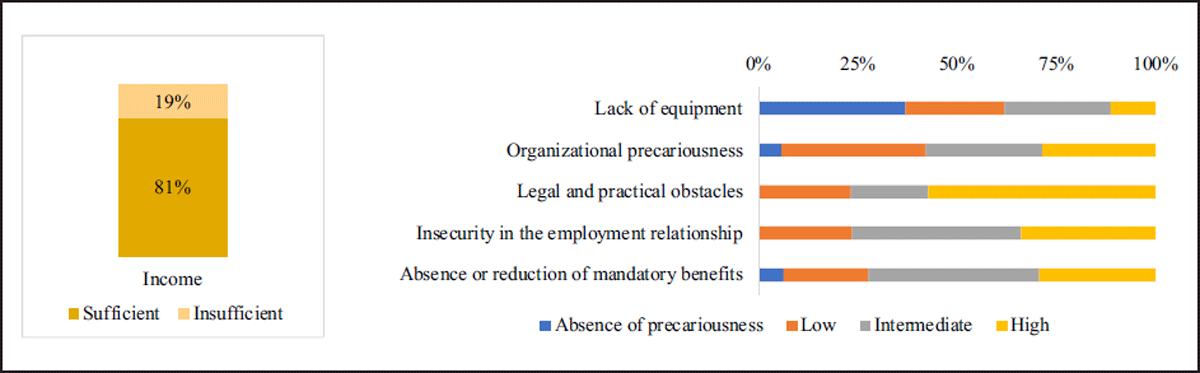
The quantitative analysis shows that precariousness has different levels (see Figure 1). At least descriptively, there do not appear to be differences in precariousness by gender alone—except for the dimension of legal and practical obstacles, where women are more likely (59.7 percent) than men (56.8 percent) to consider that their opinion is not taken into account and that their bosses do not respect their right of association (see Table 3). However, the qualitative analysis will show that men and women’s experiences of precariousness differ significantly.
Precariousness by level and dimension (based on SESNSP 2016 and Causa en Común 2017).
Precariousness, by sex.

Pearson chi2 = 0.0894.
Pr = 0.765 > 0.05.
The measurement of ILP shows the level of precariousness for each dimension: on average, 78.4 percent of Mexican state police officers work in a situation of precariousness in some degree and 19 percent earn less than MXN$5,282.40 per month (SESNSP 2016). All police officers face job precariousness because of limited to nonexistent access to freedom of association and collective bargaining and there are legal obstacles to being reinstated in the case of unjustified firing and it is impossible to form unions.
Moreover, 93.8 percent of police officers do not receive obligatory social protection: six out of ten do not receive credit toward buying a house and three out of four do not receive psychological attention. Furthermore, 63.3 percent must pay for their own work equipment and 90.1 percent feel that disciplinary actions and sanctions are handed down arbitrarily. They rarely or never are able to leave work at the end of their scheduled shift, because the right to work only eight-hour established in the federal law, does not apply to the police.
From the qualitative analysis, several findings highlight the difference between being a woman and being a man on the police force. Women face at least four additional challenges: difficulties in being integrated and accepted in a predominantly male group; gender bias in task assignments rather than capacity; discriminatory promotion practices; and greater difficulty in reconciling family and work lives and a difference in time usage.
Difficulties in integrating into the organization
The women interviewed state that they need to work harder to gain visibility based on their professional capacities in police agencies. This hinders their possibilities of integrating into police institutions and gaining the acceptance of their coworkers. They state that the effort to showcase their abilities as effective officers begins in the initial police academy training. Physical training is the same for men and women, but any sign of weakness from the women is used as a motive for discrimination. As stated by one interviewee: “The first situation we dealt with there [at the academy] was: they are women and they can’t do it” (interview, female 1, Federal Police, Mexico City, January 2018).
This bias continues once they leave the police academy as soon as women attempt to incorporate themselves into predominantly male work teams. In fact, this source also stated that she was unable to join a tactical team because it was made up of all men. As stated by a policewoman: “We were not given the opportunity to join the tactical group, because there were no women on the team. And secondly, because a woman can’t do it, even if she is interested, she can’t” (interview, female 1, Federal Police, Mexico City, January 2018).
Similarly, female officers are not considered for tasks that require the constant use of physical strength because men believe women are incapable of carrying extra weight or handling heavy instruments with ease such as weapons or vests. One interviewee described the discrimination she faced: “Men … well, there are exceptions and they do discriminate. There are times that it’s not the same strength … in terms of the gun, the gun is heavy, as is the vest, so one has to work a little harder” (focus group 1, female 1, Municipal Police, State of Mexico, February 2018).
Likewise, we have found that since women are in the minority, their mistakes are more visible and are punished with greater severity than those committed by men. They face greater scrutiny (Reference CameronCameron 2016), marginalization (Reference KanterKanter 1977a, Reference Kanter1977b; Reference GainesGaines 2017) and hostile attitudes from their coworkers. These attitudes manifest in different ways, such as the withholding of information needed to perform daily tasks, or exclusion from decision-making processes (Reference Morash and HaarrMorash and Haarr 1995; Reference Morash, Kwak and HaarrMorash, Kwak, and Haarr 2006); the creation of alliances among other male coworkers (Reference Bagilhole, Kumra, Simpson and BurkeBagilhole 2014); dismissal of female coworkers and their professional contributions disregarded (Reference Hassell, Archbold and StichmanHassell, Archbold, and Stichman 2011). This interviewee affirms that “I could do things correctly fifty times, but [if] there is one situation where you make a mistake, suddenly, you are the worst” (interview, female 1, Federal Police, Mexico City, January 2018).
Once women enter an organization, they continue to encounter workplace-related problems: sexual harassment or assault is common (Reference Bagilhole, Kumra, Simpson and BurkeBagilhole 2014; Reference Fielden, Hunt, Kumra, Simpson and BurkeFielden and Hunt 2014), as are offensive jokes related to gender (Reference Somvadee and MorashSomvadee and Morash 2008). Given these situations, women develop various strategies to address them: “As far as the operations area is concerned, yes, there is more discrimination and at times there is harassment from the men” (focus group 1, female 2, Municipal Police, State of Mexico, February 2018).
Another strategy consists of accepting and adapting to the tasks imposed by the organization, given the temporary impossibility of carrying out certain activities, such as driving a vehicle that you have never been trained to drive: “In my case, I don’t drive. I support my partner in other tasks. In the end, you try to deal with it” (focus group 2, female 1, Municipal Police, State of Mexico, February 2018).
Moreover, women modify their behavior to act the way men do; they even call this a question of survival. This is a clear example of that: “I was the only woman there … and, well, they organize the operation and never take into account that there is a woman or I don’t know, and, well, they leave me there and set off running and so you have to run after them … it’s all about you finding your own tools to survive in the world of the police” (focus group 1, female 3, Municipal Police, State of Mexico, February 2018).
From these testimonies, we find that women are looked down on by their male counterparts, either because they think they have less physical strength, or because they consider them less apt for police work, or even just because they are a minority. Many female officers must “masculinize” their gender to fit in with the predominant ideal. Female officers who challenge or resist norms and stereotypes regarding the gendered atmosphere of law enforcement are at risk for harassment, isolation, and discrimination (Reference Rabe-HempRabe-Hemp 2008; Reference Dodge, Valcore and KlingerDodge, Valcore, and Klinger 2010).
Biases in assigning tasks
Women have broader and heavier responsibilities to their families than men. As a consequence, they can’t manage their work-life balance like their male colleagues, and many times this means lower payment, part-time job, no opportunities to promotions, among other situations (Reference Cáceres-RodríguezCáceres-Rodríguez 2011). The role of women in society conditions their access, experience and career development since their main task is still the maternity as well as domestic and caring activities. Here, the sexual division of labor is at stake.
In the police, women are more likely to be assigned to administrative and supports posts and are less likely to be assigned to a patrol. In general, women are assigned to stereotypical jobs that are “natural” for them, like training, community relations and support jobs for fellow male officers, their male counterparts (Reference De Guzmán and FrankDe Guzmán and Frank 2004; Reference Bowling, Kelleher and WrightBowling, Kelleher, and Wright 2006). This situation isolates women from the central functions of police departments, which are investigating crime, patrolling, and responding to emergencies. Moreover, their performance and capacity are questioned, something that is reinforced in practice when men are assigned to the most conflictive areas. In contrast, women are generally assigned to the safest and least eventful areas, feeding the idea that women are incapable of being effective police officers (Reference De Guzmán and FrankDe Guzmán and Frank 2004). As one interviewee explained: “You fill out the report, and there is nothing bad about doing the report except that, as the woman, you are the secretary” (interview, female 2, Federal Police, Mexico City, January 2018).
This bias in assignments not only keeps women from participating in the central activities in the police institutions, such as patrolling or responding to emergencies, it also affects the labor experience they acquire over the long term and the length of their shift. As one officer described, once operational activities are over, the women must stay at the station until the report is finished: “[When] they need to take someone for an operation, women handle the administrative tasks and men take care of the fieldwork” (interview, female 1, Federal Police, Mexico City, January 2018).
This job segregation is discriminatory on four levels: first, they are assigned administrative tasks men are not asked to do; second, they must work longer hours to complete those tasks after their male counterparts finish their shifts; third, they are unable to acquire relevant or sufficient job experience; and finally, they face even greater time constraints because they face additional household duties in the home, where they are generally responsible for domestic tasks, which they have less time to do given their longer shifts. In justifying this behavior, male colleagues resort to profoundly discriminatory reasoning, such as physiological matters like menstruation.
In fact, menstruation is considered an impediment to operational tasks or patrolling, as one officer said: “They will often say to the women: well, if you are like that [menstruating], better that you stay in the station or somewhere” (focus group 2, male 1, Municipal Police, State of Mexico, February 2018).
Fieldwork is an extremely common practice in the police force, but it is complex for women without access to bathrooms or a space to change their clothing. As a result, some women have developed strategies such as consuming less water to reduce the frequency with which they must go to the bathroom. “My strategies were to [drink] a bottle of water in the morning, and at night. During operative [fieldwork] I tried to not consume water with the risk that this implies” (focus group 2, female 2, Municipal Police, State of Mexico, February 2018).
This marginalization of women is seen clearly in the division of labor within the police force. Women are relegated to administrative settings (Reference Rabe-HempRabe-Hemp 2008; Reference AquinoAquino 2014). In the long run, this limits the experience they can acquire and, in turn, limits their aspirations for promotions in their police career.
Discriminatory promotion decisions
Women face structural difficulties (Reference De Guzmán and FrankDe Guzmán and Frank 2004) to their professional development within an organization. These challenges are summarized in the metaphor of the glass ceiling, which refers to the limits on how far women may rise in a professional environment (Reference SchulzSchulz 2004; Reference Cáceres-RodríguezCáceres-Rodríguez 2011; Reference Bagilhole, Kumra, Simpson and BurkeBagilhole 2014). One interviewee cites the following dialogue with a male supervisor:
Woman: I would like to go to this application process because I fulfill all the requirements.
Supervisor: No dear, it’s that you didn’t read it right … it doesn’t say policewomen here, it says policemen … and, can I tell you something? The person [for that position] has already been chosen. (Interview, female 2, Federal Police, Mexico City, January 2018)
According to other female interviewee, discriminatory promotion practices also lead to differences in salaries. As she states: “See for yourself who is assigned the commands, who is in high posts, they are men. On the police force, women face more discrimination, and in terms of salaries, I’m almost certain that [the discrimination] is the same” (focus group 1, female 4, Municipal Police, State of Mexico, February 2018).
While women point out these problems, the men who work in the same organization feel that promotional decisions are made based on merit. For them, things are proceeding normally. That is, they do not even recognize the existence of a problem that creates so much difficulty for women. As one male police officer said: “Here, if you have the capacity, you can rise up … and yes, some [women] have been promoted, we see them outside of the stations, some are now shift leaders” (interview, male 1, Federal Police, Mexico City, January 2018).
More worrying we identified the presence of biases and stigmas related to the promotion of women within the police force, attributing their rise within the ranks to their physical appearance, relationships or romantic involvements with colleagues and superiors. Female officers’ skills, such as how women work and their physical and mental capacities, were continuously being discounted. For example, one interviewee states: “Among those who were promoted there were rumors that she was dating the boss, she gets along too well with the men, or she’s a dyke … violence, violence all the time” (interview, female 1, Federal Police, Mexico City, January 2018).
A male interviewee, for his part, asserts: “Look, it’s that you realize that they don’t reach their positions through merit, [not] really. For example, the coordinator here was hired two years ago and she is already a coordinator. They say it’s because from the start someone took a shine to her” (interview, male 2, Federal Police, Mexico City, January 2018).
In the Mexican police force, there are higher positions that are essentially inaccessible to women, such as command positions.
Work-life balance
We found consistent evidence with literature that shows that female police officers face greater difficulties in reconciling work and domestic life (Reference TenaTena 2013; Reference HardingHarding 2015; Reference DíazDíaz 2016). This difference is key in the police considering that long hours seem to be a prerequisite for many leadership positions (Reference Burke, Kumra, Simpson and BurkeBurke 2014).
For female police officers, there is an additional burden since daily shifts begin earlier and end later than for men. The following evidences this: “My daily routine is, I sleep four hours—if I’m lucky I get five hours—then, I get up and make breakfast, prepare [school] lunches; my son starts school at 7 a.m., … at night I review his homework” (focus group 2, female 2, Municipal Police, State of Mexico, February 2018).
In the case of the police force, not only do women have to use their free time for domestic responsibilities while men are able to enjoy leisure time; policewomen also work more hours than men within the police organization (Reference Tena and LópezTena and López 2017). This is heightened by the nature of police work, which differs from other occupations, as it involves night shifts, always being on call, unpredictable workloads that limit the possibility of organizing the use of time, and/or discretionary start and finish times. “We were leaving at 8:00 a.m. only because that’s what the boss wanted. … It does not matter if you don’t have anything to do, you couldn’t leave” (interview, female 2, Federal Police, Mexico City, January 2018).
These conflicts between the workplace and the home front become more serious when women are married or live with a man who is also a police officer, as women are likely to give up their career, either to dedicate more time to the home to help her partner ascend within the ranks or to avoid accusations of nepotism (Reference Archbold and HasellArchbold and Hasell 2009).
Furthermore, the tasks women do outside their work shift tend to be jobs for others, such as preparing meals, supervising homework, and cleaning on weekends:
The day starts at 5:00 a.m., making sandwiches, juice so they have breakfast. I get myself ready, get to work … after my shift, I go to the supermarket to buy food, I get home to make dinner, do a little homework if I have any because I also went back to college … the day ends around 12:30 or 1:00 a.m. and so it goes … even Sunday … chores like laundry, taking care of the house. (Focus group 2, female 3, Municipal Police, State of Mexico, February 2018)
At school they send a list of homework … on weekends, the time is for him, [for her son] if I don’t have an extra shift. (Focus group 2, female 2, Municipal Police, State of Mexico, February 2018)
In this way, women handle domestic chores, in addition to their police work, which becomes a triple shift of “house, work and self” (focus group 1, female 5, Municipal Police, State of Mexico, February 2018). The contrast with men is clear, as seen with this interviewee: “A normal day is that I get up at 6:00 a.m., bathe, get dressed and travel to this station” (interview, male 1, Federal Police, Mexico City, January 2018).
In not a single interview did the men mention being responsible for activities such as preparing food, not even for themselves. In addition, men have more free time even on the days they do work, as well as on weekends, as long as they are not on call:
When I am done with work, I go home to my two daughters. I have two older daughters, I’m a grandfather actually. … We talk about their day. If my wife is home—she also works—I chat with her. I play with my grandkids, one is in elementary school already, help them with homework … when it is about 10:00, 11:00 p.m., it’s time for bed. … On weekends I can hang out a little more with the family, with my mother, with my brothers, whoever is around. … That’s the life I lead. (Focus group 1, male 1, Municipal Police, State of Mexico, February 2018)
Another difference in the case of men, is that they spend time with their children only on weekends. During the week, women are responsible for that. It is a common practice for male police officers to rent rooms closer to their jobs and their wives and children live somewhere else, even in another state. “I’m alone, my spouse takes care of my children … I get there on Saturday mornings” (interview, male 2, Federal Police, Mexico City, January 2018).
This different use of time and division of domestic and caretaking tasks is more evident when both parents are police officers. “The difference with my husband [also an officer] is that sometimes he has a lot of work and he gets home very tired, so really I can’t tell him to help me with the chores” (interview, female 2, Federal Police, Mexico City, January 2018).
The strategy used by women was that they seek and find help for domestic tasks, generally from other women in the family, thereby perpetuating gender stereotypes: “I have a wonderful sister who is like a second mother [to my children], in that she offers to help taking them to school, picking them up, doing homework with them” (interview, female 1, Federal Police, Mexico City, January 2018).
For women, balancing family and work life is still a greater challenge than it is for men. Another interviewee stated, “My mother-in-law helps me a lot, she prepares the baby’s bottle, and then, I give it to him” (interview, female 2, Federal Police, Mexico City, January 2018).
Overall, of the four challenges we have identified, reconciling family and domestic life is perhaps the most adverse aspect in relation to labor precariousness. This adversity is bigger in the police work, in comparison with other work areas, because the nature of the job implies long and unpredictable workdays were emergency situations determine the agenda. In this scenario police officers must remain in permanent alert status and, for women, planning the use of their time for domestic tasks is very complicated.
Conclusions
This article has shown that to fully understand the impact of precarious employment among men and women it is necessary to not only measure precariousness quantitatively (as it is usually done), but also to emphasis the quality of employment. While the descriptive quantitative evidence from the preventive police in Mexico indicates that there are no huge differences in the levels of precariousness based on gender alone, the qualitative evidence shows that women not only experience precariousness differently, but also that they face additional challenges that make the work environment more adverse. Women must make greater efforts than men to make themselves visible in a predominantly male setting, and that they suffer from discriminatory decisions around promotions.
Gender stereotypes associated with the masculinization of the police work reflect and promote sex segregation in employment. And in turn, sex segregation made the already precarious job even worse for women. The article speaks to almost all Latin American countries, as this is a shared situation: the entire region faces serious problems of violence and precarious police organizations. Moreover, if this happens in the case of Mexico’s police, with 20 percent of women, it is highly likely to happen in the rest of the region, with an average of 16 percent (Reference Casas, González and MesíasCasas, González, and Mesías 2018).
Finally, from this evidence, a policy recommendation would be to design mechanisms to allow for better time management for women. This is key to decreasing unpredictability and providing certainty to women about the amount of time they will work to be able to plan domestic tasks. Moreover, it is also crucial to provide labor benefits that help women: in particular, maternity and paternity leaves as well as nursery schools. Furthermore, equipment and clothes must be adapt to women’s bodies. Finally, it is important to generate parity policies at the top levels to raise awareness of the need to live together and, little by little, to change the weight of the masculinization of the police role.
Appendix
Labor precariousness according to dimension and degree.

Legislation for police in Latin America.


 Open access

