Honorable Rector, Honorable Professors, and Students of this University: In these times of political and economic struggle and nationalistic fragmentation, it is a particular joy for me to see people assembling here to give their attention exclusivelyFootnote 1 to the highest values that are common to us all. I am glad to be in this blessed land before a small circle of people who are interested in topics of science to speak on those issues that, in essence, are the subject of my own meditations.
In science, there are always two opposite and complementary goals that, owing to their mutual complementarity, constitute the essence of its progress. On the one hand, there is the quest for enlargementFootnote 2 and enrichment of our understanding of some particular area of knowledge; and on the other hand, there is the endeavor to achieve a systematic unity of knowledge. In my work I have always attempted the latter; therefore, I wish to communicate here more accurate observations on this goal, the systematic unity of knowledge.
Using as few hypothetical laws as possible, science attempts to explain relations between observable facts, arriving at them in a deductive manner, that is, in a purely logical way. Physics is customarily referred to as an empirical science and it is believed that its fundamental laws are deduced from experiments, so as to indicate how it differs from speculative philosophy. However, in truth the relationship between fundamental laws and facts from experience is not that simple. Indeed, there is no scientific method to deduce inductively these fundamental laws from experimental data. The formulation of a fundamental law is, rather, an act of intuition which can be achieved only by one who watches empirically with the necessary attention and has sufficient empirical understanding of the field in question. The sole criteria for the truth of a fundamental law is only that we can be sure that the relations between observable events can be logically deduced from it. It follows then that a fundamental law can be refuted in a definite manner, but can never be definitely shown to be correct, as one must always bear in mind the possibility of discovering a new phenomenon that contradicts the logical conclusions arising from a fundamental law.
Experience is, therefore, the judge, but not the generator of fundamental laws. The transition from the facts of experience to a fundamental law often requires an act of free creativity from our imagination, as well as an act of creation of concepts and relations; it would not be possible to replace this act with a necessary and conclusive method.Footnote 3
The fact that a concept in the presence of experience, even if originated from experience, has a certain logical independence is appreciated by considering extra-scientific thought. The observation of the existence of similar objects has given rise to the notion of number, but has not created it. In fact, people in some cultures have not gone any further than an understanding of only the smallest of numbers.
Returning to the ideas and fundamental laws of physics, it is easy to show that starting from the facts of experience there is no fixed road taking us back to those ideas and fundamental laws. Let us consider, for example, the laws of motion on which classical astronomy rests. Using logical and mathematical methods we can deduce from Kepler's laws Newton's law on the [inverse]Footnote 4 proportionality of forceFootnote 5 on the square of the distances. But Galileo's theorem, stating that force is proportional to acceleration, does not come immediately from experience; logically considered, it is a free statement. It comes from the intuitively acquired knowledge that the phenomena of motion can be easily understood if acceleration is regarded as the fundamental phenomenon whose causes are sought. That this is not obvious in itself – to be precise, that it is not necessary – can be seen by looking at the history of mechanics before Galileo. The logical arbitrariness of this point of view is revealed by the fact that the general theory of relativityFootnote 6 has found it necessary to modify it.
Not only are fundamental laws the result of an act of imagination that can not be controlled, but so are their ingredients, the ideas derived from those laws. Thus, the concept of acceleration was in itself an act of free creation of the mind which, even if supported by the observation of the motion of solid bodies, assumes as a precondition nothing less than the infinitesimal calculus.
It follows from here that fundamental laws can be refuted not only by showing that the consequences attributed to them are wrong, inexact, or not generally applicable, but also can be refuted by showing that the concepts introduced for them do not suit the observed facts.
In this respect the history of modern theoretical physics offers beautiful examples. In the kinetic theory of heat, temperature is an elementary concept that stands out in a discussion on fundamental relations in that science. The development of thermodynamics showed that, in a body isolated from exchanges with its surroundings for any length of time, energy fluctuates permanently around a fixed average value; the smaller the portion of the body considered, the larger the fluctuations. If we observe parts that are sufficiently smaller, a precise distinction between its thermal and mechanical energy loses its meaning. The apparent incongruence of all these ideas is dispelled if we consider microscopically observable motions, such as those of very small particles suspended in liquids, as in the case of Brownian motion.Footnote 7
The process of progress in theoretical science finds its expression not only in the fact that the relations expressed by elementary laws are replaced by others that are more precise, but also in the circumstance that elementary concepts that are associated with the most immediate perceptions of reality need to be replaced by newer ones, better suited to the complex data provided by experience.
Will this development ever end?
We, contemporary physicists, no longer believe so. For us, any theory is true only in the sense in which a parable can be true.
However, if neither in this sense can we penetrate the ultimate truths, we are nonetheless left with the joyful awareness that each and every generation of researchers advances more profoundly toward the knowledge of what is true and real compared to that of its predecessors. In this sense, we wish to take joy from the work of our forerunners, and put forth our best effort on our part, while we place confidence in the strength of those who will come after us.
Appendix
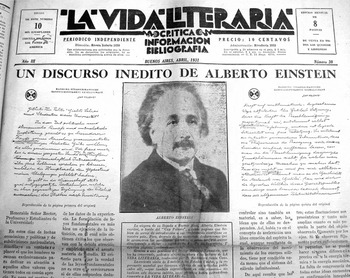
Front page of the April issue of La Vida Literaria, Buenos Aires 1931. The Spanish translation of Einstein's lecture is visible below the photograph of Einstein flanked on the left and right side by the German text of the discurso inédito in the author's handwriting.

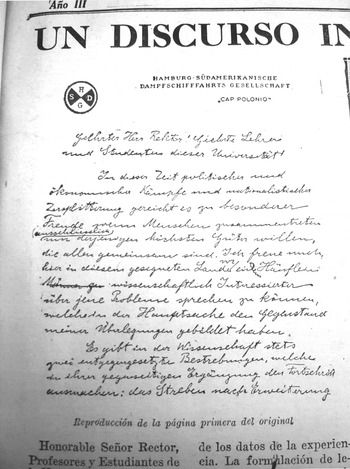
Detail of fig. 1, showing a reproduction of the first page of the original manuscript for the 1925 lecture.

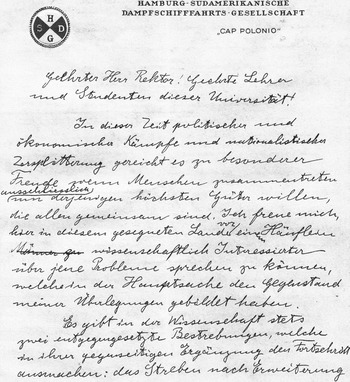
The first page of Einstein's handwritten manuscript, reproduced in J. A. Stargardt's catalogs 615 (1978), 117, and 683 (2006), 188.

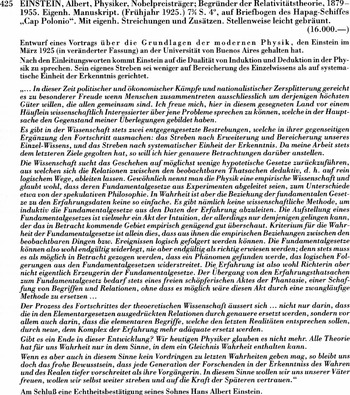
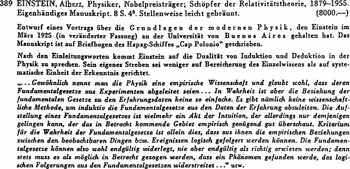
Fragment from Einstein's lecture printed in J. A. Stargardt's catalog 683 (2006), 188.

Fragment from Einstein's lecture printed in J. A. Stargardt's catalog 615 (1978), 117.

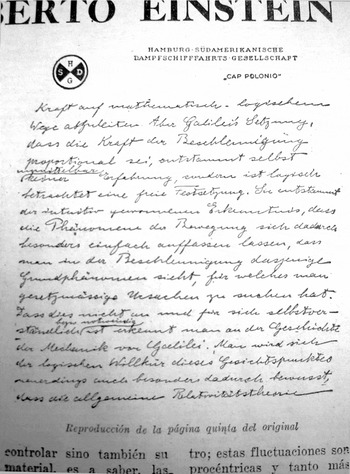
Detail of fig. 1, showing a reproduction of page 5 of Einstein's handwritten manuscript.