Introduction
Phillips and Henderson (Reference Phillips and Henderson1991) reported that less than one-third of nursing home residents with depression in a study based in Canberra, Australia were receiving antidepressant medication. Low treatment rates have also been reported in Sydney nursing homes (Snowdon et al., Reference Snowdon, Burgess, Vaughan and Miller1996). Similar findings have been reported from a major study of residents in 1,492 nursing homes in five U.S. states (Brown et al., Reference Brown, Lapane and Luisi2002). In that study just over half the residents (55%) identified as being depressed received an antidepressant. Of this group a third (32%) received less than the manufacturer's recommended minimum effective dose of antidepressant for treating depression.
A low rate of recognition and treatment of depressed older people should raise concerns, given the substantial burden associated with this illness. This is particularly so given the increasing evidence that late-life depression is treatable with pharmacological (Alexopoulos et al., Reference Alexopoulos, Buckwalter, Olin, Martinez, Wainscott and Krishnan2002; Katona and Livingstone, Reference Katona and Livingstone2002) and psychological therapies (Lebowitz et al., Reference Lebowitz1997; Gatz and Fiske, Reference Gatz and Fiske2003).
Data from low-level residential care populations is absent. This project collected information about the nature of treatments for depression delivered by health service providers to older persons in low-level care residential settings.
Methods
This study was part of a larger project examining the prevalence of depression that involved 300 participants residing in low-level aged care facilities. The findings of the larger project are reported elsewhere (Davison et al., Reference Davison, McCabe, Mellor, Ski, George and Moore2007).
Participants
Participants were recruited from ten low-level residential facilities (known in Australia as “hostels”) from various suburbs in metropolitan Melbourne. There are two kinds of aged care facilities in Australia: nursing homes (high care) and hostels (low care). This study was undertaken in hostels where residents are frail but semi-independent. They receive meals, personal care and various levels of support other than nursing. Facilities were chosen to ensure participants represented a range of socioeconomic, religious and cultural backgrounds. Facilities differed in size from 15 to 99 bed units and there was considerable variation in fees, admission criteria, staff-to-resident ratios, activities and amenities available and the quality of physical environment. This variation is typical of the diversity in Australian metropolitan facilities. Participants had been resident in their facility for between one month and over twelve years, with a median stay of two years and one month.
In total, 571 individuals resided in the participating facilities. A total of 163 residents were excluded because they met the following exclusion criteria: agitation or impaired communication related to severe dementia; diagnosis of bipolar affective disorder or schizophrenia; severe hearing impairment; acute illness; inability to communicate in English; aged less than 65 years, or presence of an intellectual disability. Of the remaining 408 residents, consent was obtained from 300 residents to participate in the study. The participants comprised 229 women and 71 men, who ranged in age from 65 to 99 (M = 85.37 years, SD = –6.44).
This sample is typical of the gender ratio in aged care facilities and is best described as “old old”, with 83.0% aged over 80 years and 31.7% aged over 90 years.
Measures
The Structured Clinical Interview for DSM-IV Axis I Disorders (First et al., Reference First, Spitzer, Gibbon and Williams1997) is a semi-structured interview schedule for making DSM-IV Axis diagnoses and has been widely used in clinical and research settings. The items for diagnosing major depressive disorder were administered according to the Clinician Version (requiring five or more symptoms, including at least one of (i) depressed mood, or (ii) loss of interest or pleasure). The items for diagnosing minor depressive disorder were administered in the same way but, consistent with the Research Version guidelines, only two to four symptoms were required to be present, including at least one of (i) depressed mood (ii) loss of interest or pleasure.
Procedure
All participants received an interview from a clinical psychologist to determine the presence or absence of major or minor depressive disorder and to determine level of cognitive function. The clinical diagnostic interview took place in the resident's private room and typically lasted between 20 and 40 minutes. Each participant was also asked if he or she had received any treatment for depression in the previous six months or was currently being treated for depression, with examples provided of antidepressant medications. Following the diagnostic interview with each participant, the clinical psychologist reviewed the resident's file held at the facility to determine whether the participant was currently receiving antidepressant medications or had “depression,” “depressed mood” or other indication of depressive illness recorded by their general practitioner (GP). In addition, data regarding the participant's age, all medical diagnoses and all prescribed medications were extracted from the file.
The clinical psychologist reviewed all cases in consultation with a gerop sychiatrist experienced in the diagnosis of depression among older persons, prior to assigning a diagnosis of depression. This consultation focused on differential diagnosis and a diagnosis of depression was not assigned if a case was determined to be most likely due to the effects of medication or a general medical condition. Given the high prevalence of dementia among this population, attention was paid to dementia as a potential etiological factor, through a review of psychiatric history, the participant's resident file and staff reports. However, a valid diagnosis of dementia, which requires a physical and neuropsychiatric examination, was beyond the scope of this study. While some cases were likely to be best explained by the diagnosis of dementia with depressed mood, this could not be validated in the current study and participants with this presentation were diagnosed with major and minor depressive disorder according to the number of symptoms present and degree of clinical impairment.
Results
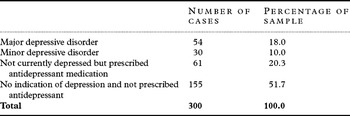
Nearly half (n = 145, 48.3%) of the sample presented with symptoms of depression at the time of the assessment and/or were currently prescribed antidepressant medication (Table 1). Fifty-four participants (18%) met DSM-IV criteria for major depressive disorder. Thirty participants (10%) presented with between two and four symptoms of depression and were classified with minor depressive disorder. Sixty-one participants (20.3%) did not meet DSM-IV criteria for depression at the time of the clinical assessment but were currently prescribed an antidepressant medication.
Diagnosis of depression

Association between depression and GP recognition and treatment
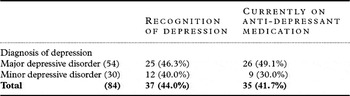
The residents’ files and medical charts were examined to investigate whether participants diagnosed with major and minor depressive disorder at the time of the clinical assessment had previously been recognized as depressed by their GP according to listed medical diagnoses and were currently being treated with an antidepressant medication. Overall, fewer than half of the participants with depression were receiving anti depressant medication at the time of the clinical assessment or had any indications of depression in their resident file, as recorded by their GP (Table 2). Detection rates were slightly higher for participants with major depressive disorder than for participants with minor depressive disorder, while treatment rates were considerably higher. Fewer than one-third of residents with a diagnosis of minor depressive disorder were receiving an antidepressant medication.
GP recognition and treatment of participants with depression

Type of antidepressant prescribed
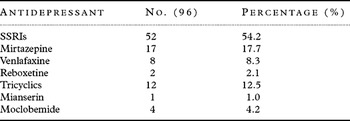
Unlike the study carried out in the Sydney nursing homes (Snowdon et al., Reference Snowdon, Burgess, Vaughan and Miller1996) the majority of the patients in our study were prescribed selective serotonin reuptake inhibitors (SSRIs) (Table 3). In the Sydney study two-thirds of those prescribed antidepressants were taking tricyclics and nearly one-quarter were on Mianserin. In this study, a decade later, only 12.5% were on tricyclics and only one patient was on Mianserin.
Type of antidepressant prescribed

Discussion
Our major finding is that less than half of the residents with current symptoms of major or minor depression had depression recorded on their list of medical conditions and were receiving current pharmacotherapy or any form of interven-tion for depression. The low rate of recognition of current depression among older persons in the low-level residential care sample mirrors previous results with community and high-level residential care (nursing home) samples. (Crawford et al., Reference Crawford, Prince, Menezes and Mann1998; Brown et al., Reference Brown, Lapane and Luisi2002).
Recent research has suggested that GPs are less likely than psychiatrists to see depression among their patients as a serious condition and to recommend the commencement of immediate treatment (Saarela and Engeström, Reference Saarela and Engeström2003), instead preferring to monitor patients and defer treatment decisions (Watts et al., Reference Watts2002). Also of concern is the research finding that older adults received fewer follow-up consultations after commencing a new antidepressant medication than younger adults (Unützer et al., Reference Unützer1999). Despite the known high prevalence of depression in residential settings, research has suggested that residents do not receive more consultations from their GP for depression than older persons living in the community (Shah et al., Reference Shah, NcNiece and Majeed2001).
In the current research, the rate of treatment for those with current minor depressive disorder was particularly low, with less than one-third of residents receiving current medications for this condition. This may suggest a reluctance to treat minor depression, which is unfortunate given indications that minor depression is a source of distress and excess disability and appears to be a risk factor for major depression (Samuels and Katz, Reference Samuels and Katz1995). It could also be due to a decision to avoid pharmacotherapy to treat minor depression. However, if a decision is made to avoid the use of medication, other treatments should be provided. With one exception, no participants with depression in this study reported receiving non-pharmacological treatments, such as cognitive therapy or interpersonal therapy, which have been established as efficacious with older adults (Lebowitz et al., Reference Lebowitz1997; Gatz and Fiske, Reference Gatz and Fiske2003). Few depressed residents had been referred to a specialist mental health service. A failure among GPs to offer alternative treatments or refer patients to appropriate specialist service providers has been reported previously in the literature (Crawford et al., Reference Crawford, Prince, Menezes and Mann1998; Watts et al., Reference Watts2002; Gatz and Fiske, Reference Gatz and Fiske2003; Saarela and Engeström, Reference Saarela and Engeström2003) with older persons receiving specialist mental health services at lower rates than younger adults (Lebowitz et al., Reference Lebowitz1997).
An interesting finding in this study was the number of residents on anti-depressants with no current symptoms of minor or major depression. Some 96 residents out of the total sample of 300 were on antidepressants. Of these 96 residents, 26 had current symptoms of major depression and nine residents symptoms of minor depression. However, 61 residents or about two-thirds of the residents on antidepressants had no current symptoms of depression. An investigation of the purpose of this treatment was outside the scope of this study. While every attempt was made to determine that symptoms were indeed due to a depressive illness rather than a medical illness or medication side effects, the scope of this project did not allow for a medical examination to fully determine the etiology of symptoms. This may have resulted in an over- or underestimation of the prevalence of depression, a common methodological problem in research of this nature that has been raised previously in the literature (Katz et al., Reference Katz, Parmelee and Streim1995; Schneider et al., Reference Schneider, Kruse, Nehen, Senf and Heuft2000).
However, the fact that 20% of residents did not meet criteria for depression during the clinical assessment but were currently prescribed an antidepressant medication requires some consideration. One can postulate either that they have been prescribed antidepressants appropriately and adequately by GPs with a resolution of symptoms or that they are inappropriately being treated with antidepressants. If we accept the initial postulate, then we have an interesting finding. If we add the 61 residents on antidepressants without depression to the 35 on antidepressants but currently depressed and generate an appropriate denominator of all those with depression plus those on antidepressants but recovered, then we have an active treatment rate of 96/146 or 66%. This is impressive compared to findings from previous studies as quoted above. If we accept the latter then there is a concern that GPs may be misdiagno-sing depression or using antidepressant medications inappropriately in some circumstances. This would suggest that further mental health training for GPs may be required.
An encouraging finding in this study was that the vast majority of patients were taking the newer antidepressants. In the Sydney nursing home study carried out in 1994 (Snowdon et al., Reference Snowdon, Burgess, Vaughan and Miller1996), two-thirds were taking tricyclics and a quarter were on Mianserin. A decade later in our study, only one-eighth (12.5%) were on tricyclics and only one patient was taking Mianserin. Obviously this is due to greater availability and increasing confidence of GPs to prescribe the more modern antidepressants (SSRIs and serotonin norepinephrine reuptake inhibitors (SNRIs)).
Conflict of interest
None.
Description of authors’ roles
Kuruvilla George was part of the project team involved in designing and supervi-sing the project, and was also the geropsychiatrist for the project. Tanya Davison coordinated the research project, conducted the interviews and did the statistical analysis. Marita McCabe was the chairperson of the project team and was the main supervisor of the project. David Mellor and Kathleen Moore were members of the project team.
Acknowledgments
This study was supported by a grant from “Beyond Blue” – the national depression initiative. We wish to thank the residents who took part in this study as well as the management and staff of the residential facilities who facilitated the project.