1. Introduction
Monitoring and enforcement to induce compliance with regulations is a main component of any environmental policy. Perhaps because of the difficulty in implementing market-based instruments, most Latin American countries still use conventional command-and-control approaches such as emission standards and technical requirements for different types of pollution. In most cases, the monitoring and enforcement of these regulations has been very weak because of the lack of funding, expertise, personnel and, mostly, political will to allocate scarce resources to environmental protection (Eskeland and Jimenez, Reference Eskeland and Jimenez1992; Russell and Powell, Reference Russell and Powell1996; Blackman, Reference Blackman2010).Footnote 1 Enforcement to induce compliance plays a critical role in the performance and final outcome of any policy. Unfortunately, the empirical analysis of the determinants and effectiveness of enforcement efforts are scarce in the developing world in general, and particularly in Latin America. To the best of our knowledge, only a few studies analyze enforcement and compliance of environmental policies in this region. Despite the fact that most of the environmental regulations in the region are command-and-control policies, a significant part of past studies has focused on the few regulations based on economic incentives (see, for example, Palacios and Chávez, Reference Palacios and Chávez2005; Briceño and Chávez, Reference Briceño and Chávez2010).
In the case of Mexico, Dasgupta et al. (Reference Dasgupta, Hettige and Wheeler2000) carried out an analysis of survey-based collected information to detect which are the decisive factors of environmental performance in the manufacturing sector. Their results suggest that stricter enforcement provides an important incentive for pollution reduction. They also highlight the potential of programs that promote more effective environmental management and training within the plants. Caffera (Reference Caffera2006) explores the effects of enforcement pressure on compliance behavior with command-and-control effluent regulations in Montevideo, Uruguay. He concludes that formal enforcement did not have a significant deterrent effect on reported effluents and the compliance behavior of industrial plants for the study period.
Palacios and Chávez (Reference Palacios and Chávez2005) consider the design of enforcement strategies and the determinants of compliance in the case of firms regulated under the emissions compensation program of Santiago, Chile (the only market of transferable emission permits in the region). More recently, Briceño and Chávez (Reference Briceño and Chávez2010) undertake an econometric analysis of the determinants of non-compliance with the payment of fees, in the context of the Colombian fee discharge program. These studies provide strong evidence that individual firm's characteristics are important determinants of compliance behavior.Footnote 2
The aforementioned analyses consider different types of environmental regulations, regulated population of polluters, and other sources of heterogeneity. Taken together, these works present mixed evidence on the role of enforcement actions in inducing compliance, but they tend to indicate that the characteristics of individual firms are relevant in their choice of whether or not to comply. Unfortunately, these works have not analyzed the driving factors behind the imposition of fines on detected violators.
In this paper we seek to provide a rigorous econometric analysis of the determinant factors of enforcement actions and their effectiveness in terms of inducing compliance. Our study focuses on industrial air pollution regulations in Mexico City. The capital city of Mexico is known internationally to be one of the most populated and polluted cities in the world. In addition to the fact that car emissions represent about 70 per cent of total emissions in the city, there are other important sources of pollutions, such as industrial emissions. According to official statistics, emissions from industrial sources have increased in absolute levels from 93.4 thousand tons per year in 2000 to 256.5 thousand tons per year in 2006.Footnote 3
During the period January 2000–October 2008, the Mexican Federal Environmental Attorney's Office (Procuraduría Federal de Protección al Ambiente, PROFEPA) carried out more than 900 inspections in Mexico City, a figure which implied an average of about 100 visits per year. This represents only 5 per cent of the total 2,000 firms liable to annual air emissions inspection by PROFEPA. This problem is compounded by the fact that 77 per cent of the total number of inspected firms exhibit some kind of violation.
The main objective of this paper is to analyze the performance of the Federal Industrial Inspection Program operated by PROFEPA in Mexico City. We seek to answer three specific questions: First, what drives PROFEPA inspections? Second, for those inspected firms, what drives non-compliance? Third, what determines the imposition of fines? Considering that PROFEPA has very limited resources for inspections and the imposition of sanctions, this analysis sheds light not only on a firm's environmental compliance results, but also on how PROFEPA can best allocate its resources to improve environmental performance by those firms under its jurisdiction.
Our work presents five main differences with respect to previous analyses. First, our data set is not based on self-reported emissions but on the result of PROFEPA's inspections. Second, unlike most of the previous studies that consider only a binary compliance variable (to comply, or to not comply), we are able to observe four different levels of compliance (Full Compliance, Minor Infractions, Urgent Measures and Priority Attention). Third, in addition to inspections, our data set contains information about the fines imposed on individual firms. In the context of environmental regulations, to the best of our knowledge, only Shimshack and Ward (Reference Shimshack and Ward2005) and Zinnes et al. (Reference Zinnes, Tarhoaca, Popovici and Sterner1999) incorporate information on fines. Fourth, we have also conducted face-to-face interviews with PROFEPA's inspectors and firm managers. This allows us to understand how they handle and perceive inspections and fines in Mexico City, as well as to collect the background information needed to develop testable hypotheses through our econometric analysis.Footnote 4 Fifth, we also explore the potential role of political transitions and institutional changes on inspections and enforcement actions.
The Federal Industrial Inspection Program carries out two types of inspections: (i) initial inspections, which represent the first contact within a given inspection procedure, between PROFEPA and a firm, and (ii) follow-up inspections that are carried out to supervise specific details related to a firm's environmental performance following initial inspections. Our empirical research focuses on the initial inspections. We use firm-level data provided by PROFEPA, including information on inspections, environmental compliance level detected by the inspection, resulting fine, firm size, and industrial sector for 1,989 firms located in Mexico City and under PROFEPA's jurisdiction during the period January 2000–October 2008. We also use information about total population and population density at the municipal level from the National Census of 2000 and 2005, as well as a socioeconomic index estimated by the National Commission of Population for the same years.
Our results suggest that larger firms and certain polluting sectors are more likely to be inspected. Also, we found that firms located in poor and high-density municipalities that make up Mexico City are more likely to be inspected. Finally, with the exception only of the first political period considered, we find no evidence that political transitions affect PROFEPA's enforcement in Mexico City.
Regarding environmental compliance, we found that only past inspection, total population in the municipality where the firm is located, and some priority groups to which the industrial sector belongs have significant effect on firms’ compliance behavior. Furthermore, our results suggest that there are not significant effects on firms’ compliance behavior from previously imposed fines. This result might indicate that in many cases the assessed fine is not paid because the firms may use different administrative and legal actions to avoid payment.
Finally, we found that the severity of the infraction does not seem relevant in the decision to impose a fine or not, but it is significant in determining its amount. Likewise, relapsing does not seem to influence the probability of receiving a fine or its amount, despite being one of the criteria in the environmental law.
The paper is organized into five sections. In section 2 we briefly explain the design and functioning of PROFEPA's Federal Industrial Enforcement Program and present some evidence about inspections efforts, compliance behavior of inspected firms, and imposition of fines. Section 3 provides a description of the data used in the empirical work. Section 4 presents the econometric specifications and the results of the estimations. Finally, section 5 presents the conclusions.
2. The Federal Industrial Inspection Program in Mexico City
This section explains how the Federal Industrial Inspection Program works in terms of monitoring and enforcement strategies, and presents some descriptive statistics about inspection activities, compliance results and imposition of fines over the period January 2000–October 2008.
2.1. Monitoring and enforcement
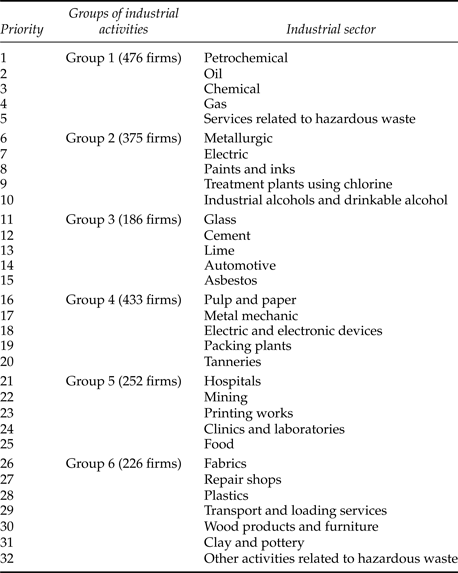
The General Law of Ecological Balance and Environmental Protection (LGEEPA) states as its objective to hold firms liable for the pollution they produce in such a way that prevention and remediation costs are not transferred to the public. This law addresses the regulation of four different activities: (i) highly risky activities; (ii) hazardous waste, (iii) environmental impacts; and (iv) air emissions. Our research focuses on the latter activity. In this particular section of the law, firms must fulfill several requirements such as installing sampling devices, registering their emissions, complying with emissions standards and dealing with a yearly operation permit, among others. Specifically, there are 31 different industrial activities regulated by this law, detailed in table 1.
PROFEPA's polluting priority list of industrial activities

PROFEPA is the office in charge of enforcing compliance of the General Law. Through the Federal Industrial Inspection Program, PROFEPA carries out a certain number of inspections yearly and imposes fines and sanctions. The total number of inspections varies each year and depends mainly on the budget devoted to this program and the number of inspectors available. Inspections are carried out as surprise visits, and selection is supposed to be made based on a priority list of different industrial sectors (see table 1). Additionally, the law requires that PROFEPA inspect all firms for which citizen complaints have been received. These complaints can be made by telephone, email or by personal contact at PROFEPA's offices and have to be identified as infractions under the federal environmental law.
During the inspection, the determination of each firm's environmental compliance status is made only through observation of the firm's operations and the examination of emissions permits. Specifically, in the case of air emissions inspections, inspectors do not regularly use technical instruments to measure emissions (concentration or flow of pollutant leaving stacks). Rather, inspectors review emissions logbooks or simply observe air emissions from the source's smokestacks.
As a result of the inspection, the firm will be ranked in one of four categories: (i) Full Compliance, which indicates that no infraction was found; (ii) Minor Infractions, which refers to various types of administrative mistakes as, for example, errors or missing information in emissions logbooks; (iii) Urgent Measures, which refers to those infractions potentially dangerous for people's health; and (iv) Priority Attention, which relates to activities that have already impacted the health of the community. Based on the compliance results, PROFEPA can carry out follow-up inspections in order to confirm whether or not the firm is taking control measures to improve its environmental performance.
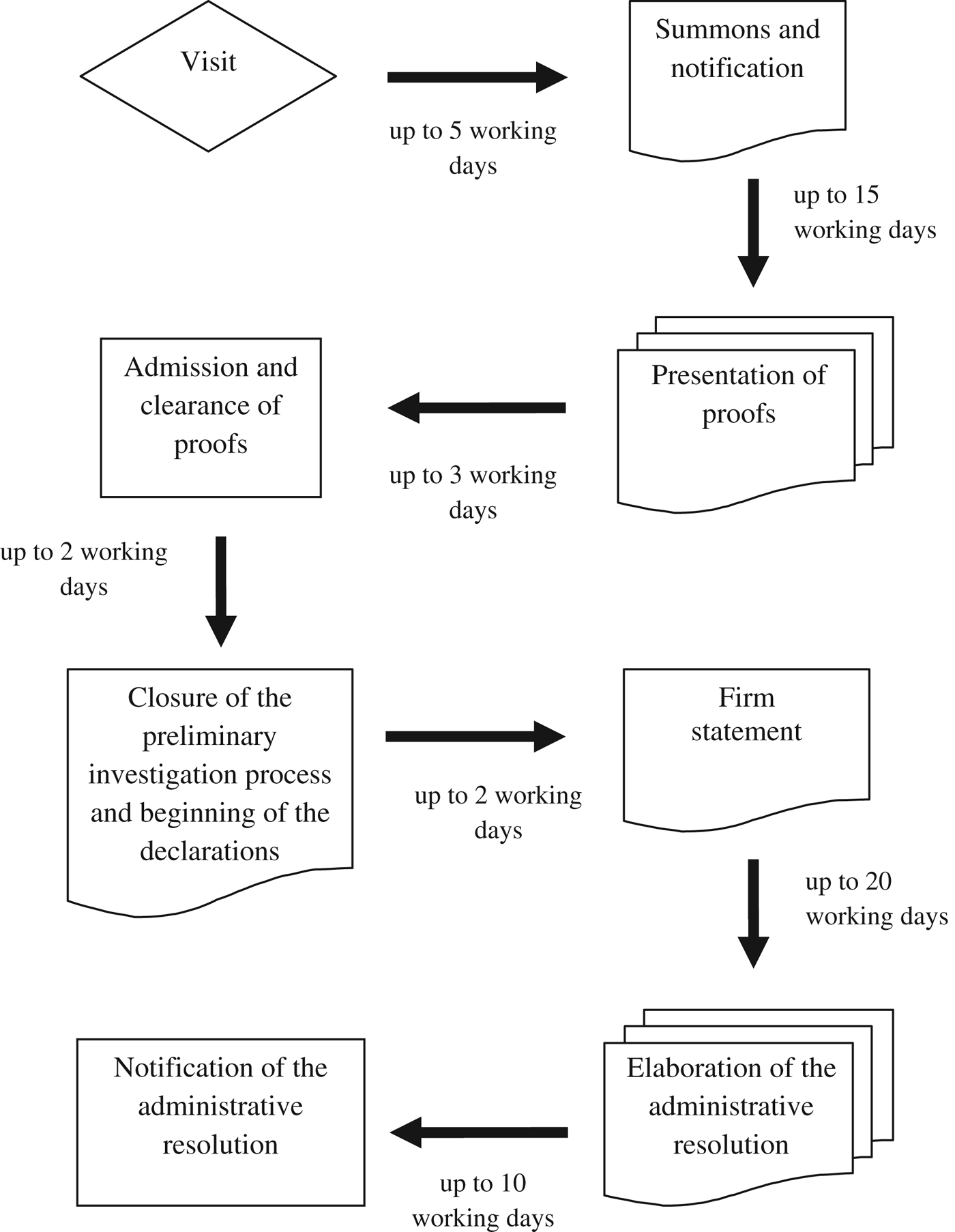
The entire inspection process involves several administrative steps and can normally take up to 57 working days (see figure 1). During this time, there are several interactions between PROFEPA and firms in which the latter can have the opportunity to deny PROFEPA's decision in case of non-compliance, and even to reduce or commute fines.Footnote 5 Based on several interviews with PROFEPA's staff, we found that the amount of fines are at the discretion of PROFEPA but, in general, they are supposed to be based on the severity of the infractions, the firm's propensity to relapse and the firm's financial statements.Footnote 6 In principle, fines range from US$100 to US$100,000 and can be doubled in case of repeat offenders.
Inspection and follow-up administrative procedure
2.2. Inspections and compliance results: January 2000–October 2008
PROFEPA observes the compliance status of a firm only when it is inspected. Because of the lack of financial resources and personnel, the number of yearly inspections is low compared to the total number of firms under PROFEPA's jurisdiction in Mexico City. Moreover, it seems that PROFEPA does not have a complete record of firms that is continuously updated in terms of their status of activity (active or out of business), since they may only come to realize a company has shut down when they go to inspect it and find it has been closed.
The number of yearly inspections by type from January 2000 to October 2008 is shown in table A1 of the online Appendix (available at http://journals.cambridge.org/EDE). From a total of 1,989 firms under PROFEPA's jurisdiction, 928 were inspected during the whole period, and 22 of them were inspected twice in a given year of the studied period. The number of normal inspections decreased significantly over time while the number of complaint-originated inspections remained rather stable (table A1).
As for environmental compliance, online Appendix table A2 shows the distribution of inspected firms according to its compliance category. First, we found that full compliance represents less than 25 per cent of the total number of inspected firms for all years. Thus, it seems that non-compliance is the rule and not the exception. Second, the most common type of non-compliance is minor infractions, which refers mainly to administrative matters such as incomplete or out-of-date documentation. Third, while the total number of inspections has decreased over time, the percentage of priority attention and urgent measures (the most serious level of non-compliance) has increased. (Online Appendix figure A1 shows the distribution of normal and complaint by firm size and group of industrial activity.)
2.3. Fine incidence/imposition of fines
In this research, we only focus on monetary fines. According to LGEEPA, the amount of fines imposed by PROFEPA must take into account the following criteria: severity of the infraction, offender's financial situation, relapsing, intentionality and negligence and, finally, benefits accruing to the firm directly related to the infraction. After interviewing PROFEPA's legal department, we noticed that the imposition of fines seems to be somewhat at the discretion of the authority, especially considering that firms can appeal on the basis of their financial situation, to reduce or even avoid the fine. This is reflected in the statistics of imposition of fines (reported in online Appendix table A3) where we can see that not all offender firms were actually fined and that the numbers of offenders and fines assessed have been reduced over time.
It is important to clarify that the amount of fines in our data set are reported on the Administrative Resolution as a final step in the Administrative Process of Inspection. However, in many cases, these fines do not represent the fine actually paid by the firm, since it has further legal instruments to reduce or cancel the fine. According to our interviews with PROFEPA's legal department, many firms ask PROFEPA if they can invest in equipment that avoids pollution or protects the environment instead of paying the fine. Likewise, once finished with the Administrative Process, firms can appeal the resolution to the superior authority of PROFEPA in order to get a reduced fine. Finally, as a last chance, firms can also get protection through a judicial process called Amparo, using the constitutional right of ‘due process of law’. This basically means that firms complain to the judicial authorities that the administrative procedure has been improperly administered and they ask for protection against that extra-legal process. If the firm succeeds with the Amparo, then the Administrative Procedure has to be replaced and firms cannot be forced to pay the fine, at least not at that moment.
Unfortunately, due to lack of information, we are not able to examine what happens with a violator firm after the notification of the Administrative Resolution. This implies that the data on fines we used may not reflect the fines actually paid in some cases. However, they are still an approximated indicator of non-compliance costs. Moreover, our estimation efforts seek to answer the question of what drives the regulator's decision on the imposition of fines. It is true that a fined firm can use procedures to reduce or even delay the payment, but our data set does not allow us to control for this, as we have already acknowledged.
From our interviews with PROFEPA's staff and with personnel at some firms, we noted that there is no clear benchmark of expected fines affiliated with each level of non-compliance. Even though PROFEPA declared it has a catalogue of fines, it is not public and firms do not seem to be well informed about the type and magnitude of sanctions they can face. Apparently, they assess their probability of being inspected, detected and fined based on their own past experience (if they have any), and the experiences of other firms (many of the firms are affiliated with industrial associations, so they can easily ascertain what has happened with other PROFEPA actions).
2.4. PROFEPA's budget and political changes
As seems logical, the performance of any public or private program should depend mainly on its available budget. For the Federal Industrial Inspection Program, figure 2 shows the total budget that PROFEPA has for this program in the Mexico City area. There we can see a radical reduction after 2002. We do not address the reasons for this reduction, although we surmise that it could have been a general reduction in the budget devoted to the Environmental Ministry and PROFEPA or it could have been a reallocation of funds among different programs within PROFEPA. In either case, as a consequence of this reduction, we would expect to observe a similar reduction in the enforcement effort regarding inspections since they are closely dependent on the number of hired inspectors and the availability of funds to make the visits.
PROFEPA's budget, 2000–2008 (constant 2008 Mexican pesos)
Additionally, it is important to mention that LGEEPA establishes that money collected from fines should be used to develop monitoring and enforcement activities of all matters covered by this law (Article 175-BIS, LGEEPA).
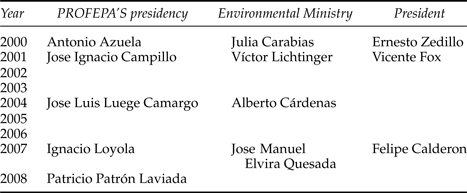
In terms of political changes throughout the entire period of this study, PROFEPA's president as well as the Minister of Environment and the President of the Republic have changed. This might have influenced the way the Industrial Inspections Program works in terms of the level of effort put into monitoring and enforcement activities. Table 2 illustrates the political changes in the relevant institutions related to PROFEPA.
Political changes in institutions related to PROFEPA, 2000–2008
Source: Authors’ own elaboration with information from http://www.semarnat.gob.mx and http://www.presidencia.gob.mx.
According to our interviews with PROFEPA's staff, there were two different periods that reflect a significant difference in the overall performance of PROFEPA and the Ministry of Environment. The first period corresponds with the terms of first Julia Carabias and then Victor Lichtinger as Ministers of Environment (1994–2000 and 2001–2003, respectively). Despite being appointed by two different political parties (PRI and PAN, respectively),Footnote 7 these two ministers are known as non-political academics, and as being very committed to environmental causes.Footnote 8
The second period corresponds with the terms of Alberto Cárdenas and Juan Elvira Quesada (2004–2006 and 2007–2008, respectively). In contrast to the previous administrators, these two men are both long-time career politicians who belong to the same party (PRI). They do not have a profile that reflects any special interest in Mexico's environmental problems and it has been argued among environmentalist groups that they were named as Environmental Ministers due more to their loyalty and friendship with the country's President than to their technical qualifications.
Additionally, we also heard in our interviews that during the last year of Vicente Fox's presidency and the first two years of Felipe Calderón's, PROFEPA's monitoring and enforcement efforts were lessened because of electoral and political reasons, due to the fact that Felipe Calderón's main campaign promise was to create jobs and promote economic growth.
Consequently, it is likely that a political factor plays a major role in the effectiveness of the program. Due to the lack of more precise variables that could measure this political influence, we are only able to control for these changes through the use of dummy variables associated with different political periods. If these hypotheses are true, we would expect to observe coefficients statistically different from each other.Footnote 9
3. Data description
The data set used in this research was constructed from three sources. The first one is a data set provided by PROFEPA that contains firm-level information about inspections, environmental compliance resulting from these inspections, fines, firm size and industrial activities for 2,544 firms located in Mexico City that were under PROFEPA's jurisdiction for air emissions inspections from January 2000 to October 2008. We also requested from PROFEPA the annual total budget devoted to the Federal Industrial Inspection Program in the Mexico City area for the same period.
Of the total number of firms included in this data set, 545 were excluded since they were reported as being under local jurisdiction even though they were inspected for exceptional reasons (i.e., local authorities asked PROFEPA to help them); 10 more firms were also excluded since the data set reported missing values for relevant variables.Footnote 10 Excluding those two sets of firms left a total of 1,989 firms that we could examine.Footnote 11 Unfortunately, the data set does not have any company names so we were not able to match this company-level information with databases from other sources to obtain additional information about individual firms.
The second source of information was the National Census of 2000 and 2005, from which we took data on total population and population density, both at the municipal level. Using annual average rates, we estimated the values for each year during the entire period of study.
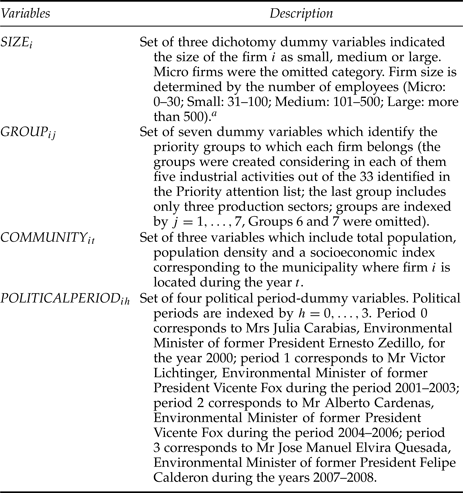
The third source was the National Commission of Population, from which we used a socioeconomic index at the municipality level. This index is a statistical summary of nine indicators, which measures four dimensions of socioeconomic status: (i) formal education; (ii) housing conditions; (iii) monetary income; and (iv) population distribution.Footnote 12 Using a different measure for each category, the socioeconomic index aggregates these measures into a single one that allows us to compare municipalities in terms of deficiencies in the four dimensions previously mentioned. The index takes values on the range −2.5 (highest level of socioeconomic status) to +4.5 (lowest level of socioeconomic status). Based on these three sources of information, we constructed a joint data set. For each regression, we used different explanatory variables; however, there are some variables appearing in all regressions. Those are described in table 3.
Data description for variables common in all regressions
Notes: aBecause of lack of information about changes in firm sizes over time, we consider the firm size reported in 2008 as a constant category for the whole period of study.
Finally, we also conducted several face-to-face interviews with PROFEPA staff and managers from companies liable to its regulations (details about the people interviewed are provided in online Appendix table A4). The purpose of these interviews was to understand how the regulator and firms handle and perceive inspections and fines in Mexico City, and also to collect the background information needed to develop testable hypotheses through our econometric analysis.
4. Econometric model specifications and results
In order to have a benchmark of the determinants of environmental compliance, we follow a heuristic model presented in Blackman (Reference Blackman2010). This model considers a firm that would face a choice between two types of costs, when deciding its optimal level of emissions as they comply with emissions standards. The first type of cost refers to abatement costs which are assumed to be decreasing in the level of emissions. The second relates to other kinds of monetary and non-monetary punishment that can be imposed on firms by several agents, including regulators, communities, employees and consumers. These punishments are assumed to increase along with the level of emission.
A firm trying to minimize its costs will choose a level of emissions where the marginal abatement costs would be equal to the expected marginal penalty. Consequently, in the following econometrics analysis we assume a firm's compliance decision can be determined by some of its characteristics (closely related to abatement costs) and several variables measuring the expected penalties, such as monetary sanctions and community characteristics.Footnote 13
Based on the previous conceptual framework and our data restrictions, we estimated different specifications for inspection decisions, compliance results and the imposition of fines. The following subsections detail each type of regression.
4.1. Determinants of inspections
In order to decide whether to estimate the regressions as a joint model or as separate entities, we calculated the correlation coefficient between normal and complaint-based inspections. If they are highly correlated, in either a positive or negative way, it would mean that both regressions should be estimated as a Bivariate Probit (which allows for correlation between the error terms in both regressions, to account for the fact that the same unobserved variables affect both). Otherwise, it is reasonable to run the regressions separately. The latter was the case since the estimated correlation coefficient was almost zero (−0.0116). We then proceed to estimate two separate equations for each type of inspection.
Explanatory variables are the same for both equations but we use different interpretations in each case. The general specification is given byFootnote 14
 $$\eqalign{INSP_{it}&=f (SIZE_{i}, GROUP_{ij}, COMMUNITY_{it}, BUDGET_{t},\cr & \qquad POLITICALPERIOD_{ih})} $$
whereFootnote 15INSP it: dichotomous indicator, with INSP it=1 if firm i was inspected in the year t, INSP it=0 otherwise; and BUDGET t: total annual budget of the Federal Industrial Inspection Program in Mexico City (thousand Mexican pesos of 2008).
For normal inspections, we first seek to identify if there is empirical evidence that certain types of firms are more likely to be inspected, based on their size and the industrial activity group to which they belong. Second, we then look at whether or not community characteristics, as a proxy of social pressure, are relevant. Third, given that during the period of study there were several political changes concerning people in charge of PROFEPA, the Ministry of Environment and even the Presidency of the nation, we aim to identify possible changes in the overall monitoring effort through the political periods we identify during the years of the study (2000–2008); results for the analysis of political periods are shown in table 2. We also include PROFEPA's total annual budget to test for possible effects from the availability of resources on inspections.
In the case of the regressions related to complaint inspections, assuming that all firms receiving complaints are actually inspected, we try to identify a certain profile for the reported firm's characteristics and those of the community where it is located.
The sample for these regressions has 17,901 observations drawn from 1,989 firms registered for nine years (2000–2008). Descriptive statistics of these observations show that a very low percentage of firms were inspected each year: 4.2 per cent for normal inspections and only 0.9 per cent for complaint-based inspections (online Appendix table A5). Additionally, we noticed that firms are mostly micro and small firms; also, we found that these firms are most commonly grouped in the chemical, metallurgic and metal mechanic sectors (see table 1 and online Appendix table A5).
Both regressions were estimated as a Random Effects Panel Probit model. Fixed effects model estimation makes no sense, since the main objective of these regressions is the study of firm characteristics that explain the probability of being supervised and all these variables would be excluded under such a model specification.
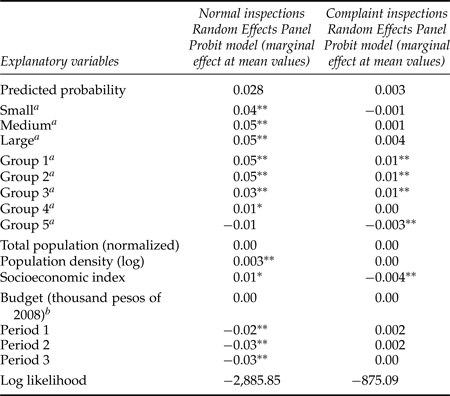
The econometric results for inspections regressions are presented in table 4. Regarding normal inspections, we found that small, medium and large firms are more likely to be inspected than micro firms, by 4, 5 and 5 percentage points, respectively. As for priority attention groups based on industrial activities to which firms belong, the results confirm that those firms belonging to groups with higher priority are more likely to be inspected, other factors being equal. Firms belonging to group 1 and group 2 increase their probability of being inspected by 5 percentage points, compared to the omitted groups (group 6 and group 7, which include firms in economic sectors at the bottom of the priority list). For firms belonging to group 3, the increase in the probability is 3 percentage points, while for those belonging to group 4 the increase is estimated to be 1 percentage point (compared to the omitted groups).Footnote 16
Estimation results of inspection regressions, 2000–2008 (marginal effects calculated at mean values; number of observations, 1,989)
Notes: Dependent variables in Normal and Complaint inspection models are INSP it: dichotomous indicator, INSP it=1 if the firm i faces a Normal or Complaint inspection in the year t, respectively; INSP it=0 otherwise.
aDummy variables. Marginal effects are calculated at mean values for continuous variables and for dummy variables, except for the one of interest. In this latter case, the effect is calculated for a discrete change from 0 to 1.
bA thousand pesos equals approximately US$80.
Omitted categories: firm size (micro), industrial activity (group), political period (period 0=2, 000)
*Significant at 5%; **significant at 1%.
Regarding community characteristics, findings show that population density and the socioeconomic index are significant. An increase of 1 per cent in the level of population density increases the probability of being inspected by 0.3 percentage points, while a unitary increase (deterioration) in the socioeconomic status where the firm is located increases the probability of inspection by 1 percentage point. This may reflect a slight tendency on PROFEPA's part to inspect firms located in more (supposedly) vulnerable locations, perhaps because of the greater potential impact that polluting activities can have in these specific locations.Footnote 17
As for the Program's budget variable, its effect has the expected sign but it is not significant. This reflects that there is no relation between the money spent on the program and the number of inspections.Footnote 18
Concerning political periods’ variables, we have the Environmental Minister of former President Ernesto Zedillo for year 2000 as the omitted category. The results suggest that, everything else being equal, the probability that a firm will face a normal inspection is reduced in each political period considered compared to the omitted period (last year of Zedillo's presidency). However, we also perform a chi-square test to test for significant differences between periods. The results indicate that there are not differences in the probability of normal inspection between political periods when considering Fox's Environmental Ministers vis-à-vis Calderon's Environmental Minister, periods 1–2, and 3, respectively. Hence, we conclude that these political transitions did not affect PROFEPA's enforcement pressure on regulated firms in México City.
As for complaint inspections, the drivers seem to be different from those pertaining to normal inspection. We are not able to find differences in the probability of inspection due to firms’ size. However, the results indicate that there are differences in the probability of inspections due to the priority groups to which a firm belongs. Firms belonging to priority groups 1, 2 and 3 have a higher probability of being inspected because of complaints but show small marginal effects (about 1 percentage point) on the probability of being inspected.
The budget turns out not to be a significant determinant factor of complaint inspections. This result seems reasonable considering that, by law, PROFEPA must inspect all firms receiving complaints. Moreover, the number of firms inspected for this reason is very low compared to those reviewed during normal inspections.
Among community characteristics, only the socioeconomic index is statistically significant, but with a negative sign. This can be explained by the fact that poorer people are more vulnerable to the effects of polluting activities and that they are perhaps less prone to complain about these issues.
Finally, as for dummy variables related to political periods, the results suggest that there are not differences in the probability of inspecting a firm with respect to the omitted period. Also, we found no differences in the probability of inspection between the periods considered.
4.2. Determinants of environmental compliance
Since we only observe the level of a firm's environmental compliance as a result of inspections, we are not able to estimate the regressions as a Panel model. Moreover, given that inspections are not random, estimated parameters are not representative for all firms, but only the inspected ones. In this case, we decided to pool in one single equation normal inspections and complaint-based ones, considering that from a firm's view there is no real difference between these two types of inspections. Actually, PROFEPA used not to give this information to the firm.
We test if there is any link between past inspections and fines and subsequent compliance behavior. We estimated three different cross-sectional Ordered Probit models for three different periods: 2004–2008, 2005–2008 and 2006–2008.Footnote 19 This way we are able to use different lengths of past-to-present periods. The general specification for these regressions is:Footnote 20
 $$\eqalign{COMP_{i}&=f(PASTINSPECT_{i}, INSP\_COMP_{i}, LAG\_FINES_{i}, SIZE_{i}, \cr & \qquad GROUP_{ij}, COMMUNITY_{i}, POLITICAL PERIOD_{ih})} $$
where
 $$\hbox{COMP}_{i} \left\{\matrix{ = 1\quad \hbox{if}\quad \hbox{Environmental Compliance} = \hbox{'Priority Attention'} \hfill \cr = 2\quad \hbox{if}\quad \hbox{Environmental Compliance} = \hbox{'Urgent Measures'} \hfill \cr = 3\quad \hbox{if}\quad \hbox{Environmental Compliance} = \hbox{'Minor Infractions'} \hfill \cr = 4\quad \hbox{if}\quad \hbox{Environmental Compliance} = \hbox{'Full Compliance'}\hfill}\right. $$
INSP_COMP i – Dichotomous variable equals 1 if the firm was inspected as a result of a citizen complaint.
PAST_INSPEC i – Dichotomous variable equals 1 if the firm was inspected during the last three years previous to the current inspection; the variable is equal to 0 otherwise.
LAG_FINES i – Set of two variables: (i) amount of fines imposed on the firm during different past periods (4, 5 and 6 years, respectively); and (ii) number of fines imposed on all the firms in the same industrial sector of firm i and located in the same municipality as firm i during the past periods.Footnote 21
The means and standard deviations of most variables are very similar among the three periods (online Appendix table A6). As expected, the magnitude of lagged variables increases as we consider a longer past period.
By including these explanatory variables we aim to test some specific hypotheses. The first of these is whether or not inspections triggered by complaints make a difference in observed compliance results. In principle, we expect that complaints help PROFEPA turn its focus towards the firms that do more polluting relative to the industry as a whole. This means we expect a positive and significant estimated coefficient.
Second, we aim to detect if the past enforcement actions, inspections and imposition of fines experienced by a firm are relevant in inducing future compliance. A firm's past inspections and fines reflect its own previous regulatory experience while fines that had been levied in the past on other firms test for the presence of reputation ‘spillover’ effects. For both variables we expect positive and significant parameter estimators.
As for a firm's characteristics, we are assessing the hypothesis that smaller firms tend to be less compliant, as our interviews indicated. The omitted category is micro size; given this, we expect a negative sign for the rest of the variables. Likewise, regarding the industrial groups, we want to test if some industries are more problematic than others.
In the case of community characteristics, even though we may expect that the most direct role of a community occurs through inspections triggered by citizen complaints, it is also possible that indirect pressures exist that influence firms to comply. We tried to test this influence using proxy indicators including total population, population density and a socioeconomic index.Footnote 22 Finally, dummy variables are used to test if political periods have a significant impact on compliance.
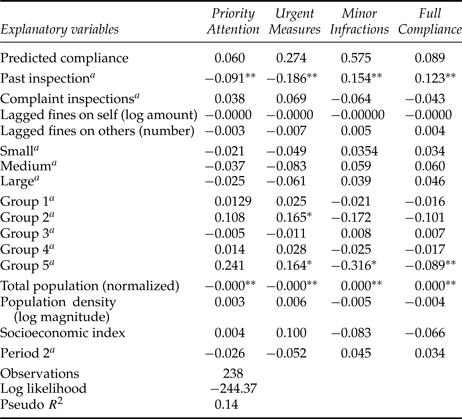
Since the results from the three different specifications of the present period (2004–2008, 2005–2008 and 2006–2008) are quite similar, we next report only the results for the period 2005–2008. The sample size for this regression is made up of 238 observations. The total number of observations corresponds to 173 normal inspections and 65 complaint-based inspections carried out during the period January 2005–October 2008.Footnote 23
Table 5 shows the estimated marginal effects for each category of compliance. The first thing to note is that only Past Inspection, Total Population and some group variables have a significant effect on firms’ compliance behavior. More specifically, our results for the variables related to a firm's past regulatory experience suggest that if the firm was inspected during the last three years previous to the current inspection, it has a 9 per cent lower chance of being labeled Priority Attention and a 19 per cent lower chance of being labeled Urgent Measures.
Estimation results Compliance Regressions, 2005–2008 (marginal effects calculated at mean values)
Notes: Dependent variable in the Compliance Regression model is an ordinal variable COMPi=1 for Priority Attention; = 2 for Urgent Measures;=3 for Minor Infractions; and=4 for Full Compliance.
aDummy variables. Marginal effects are calculated at mean values for continuous variables and for dummy variables, except for the one of interest. In this latter case, the effect is calculated for a discrete change from 0 to 1.
Omitted variables: firm size (micro); industrial activity (groups 6 and 7); political period (period 3).
*Significant at 5%; **significant at 1%.
At first this could appear counterintuitive, since inspections themselves do not imply a cost or punishment on firms, compared to the effect that a past fine could have. However, based on our interviews with PROFEPA officials and firms’ managers, we think that the effect of inspections is important since it represents the first real contact between the authority and the firm which led to the creation of a file in the PROFEPA office. Since there are many firms and very few inspectors, the fact that a firm was inspected represents the realization of an unlikely event.Footnote 24 A previous fine imposed on the firm does not have an effect on compliance. This result might be due to the fact that in many cases the fine imposed is not finally paid due to many administrative and legal means at firms’ disposal to avoid the payment. Unfortunately, we do not have the information to control for the actual payment of fines imposed on non-compliant firms.
In relation to a firm's characteristics, neither size nor group seems to be relevant, except for group 2, which has a significantly positive effect on non-compliance (Urgent Measures) and group 5, which appears to determine a firm's compliance status labeled as Urgent Measures, Minor Infractions and Full Compliance. According to marginal effects, others things being equal, a firm belonging to group 2 is 17 per cent more likely to be labeled Urgent Measures. This represents an important effect and should be taken into account when considering targeting strategies.Footnote 25 Moreover, we found that firms belonging to group 5 are less likely to be labeled as Minor Infraction and Full Compliance, with a marginal effect of -31 and -9 percentage points, respectively.
Among community characteristics, only Total Population is positive and significant for compliance. However, the marginal effect is very low. Finally, the political period variable turns out to be a non-significant determinant of firms’ compliance status, suggesting that political transition did not affect firms’ compliance behavior.Footnote 26
4.3. Determinants of fines
In order to test the congruence of the process of imposing fines according to what the Environmental Law says, the econometric specification is given by the following two equations:
 $$FINED_{i}=f(NOT COMP_{i}, RELAPSE_{i}, SIZE_{i}, GROUP_{ij}, PERIOD_{ih})$$
 $$\eqalign{AMOUNT OF FINE_{i} &=f(NOT COMP_{i}, RELAPSE_{i}, SIZE_{i}, \cr & \qquad\quad GROUP_{ij}, BUDGET_{t}, PERIOD_{ih})} $$
where FINED i – dichotomous variable equals 1 if the firm i was fined; AMOUNT OF FINE i – amount of fine imposed on firms in constant 2008 Mexican pesos; NOT COMP i – set of three dummy variables corresponding to each of the non-compliance categories: Priority Attention, Urgent Measures and Minor Infractions. This last category was the omitted variable; RELAPSE i – dichotomous variable equals 1 if firm i was found at least once as an offender (Priority Attention and Urgent Measures) as a result of an initial inspection during the previous two years; BUDGET t – total annual budget of the Federal Industrial Inspection Program in Mexico City (thousand 2008 Mexican pesos).
Equation (3) was estimated as a cross-section Probit model, while equation (4) was a Tobit model limited at zero, given that we observed zero fines for some offender firms. Descriptive statistics for both regressions are provided in online Appendix table A7.
If the environmental law is applied in practice, we expect fines to increase with the severity of the violation. Likewise, if the firm relapsed, the law must impose a larger fine. Also, because perhaps the enforcement agency is less prone to impose severe fines on smaller firms to avoid forcing them out of business, we use as a regressor firm size dummy variables. Finally, we include political periods’ dummy variables and the total annual PROFEPA budget in order to detect changes in PROFEPA's general enforcement effort to impose fines.
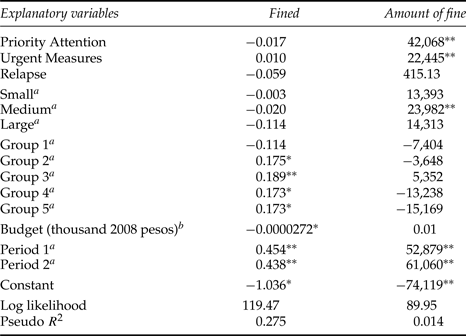
The results are presented in table 6. The sample size for both equations was, initially, 414 observations corresponding to all offender firms inspected during 2002–2007. Observations for 2000–2001 were omitted from the sample in order to calculate the relapse variable. Likewise, observations for 2008 were also omitted due to the fact that there were no fines reported for firms inspected during this year. We suspect that the legal process was still ongoing by the time we received the data set.
Estimation results of fines regressions, 2002–2007 (marginal effects calculated at mean values)
Notes: Number of observations: 414 for fines regression, 330 for ‘Amount of fine’ regression
aDummy variables. Marginal effects are calculated at mean values for continuous variables and for dummy variables, except for the one of interest. In this latter case, the effect is calculated for a discrete change from 0 to 1.
bA thousand pesos equals approximately US$80.
For the first regression, we found that the explanatory variables which are significant correspond to groups, budget and political periods. According to the marginal effects, the likelihood of having a fine assessed, given the same level of infraction in any year during the period of Mr Victor Lichtinger (2001–2003) and Mr Alberto Cárdenas (2004–2006), increases by more than 40 per cent compared to period 3 (2007–2008). Further, we found no differences in the probability of having a fine assessed between the political periods considered.
The results also suggest that, in general, everything else being equal, those groups that rank high in the priority attention list are more likely to be fined. Finally, we found that as the total annual budget of the Federal Industrial Inspection Program in Mexico City increases, the chances that a firm will be fined are reduced. This result is interesting because, according to the law, collected fines are allocated to PROFEPA's budget.
Regarding what drives the amount of the fines, we have information that the severity of infraction seems to be relevant. A Priority Attention and Urgent Measure infraction merits a fine of MEX$42,068 (US$3,005) and MEX$22,445 (US$1,603) higher than a Minor Infraction, respectively. In terms of a firm's size, no clear pattern appears; only medium firms seem to merit a fine of almost MEX$9,000 (US$643) larger than a micro firm, other things being equal. Our results also indicate that, everything else being equal, in the case of medium-size firms, the fine amount imposed is significantly higher as compared to micro-size firms. We did not find evidence of differences in the amount of fine imposed in the case of small and large-size firms, suggesting that the regulator is less prone to impose more severe fines on these firms as compared to micro-size firms.
As for the groups of industries according to PROFEPA's priority list, none of the groups appears to be significantly different compared to low-priority sectors and, again, political period dummies appear to capture much of the dependent variable's variation. The effects of the amount of fines increases from MEX$52,879 (US$3,777) in period 1 (2001–2003) to MEX$61,060 (US$4,361) in period 2 (2004–2006), compared to period 3 (2007–2008), which is the base period. Contrasting to the previous regression, using a chi-square test, this time we found that periods 1 and 2 are statistically different from each other.
Finally, it is worth noticing that Pseudo R 2 for the second regression is very low. This implies that independent variables included in the model explain a very small proportion of the amount of fines.
5. Conclusions
Our analysis for normal inspections indicates that the total number of inspections carried out each year is very low compared to the entire number of firms under PROFEPA's jurisdiction. We find an average probability of 2.8 per cent for the likelihood of inspection. Our econometric analysis for normal inspections indicates that, all else being equal, PROFEPA has focused on larger firms, on certain industrial activities, and on firms located in poor and dense municipalities.
Regarding inspections sparked by complaints, we observe that the number of these inspections is even lower than normal inspections; the predicted probability for complaint-based inspections is only 0.3 per cent. Moreover, the main drivers seem to be different from those pertaining to normal inspection. We were not able to find differences in the probability of complaint inspection due to firms’ size or political periods. However, we found differences in the probability of complaint inspections due to the priority groups to which a firm belongs and also depending on the socioeconomic level of the municipality where the firm is located.
Inspections are designed to detect infractions and these detections must result in sanctions. According to our interviews, firms figure out their expected penalty based on their own and other firms’ past experience with regulatory sanctions. As for these effects, econometric results suggest that only past inspections on the firm has a significant effect on compliance. The estimated marginal effects are relevant in magnitude. In particular, other variables such as those related to the firms’ past enforcement experience, and size appear not to determine firms’ compliance. This result confirms the deterrence effect of inspection in a developing country context. An important implication of this result is the need to increase efforts on inspections to improve compliance, which seems to be particularly low in the studied case and in developing countries in general.
We found that not all the firms detected as offenders were actually fined. Moreover, the severity of infractions does not seem to be relevant in the decision to impose a fine or not, but it is significant in the amount imposed. One of the most surprising findings is that relapsing does not significantly influence the probability of being fined or the amount levied, despite it being one of the criteria mentioned by the environmental law.
Our results also suggest that both the likelihood that a fine is imposed and the amount of the fine levied on a non-compliant firm are influenced by the political period when the fine is being considered. This result confirms the information gathered in our interviews, which suggested that the political will of the regulators as well as the bargaining power of the firms are the key elements in the enforcement process. The reason lies in the fact that the whole process from inspection to fine imposition seems to be ill defined and open to the regulator's discretion. This is, in our view, the main area in which there is opportunity for future reforms.
Finally, we provide two specific policy recommendations for improvement regarding the imposition of fines that comes from our analysis. First, reducing the number of specific considerations to set fines could help to reduce the uncertainty, from the firms’ perspective, on the consequences of being found non-compliant. This may also help to reduce the discretion and political influence in the enforcement process. Second, providing information to the regulated population on the consequences of non-compliance might help to increase incentives for compliance. This could be accomplished, for example, by publicly specifying both the fines to which firms are exposed and the conditions under which the fines are determined. The provision of information to firms on the consequences of their actions offers an opportunity to improve regulatory compliance in a cost-effective manner.
Supplementary materials and methods
The supplementary material referred to in this paper can be found online at journals.cambridge.org/EDE/.