Introduction
Over the last decade, the use of extracorporeal membrane oxygenation (ECMO) has accelerated rapidly. Reference McCarthy, McDermott and Kini1-Reference Shah, Patnaik and Patel3 It can be used as an emergent intervention for patients in severe hypoxemic respiratory failure using a veno-venous configuration (VV-ECMO) and for patients in cardiac failure using a veno-arterial configuration (VA-ECMO). As developing technology ameliorates barriers of cost and logistics, clinical indications for ECMO have grown. Reference Makdisi and Wang4,Reference Richardson, Schmidt, Bailey, Pellegrino, Rycus and Pilcher5 As a result, ECMO centers are being developed across the world, with many authors calling for a “hub and spoke” network model for ECMO centers to serve surrounding areas. Reference Broman6,Reference Combes, Brodie and Bartlett7 Early studies demonstrated a mortality benefit among patients with respiratory failure referred to ECMO centers compared to patients not referred, Reference Peek, Clemens and Elbourne8,Reference Noah, Peek and Finney9 and increasing evidence supports the relative safety of transport on ECMO. Reference Broman, Holzgraefe, Palmer and Frenckner10
Employing the “hub and spoke” network model for ECMO requires effective, safe, critical care transport. Existing literature has established that transporting a patient on ECMO has an overall low mortality rate, yet still carries a significant risk of adverse events. Reference Ranney, Bonadonna and Yerokun11-Reference Austin, Burns and Lowe13 Current guidelines call for all patients transported on ECMO to be accompanied by a physician. 14,Reference Niziolek, Preston and Osborn15 However, as ECMO centers and networks grow, this mandate will necessarily limit the increasing number of transports by physician availability to travel. Alternatively, demonstrating that appropriately trained nurse and paramedic critical care teams can safely transport ECMO patients could increase the resources for ECMO transfers and help grow networks.
In comparison to other geographic areas where ECMO transport programs were purposefully developed and staffed by members of a receiving ECMO institution, Reference Broman, Holzgraefe, Palmer and Frenckner10,Reference Javidfar, Brodie and Takayama16-Reference Gutsche, Vernick, Miano and Rescue18 ECMO transports in New England, United States evolved differently. As receiving academic hospitals developed their capability to care for patients on ECMO, sending institutions began cannulating patients in extremis, including those who may not otherwise survive the wait for a cannulation team to arrive from the receiving hospital. This necessitated the need for a regional ECMO transport team. This organization is not directed by a single institution and accordingly serves the entire region, delivering patients from sending community hospitals to any tertiary care academic medical center with the ability to receive them. The program evolved practice to support the burgeoning ECMO transport need.
The critical care transport organization is supported by a consortium of seven academic medical centers and has been performing ECMO transports since 2011. The most common team configuration is a critical care transport nurse, a critical care paramedic, and an ECMO specialist (perfusionist, specially trained nurse, or respiratory therapist) from the sending institution. The sending or receiving hospital at times will send physicians, and rarely, physician assistants (PAs) or nurse practitioners (NPs), on the transport in addition to the standard team configuration, depending on clinician preferences.
To assess the risks of transporting ECMO patients without a physician, this study compared the experience transporting patients on ECMO with and without the accompaniment of a physician or other additional clinician and assessed rates of adverse events during transport in each cohort.
Methods
This is a retrospective chart review of patients aged 18 and over transported on ECMO from January 2011 through December 2018 from referring hospitals to tertiary care hospitals. The electronic medical record system for transport records was queried for the keyword “ECMO” to identify charts for inclusion. All patients cannulated at the sending hospital were included in the cohort. Patients transported for anticipated ECMO, but not cannulated at the time of transfer, were excluded. The Institutional Review Board (IRB) approved the study (designated number 2017P002863) and waived the need for informed consent.
The transport team members are required to have at least five years of high-performance experience in their profession of nursing or paramedicine before being eligible for hire. Current tenure with the organization ranges from one month to 32.3 years, with a median of 3.5 years. Clinicians undergo intensive critical care training and transport experience during a 15-week orientation and receive dedicated ECMO education through reading and lectures in the post-orientation probationary period. The clinical quality program includes operational, clinical, and physician review of every case. Accordingly, there is feedback and discussion of each ECMO case with the transport team, and the cases are discussed organizationally at twice-monthly case review meetings. The nine-physician medical director group includes seven board certified critical care physicians, six of whom have an active ECMO practice. In-hospital clinical experience with a medical director on the ECMO service is available to the transport clinicians.
While preparing the patient for transport from the sending facility, transport team members consult with sending, receiving, and transport medical control physicians to coordinate care via the Communications Center on a recorded conference phone call line. In-transport plans for arrhythmia and arrest management, target mean arterial pressure (MAP), target peripheral oxygen saturation, and target flow rate for the ECMO specialist are discussed prior to the critical care transport team leaving the sending facility. This allows the transport team to establish and meet goals agreed to by the sending and receiving physicians.
All charts are reviewed by the organization’s Chief Quality Officer (MAF), and all ECMO transports are identified for quality assurance purposes, as per the organization’s ECMO transport protocol. The transport database was queried by an author (SRW) to verify all ECMO transports were included. The organization used a database of all records, maintaining PDFs of transport medical records in internal storage, until moving to ImageTrend Elite (ImageTrend, Inc.; Lakeville, Minnesota USA) in 2017. Chart abstraction was completed by trained abstractors (AC, SRW) and all data were reviewed by the senior author (SRW). The abstractors were aware of the study hypothesis and interobserver reliability was not tested. Data were uploaded into an approved data collection form in REDCap (Vanderbilt University; Nashville, Tennessee USA).
Transport records were reviewed in detail to collect time and date of transport, demographic information, comorbidities as known to the transport team, diagnosis, indication for ECMO cannulation, and mode of ECMO (either VV, VA, or VAV). The method of transport (ground, helicopter, or airplane) was also noted. All transports consisted of a critical care transport nurse, a critical care transport paramedic, and a sending hospital ECMO specialist. Accompaniment by an additional clinician was defined collectively as any physician, PA, or NP from either the sending or receiving hospital who rode in the transport vehicle from the sending to the receiving hospital.
Adverse events were defined as highlighted in clinical reviews and consistent with prior studies. Reference Ericsson, Frenckner and Broman19,Reference Fletcher-Sandersjoo, Frenckner and Broman20 Minor events were defined as brief hypotension with MAP less than 65mmHg responding to intervention, transient decrease in ECMO flow responding to intervention, hypertension with MAP greater than 110mmHg, bleeding not requiring intervention, desaturation of at least three percent with a nadir oxygen saturation over 88%, and loss of pulse oximetry monitoring.
Major events were defined as hypotension not responding to intervention, loss of ECMO flow, ventricular arrhythmias, pneumothorax, decannulation, malfunction of ECMO circuit, bleeding not responding to intervention, desaturation with a nadir saturation of 87% or less, or limb ischemia. Given the risks of desaturation with transport, the threshold for desaturation was set higher than may be otherwise tolerated within the hospital. Reference Wilcox, Saia and Waden21
When a patient had a major event clearly leading to another defined event (eg, ventricular tachycardia leading to hypotension in VV-ECMO), this was counted as one event for the transport. Complications of medical care present prior to the transport team’s arrival, such as pulselessness on ECMO or limb ischemia, were not considered adverse events attributable to transport.
The primary outcome was the rate of major adverse events, and the secondary outcome was minor adverse events.
Statistical Analyses
Mean and standard deviations (SD) were determined for patient demographics, comorbidities, ECMO configuration, and indication for ECMO. Distribution curves demonstrated non-normal distribution for all parameters, and comparative statistics comparing accompanied and unaccompanied transports were performed using chi-square tests.
The total number and percent of all ECMO transports in which major and minor adverse events occurred were determined. Given non-normal distribution curves, differences in the frequency with which major and minor adverse events occurred between accompanied and unaccompanied transports were assessed with nonparametric comparative analyses using chi-square tests.
Univariate regression analysis was performed to assess for clinical or patient-level factors independently associated with major adverse events. Analysis of variance (ANOVA) was performed to assess for differences in major adverse events attributable to each clinical and patient-level factor. Multivariable regression analysis was subsequently performed to describe relationships between the included clinical and patient-level parameters.
All statistical analyses were performed using JMP Pro version 14.0 (SAS Institute Inc; Cary, North Carolina USA).
Results
Over the seven-year period, 93 transports of patients on ECMO from 21 hospitals to four ECMO centers were completed. All transports included an ECMO specialist from the sending or receiving hospital. Of these, 20 were accompanied by one additional clinician, with nine accompanied by a sending physician, nine accompanied by receiving physician, one accompanied by a sending PA, and one accompanied by a sending NP. Three other transports were accompanied by two additional clinicians: one transport with a sending physician and a sending PA, and two with a receiving physician and a PA.
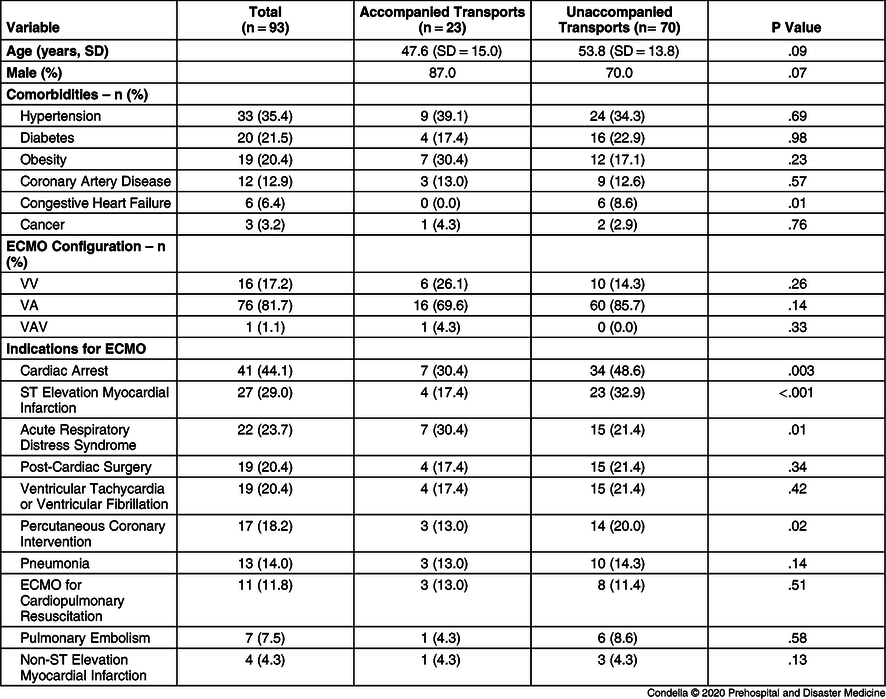
The average age of patients transported was 52.2 (SD = 14.3) years for all transports, and the cohort was predominantly male (74.5%). Mean transport time was 59.2 (SD = 31.3) minutes for all transports. Table 1 outlines demographics of transported patients, including accompanied and unaccompanied cohorts. The most common documented comorbidity was hypertension (33 patients; 35.5%). There were significantly more patients with congestive heart failure (CHF) in the unaccompanied compared to the accompanied group (P = .01) but no other significant differences between the cohorts. Seventy-six patients (81.7%) were supported on VA-ECMO and 16 (17.2%) were on VV-ECMO. One patient was cannulated in a VAV configuration. The vast majority (88; 94.6%) were cannulated by sending physicians, and five (5.4%) were cannulated by receiving physicians at the sending institution. Transport time was not significantly different for patients accompanied by an extra clinician (71.2 minutes) as compared to unaccompanied patients (55.0 minutes; P = .12).
Demographics of Transported Patients

Abbreviations: ECMO, extracorporeal membrane oxygenation; VA, veno-arterial; VAV, veno-arterio-venous; VV, veno-venous.
The most common documented indications for ECMO cannulation are listed in Table 1. Notably, 11.8% of all patients were undergoing cardiopulmonary resuscitation (CPR) at the time of ECMO cannulation. The most common indication was cardiac arrest (44.1%), followed by ST elevation myocardial infarction (STEMI; 29.0%), and acute respiratory distress syndrome (ARDS; 23.7%). All three of these diagnoses were more common in unaccompanied transport compared to accompanied transport. Percutaneous coronary intervention (PCI) was more common in unaccompanied transport (20.0% versus 13.0%; P = .02).
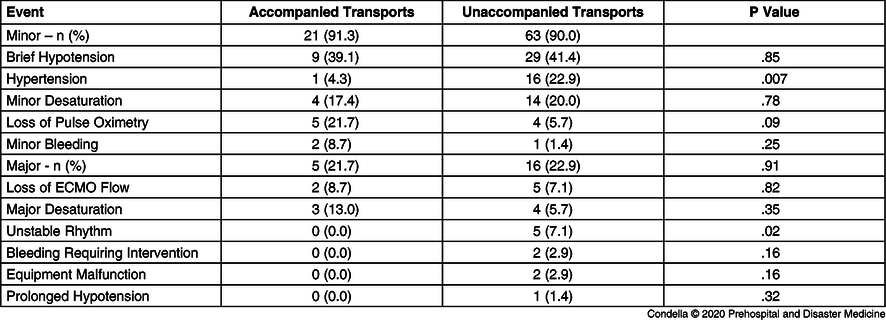
Table 2 lists minor and major adverse events occurring during transport. The most common minor adverse event was brief hypotension. Hypertension was significantly more frequent in unaccompanied transports (4.3% versus 22.9%; P = .007). Minor adverse events were otherwise similarly distributed between accompanied and unaccompanied transports.
Adverse Events During ECMO Transport

Abbreviation: ECMO, extracorporeal membrane oxygenation.
A total of 21 major adverse events occurred in 20 transports (21.5% of all transports). Of these, five occurred during accompanied transport and 16 during unaccompanied transport (21.7% versus 22.9%; P = .91). The most common major adverse events were transient loss of ECMO flow (n = 7) and major desaturation (n = 7). Ventricular arrhythmias occurred more commonly in unaccompanied transport (7.1% versus 0.0%; P = .02). Major adverse events were otherwise similarly distributed between accompanied and unaccompanied transports.
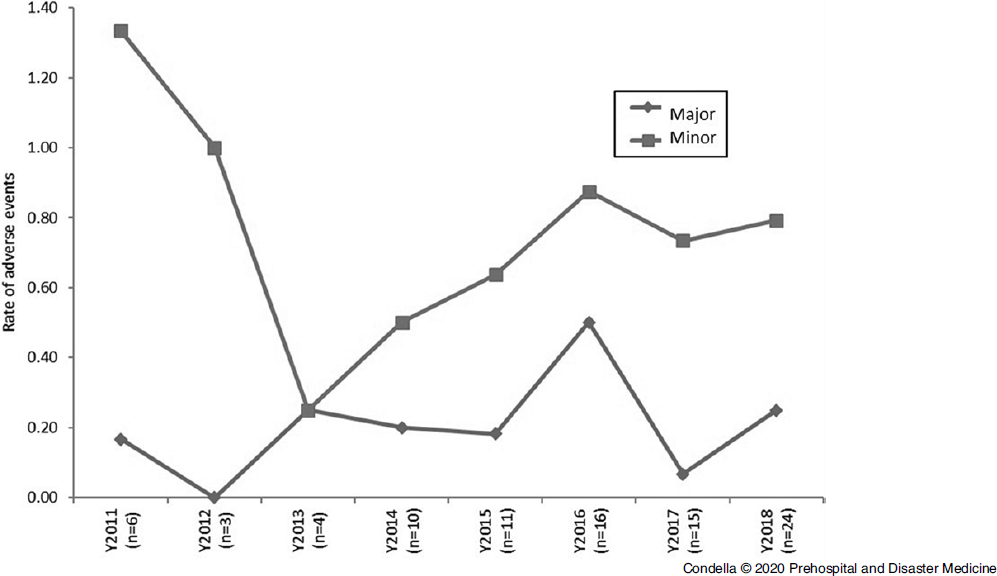
The year of transport did not predict the frequency of major or minor adverse events, as there were no consistent significant differences or trends based on the number of adverse events per calendar year. Adverse events fluctuated by year (Figure 1), but there was no significant temporal correlation between year and adverse events for all year-by-year comparisons.
Rate of Annual Minor and Major Adverse Events per Total Number of Transports.

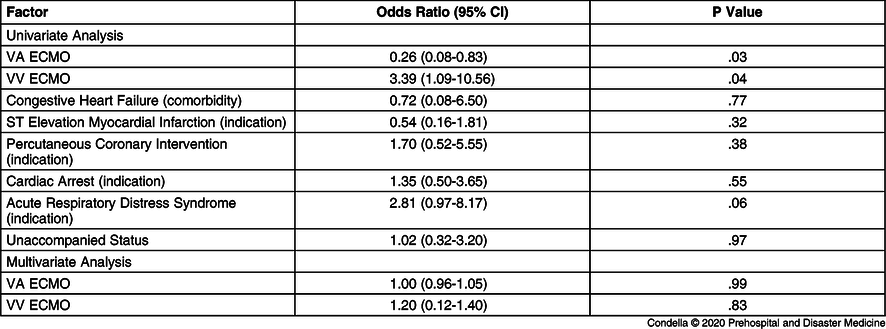
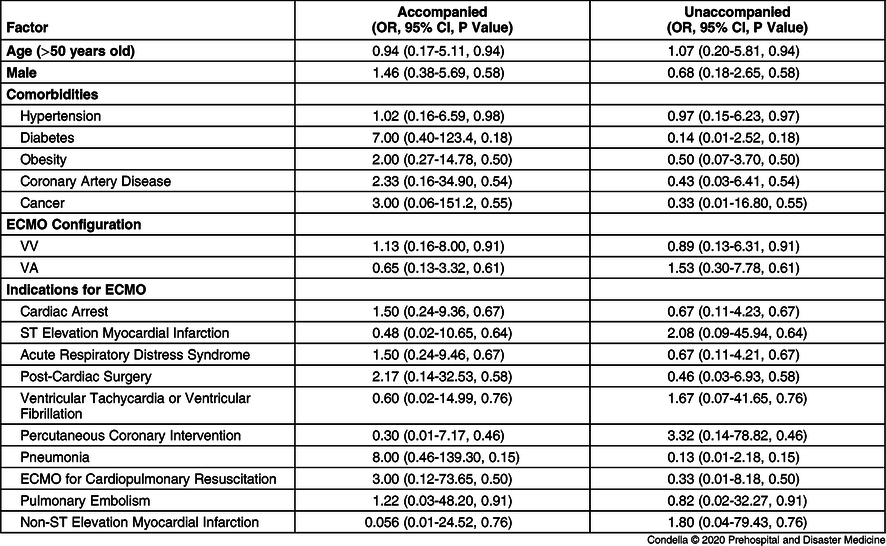
Table 3 shows factors associated with adverse events. Univariate analysis of factors associated with major adverse events found VV-ECMO as the only factor predictive of major adverse events, with an odds ratio (OR) of 3.39 (95% confidence interval [CI] of 1.09-10.56). Other factors including history of CHF, STEMI, PCI, cardiac arrest, ARDS, and unaccompanied status were not found to be predictive of major adverse events. Multivariate analysis did not demonstrate any parameter as being predictive of major adverse events during transport (VA-ECMO OR 1.00; 95% CI, 0.96-1.05 and VV-ECMO OR 1.20; 95% CI, 0.12-1.40). No variables were significantly associated with major adverse events for either accompanied and unaccompanied transports (Table 4).
Factors Associated with Major Adverse Events

Abbreviations: ECMO, extracorporeal membrane oxygenation; VA, veno-arterial; VAV, veno-arterio-venous; VV, veno-venous.
Factors Associated with Major Adverse Events for Accompanied and Unaccompanied Transports

Note: CHF was not included as no adverse events occurred in the accompanied group for patients with CHF, and VAV-ECMO was not included as no patients in the unaccompanied group were transported on VAV-ECMO.
Abbreviations: ECMO, extracorporeal membrane oxygenation; VA, veno-arterial; VV, veno-venous.
Discussion
In this cohort of 93 critical care transports of patients on ECMO, this study observed a minimal difference in the rate of major adverse events between 23 transports accompanied by a physician or other clinician and 70 unaccompanied transports, despite a similar distribution of acuity and major comorbidities. The only significant difference was the rate of ventricular arrhythmias, with no differences in the rate of hypotension, loss of ECMO flow, or clinically significant desaturation.
Previous literature has called for a physician to accompany every ECMO transport. 14,Reference Niziolek, Preston and Osborn15 A recent review of transports on ECMO in North America and Europe by Nwozuzu and colleagues established that North American transports are much less likely to have an anesthesiologist on board compared to European transports and suggested that there should be more accompanied transports. Reference Nwozuzu, Fontes and Schonberger22 These recommendations appeared based on qualitative observations of adverse events in ECMO transports and an experienced respect for the challenge of responding to complications that may occur in patients on ECMO.
However, there is further historic and logistic context to the assertion that a physician should accompany every ECMO transport. Most existing ECMO transport studies make a distinction between “primary” and “secondary” transports. These studies are often based at ECMO centers where the majority of transports begin with a mobile team that deploys to cannulate the patient at a referral hospital. Reference Javidfar, Brodie and Takayama16,Reference Gutsche, Vernick, Miano and Rescue18,Reference Ericsson, Frenckner and Broman19,Reference Wilhelm, Inderbitzin and Reser23-Reference Ehrentraut, Schroll and Lenkeit25 The patient is then transported on ECMO back to the tertiary care center for further management. This type of transport is designated as a “primary” transport. A “secondary” transport occurs when a patient has already been cannulated for ECMO at the outside hospital and is now being transported to an ECMO center for further management.
In the model of primary transport, a physician must necessarily be part of the transport team to perform cannulation at the outside hospital. Thus, a physician is also present on the return transport to respond to adverse events as needed. In this system, common to most published ECMO transport studies, there is by definition less opportunity to examine whether a physician’s presence on the return transport is actually associated with fewer adverse events.
In contrast, this cohort of ECMO transports developed from community and regional hospitals where independent institutions began cannulating unstable patients and then requesting transport to a variety of receiving centers. The organization is responsive to a consortium of tertiary care hospitals in this metro area that includes all the quaternary ECMO facilities.
In the United States, a critical care nurse and paramedic team is a common configuration for critical care transport teams, 26 and this is the model employed by the organization. In the nascent stages of this ECMO transport program, the decision was made to always bring an ECMO specialist in transport in addition to the transport team. The ECMO specialist provides expertise in ECMO management, and as such, it was not clear that it was necessary to add a physician or another clinician, particularly one less experienced with the nuances of transport.
These data demonstrate that unaccompanied transports have a comparable rate of adverse events as compared to transports accompanied by a physician or other clinician. Patients in the unaccompanied transport cohort are high acuity, with significantly more patients with cardiac arrest, STEMI, and ARDS as compared to accompanied transport. Nonetheless, there was no significant association between unaccompanied transport and any major adverse event.
The existing literature on ECMO transports describe a wide range of adverse events en route, Reference Ericsson, Frenckner and Broman19 from 1.5% to 32.0%. Reference Broman6,Reference Fletcher-Sandersjoo, Frenckner and Broman20 Some of the variability is due to discrepancies in definitions of adverse events, with some authors including power failures and complications with ambulances but not reporting changes in vital signs. Reference Biscotti, Agerstrand and Abrams12,Reference Javidfar, Brodie and Takayama16,Reference Grenda, Moll, Kalin and Blum17 The rate of major adverse events in this study is comparable to other published studies at 21.5%. However, the cohort included in the current study differs from the existing studies in terms of acuity, with cardiac arrest being the most common indication for ECMO (44.1% of patients) and 11.8% of patients undergoing CPR during cannulation. Other studies report pre-ECMO rates of arrest at 4.2%-14.0% and do not report any patients undergoing CPR at the time of cannulation. Reference Biscotti, Agerstrand and Abrams12,Reference Javidfar, Brodie and Takayama16,Reference Ehrentraut, Schroll and Lenkeit25 Although the rate of ventricular tachycardia was higher in unaccompanied transports, it is unknown if a physician’s presence could have prevented arrhythmias.
As consensus develops regarding the standard of care for ECMO transports, these findings are important in recognizing that critical care transport without physician or other clinician is not associated with increased adverse events. Furthermore, the acuity of this cohort highlights an important advantage of a network that does not require a sending hospital to wait for the arrival of a cannulating team or receiving physician. For patients who receive ECPR, minutes matter, both prior to cannulation and afterwards while awaiting definitive intervention. The ability of “spoke” sites to cannulate independently and transport the patient without delay should be prioritized. With continued development of ECMO regionalization and more “spoke” sites capable of independent cannulation, Reference Adalja, Watson, Waldhorn and Toner27 critical care transports without a physician or advanced practice provider can allow for an increased number of timely ECMO transports and the continued growth of ECMO centers.
Limitations
The primary limitations in this study are inherent to the retrospective nature of a record review study. Additionally, due to the high acuity of the patients in the study, information transmitted to the transport teams, such a complete list of comorbidities, was at times minimal. The lack of complete clinical information prevented calculation of sequential organ failure assessment (SOFA) score or other illness severity scores. This study therefore reflects the knowledge of the patients by the transport team at the time they are being transported. The rate of major adverse events in this study is higher than in other studies of transfers on ECMO. However, this experience reflects the ad hoc progression of ECMO adoption in a geographic area, and as such, the patients transported in this cohort were of exceptionally high acuity, as discussed above.
Conclusion
In this retrospective review of critical care transports of patients on ECMO, with cardiac arrest being the most common indication for cannulation, there was no association between adverse events in transport and the accompaniment of a physician or other additional clinician during transport. No variables were associated with major adverse events in either cohort. Although some current guidelines call for physicians to accompany all ECMO transports, the results of this study offer quantitative evidence demonstrating the relative safety of unaccompanied transport.
Conflicts of interest/funding
This work was performed at Boston MedFlight (Bedford, Massachusetts USA). No conflicts of interest to report.