The goal of this paper is to contribute to a better understanding of vowel change in American English by observing how vowel variants are transmitted over three generations of speakers. Vowel change has become a central topic in the emerging field of sociophonetics worldwide and has provided a rich basis for the examination of both internal (i.e., system-driven) factors and a variety of external (i.e., contact-driven) factors in different varieties of English in the world (e.g., Boberg, Reference Boberg2005; Cox, Reference Cox1999; Labov, Reference Labov1994; Labov, Ash, & Boberg, Reference Labov, Ash and Boberg2006; Labov, Yaeger, & Steiner, Reference Labov, Yaeger and Steiner1972; Torgersen & Kerswill, Reference Torgersen and Kerswill2004; Trudgill, Reference Trudgill2004; Watson, Maclagan, & Harrington, Reference Watson, Maclagan and Harrington2000; Watt, Reference Watt2000). Depending on the research focus, studies were conducted to observe changes in a selected subset of vowels or in the entire vowel system. In the present study, we use a large sample size to examine how regional vowel systems have changed across three age groups of speakers: grandparents, parents, and children generations. The inclusion of children (8–12 years old) allows us to analyze the latest developments in the respective vowel systems apart from developmental factors present in children's productions of younger age.
Our approach to the study of vowel change is to explore vowel dynamics, a type of vowel internal variation also known as vowel-inherent spectral change (VISC) (Nearey & Assmann, Reference Nearey and Assmann1986). That is, while examining more global positional vowel changes in the acoustic space, we also take into account the extent to which each vowel is “diphthongal” or “monophthongal.” This is to establish whether the dialect-specific degree of diphthongization is also transmitted across generations. In particular, we ask the question of what constitutes a vowel change. Is it only a positional change found in vowel dispersion patterns in the acoustic vowel space or does vowel change also involve a change in its dynamic characteristics?
In much traditional historical phonology, sound changes including vowel shifts were formulated based on descriptive phonological analyses involving distinctive vowel features high/low and front/back, which allowed for capturing directional diachronic movement of vowels such as rising, lowering, fronting, or backing. Subsequent phonetic studies measured the relative positions of vowel nuclei and defined vowel rotations as positional changes in the two-dimensional F1 by F2 plane. From the phonetic perspective, the principles of vowel change (e.g., Labov, Reference Labov1994) assumed that vowels are more or less “static targets” and their positional movement in the vowel space is the only change transmitted across generations. The present study draws attention to the fact that dynamic structure is inherent in the production of English vowels that must also be acquired by each successive generation. Thus, our current inquiry is to determine whether the dynamic structure remains intact in the process of sound change or whether positional vowel change also involves changes in vowel dynamics.
In this paper, we present cross-generational data that bear on both the shift in the relative positions of vowel nuclei as well as the systematic variation in the dynamic structure. Whereas the “static” positional changes inform us about the current direction of sound change, we also examine how formant patterns change over the course of each vowel's duration and seek to incorporate this variation into a more systematic study of vowel change. Though formant dynamics have been studied previously in the field of phonetics on selected subsets of American, Canadian, and Australian English vowels (e.g., Andruski & Nearey, Reference Andruski and Nearey1992; Fox, Reference Fox1983; Fox & Jacewicz, Reference Fox and Jacewicz2009; Hillenbrand, Getty, Clark, & Wheeler, Reference Hillenbrand, Getty, Clark and Wheeler1995; Watson & Harrington, Reference Watson and Harrington1999), the relevance of this type of variation to cross-generational vowel transmission has not been generally addressed with the notable exception of a study of /u/-fronting in standard southern British by Harrington, Kleber, and Reubold (Reference Harrington, Kleber and Reubold2008).
To study cross-generational vowel change, we selected three dialect areas in the United States: central Ohio (Midland), southeastern Wisconsin (Inland North), and western North Carolina (Inland South). The terms Inland North and Inland South refer to the labels given to the dialects spoken in these areas in the Atlas of North American English (widely known as ANAE, Labov et al., Reference Labov, Ash and Boberg2006). Each area is closely associated with distinct patterns of vowel variation and change that are discussed in depth in Labov et al.'s (2006) ANAE and are evidenced in other phonetic accounts such as Thomas (Reference Thomas2001) and Clopper, Pisoni, and de Jong (Reference Clopper, Pisoni and de Jong2005). Though we expect that at least some of these reported dialect-specific vowel changes will be reflected in our data, we are particularly interested in determining if the inherent dynamic structure also undergoes systematic variations as a function of speaker dialect and generation. In our approach, we use the reported patterns of changes as a general guide and examine more closely how the positional changes found in our sample correspond to a specific pattern of variation in formant dynamics. We will review the widely accepted views on the vowel changes that each of these three dialects are reportedly undergoing.
Dialectal vowel variation and change in central Ohio, southeastern Wisconsin, and western North Carolina
Central Ohio, our first selected region, is typically seen as part of the Midland dialect area, although there is controversy about whether a “Midland” dialect actually exists (see Preston, Reference Preston2003). It has traditionally been regarded as not being involved in any systematic chain shift. With regard to vowel patterns generally, Thomas (Reference Thomas2001:82) characterized all of central and southern Ohio as consisting of “several weakly differentiated dialectal areas.” Regardless of the area's status in dialectology, it is characterized by low back merger (i.e., loss of contrast between /ɑ, ɔ/) or near-merger of those vowels, cf. Labov et al. (Reference Labov, Ash and Boberg2006:263–271) and Thomas (Reference Thomas2001:94), among others.
With regard to /æ/, Labov et al. treated central Ohio, and Columbus in particular, as having a “nasal system,” where /æ/ is raised before nasals, but “otherwise the nucleus remains in low front position” (2006:175,passim). Some other evidence suggests backing of /æ/ (Thomas, Reference Thomas1989, Reference Thomas2001:94), and real-time historical evidence shows that the vowel has historically not been raised in the region (Thomas [Reference Thomas, Murray and Simon2006], though Thomas [1989] found raising in some speakers). However, more recent work in the Columbus area (Durian, Reference Durian2009, Reference Durian2010; Durian, Dodsworth, & Schumacher, Reference Durian, Dodsworth, Schumacher, Yaeger-Dror and Thomas2010) has suggested that the region is, in fact, undergoing a chain shift involving /æ/, namely a form of the Canadian Shift (a systematic retraction of /æ, ɛ, ɪ/) in addition to low back merger.
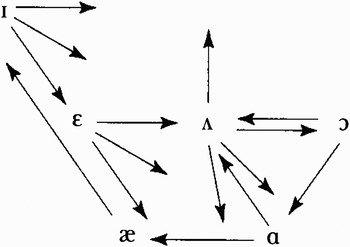
Southeastern Wisconsin, the second region of our interest, has been widely regarded as the western edge of the Northern Cities Shift (NCS) area. An overview of the whole shift is given in Figure 1. In the NCS, raising of /æ/ is often supposed to be the earliest stage, while speakers also show fronting of /ɑ/, lowering and fronting of /ɔ/, backing of /ʌ/ and /ɛ/, with the weakest and likely last stage being lowering of /ɪ/ (though Labov (Reference Labov1994) and others have treated /ʌ/ backing as a possible last stage). Other sources, such as Gordon (Reference Gordon2001:35; Reference Gordon, Joseph and Janda2003:258–260), have given evidence for fronting of the low back vowel as the first stage, which then pushes /æ/ forward, a position now supported by McCarthy (Reference McCarthy2009). (For a detailed review of the relative and absolute chronology of the NCS, see Gordon, Reference Gordon2001:33–36.) Labov et al. (Reference Labov, Ash and Boberg2006) reported the NCS to be fully developed in southeastern Wisconsin (showing the shift reaching to just west of Madison), illustrating “advanced” NCS with a speaker from Kenosha, Wisconsin. Strong /æ/ raising in particular appears in the ANAE as a widespread pattern across Wisconsin, reaching westward into Minnesota and Iowa (2006:82, Map 10.5,passim).
Schematic of the Northern Cities Shift based on Gordon (Reference Gordon2001:197; Reference Gordon, Joseph and Janda2003:255).

More recent work within the region shows somewhat different patterns. For instance, in the Milwaukee area, Purnell (Reference Purnell2010) found /æ/ raising and /ɛ/ lowering, but (using small caps for word classes, see also Labov et al. [2006:13–14]): “Movement among other vowels in the NCS is not as pronounced in southeastern Wisconsin as elsewhere in the NCS region. Bot may shift slightly forward, but not as far forward toward back” as it does in communities that show fuller NCS effects (2010:196). On this view, southeastern Wisconsin has a substantially more limited form of the NCS.Footnote 1 The subjects in the present study were largely from the Madison area, well west of Milwaukee, and thus closer to the edge of any NCS effects.
Another complicating factor for Wisconsin is chronological. Although the NCS is regularly thought of as a change in progress (e.g., Labov, Reference Labov1994; Labov et al., Reference Labov, Ash and Boberg2006), at the heart of the NCS area, new work suggests that “the earliest developments may have run their course, at least in Chicago” McCarthy (Reference McCarthy2009:110), including /æ/ raising. That would be consistent with Purnell's findings. A final possible account for such patterns would be based on Labov (Reference Labov2007), who explains the inconsistently NCS-like patterns of St. Louis as the result of dialect-learning by adults rather than children. We will not pursue that further here.
Our third region under study, far western North Carolina, is associated with an advanced stage of the Southern Shift. In the ANAE formulation (2006:128,passim), this means monophthongization or glide deletion of /aɪ/ before obstruents (stage 1), reversal of position of /e/ and /ɛ/ (stage 2), and likely reversal of /i/ and ɪ/ (stage 3). With the raising and fronting of the two lax vowels here, /ɪ, ɛ/, the Southern Shift also includes diphthongization or “breaking” (Sledd, Reference Sledd1966). Although Labov et al. (Reference Labov, Ash and Boberg2006:251–252) saw the Southern Shift as “reasonably stable” over apparent time, they identify some recessive tendencies over generations, especially in larger cities, suggesting that it is likely more robust in less urban areas. Other results show even greater diversity within the “South,” broadly defined. Fridland (Reference Fridland2002) found retreat of some aspects of the shift in Memphis, Tennessee, namely /i, ɪ/ reversal. Irons (Reference Irons2007a) found ongoing advance of the shift across generations in the rural and small-town areas of Kentucky's Eastern Coalfield region. Feagin (Reference Feagin, Nagle and Sanders2003: especially 136–139) had already called attention to such reported differences in research findings and suggested that regional, methodological, and urban/rural factors may account for these.
Finally, another chain-shift–like pattern (called “solidarity chains” by Hock, Reference Hock1991:157–158) is reported to be widespread across American English dialects, namely back vowel fronting, led by /u/ with /ο/ trailing, and /ʊ/ often found to be included. Back vowel fronting appears to be advanced and pervasive in the South (Feagin, Reference Feagin, Nagle and Sanders2003), and widespread across the Northeast (Labov et al., Reference Labov, Ash and Boberg2006:143–144) and the Midland, though less advanced. Wisconsin and areas to the west, in contrast, are regarded as showing “resistance” to this trend (Clopper et al., Reference Clopper, Pisoni and de Jong2005:1664, see also Labov et al., Reference Labov, Ash and Boberg2006:91, Map 10.14, passim). Labov (Reference Labov2010:36–40) summarized /u/ fronting as most advanced in the South and Midland and least in the North. At least some Midland varieties including Ohio, show fronting of /ʌ/ as well (Durian et al., Reference Durian, Dodsworth, Schumacher, Yaeger-Dror and Thomas2010:175; Labov et al., Reference Labov, Ash and Boberg2006:266; Thomas, Reference Thomas1989).
In short, in each of these three regions, complex patterns of vowel change are reported over real and apparent time. The reference view provided by the ANAE contrasts with other, newer research results with regard to key chain shifts: (1) whether the Southern Shift in areas such as westernmost North Carolina is progressing or receding, (2) whether Midland varieties of central Ohio are involved in no chain shift or a Canadian Shift pattern, and (3) whether the NCS in southeastern Wisconsin is largely limited to /æ/ raising and /ɛ/ lowering or shows an advanced form of the shift, involving a full set of seven vowels.
Cross-generational sound transmission
We situate the present study of cross-generational vowel change within the general theoretical framework of Labov's model of transmission and incrementation (Labov, Reference Labov2001:415–581; also Labov, Reference Labov2007). In each dialect region, we examine how directional and dynamic vowel changes are implemented in terms of transfer of features from each older to each younger generation. Following the model's assumptions, we understand transmission as the product of the acquisition of language by children. Once the learned linguistic system stabilizes when children reach young adulthood, no structural changes to the vowel system are to be expected, and it is this system that is being transmitted to the next generation. In Labov's words, “structural patterns are not as likely to be diffused because adults do not learn and reproduce linguistic forms, rules, and constraints with the accuracy and speed that children display” (2007:349). Thus, the vowel system of young adults that will be transmitted to the successive generation should not undergo further structural changes itself if these adults stay in the same speech community.
In our study, we expect a change in the vowel system of each successive generation as a result of incrementation, that is, reorganization of the initially acquired system by young children during their preadolescent and adolescent years. In our present sample, we start with an initial system configuration in the grandparents' generation; the specific configuration is different in each dialect. We then expect to find a structural change in the successive parents generation brought about by incrementation. Children are expected to exhibit further reorganization in their vowel systems as a continuation of the transmission process. What we cannot predict here, however, are the connections between the transmission of systemic vowel features (including the degree of vowel-inherent spectral change) and stages of a dialect-specific chain shift. That is, we do not know whether each successive generation carries on the change by “implementing” and/or “continuing” (to use Labov's terms, 2001:466–581) a more advanced stage of the chain shift. It could be the case that the most advanced stage has already been reached by grandparents and other, more general principles of vowel change are operative in each younger generation. The present study will shed more light on this issue.
In selecting participants for the study, we were guided by their ties with their respective speech communities. We interviewed adults who were born, raised, and spent most of their lives in a given speech community and who were not engaged in frequent travel out of the area. Our selected speech communities were defined in terms of relatively narrow geographic areas. In each dialect region, we recorded participants from three-to-four adjacent counties, mostly professionals, who grew up in their respective regions, attended local schools and events, and had ties with the local religious and other social institutions.
In this paper, we focus on the basic, fundamental vowel systems of our speakers, using a set of words that were tightly controlled for phonetic context. Using the same speech material and obtaining speech samples under the same experimental conditions is the first critical step to a rigorous comparison of vowel dynamics across generations and dialects. By minimizing the effects of the immediate consonantal context and equally large effects of prosodic variation and linguistic stress (see Fox & Jacewicz, Reference Fox and Jacewicz2009, for experimental evidence of these effects), we were able to obtain a uniform set of data and a homogenous speech sample. Further work will examine whether and how the basic vowel systems obtained in this study differ from the systems constructed on the basis of naturalistic data from a typical sociolinguistic interview, which was also conducted with each present study participant.
METHODS
Speakers, materials, and procedures
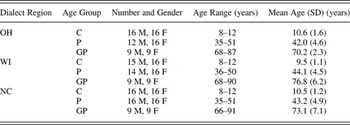
Speech samples for this study were collected from 239 participants who were born, raised, and spent most of their lives in one of three dialect regions: central Ohio (78 speakers, mostly from Columbus and its suburbs), southeastern Wisconsin (79 speakers, mostly from Madison and its suburbs) and western North Carolina (82 speakers, mostly from Sylva and adjacent areas). The participants fell into three age groups representing three generations of native residents of their respective speech communities that we define here as children (8–12 years old), parents (35–51), and grandparents (66–91). More details about their distribution by age and gender can be found in Table 1. Demographic information about each participant is presented in Appendix A (the online appendix can be viewed at http://cambridge.journals.org/LVC). The present participants were not biologically related to one another (with a few exceptions in Ohio and North Carolina). Rather, the age group brackets were selected solely based on possible (and most typical) parent and grandparent ages in relation to children 8–12 years old.
Distribution of participants into age and gender groups

NC = North Carolina; OH = Ohio, WI = Wisconsin; C = children, P = parents, GP = grandparents; F = female, M = male.
The participants were recruited using flyers; bulletin board postings; email; word of mouth; and announcements on radio and in local newspapers, churches, schools, and nursing homes. The recordings took place simultaneously in the three states in the years 2006–2008. Most participants were recorded at the university facilities in three locations: The Ohio State University, University of Wisconsin-Madison, and Western Carolina University. However, research staff members in each state were available to travel to homes and places outside the university to record participants who were unable to come to the designated testing location. This happened on several occasions, mostly with the older participants. In those cases, the same recording equipment was used as at the stationary locations to ensure uniform quality of the recordings in the entire sample. All participants were paid a nominal fee for their efforts.
During a one-hour testing session, each participant was asked to produce a set of citation form words, a set of prosodically structured sentences, and an unconstrained conversation discussing life experiences, family, regional issues, hobbies, and daily activities. For the present analysis of vowel systems, the data came from the first task only, that is, from citation form words. In this task, each participant read a list of isolated hVd-tokens using the prompts heed, hid, heyd, head, had, hod, hawed, hoed, who'd, hood, hoyd, hide, howed, which contained 13 vowels of interest to the study: /i, ɪ, e, ɛ, æ, ɑ, ɔ, o, u, ʊ, oɪ, aɪ, aʊ/.Footnote 2 The citation-form vowels provided a common database for all 239 speakers because they were obtained in a uniform style free from effects of variable consonantal and prosodic contexts that introduce variation not only in the relative positions of vowels in the acoustic vowel space but also in their formant dynamics (Fox & Jacewicz, Reference Fox and Jacewicz2009; Hillenbrand, Clark, & Nearey, Reference Hillenbrand, Clark and Nearey2001). Each participant read three repetitions of each token presented in a random order for a total of 9321 items (13 × 3 × 239). The prompts appeared randomly on a computer screen, one at a time, and the tokens were recorded and digitized directly onto a hard disc drive at a 44.1-kHz sampling rate. A head-mounted Shure SM10A dynamic microphone was used, positioned at a distance of about 1.5 inches from the speaker's lips. The experiment was controlled by a custom MATLAB program and the researcher either accepted and saved the production or asked the participant for additional repetitions.Footnote 3
Data analysis
Prior to acoustic analysis, the tokens were digitally filtered and down-sampled to 11.025 kHz. To capture the dynamic formant change in a vowel, the F1 and F2 frequencies were sampled at five equidistant temporal locations corresponding to the 20%, 35%, 50%, 65%, and 80% points in the vowel. The measurements of vowel onsets and offsets (which were located by hand), served as input to calculations of vowel duration and formant frequencies in the time course of a vowel. F1 and F2 values (based on 14th-order linear prediction coding (LPC) analysis and centering a 25-ms Hanning window at each temporal point) were extracted automatically using a program written in MATLAB that displayed these values along with the fast Fourier transform (FFT) and LPC spectra and a wideband spectrogram of the vowel. Two reliability checks were performed on all measurements by two different researchers. All automatically extracted formants were checked using the formant tracking option in the commercially available software program TF32 (Milenkovic, Reference Milenkovic2003), and any disagreements and errors in the analysis were resolved and hand-corrected when the corrections were considered necessary.
To assess the extent of formant movement in a vowel, we derived a measure formant trajectory length (TL), which is an approximate arc length of the formant trajectory in the F1 by F2 plane. Trajectory length is a measure drawn from a family of models using multiple sample points. The most widely used measure is that of the vector length, which estimates the distance in the F1-F2 plane between two sample points located close to vowel onset and offset such as 20%–80% or 20%–70% (e.g., Ferguson & Kewley-Port, Reference Ferguson and Kewley-Port2002; Hillenbrand et al., Reference Hillenbrand, Getty, Clark and Wheeler1995; Hillenbrand et al., Reference Hillenbrand, Clark and Nearey2001). The TL used in this paper is an extension of the two-measurement model and is defined as a sum of the lengths, in hertz, of the four separate vowel sections between the 20% and 80% points (i.e., 20%–35%, 35%–50%, 50%–65%, and 65%–80%):
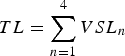
where the length of one vowel section (VSL) is:

This five-point characterization of formant change in the F1-F2 plane provides a more detailed estimation of the amount of formant movement than the two-point model (see Fox & Jacewicz, Reference Fox and Jacewicz2009, for further discussion of advantages of the TL measure).Footnote 4 A longer TL implies more frequency change and thus greater formant movement in the plane. Using this measure, two-target diphthongs (such as /aɪ/) and one-target diphthongized vowels (such as /e/) are expected to have longer TLs than monophthongs (such as /i/). To interpret the dynamic variations for the reader, we will use in this paper the terms monophthongization and diphthongization to explicate the gradience of a speech signal without any reference to the number of the actual phonetic targets. For example, the monophthong /ɪ/ may become more monophthongal (or monophthongized) in the productions of parents compared with grandparents, which indicates simplification of its formant dynamics evident in a smaller amount of spectral change. In a similar way, we will refer to a diphthong as being more or less diphthongized or becoming more or less diphthongal in the productions of a given generation.
RESULTS
We begin the presentation of the results with cross-generational displays of mean relative positions of all 13 vowels in the two-dimensional (F1 × F2) acoustic vowel space and their dynamic formant patterns. In these plots, each vowel symbol is placed near the 80% point in a vowel indicating the direction of formant movement. Because the vowels were produced in the so-called neutral hVd context, the effects of consonantal environment are minimized and the dynamic change in a vowel reflects its vowel-inherent spectral change (e.g., Nearey & Assmann, Reference Nearey and Assmann1986).Footnote 5 Given the well-known effects of vocal tract length on formant values (i.e., a longer adult vocal tract results in lower formant frequencies than a shorter child's vocal tract, ceteris paribus), if we are to directly compare the formants (and therefore the positions of the vowels in the vowel space) of these sets of speakers, we need to normalize the measured formant values. This normalization procedure should (1) eliminate variation caused by differences in vocal tract length while (2) preserving dialectal and cross-generational differences. In the current study, Lobanov's (Reference Lobanov1971) procedure, which converts formant values in hertz to z-scores for each individual speaker, was used. This is a normalization procedure that Adank, Smits, and van Hout (Reference Adank, Smits and van Hout2004) found to be one of the most effective. However, because the resulting values are quite different from the original hertz values (and thus more difficult to interpret), we used the Thomas and Kendall (Reference Thomas and Kendall2007) approach to rescale the z-scores for each of the i vowels using the following formulae, where F1iN and F2iN refer to the normalized F1 and F2 values for the ith vowel and FNMIN and FNMAX refer to the minimum and maximum FN values found across all vowels and all speakers (i.e., this is a speaker-extrinsic and not a speaker-intrinsic approach).
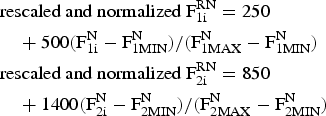
The rescaled and normalized F1 values will range from 250 to 750 Hz, and the rescaled and normalized F2 values will range from 850 to 2250 Hz. All formant frequencies reported in the Results section of this paper represent rescaled normalized formant values. The unnormalized mean hertz values are reported in Appendix B (the online appendix can be viewed at http://cambridge.journals.org/LVC).
Cross-generational patterns of vowel dispersion
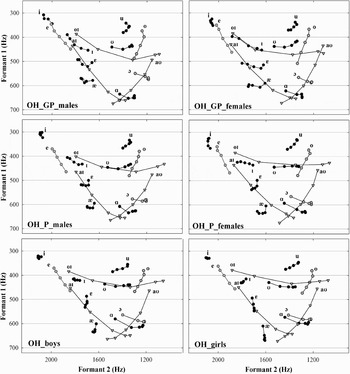
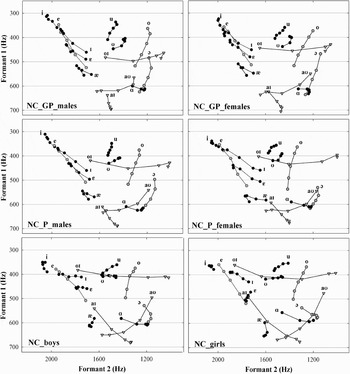
Figure 2 shows the vowel plots for three generations of Ohio (OH) speakers. Cross-generational changes are most evident in the vowels /ɪ, ɛ, æ, ɑ/. The vowels in hid, head, and had show the greatest amount of spectral change in the production of grandparents (GP), becoming increasingly monophthongized with each successive generation. A striking finding is that a further reduction of formant movement in /ɛ/ and /æ/ in children (C) corresponds to a change in the direction of formant movement in these two vowels. In addition, /æ/ shows lowering and retraction with each successive generation. Beginning with parents (P), we also notice a relation between /æ/ and /ɑ/. As the vowel in had lowers, the vowel in hod raises. The outcome of the /ɑ/-raising is its merger with /ɔ/, the low back merger. As can be seen, compared with boys, girls show a more advanced stage of both the lowering/backing of /æ/ and the merger. These results are consistent with the view that this part of the Midland region has near-merger or merger of the low back vowels (e.g., Thomas, Reference Thomas1989, Reference Thomas2001), and the advanced stage represented by the youngest females suggests ongoing progress of the merger.Footnote 6
Cross-generational dynamic vowel dispersion patterns for Ohio (OH). Lines connect measurement points from 20% to 80% and vowel symbols are placed next to the 80% point. See text for further details. GP = grandparents, P = parents.

Another set of cross-generational changes in the OH data involves the back vowels /o, oɪ/ in hoed and hoyd. The onglide (i.e., the /o/-component of the diphthong, corresponding to the 22%, 35%, and 50% measurement points) raises with each successive generation. It is also articulated farther back in the oral cavity beginning with P. In parallel to the changes in /oɪ/, the onset of /o/ in hoed raises with each generation, and compared with both P and GP, in C, the vowel is both more monophthongized and more back. Finally, whereas /o/ in hoed is backing in C, /ʊ/ in hood undergoes some fronting in their productions.
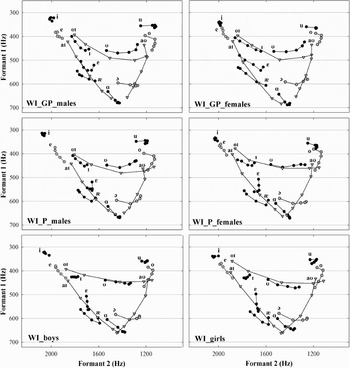
The cross-generational vowel dispersion patterns for Wisconsin (WI) are shown in Figure 3. At a first glance, the dominant feature that differentiates the WI and OH vowel systems are the positions of /u/ in who'd and /o/ in hoed, which are articulated farther back in WI speakers as compared with the fronted OH variants. The positions of these two WI vowels and the nature of their formant movement change little across generations, although some fronting can be detected in P- and C-males and some lowering of /o/ in P-and C-females. The /o/ seems to be more monophthongal in GP than in the younger generations. These results confirm that this region shows resistance to back vowel fronting, which is otherwise widespread across the United States, and shows that the pattern is strong down to the youngest speakers.
Cross-generational dynamic vowel dispersion patterns for Wisconsin.

Further differences between the WI and OH systems are in the dynamics of /e/ in heyd and /æ/ in had. The WI variant of /e/ is almost monophthongal in GP and becomes increasingly diphthongized with each successive generation. The monophthongal character of /e, o/ in the Upper Midwest, especially Wisconsin and Minnesota, is a salient feature of speech in the region for nonlinguists. A monophthongal pronunciation in the region has also been noted occasionally in the literature, particularly in Allen (Reference Allen1973–1976:II:21, 22), Labov et al. (Reference Labov, Ash and Boberg2006:181, 183), and Thomas (Reference Thomas2001:72). Our results suggest that this Upper Midwestern feature loses its strength over generations and both vowels become increasingly diphthongal. The WI vowel /æ/ has not only a greater amount of formant movement than the OH vowel does, but also shows a characteristic mark of the Northern breaking, a raised /ɛ/-like onglide and a lowered /æ/-offglide, following general patterns reported elsewhere (e.g., Labov et al., Reference Labov, Ash and Boberg2006; Purnell, Reference Purnell2010).
In general, the vowels in hid, head, and had seem to follow the same mechanism of cross-generational change as observed in OH, that is, reduction of formant movement in /ɪ, ɛ/ and lowering/backing of /æ/. However, it is evident that the vowel /æ/ does not lose its Northern breaking across generations, and the amount of its spectral change does not seem to be reduced. In spite of this, /æ/ clearly begins to lower in P and continues to lower in C. Furthermore, its offglide, corresponding to the 65%–80% region in the vowel, is clearly backing in C, thus following the pattern of change observed in OH. This lowering and backing of /æ/ affects the position of /ɑ/ in hod, which begins to rise in P. If this trend continues in WI, the low back merger seems inevitable in future generations of Wisconsin speakers. This set of vowel changes is substantially different from the NCS rotations. Although we clearly see NCS elements in the present WI sample such as lowering and centralization of /ɛ/ and the Northern breaking in /æ/, the current data show notable differences. In particular, /ɪ/ seems to be raising rather than lowering and /æ/ is clearly retracting and lowering. Thus, the linchpin change of the NCS, /æ/-raising, is absent over our generations. Similarly, the low back /ɑ/ is backing rather than fronting, whereas the NCS would crucially involve fronting of this vowel. In addition, along with the backing and raising of /ɑ/, we also find backing and raising of the onset of /aɪ/ in hide (i.e., at the 20%–35% temporal locations), which eventually “meets” the onset of /aʊ/ in C.
Finally, the cross-generational set of changes involving the WI variants of the back vowels in hoyd and hood parallels these in OH. The diphthong /oɪ/ raises and its onset retracts and the vowel /ʊ/ in hood undergoes successive lowering and fronting, which is more evident in women than in men and is most advanced in children. Fronting of /ʊ/ has been noted, for instance, by Hock as part of a general back vowel-fronting pattern in central Illinois (1991:142–158). We can also see it in the map of F2 of /ʊ/ in Labov et al. (Reference Labov, Ash and Boberg2006:Map 10.14). Lowering of the vowel is noted by Labov et al. (Reference Labov, Ash and Boberg2006:Map 10.13), but they expressly say that “the height of /u/ [= /ʊ/] does not play a prominent part in any of the sound changes discussed in the Atlas” (2006:90).
Turning to the North Carolina (NC) vowels displayed in Figure 4, we find a very different set of dialectal features. We will first focus on the vowel system of GP and will then observe the reorganization of the vowel space with each successive generation. First, the GP variants of /i, ɪ, e, ɛ, æ/ are in close proximity to one another and show a great amount of formant movement. We find a very diphthongal /e/, whose fronted nucleus “reverses” its position with /ɛ/. The dynamic patterns in the remaining four vowels demonstrate that breaking and the raised /æ/ is another characteristic mark of Southern American English.
Cross-generational dynamic vowel dispersion patterns for North Carolina.

Second, the nominal diphthongs are produced with far less spectral change than in both the OH and WI variants. We find a monophthongal /aɪ/ that also occupies the lowest position in the vowel space seen so far. The two remaining diphthongs, /aʊ/ and /oɪ/, exhibit reduced formant movement, especially in men. Glide weakening or loss, often referred to as monophthongization of “General American” diphthongs, has long been seen as a defining characteristic of Southern speech, as reviewed for all three diphthongs by Thomas (Reference Thomas2003).
Third, we find a raised /ɑ/ in hod and a heavily diphthongized /ɔ/ in hawed, which has a very distinct character of formant movement indicating a production close to /ɑɔ/. This is what Labov et al. (Reference Labov, Ash and Boberg2006:254, passim) termed the Back Upglide Shift, and which is seen as acting “to preclude the low back merger” (2006:303). The fact that the GP generation shows a powerful back upglide, while it recedes in younger speakers, would suggest that the resistance to low back merger could wane over time. Finally, the dispersion of the /o, u, ʊ/ group bears similarities with that in OH although the /u/ is even more fronted in NC and the /ʊ/ is more raised, which is consistent with what has been found in other studies.
In P, the following changes take place, which are more evident in women than in men: fronting of i, e/ and lowering and backing of /ɪ, ɛ/; lowering/backing of /æ/ and raising of /ɑ/; greater diphthongization of the three diphthongs /aɪ, aʊ, oɪ/; raising of /oɪ/; and further fronting of the /o, u, ʊ/ group. For this adult generation, the results indicate that the core Southern Shift is receding in this community, with regard to both glide deletion and the reversal of tense and lax front vowels. However, back vowel fronting continues unabated.
The set of changes in C include: fronting of /i/; loss of Southern breaking and monophthongization of /ɪ, ɛ, æ/; further lowering/backing of /æ/ and raising of /ɑ/; changing formant pattern in /ɔ/, which, especially in girls, corresponds to both OH and WI variants; greater diphthongization of /aɪ, aʊ, oɪ/; raising of /oɪ/; and further fronting of the /o, u, ʊ/ group. The loss of back upgliding—clearest in girls—suggests the possibility of future low back merger in the community. The present cross-generational progression toward the low back merger supports the findings reported by Irons (Reference Irons2007b) for Kentucky English. Irons proposed that “the mechanism underlying this low back vowel merger is back upglide loss, that is, the erosion of a phonological feature that has been a factor in resistance to merger in the South” (2007b:138). With regard to back vowel fronting, in girls, the variants of /u, o/ are clearly backing, which may indicate that fronting of these vowels reached its limit already in P-females and in boys, suggesting that no further fronting of these vowels ought to be expected without a categorical vowel change.
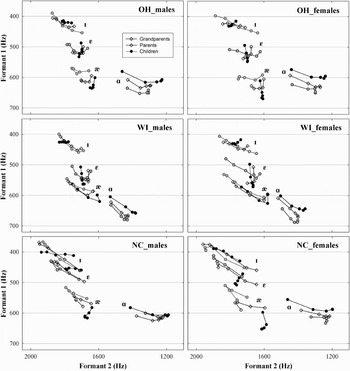
To summarize our observations thus far, we have found vowel dispersion patterns that are clearly dialect-specific as well as cross-generational changes that seem to be common across the three dialects. In particular, neither NCS nor Southern Shift appeared to be active in the selected regions, although some elements of either shift were clearly present. Instead, the cross-generational data revealed a new anticlockwise vowel rotation that was common to all three dialect areas. As an additional feature of this new development in the three regional vowel systems, the vowels /ɪ, ɛ, æ/ are found to be undergoing a common process of increased monophthongization (with the exception of WI /æ/) and /ɑ/ has been developing formant dynamics approximating those in the vowel /ɔ/. Figure 5 illustrates this process in greater detail by displaying the data from Figures 2–4 cross-generationally, separately for each dialect.
Cross-dialectal and cross-generational display of dynamic dispersion patterns for the vowels /ɪ, ɛ, æ, ɑ/.

The cross-generational lowering/backing of /æ/ and the corresponding /ɑ/-raising is evident in all three dialects. However, in the case of /ɪ/ and /ɛ/, there is more variability. Whereas NC /ɪ, ɛ/ are clearly descending and retracting and WI /ɛ/ also shows the same trend in P (but not in C), the positional changes in /ɪ/, if any, are along the front-back dimension rather than low-high. Thus, the greatest cross-generational change in /ɪ, ɛ/, common across all three dialects, is the loss of formant movement and the positional changes may reflect some dialect-specific demands. We will return to this in the General Discussion. At present, we need to determine how strongly we can claim that variation in formant dynamics play a significant role in cross-generational vowel change. The statistical analysis of formant movement (TL) will help us to better understand its importance in the patterns already described.
Cross-generational patterns of formant dynamics
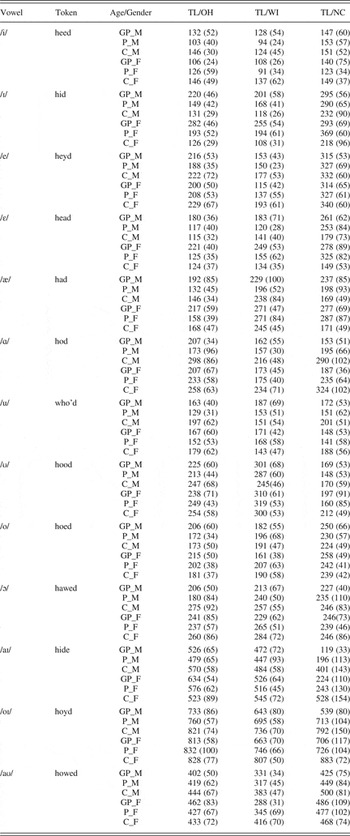
Mean TL values (and standard deviations) for each vowel broken down by dialect, age group, and gender are listed in Table 2. The TL differences were first examined using a series of one-way analyses of variance (ANOVAs) conducted separately for each vowel for each dialect. In these analyses, age group (generation: C, P, GP) and gender were the two between-subject factors. The effects of age group on changes in dialect-specific formant dynamics were of our particular interest. Following the significance of the main effect of age, Scheffé's multiple comparisons were used as post hoc tests. The second type of analysis used separate one-way ANOVAs to explore more global effects of dialect on TL of each vowel, disregarding the effects of age and gender. In this analysis, dialect was the only between-subject factor and Scheffé's comparisons followed as post hoc tests.
Means and standard deviations (in hertz) for trajectory length broken down by dialect, age group, and gender

TL = trajectory length; other abbreviations as in Table 1.
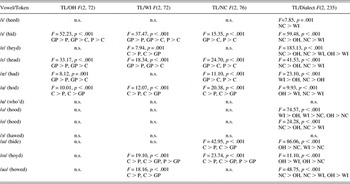
The statistical results are summarized in Table 3. Listed are significance values for the effects of age group separately for each dialect, and significant differences between age groups (C, P, GP) revealed by the Scheffé procedure. The effects of dialect (from the second analysis) are listed in the last column, which also includes significant differences between the dialects (OH, WI, NC) shown in Scheffé's post hoc comparisons. Although these post hoc comparisons were done on each vowel separately (and are thus relatively independent tests), given the large number of tests, we chose a relatively conservative α of .001. The significant results are summarized in Table 3. The effects of gender were mostly not significant and are not listed in the table. In general, female TLs were longer than male TLs and significant differences were found only for OH hid, OH and WI hide, and NC hoyd.

As before, we begin with the analysis of the results for OH. The cross-generational changes in formant dynamics were significant only for the vowels /ɪ, ɛ, æ, ɑ/. For /ɪ/, all pairwise comparisons yielded significant differences between each successive generation, providing evidence that /ɪ/-monophthongization has been a continuous process spanning all three generations. The vowels /ɛ, æ/ change their dynamics in a similar fashion. However, the differences between P and C were not significant, suggesting that a substantial reduction of formant movement has already occurred in P and formant dynamics did not change much in C. For /ɑ/, we found a significant difference between the increased formant movement in C and either P or GP, and the latter two did not differ significantly from one another.
The results for WI show similar sets of significant cross-generational TL changes for /ɪ, ɛ, ɑ/. However, there were no significant differences for /æ/, confirming that the amount of formant movement in this vowel remained unchanged across the three generations. Also significant was the amount of spectral change in /e/ in C compared with either P or GP. This vowel, being known as almost monophthongal in WI, is clearly becoming diphthongized in the youngest generation. An interesting relationship can be found between the raising of the diphthong /oɪ/ in hoyd and a significant increase of its formant movement with each successive generation. This gradual and increased cross-generational diphthongization is achieved by both backing the onset of the diphthong and fronting its offset. Finally, there is a significant increase in formant movement in the diphthong /aʊ/ in howed in C, which most likely results from some lowering and fronting of its onset.
In the NC vowel system, the significant reduction of formant movement in the /ɪ, ɛ, æ/ set is clearly a change introduced more recently. The lack of significant TL differences between GP and P and inspection of the means in Table 2 indicate that Southern breaking is no longer present in C in /ɛ, æ/, and /ɪ/ has significantly reduced formant movement in C compared to the two older generations. Another recent change introduced in C can be seen in /ɑ/, which has a significantly greater formant movement. This change corresponds to similar patterns we have already seen in OH and WI in that children's variants of /ɑ/ were more diphthongal than those of adults, and there were no significant difference between the two adult groups. The two remaining NC vowels affected significantly by cross-generational changes are the diphthongs /oɪ/ and /aɪ/. The pattern of cross-generational change in /oɪ/ is the same as in WI in that a significantly greater diphthongization in each successive generation corresponds to the raising of the diphthong. The vowel /aɪ/ undergoes a diphthongization in C and is not produced as a monophthong as in GP and P. The amount of formant movement in the variant of /aɪ/ produced by NC girls is now comparable with that produced by OH and WI girls (see Table 2).
Overall, the statistical analysis of TL variation across age groups confirmed most of our initial observations, which were based only on visual inspection of the vowel plots. It also provided firmer ground for reaching conclusions about the importance of formant dynamics and their potential contribution to the process of cross-generational vowel change. Turning to the exploration of more global effects of dialect on formant dynamics of individual vowels (the second type of our analysis), we found significant effects of dialect for 11 vowels, except for /u/ and /ɔ/. This indicates that, despite significant cross-generational changes in each vowel system, formant dynamics are strongly affected by dialect. In most cases, NC variants had a greater formant movement compared with one or both dialects. The two exceptions were /ʊ/ and /aɪ/, which had the smallest amount of formant change.
GENERAL DISCUSSION
The acoustic analysis of vowel systems reported in this study revealed a robust set of cross-generational changes in /ɪ, ɛ, æ, ɑ/ that necessitates an extended discussion of this chain-shift–like development. We will first consider the positional vowel changes across generations and will then discuss these changes in relation to formant dynamics.
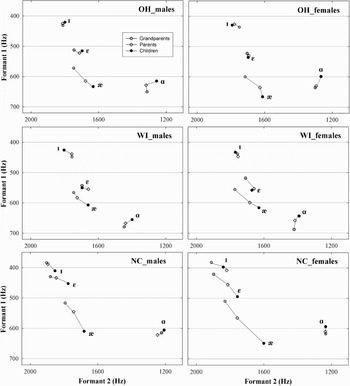
Figure 6 is a partial reproduction of the data from Figure 5 showing the location of each vowel's midpoint only, which, more or less, corresponds to a broadly defined “vowel target” or nucleus. As can be seen, there is almost no cross-generational change in the positions of /ɪ/ in OH and WI, although some fronting in WI boys can be detected. In both dialects, the location of the vowel in the acoustic space is comparable. This indicates that in OH and WI, the cross-generational change involves primarily its monophthongization and not a positional vowel movement. In NC, the vowel is retracting from its proximity to /i/, with a tendency to lowering. This movement seems to be unrelated to formant dynamics, as is evident in the female data.
Cross-dialectal and cross-generational display of midpoint measurements for the vowels /ɪ, ɛ, æ, ɑ/. All data points are redrawn from Figure 5.

The cross-dialectal differences are clearly manifested in /ɛ/. The vowel exhibits almost no positional change in OH (although slight centralization can be detected in men) but shows lowering and centralization in P in WI (more in women than in men), which is consistent with the direction of the NCS. Interestingly, there is no further retraction in WI once the vowel became monophthongized in P and the vowel seems to undergo some fronting in children. The cross-generational changes in /ɛ/ are most evident in the NC variant, which retracts from its high-front position into a more centralized and lower position with each successive generation. This positional change is much greater in women than in men and seems unrelated to the degree of diphthongization. The most dramatic change is in /æ/ which, in each dialect, is descending and backing with each successive generation. The degree of this change differs and can be as large as in NC women (where the vowel was highly raised in GP and now, in girls, is almost as low and as back as in OH children) or as small as in WI men, who nevertheless show a steady progression in the same direction. Finally, the vowel /ɑ/ shows the common cross-generational trend of raising and backing, despite the cross-dialectal differences in its exact position in the acoustic space. This upward movement is rather unrelated to any change in formant dynamics.
Taken together, the cross-dialectal and cross-generational patterns found in this apparent-time analysis reveal a common mechanism underlying the set of changes observed here. The observed outcome is a chainlike anticlockwise rotation of all four vowels and the nature of this rotation needs to be characterized with greater precision. This shift is manifested most clearly in NC. In particular, in the production of the oldest speakers, all three vowels /ɪ, ɛ, æ/ are raised and fronted as a result of the Southern Shift. In the next generation, all three vowels show retraction and lowering, which is manifested more in women than in men. This conforms to the general view of the role of women in sound change, namely, that women are leading men generationally in this development. However, while /ɪ, ɛ, æ/ are retracting and descending in the vowel space, female data show no change in the position of /ɑ/, indicating no involvement of this vowel at this stage. The final set of changes can be seen in children, showing no further change in /ɪ/ in girls (but retraction and lowering in boys) and further retraction and lowering of /ɛ, æ/. We now notice raising and some backing of /ɑ/, possibly in response to the low and back position of /æ/.
Elements of this movement across generations can be found in both OH and WI, although they do not manifest themselves as strongly and coherently as in NC. Because the vowels /ɪ/ and /ɛ/ were not involved in any shift in OH, their initial positions in the oldest speakers are lower than and not as fronted as in NC. Apparently, there has been no further lowering of both vowels in OH and some small variation in articulation can be detected in advancement rather than height. However, the raised position of /æ/ in the oldest OH speakers, especially in males, creates a condition for its lowering and backing, which indeed takes place in subsequent generations. The downward movement of /æ/ occurs simultaneously with the raising and backing of /ɑ/. The development in WI is in accord with those in OH and NC, showing no major variation in /ɪ/ (although some lowering and centralizing of /ɪ/ can be seen in adult males), centralization of /ɛ/ due to the NCS (and its lowering in adult females), and lowering and backing of the raised /æ/. The WI /ɑ/, which is low and not as back as NC or even OH variants, undergoes a steady raising and backing with each successive generation.
Considering now the relation between the positional vowel change and variation in formant dynamics, the results show a coherent set of events. While the vowel /ɪ/ in hid was diphthongized in the oldest age groups in all three dialect regions, we found a significant reduction of the extent of its formant movement in OH and WI parents groups. This reduction has been delayed by one generation in NC, and the change is occurring now in NC children. Comparing TL means, especially among the female groups (see Table 2), we find NC children values similar to those in OH and WI parents a generation earlier. Whereas NC children are “at the OH and WI parents stage,” both OH and WI now demonstrate further reduction of formant movement. The result of these cross-generational changes is a relatively monophthongal /ɪ/, whose position in the vowel space is basically the same in OH and WI. We understand these sets of changes in /ɪ/, including both positional movement in NC and simplification of the dynamic structure in all three dialects, as cross-generational progress toward the loss of distinctiveness of the dialect-specific phonetic features. Clearly, in children, the vowel has almost lost its diphthongal character, which is a most salient perceptual cue in maintaining a distinction between dialects in our oldest speakers. Results from a perceptual testing, currently under analysis in our lab, will verify our current understanding of why the vowel has become increasingly monophthongized in all three dialects.
The vowel /ɛ/ in head shows a very similar cross-generational development. However, given that this vowel, compared with /ɪ/, exhibits inherently smaller amounts of spectral change, it takes two generations in OH and WI (and not three) to reduce the formant movement sufficiently to produce a monophthong. Consequently, the /ɛ/ has already become a monophthong in OH and WI parents. The monophthongization of the NC variant of /ɛ/ takes place a generation later, in children, which is also consistent with the development of /ɪ/. We can also observe a beginning of a change in the direction of formant movement in NC girls, following the pattern in OH and WI children. Again, this increased monophthongization is most likely to reduce the phonetic contrast among the dialect-specific dynamic features that will be verified by the perception data.
The cross-generational changes in /æ/ in had in OH parallel those in /ɛ/. This is not the case in the WI variant, which remains fully diphthongized in all three generations, indicating that its Northern breaking is still a salient dialectal feature. In NC, the progressive monophthongization of /æ/ follows the same route as in /ɪ/ and /ɛ/, showing up in children (and not in adults). The NC girls have now essentially the same variant as OH girls. Finally, across all three dialects, the vowel /ɑ/ in hod shows an increase in formant movement in children compared with either adult group, suggesting that this is a recent development. That is, the quality of this vowel is changing in children, which is now more diphthongized and close to /ɔ/ in terms of the amount of formant movement (compare Table 2).
Clearly, there seems to be a common force underlying this general anticlockwise rotation, which operates in the same way regardless of the initial dialect-specific configuration in older adults. Obviously, we can see in these front vowels, the operation of Labov's Principle II, according to which lax vowels lower in chain shifts (formulated on the basis of Sievers [1876]). However, it is unclear at present what motivates this rotation other than the possibility of perceptual loss of dialectal distinctiveness in this particular subset of vowels. Certainly, the reduction of formant dynamics would point toward likelihood of this future outcome.
In parallel to the developments in the front vowels, the back /ɑ/ begins its route of raising and backing, until reaching the state of the merger with /ɔ/. In addition, a closer inspection of the back vowel space in NC (see Figure 4) indicates its successive expansion and raising of long vowels /aʊ/ and /oɪ/ that, along with /ɑ/, appear to be moving upward along the peripheral track. This development can be understood as an operation of Principle I which, again based on Sievers (Reference Sievers1876), predicts a rising tendency of the long back vowels in chain shifts. To complete the anticlockwise rotation in the vowel space, the back vowels /u, o, ʊ/ undergo successive fronting in accord with Principle III, although this fronting may have reached its limit and is receding in NC girls. In OH, we also find the raising of /o, ɪ/ along with the expansion toward the back; although there is no raising of /aʊ/ (compare Figure 2). We also see a slight fronting of /u, ʊ/ but not of /o/, which seems to be backing. Finally, in WI, we can also observe the progressive raising of /oɪ/ along with its expansion toward the back of the vowel space and some fronting of /u, o, ʊ/ across generations (see Figure 3). Thus, it seems that the same set of principles is operative in each dialect, although the particular elements are executed with variable strength and weight in each respective vowel system.
How does this general anticlockwise development correspond to more recent reports involving American English? The changes in the /ɪ, ɛ, æ, ɑ/ set have been studied in Canada and were initially referred to as the Canadian Shift (Clarke, Elms, & Youssef, Reference Clarke, Elms and Youssef1995). According to this first report, the Canadian /æ/ was retracting from its low-front position into low-central position, a movement triggered by the low back merger (cat/caught), which opened up an empty space in the vowel system previously occupied by /ɑ/. In response to this merger and the retraction of /æ/, /ɛ/ lowered to the position occupied by /æ/ and /ɪ/ lowered to the position made available by /ɛ/. Crucially, this pull chain comes to existence in response to the low back merger, which is thought to trigger the lowering and retraction of the entire front lax vowel system. Building on such earlier work, Gordon (Reference Gordon and Schneider2005) argued that retraction of the low front vowel creates a “margin of security” within the vowel space in response to low back merger. Bigham's (Reference Bigham2009) study of southern Illinois vowels supported this at the overall community level, but some individual speakers showed retraction without merger, suggesting that retraction can be or become an independent sound change.
The results from 239 speakers presented in this paper do not conform to this version of the Canadian Shift because the lowering and retraction of /æ/ is not associated with the low-back vowel merger. That is, it occurs in dialects that both do (OH) and do not (WI, NC) exhibit the merger. On the contrary, our data support the vowel development reported by Boberg (Reference Boberg2005), who provided acoustic and statistical evidence against the classic chain shift proposed in the original version of the Canadian shift. For the shift currently active in Montreal, Boberg emphasizes the parallel retractions of /ɪ, ɛ, æ/, calling it a “parallel shift” (2005:151; see the similar notion of “solidarity shift” already discussed). In this interpretation of the sound change, the retraction of /æ/ has not triggered the lowering of /ɛ/ as in a pull chain; rather, both /ɪ/ and /ɛ/ changed their positions in a parallel development with /æ/. The present study finds similar parallel developments in three very distinct varieties spoken in the United States. These results show retraction in whole communities without low back merger, suggesting even more independence between those two processes than Bigham argued for.
Given the widespread occurrence of these parallel shiftlike changes, we propose to term this recent and overarching development the North American Shift, which includes dialect regions in both Canada and the United States. An important component of this parallel anticlockwise rotation of the /ɪ, ɛ, æ/ set is monophthongization or reduction of dynamic spectral changes in these three vowels. At present, we await further reduction of formant movement in WI /æ/ and NC /ɪ/, the only two vowels that still show a substantial degree of diphthongization in children. In response to lowering, backing, and monophthongization of /æ/, we find increased diphthongization of /ɑ/ in children, which may signal an initial stage of its progression toward the low back merger, complementing its progressive raising and backing. In the present data, we find a higher-level unity across very distinct varieties that span the individual dialects. This unity subsumes but is not at odds with the diversity of dialects that is clearly visible in the strong presence of dialect-specific features across generations of speakers in each region.
It is yet unclear how the North American Shift corresponds to the developments reported in other English-speaking countries. For example, a similar anticlockwise rotation of /ɪ, ɛ, æ/ has been found in southeast England, which is viewed as a classic chain shift, originating with the lowering of /æ/ (Torgersen & Kerswill, Reference Torgersen and Kerswill2004). This shift fits together with the fronting of /ʊ/ in this region, which can also be found across the North American dialects. Torgersen and Kerswill referred to Trudgill, who has argued that this shift is a drag chain that started with the lowering of /æ/. In their words, “Trudgill (Reference Trudgill2004), looking only at the three front vowels, considers this to be a drag chain beginning with trap. We suggest that the crowding of the vowel space, perhaps caused by the lowering of trap, forced strut to move back. If this is correct, the chain shift is one beginning in the middle of the chain, initiated by the lowering of trap” (p. 45). More reports from other parts of the English-speaking world are needed to provide further insights about the nature of this shiftlike rotation.
So far, our discussion has focused on structural factors without addressing possible social factors involved in the set of vowel changes found here. However, as claimed by Labov (Reference Labov2001:463), “there must be a social force that activates the shift and drives the increment.” The basic social characteristics of the present participants are listed in Appendix A. These include both occupation and education level. All children were enrolled in elementary schools in the public school system, and adults represented a variety of educational and professional backgrounds. The oldest participants were mostly retired from their professions and lived at their homes or retirement facilities. The professional background data do not indicate major divisions within and across each dialect such as urban versus rural or related to socioeconomic status. In general, we expect the analysis of this parameter (i.e., occupation) to add little to a better understanding of the “social force” in the present study. The same holds true for the level of education.
Although the cross-generational and cross-dialectal patterns of variation found in this study are based on the most formal style of production, the results revealed substantial differences both in formant dynamics and vowel dispersion in the acoustic space as a function of age group and dialect. This indicates that linguistic forms associated with formal style in the production of the oldest adults differ from those in each successive generation. These results underscore the value of analyzing the citation-form speech in addressing questions about sound change. We also expect to find the same cross-generational patterns in vowel systems constructed on the basis of less formal, conversational speech. That is, the general vowel space along with the amount of formant movement in particular vowels will be considerably reduced in casual speech, especially when vowels occur in less prominent prosodic positions in the utterance (vowels in these positions will tend to centralize, cf. Agwuele, Sussman, & Lindblom, Reference Agwuele, Sussman and Lindblom2008; Lindblom, Agwuele, Sussman, & Cortes, 2007). Variation in speech tempo and consonantal context of the vowel will all contribute to reduction (or expansion) of the vowel space. Yet, within each type of variation, we expect the formant movement to be proportionally reduced (or expanded) although the basic pattern of dispersion within the vowel system itself is expected to remain the same. This aspect of cross-generational vowel change will be examined in our future work, using recordings of spontaneous speech collected from the present participants.
As for the effects of gender, another social factor controlled for in this study, we should not overlook the fact that, compared with male speakers, female speakers, in general, displayed somewhat greater formant movement in vowels. This was true especially for the diphthongs /aɪ/ and /oɪ/ and the /ɪ, ɛ, æ/ set (see Table 3). These vowels were more “diphthongal” in females than in males, perhaps reflecting a somewhat more exaggerated articulation in female speech. The gender-related differences may result from self-monitoring or perhaps from differences in the perception of task demands as suggested elsewhere (e.g., Beckford Wassink, Wright, & Franklin, Reference Beckford Wassink, Wright and Franklin2007; Bell, Reference Bell, Eckert and Rickford2001).
APPENDICES
APPENDIX A
Basic demographic background of the participants (self-reported). Education level is coded as: 1 = elementary, 2 = high school, 3 = two-year college, 4 = four-year college, 5 = graduate degree. ID: C = child, P = parent, GP = grandparent.

APPENDIX B
Average formant frequency values (F1 and F2, in hertz) measured at five temporal locations (20%, 35%, 50%, 65%, 80%) in a vowel.