In recent decades, there have been undeniable global changes in the economy and organizations. Their effects on workplaces have led psychologists to state that the traditional relationship between employer and employee is under pressure and may even by disappearing (Guest et al., Reference Guest, Isaksson and De Witte2010). Beyond the logical perception that substantial changes shape the way we build employment relations, psychologists and other researchers have taken a more systematic approach to identifying and analyzing these shifts. Guest (Reference Guest2004b) explains that there are fewer job positions in the workplaces, the work has become more flexible and fragmented, technology is advancing at a rapid pace, and more diverse types of workers become employees. These new employment relationships have been studied by adopting new theoretical frameworks, such as psychological contract (PC) (Guest, Reference Guest2004b; Guest et al., Reference Guest, Isaksson and De Witte2010; Rousseau, Reference Rousseau1989).
Psychological contract theory and research focus mainly on the role of fulfillment of promises. Mutuality, the agreement between two parties about the reciprocal promises made by each party, has received less attention. Most research has only indirectly studied mutuality by testing the predictive power of mutuality’s antecedents on PC breach and fulfillment, but the results show that mutuality predicts PC fulfillment and breach (Robinson & Morrison, Reference Robinson and Morrison2000). Research provides few answers about the way PC mutuality influences employees’ behaviors, attitudes, and affects, roughly linking the effect of PC mutuality on job performance, intention to quit (Dabos & Rousseau, Reference Dabos and Rousseau2004), and turnover intentions (Dick, Reference Dick2010). This study aims to explore the agreement between employer and employee about the promises made about PC (known as mutuality), but it also takes another step by proposing a mediation model that includes PC mutuality, PC fulfillment, and various work-related outcomes. The present research brings a series of developments. First, it approaches the PC from a dual perspective, gathering data from both employers and employees and, therefore, studying the agreement between both parties about the content of the PC. Second, it directly investigates possible links between mutuality and work-related outcomes, which has previously been done only in an indirect manner (Coyle-Shapiro & Kessler, Reference Coyle-Shapiro and Kessler2000; Dabos & Rousseau, Reference Dabos and Rousseau2004). Third, the research includes employees’ well-being as a work-related outcome, which has not been directly studied in the PC context before. Finally, the present research proposes the investigation of mutuality within an integrative model.
Literature Review and Hypothesis
The concept of PC, although present for decades, began to attract researchers’ attention after the article by Rousseau (Reference Rousseau1989), which represents the beginning of its modern conceptualization. Her definition of PC as ‘an individual's beliefs regarding the terms and conditions of a reciprocal exchange agreement between that focal person and another party’ (Rousseau, Reference Rousseau1989, p. 3) has been widely adopted since then. Later, some differing views appeared that argued that this definition reflects an individual-level approach focusing on the employee’s side, while ignoring the employer’s perspective. The main reason for this is the difficulty of identifying the agent who represents the organization in a psychological contract (Guest, Reference Guest1998). However, even though the individual-level approach avoids the agency problem, it might be too distant from the true essence of the construct: A contract is by definition constituted by a two-way reciprocal agreement between two parties (Guest, Reference Guest1998).
As an alternative to the unilateral approach, a refocusing on both sides involved has emerged in the literature, with the following definition of PC: “The perceptions of both parties to the employment relationship, organization and individual, of the reciprocal promises and obligations implied in that relationship” (Guest & Conway, Reference Guest and Conway2002, p. 22). Apart from being closer to the essence of the PC construct, this definition has recognized, rather than ignored, the differences between individuals representing the organization, and it has used them as important sources of information, collecting information about the employer’s perceptions from line managers, executives, or HR managers (Herriot et al., Reference Herriot, Manning and Kidd1997). Employees also seem to form perceptions of the organization as a whole based on the behavior of its agents, through the phenomenon of “anthropomorphization” (Conway & Briner, Reference Conway and Briner2005): They can perceive the organization as being generous, for example, which further supports the inclusion of the employer’s perspective in the study of PC. The specific inputs the employee brings and the rewards the employer offers in return (Claes, Reference Claes2005) constitute the PC content.
Mutuality and Perceived Agreement
Objective agreement about the PC content has been referred to by researchers as “mutuality” (Conway & Briner, Reference Conway and Briner2005; Rousseau, Reference Rousseau2001), whereas its opposite is called “incongruence” (Coyle-Shapiro & Kessler, Reference Coyle-Shapiro and Kessler2000). Mutuality can be measured in terms of the promises made by each side involved in the contract: How much the employer and employee agree on what promises were made by the employee or by the employer, respectively. In conclusion, mutuality offers the basis for the PC parties to engage in behaviors consistent with the promises made (Dabos & Rousseau, Reference Dabos and Rousseau2004).
Despite the recent recognition of the importance of mutuality, the issue has received little and rather indirect attention in the research (Ali, Reference Ali2020; Dabos & Rousseau, Reference Dabos and Rousseau2004; Dick, Reference Dick2010; Solomon & van Coller-Peter, Reference Solomon and van Coller-Peter2019; Ye et al., Reference Ye, Cardon and Rivera2012). One of the first topics addressed in relation to mutuality consisted of the promises each party considered part of the other’s contract. Herriot et al. (Reference Herriot, Manning and Kidd1997) conducted a study in the UK using the critical incidents technique, and they mapped the content of PC into seven categories of employee promises and twelve categories of employer promises that were perceived similarly by the two parties. Coyle-Shapiro and Kessler (Reference Coyle-Shapiro and Kessler2000) also looked at the agreement between employer and employees regarding the promises contained in the other’s PC, and they found general agreement about their content. These studies support the existence of mutuality as a characteristic of PCs. However, neither of the two studies used paired data from employer-employee dyads or, in other words, looked at the particular employment relationship. Dabos and Rousseau (Reference Dabos and Rousseau2004) investigated how promises made by each party are perceived by the other. They found that PCs are characterized by objective agreement about promises. They concluded that mutuality can be seen as an objective fact, at least to some degree, that relies on the simultaneous perception of both parties (the employee and the employer) that a promise has been made. When the two parties perceive that one specific promise has been made, this perceived agreement is called mutuality. Thus, mutuality comes from two coincident perceptions about the specific content of PC.
Because mutual relationships are ideal and desirable (Blau, Reference Blau1964), employees in balanced relationships are more likely to report positive organizational attitudes than employees in incongruent relationships do. Shore and Barksdale (Reference Shore and Barksdale1998) found some support for this by showing that mutual high obligation relationships were associated with the highest levels of affective commitment and the lowest levels of turnover intentions, compared to the three other combinations of employee and employer obligations. Lester et al. (Reference Lester, Turnley, Bloodgood and Bolino2002), applying a dyadic method, proposed that the relatively low levels of psychological contract breach reported in their research could reflect the more uncertain predominant labor market conditions and organizations’ success in managing employee expectations according to these conditions. Both studies also indicate that mutuality in understanding stimulates positive outcomes and enhances organizational performance (Dabos & Rousseau, Reference Dabos and Rousseau2004), whereas incongruence in understanding is related to negative outcomes, including psychological contract breach (Tekleab & Taylor, Reference Tekleab and Taylor2003), lower organizational level performance (Lester et al., Reference Lester, Turnley, Bloodgood and Bolino2002), and turnover (Dick, Reference Dick2010). Likewise, Tsui et al. (Reference Tsui, Pearce, Porter and Tripoli1997) found that mutual high obligation relationships (balanced) and employee under-obligation relationships were related to higher levels of performance and affective commitment than the other two exchange relationships. Thus, a balanced relationship of mutual high obligations has been consistently associated with the most favorable levels of attitudes and behaviors. More recently, some studies outpointed the relevance of a shared understanding of PC content (i.e., mutuality) for the formation and development of employment relationships and the need for aligning expectations between employees and employers about the PC (Solomon & van Coller-Petert, 2019). However, their qualitative study focused on coaching as a strategy to achieve such alignment and shared understanding of PC. In the same line, Ye et al. (Reference Ye, Cardon and Rivera2012) and Jonsson and Thorgren (Reference Jonsson and Thorgren2017) analysed the relevance of PC mutuality and its relationship with positive work outcomes, but both studies focused on a few particular promises, trainee programs (Jonsson & Thorgren, Reference Jonsson and Thorgren2017), and career responsibilities and job security (Ye et al., Reference Ye, Cardon and Rivera2012). Ali (Reference Ali2020) called the attention of researchers to the fact that most research considered mutuality only in an implicitly way, and rarely, and rarely considered explicitly terms. In his view, this concern leads to indeterminacy about the content of PC rather than promoting mutuality.
Therefore, the importance of studying mutuality in PC lies in its potential influence on employees’ work-related outcomes that affect the employer and organization as well. This is especially true for mutuality in the employer’s promises, because these promises are reciprocated by the employee with various attitudes and behaviors.
To start with, when the employer fails to deliver the promises made, an employee can have an affective reaction and feel that there is a violation of the PC (Morrison & Robinson, Reference Morrison and Robinson1997). Feelings of violation are especially likely if the employee perceives intentionality in non-fulfillment by the employer (Robinson & Morrison, Reference Robinson and Morrison2000). Mutuality regarding the employer’s promises should reduce the chances of violation feelings occurring because more agreement about what promises were made means fewer misunderstandings and false perceptions of intentionality.
Thus, it is hypothesized that PC mutuality regarding the employer’s promises will negatively influence the employee’s feelings of PC violation.
The PC reduces uncertainty because it contains promises about aspects that are not included in a formal, written contract (Shore & Tetrick, Reference Shore and Tetrick1994). This function is best fulfilled when there is an accurate perception of the promises made by each side (PC mutuality). If the employee and employer agree on the promises their psychological contract contains, the PC becomes a strong factor in reducing ambiguity. Uncertainty has been associated with higher levels of employees’ psychological strain (Mullarkey et al., Reference Mullarkey, Jackson, Wall, Wilson and Grey-Taylor1997), as well as anxiety and depression, especially in situations where the environment raises the levels of ambiguity, such as privatization (Nelson et al., Reference Nelson, Cooper and Jackson1995). Therefore, mutuality reduces uncertainty and, in turn, increases employees’ well-being. Thus, it is hypothesized that PC mutuality regarding the employer’s promises will be positively related to employees’ affective well-being (contentment and enthusiasm).
PC violation is viewed as the feelings of anger and betrayal that one party develops after perceiving that the PC has been broken (Morrison & Robinson, Reference Morrison and Robinson1997). Employees need to perceive that commitments have not been fulfilled when considering PC violations, but some additional conditions are required: Employees should perceive that they have fulfilled the commitments they made to the company, and some degree of responsibility for this non-fulfillment should be attributed to the company. From this perspective, lack of PC mutuality, which could result in perceptions of lack of effort by the company to fulfill some commitments (that the employer is not aware of making), would increase the employee’s perception of PC violation, beyond PC breach. Thus, we hypothesize that mutuality will be negatively related to perceptions of PC violation.
The aforementioned study by Dabos and Rousseau (Reference Dabos and Rousseau2004) found that mutuality regarding employer’s promises had a positive effect on the quality of the employment relationship (operationalized as employees’ met expectations and continuity intentions) in a sample of university-based research teams. This atypical sample composition might indicate the need for further investigation of mutuality in other organizational settings. Thus, the present study will aim to replicate the results in a larger and more general sample. It is hypothesized that PC mutuality regarding the employer’s promises will affect employees’ job satisfaction, performance, and intentions to quit. Additionally, PC mutuality, as a characteristic of the employment relationship, could affect attitudes such as organizational commitment (Tsui et al., Reference Tsui, Pearce, Porter and Tripoli1997). Thus, it is hypothesized that PC mutuality regarding the employer’s promises will predict employees’ organizational commitment.
Dabos and Rousseau (Reference Dabos and Rousseau2004) also found that PC mutuality has an effect on employees’ on-the-job performance, measured through specific outputs and the probability of career advancement (likelihood of success on future performance evaluations). Because performance is an input brought by the employee to the employment relationship, it can be viewed as an employee’s way of coping with the employer and, thus, can be affected by the characteristics of their relationship. The present study attempts to test this relationship by looking at PC mutuality regarding the employer’s promises as a predictor of employees’ job performance. Dick (Reference Dick2010) found in a qualitative study of police officers that lack of mutuality increases turnover within the same public organization. Therefore, the relationship between mutuality and turnover behaviors will also be investigated. In summary, the following hypotheses are formulated:
H1. The degree of PC mutuality regarding the employer’s promises will be positively related to employees’ (a) affective well-being, (b) job satisfaction, (c) organizational commitment, and (d) in-role perceived performance.
H2. The degree of PC mutuality regarding the employer’s promises will be negatively related to employees’ (a) feelings of PC violation by their employer and (b) intentions to quit the job.
Fulfillment of Psychological Contract
The degree to which employer and employee agree on the promises contained in their PC could serve as a starting point in fulfilling these promises (Rousseau, Reference Rousseau2001). Incongruence between the employee’s perception of a given promise and the organization’s perception of that promise is one of the premises for PC breach (Morrison & Robinson, Reference Morrison and Robinson1997). In such cases, the employer or the employee can honestly believe that they have delivered all the promises made, whereas the other party perceives some promises left unfulfilled. This issue has only been researched indirectly, namely, by testing the predictive power of mutuality’s antecedents on PC breach, and the results show that mutuality predicts PC fulfillment (Robinson & Morrison, Reference Robinson and Morrison2000). In this study, this relationship will be tested for the mutuality in the employer’s promises and its relationship with the fulfillment of such promises as perceived by the employees. Hence, the following hypothesis is formulated:
H3. The degree of mutuality between employer and employee will be positively related to the fulfillment of PC by the employer and the employee, respectively.
Thus, PC mutuality could be understood as the result of open communication between employer and employees, leading to a better understanding of HR practices and policies from the point of view of employees and improving the outcomes of socialization processes (i.e., more positive attitudinal and behavioral work outcomes). Nevertheless, PC fulfillment could act as a mediation variable between PC mutuality and work outcomes. Whereas PC mutuality increases the opportunities to fulfill promises made by each party, PC fulfillment has been consistently related to work-related outcomes. When employees perceive that their company fails to fulfill the commitments made, employees could pay their company back by decreasing their involvement in positive behaviors and reducing their positive attitudes towards their work. Reciprocity is one of the main core characteristics of the Psychological Contract (Robinson & Rousseau, Reference Robinson and Rousseau1994).
In PC research, PC fulfillment and breach by the employer has been linked to employees’ feelings of violation (Guest et al., Reference Guest, Isaksson and De Witte2010), emotional exhaustion (Gakovic & Tetrick, Reference Gakovic and Tetrick2003), organizational commitment (Sturges et al., Reference Sturges, Conway, Guest and Liefooghe2005), job and organizational satisfaction (Gakovic & Tetrick, Reference Gakovic and Tetrick2003; Robinson & Rousseau, Reference Robinson and Rousseau1994; Tekleab & Taylor, Reference Tekleab and Taylor2003), intentions to leave the organization (Robinson & Rousseau, Reference Robinson and Rousseau1994), in-role performance (Sturges et al., Reference Sturges, Conway, Guest and Liefooghe2005; Turnley et al., Reference Turnley, Bolino, Lester and Bloodgood2003), and actual turnover (Robinson & Rousseau, Reference Robinson and Rousseau1994). The present study aims to replicate these findings by testing whether fulfillment of promises by the employer predicts several employee affective, attitudinal, and behavioral outcomes. Therefore,
H4. The degree of PC fulfillment by the employer will be positively related to employees’ (a) affective well-being, (b) job satisfaction, (c) organizational commitment, and (d) in-role perceived performance.
H5. The degree of PC fulfillment by the employer will be negatively related to employees’ (a) feelings of PC violation and (b) intentions to quit the job.
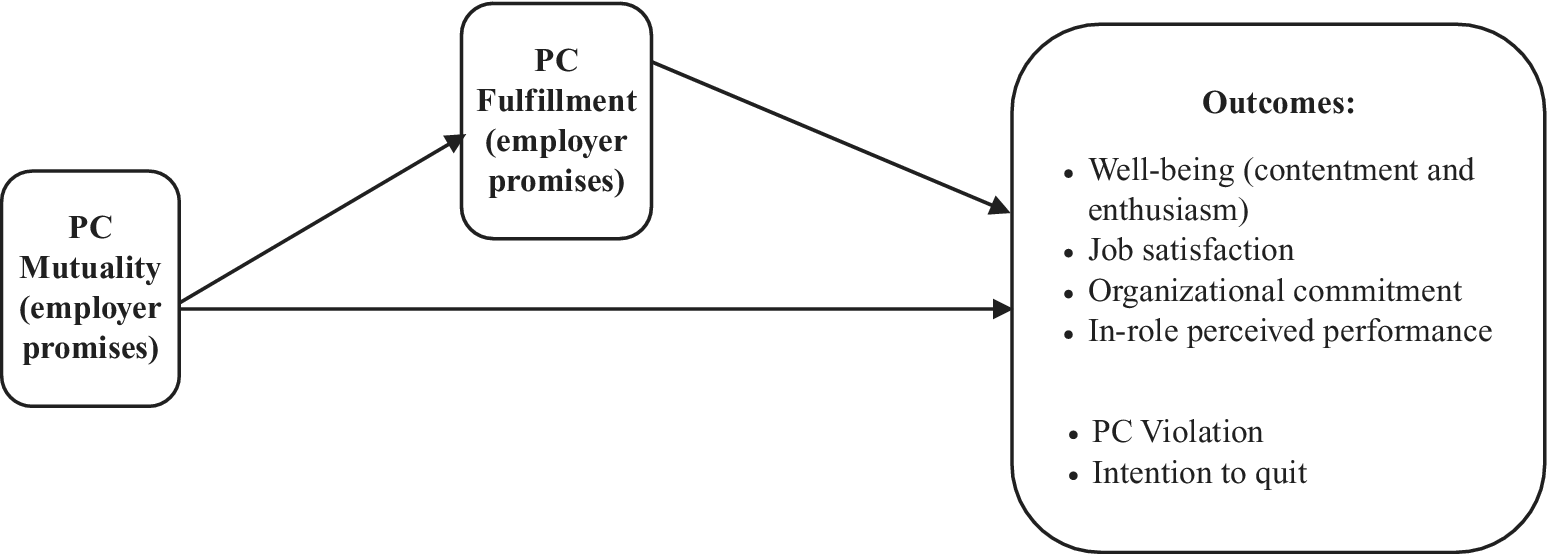
In an effort to provide an inclusive model and link the otherwise separately-studied PC variables, a simple mediation model is hypothesized (Figure 1). Thus, because PC mutuality is related to PC fulfillment, and PC fulfillment has been consistently related to work-related outcomes, the proposed model assumes that PC fulfillment will mediate the relationship between mutuality and work-related outcomes.
The Scheme of the Mediation Model

H6. The relationship between PC mutuality regarding the employer’s promises and work-related outcomes will be partially mediated by PC fulfillment of the employer’s promises.
Method
Sample
The sample was composed of 942 employees from 47 Spanish organizations. The employees’ average age was 34.38 years (SD = 9.86 years), and 51.6 % were females. Regarding the type of contract, 39.8% were temporary. The organizations were active in three sectors: manufacturing (17 organizations, 380 employees), retail/service (10 organizations, 269 employees), and education (20 organizations, 293 employees). In each organization, HR manager filled out questionnaires as a representative of the organization’s view. The answers will be used as the employer’s perspective with regard to all the employees with a temporary contract and all the permanent workers, respectively.
Measures
Control variables. Some individual variables were controlled for in the analyses: Age (in years), gender, and education level according to the International Standard Classification of Education (from 0 = pre-primary education to 6 = second stage of tertiary education). Some job variables were also included: position (ranging from 1 = unskilled blue collar worker to 6 = manager or director), number of working hours per week, tenure (in years), night shifts (1 = yes / 0 = no), and type of contract (0 = temporary or 1 = permanent). Organization size (number of employees in the company) from the employer’s questionnaire was also included.
Content and fulfillment of the PC. Employees were asked to indicate whether the organization promised them a list of 15 work features and the degree to which these promises had been fulfilled (Schalk et al., Reference Schalk, De Jong, Rigotti, Mohr, Peiró and Caballer2010). The range of responses in all cases was 0 = No, promise not made; 1 = Yes, but promise not kept at all; 2 = Yes, but promise only kept a little; 3 = Yes, promise half-kept; 4 = Yes, and promise largely kept; 5 = Yes, and promise fully kept. An example of an item was ‘allow you to participate in decision-making?’ In order to determine the content of the PC, the answers were coded as promise not made (0 = No) or promise made (all the other answers containing “Yes” = 1). To obtain the degree of fulfillment, only the promises that have been made (for which the employees chose a “yes” answer) were considered, and the average of their ratings on the Likert scale was computed. Although each commitment could differ in the level of relevance it has for each employee, our measure included the overall score without considering differences in relevance for workers, as in previous research (Dabos & Rousseau, Reference Dabos and Rousseau2004; Millward & Brewerton, Reference Millward and Brewerton1999). Employers answered the same items twice, first regarding the promises made to permanent employees and the degree of the company’s fulfillment, and then for temporary employees.
Mutuality. Mutuality is considered the simultaneous perceptions from both an employee and his/her employer that a promise has been made. For each employer-employee dyad, mutuality of the employer’s promises was obtained by combining the scores from the company and the employee. Mutuality on employer promises was computed by summing up the number of employer promises that were perceived as actually made, both for the employer and the employee, with a minimum of 0 (no features are perceived as promises made by both parties) and a maximum of 15 (all items are perceived as promises made by both parties). This indicates the agreement between the two parties regarding the promises made. Items where one party considers a promise actually made, but the other party does not, constitute disagreement and lack of mutuality. When both parties agree that a certain promise was not made, this agreement does not reflect the content of the psychological contract.
Violation of PC. Employees were asked to rate on a 5-point scale (1 = strongly disagree to 5 = strongly agree) the following feelings about their organization’s degree of fulfillment of promises: Happy, angry, pleased, violated, disappointed, and grateful (Schalk et al., Reference Schalk, De Jong, Rigotti, Mohr, Peiró and Caballer2010). Positive feeling scores were reversed.
Organizational commitment. Employees were asked about their affective relationship with their employing organization by means of four items from Cook and Wall’s (Reference Cook and Wall1980) scale, using a 5-point Likert response scale (1 = strongly disagree to 5 = strongly agree). An example of an item was ‘I feel like I’m part of the organization’.
Job satisfaction. Employees were asked about the level of job satisfaction using a four-item scale (Price, Reference Price1997), with answers given on a 5-point Likert scale (1 = strongly disagree to 5 = strongly agree). An example of an item was ‘Most days I am enthusiastic about my job’.
Intention to quit. Employees were asked about their intention to leave the organization. It was measured with a four-item scale (Price, Reference Price1997), with responses given on a 5-point scale (1 = strongly disagree to 5 = strongly agree), showing the degree of agreement with the statements, e.g., ‘If I could, I would quit today’.
Employee perceived performance. Employees were asked how well they fulfilled the 6 different in-role behaviors during the past work week on a scale developed by Abramis (Reference Abramis1994) with a 5-point rating scale (1 = very badly to 5 = very well). Examples of items were “…Perform without mistakes?” and “…Achieve your objectives?”.
Well-being. Employees were asked 12 questions about how often certain adjectives (e.g., gloomy, worried, calm, etc.) described their job-related feelings in the past few weeks (Warr, Reference Warr1990) on two axes: Anxiety-contentment and depression-enthusiasm, using a 5- point scale (1 = rarely or never to 5 = very often or always). Scores for negative adjectives were reversed. Higher scores expressed higher well-being.
Data Analysis
Means, reliabilities, and correlations among variables were computed. To test the mediation model, a bootstrapping analysis was performed for each outcome variable using the macro for IBM SPSS Statistics 20 (Hayes, Reference Hayes2017). All control variables were introduced as covariates of both the mediator and the outcome variable, and resampling was set at 5,000 times. The results obtained first represent the direct effect of the predictor on the outcome in a linear regression analysis, while controlling the covariates. Second, both the predictor and the mediator are introduced as predictors of the outcome in a second regression analysis, again controlling for the covariates. All these effects are reported as unstandardized coefficients (b), and their significance is indicated. Finally, the indirect effect is tested, and a confidence interval is generated with 95% confidence. At the same time, the confidence interval for the direct effect is also generated. The significance of the indirect and direct effects is determined based on whether the confidence intervals contain the value zero or not.
Results
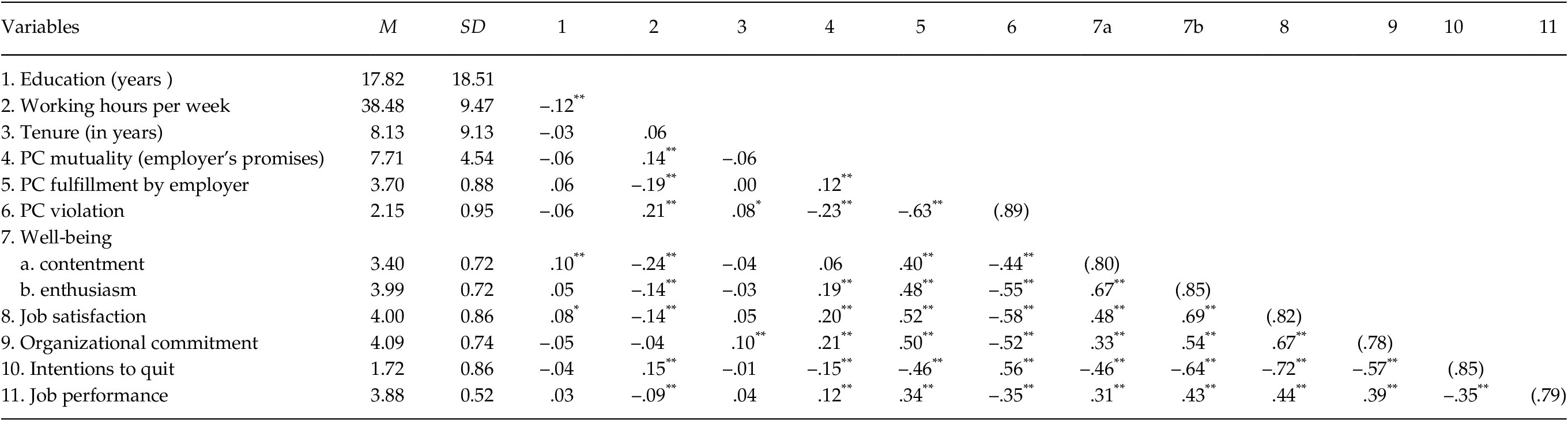
First, the zero-order correlations between variables and the alpha reliabilities of the measurement scales (where applicable) are presented in Table 1. In general, the zero-order correlations were consistent with the expected directions of the relations, offering preliminary support for the proposed model. All scales showed satisfactory reliability, with values over .78.
Descriptive Statistics and Zero-order Correlations among Study Variables

Note. Reliability’s coefficients are shown at the diagonal.
* p < .05.
** p < .01.
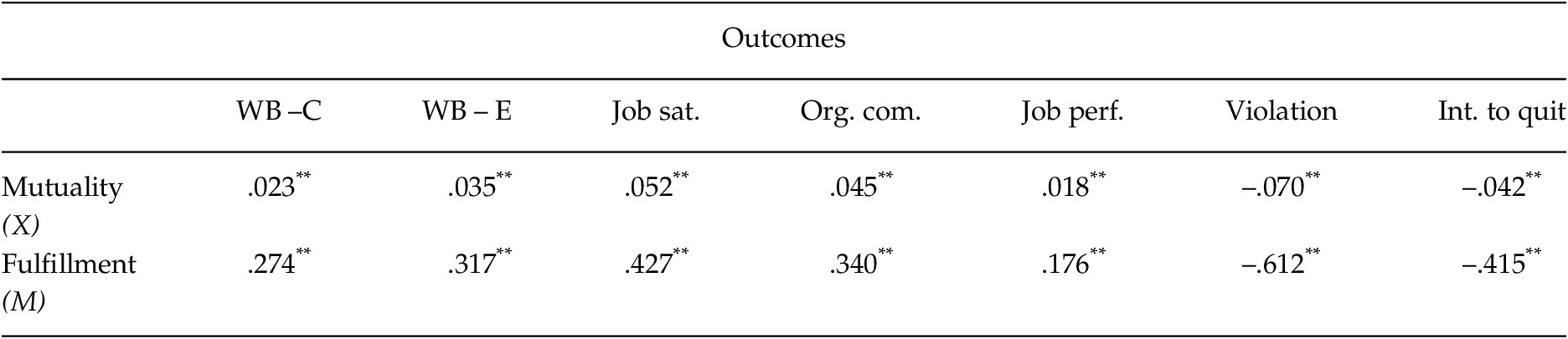
Results showed significant direct relationships between mutuality and all the work outcomes considered (see Table 2). Then, the higher the agreement between employer and employee about the employer’s promises, the higher the employee’s contentment and enthusiasm, H 1(a) confirmed; job satisfaction, H 1(b) supported; organizational commitment, H 1(c) confirmed; and perceived performance, H 1(d) supported.
Direct Effects of PC Mutuality and PC Fulfillment on Work-related Outcomes

Note. WB – C = well-being contentment; WB – E = well-being enthusiasm; Job sat. = Job satisfaction; Org. com. = organizational commitment; Job perf. = job performance; Int. to quit = intention to quit.
* p < .05.
** p < .01.
In the same line, Hypotheses 2(a) and (b) were confirmed because the more agreement between employer and employee, the lower the employee’s perceptions of violation and intentions to leave.
Next, a regression analysis was performed to test Hypothesis 3, which assumed a positive relationship between PC mutuality and PC fulfillment, both variables regarding the employer’s promises. The positive link is supported, and positive agreement about the employer’s promises (mutuality) explained 1.5% of the variance in fulfillment of promises by the employer, F(1, 900) =13.68, β = .12, p < .01. This means that the more agreement between employer and employee about what promises the company made, the more fulfillment of these promises by the company is perceived by employees.
Furthermore, in the bootstrapping analysis, PC fulfillment showed significant relationships with all the work-related outcomes. Higher scores on fulfillment of the employer’s promises are related to higher employee contentment and enthusiasm, H 4(a) supported; job satisfaction, H4(b) confirmed; organizational commitment, H 4(c) supported; and perceived performance, H 4(d) supported. In addition, higher scores on PC fulfillment by the employer are related to lower employee perceptions of PC violation, H 5(a) confirmed; and intentions to quit the job, H 5(b) confirmed.
Finally, bootstrapping analysis estimated the direct effect of PC mutuality on each work outcome and its indirect effect through PC fulfillment. Table 3 shows the indirect relationship between PC mutuality and each outcome through PC fulfillment, as well as the residual direct relationship it still has. For all outcomes, both the indirect relationship and the direct relationship are significant, showing partial mediation (H 6 supported).
Indirect and Residual Direct Effects of PC Mutuality on Work-related Outcomes through PC Fulfillment

Note. WB – C= well-being contentment; WB – E = well-being enthusiasm; Job sat. = Job satisfaction; Org. com. = organizational commitment; Job perf. = job performance; Int. to quit = intention to quit. E = effect, CI = Confidence Interval (95%).
* p < .05.
Discussion
This study aimed to investigate the role of mutuality between employer and employee regarding their PC in various work-related outcomes. The results indicate that the more agreement between employer and employee about the promises made by the company, the more employees perceive fulfillment of these promises and experience positive work outcomes.
Mutuality is considered the starting point for their fulfillment. In fact, without agreement about the promises made, each party might think they are delivering exactly what they should, while the other one is perceiving a PC breach. These results support the assumed relations described by Rousseau (Reference Rousseau2001) and Morrison and Robinson (Reference Morrison and Robinson1997), and they clarify the positive relationship found by Robinson and Morrison (Reference Robinson and Morrison2000) between the antecedents of mutuality and fulfillment, revealing the tight social interaction present in an employment relationship. Nevertheless, the variance in the employer’s promise fulfillment explained by mutuality regarding such promises is quite small. This result suggests that, although incongruence between employer and employee regarding the promises that had actually been made could cause perceptions of non-fulfillment, this does not seem to be very frequent in practice. This might be because lack of mutuality integrates three different states with regard to promises: The company considers the promise made, but the employee does not; the company does not consider the promise made, but the employee does, and both parties agree that the promise has not been made. Only the second state could be reflected in the degree of (un)fulfillment because in the other two situations the employee does not express his/her perception of a promise made by the company that s/he does not perceive. In this situation (promises not made by the company, but perceived as promised by the employee), it seems that employers frequently fulfill these work features to some degree.
However, there is more to be said about agreement between employer and employee. It also explains the existence of certain work-related outcomes, as our findings show. In order to integrate the information from previous studies, a mediation model was proposed. More specifically, it was argued that agreement about promises influences employee outcomes through PC fulfillment, thus showing an indirect relationship. In all the studied outcomes, partial mediation was identified. Overall, when an employer agrees with his/her employee about what promises the former has made as part of the PC, this agreement leads the employer to fulfill these promises to a greater extent, which in turn will make the employer experience more positive outcomes and fewer negative ones. The direct relationship of mutuality varies from 1.8% for perceived performance to 7% for perceptions of PC violation.
The presence of partial mediation, instead of a fully mediated relationship, could lead to certain conclusions. It is possible that the previously presented argument about why PC fulfillment would explain the relationship between mutuality and work-related outcomes can only account for part of the effect. In addition, PC mutuality between employer and employee might be a manifestation of better communication between the two, as well as shared cognitive schemata about employment relationships (Morrison & Robinson, Reference Morrison and Robinson1997). Better communication and shared cognitive schemata between employer and employee indicate a more functional relationship, thus increasing the probability of outcomes such as positive affects (enthusiasm and contentment), satisfaction with the job, and organizational commitment, and reducing the probability of negative outcomes. Another factor associated with higher agreement between employer and employees is the socialization process put into place by the organization for newcomers (Morrison & Robinson, Reference Morrison and Robinson1997). Socialization processes increase learning and reduce uncertainty by helping employees to make sense of the organizational reality, thus leading to higher job satisfaction, organizational commitment, and performance, as well as lower turnover behavior (Saks & Ashforth, Reference Saks and Ashforth1997). All these factors might explain why PC mutuality directly influences work-related outcomes. Nevertheless, more research is needed to explore whether other variables could play a mediator role and explain the mechanisms for these direct (not fully mediated by fulfillment) relationships.
Our findings extend the scarce empirical research than included explicitly he mutuality about the PC content,: These results reinforce the conclusions obtained by Ye et al. (Reference Ye, Cardon and Rivera2012) and Jonsson & Thorgren (Reference Jonsson and Thorgren2017), who considered only the shared perceptions of employees and employers regarding specific commitments made by each part (career responsibilities and job security, the first; trainee programs, the later). Our study points out the relevance of mutuality, considering the overall scope of promises included in the PC instead the shared understanding to specific promises. In addition, our research provides new arguments in favor of the claim of Ali (Reference Ali2020) about the implicit consideration of mutuality. This author argues that the implicit consideration of mutuality leads to indeterminacy about the PC content and facilitates a power-asymmetric Psychological contract and employment relationship. Our results clearly advocate for an explicit analysis of PC mutuality, to warrant that employees and employer have a shared understanding about what are the promise really made by each part as a critical antecedent of further fulfillment of PC and consequent positive work outcomes. As Hannah et al. (Reference Hannah, Treen, Pitt and Berthon2016) stated for the psychological contract stablished between a company and their customers/users in the marketing area, the companies not only must to fulfill the promises they made, but also the promises their customers perceive as being made, if they want to maintain a good relationship with them. Following these previous studies, our findings support the convenience to evaluate mutual perceptions about the promises made by each party, with the aim to obtain a shared understanding of the PC content (i.e., mutuality). In this way, our study contributes to fill the gap mentioned by Alcover et al. (Reference Alcover, Rico, Turnley and Bolino2017) in their multi-foci approach for understanding the nature of PC in the 21st Century, in particular in their Proposition 4. This proposition argues that the ambiguities and uncertainties about the psychological contract relies on the consistency of communications and messages transmitted by different organizational agents (p. 11), and they have a relevance on the consequences and outcomes of the psychological contract and the employment relationship. The study has both practical and theoretical implications. First, mutuality could be an easy-to-assess indicator of the probability of positive/negative developments in employment relationships, and it would be easier to increase than other predictors of PC fulfillment and work outcomes. Second, from a theoretical perspective, the study reports on one key dimension of the PC, namely its content, contributing to the advancement of PC as an analytical framework suitable for understanding changes in the current employment world. Furthermore, it proposes new methods for assessing mutuality by describing practical steps for investigating the shared understanding (the agreement between the employee and employer) about the content of the PC. These results have practical implications for companies. Organizations should be aware of positive consequences of mutuality in their relationships with employees. Thus, companies need to make enough commitments to their workers to balance employees’ contributions to the company. Looking for equity perceptions of employees, companies should reciprocate their workers’ inducements, defining and fulfilling broader psychological contracts for the employees who are more committed to the company.
Regarding practical implications, our results point out the relevance of the agreement between the company and the employees regarding the promises made by one party to the other, especially the promises made by the company to the employees. In addition, employers need to be clear when communicating to each employee what commitments are made, what commitments are not made, and why, and they need to make the exchange of commitments explicit. Clear and open communication should be the rule, and employers should make an effort to ensure that employees perceive which commitments are being made and which are not. Finally, focusing on the commitments actually made by companies, they need to openly inform employees when they find it difficult to fulfill the promises made, explain why they cannot fulfill them, and, when available, offer some kind of compensation (i.e. other commitments) for not fulfilling these promises.
The study has some limitations. First, the fact that it used mostly self-report questionnaires to assess employees’ outcomes could lead to common method variance (CMV). To prevent this CMV, the criterion variable was computed from two sources (employer and employee). To be sure that CMV does not occur, Harman one’s factor test was applied. This test shows problematic CMV when an exploratory factor analysis (EFA) with all the variables under study produces eigenvalues suggesting that the first factor accounts for more than 50% of the variance. Nevertheless, our study showed 31.2% of the variance in its first factor, and so it did not show evidence of CMV. Additionally, items with negative wording were included in the measurement of the variables to avoid acquiescence or desirability bias (Podsakoff et al., Reference Podsakoff, MacKenzie and Podsakoff2012). Moreover, although significant, the direct relationships between PC mutuality and the work-related outcomes are generally small, always smaller than those of fulfillment. This could in turn indicate that there are unidentified moderators of the relationship being addressed. The influence PC mutuality has on the affective, attitudinal, and behavioral outcomes might be affected by other factors. One such variable could be the change in promises over time. Especially in long-term employment relationships, an employer might change the promises s/he made, especially nowadays when changes in the economic environment push organizations to quickly adapt. Employees might not perceive, or even be informed, that the promises made initially have changed, and so they might be more prone to developing feelings of violation (Cullinane & Dundon, Reference Cullinane and Dundon2006). Similarly, other outcomes might be affected in this situation. Finally, all potential employer commitments to employees are considered equally relevant for any employee in our sample, whereas not fulfilling some commitments could be perceived by each employee as more negative than other unfulfilled commitments. Nevertheless, despite the relevance of different commitments, when the employer fails to fulfill any promise made, perceived equity and trust from the company could decrease, and the employer-employee relationship could suffer to a certain degree.
This study opens up many questions for future research in the area of PC. First, it prompts researchers to adopt more integrative perspectives on the PC variables studied. Instead of isolating them when trying to link them to relevant outcomes, they should look at whole models that explain how they also relate to each other. Second, it stresses the importance of further studying behavioral outcomes because even though they might be harder to predict, they are also the most relevant. In the end, employees’ behaviors such as performance and turnover are the main interests of their employers. Third, future research should focus on testing additional mediators of the relationship between PC mutuality and various work-related outcomes, especially PC variables such as trust in the employer and fairness of the exchange as part of the psychological contract state (Guest, Reference Guest2004a). Their integration in a model comprising PC variables and their effects on work-related outcomes would lead to a better understanding of an analytical framework that is useful in understanding today’s employment relationships.
In addition, future research could look at possible variables that might play a moderator role in the relationship between PC mutuality and work-related outcomes. Looking at the way an employer could change his/her promises over time could be a starting point, and it would also contribute to a long-term, longitudinal design of employment relationships, thus being more informative than the cross-sectional design adopted by most of the current research.
In conclusion, the present study focuses on the PC variable of mutuality, or the agreement between employer and employee regarding the promises included in the PC, supporting its importance. Contributing to expand the scarce research that empirically and explicitly consider PC mutuality, our study makes two main contributions. First, PC mutuality shows the degree to which both employer and employee fulfill agree about their promises to each other, contributing to achieve a better fulfillment of such promises. Second, PC mutuality is also directly linked to several affective, attitudinal, and behavioral work-related outcomes. Indeed, the relationships between PC mutuality and work-related outcomes are partially mediated by PC fulfillment. These patterns of results provide interesting starting points for discussing mediation and moderation effects linked to PC variables and other facets of the employment relationship. These results, together with the study’s limitations, provide future directions for research in the area of PC. Hopefully, this study, along with future research it might encourage, will contribute to better understanding employment in today’s world, making work better for employees and their employers.