Introduction
Alcohol dependence is a severe psychosocial problem with a long-term course. The lifetime prevalence of alcohol dependence has been reported to be 12.5% in the USA (Hasin et al. Reference Hasin, Stinson, Ogburn and Grant2007), 6% in Europe (Anderson & Baumberg, Reference Anderson and Baumberg2006) and 2.4% in Poland (Moskalewicz et al. Reference Moskalewicz, Kiejna, Wojtyniak, Moskalewicz, Kiejna and Wojtyniak2012). The course of alcohol dependence is often complicated, with serious physical and psychological conditions. Hallucinations comprise one of the many psychopathological complications of alcohol-related disorders, including alcohol dependence, and are seen mainly in delirium, intoxication, withdrawal syndrome and alcohol-induced psychotic disorders, and in traditional diagnoses of alcohol hallucinosis. There are very few studies that have considered the wide range of hallucinations occurring in the course of alcohol dependence. The experience of hallucinations was reported by Schuckit (Reference Schuckit1982) in 39% of 220 consecutive patients of an alcohol treatment programme (including 9% who also had delusions). Among 643 consecutive patients of an alcohol and drug treatment programme reported by Tsuang et al. (Reference Tsuang, Irwin, Smith and Schuckit1994), 48 (7.5%) met criteria for hallucinosis, 42 (6.5%) had hallucinations during alcohol withdrawal only, 20 (3.0%) had hallucinations in the context of psychoactive drug use and 49 (7.6%) 'did not have true hallucinations but reported abnormal perceptions such as hearing music, seeing spots or flashing lights’. The importance of research into the mechanism of hallucinations is illustrated by the results of a study on the lifetime prevalence of alcohol-induced psychotic syndrome (AIPS), which indicated that 97% of subjects (the rate was 0.5%) had the subtype with hallucinations (Perala et al. Reference Perala, Kuoppasalmi, Pirkola, Harkanen, Saarni, Tuulio-Henriksson, Viertio, Latvala, Koskinen, Lonnqvist and Suvisaari2010). A search of Medline found no other publications on the occurrence of hallucinations in a wide range of alcohol-related mental disorders and on their psychological mechanisms. Overall, there has been no progress in studies on the psychological mechanisms of hallucinations in the course of alcohol dependence since the 1980s, when they were considered according to an integrated approach towards viewing the aetiology and clinical presentations of hallucinations, similarly to hallucinations in other mental disorders, in terms of biological vulnerability and psychological influences (Asaad & Shapiro, Reference Asaad and Shapiro1986).
Nevertheless, a cognitive model of hallucinations was developed in the context of schizophrenia. It was proposed that hallucinations occurred due to a deficit in monitoring (Frith, Reference Frith1992) or faulty appraisals (Bentall, Reference Bentall1990) of internally generated states (e.g. inner speech in auditory hallucinations or vivid daydreams in visual hallucinations) that, in consequence, are perceived as externally generated. This approach used the concept of source monitoring, that is cognitive operations that enable discrimination of the context in which the information appears (Johnson et al. Reference Johnson, Hashtroudi and Lindsay1993). Three types of source monitoring have been proposed: (1) reality discrimination (discriminating the external versus internal source of information); (2) self-monitoring (differentiation between two internal sources); and (3) discriminating between two external sources. This concept has stimulated the development of various experimental paradigms that have been used in hallucination research (Laroi & Woodward, Reference Laroi and Woodward2007). The role of different types of source monitoring in hallucinations has been studied mostly among patients with schizophrenia (for review, see Ditman & Kuperberg, Reference Ditman and Kuperberg2005; Waters et al. Reference Waters, Woodward, Allen, Aleman and Sommer2012b ) or healthy subjects prone to psychosis (e.g. Peters et al. Reference Peters, Smeets, Giesbrecht, Jelicic and Merckelbach2007). Typically, in the reality discrimination task the participants are required to generate the words themselves, or the words are provided by an external source (e.g. an experimenter or a computer). Later the participants are asked to recognize the source of information. Schizophrenia patients with hallucinations (e.g. Baker & Morrison, Reference Baker and Morrison1998; Brebion et al. Reference Brebion, Amador, David, Malaspina, Sharif and Gorman2000; Brunelin et al. Reference Brunelin, Combris, Poulet, Kallel, D'Amato, Dalery and Saoud2006; Anselmetti et al. Reference Anselmetti, Cavallaro, Bechi, Angelone, Ermoli, Cocchi and Smeraldi2007; Woodward et al. Reference Woodward, Menon and Whitman2007; Waters et al. Reference Waters, Woodward, Allen, Aleman and Sommer2012b ; for review, see Ditman & Kuperberg, Reference Ditman and Kuperberg2005) and healthy persons prone to hallucinations were reported to have a tendency to misattribute internally generated events with an external source (e.g. Laroi et al. Reference Laroi, Collignog and van der Linden2005; Allen et al. Reference Allen, Freeman, Johns and McGuire2006). It should be noted that this misattribution pattern has also been found to be related to other symptoms of schizophrenia, such as delusions (Brebion et al. Reference Brebion, Amador, David, Malaspina, Sharif and Gorman2000; Anselmetti et al. Reference Anselmetti, Cavallaro, Bechi, Angelone, Ermoli, Cocchi and Smeraldi2007; Costafreda et al. Reference Costafreda, Brebion, Allen, McGuire and Fu2008), and delusion proneness among healthy subjects (e.g. Allen et al. Reference Allen, Freeman, Johns and McGuire2006).
Other studies have focused on self-recognition by showing that schizophrenia patients with hallucinations tend to misperceive imagined events (e.g. silent reading) with overt internally generated events (Franck et al. Reference Franck, Rouby, Daprati, Dalery, Marie-Cardine and Georgieff2000; Mammarella et al. Reference Mammarella, Altamura, Padalino, Petito, Fairfield and Bellomo2010). More recently, our group has shown that false recognition of imagined actions as being performed is exaggerated in patients with hallucinations (Gaweda et al. Reference Gaweda, Woodward, Moritz and Kokoszka2013). Intriguingly, the results of this study suggest a specific self-monitoring misattribution pattern associated with hallucinations, as there were no differences in the reverse misattribution patterns. In their meta-analysis, Waters et al. (Reference Waters, Woodward, Allen, Aleman and Sommer2012b ) confirmed that the source-monitoring biases assessed with various cognitive tasks are associated with hallucinations in schizophrenia.
Different theories have been proposed to explain deficits in source monitoring. Both bottom-up and top-down processes are thought to be involved in source-monitoring deficits. With regard to bottom-up processes, Allen et al. (Reference Allen, Laroi, McGuire and Aleman2008) suggested that persons with hallucinations 'over-perceptualize’ internally generated events due to increased activity of the primary auditory cortex (in the case of auditory hallucinations) (for review, see Kompus et al. Reference Kompus, Westerhausen and Hugdahl2011). Other theories suggest that disturbances in the context of memory (Waters et al. Reference Waters, Badcock, Michie and Maybery2006; Brebion et al. Reference Brebion, David, Jones, Ohlsen and Pilowsky2007), inner speech monitoring (reviewed by Moseley et al. Reference Moseley, Fernyhough and Ellison2013) or the feedforward system (Ford & Mathalon, Reference Ford and Mathalon2005) may underlie source-monitoring deficits. In a functional magnetic resonance imaging (fMRI) study of source monitoring in schizophrenia, Wang et al. (Reference Wang, Metzak and Woodward2011) showed that an aberrant connectivity between the medial prefrontal cortex and the superior temporal gyrus may result in inner–outer confusion. A recent study by Hugdahl et al. (Reference Hugdahl, Nygard, Falkenberg, Kompus, Westerhausen, Kroken, Johnsen and Loberg2013) revealed that patients with hallucinations exhibited an inability to allocate their attention to an external source, which may result in enhancement of inner intrusive experiences. These deficits may also contribute to inter–outer confusion. Waters et al. (Reference Waters, Woodward, Allen, Aleman and Sommer2012b ) suggested that these theories are not exclusive. Cognitive integrative models of hallucinations have proposed that the interaction between bottom-up and top-down processes contributes to hallucinations (Hugdahl, Reference Hugdahl2009; Waters et al. Reference Waters, Allen, Aleman, Fernyhough, Woodward, Badcock, Barkus, Johns, Varese, Menon, Vercammen and Larøi2012a ).
However, source-monitoring deficits are not limited to hallucinations that occur only in schizophrenia. They have also been found among healthy people who are prone to hallucinations (e.g. Peters et al. Reference Peters, Smeets, Giesbrecht, Jelicic and Merckelbach2007) and among patients with Parkinson's disease who experience hallucinations (Barnes et al. Reference Barnes, Boubert, Harris, Lee and David2003). These findings provided a rationale for a transdiagnostic cognitive model of hallucinations based on source monitoring that states that similar cognitive operations may underlie hallucinations across different clinical and non-clinical populations (Waters et al. Reference Waters, Allen, Aleman, Fernyhough, Woodward, Badcock, Barkus, Johns, Varese, Menon, Vercammen and Larøi2012a ).
The current study, to the best of our knowledge, is the first to investigate whether the source-monitoring model may be applied to hallucinations in the course of alcohol dependence. The results of the only study so far on source monitoring in detoxified alcoholics (Weingartner et al. Reference Weingartner, Andreason, Hommer, Sirocco, Rio, Ruttimann, Rawlings and Eckardt1996) suggested that two subgroups of patients could be distinguished based on the reality monitoring task. The first group (n = 5) had significant difficulties in discriminating self-generated words from those that were provided by the experimenter. Source monitoring was unimpaired in the second subgroup of patients (n = 8). Positron emission tomography (PET) scanning revealed that source monitoring was associated with brain areas involved in controlled cognitive functions (i.e. the prefrontal cortex, temporal and temporal cortices). However, Weingartner et al. (Reference Weingartner, Andreason, Hommer, Sirocco, Rio, Ruttimann, Rawlings and Eckardt1996) did not attribute their results, according to the cognitive model of hallucinations, to the differences in psychopathology (in this case the presence of hallucinations). Moreover, conclusions from their study may not be reliable because of the small sample size (n = 13). Hence, it is still unresolved whether a cognitive model that emphasizes the role of source monitoring may be applied to hallucinations that occur in the course of alcohol dependence.
We intended to fill this gap by using an action memory task (Moritz et al. Reference Moritz, Ruhe, Jelinek and Naber2009; Gaweda et al. Reference Gaweda, Moritz and Kokoszka2012, Reference Gaweda, Woodward, Moritz and Kokoszka2013) that assesses two types of source monitoring (i.e. self-monitoring: discrimination between imagined versus performed actions and between two types of action presentation, text versus picture) among patients with and without a history of hallucinations during their course of alcohol dependence. In addition, cognitive confidence ratings were provided along with source-monitoring responses, as previous studies have shown that patients with severe reality distortions commit failures while at the same time being convinced that their responses are correct (so-called knowledge corruption) (Moritz et al. Reference Moritz, Woodward, Whitman and Cuttler2005; Gaweda et al. Reference Gaweda, Moritz and Kokoszka2012, Reference Gaweda, Woodward, Moritz and Kokoszka2013). In accordance with previous research on self-monitoring in hallucinations in schizophrenia (Gaweda et al. Reference Gaweda, Woodward, Moritz and Kokoszka2013), we hypothesized that alcoholics with a history of hallucinations would misremember imagined actions with performed ones (but not the reverse) more frequently than alcoholics who never hallucinated. At the same time we expected no group differences in the presentation type of stimuli discrimination (verbal versus pictures).
Method
Participants
Fifty-eight in-patients were recruited for this study from the II Department of Psychiatry, Medical University of Warsaw and from Zabki Psychiatry Hospital, Warsaw, Poland. All patients were diagnosed as alcohol dependent according to ICD-10 criteria and had at least one alcohol withdrawal syndrome that required hospitalization. Two groups of alcoholics were formed according to clinical interviews with the patients. Patients were asked whether they had experienced hallucinations during the course of their alcohol dependence with no regard to any specific modality. The first group consisted of 29 patients who had no history of hallucinations or any other severe reality distortions (e.g. awareness disorders). The second group consisted of 29 patients with a history of at least one episode of hallucinations of any modality during the course of their alcohol dependence. The patients were screened for the occurrence of hallucinations based on a clinical interview and case records. We did not record the modality of the hallucinations in the study. However, the vast majority of our patients had a history of multi-modal hallucinations (auditory and visual hallucinations occurring simultaneously). None of the patients had ever been diagnosed with a disorder other than alcohol-induced psychotic disorder (e.g. schizophrenia spectrum disorders, affective psychosis). Other psychiatric co-morbidities were not investigated. The subgroups of patients were matched in terms of age and gender. Twenty-four healthy subjects were included from the total sample of 124 persons from the existing dataset, which consisted of healthy persons who were investigated continually by our group from October 2008 to September 2012. The study was approved by a local bioethical committee.
Source-monitoring task
We used an action memory task that was originally developed by Moritz et al. (Reference Moritz, Ruhe, Jelinek and Naber2009) to assess source monitoring and that had been used to investigate the cognitive processes involved in hallucinations among schizophrenia patients (Gaweda et al. Reference Gaweda, Woodward, Moritz and Kokoszka2013). This task allowed for a comprehensive assessment of source monitoring, as two types of source monitoring were targeted along with associated subjective confidence. In the learning phase the participants were presented with text instructions or pictures of simple physical actions. Half of the actions had to be performed (surrounded by a green frame) and half had to be imagined (surrounded by a red frame). Participants were instructed later to recognize the actions and to distinguish whether the action had been performed or imagined. In addition, new actions (not presented before) were presented in the recognition phase. A short practice trial acquainted the participants with the task requirements. In the main phase, 18 texts and 18 pictures with action instructions were presented, with each part (nine items each) requiring the participant to either perform or imagine each item. Each instruction was displayed once on a computer screen for 10 s. Before recognition, a filler task was administered that took 10 min to complete. Then 36 actions were presented for the studied items along with 20 new action instructions (the recognition items were presented in a different font to the encoding items to prevent physical matching). Participants were required to respond by indicating whether the corresponding instruction had appeared either as text or as pictures or was new (presentation type differentiation) and whether or not the action had been performed or imagined (self-monitoring), and a grade was given for confidence (binary scale: unsure versus sure). All items were randomized in both the learning and the recognition phase.
Data analysis
All groups were contrasted using a one-way ANOVA. In the source-monitoring conditions we analysed only false alarms (no hits) when computing source-monitoring responses. However, when considering the recognition of new versus old actions, hits and false alarms were analysed. Source-monitoring errors were computed according to difference score methodology as proposed by Woodward & Menon (Reference Woodward and Menon2011). This methodology removes false positive responses from the source-monitoring errors and from old/new recognition hit rates, providing the opportunity to control guessing responses (i.e. new items are remembered as imagined or performed). Hence, we calculated the number of imagined actions that were remembered as performed as the raw value, and we subtracted the number of new actions that were mislabelled as performed. This method has been described in detail elsewhere (Woodward & Menon, Reference Woodward and Menon2011; Gaweda et al. Reference Gaweda, Woodward, Moritz and Kokoszka2013).
Results
Basic characteristics
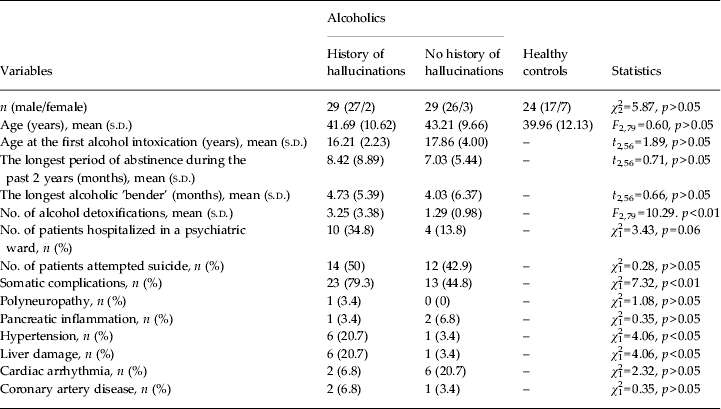
Table 1 presents the basic characteristics of the groups. There were no differences between the groups in age (F 2,79 = 0.6, p > 0.5) and gender distribution (χ 2 2 = 5.87, p > 0.05). The two groups of alcoholics did not differ in terms of the age of first intoxication (t 2,56 = 1.89, p > 0.05), the longest period of abstinence during the past 2 years (t 2,56 = 0.71, p > 0.05) and the longest alcoholic 'bender’ during the past 2 years (t 2,56 = 0.66, p > 0.05). Patients with a history of hallucinations were, however, detoxified more often than patients without a history of hallucinations (F 2,79 = 10.29, p < 0.01). Moreover, at trend level, patients with a history of hallucinations were more frequently hospitalized in a psychiatric ward (χ 2 1 = 3.43, p = 0.06). There were no group differences in suicide attempts (t 1,54 = 0.52, p > 0.05). Patients with a history of hallucinations had more somatic complications than those without a history of hallucinations (χ 2 1 = 7.32, p < 0.01). The frequencies of specific somatic complications are presented in Table 1.
Basic characteristics of the groups

s.d., Standard deviation.
Old versus new action discrimination accuracy
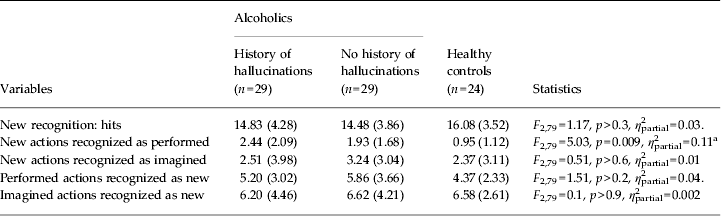
Prior to the main analysis of source-monitoring biases, we checked for hits and false alarms with regard to old versus new action discrimination. First, we calculated new action recognition. No significant group differences were found for hits (F 2,79 = 1.17, p > 0.3, η 2 partial = 0.03).
Second, we calculated the false positive responses, that is when new items were recognized as having been presented. Two types of false positive responses are possible in this condition. There were no group differences for new actions that were misperceived as having been imagined (F 2,79 = 0.51, p > 0.6, η 2 partial = 0.01). However, we found significant group differences in false recognition of new actions as having been performed (F 2,79 = 5.03, p = 0.009, η 2 partial = 0.11). A Bonferroni post-hoc comparison revealed that alcoholics with a history of hallucinations significantly more often misremembered new actions as having been performed than healthy controls (p = 0.007), but this was not the case with alcoholics without a history of hallucinations (p > 0.1).
Third, we analysed the false negative responses, that is when performed and imagined actions were recognized as new actions. No group differences were found for the imagined actions (F 2,79 = 0.1, p > 0.9, η 2 partial = 0.002) and for the performed actions (F 2,79 = 1.51, p > 0.2, η 2 partial = 0.04). The results are presented in Table 2.
Group differences in old/new action recognition accuracy

Values given as mean (standard deviation).
a A Bonferroni post-hoc comparison revealed that alcoholics with a history of hallucinations significantly more often misremembered new actions as having been performed than healthy controls (p = 0.007), but this was not the case with alcoholics without a history of hallucinations (p > 0.1).
Imagined versus performed action discrimination
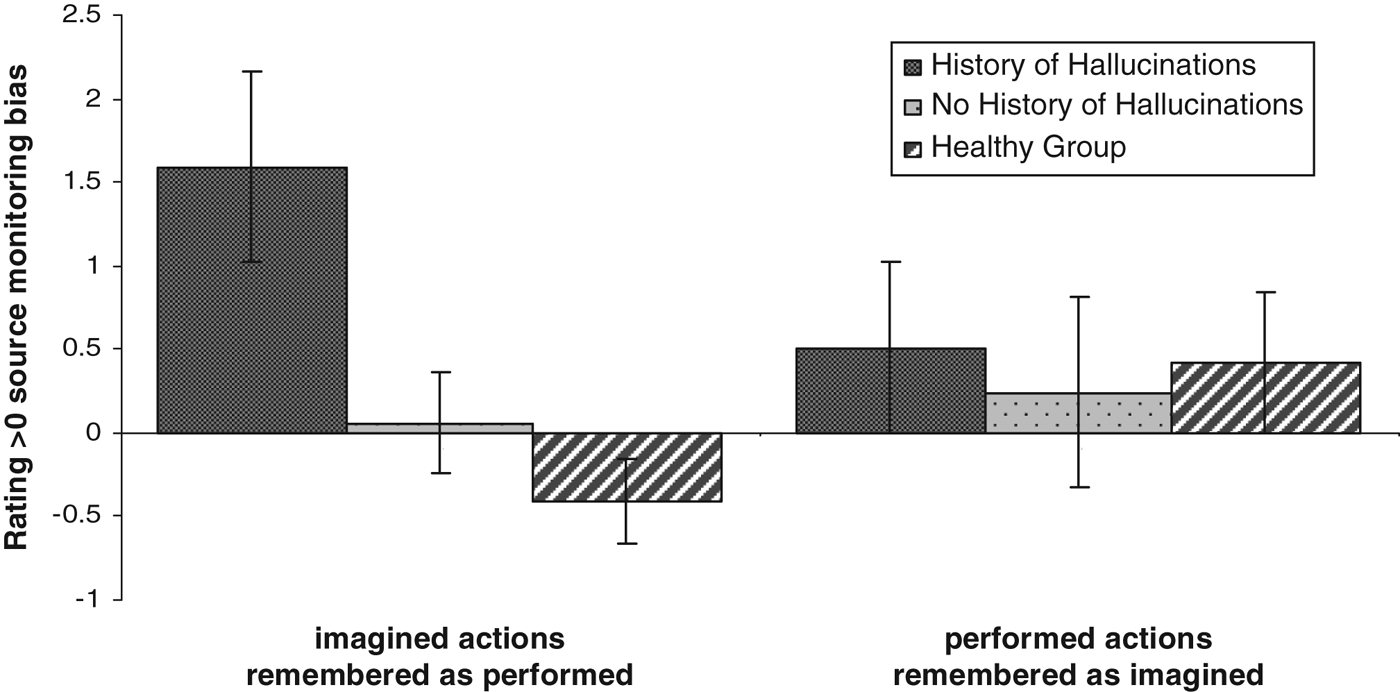
As we were interested in any group differences in source-monitoring misattribution patterns, only false alarms responses were calculated with a one-way ANOVA. Two specific misattribution patterns can be observed in the action memory task, namely imagined actions are falsely recognized as having been performed and vice versa. With regard to performed actions that were falsely recognized as imagined ones, no group differences emerged (F 2,79 = 0.21, p > 0.8, η 2 partial = 0.005). However, significant group differences were found for imagined actions that were classified as performed ones (F 2,79 = 6.25, p = 0.003, η 2 partial = 0.14). A post-hoc comparison showed that alcoholics with a history of hallucinations made significantly more misattributions than alcoholics with no history of hallucinations (p = 0.03) and healthy controls (p = 0.004). Importantly, there were no group differences between patients with no history of hallucinations and healthy controls (p > 0.9). The results are presented in Fig. 1.
Group differences in action self-monitoring errors. The difference score methodology (Woodward & Menon, Reference Woodward and Menon2011) was used to remove estimates of false positive rates from self-monitoring errors. False positive rates are estimated as the number of occurrences of the source of interest in response to new items. Values greater than zero indicate that true errors of a given type were more frequent than false positive of that type, and values less than zero suggest the opposite. Bars represent standard error of the mean (s.e.m.). The highest rate of imagined actions that were remembered as performed was observed among alcoholics with a history of hallucinations (mean = 1.59, s.d. = 0.57), who scored significantly higher than patients without a history of hallucinations (p = 0.03, mean = 0.07, s.d. = 0.31) and healthy subjects (p = 0.004, mean = –0.42, s.d. = 0.25). With regard to performed actions that were recognized as imagined, no group differences were observed (alcoholics with a history of hallucinations: mean = 0.52, s.d. = 0.51; alcoholics without a history of hallucinations: mean = 0.24, s.d. = 0.58; healthy group: mean = 0.4, s.d. = 0.42).

Text versus picture action discrimination
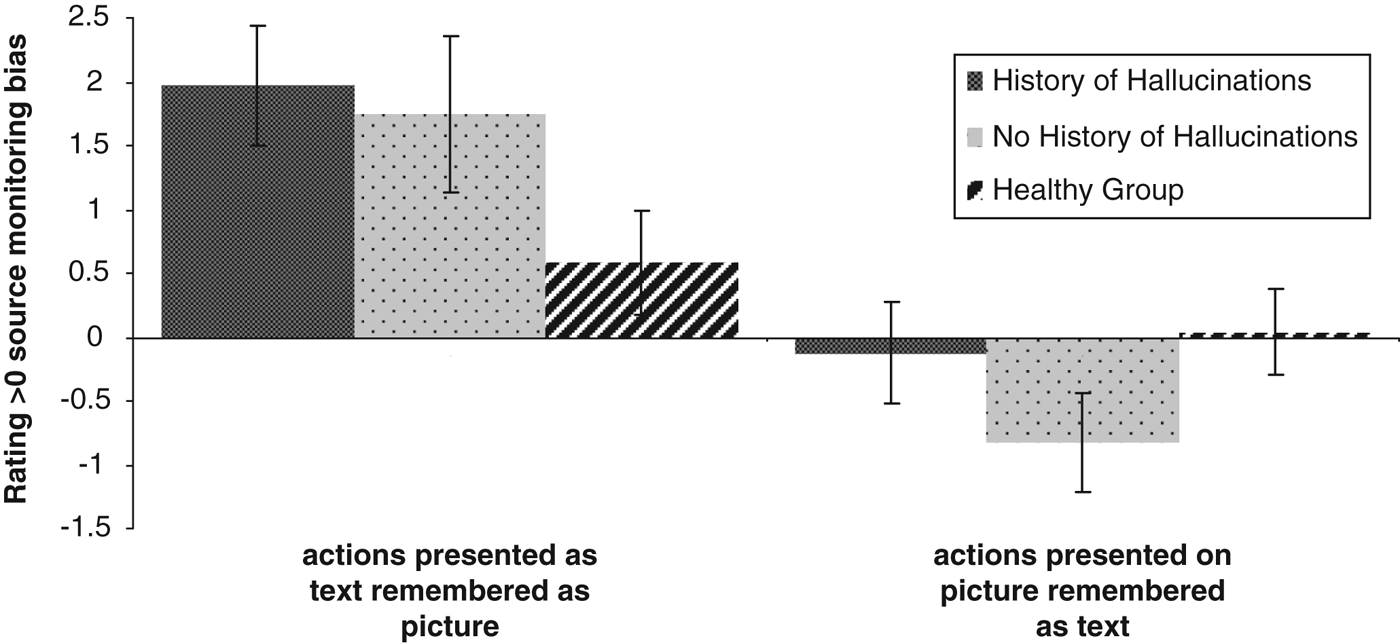
In the next step of our analysis we calculated group differences in false alarms for discrimination between two types of action presentation: text and pictures. Two misattribution patterns in this type of source monitoring can be obtained from an action memory task. No group differences were found concerning actions that were presented on pictures and those that were remembered as verbal (F 2,79 = 1.44, p > 0.2, η 2 partial = 0.04). Again, no group differences emerged concerning actions presented as text that were classified as presented on pictures (F 2,79 = 1.95, p > 0.05, η 2 partial = 0.05). The results are presented in Fig. 2.
Group differences in action presentation type. The difference score methodology (Woodward & Menon, Reference Woodward and Menon2011) was used to remove estimates of false positive responses from true action presentation type discrimination errors. Hence, mean scores represents only source-monitoring errors. False positive rates are estimated as the number of occurrences of the source of interest in response to new items. Hence, the mean scores presented are true source misattributions errors without false positive ratings. No group differences were found. Bars represent standard error of the mean (s.e.m.). There were no group differences in false recognition of action presentation type. Means and standard deviations (s.d.) for the actions presented as text that were recognized as pictures are as follows: alcoholics with a history of hallucinations: mean = 1.96, s.d. = 0.49; alcoholics without a history of hallucinations: mean = 1.75, s.d. = 0.6; healthy group: mean = 0.58, s.d. = 0.41. For the opposite error type the values are: alcoholics with a history of hallucinations: mean = –0.14, s.d. = 0.4; alcoholics without a history of hallucinations: mean = –0.83, s.d. = 0.39; healthy group: mean = 0.04, s.d. = 0.33.

Subjective cognitive confidence
Finally, we were interested in subjective response confidence in imagined versus performed action discrimination. We calculated the knowledge corruption (KC) index according to previous studies (Moritz et al. Reference Moritz, Woodward, Whitman and Cuttler2005; Gaweda et al. Reference Gaweda, Moritz and Kokoszka2012, Reference Gaweda, Woodward, Moritz and Kokoszka2013). The KC index was calculated as the proportion of false alarm responses for the action recognition condition that were given with high confidence ratings relative to the total responses that were given with high confidence. A one-way ANOVA revealed significant group differences in the KC index (F 2,79 = 7.38, p = 0.001, η 2 partial = 0.16). Post-hoc comparisons showed that patients with (mean = 25.5%, s.d. = 16.3%, p = 0.001) and without (mean = 20.8%, s.d. = 14.6%, p = 0.03) a history of hallucinations had a higher KC index than healthy controls (mean = 10.1%, s.d. = 12.83%). This suggests that both clinical groups held false decisions with strong conviction. No differences were found between the two clinical groups (p > 0.6).
Discussion
These preliminary results demonstrate, for the first time, that a transdiagnostic source monitoring-based approach to hallucinations may be applied beyond schizophrenia to other clinical groups, in this case to alcohol-dependent patients. A specific type of source monitoring has been found to be related to a history of hallucinations in alcoholics. We found that patients with a history of hallucinations committed more imagined versus performed discrimination errors (i.e. self-monitoring bias). At the same time, no differences in the action presentation type discrimination emerged. Only one type of misattribution (i.e. remembered imagined actions as performed ones) in discrimination between imagined and performed actions was found among patients with a history of hallucinations compared to both patients without hallucinations and healthy controls. This suggests a specific type of misattribution pattern that contributes to hallucinations in alcohol-dependent persons. These results mirror previous findings obtained with schizophrenia patients (Gaweda et al. Reference Gaweda, Woodward, Moritz and Kokoszka2013) and healthy subjects prone to hallucinations (Peters et al. Reference Peters, Smeets, Giesbrecht, Jelicic and Merckelbach2007). Disrupted cognitive confidence (i.e. high confidence in incorrect responses) was found more frequently in both clinical groups compared with healthy subjects, but no differences between the two clinical groups emerged.
Previous findings have suggested that alcohol-dependent patients with severe reality distortions tend to exhibit a more external locus of control compared to patients with no reality distortions (Kokoszka et al. Reference Kokoszka, Laskowska and Mikula2011). Our study extends the knowledge on the potential mechanisms of hallucinations in alcoholics by showing that deficits in source monitoring are involved in the experience of past hallucinations. A previous study also showed source-monitoring deficits in alcoholics (Weingartner et al. Reference Weingartner, Andreason, Hommer, Sirocco, Rio, Ruttimann, Rawlings and Eckardt1996). Intriguingly, a subsample of these patients was found to be unimpaired in their ability to monitor the source of information (Weingartner et al. Reference Weingartner, Andreason, Hommer, Sirocco, Rio, Ruttimann, Rawlings and Eckardt1996). According to the cognitive model (e.g. Bentall, Reference Bentall1990; Frith, Reference Frith1992), we hypothesized that alcoholics may differ in source monitoring because of the presence of hallucinations. Indeed, our results provide a preliminary verification of this hypothesis and reveal that self-monitoring deficits are related to a history of hallucinations, as the performance of patients with no history of hallucinations was similar to that of healthy controls in the source-monitoring task. These results are very similar to previous findings on schizophrenia patients with hallucinations (Gaweda et al. Reference Gaweda, Woodward, Moritz and Kokoszka2013), and to findings showing that hallucination proneness among healthy persons is also related to source-monitoring deficits (Peters et al. Reference Peters, Smeets, Giesbrecht, Jelicic and Merckelbach2007).
Importantly, alcoholics experience hallucinations and hallucinatory-like experiences (Saha et al. Reference Saha, Scott, Varghese, Degenhardt, Slade and McGrath2011) in different modalities. One of the limitations of our study was that we did not analyse the modality of the hallucinations, thus our conclusions refer to hallucinations in general. However, some mechanisms may be common for hallucinations occurring at different modalities; for example, source-monitoring deficits were confirmed with speech-related (e.g. Johns et al. Reference Johns, Gregg, Allen and McGuire2006) and kinesthetic paradigms (e.g. Mammarella et al. Reference Mammarella, Altamura, Padalino, Petito, Fairfield and Bellomo2010; Gaweda et al. Reference Gaweda, Moritz and Kokoszka2012) and among patients with auditory (for review, see Waters et al. Reference Waters, Woodward, Allen, Aleman and Sommer2012b ), visual (Brebion et al. Reference Brebion, Ohlsen, Bressan and David2012) and olfactory (Arguedas et al. Reference Arguedas, Stevenson and Langdon2012) hallucinations. However, the study by Arguedas et al. (Reference Arguedas, Stevenson and Langdon2012) indicated that source-monitoring deficits may be modality specific. To resolve this issue in alcoholics, future studies should analyse the association between different modality hallucinations and source monitoring. Some studies have found that hallucinations are also related to delusions in schizophrenia (Brebion et al. Reference Brebion, Amador, David, Malaspina, Sharif and Gorman2000; Anselmetti et al. Reference Anselmetti, Cavallaro, Bechi, Angelone, Ermoli, Cocchi and Smeraldi2007; Costafreda et al. Reference Costafreda, Brebion, Allen, McGuire and Fu2008). Although delusions are present among alcoholics, we did not control for these in the current study. Future studies may consider delusions and other symptoms to assess whether source-monitoring biases are limited to one type of symptom (e.g. hallucinations) or may also be generalized to other symptoms.
We observed that alcohol-dependent patients complicated with a history of hallucinations tended to confuse imagination with reality, but our study could not determine the origins of these deficits. In previous studies on detoxified alcoholics, source-monitoring deficits were correlated with a wide range of cortical regions, including the prefrontal cortex, orbital frontal, and temporal and parietal cortices (Weingartner et al. Reference Weingartner, Andreason, Hommer, Sirocco, Rio, Ruttimann, Rawlings and Eckardt1996). Disturbances in neural activation were also found to underlie source-monitoring deficits among schizophrenia patients (Ragland et al. Reference Ragland, Valdez, Loughead, Gur and Gur2006; Wang et al. Reference Wang, Metzak and Woodward2011) and healthy subjects (e.g. Mugikura et al. Reference Mugikura, Abe, Suzuki, Ueno, Higano, Takahashi and Fujii2010). Future studies might investigate the neural underpinnings of source-monitoring deficits to build a more comprehensive bio-psychological model of hallucinations in alcoholics. Longitudinal studies that assess a wide range of clinical characteristics, alcohol consumption or neuropsychological functioning may also provide potential mechanisms that influence source monitoring and then result in hallucinations among alcoholics.
Importantly, we did not find global source-monitoring deficits in alcoholics with a history of hallucinations; only the discrimination between imagination and performance (i.e. self-monitoring) was disturbed, and at the same time a discrimination of the action presentation type was preserved. In line with findings on hallucinations in schizophrenia patients (Gaweda et al. Reference Gaweda, Woodward, Moritz and Kokoszka2013), we found that alcoholics with a history of hallucinations more frequently committed errors of misremembering imagined actions as performed ones, but not the reverse, compared with healthy subjects and alcohol-dependent patients without hallucinations. This specific type of self-monitoring misattribution pattern is in line with the 'over-perceptualization’ hypothesis of hallucination (Allen et al. Reference Allen, Laroi, McGuire and Aleman2008). Speech-related structures have been found to be overactivated in patients with auditory hallucinations, leading to percept-like experiences (e.g. Rapin et al. Reference Rapin, Dohen, Loevenbruck, Whitman, Metzak and Woodward2012). However, there are no neuroimagining studies on the neural underpinnings of the hallucinations or hallucination proneness in alcoholics and thus particular brain structures that are involved are still unknown.
Given that cognitive impairments are frequently observed among alcoholics (Munro et al. Reference Munro, Saxton and Butters2000; Kopera et al. Reference Kopera, Wojnar, Brower, Glass, Nowosad, Gmaj and Szelenberger2012), the question arises of whether impairments in the source monitoring observed among patients with a history of hallucinations are influenced by other cognitive deficits. The specificity of the source-monitoring bias and self-monitoring misattribution pattern suggests that these are not related to general cognitive decline; otherwise we would expect more generalized source-monitoring deficits. However, we did not use an additional neuropsychological assessment that could verify the associations between specific cognitive functions and source monitoring. Weingartner et al. (Reference Weingartner, Andreason, Hommer, Sirocco, Rio, Ruttimann, Rawlings and Eckardt1996) found that a subsample of alcoholics impaired in source monitoring had more difficulties in explicit memory (free recall of categorically related words) and inhibition of intrusion errors than those with normal performance in source monitoring. However, there were no other group differences in the cognitive domains. A study by Shakeel & Docherty (Reference Shakeel and Docherty2012) on the role of cognitive functions in source monitoring among schizophrenia patients revealed that source-monitoring impairments were related to operational sequencing measured with the Trail Making Test. It is then unlikely that source-monitoring deficits are a simple by-product of general cognitive decline, but they are related to some cognitive functions. Future studies considering the relationship between source monitoring and the wide range of cognitive functions may provide valuable data on the relationship between different cognitive domains and source monitoring in alcoholics.
An important issue to discuss is whether source-monitoring deficits are state or trait dependent. Because of a very florid psychosis with awareness disturbances, delusions and different modality hallucinations during severe complications in the course of alcohol dependence (e.g. delirium tremens), it is not possible to adequately assess cognitive functioning in alcoholic patients. Hence, our study was targeted at alcoholics with a history of hallucinations, thus limiting our conclusions to a trait-dependent role of source monitoring. Source-monitoring deficits have been found among healthy subjects who were prone to hallucinatory-like experiences (e.g. Peters et al. Reference Peters, Smeets, Giesbrecht, Jelicic and Merckelbach2007), and among the relatives of schizophrenia patients (Brunelin et al. Reference Brunelin, d'Amato, Brun, Bediou, Kallel, Senn, Poulet and Saoud2007) and patients with clinical hallucinations (reviewed by Waters et al. Reference Waters, Woodward, Allen, Aleman and Sommer2012b ), suggesting that source-monitoring deficits are trait and state dependent. The cross-sectional design of our study prevents any causal inferences. It is therefore not known whether self-monitoring deficits increase the likelihood of hallucinations in alcoholics who have not yet hallucinated or if it is instead a consequence of a history of hallucinations during alcohol dependence. Future studies may address this question in a longitudinal design.
With regard to cognitive confidence, we found that alcoholics with and without a history of hallucinations exhibited more severe knowledge corruption compared to healthy controls. The higher proportion of high-confident incorrect responses (KC index) among alcoholics compared to healthy subjects suggests that alcoholics in general have more trust (a higher degree of subjective confidence) in the responses that are in fact incorrect. In other words, alcoholics hold their false beliefs (i.e. source-monitoring errors) with higher confidence than healthy controls. Similar results were found in schizophrenia patients (Moritz et al. Reference Moritz, Woodward, Whitman and Cuttler2005; Gaweda et al. Reference Gaweda, Moritz and Kokoszka2012). In line with previous studies (Gaweda et al. Reference Gaweda, Woodward, Moritz and Kokoszka2013), knowledge corruption was not related to hallucinations. This may suggest impairments in meta-cognitive functioning in alcoholics, but further study is needed to replicate this finding.
Several limitations of our study merit comment. First, as mentioned earlier, the history of hallucinations was assessed with no regard to the specific modality of hallucinations during the unstructured clinical interview. Future studies may apply a structured and detailed measure of hallucinations, such as the Psychotic Symptom Rating Scales (PSYRATS) by Haddock et al. (Reference Haddock, McCarron, Tarrier and Faragher1999). A cross-sectional design precludes causal inference, and thus future longitudinal studies are warranted. This is the first study on source-monitoring mechanisms of hallucinations among alcoholics, and further studies are needed to replicate our findings. A more detailed description of hallucinations along with the severity of alcohol consumption should be considered.
To conclude, our study provides the first preliminary findings for specific source-monitoring deficits associated with a history of hallucinations among alcoholics. Our results tentatively suggest that confusing imagery with reality, but not the reverse, may be involved in hallucinations among this clinical group. Moreover, alcoholics tend to hold their false beliefs (i.e. source-monitoring errors) with stronger conviction than healthy controls. In general, this preliminary study indicates that alcoholics with a history of hallucinations may share some cognitive operations associated with hallucinations that are observed among other clinical and non-clinical groups that are prone to hallucinations. Hence, this is the first step towards applying the transdiagnostic cognitive model of hallucinations (Waters et al. Reference Waters, Allen, Aleman, Fernyhough, Woodward, Badcock, Barkus, Johns, Varese, Menon, Vercammen and Larøi2012a ) to alcoholics. However, further studies with a more detailed description of hallucinations (e.g. modality, severity and associated stress) among alcoholics are needed to replicate our findings.
Acknowledgements
We thank all the participants of this study. We also thank our colleagues at the II Department of Psychiatry, Medical University of Warsaw, the staff at the Psychiatric Ward, Zabki Psychiatry Hospital, Warsaw, and M. Sokołowska for help in recruiting participants for the study.