Introduction
The Digenea is the most abundant parasitic helminth taxon both worldwide and in Poland (Pojmańska et al., Reference Pojmańska, Niewiadomska and Okulewicz2007), and digeneans are important in controlling host abundance. The digenean life cycle involves numerous invertebrates as intermediate hosts, wild waterfowl frequently acting as the definitive hosts. Many waterfowl species, wild ducks (Anatidae) in particular, migrate to wintering grounds at the southern coast of the Baltic Sea where they form flocks consisting of several thousand individuals. Parasitological research on those ducks has the potential to elucidate mechanisms underpinning the formation and persistence of waterfowl parasites.
As the digenean fauna of wild ducks is quite well known (e.g. McDonald, Reference McDonald1969), this knowledge provides a sound basis for research on waterfowl parasite ecology. The structure of parasitic assemblages and factors affecting their patterns have been studied extensively (e.g. Bush & Holmes, Reference Bush and Holmes1986a, b; Kennedy et al., Reference Kennedy, Bush and Aho1986; Stock & Holmes, Reference Stock and Holmes1988; Sitko, Reference Sitko1993; Šimková et al., Reference Šimková, Sitko, Okulewicz and Morad2003). Those studies showed that, inter alia, helminth assemblages in a single host are interactive and their distribution in the digestive tract, despite species-specific site specialization, is governed by interspecific interactions (Bush & Holmes, Reference Bush and Holmes1986b). It would be interesting to find out if such conclusions can be generalized, i.e. extended over a broader range of hosts. The first step in this direction is to explore possible differences between helminth assemblages occurring in different, albeit related and sympatric, hosts. Should such differences exist, it would be of interest to find out what they entail.
This study focuses on digenean assemblages hosted by the tufted duck and greater scaup wintering in Lake Dębie, a southern Baltic coastal lake (north-west Poland). The area provides very good overwintering conditions for waterfowl as winters are usually mild and the area abounds in lakes which seldom freeze over and provide ample food resources. The Polish southern Baltic coast, including the River Odra mouth with Lake Dębie, is an important wintering ground for the tufted duck and greater scaup, and supports abundant flocks of these ducks (Tomiałojć & Stawarczyk, Reference Tomiałojć and Stawarczyk2003). Biological traits of the two duck species may contribute to both similarities and differences in their exposure to infective stages of parasites (Cramp & Simmons, Reference Cramp and Simmons1978), and – consequently – in helminth assemblage structure. Therefore, we analysed the composition of digenean communities hosted by Aythya fuligula and A. marila wintering in Lake Dębie.
In addition, we tested the data for host age- and sex-related effects. Other studies have revealed that avian age and sex may be important in shaping parasitic assemblages, and that males and females may differ in their susceptibility to some parasitic invasions (Bykhovskaya-Pavlovskaya, Reference Bykhovskaya-Pavlovskaya1962; Smogorzhevskaya, Reference Smogorzhevskaya1976; Silan & Maillard, Reference Silan and Maillard1990; Richner et al., Reference Richner, Christe and Opplinger1995). We expected that the parasite species richness and diversity would differ between immature and adult birds and between males and females of the two duck species, as – in the Aythyini – these groups show differences in biological traits (Cramp & Simmons, Reference Cramp and Simmons1978).
Materials and methods
Collection and examination of ducks
The study involved examination of 124 specimens of the tufted duck and 63 greater scaup, collected in the freshwater Lake Dębie (north-west Poland; 53°27′49″N, 14°40′29″E). The lake extends over 56 km2 and is, on average, 3–3.5 m deep (the waterway crossing the lake is 8 m deep). The birds, drowned when entangled in fishing nets, were acquired in November and December of 2006 and 2007 (table 1). The tufted duck is a protected species in Poland, therefore appropriate permissions to examine and dissect the collected dead birds were sought and granted.
Parameters and ecological indices of infection in the tufted duck and greater scaup.

N, number of ducks examined; P, prevalence (%); MI, mean intensity; SD, standard deviation; MA, mean abundance; S, species richness of digenean community; D, Simpson's species richness index; d, Berger–Parker dominance index; s, species richness of digenean infrapopulation in infracommunity; HB, Brillouin's index of diversity; A,B,C,D, means denoted with identical letters are significantly different; **, P < 0.01; ***, P < 0.001.
The birds were examined for the presence of parasites according to standard protocols (Dubinina, Reference Dubinina1971). The digeneans were looked for in the subcutaneous tissue, leg joints, eyelids, eye sockets, mouth and nasal cavities, oesophagus, stomach, intestine, liver, gall bladder, body cavity, trachea, air sacs, lungs, kidneys, urinary ducts and ovarian duct. The digeneans found were fixed in 75% ethanol, stained with alum carmine and mounted in Canada balsam.
The birds were sexed based on gonad appearance. Age was determined from the presence or absence of the bursa Fabricii, its size and permeability (Skrjabin, Reference Skrjabin1928; Shaw & Kocan, Reference Shaw and Kocan1980). According to Mather & Esler (Reference Mather and Esler1999), the use of the bursa Fabricii for duck age determination produces consistent and reliable data. Immature birds were not assigned to any gender group (table 1).
Data analysis
The terminology of infection parameters used in this study follows that of Bush et al. (Reference Bush, Lafferty, Lotz and Shostak1997). Depending on their frequency of occurrence, the digenean species found were termed, following Hanski (Reference Hanski1982) and Bush & Holmes (Reference Bush and Holmes1986a), the core, secondary or satellite species. In terms of host specificity, the digenean species status was classified as generalist, specialist or captured specialist (Price, Reference Price1980; Bush & Holmes, Reference Bush and Holmes1986a, b; Holmes, Reference Holmes, Esch, Bush and Aho1990). The infection level was assessed using prevalence, mean intensity and mean abundance (Bush et al., Reference Bush, Lafferty, Lotz and Shostak1997).
Ecological characterization of digeneans occurring in complex communities as well as in the age and sex groups relied on the following indices: species richness (S), expressing the number of digenean species in the community studied; Simpson's index of diversity (D; 1 − D); and the Berger–Parker dominance index (d) (Magurran, Reference Magurran2004). Species richness of digenean infracommunities (s), i.e. the mean number of species in a single host, was determined as well. Brillouin's diversity index (Magurran, Reference Magurran2004) was used to describe species diversity of digenean infracommunities. The indices used belong to those most frequently applied to characterize species diversity and dominance in parasitic communities (e.g. Kennedy & Bakke, Reference Kennedy and Bakke1989; Kennedy & Pojmańska, Reference Kennedy and Pojmańska1996; Gelnar et al., Reference Gelnar, Šebelová, Dušek, Koubková, Jurajda and Zahrádková1997; Šimková et al., Reference Šimková, Sitko, Okulewicz and Morad2003).
Due to the nature of data distributions, statistical treatment of the data obtained involved non-parametric techniques, supported by the Statistica PL v. 10 software (StatSoft Inc., Tulsa, Oklahoma, USA). The Mann–Whitney U test was used to test for significance of differences in parasite species richness, infection intensity, mean abundance and diversity (Brillouin's index) between the duck species and between the age groups (regardless of duck species and within each species). Corresponding differences between the sexes (regardless of duck species and within each species) were tested for significance with the Kruskal–Wallis test. In addition, significance of differences in the intensity of infection with those parasite species supplying more than ten individuals in each duck species (Echinostoma revolutum, Australapatemon minor, Notocotylus attenuatus and Echinoparyphium recurvatum) was tested following the above pattern.
Faunistic similarity of the digenean communities hosted by A. fuligula and A. marila, as well as similarities between the assemblages supported by ducks of each sex, were determined using Jaccard's coefficient of similarity (e.g. Šimková et al., Reference Šimková, Sitko, Okulewicz and Morad2003). Similarities and dissimilarities in the structure of digenean communities in the two duck species were explored using the non-parametric multidimensional scaling (MDS) ordination run with the MDS module of PRIMER v. 6 software (Clarke & Warwick, Reference Clarke and Warwick2001).
Results
Digenean fauna and component communities
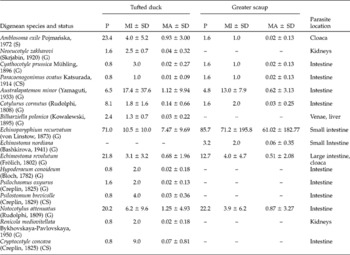
The ducks examined were found to harbour a total of 16 digenean species (table 2). Overall, the prevalence of infection in the two host species was similar, but the mean intensity and abundance of parasites were higher in the greater scaup, the differences between the host species being significant (P< 0.01) (table 1).
Parameters of infection in the tufted duck and greater scaup.

G, generalist; S, specialist; CS, captured specialist; P, prevalence (%); MI, mean intensity; SD, standard deviation; MA, mean abundance.
The digeneans were found to occur in typical locations in the host (table 2). In both hosts, E. recurvatum was the dominant and the core species. No digenean species was assigned the secondary species status. On the other hand, A. minor, E. revolutum and N. attenuatus (and Amblosoma exile in the tufted duck only) were the satellite species, but with infection parameters higher than those of the remaining satellite species (table 2). The parameters of infection of the dominant species were significantly different between the host species (P< 0.001), whereas the corresponding parameters of the satellite species showed no significant host-dependent differences.
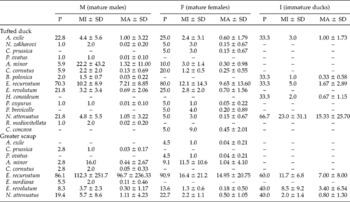
Overall, no significant between-sexes differences in the digenean species richness, abundance and intensity were revealed. Tufted duck males and females supported identical numbers of species (11; table 1). The tufted duck females showed higher infection parameters, compared to males (table 1), but the differences were not significant (P>0.05). Tufted duck males and females were most similar in the prevalence, mean intensity and abundance of infection with E. recurvatum and E. revolutum (table 3), whereas infections with N. attenuatus and A. minor showed some differences (table 3), significant for the first of the two species (P< 0.05). A comparison of digenean infections between males and females of the greater scaup showed different numbers of parasite species (table 1). Although the digenean prevalence was higher in females, and the infection intensity and abundance were higher in males (table 1), the differences were not significant (P>0.05). The intensity of occurrence and the abundance of the dominant E. recurvatum (core species) were several times higher in greater scaup males than in females, but – owing to the wide scatter of the data (high within-sex variability) – the between-sexes differences proved non-significant (P>0.05). Differences in infection parameters between greater scaup males and females were most pronounced in A. minor, E. revolutum and N. attenuatus (table 3), but for none of the species were they significant (P>0.05).
Parameters of infection of mature males, females and juveniles of the tufted duck and greater scaup.

P, prevalence (%); MI, mean intensity; SD, standard deviation; MA, mean abundance.
Despite a higher infection intensity and parasite abundance in the immature tufted duck, compared to the adults, and an opposite pattern in the greater scaup (table 1), differences between the age groups (adults versus immatures) were not significant (P>0.05). The digenean fauna of the juvenile tufted duck was dominated by N. attenuatus; E. recurvatum dominating in juvenile greater scaup (table 3).
The digenean community hosted by the greater scaup showed a lower species richness (S and s) and diversity (D and HB), compared to that in the tufted duck. The between-host differences were highly significant (P< 0.01; table 1) and the greater scaup digenean infracommunity was more strongly dominated (d) by the core digenean species, E. recurvatum. The faunistic similarity between digenean infracommunities harboured by the tufted duck and greater scaup, as determined with Jaccard's coefficient, was 50%. In the tufted duck, males showed a higher species diversity (D) than females (table 1), the faunistic similarity between digeneans present in males and females being 57%. An opposite pattern was seen in the greater scaup: the female-supported digenean assemblage showed a higher diversity (D), the dominance (d) being higher in the male-hosted assemblage (table 1). The faunistic similarity of digeneans present in greater scaup males and females was 44%. At the infrapopulation level, a higher diversity (HB) in both host species was typical of females than of males (table 1), the differences being, however, non-significant (P>0.05). In the immature tufted duck, diversity at the complex community level (D) was lower than in the adults of both sexes, but a higher diversity was observed in juveniles at the infrapopulation level (HB; table 1); the differences, however, were not significant (P>0.05). The corresponding indices in the greater scaup were different (table 1). The faunistic similarity between digenean assemblages in the immature tufted duck and greater scaup was 33%. There were no significant sex- and age-dependent differences in species richness and infrapopulation diversity between the digenean infracommunities (P>0.05).
Digenean community structure
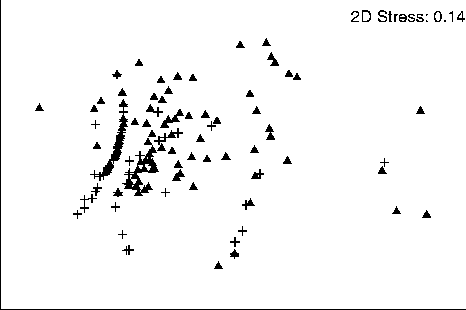
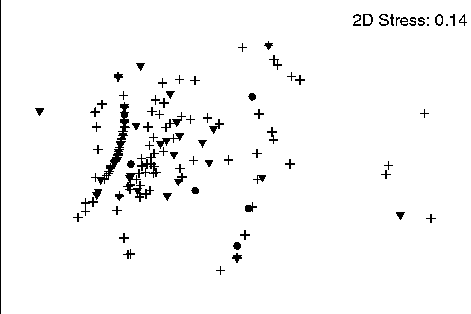
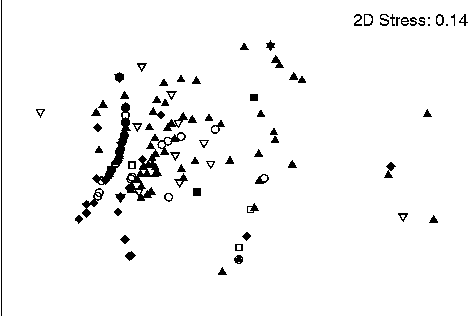
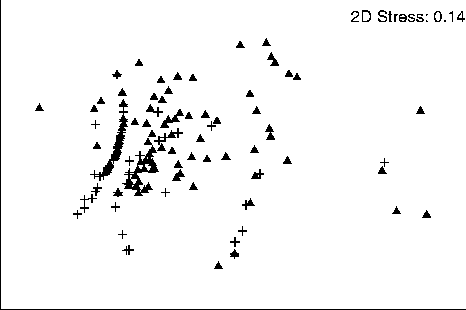
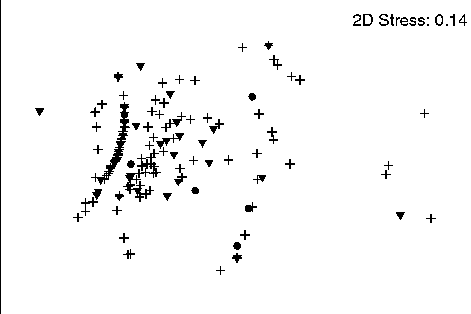
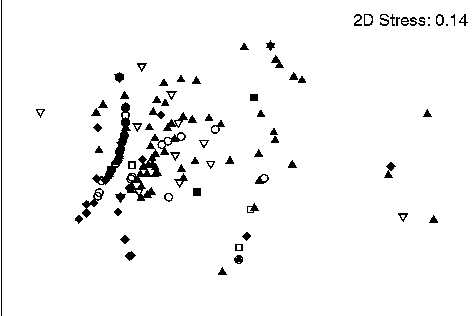
Results of MDS showed the digenean communities in the two hosts to be relatively similar in their structure, as evidenced by the absence of any clearly definable cluster of individuals (fig. 1). However, the greater scaup digeneans formed a much more homogeneous group than the community hosted by the tufted duck, which is in line with significant between-host differences in the infection metrics, as described above. As shown in fig. 2, there were no pronounced dissimilarities between the structure of digenean communities hosted by males and females, regardless of the host species. The digenean community structure in females seems to be more homogeneous than that in males, but it is primarily because of the high homogeneity within a group formed by the greater scaup-supported digeneans (cf. fig. 1). Within each host species, too, males and females supported a relatively similar digenean community structure (fig. 3). A closer analysis, however, showed the greater scaup digenean community structure to be more distinguishable than that of the tufted duck, regardless of the host sex.
Multidimensional scaling (MDS) diagram showing the pattern of similarity and dissimilarity between digenean communities in the host species. The data were square root transformed; similarity was determined using the Bray–Curtis similarity index; the value of stress indicates closeness of the two-dimensional (2D) representation in the diagram to the multivariate pattern. Key to symbols: regular solid triangles, Aythya fuligula; crosses, A. marila.
Multidimensional scaling (MDS) diagram showing pattern of similarity and dissimilarity between digenean communities in males, females and immature ducks, regardless of the host species. The data were square root transformed; similarity was determined using the Bray–Curtis similarity index; the value of stress indicates closeness of the two-dimensional (2D) representation in the diagram to the multivariate pattern. Key to symbols: crosses, males; inverted solid triangles, females; solid circles, immature ducks.
Multidimensional scaling (MDS) diagram showing pattern of similarity and dissimilarity between digenean communities in males, females and immature birds of each host species. The data were square root transformed; similarity was determined using the Bray–Curtis similarity index; the value of stress indicates closeness of the two-dimensional (2D) representation in the diagram to the multivariate pattern. Key to symbols: regular solid triangles, Aythya fuligula males; inverted open triangles, A. fuligula females; solid squares, immature A. fuligula; solid diamonds, A. marila males; open circles, A. marila females; open squares, immature A. marila.
Discussion
Digenean fauna and community structure in the tufted duck and greater scaup
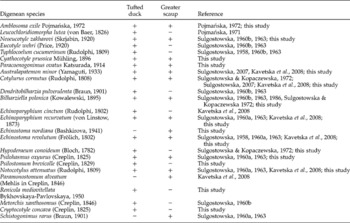
The present study supplied new information on the digenean fauna hosted by the tufted duck and greater scaup in Eurasia. With respect to knowledge of the wild duck digenean fauna in Poland, the present study extended the list of digenean species occurring in the tufted duck and greater scaup by six and five, respectively (table 4).
Digeneans of the tufted duck and greater scaup in Poland (+, present; −, absent).

Half of the total number (16) of digenean species found were shared by the two ducks; six of the shared species are generalists, one is a specialist, and one is a captured specialist (table 2). The high number of generalists is no surprise, as the two hosts have similar modes of life in winter and are therefore similarly exposed to the infective digenean stages. The two duck species share the foraging mode (picking the food when diving) and diet which, in winter, consists mainly of molluscs.
Contrary to expectations, the infection parameters (table 1) and the structure of infracommunities (fig. 1) proved to differ between the host species despite their sharing the common wintering ground. When searching for an explanation of these differences, the earlier, pre-wintering stages in the ducks' life histories have to be invoked. Prior to arrival at the wintering ground, the tufted ducks dwell in freshwater reservoirs and acquire freshwater parasites, including digeneans (Sulgostowska & Czaplińska, Reference Sulgostowska and Czaplińska1987). In contrast, the pre-wintering stage of the greater scaup's life history takes place at sea, which gives the bird no chance of exposure to freshwater parasites, whereas any possible marine parasites disappear when the ducks arrive at the freshwater wintering ground.
The high values of infection parameters describing the occurrence and dominance of E. recurvatum in both hosts confirmed the results of our earlier study on the tufted ducks in Lake Dębie and on the greater scaup in the Szczecin Lagoon (Rzęd et al., unpublished data). The high degree of domination of this digenean resulted most likely from the ducks acquiring high numbers of E. recurvatum metacercariae when arriving at the wintering ground and prior to dissection. The success of E. recurvatum is most probably enhanced by environmental conditions in Lake Dębie, including the presence of intermediate hosts. High numbers of the digeneans are supplied by the diet which relies heavily on molluscs, the second intermediate hosts of E. recurvatum. The Lake Dębie molluscs have not been adequately studied to date, except for the distribution of the zebra mussel Dreissena polymorpha (Pallas) (Bivalvia, Dreissenidae) (Piesik et al., Reference Piesik, Zieliński, Wachowiak-Zielińska, Ochman, Soroka and Polok1998). The study of Piesik et al. (Reference Piesik, Zieliński, Wachowiak-Zielińska, Ochman, Soroka and Polok1988) demonstrated the zebra mussel to have colonized about 46.5% of the Lake Dębie bottom, the mussel's average abundance amounting to 891 individuals/m2. Some authors (e.g. Mastitsky & Veres, Reference Mastitsky and Veres2010) expounded an important role of D. polymorpha as the second intermediate host of E. recurvatum. In their Lake Naroch (Belarus) study on parasites of the zebra mussel, a non-indigenous species, Mastitsky & Veres (Reference Mastitsky and Veres2010) found the metacercarial stage of the parasite to be substantially more abundant than other echinostomatid trematodes recorded in native molluscs. This was particularly the case in autumn at a depth of 2 m and at sites of bird gatherings. Bivalve infections with echinostomatids in Lake Dębie therefore require in-depth research. Echinoparyphium recurvatum is a generalist, commonly occurring in Poland; it has been reported from wild birds of the genera Anas, Aythya, Bucephala, Clangula, Cygnus and Larus throughout the country (Pojmańska et al., Reference Pojmańska, Machalska and Niewiadomska1984; Sulgostowska, Reference Sulgostowska1986; Sulgostowska & Czaplińska, Reference Sulgostowska and Czaplińska1987; Betlejewska & Korol, Reference Betlejewska and Korol2002). Larval stages of E. recurvatum have been recorded in Poland as well (Pojmańska et al., Reference Pojmańska, Niewiadomska and Okulewicz2007). Similarly high parameters of definitive host infection with E. recurvatum were reported by Sulgostowska (Reference Sulgostowska1963) from Lake Gołdapiwo, where the species accounted for 60.8 and 98.3% of the digenean communities hosted by the tufted duck and greater scaup, respectively. According to Sulgostowska (Reference Sulgostowska1963), the high abundance was related to a wealth of immature individuals of E. recurvatum. Although a host acquires a high number of larvae, only some of them reach sexual maturity, the redundant larvae being destroyed (Sulgostowska, Reference Sulgostowska1963).
Among the satellite species, E. revolutum, A. minor and N. attenuatus were characterized, in the two hosts, by higher infection parameters than other digeneans. The species mentioned are commonly found in Poland. Larvae of E. revolutum were reported from snails (Pojmańska et al., Reference Pojmańska, Niewiadomska and Okulewicz2007), adult E. revolutum being found in numerous bird species (Pojmańska et al., Reference Pojmańska, Machalska and Niewiadomska1984, Sulgostowska, Reference Sulgostowska1986; Sulgostowska & Czaplińska, Reference Sulgostowska and Czaplińska1987; Żuchowska, 1997; Betlejewska & Korol, Reference Betlejewska and Korol2002). Notocotylus attenuatus is a common duck parasite. Its life cycle involves a single intermediate host only, the cercariae encysting on aquatic plants and other objects (e.g. Našincová, Reference Našincová1992; Faltýnková, Reference Faltýnková2005). In Poland, N. attenuatus cercariae were reported from snails (Pojmańska et al., Reference Pojmańska, Niewiadomska and Okulewicz2007), and the adults were found in numerous bird species representing mainly the genera Anas and Aythya (Sulgostowska, Reference Sulgostowska1986; Sulgostowska & Czaplińska, Reference Sulgostowska and Czaplińska1987; Betlejewska & Korol, Reference Betlejewska and Korol2002). Australapatemon minor, previously considered to be a subspecies of Apatemon gracilis (Niewiadomska, Reference Niewiadomska, Gibson, Jones and Bray2002), has been recorded in Poland less frequently than E. revolutum and N. attenuatus. Its life cycle involves leeches as the second intermediate host and the source of infection for waterfowl.
The most likely reason why the tufted duck showed a conspicuous infection with A. exile (a specialist species known exclusively from Aythya; Pojmańska, Reference Pojmańska1972) is an earlier acquisition of the parasite, prior to wintering. Amblosoma exile metacercariae have been recorded in several Polish studies from the snails Viviparus viviparus and V. contectus (Pojmańska, Reference Pojmańska1972; Jeżewski, Reference Jeżewski2004, unpublished data). The tufted duck, a freshwater bird, feeds on those snails, thus encountering the digenean. As already mentioned, the greater scaup is basically a seaduck and therefore has no possibility of acquiring A. exile prior to wintering, as the parasite's intermediate hosts are the Viviparus snails inhabiting lenitic or sluggish lotic waters, fresh or slightly brackish, with lush aquatic vegetation and muddy bottom (Jeżewski, unpublished data). This problem is interesting and requires further studies, particularly because not all stages in the A. exile life cycle are known; for instance, the sporocysts and cercariae have not been encountered (Pojmańska, Reference Pojmańska, Gibson, Jones and Bray2002).
The presence of all digeneans in hosts is determined by the availability of intermediate hosts and depends on the available transmission pathways (with food, or via active free-living stages in the case of Bilharziella polonica); it is also associated with digenean definitive host specificity and the habitat type (freshwater or marine). Of the remaining digenean species, Paracoenogonimus ovatus is specific to various piscivorous species (e.g. Sitko et al., Reference Sitko, Faltýnková and Scholz2006). Its presence in the ducks examined was accidental, as confirmed by the low infection parameters (table 2). Psilostomum brevicolle and Cryptocotyle concava are specific to waterfowl associated with brackish and marine locations. Ducks can become infected when feeding in coastal lakes and lagoons as well as at the Baltic coast. Larval stages of C. concava were recorded in Poland along the Baltic Sea shoreline (Niewiadomska, Reference Niewiadomska2003). Details of life cycles and transmission pathways of Neoeucotyle zakharovi and Renicola mediovitellata have not yet been elucidated, therefore the major factors determining the infection success of those parasites in host species remain to be explored.
As noted by Šimková et al. (Reference Šimková, Sitko, Okulewicz and Morad2003), interaction between the habitat and the parasite life cycle should be regarded as a basic factor affecting the helminth community structure. It is particularly relevant for avian endoparasites which undergo complex developmental cycles. The higher digenean species diversity in the greater scaup is likely a result of a more variable provenance of tufted duck flocks present in the wintering ground, compared to flocks of the greater scaup. The wintering population of the tufted duck may include individuals that breed and nest in Poland as well as those that have arrived from the northern part of Eurasia. Most probably, the tufted duck-supported digenean community structure reflects, in addition to the digeneans acquired during wintering, the presence of digeneans taken up earlier (and the mode of their acquisition), prior to arrival at the wintering ground. The absence of marine digeneans in the greater scaup evidences a possibility of their being lost during migration to the wintering ground and during the initial weeks in the freshwater Lake Dębie. The mollusc-based monodiet in the wintering grounds in Poland could have contributed substantially to the low diversity of the digenean community hosted by A. marila.
Digenean fauna and community structure in ducks, relative to host sex and age
Contrary to expectations, the digenean communities hosted by males and females were very similar both in the tufted duck and in the greater scaup. On the other hand, males and females of the Aythyini are known to behave differently during and after the breeding season (Cramp & Simmons, Reference Cramp and Simmons1978). The host sex-dependent occurrence of digeneans was demonstrated by, inter alia, research on trematodes of the black headed gull (Larus ridibundus) (Sitko, Reference Sitko1993). Host sex-dependent differences in Aythyini-supported helminth communities have been recorded in other helminth groups, e.g. nematodes (Kavetska, Reference Kavetska2006). The similarity of digenean communities supported by males and females is in contrast to those observations, but may be a result of a non-typical situation. Possible differences could have been masked by the high dominance of E. recurvatum in the tufted ducks of both sexes. The mean abundance of E. recurvatum in the greater scaup, several times higher than that in the tufted duck, is interesting. Further studies should identify factors enhancing transmission success of the digenean, particularly in view of high abundance of echinostomatids in the zebra mussel elsewhere (Mastitsky & Veres, Reference Mastitsky and Veres2010) – the zebra mussel being a malacofauna dominant (Piesik et al, Reference Piesik, Zieliński, Wachowiak-Zielińska, Ochman, Soroka and Polok1998) in the duck wintering ground where this study was carried out. Differences in the parameters of infections with the remaining digeneans, shown by males and females of the tufted duck and greater scaup, could have been related to individual differences in feeding sites variously populated by the intermediate hosts.
The digenean communities supported by males and females of both duck species showed an inverse relationship between species diversity and dominance: a higher diversity was accompanied by a lower dominance. At the level of host individuals (in infrapopulations), the two host species were similar in that the digenean diversity in infracommunities was higher in females than in males. It has been pointed out that differences in the helminth occurrence between males and females may be underpinned by ecological, behavioural and immunity-related factors, including sex hormones, particularly testosterone (Alexander & Stimson, Reference Alexander and Stimson1988; Saino et al., Reference Saino, Møller and Bolzern1995; Klein, Reference Klein2000). With respect to helminth communities in the Aythyini, the problem is inadequately resolved and requires further study.
Domination of N. attenuatus and E. recurvatum in the community structure of digeneans hosted by immature ducks is due to the feeding behaviour of the juveniles. In their initial period of life, juveniles of most Aythyini feed among aquatic vegetation where cercariae of N. attenuatus are encysted and take the opportunity of infecting the definitive host. Later on, the ducks feed away from the shore, whereby their exposure to parasites is similar to that of the adults. However, as the number of immature specimens examined in the present study was low, the results obtained are by no means conclusive and digenean infections in immature ducks require further research.
Similarities and dissimilarities between digenean communities
In their study on parasites of A. affinis, Bush & Holmes (Reference Bush and Holmes1986b) demonstrated helminth infracommunities to be highly organized, the infracommunity structure tending to show distinct differences between the core and the satellite species. The parasite prevalence and intensity were highly correlated: those parasites occurring in a larger number of hosts were also more abundant in individual hosts (Bush & Holmes, Reference Bush and Holmes1986b). The main cause of the high homogeneity of the digenean communities hosted by the tufted ducks and greater scaup in the present study seems to be the ducks' monodiet, consisting in winter almost exclusively of molluscs, for which reason the digenean fauna is represented by a low number of species. The homogeneity of the digenean communities hosted by the tufted ducks and greater scaup stems most likely from conditions offered by the wintering ground. The habitat characteristics, particularly the species richness of malacofauna (including the second intermediate hosts of the digeneans), are likely to play a significant part, as already discussed above. It seems that the similarity of digenean communities supported by males, females and immature ducks of both species (cf. figs 2 and 3) may be explained by referring to the same factor, whereas the pre-wintering life histories underlie a general pattern of relative dissimilarity between the two hosts (fig. 1). Further studies on the tufted duck and greater scaup in other seasons of the year should show which digenean species will reach maturity in their definitive hosts. Such studies, hampered to some extent by legal protection of certain birds, should nevertheless be carried out whenever the ducks become available for parasitological examination.
Acknowledgements
We wish to acknowledge two anonymous reviewers who provided helpful comments on an earlier version of the paper. We are greatly indebted to Dr Teresa Radziejewska for her comprehensive assistance in preparation of the manuscript and for making the PRIMER software available to us, and to Dr Brygida Wawrzyniak-Wydrowska for preparing the graphics.