

Recently, as I was doing research for a project on eighteenth-century dances, I came across the following entry in Charles Compan's Dictionnaire de danse (1787):
Salamalec. Salut à la Turque, qui signifie, Dieu vous garde. On s'est servi longtems à Paris de cette expression, pour saluer une personne en buvant à sa santé. Salamalec, ou, comme prononcent les Turcs, Selamalec, n'est pas seulement une salutation des Turcs, mais encore des Arabes, & même de tous les peuples Mahométans.Footnote 1
Salamalec. Turkish greeting meaning ‘May God keep you’. This expression has long been used in Paris as a toast when drinking to someone's health. ‘Salamalec’, or as the Turks pronounce it, ‘Selamalec’, is not only a greeting of the Turks, but of Arabs and even of all Muslim peoples.
This entry reminded me of ‘salamelica’, the first word of Volpino's aria in Act 3 of Carlo Goldoni's libretto Lo speziale (The Apothecary), which Joseph Haydn set for the opening of the opera house at Eszterháza in 1768. Volpino's short aria is one of the most widely discussed numbers in Haydn's operatic output, yet the significance of Volpino's very first utterance in it has yet to be considered closely. As the first in a string of only loosely related short phrases, the expression might seem initially to be a nonsense construction or neologism. Indeed, both Matthew Head and Caryl Clark qualify it simply as ‘Italian-derived gibberish, standing in for Turkish’ or ‘Italianized gibberish’, although Clark translates it consistently as ‘Salaam’, and Larry Wolff characterizes it as ‘a Muslim greeting (“salam-aleykum”)’ or as ‘Italianized Arabic’.Footnote 2 These explanations, however, do not account for the intercultural valences of the expression in the eighteenth century, as attested by Compan's definition of it, nor for its potential resonances for Haydn's audience at Eszterháza.Footnote 3 Against the backdrop of the substantial literature on Volpino and his aria, in this essay I explore the uses and meanings of expressions related to ‘salamelica’ in the eighteenth century, and I suggest that Volpino's exclamation adds a further layer of complexity to his character. Despite the apothecary Sempronio's fascination with news from around the world, I contend that he is duped not only by his lack of worldliness, but by his ignorance of the cultural, theatrical and operatic conventions of Europe itself, the very conventions Volpino's aria evokes and with which Haydn's original audience would have been familiar.
THE LITTLE FOX
In Lo speziale, which Haydn set in a shortened and simplified version for the opening of the new theatre, Volpino – literally, the ‘little fox’ – is an aptly named character.Footnote 4 Haydn's comic opera features only a handful of the stock character-types familiar from the commedia dell'arte, who interact in often predictable ways: the apothecary Sempronio, his assistant Mengone and the dandy Volpino, each of whom wants to marry Sempronio's ward Grilletta. Although he is ultimately unsuccessful, Volpino lives up to his name and tries to best his rivals through cunning, trickery and deceit. In Act 2 he impersonates a notary in order to inscribe his own name into the marriage contract Sempronio dictates to him. When this ploy fails, he returns in Act 3 to give Sempronio a note requesting an Italian apothecary to help fight an outbreak of the plague in Turkey, which Sempronio had read about aloud from his newspaper at the beginning of the opera. Volpino then reappears disguised as a Turkish envoy to accompany Sempronio on his journey and to request Grilletta's hand in marriage; Sempronio is now happy to comply, eager only for the riches that await him in Turkey. As they prepare to depart, Volpino sings the following short aria, set to one of the few surviving passages of music Haydn composed for Act 3:
The libretto printed for the premiere of Haydn's opera indicates that at this point, Volpino is dressed in Turkish costume and accompanied by a retinue of other faux Turks (‘Sempronio, e Volpino vestito alla turca con finti Turchi’). Unfortunately for Volpino and unbeknownst to him, Mengone copies his disguise, and Sempronio marries Grilletta to him instead of to Volpino, presumably believing the two ‘Turks’ are the same person. At least when Lo speziale was revived at Eszterháza in 1774 and possibly when it was premiered there as well, both Volpino and Mengone's costumes were red and included caps and cummerbunds, and the libretto makes it clear that they also sported moustaches.Footnote 6
Although Volpino dresses up as a Turk and refers to Constantinople, several scholars have noted that aspects of both the text he sings and the music to which it is set complicate the identity he projects. Head has observed that the aria's duple metre, rebounding melodic thirds and harmonic retrogression from V to IV bring to mind the törökös, a parodic dance performed in Turkish costume to music most likely played by Roma (‘Gypsy’) musicians at weddings in central Hungary beginning during the Ottoman occupation (1526–1699). Head, like Bence Szabolcsi before him, identifies the törökös as an important source of the alla turca style of eighteenth-century European music, of which Volpino's aria is an early example.Footnote 7 Clark has also found significance in the vocables ‘dadl, dadl, dadl, dadl’ that appear in Haydn's autograph of the aria, replacing Goldoni's original ‘là, là, là, là’, syllables that were also retained in the printed libretto for Eszterháza. Clark proposes that ‘here the blending of ethnic otherness embraces that of Jewish vocality, for this noodling nonsense vocable bears a striking resemblance to the “deidl deidl” refrain concluding many a Hasidic tune or niggun’.Footnote 8
My purpose in summarizing existing scholarship is neither to support nor to refute specific readings of Volpino, but to highlight how the text and music of this aria have engendered varying interpretations of this character. The most neutral reading of this passage is that it confirms Volpino's fox-like nature while heightening the spectacle of operatic performance through visual and aural exoticism. The aria, furthermore, is typical of the alla turca style of the late eighteenth century in that it suggests what Mary Hunter has called a ‘classically Orientalizing blurring of boundaries among different sorts of Others’.Footnote 9 Neither Goldoni's original libretto nor the version set by Haydn provides any information about Volpino beyond his name, and there is no reason to think he is not Italian, especially within the context of an opera set in Italy.Footnote 10 However, a close consideration of Volpino's very first utterance – ‘salamelica’ – suggests that this Italian man may have assimilated more than Turkish, Hungarian, Roma and/or Jewish idioms into his discursive persona.
‘SALAMELICA’ IN EIGHTEENTH-CENTURY SOURCES
Perhaps because he was from Venice, with its history of trade and conflict with the Ottoman empire, Goldoni had a long-standing interest in writing plays and librettos with Eastern themes and settings, including Lugrezia romana in Costantinopoli (Lucretia of Rome in Constantinople, 1737); the trilogy La sposa persiana (The Persian Wife, 1753), Ircana in Julfa (Ircana in Jaffa, uncertain date) and Ircana in Ispahan (Ircana in Isfahan, uncertain date); La Dalmatina (The Dalmatian Woman, 1758); and L'impresario delle Smirne (The Impresario from Smyrna, 1759).Footnote 11 Yet a search of Goldoni's librettos reveals, other than Volpino's exclamation (which Goldoni spelled ‘salamelicca’), only two related expressions: ‘salamelech’ in Lugrezia romana in Costantinopoli and ‘salamelecch’ in La conversazione (The Conversation, 1758).Footnote 12 Similarly, searches – including a full-text search of the Eighteenth-Century Collections Online database, encompassing over 180,000 books, pamphlets, essays and broadsides – for terms similar to ‘salamelic(c)a’ return relatively few additional sources, which are detailed in Table 1.
Eighteenth-century sources containing variants of ‘salamelica’ (ordered by date of publication; original orthography retained and pagination given in parentheses)
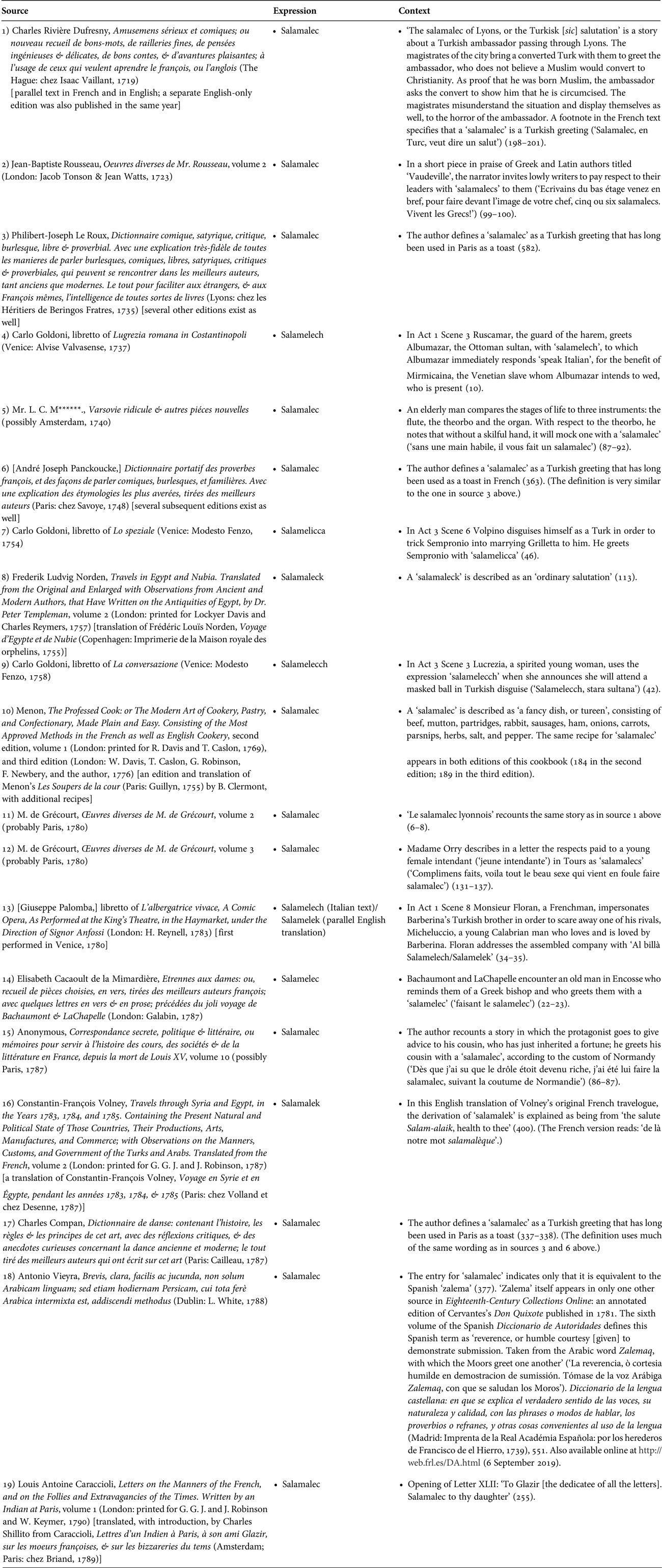
Although this listing is surely not exhaustive, it reveals a trend not evident from a consideration of Goldoni's librettos alone, namely that expressions related to ‘salamelica’ are most common in French contexts. In contrast to Goldoni's librettos, in which such exclamations are used exclusively by Turks (Lugrezia romana in Costantinopoli) or characters disguised as Turks (La conversazione and Lo speziale), only five additional sources (numbered 1, 8, 11, 13 and 16 in Table 1) – two of which (sources 1 and 11) recount the same story – involve a Turk (or Middle Easterner or North African) or a character impersonating one. With the exceptions of source 10, in which a ‘salamalec’ is described as ‘a fancy dish, or tureen’, and source 18, which provides no definition of ‘salamalec’ but simply gives its Spanish translation, the other sources involve non-Turks using variants of ‘salamelica’ in the same way Turks and pseudo-Turks do in Goldoni's librettos and in sources 1, 8, 11, 13 and 16: as a greeting or an expression of respect, sometimes satirical.Footnote 13 Moreover, most instances of expressions related to ‘salamelica’ occur in French sources (most commonly spelled ‘salamalec’) and/or are pronounced by French characters. Although source 1 (from 1719) explains explicitly that a ‘salamalec’ is a Turkish greeting, source 15 (from 1787) implicitly suggests that this expression had become naturalized during the intervening years, describing a ‘salamalec’ as a custom of Normandy.Footnote 14 Indeed, two sources are presented explicitly as being about French society and manners (sources 15 and 19), and three others are directed at readers who wish to increase their comprehension or perfect their knowledge of the French language (sources 1, 3 and 14).
Compan's dictionary of dance, which I cited at the beginning of this essay, further corroborates the well-established use of the expression ‘salamalec’ in France by the second half of the eighteenth century, and the Dictionnaire historique de la langue française traces its adoption into the French language to 1659:
Salamalec n. m. est emprunté à l'arabe as-salam ‘alayk, formule de salutation signifiant ‘paix sur toi’. Introduit avec le sens de ‘salut à la turque, grande révérence’ (on relève aussi l'ancien provençal çalamalec ‘salut arabe’), le mot est employé à partir du XVIIe s. (1659) avec une connotation péjorative et n'a conservé que le sens familier, surtout au pluriel, de ‘révérences, politesses exagérées’ (faire des salamalecs). On rencontre la graphie salamalek chez Nerval et, en français d'Afrique, la forme empruntée salamalekoum, formule de salutation équivalente à ‘la paix soit avec vous (pluriel)’.Footnote 15
Salamalec (masculine noun) is borrowed from the Arabic as-salam ‘alayk, a greeting that means ‘peace be with you [informal singular]’. Introduced [into French] with the sense of ‘Turkish greeting, great reverence’ (one also finds the old provençal çalamalec ‘Arab greeting’), the word is used from the seventeenth century (1659) with a pejorative connotation and has only preserved the colloquial meaning, especially in the plural, of ‘exaggerated bows and politenesses’ (faire des salamalecs). In Nerval's works, one encounters the spelling salamalek and, in African French, the borrowed form salamalekoum, a greeting equivalent to ‘peace be with you (plural)’.
Conversely, although the encyclopedic Grande dizionario della lingua italiana includes entries for the verb ‘salameleccare (salamaleccare)’ and the nouns ‘salamelècca’ and ‘salamelècco (salamalècco, salamelech, salemelèc, salemelècche)’, which it defines as ‘greeting, homage, regards’ (‘saluto, omaggio, ossequio’) in accordance with the meaning of the Arabic sala'm alayk (‘pace a te’ – peace be with you (singular)), it does not suggest that these expressions have ever commonly been used in Italian.Footnote 16 Instead, the entries identify isolated occurrences of these words in a variety of sources ranging over several centuries, highlighting their very limited role in Italian, especially as compared to the evidence of the much more common use of ‘salamalec’ in French. The French assimilation of this term may bear witness to the cordial relations and alliances between the French and Ottomans extending back to the early sixteenth century.Footnote 17
POSSIBLE INTERPRETATIONS AND RESONANCES AT ESZTERHÁZA
Goldoni's grasp of French was idiomatic, if ungrammatical, even before he settled in Paris in 1762,Footnote 18 and presumably the use of ‘salamalec’ in French was known to him as he penned the libretto of Lo speziale. Volpino's utterance of the expression in an Italianized form (matching the language of the opera's libretto and the five-syllable lines of his aria, in which stress falls on the penultimate syllable of each line) may suggest this character's acquaintance with and adoption of French speech and customs, perhaps in an effort to increase his appeal to women.Footnote 19 Indeed, French men are characterized in librettos roughly contemporary with Lo speziale as appealing, flirtatious or womanizing, shedding light on popular stereotypes. In Act 1 Scene 1 of Goldoni's La conversazione (Table 1, source 9), for example, Giacinto, whose travels have taken him throughout the world, declares:
Similarly, in Act 1 Scene 1 of L'albergatrice vivace (The Vivacious Landlady; Table 1, source 13), Monsieur Floran describes himself as a ‘pretty Paris toy’, certain that ‘this face, my complexion, my shape, this tout ensemble François [whole French package], has certainly captivated her [Barberina's] heart’.Footnote 21 But even if Haydn's audience at Eszterháza was familiar with such stereotypes of French men, would Volpino's exclamation ‘salamelica’ have evoked the French ‘salamalec’ and brought these stereotypes to mind? If not, what resonances might Volpino's expression and the Turkish scene more generally have had for them?
The opera librettos from which I have just quoted are helpful sources for speculating about contemporary interpretations of Volpino in Haydn's setting of Lo speziale. In L'albergatrice vivace, Giuseppe Palomba puts ‘salamelech’ in the mouth of Monsieur Floran, a Frenchman impersonating his beloved Barberina's Turkish brother in order to scare away a rival for her affections. The libretto as a whole is striking in its multilingualism, with characters singing in French, German and Spanish in addition to Italian. Similarly, in Goldoni's La conversazione, Lucrezia uses the expression ‘salamelecch’ in the context of what John A. Rice has described as ‘one of Goldoni's most relentlessly multilingual librettos. . . . It includes not only German but French, English, Latin and Turkish; not only standard Italian but Venetian, Bolognese, Neapolitan and Calabrese dialects’.Footnote 22 In these cases as in Lo speziale, then, one might read the inclusion of ‘salamelica’ and related expressions as markers of characters’ general worldliness and fluency in a variety of idioms, linguistic and/or musical.Footnote 23
Furthermore, while Volpino – much like Giacinto in La conversazione – uses his knowledge of the world to his advantage, Sempronio is at once fascinated by but deeply uninformed about the wider world. Fiction is thematized throughout Lo speziale, from the preposterous news items Sempronio shares at its outset – in China, a man from Moscow gave birth; in Persia, a sofa took a wife – to the Turkish travesty at its conclusion. Sempronio's avarice and professional incompetence predispose him to believe this exotic sham, as he dreams of becoming rich while curing the plague in Turkey. Sempronio is the target of ridicule in this scene, not the Turks,Footnote 24 and it is a given of the opera's plot that he will ultimately be duped. Lo speziale parodies the hapless apothecary as a gossip-mongering nouvelliste, a character type lampooned in other eighteenth-century comic operas such as Charles-François Panard's Le Nouvelliste dupé (The Duped Newsmonger, 1732; performed in Vienna in 1759).Footnote 25 Sempronio's enthusiasm for Turkey specifically is rooted in his greed, and – like Panard's nouvelliste Monsieur Timbré – his insatiable appetite for world news more generally blinds him to the trickery taking place right under his nose, as Head has pointed out.Footnote 26
I suggest, however, that Volpino's ruse (which Mengone co-opts) owes its success in at least equal measure to Sempronio's ignorance of the European cultural, theatrical and operatic conventions highlighted in the diegetic Turkish scene. The words ‘cantara’ and ‘ballara’ in the text of the aria strongly suggest that Volpino is not only referring to singing and dancing in Constantinople but demonstrating both for Sempronio. Green has noted that the libretto for Pallavicini and Fischietti's 1755 setting of Lo speziale for Venice lists ten ‘ballerini’ – possibly the ‘finti Turchi’ who appeared alongside Volpino and who may have danced at Eszterháza as well.Footnote 27 The choreography may have incorporated exotic elements like those of Anthony L'Abbé’s Turkish dance of the early 1720s, which sets music from the Turkish entrée of André Campra's opéra-ballet L'Europe galante (1697) and features movements that were not typical of contemporary French-style noble dancing, including flat-footed steps, successive brushes of the foot and successive hops, frequent circles of the leg, and balancing on one leg with the other lifted in the air.Footnote 28 Bernardo Bellotto's famous engraving of the stage of Vienna's Burgtheater at the premiere on 26 April 1758 of Joseph Starzer and Franz Hilverding's pantomime ballet Le Turc généreux (The Magnanimous Turk), which includes male characters disguised as Turks at the back right of the stage balancing on one leg, reveals that at least this element of L'Abbé’s choreography was still current near the time of Lo speziale’s premiere at Eszterháza. Compan's inclusion of ‘salamalec’ in a dictionary devoted to dance, furthermore, suggests that Volpino's own performance may have included physical gestures, perhaps the ones described by Grécourt in Table 1, source 11:
As Sempronio witnessed the Turkish scene along with the Esterházys and their guests, only the apothecary could have been insensible to the conventions it referred to – and subverted by having a soprano sing the part of the ‘Turk’ during a century in which masculinity became an integral aspect of his operatic representation.Footnote 29 Turkish costumes were popular at carnivals, masquerades and fancy-dress parties throughout Europe in the eighteenth century.Footnote 30 Disguises and deceit, moreover, were recurring features not only of comic operas in general, but of operas on Turkish subjects and scenes with Turkish themes in particular.Footnote 31 These extend back to the ceremony concluding Molière and Jean-Baptiste Lully's comédie-ballet Le bourgeois gentilhomme (The Would-Be Gentleman, 1670), in which Cléonte disguises himself as the son of the Grand Turk in order to trick Monsieur Jourdain into giving him his daughter in marriage. Cléonte then proceeds to ‘ennoble’ Jourdain to the fictitious Turkish rank of ‘mamamouchi’, playing up to his desire for status and uttering ‘salamalequi’ in the process – a parallel that is particularly noteworthy given Goldoni's long-standing reverence for the works of Molière, upon which he based his own reform of Italian comedy.
Turkish themes continued to be popular, especially in French plays, operas and ballets (well-known examples include Hilverding and Starzer's previously mentioned Le Turc généreux as well as Christoph Willibald von Gluck's Le Cadi dupé (The Duped Judge, 1761) and La Rencontre imprévue (The Unexpected Meeting, 1764)), some of which shared the stage of the Burgtheater in Vienna with Italian and German offerings, especially in the wake of the fire that destroyed the Kärntnertortheater in 1761.Footnote 32 As Bruce Alan Brown has documented, French theatre already had a long tradition in Vienna by the later eighteenth century, and the diversity of linguistic, national and generic offerings in the Habsburg capital meant that spectators often ‘perceived resonances with French stage pieces regardless of whether they were real or intentional’.Footnote 33 He notes that in his Briefe über die wienerische Schaubühne (Letters on the Viennese Stage, 1767–1768), for instance, Joseph von Sonnenfels, a jurist, journalist and court official, commented explicitly on the similarity between the narratives of Pietro Chiari and Baldassarre Galuppi's opera buffa Il marchese villano (The Boorish Marquis, 1762) and Le bourgeois gentilhomme.
Such parallels would hardly have escaped the Esterházys or their guests: they patronized French theatre and Italian opera through attendance at public and private performances in Vienna and elsewhere, and in the case of the Esterházys, through their extensive music collection as well.Footnote 34 Of particular note in their private library are numerous operas and ballets on Turkish subjects. As the primary original audience for Haydn's Lo speziale, their acquaintance with theatrical turquerie can thus hardly be questioned. Just as only Monsieur Jourdain could mistake disguised Frenchmen for actual Turks – and representation for reality in Le bourgeois gentilhomme – only someone as uncultured as Sempronio could fail to recognize the similarly diegetic fiction acted out by Volpino, which indirectly praised Haydn's audience for its own cultivation and cosmopolitanism.
We may never know with certainty how Goldoni's libretto for Lo speziale made it into Haydn's hands or why a piece originally composed for a bourgeois Italian audience appealed to Prince Esterházy. The Prince's selection of librettos for Haydn to set – most likely in consultation with the composer and possibly with others in his musical establishment – undoubtedly depended on several factors, including personnel, cost and availability of staging materials, and personal taste. The choice to inaugurate his opera house with a dramma giocoso established Prince Esterházy as a patron who shared the fashionable modern taste for Italian comic opera evident in Vienna's court theatres as well as in public theatres throughout Europe. Significantly, the Turkish scene near the conclusion of Lo speziale emphasized the uniqueness of the specific location of the new theatre while simultaneously claiming its place on a broader European stage. The mixing of references in Volpino's aria reflects the ethnic and cultural diversity of the area surrounding Eszterháza, not least because of its proximity to the border between the Habsburg and Ottoman empires, which had shifted relentlessly over the preceding centuries. In 1768, the outbreak of the Russo-Ottoman war ensured that the Turks were once again of central political and cultural interest across Europe, reflected in the number of operas on Turkish themes created during the war years (1768–1774).Footnote 35 A comedy whose denouement occurs through a Turkish scene was thus a perfect choice for the inauguration of the opera house at Eszterháza: it spoke to current affairs while drawing on a traditional operatic theme, and it alluded to the multicultural contact zone in which the theatre was located while drawing on conventions of Turkish operatic representation that were popular and familiar throughout Europe.