


Introduction
Accumulating research (e.g. Figueira et al., Reference Figueira, Luz, Braga, Cabizuca, Coutinho and Mendlowicz2007; Paunovic and Ost, Reference Paunovic and Ost2001; Pham, Weinstein, and Longman, Reference Pham, Weinstein and Longman2004; Vinck, Pham, Stover and Weinstein, Reference Vinck, Pham, Stover and Weinstein2007) indicates posttraumatic stress disorder (PTSD) is a universal phenomenon. However, it remains substantially unknown as to whether the processes implicated in the aetiology and maintenance of PTSD are culturally similar. Recent studies, conducted primarily in cultures that are western and emphasize the independent self, identify a number of factors that impede post trauma recovery, maintain post traumatic symptoms and potentially predict the development of ongoing PTSD (see Brewin, Andrews and Valentine, Reference Brewin, Andrews and Valentine2000; Ozer, Best, Lipsey and Weiss, Reference Ozer, Best, Lipsey and Weiss2003 for reviews). These factors include both historical and developmental variables such as a history of psychological problems and previous trauma; specific trauma related factors such as trauma type, trauma severity, peri-traumatic dissociation and peri-traumatic emotional response; post trauma factors such as the quality of social support and avoidant coping; and cognitive factors such as ongoing negative appraisals of the self, appraisals of personal action during the trauma, appraisals of others and rumination (Kleim, Ehlers and Glucksman, Reference Kleim, Ehlers and Glucksman2007).
Despite such impressive theoretical and empirical advances, the applicability of these factors in the development and maintenance of PTSD in trauma survivors from cultures that are non-western and emphasize the interdependent self remains relatively unknown. For three reasons, this current study has chosen to focus on the impact of culture on the relationship between cognitive appraisals and PTSD. First, cognitive appraisals are of particular interest because they are central to some recent influential clinical cognitive models of PTSD (e.g. Ehlers and Clark, Reference Ehlers and Clark2000) and also because they are potentially modifiable. They may provide important targets for strategies to prevent or reduce distress and psychological disability following trauma. Second, there is recent empirical evidence that suggests that cognitive factors are the most useful of a set of historical, trauma specific, and other predictors for identifying chronic PTSD (Kleim et al., Reference Kleim, Ehlers and Glucksman2007). Third, there is substantial literature indicating cultural differences in appraisals and subsequent affective responses and psychological adjustment.
The model of PTSD put forward by Ehlers and Clark (Reference Ehlers and Clark2000) emphasizes the role of self-relevant appraisals of the trauma experience and/or its sequelae in the maintenance of PTSD. The model suggests that appraisals function to maintain a sense of current threat in the survivor's life and are instrumental in promoting the use of maladaptive strategies intended to control this threat and the current symptoms. There has been ongoing examination of four theoretical-derived cognitive appraisal domains in particular. Two of these appraisal domains (mental defeat, control strategies) refer to survivors' appraisal of their cognitive, emotional and behavioural responses during the traumatic event. The other two appraisal domains (permanent change, alienation) refer to survivors' appraisals of themselves and of their relationship to others subsequent to the trauma. There is some evidence that these four appraisals operate in PTSD consistently with the appraisal model. A number of studies have found mental defeat to be associated with PTSD severity (Dunmore, Clark and Ehlers, Reference Dunmore, Clark and Ehlers2001; Ehlers, Clark et al., Reference Ehlers, Clark, Dunmore, Jaycox, Meadows and Foa1998; Ehlers, Maercker and Boos, Reference Ehlers, Maercker and Boos2000; Ehlers, Mayou and Bryant, Reference Ehlers, Mayou and Bryant1998) and mental defeat has been consistently found to be associated with persistent PTSD following assault (Dunmore et al., Reference Dunmore, Clark and Ehlers2001). Ehlers et al. (Reference Ehlers, Maercker and Boos2000) found that when compared to political prisoners without PTSD, political prisoners with chronic PTSD were more likely to perceive mental threat and an overall feeling of alienation and perceived negative and permanent change in their personalities or life aspirations. Ehlers, Clark et al. (Reference Ehlers, Clark, Dunmore, Jaycox, Meadows and Foa1998) found that rape survivors whose memories reflected mental defeat or the absence of mental planning/control strategies showed little improvement following exposure therapy, and inferior outcome was associated with overall feelings of alienation and permanent change following the trauma.
While these data are consistent, there is acknowledgment (Ehlers and Clark, Reference Ehlers and Clark2000; Kleim et al., Reference Kleim, Ehlers and Glucksman2007) that the relative importance of specific appraisal factors may be influenced by several “background” factors, in particular characteristics of the trauma and the person's previous experiences and beliefs. We believe that there are very good conceptual and empirical reasons to propose that cultural differences in the nature of self and self-construal may play an important role in determining the relative importance of appraisal domains in PTSD. All four appraisal domains proposed by Ehlers and Clark either focus on the self and one's actions, autonomy and consistency across time (e.g. “I was weak”, “I deserved for this to happen”, “I am incompetent, inferior, unworthy”, “I am permanently damaged”), or on self in relationship to others (e.g. “Others can know that I am a trauma survivor”, “I will always be alone and no one understands”, “Others think I cannot cope”). Ehlers and Clark posit that appraisals centered round the self maintain PTSD as survivors continue to perceive current situations as threatening and dangerous and themselves as inadequate and unable to cope in current situations. They suggest that appraisals about others and interpersonal relationships maintain PTSD because they are instrumental in withdrawal from social interactions and reduce opportunities to receive social support and to correct negative beliefs about themselves and others (Ehlers et al., Reference Ehlers, Maercker and Boos2000).
It is this inclusion of appraisal of self and self-in-relationship that brings Ehlers and Clark's model into the cultural sphere. Mesquita and Walker (Reference Mesquita and Walker2003) propose that cultural differences in self-construal “facilitate and render desirable certain appraisals of events, while making the occurrence of others less likely and less valued” (p. 784). Additionally, they suggest cultural variation in self-construal “foster culture-specific appraisal tendencies that are reflected in culturally distinct patterns of emotional experience” (p. 784). For example, independent cultures appraise success through independence, agency, personal accomplishment and a personal sense of control (Markus and Kitayama, Reference Markus and Kitayama1991). In contrast, it is suggested that personal agency and control has “very limited applicability” (Mesquita and Walker, Reference Mesquita and Walker2003, p. 785) in interdependent cultures, rather the interdependence of an individual and their social environment is stressed. Such theoretical positions are supported by considerable research (e.g. Matsumoto, Kudoh, Scherer and Wallbott, Reference Matsumoto, Kudoh, Scherer and Wallbott1988; Mauro, Sato and Tucker, Reference Mauro, Sato and Tucker1992; Mesquita and Ellsworth, Reference Mesquita, Ellsworth, Scherer and Schorr2001; Mesquita and Markus, Reference Mesquita, Markus, Frijda, Manstead and Fischer2004; Scherer, Reference Scherer1997).
Additionally, cultural differences in appraisals have been found to impact on affective responses (Mesquita and Karasawa, Reference Mesquita and Karasawa2002; Mesquita and Walker, Reference Mesquita and Walker2003) with appraisals of personal responsibility, autonomy and control associated with positive affect in independent cultures but not in interdependent cultures. Furthermore, it has been suggested (e.g. Sato, Reference Sato2001) that poorer psychological adjustment is associated with perceived diminished autonomy and personal control for those from independent cultures, while poorer psychological adjustment is associated with perceived alienation and social rejection for those from interdependent cultures.
Combining the literature indicating cultural differences in self-construal impacts on appraisals and subsequent affective responses with Ehlers and Clark's appraisal model, this study hypothesizes that the differences in these cognitive appraisals between those with and without PTSD will culturally differ. It is predicted that trauma appraisals that focus on the self, independence, control and agency (i.e. mental defeat, control strategies and permanent change) will have greater impact on post-trauma psychological adjustment of trauma survivors from independent cultures than for trauma survivors from interdependent cultures. Hence, the difference in these appraisals between those with and without PTSD will be significantly more pronounced for trauma survivors from independent cultures than for trauma survivors from interdependent cultures. On the other hand, trauma appraisals that focus on the self in relation to others and interdependence (i.e. alienation) will have a greater impact on the psychological adjustment of those from interdependent cultures than those from independent cultures. Thus, the difference in these appraisals between those with and without PTSD will be significantly more pronounced for trauma survivors from interdependent cultures than for trauma survivors from independent cultures.
Method
Participants
All participants (N = 106) were recruited from the general community by posters in public places, Adult Migrant English Programs, advertisements in local and ethnic newspapers, and contacts with ethnic organizations and communities, and organizations that provide treatment for trauma survivors. The researchers promoted the study in places likely to reach people with a high probability of having a Diagnostic and Statistical Manual of Mental Disorders-IV (DSM-IV) PTSD Criteria A trauma experience (i.e. “the person has experienced, witnessed, or been confronted with an event that involved actual or threatened death or serious injury . . . to oneself or others” and “the person's response involved intense fear, helplessness, or horror” (American Psychiatric Association, 1994, pp. 427–428). Notices called for those who had experienced a traumatic event and identified the study as researching trauma, memory and culture. Participants received a $20 supermarket voucher for their participation.
Measures
Independence/interdependence. Cultural independence/interdependence was measured using the Twenty Statements Test (TST; Kuhn and McPartland, Reference Kuhn and McPartland1954). The TST is a simple and commonly used technique to assess one's sense of self or self-identification (Kuhn and McPartland, Reference Kuhn and McPartland1954). Researchers have frequently used the TST to examine and control for cultural differences in the individual's sense of self (Bochner, Reference Bochner1994; Dhawan, Roseman, Naidu, Thapa and Rettek, Reference Dhawan, Roseman, Naidu, Thapa and Rettek1995; Ma and Schoeneman, Reference Ma and Schoeneman1997; Rhee, Uleman, Lee and Roman, Reference Rhee, Uleman, Lee and Roman1995; Wang, Leichtman and White, Reference Wang, Leichtman and White1998; Watkins and Gerong, Reference Watkins and Gerong1999). The TST has been found to have high interrater reliability, criterion validity tests have generally supported the TST, and researchers have shown the TST to have a fair degree of test-retest reliability (Kuhn and McPartland, Reference Kuhn and McPartland1954; Spitzer, Couch and Stratton, Reference Spitzer, Couch and Stratton1973), content validity (Kuhn and McPartland, Reference Kuhn and McPartland1954), and comparability with other self-instruments (in terms of concurrent validity; Spitzer et al., Reference Spitzer, Couch and Stratton1973).
Posttraumatic stress disorder status. Posttraumatic stress disorder was diagnosed using the Posttraumatic Stress Diagnostic Scale (PDS; Foa, Riggs, Dancu and Rothbaum, Reference Foa, Riggs, Dancu and Rothbaum1993). The PDS was developed to provide a brief self-report instrument to assist with the diagnosis of PTSD. The PDS has four parts. Parts I and II contains trauma screening questions that correspond to DSM-IV (APA, 1994) PTSD Criteria A. Part III contains 17 items, each corresponding to the Criteria B through Criteria D. Participants are asked to rate these items, for the past month, on a 4-point scale ranging from 0 (not at all) to 3 (almost always). A symptom is considered to be present if it is scored 1 or higher. The ratings of the items are summed to calculate a total severity score. The PDS then ascertains duration of the symptoms (Criteria E) and impairment of functioning (Criteria F). To be considered a positive screen on the PDS, a participant must meet Criteria A, endorse a broad enough range of items to meet Criteria B (re-experiencing), C (avoidance), and D (increased arousal), have symptoms present for over one month, and indicate that the disturbances are causing significant impairment in functioning (i.e. a diagnosis of PTSD is only made if all six DSM-IV criteria are endorsed. If one or more of the criteria is not met, a diagnosis of PTSD is not made). The PDS has adequate test-retest reliability, concurrent and convergent validity with other measures of psychopathology (including the Structured Clinical Interview; Spitzer, Williams and Gibbon, Reference Spitzer, Williams and Gibbon1987) and predictive validity (Foa et al., Reference Foa, Riggs, Dancu and Rothbaum1993). The PDS has also been used in previous research with interdependent populations (e.g. Garcia, Reference Garcia2005).
Trauma history. To control for lifetime exposure to traumatic events, the Trauma History Questionnaire was used (THQ; Green, Reference Green and Stamm1996). The THQ is designed to assess exposure to a wide range of potentially traumatic events in three areas: crime-related events, general disaster and trauma, and unwanted physical and sexual experiences (Green, Reference Green and Stamm1996). Test-retest reliability of the THQ has been found to be moderate to high and interrater reliability high (Mueser et al., Reference Mueser, Rosenberg, Fox, Salyers, Ford and Carty2001). Furthermore, the THQ has also been used in interdependent cultures (e.g. Fiszman, Cabizuca, Lanfredi and Figueira, Reference Fiszman, Cabizuca, Lanfredi and Figueira2005).
Depression. Depression was measured using Part II of the Hopkins Symptom Checklist (HSCL-25; Derogatis, Lipman, Rickels and Cori, Reference Derogatis, Lipman, Rickels and Cori1974). The HSCL-25 depression score has been consistently shown in several populations to be correlated with major depression as defined by DSM-IV (APA, 1994), has adequate psychometric properties (Derogatis et al., Reference Derogatis, Lipman, Rickels and Cori1974) and is regularly used in cross-cultural research (e.g. Mouanoutoua and Brown, Reference Mouanoutoua and Brown1995).
Demographics. Participants were asked to disclose their age, gender, length of time in Australia and ethnicity. Following this, participants were asked to rate on a 10-point Likert-type scale from 1 (not at all) to 10 (extremely) how hard they found the study.
Trauma narratives. Participants were asked to “Please think about a significant, emotionally, traumatic event. Please write about this event in as much detail as you can. All your writing will be completely confidential. As you write do not worry about punctuation or grammar, just write as much as you can and you can include thoughts, feelings, reflections, etc. If you need more room please use the next page.”
Scoring/coding system
Independence/interdependence. The TST was coded for independence and interdependence. Each participant's self-cognitions were coded as referring to independent (private) or interdependent (collective or public) aspects of self, in line with the definitions provided by Trafimow, Triandis and Goto (Reference Trafimow, Triandis and Goto1991) and Triandis (Reference Triandis1989). Therefore, self-cognitions were coded as independent (private) if the responses referred to personal qualities, attitudes, beliefs, or behaviours that were not related to other people (e.g. “I am kind”, “I am happy”). Self-cognitions were coded as interdependent if they were collective self-cognitions (responses concerning to particular groups or categories, e.g. “I am Asian, woman, daughter”) or cognitions pertaining to interdependence, friendship, and relationships or to the sensitivity of others (e.g. “I am in love”). Each participant received an independent and interdependent score, which was the ratio of each type of self-cognition divided by the number of cognitions provided.
Narratives. Narratives were scored based on the coding developed in the 10-page manual by Ehlers, Clark and Foa (received by personal correspondence, cited in Ehlers, Clark et al., Reference Ehlers, Clark, Dunmore, Jaycox, Meadows and Foa1998) and Ehlers et al. (Reference Ehlers, Maercker and Boos2000). Following Ehlers, Clark et al., (Reference Ehlers, Clark, Dunmore, Jaycox, Meadows and Foa1998) narratives were read three times. The first reading was to familiarize the raters with the memory. The raters then read the transcripts again highlighting any material relevant to the concepts of mental defeat, control strategies, alienation and permanent change. On the third reading raters gave an overall rating using the following criteria.
Mental defeat. Mental defeat was defined as the perceived loss of psychological autonomy, the sense of no longer being human, the threat to the self as an autonomous human being, the state of mentally giving up and the loss of all efforts to retain one's identity as a human being with an individual will. Evidence for mental defeat comes from direct comments about the survivor's perception that they gave up in their own mind, was completely defeated, feeling completely at the will of the assailant or cause of trauma, the loss of being a person with their own will, not feeling like a human being any longer, and so forth. Autonomous frame of mind is the opposite of mental defeat and reflects retaining a sense of freedom of mind and maintaining their will, convictions and/or character. Each participant's narrative received a mental defeat score from -2 (strong evidence of autonomous frame of mind during trauma) to 2 (strong evidence of loss of psychological autonomy). Examples of mental defeat were “I thought my life was over” (rating 2) and “it looks like my time is up” (rating 2). Whereas an example of an autonomous frame of mind was “I knew I could help them and support them. I was powerful” (rating -2).
Control strategies. Control strategies was coded as the overall level of thinking about or planning in one's mind about what might be able to be done to minimize physical or psychological harm, to make the experience more tolerable, or to influence the situation. Evidence for control strategies was taken from planning thoughts, statements and actions that were taken intentionally in an attempt to exert control over the situation. Each participant's narrative received a control strategies score from 0 (no evidence of control strategies) to 4 (strong evidence of control strategies). Examples of control strategies were “He [husband] stabbed me below the eye. I resisted and screamed as blood ran down my face onto my dress . . . so I left him” (rating 4) and “I felt that if I am an adult I may stop the man from beating the woman. I also felt I could kill the man” (rating 4).
Alienation. Alienation was coded as a general overall feeling in the narrative that the participant felt alienated from the world and others. This was taken from participants' feelings with others after trauma and their feelings about these interactions. It needed to be clear that participants viewed these interactions and people in a negative way. It also included not being able to interrelate with people after trauma or that others failed to meet their needs. Evidence against alienation was taken from statements about a sense of support and safety provided by others. Each participant's narrative received an alienation score from -2 (strong evidence against alienation, i.e. connectedness) to 2 (strong evidence of alienation). Examples of alienation included “I feel betrayed, unloved and unsupported by my family” (rating 2) and “I was ignored by others. . . . disregarded completely” (rating 2). Examples of feeling socially supported included “I spent time with a group of friends” (rating -2), and “as a result of her death – the time family spends together/relationships became so much more important with that particular family . . . you are thankful for those special people around you” (rating -2).
Permanent change. Permanent change was coded as an overall sense that participants viewed their life as having been changed forever in a negative way. Evidence against permanent change was a sense that participants saw the event as an isolated bad experience or participants felt that they had grown or developed from the experience. Each participant's narrative received a permanent change score from 0 (no negative changes in personality, life goals, future of life) to 4 (strong evidence of changes in personality, life goals, future of life). Examples of statements indicating permanent change included “The person I was ended that night . . . I have become an ugly burnt freak” (rating 4), and “My personality was adversely affected” (rating 3).
Design and procedure
Interested potential participants were sent a data package. Return rate was 42.4%. The data package contained a letter outlining the aims of the study, the instructions for participation and that if the participant decided to return the questionnaire they were giving their consent to having their questionnaire used in the study. The package also contained a reply paid self-addressed envelope so the participants could return the questionnaire to the researcher and a voucher slip. The voucher slip required participants to enter their name and address and these slips were returned with the questionnaire in the reply paid envelope. However, once the voucher was sent to the participant the slip was destroyed so the questionnaires were examined anonymously. Participants were informed of this in the letter. In the questionnaire, participants were asked to provide a trauma narrative and were then asked to complete the PDS, HSCL-25, THQ, TST and demographics. Participants also completed other memory tasks (i.e. provided personal goals, an everyday memory and self-defining memories) that were not related to this study.
Participants were allocated to one of the two cultural groups based on their identified ethnicity. Participants' identified ethnicity was compared to Hofstede and Hofstede's (Reference Hofstede and Hofstede2004) categorization of cultures along the individualism/collectivism dimension (i.e. participants who identified themselves as Australian were placed in the independent group, whereas participants who identified themselves as Chinese were placed in the interdependent group). Only cultures that could be clearly identified as independent or interdependent were selected (i.e. cultures that are not distinctly independent or interdependent were excluded). Two participants (both Spanish) were excluded based on this criterion. This allocation was then validated using the TST.
Participants who met DSM-IV (1994) PTSD Criteria A on the PDS were allocated to either the PTSD or no PTSD group based on their completion of the remaining sections of the PDS. Eight participants (5 interdependent culture) were excluded as they did not meet Criteria A. Following PDS scoring, if participants endorsed items that were consistent with a DSM-IV diagnosis of PTSD (i.e. all six criteria are met) they were allocated to the PTSD group.
Reliability
Narratives were coded without knowledge of PTSD and cultural status. This allowed raters to be blind to cultural group and PTSD status of participants. A second independent rater who was Chinese coded 20% of responses. Discrepancies between raters were resolved through discussion. Interreliability was good (mental defeat, r = .79, control strategies, r = .79, alienation, r = .77, permanent change, r = .81) and discrepancies between raters were resolved through discussion.
Results
Group characteristics
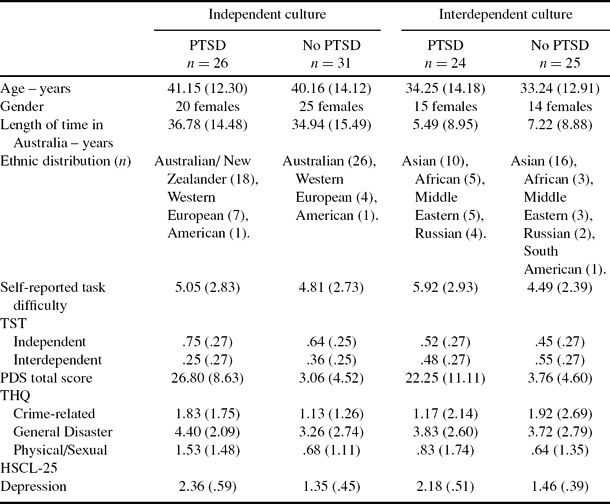
Group and participant characteristics are outlined in Table 1.
Means and standard deviations of group and participant characteristics

Note. Numbers in brackets denote standard deviations unless otherwise specified.
Independence/interdependence. The independent group provided significantly more independent and less interdependent statements on the TST than the interdependent group, t (104) = 3.89, p < .01, CI.95 = .10, .31.
PTSD severity and trauma exposure. There were no cultural differences in terms of PTSD symptom score on the PDS, F (1, 102) = 1.71, p = .20. Those with PTSD scored significantly higher than those without PTSD, F (1, 102) = 204.91, p < .01. The interaction was not significant, F (1, 102) = 3.16, p = .08.
The independent group (8 crime-related, 30 general disaster and trauma, 19 unwanted physical and sexual experience) did not differ from the interdependent group (7 crime-related, 27 general disaster and trauma, 15 unwanted physical and sexual experience) in terms of the trauma distribution as indicated on the PDS, χ2 (2, N = 106) = .09, p = .96. The independent and interdependent group were equivalent in terms of trauma history (THQ); crime-related event, t (104) = .27, p = .79, general disaster, t (104) = .00, p > .99, and unwanted physical and sexual experiences, t (104) = 1.19, p = .24.
The PTSD group (6 crime-related, 25 general disaster and trauma, 19 unwanted physical and sexual experiences) did not differ from the no PTSD group (9 crime-related, 32 general disaster and trauma, 15 unwanted physical and sexual experiences) in terms of trauma distribution as indicated on the PDS, χ2 (2, N = 106) = 1.60, p = .45. The PTSD and no PTSD group were equivalent in terms of trauma history (THQ); crime-related event, t (104) = .07, p = .94, general disaster, t (104) = 1.33, p = .19, and unwanted physical and sexual experiences, t (104) = 1.94, p = .06.
Participant characteristics
The four groups did not differ in terms of gender distribution (3, N = 104) = 5.97, p = .11. Those from independent cultures were significantly older than those from interdependent cultures, F (1, 102) = 6.96, p = .01. However, those with and without PTSD did not differ regarding age, F (1, 102) = .15, p = .70, and the interaction was not significant, F (1, 102) = .00, p > .99. Those from interdependent cultures had lived in Australia for significantly less time than those from independent cultures, F (1, 102) = 144.04, p < .01. However, there was no significant difference between those with and without PTSD, F (1, 102) = .00, p = .98, and the interaction was not significant, F (1, 102) = .53, p = .47. There were no cultural differences in self-reported study difficulty, F (1, 102) = .26, p = .61, nor between those with and without PTSD, F (1, 102) = 2.45, p = .12, and the interaction was not significant, F (1, 102) = 1.25, p = .27.
The independent culture group did not differ from the interdependent culture group in terms of depression, F (1, 102) = .10, p = .75. However, those with PTSD were significantly more depressed than those without PTSD, F (1, 102) = 81.35, p < .01. The interaction was not significant, F (1, 102) = 2.41, p = .12.
Preliminary analysis
Narrative type. The trauma narratives were classified into the following trauma type categories; death (N = 29), family-related trauma (N = 16), non-sexual assault (N = 12), child abuse (N = 10), serious physical injury, illness (N = 8), war (N = 8), natural disaster (N = 6), sexual assault (N = 5), serious accident (N = 6), and torture/kidnapped (N = 6). The four groups did not differ in terms of trauma type distribution, χ2 (27, N = 106) = 39.43, p = .06. Given the near significance of this finding, trauma narrative type analyses were followed up further. It was found that all groups were relatively similar on all trauma types except war and torture. Those from interdependent cultures seemed to recall more war memories than those from independent cultures.
Comparative analysis
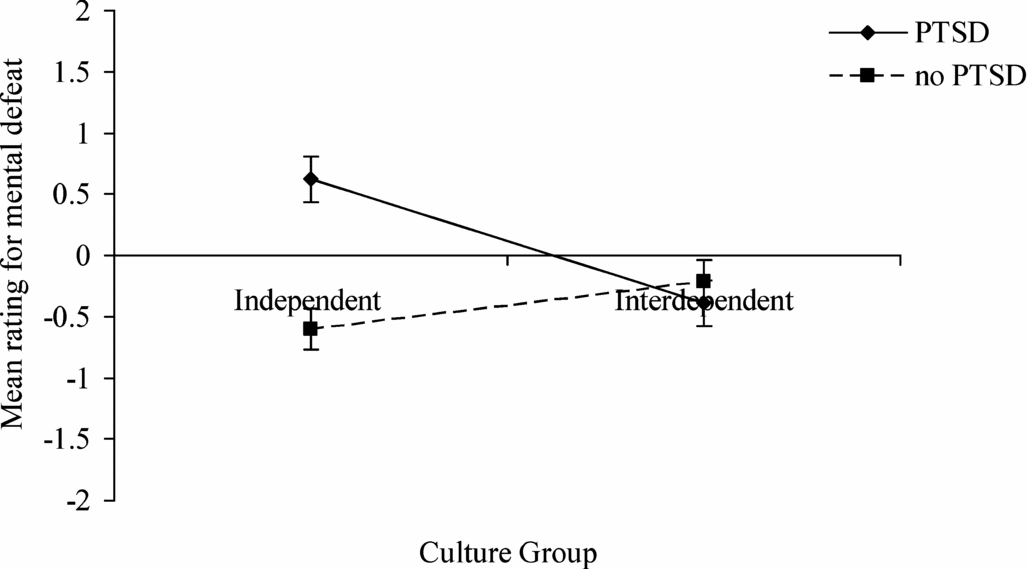
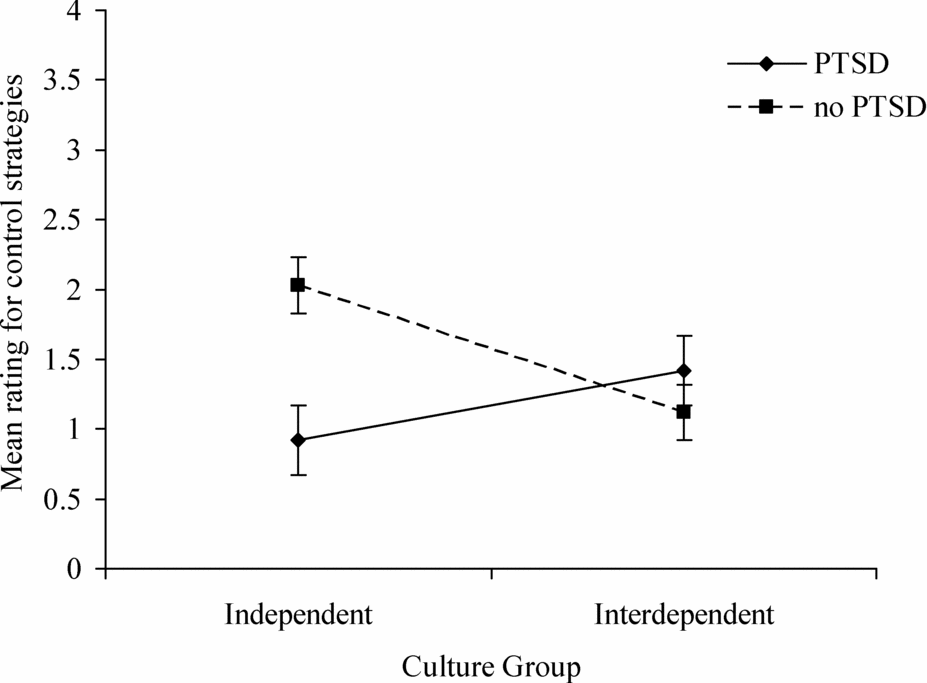
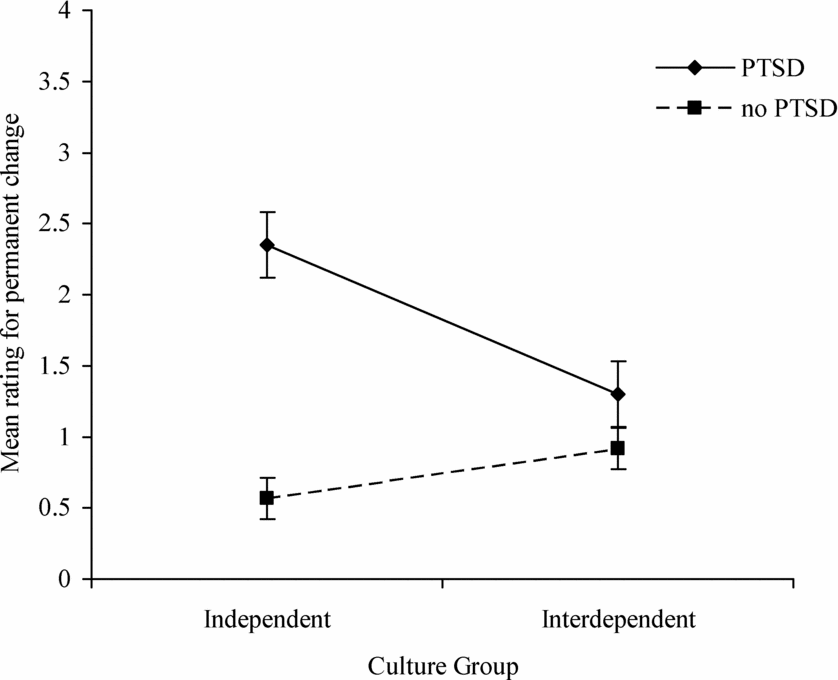
To examine cultural differences in the four cognitive appraisal styles four culture (interdependent vs. independent) x PTSD status (PTSD vs. no PTSD) ANCOVAs were conducted with length of time in Australia, age and depression as covariates and each cognitive appraisal style as the dependent variable. Figures 1a and 1b show the mean ratings and standard errors for mental defeat and control strategies for the four groups.
Mean ratings for mental defeat for independent and interdependent groups with and without PTSD. Error bars indicate ± 1 SE of the mean

Mean ratings for control strategies of independent and interdependent culture group with and without PTSD. Error bars indicate ± 1 SE of the mean

Mental defeat. Independent and interdependent cultures did not differ in levels of mental defeat, overall, F (1, 99) = .71, p = .40. Those with PTSD had greater mental defeat than those without PTSD, F (1, 99) = 6.17, p = .02. The interaction between culture and PTSD status was significant, F (1, 99) = 15.22, p < .01. Independent PTSD had significantly greater mental defeat than independent without PTSD, t (55) = 5.15, p < .01, CI.95 = .74, 1.69, d = 1.37. However, interdependent PTSD did not differ significantly from interdependent no PTSD, t (47) = .70, p = .49, CI.95 = −.71, .34, d = .20. Independent PTSD had significantly greater mental defeat than interdependent without PTSD, t (48) = 3.90, p < .01, CI.95 = .49, 1.52, d = 1.11. Independent without PTSD did not differ significantly from interdependent without PTSD regarding mental defeat, t (54) = 1.64, p = .11, CI.95 = −.88, .09, d = .44.
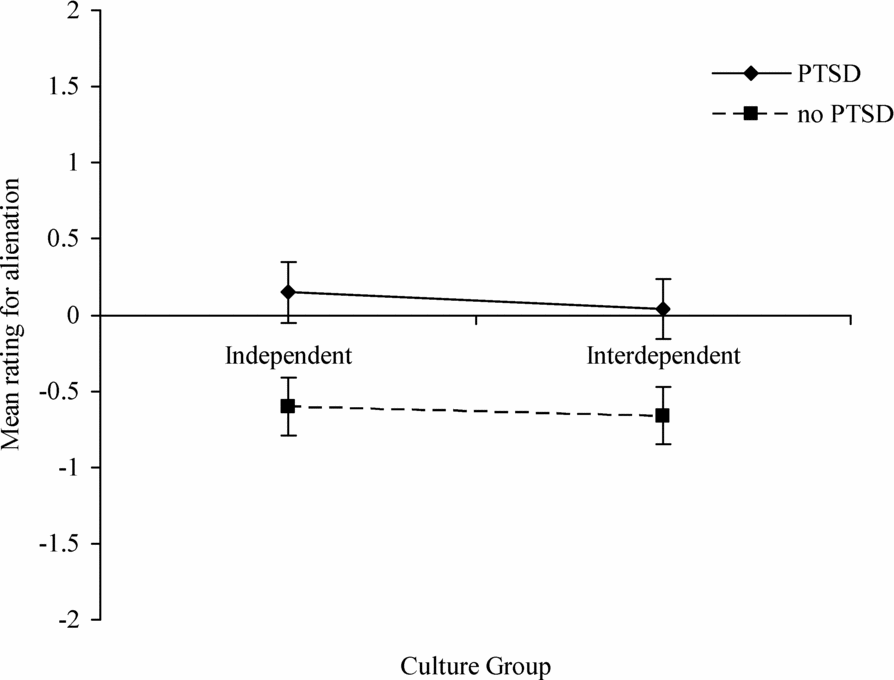
Control strategies. There was no significant difference between interdependent culture and independent cultures in control strategies, F (1, 99) = .67, p = .42. Those with PTSD and without PTSD did not differ in control strategies, F (1, 99) = 3.20, p = .08. The interaction between culture and PTSD status was significant, F (1, 99) = 11.68, p < .01. Independent PTSD had significantly fewer control strategies than independent without PTSD, t (55) = 4.52, p < .01, CI.95 = −1.60, −.63, d = 1.22. However, interdependent PTSD did not differ significantly from interdependent no PTSD, t (47) = .91, p = .37, CI.95 = −.36, .96, d = .26. Independent PTSD tended to have fewer control strategies than interdependent without PTSD, t (48) = 1.74, p = .09, CI.95 = −1.08, .08, d = .49. Independent without PTSD had significantly greater control strategies than the interdependent without PTSD, t (54) = 3.21, p < .01, CI.95 = .34, 1.47, d = .86. Figures 2a and 2b show the means and standard errors for the groups for alienation permanent change.
Mean ratings for alienation of independent and interdependent groups with and without PTSD. Error bars indicate ± 1 SE of the mean

Mean ratings for permanent change of independent and interdependent group with and without PTSD. Error bars indicate ± 1 SE of the mean

Alienation. There was no significant difference between interdependent cultures and independent cultures in alienation, F (1, 99) = .12, p = .73. However, those with PTSD had significantly more alienation appraisals in their memories than did those without PTSD, F (1, 99) = 5.88, p = .02. The interaction between culture and PTSD status was not significant, F (1, 99) = .01, p = .93.
Permanent change. Independent culture did not differ from interdependent cultures in terms of permanent change appraisals, F (1, 99) = .25, p = .62. Those with PTSD had significantly more permanent change appraisals than those without PTSD, F (1, 99) = 17.21, p < .01. The interaction between culture and PTSD status was significant, F (1, 99) = 13.13, p < .01. Independent PTSD had significantly greater permanent change than independent without PTSD, t (55) = 7.37, p < .01, CI.95 = 1.30, 2.26, d = 1.91. Furthermore, interdependent PTSD did not differ significantly from interdependent no PTSD, t (47) = 1.38, p = .17, CI.95 = −.18, .95, d = .39. Independent PTSD had significantly greater permanent change than interdependent without PTSD, t (48) = 3.29, p < .01, CI.95 = .40, 1.68, d = .94.Interdependent without PTSD tended to have more permanent change than did interdependent without PTSD, t (54) = 1.77, p = .08, CI.95 = −.75, .05, d = .47.
Discussion
This study, although somewhat preliminary, is the first to show that trauma's impact on appraisals and associated psychological adjustment may be culturally specified. The findings suggest that cultural differences in self impacts on the relationship between cognitive appraisals and posttraumatic psychological adjustment. As hypothesized the interactions for the trauma appraisals that focus on the self, independence, control and agency (i.e. mental defeat, control strategies and permanent change) were significant. Trauma survivors with PTSD from independent cultures had greater mental defeat, less control strategies and greater permanent change than trauma survivors without PTSD from independent cultures. However, trauma survivors with and without PTSD from interdependent cultures did not differ in terms of trauma appraisals that focus on the self, independence, control and agency. These findings suggest that appraisals of personal responsibility, autonomy and control have greater impact on post-trauma psychological adjustment of trauma survivors from independent cultures than for trauma survivors from interdependent cultures. Additionally, those with PTSD from independent cultures had significantly more appraisals of mental defeat and permanent change and tended to have less appraisals of control than those with PTSD from interdependent cultures. However, the hypothesis was not supported in terms of trauma appraisals that focus on the self in relation to others and interdependence (i.e. alienation). That is, although trauma survivors with PTSD from both cultures had significantly more alienation appraisals than those without PTSD, this difference was not more significant for trauma survivors from interdependent cultures when compared to trauma survivors from independent cultures. This will be discussed below.
While these results are consistent with those of other studies (e.g. Dunmore et al., Reference Dunmore, Clark and Ehlers2001) that show that these cognitive variables are related to PTSD, they also demonstrate that the relationship between the cognitive variables and PTSD seems to be moderated by cultural variation in self. Specifically, it appears that autonomous and interdependence appraisals are instrumental in the aetiology and maintenance of PTSD for those with an independent self-construal, while autonomous appraisals may be less instrumental in the aetiology and maintenance of PTSD for those with an interdependent self-construal.
Theoretically, the findings extend Mesquita and Walker's (Reference Mesquita and Walker2003) argument that cultural differences in self-construal moderates the relationship between the way in which individuals appraise situations, events and life encounters and affective responses, to the trauma experience and PTSD. Furthermore, the findings support Sato's (Reference Sato2001) claim that, for those with an independent self-construal, poor mental health may result when personal control over their environment is perceived to have diminished, whereas for those with an interdependent self-construal poor mental health seems not related to the perceived level of personal control over the environment but rather may result when there is perceived alienation or isolation. Additionally, these findings support Ehlers and Clark's (Reference Ehlers and Clark2000) appraisal model. The findings suggest trauma appraisals that threaten the self (i.e. by negative autonomous appraisals for those with an independent self-construal and by negative interdependence appraisals for those with an interdependent self-construal) may produce a sense of current threat that is accompanied by PTSD symptoms. However, the findings suggest the appraisal model may need to consider and make explicit how cultural differences in self impact on the way in which appraisals may be implicated in the aetiology and maintenance of PTSD.
It must be noted that alienation in the independent group also distinguished between those with and without PTSD. It is proposed that alienation is a maintaining factor in both cultures, but via different means. Ehlers (e.g. Ehlers et al., Reference Ehlers, Maercker and Boos2000) suggests that alienation maintains PTSD because appraisals and feelings of alienation result in the PTSD sufferer not engaging with the world. Hence, the survivor fails to alter self-cognitions and “re-learn” that the world is safe and people are good. PTSD is maintained as current situations are perceived as threats, as the survivor has not altered their views of others and the world. This appears to be an independent approach to alienation as it is in relation to the private self and the individual shifting private cognitions and appraisals. It is proposed that alienation may be maintaining PTSD in interdependent cultures in a different manner. That is, alienation challenges the interdependent self. The survivor feels isolated from the group and thus perceives the self as failing as a socially valued relatedness being. Consequently, alienation impacts on the public (i.e. social roles) and communal (i.e. interpersonal/relatedness) aspects of self. This proposal is supported by Markus and Kitayama's (Reference Markus and Kitayama1991) assertion that for the independent self-construal “others, or the social situation in general, are important, but primarily as standards of reflected appraisal, or as sources that can verify and affirm the inner core of the self” (p. 224), whereas the interdependent self-construal may adhere to goals and motivations that are significantly shaped and dominated by the reaction of others, and in doing so gain self-definition. They propose relationships for the independent self-construal may be viewed as a means for obtaining individual goals, whereas in interdependent self-construal relationships will often be ends in and of themselves. Additionally, according to Sato (2001), in interdependent societies a person without a strong sense of interdependence is often considered a dysfunctional member of society, and such societies are thus relatively intolerant of a lack of interdependence in an individual. He claims that for emotional health, individuals holding an interdependent self-construal have a need to be accepted by others. Further research is required to investigate the mechanisms by which alienation is involved in the aetiology and maintenance of PTSD and the impact of cultural variation in self on such mechanisms. Finally, Ehlers' (e.g. Ehlers et al., Reference Ehlers, Maercker and Boos2000) approach to alienation highlights that many of the appraisals outlined in Ehlers and Clark's model are relatively independently focused. This is appropriate for autonomous appraisals. However, few of Ehlers and Clark's identified appraisals focus on social roles. Additionally, even the communal/relatedness appraisals (i.e. alienation) are predominately private self-focused. Public and communal appraisals need to be given greater emphasis in the appraisal model.
The findings have clinical implications as they suggest that, although a clinical awareness of the impact of trauma on appraisals is essential, awareness also needs to consider cultural factors that moderate any impact. Specifically, assessment and therapy needs to address the impact of trauma on appraisals associated with private aspects of self and the impact of trauma on appraisals associated with public and collective components of the self. This would include identifying, challenging and re-appraising relatedness appraisals (e.g. I am isolated, I am alienated, I am not a good mother, I let others down). These results support the growing advocacy (e.g. Jobson and O'Kearney, Reference Jobson and O'Kearney2008; Schwartz, Reference Schwartz2005; Tarrier and Humphreys, Reference Tarrier and Humphreys2003) for the use of interventions that target social support as adjuncts to cognitive behaviour therapy. Ehlers (e.g. Ehlers, Clark et al., Reference Ehlers, Clark, Dunmore, Jaycox, Meadows and Foa1998) has found that the level of these appraisals in trauma narratives impacts on treatment outcomes. In general, those with high levels of mental defeat, alienation and permanent change appraisals do not show the same therapeutic improvements following exposure treatment. It is suggested that these clients require a stronger focus on cognitive work alongside the exposure work. It is recommended that research explores whether culture moderates this relationship between the trauma appraisals and treatment outcomes.
We acknowledge the shortcomings of this study. First, a major limitation of this study was in the method of PTSD diagnosis. The study would be improved if the self-report questionnaire (PDS) used for diagnostic purposes was followed up with a structured interview. Additionally, the low return rate, although not excessively low for the methodology employed, may suggest a self-selection process. Factors such as asking participants to retrieve memories in English, literacy and educational levels, and higher levels of PTSD symptomatology may have impacted on response rate and may, in turn, have confounded findings. Second, as in any study exploring the impact of culture on certain variables, language and task understanding must be considered. The finding of no cultural differences in the self-report of task difficulty was taken to suggest that there were no major cultural differences in task understanding and responding. However, retrieving memories in English may impact on appraisals. Third, this study was conducted in Australia, an independent cultural environment. This may result in an intracultual context for the interdependent groups but an intercultural context for the interdependent groups. We aimed to minimize this by allowing all participants to complete the study at home and including migrants in both groups. Further, the cultural groups did differ significantly in the expected direction on the TST (i.e. the independent group provided more independent statements than the interdependent group). Fourth, there is an acknowledgement of possible demographic differences (e.g. education, economic sufficiency) between groups that may have confounded our cultural independent variable. While there is little evidence that such factors would affect appraisals it may be helpful for groups to be more closely matched in further research. Fifth, it would be useful in future studies to examine the above, matching trauma type (i.e. just rape survivors, just torture survivors), as is done in Ehlers' (e.g. Ehlers et al., Reference Ehlers, Maercker and Boos2000) work. Trauma event type may impact on the type of appraisals generated, such as some trauma events may be more likely to result in alienation appraisals while other trauma types may result in autonomous type appraisals. Finally, it is acknowledged that the independent/interdependent construct is only one cultural dimension and the cultures comprising these groups in this study vary on other cultural dimensions.
Despite the shortcomings, this study is timely as it demonstrated cultural variation in self impacts on the role of appraisals in the understanding of PTSD. The study replicated Ehlers' (Ehlers et al., Reference Ehlers, Maercker and Boos2000) findings; cognitive appraisal styles (mental defeat, control strategies, alienation and permanent change) distinguish between those with PTSD from those without PTSD. However, these findings appear culturally specific, that is, these differences were only found in the independent sample. Unlike the independent cultural group, autonomous cognitive appraisals did not differentiate between those with and without PTSD from interdependent cultures. However, like the independent group, alienation did differ between those with and without PTSD from interdependent cultures. Therefore, the only cognitive appraisal style distinguishing between those with and without PTSD in interdependent cultures was alienation, an interdependent cognitive appraisal. Hence, it appears possible that following Ehlers and Clark's model, alienation may be factor maintaining PTSD in interdependent populations as the information and memories the survivor retrieves following trauma aligns with these appraisals of alienation, being separated from others, excluded from the group and so forth, resulting in those from interdependent cultures continuing to view themselves as failing as a interdependent unit.



Comments
No Comments have been published for this article.