Introduction
Sleep disturbances are quite common in both mood and anxiety disorders that on the other side frequently co-occur.Reference Cavicchioli, Maes and Roomruangwong1 Furthermore, any impairment of sleep quality and continuity predisposes subjects to the development or to the exacerbation of mood and anxiety disorders and vice versa, as well as to poorer treatment outcomes and to an increased risk for relapses/recurrences in depressed patients.Reference Troxel, Kupfer and Reynolds2 Data on the relationship between sleep disturbances and mood disorders are consistentReference Harvey3–Reference Sivertsen, Salo and Mykletun6; conversely, the information on sleep disturbances in panic disorder (PD) is limited. The occurrence of nocturnal panic attacks is traditionally considered around 18% of all panic attacks, but may be present in 44–71% of PD patients.Reference Nakamura, Sugiura and Nishida7, Reference Abad and Guilleminault8 Mellman and Uhde (1990)Reference Mellman and Uhde9 suggest that 67% of PD patients report insomnia as a relevant problem. However, there is no agreement regarding the objective severity of sleep disturbances in this population, and on their impact on course/treatment response. Most of the reports are based on subjective statements of the patients, and polysomnographic studies are inconsistent. According to Ferini-Strambi et al.,Reference Ferini-Strambi, Bellodi and Oldani10 there is no difference between control subjects and PD patients in sleep induction and maintenance parameters, but the percentage of non-Rapid Eye Movements (REM) sleep stage 1 is increased in PD patients when compared with healthy controls. A significant improvement of PD is not usually accompanied by a corresponding improvement of major sleep variables.Reference Cervena, Matousek and Prasko11 A recent study shows that PD patients experience sleep disturbances even after PD symptomatic remission while suggesting that they are not simply consequent to nocturnal panic attacks, or to the severity of PD core manifestations.Reference Cousineau, Marchand and Bouchard12
According to a different perspective, as postulated by the spectrum model proposed by Cassano et al.,Reference Cassano, Dell’Osso and Frank13 sleep disturbances may be considered a dimension crossing and/or underlying both Axis I categories and sub-threshold syndromes: indeed sleep disturbances have been considered as a transdiagnostic process in psychiatric disorders, by contributing to their onset and course.Reference Harvey3–Reference Sivertsen, Salo and Mykletun6, Reference Dolsen, Asarnow and Harvey14 In this framework, the mood spectrum model refers to a dimensional view of mood disorders that encompasses their most typical symptoms, including sleep disturbances, and also a range of more subtle features less easily detectable which may include sleep disturbances as well.Reference Cassano, Dell’Osso and Frank13, Reference Dolsen, Asarnow and Harvey14 The mood spectrum manifestations might be present in patients who never suffered from a full-blown mood disorder, but who may be affected by other psychiatric disorders, such as PD,Reference Savino, Perugi and Simonini15 obsessive-compulsive disorder (OCD), social phobia (SP),Reference Fagiolini, Frank and Rucci16 or eating disorders (EDs),Reference Miniati, Benvenuti and Bologna17 thus determining a clinical condition of sub-threshold (or spectrum) mood comorbidity.
The aim of this study was to evaluate the impact of sleep disturbances, as assessed by the Mood Spectrum Self-Report Questionnaire (MOODS-SR)Reference Dell’Osso, Armani and Rucci18 on clinical features and treatment response of PD patients without a full-blown comorbidity for mood disorders.
Material and Methods
Study sample
Outpatients referred by primary care physicians underwent a psychiatric screening at the Section of Psychiatry of the University of Pisa, Italy. Those who met DSM-IV-TR criteria for current PD with or without agoraphobia,19 and volunteered in participating in a naturalistic follow-up, were provided with a complete description of the study and gave written informed consent for participation. We included patients who met the following criteria at baseline: Panic Disorder Severity Scale (PDSS)Reference Shear, Rucci and Williams20 total score > 7; no current major depression; no past or current Bipolar Disorder (BP).
Pharmacological treatments were guided by published international standards (American Psychiatric Association Guidelines, APA, 2000)21 and provided by clinical physicians within the framework of a naturalistic follow-up. Structured psychotherapy was not included as a treatment option. Patients with full-blown BPs were excluded for three reasons: (a) the hierarchical position of BP on PD; (b) the potential implications of treatment with mood stabilizers or neuroleptics; and (c) the heterogeneity of clinical presentation of PD, when a BP has been diagnosed even in the past. According to international standards for PD (APA Guidelines, 2000; National Institute for Health and Care Guidelines, NICE, 2011),21, 22 treatment goals were the following: reducing frequency and intensity of panic attacks, reducing anticipatory anxiety and agoraphobic avoidance, and achieving symptomatic remission. Participants were asked to complete a baseline assessment (T0) with the Structured Clinical Interview for DSM-IV Disorders (SCID-I) administered by a rater trained and certified in its use,Reference First, Spitzer and Gibbon23 the PDSS,Reference Shear, Rucci and Williams20 and the MOODS-SR,Reference Dell’Osso, Armani and Rucci18 and to participate in follow-up evaluations after 1 month (T1), 3 (T2), 6 (T3) and 12 months (T4), with the PDSS as outcome measure.
Follow-up procedures were approved by the Ethical Committee of the Azienda Ospedaliero-Universitaria of Pisa (Italy), according to the Code of Ethics of the World Medical Association (Declaration of Helsinki) and the standards established by the authors’ institutional review board.
Instruments
Panic Disorder Severity Scale (PDSS)Reference Shear, Rucci and Williams20
The PDSS is a 7-item scale each with a 5-point rating system, ranging from 0 to 4. Adding the scores for all seven items makes the overall assessment. The total score ranges from 0 to 28. The seven items assess the overall severity of PD, including the frequency and severity of panic and limited symptom episodes, such as severity of anticipatory anxiety, phobic avoidance and functional impairment.21 Remission was defined as a PDSS score <5, according to published guidelines for the interpretation of the PDSS scores.Reference Furukawa, Shear and Barlow24, Reference Keough, Porter and Kredlow25
Mood Spectrum Self-Report questionnaire lifetime version (MOODS-SR)Reference Dell’Osso, Armani and Rucci18
MOODS-SR assesses lifetime symptoms, traits and lifestyles that characterize threshold and sub-threshold mood episodes as well as “temperamental” features related to mood dysregulations. It consists of 161 symptoms coded as present or absent for one or more periods of at least 3–5 days throughout the subject’s lifetime. For some questions, such as exploring temperamental features or the occurrence of specific events the duration is not specified because not applicable for a limited timeframe. Summing the scores for the dichotomous items makes the overall assessment, but seven impairment items are not scored (total score ranging between 0 and 154). Items with multiple responses are coded “1”if at least one of the responses is scored positively, and “0”elsewhere. Items are organized into manic/hypomanic, depressive and rhythmicity/vegetative domains. Manic and depressive domains are sub-typed in three sub-domains, each exploring mood, energy, and cognition. The sum of mood, energy, and cognition manic items made the overall manic component score (range: 0–62); the sum of mood, energy, and cognition depressive items made the overall depressive component score (range: 0–63). Twenty-nine items compose the rhythmicity/vegetative function domain (range: 0–29): It explores alterations in circadian rhythms and vegetative functions, including sleep dysregulations. The sleep items are 12 out of 29 and explore in a lifetime perspective the presence/absence of sleep disturbances related to sub-threshold mood dysregulations. For the purposes of this study, we extracted the MOODS-SR sleep items that are 12 out of 29 and explore, in a lifetime perspective, the presence/absence of sleep disturbances related to sub-threshold mood dysregulations. However, for this preliminary study, no psychometric validation of this sleep domain/dimension has been carried out.
The reliability of the interview proved to be excellent: the inter-rater reliability of domains ranged between 0.93 and 0.94, and the internal consistency of domains ranged between 0.79 and 0.92. There was a high correlation between the SCI for the Mood Spectrum (SCI-MOODS) and the questionnaire of the MOODS assessment (Intra Class Correlation = 0.97), whose reliability and validity have been successively confirmed.Reference Dell’Osso, Armani and Rucci18
Statistical analyses
Statistical analyses were performed using the SPSS statistic version 17.0. Results were expressed as mean ± standard deviation (SD) or percentages. The Shapiro–Wilk test was used to check the normality of the variables. Differences in means between “remitters” and “non-remitters” were assessed using t-tests for normally distributed variables, or the Mann–Whitney U/Wilcoxon test for not-normally distributed variables. Mean p-values were adjusted for the number of tests using the Bonferroni correction with a significance of p < 0.05. Univariate linear and/or logistic regression analyses were performed to test the correlates of lifetime mood spectrum and of its domains, such as depressive, manic/hypomanic, rhythmicity, sleep disturbances, and PD non-remission or remission.
Results
The study sample included 85 outpatients suffering from PD (55 women and 30 men, mean age + SD: 34.5 ± 12.5 years). Seventy-five patients (88.2%) met SCID-I criteria for PD with agoraphobia, 10 (11.8%) for PD without agoraphobia (11.8%).
The most prescribed drugs were SSRIs (63.2%), specifically in decreasing order, paroxetine and citalopram (n = 87, 21%), sertraline (n = 70, 16.9%), fluvoxamine (n = 13, 3.1%), and fluoxetine (n = 5, 1.2%). Tricyclics were also administered (n = 98, 23.6%), namely trimipramine (n = 57, 13.8%), imipramine (n = 27, 6.5%), clomipramine (n = 11, 2.6%), desipramine (n = 2, 0.4%), and amitriptyline (n = 1, 0.2). Venlafaxine was prescribed in seven (1.6%), and trazodone in three (0.7%) cases. Delorazepam was the most frequently prescribed benzodiazepines (n = 26, 6.2%), followed by alprazolam (n = 12; 2.9%), and diazepam (n = 3, 0.7%). Zolpidem was prescribed only in two cases (0.4%).
Effect of lifetime MOODS-SR domains on PD severity at baseline
The mean total PDSS scores at the different time points were 14.6 ± 4.9 at baseline, 10.4 ± 5.7 at T1, 7.9 ± 5.2 at T2, 5.8 ± 4.6 at T3, and 4.9 ± 4.4 at T4. The scores of the PDSS single items (panic attacks, anticipatory anxiety, phobic avoidance, and impairment) at baseline and at each time point are reported in Table 1. Lifetime mood spectrum total scores at baseline were, respectively, 50.2 ± 21.4 (range: 0–154), 22.4 ± 11.8 for the depressive domain (range: 0–62), 17.5 ± 9.4 for the manic/hypomanic domain (range: 0–63), and 10.3 ± 4.9 for the rhythmicity/vegetative function domain (range: 0–29). No correlation was found between total baseline PDSS score and lifetime mood spectrum total score or depressive, manic or rhythmicity domain scores (respectively, coeff. = 0.12, p = 0.15, coeff. = 0.09, p = 0.45, coeff = 0.10, p = 0.32), using a univariate regression analysis.
Panic Disorder Severity Scale scores at baseline and at each follow-up

Note. PDSS, Panic Disorder Severity Scale.
Effect of lifetime MOODS-SR domains on PD severity at follow-up
Lifetime spectrum scores had a significant effect, but scarce, on PDSS outcome. Only the MOODS-SR depressive and rhythmicity/vegetative functions domains were associated with outcomes (anticipatory anxiety), with low/moderate statistical correlations. Thus, results of the univariate analyses showed a positive correlation between higher scores at the rhythmicity/vegetative functions domain and higher PDSS scores (coeff. = 0.233; p = 0.03), and PDSS panic frequency and severity (coeff. = 0.25; p = 0.02) at T1. Higher scores in MOODS-SR depressive and rhythmicity/vegetative functions domains were positively correlated with higher anticipatory anxiety scores at T1 (coeff. = 0.21; p = 0.049; coeff. = 0.27; p = 0.01, respectively) and at T4 (coeff. = 0.28; p = 0.035; coeff. = 0.28; p = 0.038, respectively).
Determinants of PD outcome: non-remission
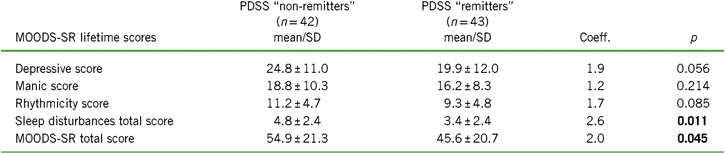
We categorized each patient as a remitter or non-remitter at each time point. Forty-three patients (50.5%) met criteria for remission during the follow-up period. Twenty out of 43 patients (46.5%) firstly met remission criteria at T1, nine (20.9%) at T2, 11 (25.5%) at T3, and 3 (6.9%) at T4. Compared to non-remitters patients (n = 42), those who achieve remission (n = 43) had significantly lower scores on the mood spectrum total score (45.6 ± 20.7 vs 55.0 ± 21.5; t = 2.0, p = 0.045) and on the sleep disturbances dimension, namely on the sum of the items from 138 to 149 (3.4 ± 2.4 vs 4.8 ± 2.4, respectively; t = 2.6, p = 0.011; range: 0–9) (Table 2).
Mood spectrum components in panic disorder “remitters” and “non-remitters”

Note. MOODS-SR Lifetime, Mood Spectrum Self-Report Questionnaire Lifetime Version; PDSS, Panic Disorder Severity Scale.
Significance p < 0.05 in bold.
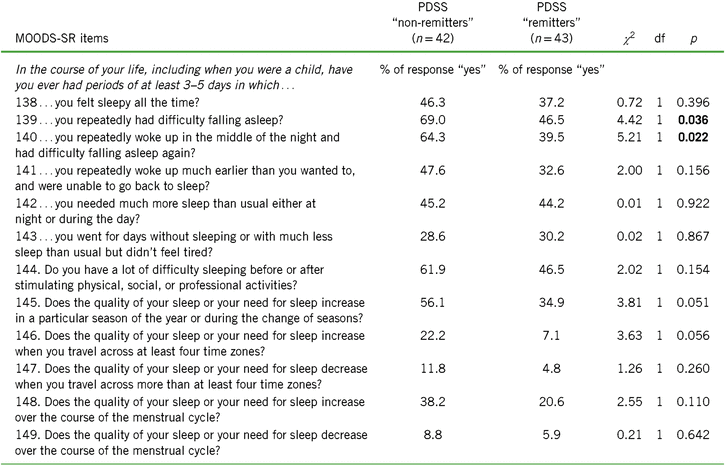
In a logistic regression model with remission (yes/no) as the dependent variable and the mood spectrum scores as the independent variables, sleep disturbances was the only component associated with a lower likelihood of remission (Odd Ratio = 0.79; p = 0.045). The items accounting for this result were as follows: repeated difficulty falling asleep (chi-square = 4.4; df = 1; p = 0.036) and repeatedly waking up in the middle of the night (chi-square = 5.2; df = 1; p = 0.022) (Table 3).
Sleep disturbances component of mood spectrum in panic disorder “remitters” and “non-remitters”

Note. MOODS-SR Lifetime, Mood Spectrum Self-Report Questionnaire Lifetime Version; PDSS, Panic Disorder Severity Scale.
Significance p < 0.05 in bold.
Discussion
The study evaluated the impact of lifetime sleep dysregulations, as assessed by a specific instrument for mood assessment called MOODS-SR, on PD treatment response. The main finding was that two items of the MOODS-SR sleep disturbances component, namely trouble falling asleep (item 139) and waking in the middle of the night (item 140), resulted associated with less likelihood of remission of PD. Several data showed that the comorbidity between panic and mood disorders might occur frequently and have important prognostic and therapeutic implications, such as higher suicide risk, higher rates of chronicity, greater social impairment, and poorer outcome in comorbid compared with non-comorbid illnesses.Reference Boylan, Bieling and Marriott26 However, to our knowledge, this is the first study considering sleep disturbances as a symptoms’ dimension belonging to the sub-threshold mood spectrum realm, able to interfere with treatment response and clinical course of PD. Two previous studiesReference Cyranowski, Endicott and Fagiolini27, Reference Frank, Cyranowski and Rucci28 explored a converse question, namely if panic-agoraphobic spectrum symptoms could influence treatment response and course of unipolar and bipolar depression. The presence of panic-agoraphobic spectrum, as assessed by the Panic-Agoraphobic Spectrum Questionnaire Self-Report Version (PAS-SR)Reference Shear, Cassano and Frank29 in the absence of a full-blown comorbidity for PD, was related to a poorer response to interpersonal psychotherapy (IPT) in a sample of women with recurrent major depressive episodes (MDE).Reference Cyranowski, Endicott and Fagiolini27 Moreover, a sample of patients with Bipolar I Disorder (BP-I) was reported to achieve remission 27 weeks later when PAS-SR scores were >45.Reference Frank, Cyranowski and Rucci28
In our study, we observed no correlation between the total number of MOODS-SR symptoms and treatment response. However, in our opinion, lifetime MOODS-SR was helpful to identify a clinical phenotype of PD characterized by a comorbidity for sleep disturbances belonging to the realm of (sub-threshold) mood spectrum signs that would represent a cue of mood liability.
The clinical usefulness of the spectrum assessment in detecting signs and symptoms that can interfere with treatment, thus depicting more refined clinical phenotypes of patients, has been demonstrated in a number of studies on patients with eating disordersReference Miniati, Benvenuti and Bologna17 unipolar depression and BP.Reference Berrocal, Ruiz Moreno and Merchán30–Reference Ghouse, Sanches and Zunta-Soares35 It could be argued that mood spectrum dysregulations, including sleep disturbances, could reflect some aspects of PD (e.g., nocturnal panic attacks). Unfortunately, the proposed lifetime assessment did not allow us to determine if mood spectrum symptoms might precede or follow the onset of PD. Previous studies investigated the association between sleep disturbances and the onset of depressive or anxiety disorders, and led to the hypothesis of the existence of an underlying vulnerability, such as temperamental features or cognitive styles.Reference Batterham, Glozier and Christensen36 We started from a different perspective, by observing that PD patients may show a spectrum of associated clinical features, not included in the criteria set, and belonging to mood dysregulations, without meeting criteria for a comorbid Axis I mood disorder, even if we were aware that our study had a number of limitations. The sample size was limited. Moreover, the naturalistic follow-up study design did not allow any balance of the two groups of remitters and non-remitters on the use of pharmacotherapy. Thus, pharmacological treatments were decided on a clinical base by an independent clinician, blind on the study procedures. Length of treatment was a variable across patients: future studies should take into account mean and range of treatment duration.
According to this model, spectrum manifestations may occur in the absence of threshold level criteria for mood disorders. Some are trait-like symptoms that occur as the subtle manifestations of an illness diathesis. Early onset of such signs and symptoms can act to shape developing mental functions and change personality.Reference Cassano, Dell’Osso and Frank13 Mood spectrum features, including sleep disturbances, are significant also when they remain as residual symptoms or co-occur with another disorder, such as PD. Failure to recognize residual or comorbid mood spectrum features in treating PD may explain continued impairment, even when core PD symptoms have been successfully treated.Reference Shear, Cassano and Frank29
Conclusions
Sleep disturbances, experienced during lifetime, seem to be a chain linking mood spectrum comorbidity and PD, considering that they were the only ones related with PD non-response, in a logistic regression model. As a consequence, we could speculate that the adoption of specific therapeutic strategies for sleep disturbances as part of a sub-threshold mood comorbidity could be useful to increase the remission rates of PD, or to prevent the development of a full-blown mood disorder.
Disclosures
The authors have nothing to disclose.