A model published by Lewis et al. (Reference Lewis, Morris and Perry2003) and Lewis & Morris (Reference Lewis and Morris2004) described the effect of two opposing changes in photoperiod, applied during rearing, on age at first egg (AFE) in layer-hybrid pullets. This model postulates that a change in photoperiod alters physiological age so that if, for example, the first change in daylength is an increment, sexual development is accelerated. The result is that the pullet is then physiologically ‘older’ and so it responds to any subsequent decrease in photoperiod as though it had been given at a later age than the true chronological age. The model assumes that this change in physiological age occurs as soon as the photoperiod is altered, but that is clearly unrealistic and the model cannot be expected to predict successfully the outcome of two (or more) changes in photoperiod applied in rapid succession.
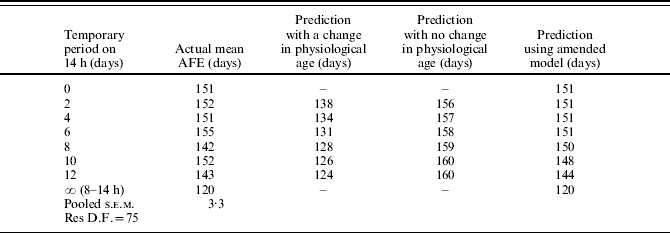
Subsequently, Lewis & Gous (Reference Lewis and Gous2006) reported the findings of a study in which immature domestic pullets were temporarily transferred at 80 days of age from an 8-h to a 14-h photoperiod for periods varying from 2 to 12 days. There was poor agreement (R 2=0·280) between recorded AFE and the AFE predicted by the earlier model (compare columns 2 and 3 in Table 1). The explanation of the reducing values seen in column 3 (i.e. earlier sexual maturity with later times of return to short days) is that the model predicts bimodal responses, with an increasing fraction of the flock reaching the ‘point of no return for first ovulation’ before the reduction in photoperiod was applied.
Actual (Lewis & Gous Reference Lewis and Gous2006) and predicted AFE for egg-type pullets temporarily transferred at 80 days of age from 8- to 14-h photoperiods for various periods between 2 and 12 days, maintained on 8 h, or permanently transferred to 14 h at 80 days
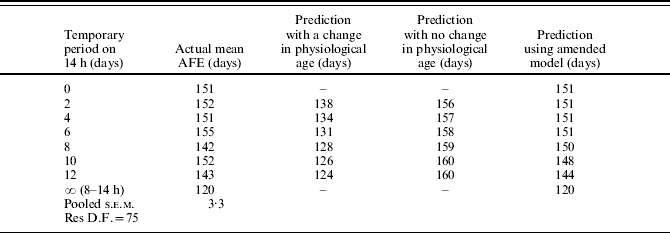
This confirms that the model could not be used to predict AFE when the interval between two opposing changes is small. This is presumably because a short exposure to long days is insufficient to alter the pullet's physiological age. The observed data were also poorly correlated (R 2=0·307) with AFE predictions obtained by simply summing the anticipated individual responses to the increase and decrease in photoperiod without making any allowance for a change in physiological age (column 4 in Table 1).
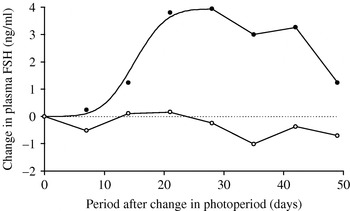
Lewis et al. (Reference Lewis, Perry, Morris, Douthwaite and Bentley1998) have shown that rapid gonadal development in pullets is initiated by photoinduced changes in follicle stimulating hormone (FSH) release. Plasma FSH concentration rises very little in the first 7 days following a transfer from 8- to 14-h photoperiods, then increases markedly in the 2nd and 3rd weeks and remains high in the 4th and 5th weeks after photostimulation (Fig. 1). This is in marked contrast to luteinizing hormone (LH), which shows a two- to three-fold rise in plasma concentration within 1–3 days of pullets being transferred to a stimulatory daylength (Wilson Reference Wilson1982). However, circulating LH concentrations are poorly correlated with rate of sexual development in pullets (Lewis et al. Reference Lewis, Perry, Morris and Follett1994). After a decrease in photoperiod, plasma FSH concentration falls only very slightly (Fig. 1).
Change in plasma FSH concentration in domestic pullets following a transfer from 8 to 14 h (●) and from 14 to 8 h (○) at 56 days of age (from Lewis et al. Reference Lewis, Perry, Morris, Douthwaite and Bentley1998). The fitted curve between 0 and 28 days is the ogive of a normal distribution with a mean of 15 days, a s.d of 4·2 days, and a peak change in plasma FSH of 3·94 ng/ml at 30 days.

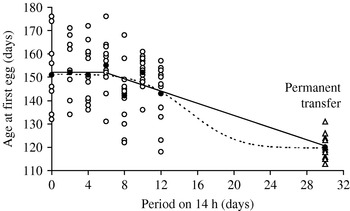
It is therefore postulated that the similarity in AFE for pullets exposed to 2, 4 or 6 days of longer photoperiods and those maintained on 8 h (see Table 1) was due to the minimal change in plasma FSH expected during the first 6 days of photostimulation. The progressive advance in AFE observed when the birds experienced 8 or more long days was presumably the consequence of longer exposure to higher circulating concentrations of FSH, with little or no depression of FSH release caused by the return to 8-h days. The individual AFE data in Fig. 2 show that the pullets in the various treatment groups responded as a whole, with the spread of ages between the first and last birds to mature being similar in each group. There was no suggestion of a bimodal distribution, indicative of some birds responding and others not.
Individual ages at first egg (○) and treatment means (●) for domestic pullets temporarily transferred at 80 days of age from 8 to 14 h for 2, 4, 6, 8, 10 or 12 day, or (△) permanently transferred to 14 h (Lewis & Gous Reference Lewis and Gous2006). The horizontal line is the mean for constant 8-h and groups given 2, 4 or 6 long days, and the sloping line is an extrapolation of the regression of the means for groups given 6, 8, 10 or 12 long days. The broken line is the predicted AFE obtained by using the ogive of a normal curve to interpolate changes in FSH concentration (see Fig. 1) and the regression from Fig. 3 to predict AFE as a function of change FSH.

It is interesting that the extrapolation in Fig. 2 of mean AFE for groups given 6, 8, 10 and 12 long days to intersect the mean AFE of birds permanently transferred to 14 h at 80 days suggests that pullets probably require about 30 days of exposure to a stimulatory photoperiod to achieve the same advance in AFE as shown by the permanent transfer treatment. This period is similar to that required to reach peak plasma FSH concentration (Fig. 1).
It is therefore suggested that, when two opposing changes in photoperiod are given within an interval of <30 days, rate of sexual maturation is determined by the change in circulating FSH concentration achieved during the time on the second photoperiod. If a decrease in photoperiod is given within a week of an increase, a period in which circulating FSH concentration rises very little (Fig. 1), AFE will not be significantly different from constant short-day controls. If pullets are exposed to more than a week of long days and then transferred back to short days while FSH secretion is rising rapidly and there is little depression in FSH release following the reduction in photoperiod (Fig. 1), advances in AFE will be proportional to plasma FSH concentration at the time of the second change in photoperiod. Physiological age (as defined in the model of Lewis et al. Reference Lewis, Morris and Perry2003) is unlikely to be fully changed until the pullets have been exposed to about 30 stimulatory daylengths when plasma FSH concentrations begin to wane (Fig. 1). Data reported by Lewis et al. (Reference Lewis, Morris and Perry2003) show that potential AFE will certainly have changed by the time the birds have had 35 long days. However, the effect on AFE will also depend on the age at which the change in photoperiod is given. For example, in the study by Lewis et al. (Reference Lewis, Morris and Perry2003), opposing changes between 8 and 14 h with a 35-day interval between changes induced a 23-day delay in AFE when the increment was given at 35 days, but a 42-day advance when given at 56 days. The effect of a change in photoperiod on AFE will also depend on the initial and final photoperiod. For example, whereas a single transfer from 8 to 13 h advanced AFE in brown-egg hybrids by 24 days when given at 84 days of age but by only 6 days when given at 119 days, increases from 13 to 18 h at the same two ages advanced AFE by only 6 and 4 days, respectively (Lewis et al. Reference Lewis, Perry and Morris1996).
The model reported by Lewis et al. (Reference Lewis, Morris and Perry2003) therefore needs to be amended to predict that, when a decrease in photoperiod is given within 30 days of an increase, the advance in AFE will be a function of the predicted increase in plasma FSH concentration induced by the increment. The change in FSH concentration to be expected for a given number of days after photostimulation can be calculated, as shown in Fig. 1, using the ogive of a normal distribution with a mean of 15 days (midpoint of the range 0–30 days) and a standard deviation (s.d) of 4·2 days. This SD was obtained iteratively as the value giving the smallest residual sum of squares when the actual changes in plasma FSH reported by Lewis et al. (Reference Lewis, Perry, Morris, Douthwaite and Bentley1998) were regressed on predicted values. Peak increase in plasma FSH concentration for 30 days after photostimulation was set at the value of 3·94 ng/ml observed at 28 days.
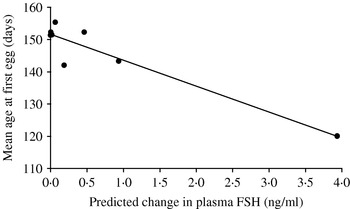
The regression of AFE on predicted change in plasma FSH concentration at the time of the return to short days is shown in Fig. 3. The result for the group retained on long days is plotted against the maximum observed change in FSH concentration of 3·94 ng/ml. The slope of the regression is an 8·0-day advance in AFE for each 1 ng/ml increase in plasma FSH concentration. This number will be incorporated in the model to predict expected change in AFE as a function of predicted change in FSH at the time of a return to short days. The response to a decrease in photoperiod given more than 30 days after an increase will be predicted using the pullet's ‘physiological age’ as calculated from the first change in photoperiod: no amendment to the model is required for such changes.
Regression of actual mean AFE (Lewis & Gous Reference Lewis and Gous2006) on change in plasma FSH concentration predicted for the time of the decrease in photoperiod. The predictions for change in plasma FSH concentration are those illustrated in Fig. 1.

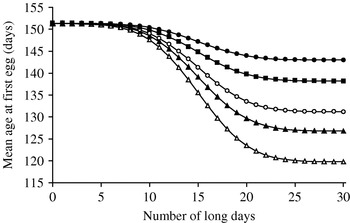
The existing model satisfactorily predicts mean AFE for birds given a single transfer between any two photoperiods (and at any age) but the pattern of changes in circulating FSH has only been reported for transfers between 8 and 14 h. The proposed amendment to the model makes an assumption that changes in mean AFE resulting from temporary transfers between other photoperiods will be the same proportion of the predicted response to a single change as that predicted for birds transferred from 8 to 14 h for the equivalent number of days. For example, the data in column 5 of Table 1 show that AFE is advanced by 7·5 days (151·3–143·8) after 12 long days, which is 0·238 of the 31·5-day advance expected for birds permanently transferred to 14-h days. For birds given a single transfer from 8 to 12 h at 100 days the original model predicts a 20·1-day advance in AFE: the predicted advance after only 12 days exposure to 12 h would thus be 20·1×0·238=4·8 days. Predicted mean AFE for other exposures to this lighting treatment and for four other temporary changes in daylength are illustrated in Fig. 4.
Predicted mean AFE for domestic pullets temporarily transferred for up to 30 days from an 8-h photoperiod to 14 h at 130 days (●), to 13 h at 120 days (■), to 12 h at 100 days (○), to 11 h at 55 days (▲) or to 14 h at 80 days of age (△) using the amended model.

As shown in the last column of Table 1, the values predicted by the amended model are in good agreement with the data recorded by Lewis & Gous (Reference Lewis and Gous2006) (R 2=0·887, P<0·001 and residual s.d=4·16 days) and represent a marked improvement on predictions obtained with the current model (R 2=0·323, P=0·142 and residual s.d=10·20 days).