Introduction
Corn (Zea mays, Poaceae) is the most widely cultivated crop globally and is essential for human consumption, animal feed, and various industrial applications (Pechanova and Pechan, Reference Pechanova and Pechan2015; Shen et al., Reference Shen, Zhang, Lin, Li, Li and Song2015; Sayed et al., Reference Sayed, El Sayed and Rizk2023). It is produced on an annual basis with global production reaching over 1 billion metric tons. In China, one of the leading producers, corn production exceeds 250 million metric tons annually (Wang and Hu, Reference Wang and HU2021). Despite its significance, corn is highly vulnerable to various herbivorous insects, which can significantly impact yield and quality (Kurtz et al., Reference Kurtz, Hiltpold, Turlings, Kuhlmann and Toepfer2009; Park et al., Reference Park, Seo, Jung, Kim, LEE and Seong2017; Rashed, Reference Rashed2023). Among these, Lepidopteran pests are particularly destructive and represent a major threat to corn cultivation (Seshu Reddy, Reference Seshu Reddy1998). The Asian corn borer, Ostrinia furnacalis Guenée (Lepidoptera: Crambidae), is one of the most severe pests impacting corn production, especially in China’s key corn-growing regions (Abel et al., Reference Abel, Wilson, Wiseman, White and Davis2000; Blanco et al., Reference Blanco, Pellegaud, Nava-camberos, Lugo-barrera, Vega-aquino, Coello, Terán-vargas and Vargas-camplis2014; Jianguo, Reference Jianguo1996).
Ostrinia furnacalis is a globally distributed pest that causes substantial agricultural damage (Afidchao et al., Reference Afidchao, Musters and DE Snoo2013; Xie et al., Reference Xie, LI, Zhang, Mason, Wang, Lu, Cai and He2015; Park et al., Reference Park, Seo, Jung, Kim, LEE and Seong2017; Zhenying et al., Reference Zhenying, Xin, Kanglai and Darong2000). As a voracious feeder, O. furnacalis inflicts damage at multiple developmental stages. The larvae are particularly destructive, with early instars feeding on leaves and flower parts, while later instars bore into the stem and ears of corn plants. This feeding behaviour results in severe damage, including stem breakage and reduced yield (Ma et al., Reference Ma, Ma, Zhang and Pan2018; Nguyen et al., Reference Nguyen, Do, Hoang and Truong2018; Nalinci et al., Reference Nalinci, Karagoz, Gulcu, Ulug, Gulsen, Cimen, Touray, Shapiro-Ilan and Hazir2021). The pest’s impact is significant across various corn-growing regions worldwide. However, traditional control methods are becoming less effective due to the development of insecticidal resistance (He et al., Reference He, Wang, Zhou, Wen, Song and Yao2003). Although numerous pest management strategies have been explored (Abbas et al., Reference Abbas, Zhao, Arshad, Han, Iftikhar, Hafeez, Aslam and Ullah2023; Alam et al., Reference Alam, Abbas, Abbas, Abbas, Hafeez, Shakeel, Xiao and Zhao2023, Reference Alam, Abbas, Ali, Liangzhu, Shakeel, Ullah, Xiao, Weibo, Haichao and Jiali2024), biological control remains a viable and environmentally friendly alternative, with entomopathogenic nematodes emerging as an effective option for managing O. furnacalis (Caoili et al., Reference Caoili, Latina, Sandoval and Orajay2018).
Entomopathogenic nematodes have emerged as promising biological control agents due to their unique parasitic behaviours, diverse species, broad host ranges, and environmental friendliness (Li et al., Reference Li, Lu, Zhang, Kong and An2022; Wong et al., Reference Wong, Oliveira-hofman, Blaauw, Chavez, Jagdale, Mizell Iii and Shapiro-Ilan2022; Wakil et al., Reference Wakil, Kavallieratos, Eleftheriadou, Yaseen, Rasool, Husain and Aldawood2023). These nematodes offer an effective strategy for managing pests like the corn borer, O. furnacalis, below economically damaging levels. The primary families of entomopathogenic nematodes, Steinernematidae and Heterorhabditidae, have been recognised for their pest control capabilities since the discovery of Steinernema glaseri in the early 20th century (Steiner, Reference Steiner1929). Typically existing in the soil as non-feeding infective juveniles (IJs) (Xuenan et al., Reference Xuenan, Guangwen and Ling2004; Yan et al., Reference Yan, Shahid Arain, Lin, Gu, Zhang, Li and Han2020; Tareen et al., Reference Tareen, Hussain, Alam, Haq, Rana, Rauf, Ahmad and ABBAS2021), these nematodes can infect various larval and pupal stages of pests (Ellis et al., Reference Ellis, Spiewok, Delaplane, Buchholz, Neumann and Tedders2010; Patil et al., Reference Patil, Vijayakumar, Linga and Sivakumar2020). Although traditionally used for controlling underground pests (Akhurst, Reference Akhurst, Samson and Just1986; Zhang et al., Reference Zhang, Machado, Doan, Arce, Hu and Robert2019), recent studies have highlighted their potential for managing foliar pests as well (Kaya and Grieve, Reference Kaya and GRIEVE1982; Kaya, Reference Kaya and Samson1986; Čačija et al., Reference Čačija, Bažok, Kolenc, Bujas, Drmić and Kadoić Balaško2021). S. carpocapsae is particularly effective against a wide range of O. furnacalis and thrives in dark, humid environments. The microhabitat created by corn plants, such as the trumpet-shaped structures during growth, provides an ideal environment for these nematodes, enhancing their biological control efficacy (Glazer, Reference Glazer1992; Xuenan et al., Reference Xuenan, Guangwen and Ling2004; Zahra, Reference Zahra2021; Wu et al., Reference Wu, Mechrez, Ment, Toews, Mani, Feldbaum and Shapiro-Ilan2023). This research explores the potential of S. carpocapsae as a biocontrol agent for O. furnacalis, examining its effectiveness and interactions under various conditions.
S. carpocapsae is primarily found in the top 2–3 cm of soil, where it is both abundant and easily accessible (Gaugler, Reference Gaugler2002). It is a widely utilised biocontrol agent, having been developed and applied extensively for pest management (Gaugler and Georgis, Reference Gaugler and Georgis1991; Kvvs et al., Reference Kvvs, Yadav and Patil2020). S. carpocapsae has a broad host range, affecting insects from various orders, including Coleoptera, Lepidoptera, Diptera, Blattaria, and Thysanoptera (Garriga et al., Reference Garriga, Mastore, Morton, Garcia Del Pino and Brivio2020; Guo et al., Reference Guo, Zhao, Wang, Zhou, Zhai, Men and Yu2020; Gulzar et al., Reference Gulzar, Wakil and Shapiro-Ilan2021; Topalović and Vestergård, Reference Topalović and Vestergård2021; Aslam et al., Reference Aslam, Chi, Abbasi and Arshad2023; Tomar et al., Reference Tomar, Thakur, Sidhu, Laskar, Hashem, Avila-quezada and Abd_allah2023). Notably, S. carpocapsae can parasitise the larvae of lepidopteran pests, resulting in high mortality rates due to its high reproductive capacity and potential for biological control (Xu et al., Reference Xu, Zhu, Liu, Guo and Chen2020; Sujithra et al., Reference Sujithra, Rajkumar, Mhatre and Guru-pirasanna-pandi2022). While most studies have focused on the larval stage of lepidopteran pests, there has been limited research on the pupal stage. This study addresses that gap by examining the interactions between S. carpocapsae and the pupal stage of lepidopteran pests, especially exploring how factors such as distance, developmental stage, and soil depth influence the effectiveness of this nematode as a biocontrol agent.
This study aimed to determine the effects of various factors on the efficacy of S. carpocapsae as a biocontrol agent against the pupal stage of O. furnacalis. In particular, we investigated how pupa placement distance, sex, and development time influenced the selection by S. carpocapsae, as well as the effects of light and soil depth on infection efficiency. Additionally, we examined the survival rate and adult lifespan of pupae post-infection. By identifying key influencing factors and understanding the parasitic effects of S. carpocapsae, this research seeks to provide valuable data to enhance the application of entomopathogenic nematodes in the biological control of O. furnacalis.
Materials and methods
Insects and entomopathogen
Ostrinia furnacalis insects were collected from Changchun Jilin (43.81318 E, 125.40979 N) and reared under constant laboratory conditions (28 ± 2°C temperature, 40 ± 10% Relative Humidity, 16 L: 8 D). Insects were reared on an artificial diet consisting of 60 g corn flour, 60 g soybean flour, 36 g yeast powder, 30 g glucose, 2 g Vitamin C, 2 g sorbic acid, and 8 g agar powder (Abbas et al., Reference Abbas, Alam, Abbas, Abbas, Ali, Schilthuizen, Romano and Zhao2024). Steinernema carpocapsae was purchased from Henan Keyun Biological Co., LTD (China). O. furnacalis pupae (<3 days old) were used as hosts for S. carpocapsae, which were maintained under controlled environmental conditions as mentioned above. Only IJs of S. carpocapsae were used in the experiment.
Entomopathogen nematode infection: pupa body part infection
An agar medium (8 gL−1) was poured into a 90 mm Petri dish. Ostrinia furnacalis pupae (<1 day old) were stabilised on the agar surface. A 10 µL volume of S. carpocapsae culture was diluted to 1.0 × 10³ IJs.mL−1 using a micropipette (Joanlab® JN101889, 0.5–10 µL). Droplets of the final S. carpocapsae dilution were applied separately to the head, thorax, and abdomen of the pupae. The initial number of IJs on each body part was recorded. The pupae were then maintained in dark conditions for 24 h. After this period, the pupae were carefully removed, and each body part was examined under a stereomicroscope to count the number of S. carpocapsae present. The experiment was conducted with ten replicates.
Entomopathogen nematode infection: pupa survival
To assess the impact of S. carpocapsae infection on pupal survival, O. furnacalis pupae were exposed to S. carpocapsae as described above and maintained in dark conditions. Mortality was recorded at 24 and 48 h post-exposure. Pupae that became soft or developed black necrotic patches on the body surface were considered dead. The experiment was conducted with ten replicates.
Entomopathogen nematode infection: effect of distance
To assess the effect of distance on the attraction of S. carpocapsae, a line was drawn at the bottom of a 90 mm diameter Petri dish before pouring 8 g L−1 agar medium evenly across the surface. Distances of 3 cm, 5 cm, and 7 cm from the release point to the pupa were marked on the dish. A 10 µL solution containing 100 infective S. carpocapsae juveniles (IJs) was released at the designated point, and 1-day-old pupae were placed at the 3 cm, 5 cm, and 7 cm distances. The number of nematodes attracted to each pupa, defined as those within 1.5 cm radius was recorded at 2, 4, and 6 h post-release. Each treatment was replicated ten times.
Entomopathogen nematode preference: effect of age and sex
The influence of pupal age on the attraction of S. carpocapsae was assessed by placing 1-day-old, 5-day-old, and 10-day-old pupae at 3 cm from the nematode release point. The experiment involved three key comparisons: first, between 1-day-old and 5-day-old pupae; second, between 5-day-old and 10-day-old pupae; and third, between pupae aged within 12 h and those over 12 h. The number of nematodes attracted to each pupa, defined as those within a 1.5 cm radius, was recorded at 2, 4, and 6 h post-release intervals. All other experimental conditions and procedures were consistent with those established in the previous experiments. Each treatment was replicated ten times.
The effect of pupal sex on the attraction of S. carpocapsae was evaluated by placing 1-day-old male and female pupae 3 cm apart from the nematode release point. The number of nematodes attracted to each pupa, defined as those within a 1.5 cm radius, was recorded at 2, 4, and 6 h post-release. The experimental setup and procedures were consistent with those used in previous experiments. Each treatment was replicated ten times.
The mortality effect of S. carpocapsae in different soil depth
To assess the impact of soil depth and light conditions on the mortality of O. furnacalis pupae, pupae were placed in soil layers at depths of 0 cm, 1 cm, and 2 cm, with five pupae per depth. Each depth was tested under two light conditions: one group was exposed to light, while the other was kept in the dark. A total of 5000 S. carpocapsae IJs were released onto the soil surface. The mortality of pupae was recorded after 48 hours. Controls were kept in identical conditions but were not exposed to nematodes. Each treatment was replicated ten times.
Sublethal effects of S. carpocapsae on O. furnacalis: oviposition and longevity
To investigate the sublethal effects of S. carpocapsae infection, ten 10-day-old pupae (5 males and 5 females) were selected. Each pupa was infected with S. carpocapsae to monitor subsequent oviposition and longevity. After emergence, male and females were paired, resulting in five isolated groups for oviposition observation. The pairs were allowed to mate, and the number of eggs laid by each female per day, the total number of eggs laid, and the adult longevity were recorded. The eggs were counted using a stereomicroscope (BELONA® BL-TS2040) and the time from emergence to death was recorded, a total of ten replicates.
Statistical analysis
The count data were subjected to generalised linear models with Poisson distribution with log link function, followed by Tukey multiple comparison tests using glht function from multcomp package. Proportional data were processed with generalised linear models with quasibinomial distribution. The car package was used to derivate statistical values of Likelihood ratio test results. The pupa survival data was analysed using survival analysis under the methodology proposed in survival and survminer packages using Kaplan-Meier estimators. Log-rank test was used to reveal the treatment effect on survival data. The longevity of adults was processed as count data since observations were performed until last female died.
Results
Entomopathogen nematode infection: pupa body part infection
Body part-based infection data were recorded at two sampling times; 1) initially after treatment and 2) 24 h post treatment to reveal whether S. carpocapsae infection is consistent and persistent. In the initial sampling, the entomopathogen infection was significantly affected by O. furnacalis body part (χ2 = 12.59, df = 2, P = 0.002). Multiple comparison tests revealed that the infection over O. furnacalis head was higher than that over abdomen (fig. 1A). Similarly, at the post treatment sampling day, the effect of body part factor on the infection of S. carpocapsae was statistically significant (χ2 = 35.42, df = 2, P < 0.001). The infection of entomopathogenic nematodes on the pupal head, thorax, and abdomen followed a declining pattern, with the head having the highest infection, followed by the thorax, and the abdomen having the lowest. Each region was significantly different from the others as a result of multiple comparison tests (fig. 1A). Our statistical evaluation regarding the comparison of initial and 24 h post treatment infection has revealed a significant reduction in the infection of the entomopathogen on all three body parts of O. furnacalis pupa (χ2head = 188.06, df = 1, P < 0.001; χ2thorax = 225.32, df = 1, P < 0.001, χ2abdomen = 258.3, df = 1, P < 0.001). Consequently, we calculated the proportion of successful infection for the entomopathogen nematode to find out whether the persistency of infection is relevant to initial inoculation. The effect of body part factor on the infection proportion was statistically significant (χ2 = 7.25, df = 2, P = 0.027). Being consistent with initial infection, the proportion of successful infection was higher on head than abdomen while that on thorax was not significantly different from both (fig. 1B).
Initial and 24 h post treatment infection (day 1) of Steinernema carpocapsae over the head, thorax and abdomen of Ostrinia furnacalis (A) and the proportion of successful infection over the sampling period respective to each body part (B). The triple asterisks demonstrate the significance level (*** = P < 0.001) of model effect on the infection of the entomopathogen on both sampling times. The lower cases in red font demonstrate the differences between infection of the nematode at the initial day for comparison of body parts while those in blue font depict the differences among body parts for day 1 infection of S. carpocapsae (A). The lower cases in black font indicate the differences between the proportion of successful establishment of S. carpocapsae on different body parts (B). A common legend to corresponding to the datasets in both panels is provided on the panel B.

Entomopathogen nematode infection: pupa survival
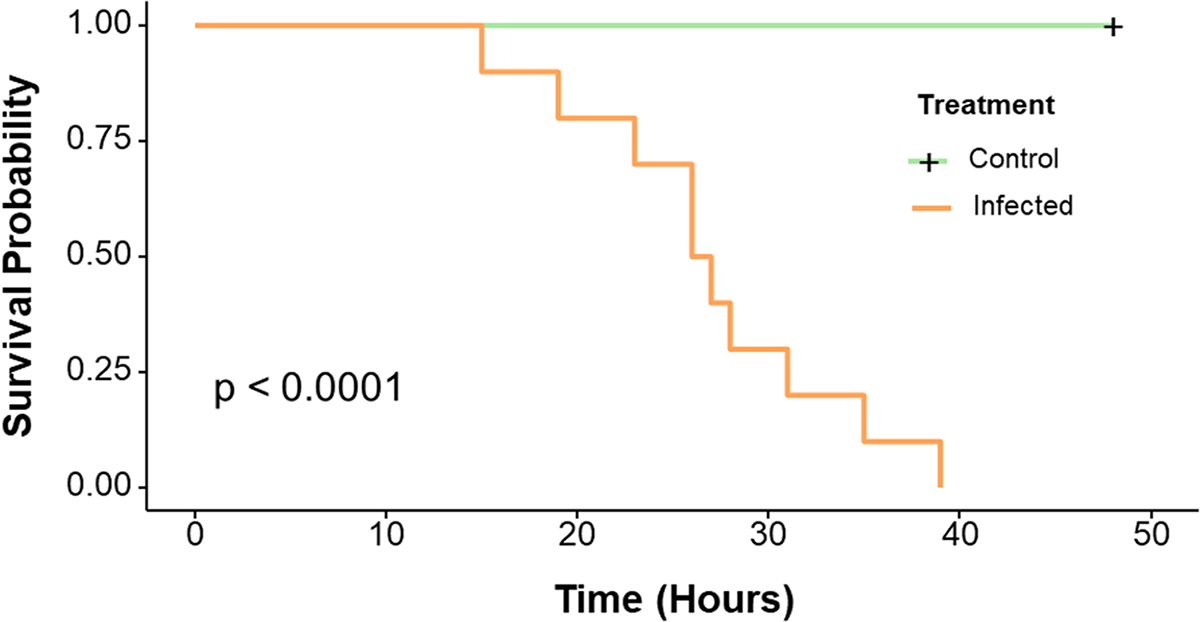
There is a significant difference in survival probability between control and infected groups (χ2 = 21.80, P < 0.0001). The infected group experienced significantly lower survival compared to the control group (fig. 2).
Survival curves for Steinernema carpocapsae-infected Ostrinia furnacalis pupa (pale green) following 48 h of experimental observation in comparison with control group (Orange). the P value is derived from log-rank test to illustrate the treatment effect.

Entomopathogen nematode infection: the effect of distance
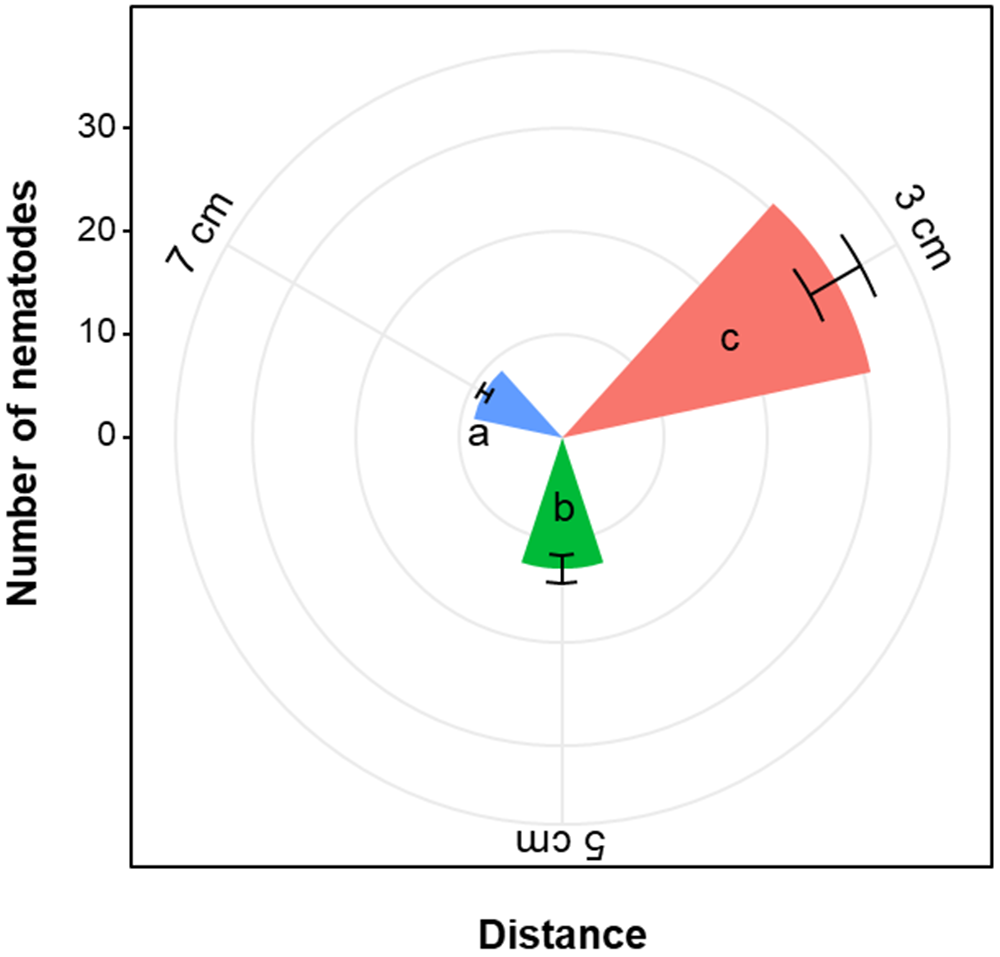
The distance effect on the infection of S. carpocapsae on the pupae of O. furnacalis was statistically significant (χ2 = 148.28, df = 2, P < 0.001). S. carpocapsae juveniles were more prone to settle on the pupa at the closest distance (3 cm) than the second distance (5 cm) which was followed by least infection at farthest distance (7 cm), clearly suggesting a distance-based infection pattern (fig. 3).
The infection of Steinernema carpocapsae over Ostrinia furnacalis pupa located on different distances. Different lower cases depict the differences between the number of settled nematodes over distances.

Entomopathogen nematode preference: the effect of age and sex
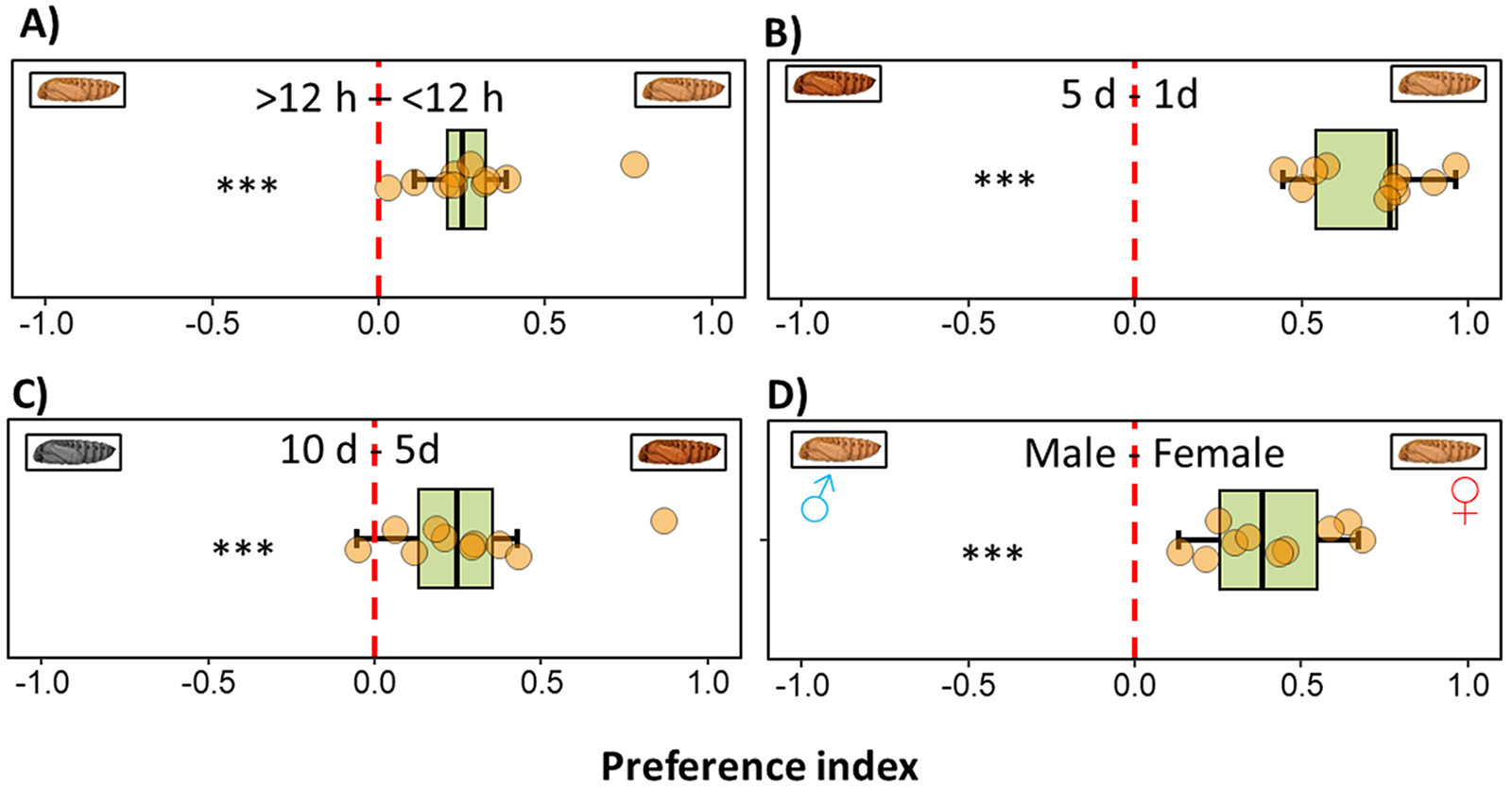
The preference index showed that the entomopathogenic nematode made clear choice between pupae with same age (1 d old) while preferring the ones with age of <12 h over those the ones with the age of > 12 h (χ2 = 46.32, df = 1, P < 0.001) (fig. 4A). The fresher, the more S. carpocapsae prefers as for other age-based comparisons. For example, S. carpocapsae preferred 1 d old O. furnacalis pupa over 5 d old ones (χ2 = 276.37, df = 1, P < 0.001) and preferred 5 d old ones over 10 days old ones (χ2 = 47.61, df = 1, P < 0.001). Additionally, S. carpocapsae preferred females of the O. furnacalis pupa over males (χ2 = 75.20, df = 1, P < 0.001).
Preference index established to demonstrate the preference tendency of Steinernema carpocapsae on Ostrinia furnacalis pupae with different ages and sexes. First, the pupa with age of <12 (right) was compared with those with >12 h (left) as in panel A. Second, the pupa with age of 1 d old was compared with 5 d old ones as in panel B. Third, the pupa with age of 5 d old was compared with 10 d old ones as in panel C. Finally, the female pupae were compared with male ones as in panel D. The triple asterisks demonstrate the significance level (*** = P < 0.001) of model effect on the preference of S. carpocapsae over submitted groups of pupae.

Mortality effect of entomopathogen nematode in different soil depth
The mortality experiments revealed that S. carpocapsae managed to kill the complete set of tested pupae when covered in 0, 1, and 2 cm soil depth both under light and dark illumination conditions except a minor portion of infected pupae managed to survive when tested on 0 cm under light condition. Therefore, compared to control groups, the survival proportion of the infected O. furnacalis pupae was consistently lower (0 cm = > χ2light = 121.77, df = 1, P < 0.001; χ2dark = 1.1642e + 12, df = 1, P < 0.001), (1 cm = > χ2light = 303.91, df = 1, P < 0.001; χ2dark = 217.07, df = 1, P < 0.001) (2 cm = > χ2light = 132.88, df = 1, P < 0.001; χ2dark = 132.88, df = 1, P < 0.001) (fig. 5).
Mortality of Ostrinia furnacalis pupa by Steinernema carpocapsae when exposed under different soil depth and illumination conditions. Triple asterisks depict the treatment effect significance level of statistical models (*** = P < 0.001).

Sublethal effects of S. carpocapsae on O. furnacalis: oviposition and longevity
The number of eggs produced by O. furnacalis females exposed to S. carpocapsae infection during pupa stage was lower compared to control group, either when handled as mean number of eggs as per oviposition days (χ2 = 55.87, df = 1, P < 0.001, fig. 6A) or as total number of eggs laid (χ2 = 180.91, df = 1, P < 0.001, fig. 6B). The longevity of adults was significantly shortened by infection (χ2 = 19.68, df = 1, P < 0.001, fig. 6C).
The number of eggs produced by Steinernema carpocapsae-infected Ostrinia furnacalis females when exposed during pupal stage in comparison with control group either as a mean of daily oviposition (A) or total oviposition (B) along with female longevity (C). Triple asterisks depict the treatment effect significance level of statistical models (*** = P < 0.001).

Discussion
This study highlights the efficacy of S. carpocapsae as a potential biological control agent for O. furnacalis pupae by elucidating key factors influencing infection dynamics. Our findings demonstrate that nematode attraction is distance-dependent, with the highest infection occurring at a 3 cm range. Additionally, younger pupae (<12 h old) and female pupae exhibited greater susceptibility to nematode infection than their older and male counterparts. Infection was not uniformly distributed across the pupal body, with the head and thorax being the most affected regions, and infection significantly declined 24 h post-inoculation. Furthermore, soil depth influenced nematode-induced mortality, with a complete kill rate observed at depths of up to 2 cm. Light exposure slightly diminished infection efficacy. Beyond mortality, sublethal effects of nematode infection included significant reductions in adult longevity and fecundity, suggesting long-term consequences for population suppression.
Steinernema carpocapsae can crawl on the surface of an infected pupa, causing the body surface turns black and dies within 1–2 days. As decomposition progresses, a small amount of white material appears, followed by the emission of a strong odour (Aryal et al., Reference Aryal, Nielsen, Sumaya, Wilson and Riegler2022). Entomopathogenic nematodes can enter insect hosts through intersegmental membranes, natural openings, or wounds, ultimately reaching the insect’s hemocoel, where they release symbiotic bacteria that rapidly infect and kill the host. However, the insect’s immune response can influence the success of nematode infection and survival (Adams and Nguyen, Reference Adams and Nguyen2002; Koppenhöfer et al., Reference Koppenhöfer, Grewal and Fuzy2007). S. carpocapsae has demonstrated high virulence, often inducing greater mortality in lepidopteran pests compared to other EPN species. For instance, a previous study has revealed that S. carpocapsae caused higher mortality rates in Mythimna separata than S. abbasi, S. siamkayai or Heterorhabditis indica (Patil et al., Reference Patil, Vijayakumar, Linga and Sivakumar2020). Furthermore, its efficiency was confirmed against Tuta absoluta pupae, even when located in deeper soil layers (Garcia-del-pino et al., Reference Garcia-Del-Pino, Alabern and Morton2013).
In this study, some infected pupae successfully emerged, suggesting a degree of insect immunity against S. carpocapsae. Upon entering the hemocoel, EPNs release symbiotic bacteria that rapidly kill the host (Gaugler, Reference Gaugler2002; Hazir et al., Reference Hazir, Kaya, Touray, Cimen and Ilan2022). However, the host’s immune response plays a crucial role in determining parasitism success (Topalović and Vestergård, Reference Topalović and Vestergård2021). As pupae mature, haemolymph accumulation increases, and immune defences such as haemocyte encapsulation counteract nematode infection (Li et al., Reference Li, Cowles, Cowles, Gaugler and Cox-foster2007; Castillo et al., Reference Castillo, Reynolds and Eleftherianos2011; Garriga et al., Reference Garriga, Mastore, Morton, Garcia Del Pino and Brivio2020). Our results indicate that O. furnacalis pupae that had developed for more than six days exhibited a higher probability of normal emergence. This suggests that more developed pupae possess greater resistance to nematode infection. Consequently, in our experiments, S. carpocapsae predominantly targeted younger pupae rather than those with extended developmental periods (Jaiswal and Kumar, Reference Jaiswal and Kumar2020). Despite high mortality rates, some O. furnacalis individuals survived S. carpocapsae infection and completed metamorphosis However, little is known about physiological and reproductive consequences of infection survivors. Our oviposition and longevity experiments revealed that moths surviving pupal-stage infection exhibited significantly reduced fecundity and lifespan.
Preference assays investigating S. carpocapsae attraction to pupae at varying distances demonstrated a distance-dependent preference. S. carpocapsae employs an ambush strategy, lying in wait rather than actively foraging (Rakubu et al., Reference Rakubu, Katumanyane and Hurley2024). Its host detection efficiency increases at shorter distances, allowing for rapid host localization and aggregation (Kaur and Brown, Reference Kaur and Brown2023). However, its ability to actively search for and track hosts is inferior to that of S. glaseri (Sarwar and Mukhtar, Reference Sarwar and Mukhtar2021). Compared to roaming EPNs, S. carpocapsae exhibits slower movement, a more limited search area, and reduced foraging efficiency (Lewis et al., Reference Lewis, Gaugler and Harrison1992; Wilson et al., Reference Wilson, Ehlers and Glazer2012).
Several factors did not influence S. carpocapsae behaviour in our experiments. For example, we observed no sex- or body part-dependent host preference. This may be due to the nematode’s insensitivity to sex-specific host signals (Lewis et al., Reference Lewis, Gaugler and Harrison1992) or the absence of such signals at the pupal stage. However, the reproductive potential of O. furnacalis survivors was negatively affected by S. carpocapsae infection. Few studies have investigated the control of O. furnacalis pupae, despite the potential risk of pest resurgence due to the incorporation of crop residues into the soil (Logan et al., Reference Logan, Allsopp and Zalucki2003; White et al., Reference White, Viator and White2011; Li et al., Reference Li, Shapiro-Ilan, Tarasco, Zeng, Liu, Yang, Jun, Chen and Fu2024). The presence of O. furnacalis pupae in the soil presents an opportunity for the use of EPNs as a biological control measure (Abd-elgawad, Reference Abd-Elgawad2022). Previous research suggests that tilling soil deeper than 20 cm effectively suppresses O. nubilalis populations (Atanasov, Reference Atanasov1964; Guo et al., Reference Guo, Zhao, Wang, Zhou, Zhai, Men and Yu2020), implying that O. furnacalis pupae likely remain within the topsoil. Studies on Spodoptera exigua indicate that pupae typically reside at an average depth of ∼0.9 cm (Kaya and Grieve, Reference Kaya and GRIEVE1982), a factor relevant to optimising S. carpocapsae application. Additionally, S. carpocapsae infection rates remained stable at soil depth of 0–10 cm (Koppenhöfer et al., Reference Koppenhöfer, Kaya and Taormino1995; Guo et al., Reference Guo, Zhao, Wang, Zhou, Zhai, Men and Yu2020, Reference Guo, Wang, Men, Wang, Pan, Song, Cui, Lv, Yu and Li2023), making it a promising candidate for O. furnacalis control. Despite its relatively weak mobility and search efficiency, S. carpocapsae significantly increased pupa mortality and reduced O. furnacalis population density. Light conditions also influenced infection rates (Wilson and Gaugler, Reference Wilson and Gaugler2004); all pupae on the soil surface (0 cm depth) succumbed to S. carpocapsae infection under dark conditions, whereas no significant differences were observed at depths of 1 cm and 2 cm.
Our findings highlight that S. carpocapsae is an effective biological control agent against O. furnacalis, offering both environmental safety and significant suppression of pest populations. Investigating the various factors influencing the parasitism of O. furnacalis pupae by S. carpocapsae provides valuable insights into the control mechanisms of entomopathogenic nematodes. These findings can serve as a reference for developing more targeted and efficient pest management strategies.
Conclusion
This study demonstrates the efficacy of S. carpocapsae as a biological control agent against O. furnacalis pupae. Our findings reveal that while S. carpocapsae causes high pupal mortality, some individuals can still complete metamorphosis, likely due to immune defences that strengthen with pupal development. Surviving moths exhibited reduced oviposition and longevity, indicating sublethal effects that may further suppress pest populations. Additionally, S. carpocapsae showed a distance-dependent preference for host pupae, reinforcing its role as an ambush strategist with limited active foraging capabilities. Despite this, its effectiveness remained consistent across different soil depths, suggesting its potential for field application. Given its environmental safety and ability to target pupae concentrated in the topsoil, S. carpocapsae presents a promising strategy for managing O. furnacalis infestations. Future studies should explore its interactions with environmental factors and optimise application strategies for enhanced biocontrol efficacy.
Acknowledgements
The research was carried out thanks the Institute of Plant Protection of Tianjin Academy of Agricultural Sciences. This work was funded by People’s Government of Jilin Province (20220203198SF), the Ministry of Science and Technology of China (2022YFD1500701), and the Ministry of Agriculture of the People’s Republic of China (15226025). The authors also extend their appreciation to the Deanship of Research and Graduate Studies at King Khalid University, through Large Group Project (RGP2/102/46).The authors also wish to acknowledge BioRender for providing its illustration and visualization services.
Author contributions
Wu Hai-chao: Conceptualisation, Methodology, Formal analysis, Data curation, Writing – original draft preparation, Visualisation; Chen Ri Zhao: Conceptualisation, Supervision, Funding, Resources, Project administration, Writing – original draft preparation, Writing – review & editing. Jamin Ali: Writing – original draft preparation, Dara Analysis, Visualisation; Sohail Abbas: Writing – original draft preparation; Aleena Alam: Writing – review & editing (supporting); Chen Ge: Methodology, Writing – original draft preparation; Geng Meng Chen: Writing – review & editing (supporting); Ji Yun-liang: Writing – review & editing (supporting); Arzlan Abbas: Writing – review & editing (supporting); Feng Xiao: Writing – review & editing (supporting); Bilal Ahmad: Writing – review & editing (supporting); Huang Jing Xuan: Writing – review & editing (supporting); Zhao Jian Ye: Writing – review & editing (supporting); Adil Tonga: Writing – original draft preparation, Dara Analysis, Visualisation; Khalid Ali Khan: Writing – review & editing; Hamed A. Ghramh: Writing – review & editing.
Conflict of interests
The authors declare that they have no known competing financial interests or personal relationships that could have appeared to influence the work reported in this paper.