Neoliberal reforms in public policies and economic institutions have proliferated across the developed democracies and the globe in the latter decades of the twentieth century.1
See, among others, Campbell and Pedersen 2001; and Simmons, Dobbin, and Garrett this volume.
The present analysis is limited to the developed democracies for two reasons. First, a central theoretical motivation of this article is to explore how domestic politics and political economic institutions of democratic market economies shape diffusion. Second, the large majority of international investment moves between the developed economies. Given that this article focuses on the influence on policy of tax competition for mobile assets, a sample of developed nations is particularly appropriate.
To answer this question, I build on my recent work on the determinants of change in tax policy in the developed democracies and explore the dynamics of diffusion of the neoliberal tax policy paradigm in the area of capital taxation.3
See Swank 1998; and Swank and Steinmo 2002. Regarding the focus on capital taxation, it is important to note that while the shift to neoliberal tax policy affects both labor and capital income taxation, the combination of rate reductions and base broadening has been especially pronounced in corporate tax policy; Ganghof 2004. Moreover, many of the central questions surrounding the mechanisms of diffusion (for example, pressures from tax competition) are more relevant to the capital tax side.
I organize my analysis as follows. First, I briefly discuss recent trends in taxation and review theories about contemporary tax policy change. Next, I elaborate my arguments about policy diffusion. I then develop empirical models of statutory and effective tax rates on capital and assess these with 1981–98 data from sixteen nations. I conclude with a summary of what is known about the forces driving tax policy change and the diffusion of neoliberal policies in an era of globalization.
Tax Policy Change in the Developed Democracies
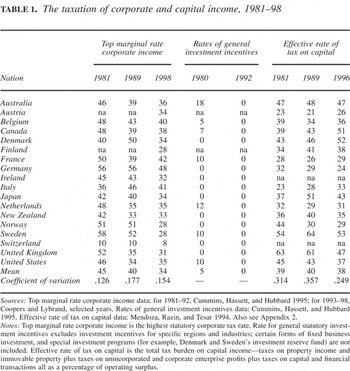
Beginning in the early 1980s, incumbent governments significantly altered national policies on the taxation of corporate profits and capital income. The near universal system of relatively high marginal statutory tax rates and extensive use of tax instruments to target investment (and otherwise shape the behavior of economic agents in accord with national policy goals) was significantly reformed in nearly all nations. Table 1 summarizes the most significant features of changes in corporate and capital taxation. Policymakers reduced statutory corporate tax rates on average from 45 percent in 1981 to 34 percent in 1998. They also commonly eliminated or reduced various investment credits, exemptions, and grants that had significantly lowered effective corporate tax rates on reinvested profits. As Table 1 illustrates, the general investment tax credit was eliminated by 1992 in all nations that had employed it.4
See, among others, Boskin and McClure 1990; Ganghof 2000; Genschel 1999; and Pechman 1988. In addition, two points need to the clarified. First, depreciation for investments in equipment and plant has been everywhere maintained. Moreover, some countries have maintained nontrivial tax-based investment incentives. Second, personal income tax structure, which determines the tax burden on unincorporated enterprise and household capital income, has been similarly changed. For instance, top marginal central government rates declined from 63 to 42 percent between 1976 and 1997 in the typical OECD economy. Steinmo 2002, tab. 3.
The taxation of corporate and capital income, 1981–98

These notable changes in the substantive content of tax policy reflect, in part, a long-term shift in economist and policymaker thinking about optimal tax structure. While the system of high marginal statutory rates, targeted investment incentives, and other tax expenditures was once viewed as a means to foster both equity and growth, the extant structure of taxation had by the early 1980s become emblematic of unfairness, undue complexity, and inefficiency. By the mid-1980s, significant numbers of OECD finance ministers and their economic advisers had come to view the existing tax structure as the source of inefficient allocation of productive investment and lost tax collections; tax rate cuts and base-broadening were commonly seen as mechanisms to both bolster economic efficiency and maintain government revenues.5
Generally, statutory rate cuts coupled with base-broadening elimination of tax expenditures have become part and parcel of neoliberal economic orthodoxy (for example, the Washington consensus).Two departures from the trend toward market-oriented taxation, however, stand out. First, the pace and depth of the near universal course of policy reform varies across nations. As Table 1 illustrates, some nations (for example, the Anglo democracies, France, and the Netherlands) cut statutory rates relatively quickly (and concomitantly reduced or eliminated tax-based investment incentives). On the other had, tax rates remained constant or increased in several other political economies; significant market-oriented tax reforms did not occur until the late 1990s in Italy and statutory rates in some nations (for example, Germany) remained moderately high in 1998. Second, despite notable and widespread cuts in statutory income tax rates, the effective capital tax rate in the typical developed democracy has actually remained relatively stable: governments collected on average 39 percent of capital income in revenue in 1981 and 38 percent in 1996. This tendency toward stability largely reflects the joint effects of rate cuts and substantial base-broadening as well as moderate to strong general capital income growth from the mid-1980s.6
Two additional points deserve mention. First, the coefficient of variation (the standard deviation divided by the mean) for corporate tax rates reveals continued divergence around the new statutory corporate tax structure; in the case of the stable effective capital tax burden, the coefficient of variation suggests some moderate convergence by the late 1990s. Second, recent efforts to measure effective capital tax rates through 2000 by the OECD and European Union show a modest increase of roughly two points in effective capital tax burdens from 1996 to 2000. See Carey and Rabesona 2002; and European Commission 2004.
With these central features of corporate and capital tax reform in mind, central questions for analysis are as follows: What political economic forces have promoted the general shift to market-conforming tax policy? Is the process of tax policy change an interdependent one where reforms in other nations affect the probability of reform in each specific political economy? If diffusion occurs, what form does it take and do domestic factors shape the actual pace and depth of adoption of neoliberal tax policy reforms across countries and time?
Theories of Tax Policy Change
In a recent paper, Swank and Steinmo assessed the widely debated globalization thesis of tax policy change.7
Swank and Steinmo 2002.
Extant research suggests, on balance, that internationalization has not generated a “run to the bottom” in effective capital tax burdens or a shift of taxation to labor and consumption. See Garrett 1998a and 1998b; Garrett and Mitchell 2001; Hays 2003; Quinn 1997; and Swank 1998. Some have found support for the conventional thesis. Rodrik 1997.
Slemrod 1990.
Ganghof 2000.
Swank and Steinmo argued that domestic economic stress and budgetary dynamics also shape tax policy reform. Post-1970 declines in investment rates as well as the secular rise in general and structural unemployment are likely to prompt efficiency-enhancing reforms in tax policy (that is, statutory and effective capital tax rate cuts). Cuts in effective tax burdens on capital are, however, circumscribed by budget dynamics: increases in needs and demands for income maintenance, political limits on retrenchment in social spending, and the consequent specter or reality of rises in public debt constrain the reductions in capital tax burdens and even prompt tax increases. Reductions in effective tax rates on capital are also constrained by difficulties in shifting tax burdens to labor. Capital mobility, itself, pressures policymakers to lower nonwage labor costs. Moreover, since the mid-1980s, policymakers have increasingly focused on reductions in labor taxes that create “tax-wedge” effects on employment.11
See, among others, OECD 1994.
Tax Policy Reform as an Interdependent Process: Diffusion Processes
Internationalization, adverse domestic economic change, and budgetary dynamics exert varying levels of direct pressure on incumbent governments. There is little question that post-1980 tax policy reforms across the developed democracies were shaped to some extent by responses of national policymakers to these common forces. As Simmons, Dobbin, and Garrett note in the introduction to this symposium, there are theoretical and substantive reasons to believe, however, that neoliberal policies also diffused across regions, types of political economies, and, in some cases, the globe. As Simmons, Dobbin, and Garrett also point out, four sets of mechanisms are likely conduits for the diffusion of neoliberal policies and institutions: coercion, the competitive pressures of markets, policy learning, and social emulation.
In the present article, I focus most centrally on the competitive pressures of markets as the potential source of the diffusion of capital tax policy. In addition, I elaborate and test policy learning and social emulation models of policy diffusion where learning and emulation are assessed as alternatives or supplements to core models. In a final stage of analysis, I also explore the possibility of contagion effects and the temporal dynamics of diffusion and policy change. Coercive pressures for tax policy diffusion, on the other hand, where coercion is defined as “the manipulation of economic costs and benefits, and even the monopolization of information and expertise—all with the aim of influencing policy adoption elsewhere,” should be of marginal importance to the present study.12
Simmons, Dobbin, and Garrett this volume.
General and Asymmetric Competition
Previous work referenced above on the determination of contemporary tax policy highlights and tests variations of the globalization thesis: in order to attract and retain mobile assets, national policymakers lower tax burdens on capital and otherwise move policy in a market-conforming direction. Recent work on tax policy and the arguments advanced by authors of this volume make clear, however, that incumbent governments not only respond to pressures emanating from increased levels of international openness, they are also likely to take leads from policy change in other nations.13
As a number of contributors to the present symposium argue, national policymakers may monitor and respond to policy change among all member nations of a particular set (homogenous diffusion). Thus, Britain, Germany, and Sweden, for instance, might survey and react to tax policy change across the OECD. On the other hand, a developed democracy may monitor and respond to policy change in those polities with which it most extensively competes. Thus, British or Swedish policymakers may closely follow tax policy in nations with which they share ample flows of foreign investment and those nations that possess a similar cross-national distribution of investment (that is, those countries with which they compete in global markets). Thus, I develop and test models of homogenous and competitive diffusion of capital tax policy below. There are good theoretical and evidentiary reasons to believe, however, that an equally if not more plausible competition model is one that brings the seminal mid-1980s U.S. tax policy reform center stage. Moreover, I argue that because the shift to the neoliberal tax structure entails the potential for significant economic and political costs, one must also incorporate domestic political and institutional factors into the model of capital tax policy diffusion.14
In the analysis to follow, I assume that all policymakers seek to maximize—subject to political economic and institutional constraints and thus common situational tradeoffs—economic performance and political support. In the short term, incumbent governments will also strive to maintain revenue levels to fund favorite and politically popular programs as well as limit public deficits and debt. Left and Christian Democratic governments, however, have different intermediate and long-term targets for the level and distribution of taxes than do center and right parties.
The linchpin of contemporary tax policy reform is arguably the U.S. 1986 Tax Reform Act. The act embodied the fundamentals of the new tax policy paradigm: top statutory corporate rates were reduced over multiple years from 46 to 34 percent, the investment tax credit was abolished, and accelerated depreciation and a variety of other allowances were significantly scaled back. (Top marginal personal rates were reduced from 50 to 28 percent, the number of brackets cut from fifteen to two, and a variety of tax expenditures limited and eliminated.)
The cross-national implications of the 1986 Act were immediately clear. Tanzi notes that the 1986 reforms, enacted in the context of substantial cross-national convergence in academic and policymaker thinking about tax policy, and motivated by common concerns over slow economic growth and rising unemployment, “sent shock waves to other countries.”15
Tanzi 1987, 335.
Britain reduced marginal personal income tax rates in 1979 and corporate rates in 1984; several other nations had enacted modest reforms in the direction of lower marginal rates and a larger tax base. See Tanzi 1987; Boskin and McClure 1990; and Pechman 1988. However, the large majority of nations had yet to execute significant reforms in 1986.
Other general and country-specific analyses echo Tanzi's cross-national survey of the impact of the 1986 U.S. tax reforms.17
See contributions to Boskin and McClure 1990; and Pechman 1988. See also Ganghof and Eccleston 2004.
Two technical points are in order. First, as tax credits, allowances and deductions modify the statutory rate—that is, produce a lower effective tax rate—on marginally profitable investment, the statutory rate becomes particularly important in attracting and retaining clearly profitable foreign investment. Second, as governments of source countries do not give tax refunds for taxes paid in relatively high-tax jurisdictions, there is a strong incentive to reduce rates below those in source countries that supply ample capital investment. Ganghof and Eccleston 2004.
On shares of developed country inflows (1997 is the sample year), see IMF 1998. For extensive data on bilaterial capital flows, see recent editions of the OECD's International Direct Investment Statistics Yearbook.
Ganghof and Eccleston 2004, 523.
In addition, leading international tax specialists such as Gordon and Slemrod have pointed out that the impact of U.S. tax policy change must also be examined in historical perspective.21
As these scholars argue, before the tax reforms of the mid-1980s, the United States acted as a Stackelberg leader, namely, a dominant economy with a positive net foreign investment flow to the rest of the world. As such, the United States could keep corporate rates high and other nations had an interest in following suit. (As multinational enterprises can generally get credits for taxes paid in host jurisdictions, other nations had strong incentives to keep rates close to the U.S. rates. In doing so, they could simultaneously preserve investment while accomplishing redistributive and revenue goals.) With the decline of the position of the United States as net lender of capital, Slemrod, Gordon, and others have pointed out that the Stackelberg equilibrium became a noncooperative Nash equilibrium where tax competition through rate reductions was increasingly likely. Yet, as discussed above, the formidable role of the United States as dominant host and supplier of capital relative to other developed democracies is likely to sustain the “leading” role for the United States in tax policy in an era of tax competition.Conditional Diffusion of Neoliberal Reforms
In addition to the perceived competitive benefits accorded those nations who follow the U.S. lead, national policymakers face the risks of economic and political costs by adopting the market-conforming tax regime. The post–World War II tax structure of significant marginal statutory rates on capital and high-income earners, coupled with substantial investment and related incentives, served as a central mechanism for achieving growth and equity in contemporary democratic capitalism.22
As I detail below, the active use of tax policy in the form of general and targeted investment credits also complemented other elements of macro- and microeconomic management in many political economies. Significant and rapid reform of the postwar tax structure thus generates economic uncertainty and raises the specter of economic performance problems.Second, rapid and deep policy change toward the neoliberal tax structure may entail substantial political costs. Not only are those economic interests who benefit from the current structure of taxation likely to mobilize to resist policy change, those who support the redistributive character of extant corporate and personal income taxation are likely to act to thwart policy reform. In this context, it is important to keep in mind that although the majority of income redistribution comes through the mechanism of cash and in-kind social transfers, personal and capital income taxation contributed roughly 28 percent of income redistribution in the typical developed democracy during the period 1980–2000.23
These estimates of the role of taxation in total fiscal redistribution (the change between pre- and post-fisc income inequality as measured by the GINI index) are made on the basis of 1980–2000 data from the twelve principal nations of the Luxembourg Income Study. Mahler and Jesuit 2004.
Slemrod 2004, 1172.
Ultimately, the likelihood of adoption of U.S. neoliberal tax policy by other nations should be a function of the relative weights assigned by policymakers to the expected benefits and political and economic costs associated with neoliberal tax structure. By “relative weights,” I mean the assessment of the benefits and costs associated with the shift to neoliberal tax structure in light of basic policy priorities (that is, economic performance and political support) and of the probability that the benefits and costs will materialize.25
See fn. 14 above on assumptions on general policy priorities.
First, domestic political forces should influence the pace and depth of a nation's tax policy response to U.S. tax reform. Recent levels of success by right-of-center political parties should matter. Specifically, frequent government control by right-of-center parties in years preceding the proposal of market-conforming tax policy reforms should facilitate adoption of those reforms. Extended right-party government will bolster mass and elite support for liberalization and market-oriented policies generally and produce incremental (if not dramatic) enactments of a variety of neoliberal economic and social policy reforms that lay the groundwork for a shift in the tax policy paradigm. Second, from the perspective of a substantial body of political economy theory, the position of the median voter ultimately determines policy: electoral support for notable reductions in marginal capital tax rates is requisite for adoption of focal reforms. As suggested above, substantial reductions in marginal tax rates on capital imply potential diminution of the commitment to redistribution, suggest economic gains for upper-income strata, and raise the specter of reductions in social protection and public goods provision. Thus, a recent and general shift to the right by the median voter suggests increased demands for less government intervention and generally augers well for the success of significant neoliberal reforms. Overall, a shift to the right at the mass and elite level should significantly increase the weight assigned potential benefits and diminish the costs associated with adoption of the U.S. model.26
An additional argument is that the pace and depth of tax policy change is conditioned by the extent of “veto points” in the focal political system. See Hallerberg and Basinger 1998. Multiparty legislatures and cabinets and horizontally and vertically fragmented political authority create opportunities for opponents of policy change to slow or block reform. I report results of tests of this argument below.
In addition, the character of domestic political economy should matter. Specifically, the nature of the production regime should be fundamentally important to the pace and depth of adoption of the neoliberal tax policy model. As Soskice has argued, countries may be classified by the extent of national coordination through economy-wide collective bargaining among relatively centralized national employer and union associations.27
Second, nations will vary according to the degree of sector (or business group) coordination of the economy, or the level of cooperation by enterprises in organizing product, financial, and labor markets. With regard to national coordination, supply-side–oriented economic policies place a strong emphasis on employment. Active labor market policies generously fund training, placement, relocation, and general employment services (and the income maintenance system contains relatively strong work incentives). Macroeconomic and supply-side policies have sought full or near-full employment, and extensive public control of banking and credit has allowed governments to channel resources to employment-enhancing investments. Corporatist institutions, where labor has regularly exchanged wage restraint for full employment commitments and improvements in social protection, undergird macroeconomic and supply-side policies. In the 1970s and 1980s, wage restraint and currency devaluations further promoted growth and employment in core export-oriented industries in nationally coordinated economies.28 The role of tax policy in the model is important: high marginal rates on uninvested profits coupled with general investment reserves, investment tax credits, and other incentives for saving complement other supply-side policies in promoting long-run economic growth and employment.Sector-coordinated market economies typically exhibit moderate to high levels of centralization of collective bargaining; relatively centralized wage bargaining is supported by works councils and other cooperative arrangements between business and labor at the firm level. In addition, as Soskice and collaborators have demonstrated, the sector-coordinated economy is structured by high levels of organization of economic activity within industrial sectors oriented to the long-term development and production of high-quality, diversified consumer and industrial goods.29
Trade associations, holding companies, industry-financial networks, and informal cooperative business groups typically organize research and development and technology transfer, export and marketing strategy, vocational training, some aspects of competition and pricing, and other activities. Coordination of economic activity by business is supported by stable, long-run labor-business relations and by state regulatory frameworks. Traditionally, interventionist tax policy has played two key roles in sector-coordinated economies. First, it has generally facilitated state promotion of long-run growth (for example, regional and sector targeting of investment during periods of economic modernization and restructuring). Second, tax policies of high marginal capital tax rates (and high employer social insurance contributions) have been instrumental to the maintenance of social solidarity and long-term stability in labor and industrial relations.30See Swank 2002, chap. 5, and the literature cited therein.
The significance to tax policy change of national or sector coordination should be clear. As Hall and Soskice have argued, elements of national economic models are functionally interdependent.31
Hall and Soskice 2001.
Soskice 1999.
Thelen 1999.
Swank 2002, chap. 5.
Policy Learning and Social Emulation
Two alternative diffusion processes may be relevant for understanding the shift to the market-oriented tax structure: policy learning and social emulation. Regarding policy learning, two central claims of proponents of the neoliberal tax structure are that it enhances efficiency by removing distortions to the market allocation of capital and that it maintains (or even increases) revenue collection from capital income while lowering capital tax rates. That is, the treasury is protected and government intervention in markets is reduced (and thereby efficiency is presumably increased) by simultaneously cutting rates and broadening the tax base through the elimination of incentives that were designed primarily to channel investment in accord with policy goals.
The mid-1980s U.S. tax reform, the archetype of the shift to the neoliberal tax paradigm, may have served as a natural experiment (as did early, extensive privatization in Great Britain) to test the claims of proponents about efficiency and revenues. As such, the U.S. tax reform may have generated “information externalities” for countries throughout the OECD on the veracity of proponents' claims. As Tanzi notes, the U.S. reforms drew intense interest throughout the democratic market economies. There is also clear evidence that while concerns about tax competition were predominant, policymakers were also interested in efficiency and revenue potential. In fact, at a January 1987 meeting, OECD heads of governments, finance ministers, and international business elites suggested that the investment and revenue performance of the United States in the years immediately following the reform would serve as a test for the soundness of the new policy regime.35
This meeting, held on January 12 and 13 in France, focused on the merits of recent and planned personal and corporate tax policy change in the developed democracies. OECD 1987.
Finally, it may be likely that nations that share common political histories and institutions, cultures, and, to a lesser extent, geographical boundaries emulate recent policy innovations in peer countries. That is, similar policy orientations and legacies (for example, shared traditions in the level and form of state interventions), framed within shared histories of political development, institutional patterns, and cultures, undergird this process. Indeed, in influential work on “families of nations,” Castles and collaborators have suggested that policies often diffuse most readily within culturally and politically similar groups of nations.36
In the democratic capitalist world, these families include the English-speaking countries that are linked by language and common legal and political traditions, the Nordic countries who share culture, legal traditions, and centuries of interdependent political development, and the continental European nations that are united by religion and other cultural attributes as well as shared political history. Thus, one might hypothesize that as in other policy areas, a focal nation would monitor and respond to recent policy changes in taxation within its family of nations more readily than to past changes in other families or across the developed democracies as a whole.Empirical Models of Tax Policy Reform
I evaluate hypotheses about the diffusion of neoliberal tax policy reforms by using the linear models of corporate and capital taxation developed in Swank and Steinmo as a base.37
Swank and Steinmo 2002.
In this article, I extend the sample to 1981–98 data from sixteen advanced nations.38
Models of corporate taxes are generally estimated with 1982 to 1998 data for fourteen nations while those for capital tax burdens are estimated with 1981 to 1996 data from sixteen countries. Models of diffusion of U.S. reforms exclude the United States. The sixteen nations are Australia, Austria, Belgium, Canada, Denmark, Finland, France, Germany, Italy, Japan, the Netherlands, New Zealand, Norway, Sweden, the United Kingdom, and the United States; Austria and Finland are excluded from the corporate rate models because of data unavailability.

Again, this model assumes independence in national responses, or that the shift to a market-conforming tax model is a function of varying national responses to common domestic and international political economic forces.
The central hypotheses on diffusion are modeled in three ways. First, I use general spatial lags. I test the proposition that policymakers monitored and responded to tax policy change in all other developed nations by including an unweighted spatial lag:

where φs is the coefficient for the spatial lag, (tax ratemean j−n). (tax ratemean j−n) is the average change in tax rates in j to n countries (nations other than i) at time t−1.39
Beck 2001. Change measures of other-country (or U.S.) tax reforms are particularly appropriate for our models as the control for the lagged tax rate effectively makes the dependent variable a change variable, or equivalent to tax ratei,t − tax ratei,t−1 in equation (1). When we substitute tax ratei,t − tax ratei,t−1, for tax ratei,t, only the coefficient for the lagged tax rate, φ, changes; it is equal to φ − 1 when the dependent variable is a change measure. Effects of causal variables are mathematically equivalent across the two equations. I estimate effects of levels and changes in other-country and U.S. tax rates in the context of error correction models; these are presented below.

Total trade for country i with some other country j is highly correlated with country i's capital stock position with j (that is, inward direct investment in i by j and outward direct investment in j by i).40
For instance, the simple cross-national correlation between trade with the U.S. and capital stock position with the Untied States (1989–91 means) is .689 (p < .01) for OECD nations. As is well known, this relationship stems from the fact that a significant portion of all trade is intrafirm trade; see Bonturi and Fukasaku 1993.
Finally, for each country i, I weight past tax policy changes in other countries by a dummy variable that measures whether they are of the same “family of nations” as country i. Thus, tax policy change in country i is modeled as a function of the mean of past policy change in country i's main reference political systems. This provides a straightforward test of one basic form of social emulation.
Second, I test the direct impacts of reforms in U.S. corporate and capital tax rates on other nations' tax policies by adding lagged changes in U.S. statutory corporate and effective average capital tax rates to the models; the competition-weighted measure of past policy change in non-U.S. cases is left in the equation as a control. To provide specific quantitative evidence on the competition-driven diffusion of U.S. tax reforms, I interact lagged U.S. tax rates with lagged U.S. trade flows in the focal non-U.S. cases. Trade with the United States, as in the case of the general bilateral trade weights for competition, is used as a proxy for the extent of market integration for foreign direct investment. To echo the point above on measuring capital competition, the correlation for trade between the United States and some country i, and the inward and outward capital stock position of country i with the United States, is strong and highly significant (r = .689, p < .01). I also use a similar interaction-based test for the policy learning hypothesis in which I interact lagged changes in U.S. rates with (one- through three-year) lagged measures of the relative (posttax change) performance of the United States on the dimensions of domestic investment and income tax revenues. Specifically, I compute a variety of measures of the difference between U.S. investment (or revenue) growth and investment (or revenue) growth in the focal country and use this to effectively weight lagged change in U.S. tax rates. I report these tests below.
Third, tests of the conditional effects of U.S. tax reforms (and general and weighted past policies in other nations) on tax policy change in other democracies are made through interaction analysis.41
Interaction analysis is well-suited for examining the conditional effects of external forces on domestic political or policy outcomes. In short, the interaction of, for example, X1 (the level of sector coordination of the economy, for instance) and X2 (lagged U.S. tax policy change) when the dependent variable is Y (current tax rates in other developed democracies), will show whether the effect of X2 on Y varies with levels of X1. The significance test for the interaction term indicates whether differences in the effect of X2 at different levels of X1 are significantly different from 0. The interaction term itself, when multiplied by a value of X1 and added to the coefficient of X2, becomes the slope for the effect of X2 at that level of X1. Standard errors for computing the significance of the effects of X2 at some level of X1 are easily calculated. See Friedrich 1982.
Finally, I follow leads in Blanchard and Wolfers's analysis of the determinants of unemployment and estimate the tax policy effects of a variety of exogenous shocks (for example, energy prices and real interest rates) and assess their impact on the results of diffusion models. Blanchard and Wolfers 1999. Results are noted below.
The models are estimated by ordinary least squares (OLS) regression analysis with panel-corrected standard errors.43
An alternative approach is event history analysis. However, the occurrence of multiple points of reform in some nations, no clear single reform event during the sample period in a few others, and the presence of several common problems of event history analysis in the current modeling context suggest OLS regression is a more tractable strategy. New event history estimators such as Cox hazard models for multiple events offer promise for future work. See Box-Steffensmeier and Zorn 2002.
Beck and Katz 1996.
For example, Kvist 1995.
I also estimate final empirical models of statutory corporate rates with a generalized error correction method. The estimating equation is:

where X is a vector of variables that consists of exogenous factors from equation (1). This estimator, for instance, allows one to assess both the dynamic short-term responsiveness of tax rates in the developed democracies to changes in U.S. tax rates (β2) and the long-term structural relationship between U.S. rates and tax policies in other nations (β1).46
See Beck and Katz 1996; and Beck 2001. I extend the error correction models only to statutory rates to simplify analysis and to explore the relatively rich findings on the mediation of the impact of U.S. policy change on statutory tax rates in other nations. I do not adopt the general error correction method as the principal estimation technique because of the greater flexibility of OLS regression of simple dynamic models. Error correction models serve as a check on the robustness of the simple dynamic models.
Findings
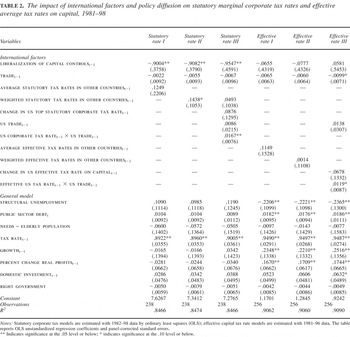
Results of the estimation of equations (2) and (3) for corporate tax rates are presented in the first two columns of Table 2; comparable results for effective capital tax rates are presented in the fourth and fifth columns. The findings on the tax effects of common international and domestic forces are as follows. With regard to direct impacts of internationalization of markets, liberalization of international capital controls in prior years is associated with reductions in statutory corporate rates (but not with actual capital tax burdens).47
Liberalization is associated with tax reform at lags of 1 through 4 years (but not contemporaneously related to tax policy). Swank and Steinmo argue that liberalization and consequent growth in actual capital flows pressured policymakers, for reasons discussed above, to initiate tax policy reform; see Swank and Steinmo 2002. Increases in formal-legal and actual capital mobility also reinforce calls from center-right partisans and business for general neoliberal reforms of social and economic policies. We documented these mechanisms with evidence from the case study literature and our own interviews with policymakers.
The impact of international factors and policy diffusion on statutory marginal corporate tax rates and effective average tax rates on capital, 1981–98

As to general diffusion processes, unweighted past policy changes in other countries are not significantly related to current tax policy change in a focal nation (for either corporate or effective capital tax rates). Net of other factors in the model, national policymakers are not systematically influenced by the general course of recent policy change across the developed democracies.48
In the case of these tests (and all others presented below), I examined longer-term lags for core variables. In no instance did a longer time lag change reported results.
Tests for the effects of changes in statutory corporate and effective capital tax rates in the United States are presented in the third and sixth columns of Table 2. While I estimated the tax impacts of past change in U.S. rates as well as past U.S. tax policy change interacted with a country's U.S. trade in both sets of analyses (controlling for past weighted policy change in all non-U.S. nations), I report only the U.S. tax rate—U.S. trade interaction equation here (for the sake of parsimony). The direct linear effect of past changes in U.S. corporate rates on current corporate tax rates elsewhere is .1917 (p < .05); the direct linear impact of U.S. effective capital rates on capital taxes elsewhere falls just short of statistical significance. As the table indicates for the interaction model (and I will focus on corporate tax structure), a one-point change in U.S. rates is associated with a .1711- (p < .10) point change in corporate rates elsewhere when U.S. trade is low (U.S. trade at 5 percent of GDP). At moderate levels of U.S. market integration (U.S. trade at 10 percent of GDP), the effect of a one-point change in U.S. rates is .25 points elsewhere (.0876 + [.0167 × 10]). Given the relatively dominant role of the United States as a host and supplier of capital investment in virtually every developed democracy, and the theory and substantive evidence on pervasive fears of tax competition in the wake of initial U.S. policy change, one would expect the general linear impact of U.S. tax rate change to be important. One would also expect that this substantial and significant effect would increase with rises in market integration with the United States; this is in fact the pattern of results that I obtain.
I also reestimated Table 2 models with longer lags of U.S. tax policy change, British statutory and effective tax rates (recall the 1984 British reforms), and an average of British and U.S. tax rates. Analysis of lags suggests that the change between t−2 and t−1 is in fact the optimal lag specification. Lagged British tax policy change (at lags of t−1 through t−4) was not significantly related to tax policy change across the developed democracies (at or below the .05 level); average UK/U.S. rate measures were marginally but, in substantive magnitude and significance, not as strongly and robustly related to subsequent tax policy change in other nations as were U.S. tax policy changes alone.49
Results reported in Table 2 are near perfectly reproduced when moving to the fixed-effects estimator discussed above. All core findings on the direct and conditional impacts of U.S. tax policy presented in Tables 2, 3, 4, and 5 are reproduced in the presence of fixed effects.
Tax Policy Diffusion and Domestic Politics
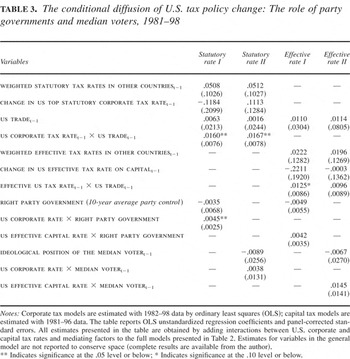
The tests for the hypotheses that cross-national effects of U.S. tax reforms are conditioned by the extent of government control by right parties and the ideological position of the median voter are presented in Table 3. As the table illustrates, only one of four possible interactions between U.S. tax reforms and domestic political conditions in the responding countries is significant. This occurs for the case of the interaction between U.S. corporate tax rates and right party government. Where right-of-center parties have governed extensively in recent years, tax policy responsiveness to U.S. tax reforms is significantly greater than elsewhere. A one-point cut in U.S. rates is associated with a decline of .22 percentage points in rates where right-of-center parties have held 75 percent of the cabinet portfolios over the past ten years. There is no support, however, for the notion that adoption of U.S. tax policy change is stronger in polities where, net of other forces, the median voter is more ideologically supportive of neoliberal reforms.50
I also assessed whether or not the responsiveness to past policy change in the United States was slower in nations with substantial veto points. Using the measure of total veto points developed by Huber, Ragin, and Stephens, I found no evidence for the veto point hypothesis; Huber, Ragin, and Stephens 1993.
The conditional diffusion of U.S. tax policy change: The role of party governments and median voters, 1981–98

Tax Policy Change and Production Regimes
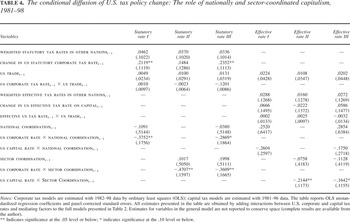
Table 4 presents tests of the hypotheses that general effects of U.S. tax policy change will be conditional on the organizational structure of the domestic political economy. As displayed in the first and fourth columns of Table 4, analyses indicate that where national coordination is strong (1.00 on the index), U.S. corporate tax rate cuts have a trivial effect on policy reform in other polities (b = .2119 + [−.3752 × 1.00]); where national coordination is weak (−1.00 on the index), as in the typical liberal market economy, U.S. corporate tax change has a large effect on tax reform in the focal nation (b = .2119 + [−.3752 × −1.00]). There is no significant mediation of the impact of U.S. effective capital rate cuts by national coordination.
The conditional diffusion of U.S. tax policy change: The role of nationally and sector-coordinated capitalism, 1981–98

Results for tests for the role of sector coordination in mediating the effect of U.S. tax reforms are stronger. In the case of both U.S. corporate and effective capital tax rate change, the degree of sector coordination conditions the impact of U.S. reform on tax policy change in other nations. To highlight the role of uncoordinated market economies, one can compute the impact of U.S. corporate and effective capital tax rate cuts when sector coordination is very low (−1.00). In the case of corporate taxation, a one-point cut in U.S. statutory rates will be associated with a .3-point cut in the focal liberal market economy (b = .1484 + [−.4707 × −1.00]). For effective capital tax rates, a cut of 1 point would be associated on average with roughly a .2-point reduction in the other liberal market economies (b = −.0222 + [−.2144 × −1.00]).51
Effects of U.S. rate cuts in uncoordinated market economies are in each case statistically significant; coefficients for the effects of U.S. rate cuts in coordinated market economies are systematically insignificant. In addition, I explore whether unweighted and trade-weighted measures of tax policy change in non-U.S. nations affected current policy changes differentially across uncoordinated and coordinated market economies. I found no evidence that this was the case.
I also assessed the joint impacts of mediation of U.S. tax policy change by national and sector coordination of the economy; the results of this analysis are displayed in the third and sixth columns of Table 4. As indicated in the table, sector coordination appears to be the most salient feature of the organization of the economy: in the presence of both sets of interactions, the U.S. tax rate–national coordination interaction becomes significant at only the .10 level for statutory corporate taxes, and falls to insignificance in the effective capital tax rate models. As sector coordination and national coordination share core features (for example, labor organization) and are significantly correlated across countries, and as further analysis adds linear variables and interactions and thus risks high multicollinearity, I will subsequently report results from models with sector coordination only.52
The same considerations apply to the interaction between U.S. tax rate change and right governments. In the presence of the U.S. tax rate–sector coordination interaction, the interaction between U.S. rates and right governments falls to significance at the .10 level. For the sake of parsimony and protection against excessive multicollinearity, I report only the U.S. tax rate–sector coordination interaction in the final models (and continue to acknowledge the prospect of a role for party governments in U.S.-driven diffusion of tax policy).
Finally, it is interesting to note that in the models estimating the interaction of past U.S. tax policy change and the degree of coordination of markets, the interaction between past U.S. tax rates and a country's U.S. trade becomes insignificant. On closer inspection, this finding is not surprising. The simple cross-national correlation between integration with U.S. markets (a country's inward and outward capital stock position with the United States) and sector coordination is strong (r = .776, p < .01). Levels of multicollinearity when both U.S. tax–U.S. trade and U.S. tax–sector coordination interactions are in the equation are also very high. Generally, this pattern of findings suggests that at a specific level of coordination of markets (coordination itself being highly correlated with U.S. market integration), additional increases in U.S. trade do not intensify the impact of past tax policy change in the United States.
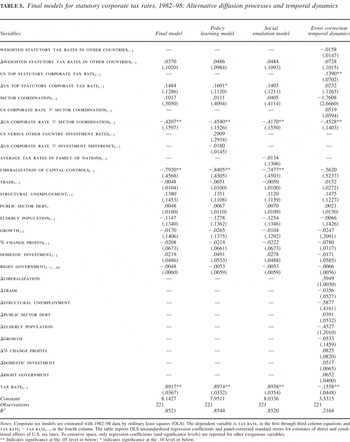
As a concluding stage of the analysis, I assess the possibility that systematic policy learning and social emulation undergird the diffusion of neoliberal tax policy, as well as assess the temporal dynamics of diffusion. For parsimony, I focus on the corporate tax structure models (although the same patterns as reported below hold for capital taxation, albeit at weaker substantive and significance levels). As a final baseline model, I use the equation that reports the mediation of the impact of U.S. tax policy by market coordination and controls for weighted past policy change in non-U.S. cases as well as common international and domestic forces (see above on considerations that underscore this choice). I employ the tests outlined above: for policy learning I explore the impacts of the interaction of past U.S. policy change and past investment or revenue performance differentials between the U.S. and focal nations (at lags of t−1 to t−3 years).53
Thus, for the lag of one year, the interaction is U.S. policy change from t−2 to 2−1 and the investment rate or revenue growth difference between the United States and the focal country in t−1.
The first column of Table 5 reports the complete baseline model while the second column displays the results for a test of a representative policy learning model. As in the case of other specifications (for example, longer lag lengths or revenue performance differentials), there is no evidence that responsiveness to U.S. tax policy varies by the degree of relative superior U.S. economic performance over performance in the focal country. The same null findings are produced if one weights past policy change in all nations by relative policy performance with the focal nation (results not reported). In addition, there is little evidence of social emulation. The effect of past tax policy reforms in a nation's peer group is not related to contemporary policy change. This result holds with or without the extant specification of the U.S.-centered, conditional diffusion mechanism.54
I also tested for the role of exogenous shocks that should affect capital accumulation and, in turn, policymakers' efforts to encourage it. Specifically, I added year dummies to the third column equation to account for general, unspecified common shocks that may affect tax policy reforms. I also estimated the direct and institutionally mediated effects of specific common shocks that should influence capital investment and policies designed to influence it: energy prices, inflation rates, and real interest rates. Blanchard and Wolfers 1999. Time dummies and estimates of specific shocks were consistently insignificant at the .05 level.
Final models for statutory corporate tax rates, 1982–98: Alternative diffusion processes and temporal dynamics

National political economic institutions, 1979–97: Principal components analysis

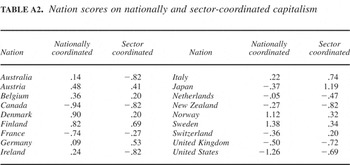
Nation scores on nationally and sector-coordinated capitalism

Finally, I assessed temporal dynamics by estimating a general error correction model of tax policy change. As noted above, this model allows one to estimate long-term and short-term components of factors' influences on the shift to neoliberal tax structure. As the fourth column of Table 5 suggests, the results are instructive. First, while the interaction of the change in U.S. rates and sector coordination is significant, the interaction between levels of U.S. tax rates and sector coordination is not. This tells one explicitly that while policymakers in coordinated market economies were less responsive in the short term, the long-term relationship between U.S. tax structure and tax policy in other nations did not vary by political institutional context.
Second, and related, the results of Table 5 allow us to assess and compare the actual nature of the impact of levels of U.S. tax rates and levels of (weighted) tax structure in non-U.S. nations on tax policies in a focal nation. The latter measure captures the secular changes in policy that accumulate across nations and, in turn, allows one to look for any contagion effects that occur, net of effects of tax policy in the United States and of common international and domestic forces. As the table reveals, the coefficient for past levels of U.S. rates and current tax policy in a focal nation—that is, the long-term structural relationship between the two—is indeed significant. For every one-point drop of U.S. rates in the long term, rates in other nations fall by about .14 points (net of all other influences, including the short-term effects of U.S. tax change in liberal market economies). The coefficient on the (weighted) level of past tax rates in non-U.S. cases is, however, insignificant. This of course tells us that there is little in the way of evidence for a “general contagion toward neoliberalism” net of the U.S. policy shifts.
Conclusions
During the past two decades, the tax treatment of corporate and capital income has changed rather dramatically across the capitalist democracies. While the pace and depth of change varies, corporate and personal rates have been reduced and the tax base broadened through significant shifts away from significant investment credits and allowances in virtually all countries. In fact, not only have instruments and the settings of those instruments been altered, but the basic goals of tax policy have seemingly shifted from redistribution and interventionism toward efficiency.55
See Swank 1998; and Swank and Steinmo 2002. I use the language of Hall's conceptualization of policy paradigm shift; Hall 1993.
The analyses presented in this article offer some clear answers to this question. To an extent, national policymakers responded to common international and domestic pressures. Internationalization, in some areas of tax policy, militated toward significant policy change; as Swank and Steinmo have argued elsewhere, the room for maneuver by policymakers, however, was constrained by domestic economic change (for example, deindustrialization and economic performance problems) and domestic budgetary politics.56
Swank and Steinmo 2002.
What do the above results reveal about the mechanisms of diffusion and about the future of neoliberal reforms? On the question of diffusion, substantial theory, an abundance of qualitative evidence about the perceptions of national policymakers, and the results presented above indicate that competitive pressures undergirded the diffusion of U.S. reform. Policymakers in other nations say they were quite concerned with the tax competition for mobile assets with the United States that was implied by the structural change in tax policy; economic theory tells one that they were largely correct in being concerned about this despite the clear political (and plausible economic) costs of reform faced by policymakers in many nations. Moreover, quantitative analyses presented above are completely consistent with this account. On the other hand, the results presented in previous sections of this article do not support policy learning or social emulation mechanisms of diffusion. Policymakers certainly recognized potential efficiency gains and revenue benefits of a shift to a neoliberal tax regime; they did not, however, systematically adopt the reforms on the basis of the relative U.S. performance record in these areas. Second, a general test for diffusion through emulation of historically and socioculturally defined peer nations results in null findings. Overall, the results of systematic empirical analysis and the great weight of theory indicate competitive pressures—as mediated by domestic political economic institutions—drove diffusion.57
As such, my results are completely consistent with—indeed support—some papers in this symposium, such as that of Elkins, Guzman, and Simmons. My findings are less consistent with others (Lee and Strang). Part of this inconsistency, however, may be explained by the difference in relevance of competition for mobile assets across policy areas (consider bilateral investment treaties and capital taxation versus general public sector size).
As to the generalizability of the results of this article's analysis, the large majority of findings presented above are premised on the assumptions that the political economies in question are relatively developed capitalist systems and stable democracies. That is, the results can not be generalized much beyond the contemporary OECD world. Elsewhere, the role of coercive pressures for tax policy diffusion, for instance, may be much more relevant. On the other hand, the diffusion of markets and democracy itself, as well as the central competitive dynamics that surround capital taxation in a world of increasingly integrated capital markets, suggest that the findings of this article may in fact become more generalizable as time passes.
Finally, on the long-term prospects of neoliberal reform in the relatively developed democratic capitalist world, my final set of analyses suggests that policymakers in coordinated market economies—political economic systems with notable traditions of (private) coordination of markets coupled with substantial public-sector intervention and redistributive social and fiscal policies—ultimately moved toward neoliberal tax structure as the twentieth century drew to a close. This is certainly the proper interpretation of the quantitative findings and of the empirical record of tax reform. On the other hand, it is important to note that effective tax rates on capital, or the revenue actually raised by taxing capital, has on average actually been maintained if not increased.58
See notes to Table 1.
Appendix 1: Operationalization of Core Variables
All variables are lagged one year unless noted otherwise in text.
- statutory marginal corporate and effective average capital tax rates: see notes to Table 1.
- international capital mobility: index of the liberalization of capital controls developed by Quinn (1997) where liberalization is a 0.0 to 4.0 scale of the removal of capital controls.
- trade openness: exports and imports as percentages of GDP.
- structural unemployment: percentage of the civilian labor force unemployed for one year or more.
- profits: percentage change in real operating surplus.
- investment: percentage change in real machinery and equipment outlays.
- growth: percentage change in real per capita GDP.
- public sector debt: gross public debt as a percent of GDP.
- needs elderly population: percent of the population sixty-five and older.
- right government: percentage of cabinet portfolios held by right parties (one-year lags; ten-year means).
- us trade: merchandise imports and exports as a percent of GDP.
- nationally coordinated and sector-coordinated economy: see Appendix 3 below for the derivation of these two indices.
- median voter: ideological position of median voters as developed by HeeMin Kim (see data sources), where median voter position is computed from vote shares for ideologically ranked parties (twenty-six-item index of a party's positions on a traditional left-right continuum) through the application of the formula for the median in grouped data.
Appendix 2: Data Sources
Data for Internationalization Variables
- Exports and imports to and from the United States: IMF, Direction of Trade Statistics, selected years.
- Indexes of restrictions on capital and financial flows: Quinn 1997.
- Exports and imports of goods and services in national currency units: OECD, National Accounts of OECD Member Countries, selected years.
- Gross domestic product in current US dollars: OECD, National Accounts, selected years.
Policy/Government/Politics
Also see below on socioeconomic data for some data on standardizations.
- Data for top statutory corporate tax rate: see notes to Table 1.
- General government debt as a percentage of GDP: OECD, Economic Outlook, National Accounts, selected years.
- Total and categorical tax revenues for computation of capital taxation (national currency units): OECD, Revenue Statistics of Member Countries, selected years.
- Right party cabinet portfolios as a percent of all cabinet portfolios. Sources for party portfolios: Browne and Dreijmanis 1982; Keesings Contemporary Archives, selected years. Sources for classification of parties: (1) Castles and Mair 1984; (2) Political Handbook of the World, selected years; (3) Country sources.
- Political economic institutions: Union membership: Visser 1992 and 1996; and unpublished data from Bernhard Ebbinghaus. Confederal power, level of wage bargaining, and related union and employer measures: Miriam Golden, Michael Wallerstein, and Peter Lange, Union Centralization Among Advanced Industrial Societies: Update, Department of Political Science, UCLA, 2002. Political institutions data: Huber, Ragin, and Stephens 1993; and country-specific sources. Components of Sector-Coordinated Economic model: Hicks and Kenworthy 1998. Values of the components from the Hicks-Kenworthy database for 1995–97 have been extrapolated from 1960–94 time series for those dimensions of the organization of capitalist economies.
- Median voter: data supplied by HeeMin Kim, Department of Political Science, Florida State University, and published with CD version of the Parties Manifestos Data Set. See Budge et al. 2001.
Socioeconomic Data
- Consumer price index: IMF, International Financial Statistics, selected years.
- Percent of the civilian labor force unemployed, wage and salary employees, civilian labor force, population, population 65 and older: OECD, Labor Force Statistics, selected years.
- Percent of civilian labor force unemployed one year or more (based on percent of unemployed out of work one year or more): OECD, Employment Outlook, selected years.
- Gross fixed capital formation, investment deflator, GDP deflator, gross domestic product, net operating surplus of domestic producers, national income, machinery and equipment expenditures (including transport equipment), compensation of employees by resident producers, private consumption expenditure, compensation of producers of government services, operating surplus of unincorporated enterprises, household property and entrepreneurial income, wages and salaries paid, and operating surplus for nonfinancial and financial corporate and quasi-corporate enterprises where national account aggregates other than deflators are in national currency: OECD, National Accounts, selected years.
Appendix 3: National Political Economic Institutions
To measure the degree to which a nation's economy is nationally and sector coordinated, I replicated factor analysis in my earlier work of dimensions of economic coordination for the expanded sample of nation years used in the present study.59
Swank 2003.