Introduction
Anxiety disorders are an insidious public health problem with a high prevalence and a substantial burden of suffering (Mendlowicz & Stein, Reference Mendlowicz and Stein2000; Kessler et al. Reference Kessler, Chiu, Demler, Merikangas and Walters2005), and great effort has been directed towards identifying and probing neural substrates responsible for the development of excessive anxiety. The majority of studies have focused on descriptive characterization of dysfunctional brain substrates in participants already manifesting anxiety disorders (Paulus, Reference Paulus2008). Although such studies are useful in directing the focus of research towards relevant brain regions, they are unable to drive inference concerning neural mechanisms which underlie the etiology of clinical anxiety. Understanding the mechanisms by which mental illness manifests has emerged as a major focus of scientific interest, and particularly so in the framework of the Research Domain Criteria (RDoC; Insel et al. Reference Insel, Cuthbert, Garvey, Heinssen, Pine, Quinn, Sanislow and Wang2010; Insel, Reference Insel2014), which emphasizes the establishment of mechanistic relationships by which disruptions in one or more specified constructs results in symptoms or impairment (Cuthbert, Reference Cuthbert2014). To address this critically important issue, it is crucial to move beyond a descriptive focus on end-state neural abnormalities towards testing hypothesized models of neural mechanisms that putatively lead to the manifestation of anxiety disorders.
A useful method to facilitate mechanistic inference is through study of developmental risk factors known to predispose individuals to the later manifestation of clinical anxiety. As many mental illnesses can be viewed as neurodevelopmental disorders (Cuthbert, Reference Cuthbert2014), understanding how particular known risk factors interact with the developing brain to result in intermediate phenotypes and eventual full manifestation of pathology can provide a mechanistic view of an etiological pathway. A potent risk factor for adult anxiety (amongst other psychopathology) is childhood emotional maltreatment (CEM), a prevalent and damaging form of early life stress broadly defined as the intentional or unintentional commission of acts (e.g. verbal abuse, taunting, belittling) or withholding of emotional resources (e.g. emotional neglect, unavailability, or dismissiveness) by caregivers that adversely influence the emotional health, growth, or adaptation of the child (Egeland, Reference Egeland2009). CEM is not only reliably associated with more severe anxiety in adulthood (Zlotnick et al. Reference Zlotnick, Johnson, Kohn, Vicente, Rioseco and Saldivia2008; Simon et al. Reference Simon, Herlands, Marks, Mancini, Letamendi, Li, Pollack, Van Ameringen and Stein2009; Spinhoven et al. Reference Spinhoven, Elzinga, Hovens, Roelofs, Zitman, van Oppen and Penninx2010; Kuo et al. Reference Kuo, Goldin, Werner, Heimberg and Gross2011) but both anxious and maltreated populations display altered processing of emotional stimuli, particularly those that are negative in valence and convey potential threat, i.e. fear and anger (Masten et al. Reference Masten, Guyer, Hodgdon, McClure, Charney, Ernst, Kaufman, Pine and Monk2008; Amir et al. Reference Amir, Taylor, Bomyea and Badour2009; Gibb et al. Reference Gibb, Schofield and Coles2009; Klumpp & Amir, Reference Klumpp and Amir2009; Waters et al. Reference Waters, Bradley and Mogg2014). From a developmental perspective, the ability to accurately identify facial emotions is a crucial skill that facilitates a child's ability to read non-verbal cues, anticipate another's mental state, and adaptively respond to human interaction. In a childhood environment saturated with constant threats to emotional well-being via criticism, teasing, or verbal abuse, an increased sensitivity to facial emotions signaling a potential threat to emotional well-being is likely to convey an adaptive advantage, facilitating early detection and avoidance of a potentially emotionally harmful interaction with the caregiver (Masten et al. Reference Masten, Guyer, Hodgdon, McClure, Charney, Ernst, Kaufman, Pine and Monk2008; Gibb et al. Reference Gibb, Schofield and Coles2009).
Over the course of development, however, this initially adaptive sensitivity may become maladaptive, rendering the individual prone to hypervigilance for potential threats to emotional stability in the environment and fostering heightened stress responses and poorer overall mental health (Herringa et al. Reference Herringa, Birn, Ruttle, Burghy, Stodola, Davidson and Essex2013). The neurocircuitry underlying facial emotion processing encompasses both limbic and prefrontal regions responsive to emotion, such as the amygdala, insula, anterior cingulate/medial prefrontal cortex (ACC/mPFC), dorsolateral (dlPFC) and ventrolateral prefrontal cortex (vlPFC), as well as specialized visual cortical face-processing regions such as the fusiform gyrus (Sabatinelli et al. Reference Sabatinelli, Fortune, Li, Siddiqui, Krafft, Oliver, Beck and Jeffries2011). Imaging studies have revealed that adult participants with anxiety disorders as well as those exposed to CEM display similar alterations distributed across this affective corticolimbic network in response to stimuli conveying threat or negative emotionality (Etkin & Wager, Reference Etkin and Wager2007; Williams et al. Reference Williams, Gatt, Schofield, Olivieri, Peduto and Gordon2009; Dannlowski et al. Reference Dannlowski, Stuhrmann, Beutelmann, Zwanzger, Lenzen, Grotegerd, Domschke, Hohoff, Ohrmann, Bauer, Lindner, Postert, Konrad, Arolt, Heindel, Suslow and Kugel2012). Particularly relevant evidence comes from a series of studies investigating the neural ‘imprinting’ of CEM in the context of healthy individuals and outpatients with anxiety and depressive disorders. These studies reveal CEM is associated with reduced structural integrity and engagement of the mPFC to emotional and neutral word pair encoding and recognition (van Harmelen et al. Reference van Harmelen, van Tol, van der Wee, Veltman, Aleman, Spinhoven, van Buchem, Zitman, Penninx and Elzinga2010, Reference van Harmelen, van Tol, Dalgleish, van der Wee, Veltman, Aleman, Spinhoven, Penninx and Elzinga2014), as well as enhanced amygdala engagement to emotional and neutral faces (van Harmelen et al. Reference van Harmelen, van Tol, Demenescu, van der Wee, Veltman, Aleman, van Buchem, Spinhoven, Penninx and Elzinga2013). Importantly, these findings did not vary as a function of psychopathology, suggesting such effects may be instantiated early in life and confer vulnerability to development of anxiety and depression. This aggregate evidence suggests CEM-related alterations in neural structure and neural responses to facial emotions may serve as one mechanism through which CEM promotes the propensity towards the manifestation of anxiety symptoms. However, the nature of this mechanism and relationships among its constituent neural components remains unknown. Ideally, one would prospectively follow individuals whom have experienced CEM and examine them longitudinally. Indeed, such an approach has already yielded promising results in adolescents (Burghy et al. Reference Burghy, Stodola, Ruttle, Molloy, Armstrong, Oler, Fox, Hayes, Kalin, Essex, Davidson and Birn2012; Herringa et al. Reference Herringa, Birn, Ruttle, Burghy, Stodola, Davidson and Essex2013). However, for examining such mechanisms into adulthood, this approach is time and cost prohibitive. Before such investments are made, it is prudent to first identify if neural characteristics in a cross-sectional sample of adults encompassing various levels of anxiety and retrospectively reported CEM can be leveraged towards informing future longitudinal investigations.
Here, we employ a transdiagnostic, mechanistically focused analytic approach across neural data from a large, primarily female sample of adults, both healthy and anxiety and mood-disordered. Consistent with a neurodevelopmental perspective on the RDoC initiative (Insel et al. Reference Insel, Cuthbert, Garvey, Heinssen, Pine, Quinn, Sanislow and Wang2010; Simpson, Reference Simpson2012; Casey et al. Reference Casey, Oliveri and Insel2014; Insel, Reference Insel2014), we utilize a dimensional approach to assessing a candidate neural mechanism that links a potent developmental risk factor to mental health outcomes. To do this, we employed a voxelwise mediation analysis mapping approach. To our knowledge, it is the first such application of this statistical technique to facilitate inference on neural mechanisms linking CEM to anxiety in adulthood. Mediation analysis provides a powerful statistical framework to test a proposed mechanism linking two related variables (MacKinnon et al. Reference MacKinnon, Fairchild and Fritz2007). In the current investigation, CEM served as the independent (causal) variable, adult anxiety symptoms as the outcome, and neural function and structure as the mechanism (indirect path) through which CEM conveys risk for anxiety symptoms in adulthood. We sought to answer the following questions: (a) Can a plausible neural mechanism relating CEM to anxiety be identified retrospectively from brain function and structure assessed in adulthood?; and (b) What is the nature of this neural mechanism?, i.e. which component brain structures are involved and what can we infer about the process(es) occurring in the brain from existing knowledge of neurocircuitry? Neural function was probed using separate emotion contrasts (fear, anger, and happy, each v. a sensorimotor baseline condition) from a widely employed facial emotion-processing paradigm. This task reliably activates conceptually relevant limbic and cortical regions (Bertolino et al. Reference Bertolino, Arciero, Rubino, Latorre, De Candia, Mazzola, Blasi, Caforio, Hariri, Kolachana, Nardini, Weinberger and Scarabino2005; Hariri et al. Reference Hariri, Drabant, Munoz, Kolachana, Mattay, Egan and Weinberger2005) and elicits neural abnormalities in anxious populations (Stein et al. Reference Stein, Simmons, Feinstein and Paulus2007; Fonzo et al. Reference Fonzo, Simmons, Thorp, Norman, Paulus and Stein2010, Reference Fonzo, Flagan, Sullivan, Allard, Grimes, Simmons, Paulus and Stein2013, Reference Fonzo, Ramsawh, Flagan, Sullivan, Letamendi, Simmons, Paulus and Stein2015).
On the basis of existing findings (van Harmelen et al. Reference van Harmelen, van Tol, van der Wee, Veltman, Aleman, Spinhoven, van Buchem, Zitman, Penninx and Elzinga2010, Reference van Harmelen, van Tol, Demenescu, van der Wee, Veltman, Aleman, van Buchem, Spinhoven, Penninx and Elzinga2013, Reference van Harmelen, van Tol, Dalgleish, van der Wee, Veltman, Aleman, Spinhoven, Penninx and Elzinga2014; Dannlowski et al. Reference Dannlowski, Stuhrmann, Beutelmann, Zwanzger, Lenzen, Grotegerd, Domschke, Hohoff, Ohrmann, Bauer, Lindner, Postert, Konrad, Arolt, Heindel, Suslow and Kugel2012), we expected to detect evidence consistent with the following hypothesized mechanism. We believe CEM provokes increased reactivity of affective processing regions to facial emotions, particularly those conveying negative valence and/or potential threat (e.g. fear and anger), which in turn initially promote a compensatory engagement of prefrontal substrates for affective regulation. Some individuals will be successful in regulating emotional state via cortical engagement, but in vulnerable individuals this compensatory mechanism likely breaks down with repeated overuse and leads to prefrontal hypoactivity and insufficient emotional regulation. In CEM-exposed adults with significant levels of anxiety symptoms, this compensatory engagement was likely ineffective at adequately regulating emotional state, leading to a dysregulation of emotional reactivity, hypofrontality, increased limbic engagement, and the emergence of symptoms. We also predict this threat-priming mechanism will interact with developmental brain processes to confer abnormal structure of implicated substrates, most notably in the PFC and hippocampus due to their prominent stress hormone structural sensitivity (Carrion et al. Reference Carrion, Weems and Reiss2007; Kremen et al. Reference Kremen, O'Brien, Panizzon, Prom-Wormley, Eaves, Eisen, Eyler, Hauger, Fennema-Notestine, Fischl, Grant, Hellhammer, Jak, Jacobson, Jernigan, Lupien, Lyons, Mendoza, Neale, Seidman, Thermenos, Tsuang, Dale and Franz2010). Specifically, we hypothesized that increasing activation in limbic structures (i.e. amygdala and insula) across all emotion types would serve as an indirect path linking CEM to anxiety symptoms. In the context of negative valence facial emotions conveying potential threat, i.e. fear and anger, we also predicted decreasing activation in medial and lateral prefrontal cortical regulatory regions would serve as an indirect path. Finally, due to considerable evidence demonstrating decreased prefrontal cortical and hippocampal gray matter volumes in individuals exposed to childhood maltreatment (Woon & Hedges, Reference Woon and Hedges2008; van Harmelen et al. Reference van Harmelen, van Tol, van der Wee, Veltman, Aleman, Spinhoven, van Buchem, Zitman, Penninx and Elzinga2010; Dannlowski et al. Reference Dannlowski, Stuhrmann, Beutelmann, Zwanzger, Lenzen, Grotegerd, Domschke, Hohoff, Ohrmann, Bauer, Lindner, Postert, Konrad, Arolt, Heindel, Suslow and Kugel2012; Fonzo et al. Reference Fonzo, Flagan, Sullivan, Allard, Grimes, Simmons, Paulus and Stein2013; Kelly et al. Reference Kelly, Viding, Wallace, Schaer, De Brito, Robustelli and McCrory2013) and those with anxiety (Bonne et al. Reference Bonne, Vythilingam, Inagaki, Wood, Neumeister, Nugent, Snow, Luckenbaugh, Bain, Drevets and Charney2008; Uchida et al. Reference Uchida, Del-Ben, Busatto, Duran, Guimaraes, Crippa, Araujo, Santos and Graeff2008; Asami et al. Reference Asami, Yamasue, Hayano, Nakamura, Uehara, Otsuka, Roppongi, Nihashi, Inoue and Hirayasu2009; Sobanski et al. Reference Sobanski, Wagner, Peikert, Gruhn, Schluttig, Sauer and Schlosser2010; Thomaes et al. Reference Thomaes, Dorrepaal, Draijer, de Ruiter, van Balkom, Smit and Veltman2010; Hettema et al. Reference Hettema, Kettenmann, Ahluwalia, McCarthy, Kates, Schmitt, Silberg, Neale, Kendler and Fatouros2012), we also predicted decreasing prefrontal and hippocampal gray matter volumes would serve as an indirect path linking CEM to anxiety symptoms.
Method
Participants
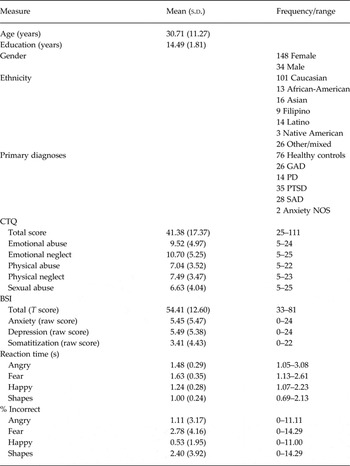
One hundred eighty-two participants (148 females, 34 males) were recruited through online and print advertisements and referral from university-affiliated primary-care and mental health clinics. Participants were pooled from ongoing research studies investigating the neurobiology of anxiety disorders, post-traumatic stress disorder (PTSD), and anxiety disorder-proneness (high levels of trait anxiety). These participants encompassed a wide range of anxiety psychopathology, consisting of psychiatrically healthy individuals as well as those with clinical and subclinical anxiety manifestations. Clinical participants were recruited on the basis of a primary diagnosis of PTSD, social anxiety disorder (SAD), generalized anxiety disorder (GAD), or panic disorder (PD). All diagnoses were confirmed through structured clinical interview by experienced clinicians using: (a) the Clinician-Administered PTSD Scale (CAPS; Blake et al. Reference Blake, Weathers, Nagy and Kaloupek1995) for those patients recruited into a PTSD study and their matched healthy controls; (b) Structured Clinical Interview for Diagnosis-DSM IV (SCID-IV; First et al. Reference First, Spitzer, Gibbon and Williams1998) for individuals recruited for a primary diagnosis GAD, PD, or for high levels of trait anxiety, and their matched healthy controls; and (c) Mini International Neuropsychiatric Interview (Sheehan et al. Reference Sheehan, Lecrubier, Sheehan, Amorim, Janavs, Weiller, Hergueta, Baker and Dunbar1998) for individuals recruited into an SAD study. Exclusion criteria included lifetime diagnosis of psychotic disorder, organic mental disorder, mental retardation, bipolar disorder, substance dependence in the past year, and substance abuse in the past month. All participants were medication-free for a minimum of 30 days prior to study enrollment and not undergoing current psychotherapy for anxiety or related symptoms. After complete description of the study to subjects, they provided informed written consent according to University of California San Diego Institutional Review Board guidelines (see Table 1 for more information).
Participant demographics and clinical characteristics

BSI, Brief Symptom Inventory-18; CTQ, Childhood Trauma Questionnaire; GAD, generalized anxiety disorder; NOS, not otherwise specified; PTSD, posttraumatic stress disorder; PD, panic disorder; SAD, social anxiety disorder.
Self-report measures
The emotional abuse (EA) and emotional neglect (EN) subscales from the 28-item Short Form version of the Childhood Trauma Questionnaire (CTQ-SF, Bernstein et al. Reference Bernstein, Stein, Newcomb, Walker, Pogge, Ahluvalia, Stokes, Handelsman, Medrano, Desmond and Zule2003) were additively combined to create a composite measure of CEM. Scores on CTQ subscales range from 5 to 25 and assess EA, EN, physical abuse (PA), physical neglect (PN), and sexual abuse (SA). Given their high intercorrelation (r = 0.76) in this sample, EA and EN scores were combined to yield a single measure of CEM; thus, the CEM composite measure ranged from 10 to 50. Anxiety symptoms were quantified using the score from the 6-item anxiety subscale (BSI-Anx) of the Brief Symptom Inventory-18 (Derogatis & Fitzpatrick, Reference Derogatis, Fitzpatrick and Maruish2004) in which participants rate, on a 5-point Likert scale, how often they were distressed by a list of symptoms within the past week. Symptoms of depression were quantified using the depression subscale of this same measure (BSI-Dep).
Emotion-processing task
Participants completed a modified version of the Emotion Face Assessment Task (Hariri et al. Reference Hariri, Drabant, Munoz, Kolachana, Mattay, Egan and Weinberger2005; Paulus et al. Reference Paulus, Feinstein, Castillo, Simmons and Stein2005) with angry, happy, or fearful faces. On each trial, participants viewed a trio of faces and were instructed to match the facial expression of the top face to one of the two bottom faces through key press of a button box (see Supplementary method for further details).
Image acquisition
Data were collected during task completion using fMRI image parameters sensitive to BOLD contrast on a 3 T GE Signa EXCITE (GE Healthcare, USA) scanner [T2*-weighted echo planar imaging, repetition time (TR) = 2000 ms, echo time (TE) = 32 ms, field of view (FOV) = 250 × 250 mm, 64 × 64 matrix, 30 2.6 mm axial slices with 1.4 mm gap, 256 repetitions]. A high-resolution T1-weighted image [172 sagitally acquired spoiled gradient recalled 1 mm thick slices, inversion time (TI) = 450 ms, TR = 8 ms, TE = 4 ms, flip angle = 12°, FOV = 250 × 250 mm] was also collected from each participant for anatomical reference. Echo-planar images were preprocessed by interpolating voxel time-series data to correct for non-simultaneous slice acquisition in each volume.
Activation preprocessing and individual analysis
Data were processed using the AFNI software package (Cox, Reference Cox1996). The outcome measures of interest were activation magnitudes for the within-subject contrasts of trials in which the subject engaged in emotion matching directed towards angry, fearful, or happy faces v. the shape-matching baseline condition (see Supplementary method for details).
Optimized voxel-based morphometry
Gray-matter (GM) volumes were assessed using FSL-VBM, a voxel-based morphometry style analysis (Ashburner & Friston, Reference Ashburner and Friston2000; Good et al. Reference Good, Johnsrude, Ashburner, Henson, Friston and Frackowiak2001) implemented using FSL tools (Smith et al. Reference Smith, Jenkinson, Woolrich, Beckmann, Behrens, Johansen-Berg, Bannister, De Luca, Drobnjak, Flitney, Niazy, Saunders, Vickers, Zhang, De Stefano, Brady and Matthews2004) (see Supplementary method for details).
Task effect activation
In order to identify significant task-evoked activation within each contrast, t tests against the null hypothesis were carried out on individual activation maps across all participants.
Basic mediation analyses
Voxelwise basic mediation analyses were conducted using the MBESS package (Kelley, Reference Kelley2007a ,Reference Kelley b ; Kelley & Lai, Reference Kelley and Lai2012) implemented in R (R Core Team, 2013). Mediation models provide a statistical framework for testing a proposed variable as an indirect path (brain function/structure) for conveying an effect of an independent variable (CEM) on a dependent variable (adult anxiety symptoms) (MacKinnon et al. Reference MacKinnon, Fairchild and Fritz2007). CEM served as the independent variable and anxiety symptoms served as the dependent variable in the mediation model. For each activation contrast and GM volumetric map, voxelwise percent signal change (%SC) or GM volumes served as the respective mediating variable in the mediation model. The main outcome measure was the 95% confidence interval (CI) for the indirect effect (mediation effect). Bootstrapping of the indirect effect was utilized to determine the standard error (s.e.) and CIs of the indirect effect (MacKinnon et al. Reference MacKinnon, Fairchild and Fritz2007). At each voxel, 500 bootstrap samples were utilized to derive s.e. estimates.
Region of interest (ROI) and whole-brain analyses
Two types of analyses were conducted on the group level. For functional data, in addition to a whole-brain exploratory analysis, a-priori ROI analyses were conducted on emotion-processing brain regions previously implicated in studies of anxiety and CEM: bilateral insula, bilateral amygdala, and ACC/mPFC. Boundaries of these ROIs were based upon both anatomical criteria and standardized locations taken from the Talairach atlas (Talairach & Tournoux, Reference Talairach and Tournoux1998). For structural data, these regions were also investigated in ROI analyses, with the addition of the bilateral hippocampus. A threshold adjustment based upon Monte-Carlo simulations (using AFNI's program AlphaSim) was used to guard against false positives in the whole-brain and ROI analyses (see Supplementary method for details).
Extended mediation analyses
We performed moderated mediation analyses to test if the strength of mediation relationships were conditional on another variable – that is, if identifiable subject characteristics could influence the strength of mechanistic effects. In particular, we were interested whether structural brain characteristics influenced the mediation relationship of specific functional brain activation patterns between CEM and anxiety. Moderated mediation tests whether the strength of a mediating variable's effect on the relationship between the independent and dependent variables is conditional upon a fourth variable. In this context, we conducted exploratory analyses to test whether the strength of the effect of a particular cluster of brain activation on mediating the CEM-anxiety symptom relationship was moderated by brain structure (GM volumes). We also performed additional mediation analysis on brain activation identified in the voxelwise mediation analysis to test if the mediating effect of brain function on the CEM-anxiety symptom relationship remained significant when controlling for current regional GM volumes. In order to perform moderated mediation analyses and mediation with covariates, the average %SCs and GM volumes were extracted from each participant from clusters displaying significant basic mediation effects in the voxelwise analyses. The PROCESS package (Hayes, Reference Hayes2013) implemented in IBM SPSS version 19.0 (IBM SPSS Inc., 2010) was utilized for extended mediation analyses. Bootstrapping of the CI of the indirect effect was utilized to determine significance. To describe the robustness of mediation effects and their adequacy in supporting our proposed threat-priming model, we also tested the indirect effect of an alternative model (anxiety symptoms mediating the effect of CEM on brain function/structure). To examine the degree to which the indirect effect accounted for the relationship between the independent and dependent variables in each model, we constrained the direct path between the variables to zero to test the adequacy of a fully mediated relationship, i.e. if the effects of the independent variable on the dependent variable are conveyed entirely via the mediator. We report the χ2 for each model with the direct path constrained to zero, as well as root mean square error of approximation (RMSEA), the Comparative Fit Index (CFI), and the standardized root mean square residual (SRMR). These model fit indices were derived using MPlus version 7.3.1 (Muthén & Muthén, Reference Muthén and Muthén1998–2012). Good model fit indices with the direct path constrained to zero (e.g. non-significant χ2, RSMEA and SRMR < 0.1, CFI > 0.93) in combination with a significant indirect effect suggest a fully mediated relationship between the independent and dependent variable, while poor model fit statistics with a significant indirect effect indicate a partially mediated relationship.
Ethical standards
The authors assert that all procedures contributing to this work comply with the ethical standards of the relevant national and institutional committees on human experimentation and with the Helsinki Declaration of 1975, as revised in 2008.
Results
Demographics and symptoms
The sample was almost entirely female (~81%) and displayed low levels of CEM and anxiety symptoms, on average, though the full spectrum observed ranged from low to severe (Table 1).
Relationships among CEM and anxiety symptoms
As expected, CEM was significantly positively correlated with BSI-Anx scores (Pearson's r = 0.317, p < 0.001) and BSI-Dep scores (Pearson's r = 0.347, p < 0.001). The BSI-Anx and BSI-Dep subscales were also significant positively correlated (Pearson's r = 0.694, p < 0.001). The associations between CEM and anxiety and depression symptoms continued to remain significant after controlling for age, gender, years of education, and presence of a current anxiety or depressive disorder.
Task-related behavior
All participants completed the emotional face-matching task with high levels of accuracy. There were no significant correlations between measures of accuracy and reaction time and measures of CEM, anxiety symptoms, or depressive symptoms (all p's > 0.05) (see Table 1).
Task-related activation
In brief, all emotion contrasts activated the bilateral amygdala, bilateral posterior insula, subgenual ACC, and visual cortices, and deactivated the perigenual ACC. For fear and anger, additional activation was observed in the bilateral dlPFC and bilateral anterior insula (see Supplementary Tables S1–S3).
Threat-related limbic activation and maltreatment-priming effects
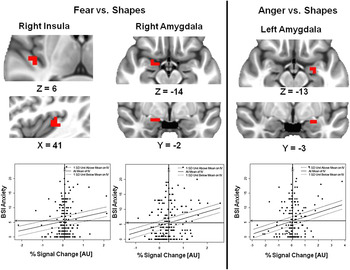
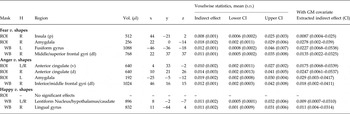
To test our hypothesis that CEM will prime affective processing regions for exaggerated reactivity to threatening facial cues, we examined two threat-contrasts of interest: anger v. shapes and fear v. shapes. For the contrast of fear v. shapes, greater activation in the right posterior insula [indirect effect = 0.009, 95% bootstrapped CI 0.001–0.016; χ2(1) = 17.36, p < 0.0001; RMSEA = 0.30, 90% CI 0.187–0.431; CFI = 0.27; SRMR = 0.101] and the right amygdala [indirect effect = 0.028, 95% bootstrapped CI 0.001–0.057; χ2(1) = 15.27, p = 0.0001; RMSEA = 0.280, 90% CI 0.168–0.412; CFI = 0.552; SRMR = 0.09] partially mediated the relationship between CEM and anxiety (Table 2, Fig. 1). Note that model fit indices when constraining the direct effect to zero were poor in both regions, indicating that although the indirect effect is significant it does not fully account for the relationship between CEM and anxiety, i.e. partial mediation. The alternative model indirect effect was non-significant for both the posterior insula [indirect effect = 0.002, 95% bootstrapped CI −0.001 to 0.005; χ2(1) = 29.78, p < 0.0001; RMSEA = 0.276, 90% CI 0.194–0.456; CFI = 0.167; SRMR = 0.141] and right amygdala [indirect effect = 0.004, 95% bootstrapped CI −0.001 to 0.009; χ2(1) = 18.448, p < 0.0001; RMSEA = 0.319, 90% CI 0.188–0.462; CFI = 0.162; SRMR = 0.138], and model fit indices were also poor. For the contrast of anger v. shapes, greater activation in the left amygdala partially mediated the relationship between CEM and anxiety [indirect effect = 0.019, 95% bootstrapped CI 0.005–0.033; χ2(1) = 15.015, p = 0.0001; RMSEA = 0.277, 90% CI 0.165–0.409; CFI = 0.539; SRMR = 0.089; Table 2, Fig. 1]. Although the indirect effect was significant, the overall model fit was poor, indicating a partial mediation effect. The indirect effect of the alternative mediation model was also not significant [indirect effect = 0.006, 95% bootstrapped CI −0.001 to 0.013; χ2(1) = 25.87, p < 0.0001; RMSEA = 0.301, 90% CI 0.194–0.408; CFI = 0.215; SRMR = 0.132] and model fit statistics were also poor. Indirect effects remained significant when controlling for structural characteristics (i.e. GM volume).
Increasing limbic activation to anger and fear partially mediates the relationship between childhood emotional maltreatment (CEM) and anxiety. Graphs depict the relationship between regional brain activation and anxiety symptoms at different levels of CEM (the additive combination of the Childhood Trauma Questionnaire Short Form emotional abuse and emotional neglect subscales), with the center fitted line indicating the activation anxiety relationship at the CEM sample mean and each line above or below representing one standard deviation above or below the CEM mean, respectively. AU, Arbitrary units; BSI, Brief Symptom Inventory.

Activation mediating the relationship between childhood emotional maltreatment and adulthood anxiety

d, Dorsal; dl, dorsolateral; EA, emotional abuse; EN, emotional neglect; GM, gray matter; H, hemisphere; L, left; p, posterior; R, right; ROI, region of interest masks; s.d., standard deviation; v, ventral; Vol., volume; WB, whole-brain masks.
x, y, z are the Talairach coordinates for the cluster center of mass. Voxelwise statistics report mean statistical value with standard deviations in parentheses; Column with GM and depression covariates indicates indirect mediation effect for extracted cluster values after controlling for cluster gray matter volume, with lower and upper bounds of 95% confidence interval in parentheses. Locational descriptors in parentheses do not denote actual anatomical distinctions but are based upon the relative location of the cluster in standardized space.
Threat-related prefrontal activation and maltreatment-related engagement
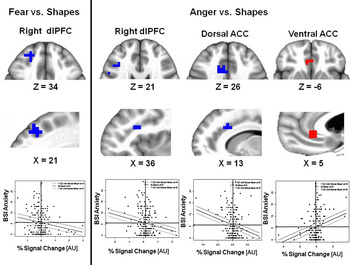
We next examined prefrontal substrates using an ROI mask for the ACC/mPFC and a whole-brain mask for the remaining portions to test the hypothesis that CEM-related priming of affective processing regions would tax prefrontal affective control regions and result in diminished prefrontal cortical responses. For the contrast of fear v. shapes, we observed that less activation in the right dlPFC (middle/superior frontal gyri; BA 8 and 9) partially mediated the relationship between CEM and anxiety symptoms [indirect effect = 0.014, 95% bootstrapped CI 0.001–0.029; χ2(1) = 16.53, p < 0.0001; RMSEA = 0.292, 90% CI 0.179–0.423; CFI = 0.498; SRMR = 0.095; Table 2, Fig. 2]. Again, the indirect effect was significant but model fit statistics were generally poor, indicating the mediation effect was partial. The mediation effect was non-significant for the alternative model [indirect effect = −0.003, 95% bootstrapped CI −0.007 to 0.001; χ2(1) = 24.78, p < 0.0001; RMSEA = 0.350, 90% CI 0.268–0.443; CFI = 0.116; SRMR = 0.127] and model fit statistics were also poor. We also observed effects in other non-hypothesized regions (see Supplementary Results). For the contrast of anger v. shapes, we observed that decreasing activation in the right dlPFC (inferior/middle frontal gyri; BA 10 and 46) also partially mediated the relationship between CEM and anxiety [indirect effect = 0.018, 95% bootstrapped CI 0.001–0.035; χ2(1) = 15.644, p = 0.0001; RMSEA = 0.284, 90% CI 0.171–0.415; CFI = 0.479; SRMR = 0.092; Table 2, Fig. 2]. Model fit statistics were poor, indicating the mediation effect was partial. The mediation effect was non-significant for the alternative model [indirect effect = −0.002, 95% bootstrapped CI −0.005 to 0.001; χ2(1) = 25.23, p < 0.0001; RMSEA = 0.324, 90% CI 0.194–0.454; CFI = 0.213; SRMR = 0.138] and model fit statistics were also poor. We additionally observed mediation effects in medial prefrontal regions for anger, with greater activation in the ventral ACC [indirect effect = 0.020, 95% bootstrapped CI 0.001–0.039; χ2(1) = 15.962, p = 0.0001; RMSEA = 0.287, 90% CI 0.174–0.415; CFI = 0.451; SRMR = 0.093] and decreasing activation in the dorsal ACC partially mediating this relationship [indirect effect = 0.028, 95% bootstrapped CI 0.004–0.053; χ2(1) = 13.835, p = 0.0002; RMSEA = 0.266, 90% CI 0.154–0.398; CFI = 0.634; SRMR = 0.084; Table 2, Fig. 2]. Indirect effects were significant but model fit statistics were also poor for both ACC effects, indicating the mediation effects were partial. The mediation effect was non-significant for the alternative model in both the ventral ACC [indirect effect = 0.006, 95% bootstrapped CI −0.001 to 0.013; χ2(1) = 23.41, p < 0.0001; RMSEA = 0.318, 90% CI 0.215–0.421; CFI = 0.263; SRMR = 0.142] and dorsal ACC [indirect effect = −0.002, 95% bootstrapped CI −0.005 to 0.001; χ2(1) = 21.398, p < 0.0001; RMSEA = 0.342, 90% CI 0.274–0.410; CFI = 0.389; SRMR = 0.112] and model fit statistics for both were also poor. Indirect effects remained significant when controlling for structural characteristics.
Prefrontal activation to anger and fear partially mediates the relationship between childhood emotional maltreatment (CEM) and anxiety. Graphs depict the relationship between regional brain activation and anxiety symptoms at different levels of CEM (the additive combination of the Childhood Trauma Questionnaire Short Form emotional abuse and emotional neglect subscales), with the center fitted line indicating the activation-anxiety relationship at the CEM sample mean and each line above or below representing one standard deviation above or below the CEM mean, respectively. AU, Arbitrary units; BSI, Brief Symptom Inventory.

Ventral striatal engagement to happy faces and maltreatment effects
We then examined brain responses to happy faces v. shapes to examine if limbic activation mediated the relationship between CEM and anxiety symptoms. We did not observe any significant mediation effects in a-priori hypothesized regions. An exploratory whole brain analysis did, however, identify additional effects of interest. Decreasing activation in a cluster encompassing the ventral striatum/pallidum (lentiform nucleus and caudate head) and hypothalamus partially mediated the relationship between CEM and anxiety [indirect effect = 0.015, 95% bootstrapped CI 0.001–0.029; χ2(1) = 17.115, p < 0.0001; RMSEA = 0.298, 90% CI 0.185–0.429; CFI = 0.385; SRMR = 0.090; Table 2, Supplementary Fig. S1]. This was also a partial mediation effect, as indicated by the significant indirect effect but poor model fit statistics when constraining the direct path from CEM to anxiety. The indirect effect for the alternative model was non-significant [indirect effect = −0.001, 95% bootstrapped CI −0.003 to 0.001; χ2(1) = 20.732, p < 0.0001; RMSEA = 0.334, 90% CI 0.214–0.454; CFI = 0.302; SRMR = 0.142] and model fit was also poor. An additional similar effect was observed in the right visual cortex [lingual gyrus; indirect effect = 0.011, 95% bootstrapped CI 0.002–0.020; χ2(1) = 16.737, p < 0.0001; RMSEA = 0.294, 90% CI 0.181–0.425; CFI = 0.329; SRMR = 0.091]. The indirect effect for the alternative model was non-significant [indirect effect = −0.002, 95% bootstrapped CI −0.005 to 0.001; χ2(1) = 19.484, p < 0.0001; RMSEA = 0.387, 90% CI 0.294–0.480; CFI = 0.284; SRMR = 0.122] and model fit was also poor. Indirect effects remained significant when controlling for structural characteristics. Given the role of the ventral striatum in reward and positive affect, we expected the mediation effect seen in this region for the CEM-anxiety relationship might be better accounted for by concurrent symptoms of diminished positive affect (e.g. anhedonia) observed in depression. We therefore also tested extracted %SCs as a mediator of the relationship between CEM and BSI-Dep scores. However, activation in this region to happy facial expressions did not significantly mediate the CEM-depression relationship (lower bound of 95% CI for indirect effect = −0.003).
Maltreatment effects on prefrontal brain structure
We also predicted our hypothesized functional mechanism would interact with brain development to result in abnormal structure of affective processing and control substrates in adulthood. In support of this, we examined GM volumes in limbic regions first, including the amygdala, hippocampus, and insula. There were no limbic structures in which GM volumes mediated the relationship between CEM and anxiety.
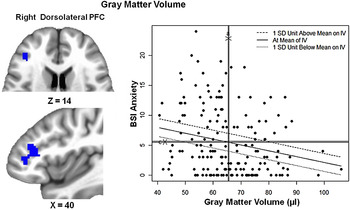
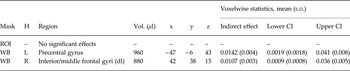
Next, we used an ROI analysis for the ACC/mPFC and a whole-brain analysis for the lateral PFC to examine how prefrontal structure might be implicated in our proposed model. We observed that smaller GM volumes in the right dlPFC (inferior/middle frontal gyri; BA 10 and 46) partially mediated the relationship between CEM and anxiety [indirect effect = 0.020, 95% bootstrapped 95% CI 0.001–0.039; χ2(1) = 13.551, p = 0.0002; RMSEA = 0.263, 90% CI 0.151–0.395; CFI = 0.556; SRMR = 0.085; Table 3, Fig. 3]. The indirect effect was significant though model fit was poor when constraining the direct effect, indicating a partial mediation. The indirect effect for the alternative model was non-significant [indirect effect = 0.001, 95% bootstrapped CI −0.009 to 0.011; χ2(1) = 19.101, p < 0.0001; RMSEA = 0.365, 90% CI 0.283–0.447; CFI = 0.313; SRMR = 0.115] and model fit was also poor. Moreover, this structural effect partially overlapped the functional effect seen in this same affective control region for processing anger expressions. To determine if this effect may be attributed entirely to the functional process implicated in this region, this structural mediation effect was also tested for significance when controlling for brain activation to anger v. shapes in this cluster. This effect continued to remain significant when controlling for functional activation (see Table 3 for details). We also observed additional structural effects in non-hypothesized regions (see Supplementary Results).
Decreasing right dorsolateral prefrontal gray matter volumes partially mediates the childhood emotional maltreatment (CEM)-anxiety relationship. Graphs depict the relationship between regional gray-matter volume and anxiety symptoms at different levels of CEM (the additive combination of the Childhood Trauma Questionnaire Short Form emotional abuse and emotional neglect subscales), with the center fitted line indicating the gray-matter volume-anxiety relationship at the CEM sample mean and each line above or below representing one standard deviation above or below the CEM mean, respectively. AU, Arbitrary units; BSI, Brief Symptom Inventory.

Gray-matter volumes mediating the relationship between childhood emotional maltreatment and adulthood anxiety

dl, Dorsolateral; H, hemisphere; L, left; R, right; ROI, region of interest masks; s.d., standard deviation; Vol., volume; WB, whole-brain masks.
x, y, z are the Talairach coordinates for the cluster center of mass. Voxelwise statistics report mean statistical value with standard deviations in parentheses. Locational descriptors in parentheses do not denote actual anatomical distinctions but are based upon the relative location of the cluster in standardized space.
Structural independence of functional mediation effects
In order to explore whether the strength of a functional mediation effects was conditional upon the structure of that particular region, structural characteristics of regions (i.e. GM volumes of clusters) displaying functional mediation effects were explored as potential moderators of the mediation effect in limbic and prefrontal regions relevant to our hypotheses (bilateral amygdala, right posterior insula, dorsal and ventral ACC, and right dlPFC). We did not observe any significant moderation effects of structural characteristics on strength of functional mediation.
Discussion
We utilized functional activation patterns to facial emotions across a large, primarily female adult sample with a wide range of CEM and transdiagnostic anxiety symptoms to identify candidate neural mechanisms that may underlie the CEM conferment of risk for anxiety disorders. We tested a hypothesized corticolimbic threat priming model as a potential neural mechanism linking these two constructs. This study produced three primary findings consistent with this model. First, greater amygdala engagement to both fear and anger partially mediated the relationship between CEM and anxiety symptoms. Second, decreasing recruitment of the right dlPFC to fear and anger also partially mediated the relationship between CEM and anxiety symptoms. Third, diminished structural integrity (lower GM volumes) of the right dlPFC partially mediated the relationship between CEM and adulthood anxiety. Taken together, these findings are consistent with the hypothesis that CEM predisposes individuals to the development of anxiety via a breakdown of cortical regulation of limbic responses to emotional stimuli that convey negative valence and/or potential threat. Moreover, these findings demonstrate the utility of adult brain measures in facilitating inference on etiological neural mechanisms that relate known risk factors to mental health outcomes. Such inferences, although post-hoc and retrospective, will likely be important contributors to the design of future longitudinal studies that can confirm or disconfirm hypothesized models.
The overall mediating neural activation pattern is consistent with an emotional dysregulation mechanism of CEM effects, such that exposure to stressful childhood emotional experiences like verbal abuse and emotional neglect disrupt normal socioemotional functioning by fostering enhanced emotional reactivity to threatening interpersonal stimuli (i.e. threat-priming), and over time this results in a dysregulation of stress and fear responses and the emergence of anxiety symptoms (Nolte et al. Reference Nolte, Guiney, Fonagy, Mayes and Luyten2011). These findings dovetail nicely with recent longitudinal reports implicating frontal-amygdalar resting connectivity as another developmental mechanism linking early life stress to anxiety and internalizing symptoms later in life (Burghy et al. Reference Burghy, Stodola, Ruttle, Molloy, Armstrong, Oler, Fox, Hayes, Kalin, Essex, Davidson and Birn2012; Herringa et al. Reference Herringa, Birn, Ruttle, Burghy, Stodola, Davidson and Essex2013). Here, we observed the amygdala and right dlPFC to be two key nodes of one potential mechanism linking CEM with anxiety, both implicated in response to processing of negative valence facial emotions that convey potential threat (fear and anger), but not emotions lacking a threatening context (i.e. happy). These findings are broadly in accord with existing emotional regulatory theories that posit an important role for the dlPFC in regulating emotional reactivity in the amygdala (Delgado et al. Reference Delgado, Nearing, Ledoux and Phelps2008; Ray & Zald, Reference Ray and Zald2012), particularly during use of top-down emotional regulatory strategies such as cognitive reappraisal (Ochsner & Gross, Reference Ochsner and Gross2005). These interactions likely occur primarily via indirect connections between the dlPFC and amygdala by way of the ACC or orbitofrontal cortex, though the dlPFC and amygdala do share sparse direct connections but more plentiful indirect connections via thalamic pathways (Ray & Zald, Reference Ray and Zald2012; Eden et al. Reference Eden, Schreiber, Anwander, Keuper, Laeger, Zwanzger, Zwitserlood, Kugel and Dobel2015). In the context of emotional reactivity, the dlPFC co-activates with the amygdala in attending to stimuli of negative emotional valence as well as under conditions necessitating top-down attentional control (Comte et al. Reference Comte, Schon, Coull, Reynaud, Khalfa, Belzeaux, Ibrahim, Guedj, Blin, Weinberger and Fakra2014). Moreover, prior findings in both adolescents and adults suggest early life stress impacts dlPFC and amygdala structure and function in the context of both emotional reactivity and regulation (Dannlowski et al. Reference Dannlowski, Stuhrmann, Beutelmann, Zwanzger, Lenzen, Grotegerd, Domschke, Hohoff, Ohrmann, Bauer, Lindner, Postert, Konrad, Arolt, Heindel, Suslow and Kugel2012, Reference Dannlowski, Kugel, Huber, Stuhrmann, Redlich, Grotegerd, Dohm, Sehlmeyer, Konrad, Baune, Arolt, Heindel, Zwitserlood and Suslow2013; Marusak et al. Reference Marusak, Martin, Etkin and Thomason2015). These previously reported findings suggest: (a) dlPFC-amygdala interactions are important in regulating and attending to negative affect; (b) the dlPFC exerts a regulatory role over amygdala activity, most prominently under conditions that bring cognitive resources to bear; and (c) this relationship is disrupted from exposure to extreme stress early in life. Notably, increased dlPFC engagement to emotional conflict regulation was observed in adolescents exposed to childhood trauma (Marusak et al. Reference Marusak, Martin, Etkin and Thomason2015), consistent with the proposal that CEM will initially provoke increased compensatory prefrontal engagement for regulation of emotional state, which across development will lead to a breakdown of dlPFC regulatory processes in a subset of individuals that go on to manifest psychopathology. The current findings support the aforementioned hypotheses, demonstrating that greater amygdala and reduced dlPFC engagement to fear and anger cues in adulthood partially account for the positive relationship between CEM and anxiety symptoms across a large sample with a wide range of anxiety and mood psychopathology. These findings are also broadly consistent with highly-relevant prior work, which found indiscriminate amygdalar hyperactivation to emotional and neutral facial expressions as a function of CEM, with effect sizes being the largest for fear and anger (van Harmelen et al. Reference van Harmelen, van Tol, Demenescu, van der Wee, Veltman, Aleman, van Buchem, Spinhoven, Penninx and Elzinga2013).
Further implicating the right dlPFC in CEM conferment of risk for anxiety, GM volumes in this region were also found to partially mediate the relationship between CEM and anxiety. Both anxiety and childhood maltreatment have been found to be associated with reduced GM volumes in the lateral prefrontal cortices (Yoo et al. Reference Yoo, Kim, Kim, Sung, Sim, Lee, Song, Kee and Lyoo2005; Woodward et al. Reference Woodward, Schaer, Kaloupek, Cediel and Eliez2009; Eckart et al. Reference Eckart, Stoppel, Kaufmann, Tempelmann, Hinrichs, Elbert, Heinze and Kolassa2010; Gatt et al. Reference Gatt, Williams, Schofield, Dobson-Stone, Paul, Grieve, Clark, Gordon and Nemeroff2010). This convergence of functional and structural effects across studies in the same brain region leads us to speculate that the right dlPFC is a structure vulnerable to becoming ‘scarred’ by early maltreatment experiences, and this may promote dysregulatory effects on emotional processing that lead to anxiety. The lateral portions of the PFC, in particular, are some of the latest regions to fully mature over the course of brain development (Shaw et al. Reference Shaw, Kabani, Lerch, Eckstrand, Lenroot, Gogtay, Greenstein, Clasen, Evans, Rapoport, Giedd and Wise2008), which suggests the relative immaturity of this region in childhood may render this structure particularly prone to a reduced functional capacity from chronic fear and stress states. Given the cross-sectional design of this study, it is impossible to determine casual relationships between dlPFC functional and structural effects. We also expected hippocampal GM volume to mediate the CEM-anxiety relationship, but we did not observe any significant effects. Meta-analyses have indicated variable effects of stress and trauma on hippocampal volume stratified by developmental stage (Karl et al. Reference Karl, Schaefer, Malta, Dorfel, Rohleder and Werner2006; Woon & Hedges, Reference Woon and Hedges2008), and such effects may be most prominent in neuropsychiatric disorders manifesting a dysregulation of the hypothalamtic-pituitary-adrenal axis (Sapolsky, Reference Sapolsky2000). Thus, reductions in hippocampal volume may not be an enduring neural characteristic influencing the CEM-anxiety relationship, or this influence may occur via other types of maltreatment or be present more prominently within a specific subset of individuals.
We also observed a notable emotion specificity of mediation effects in the dorsal ACC and ventral ACC during anger processing. The finding of greater ventral ACC activation and decreasing dorsal ACC activation to anger cues partially mediating the CEM-anxiety relationship is broadly consistent with the pattern of dlPFC-amygdala findings across both anger and fear, indicating a mismatch between: (a) increasing activity of a ventral, ‘automatic’ emotion-processing stream (composed primarily of the amgydala and ventral ACC/mPFC) that is emotionally reactive and drives implicit regulatory activity; and (b) decreasing activity of a dorsal, ‘deliberate’ processing stream (composed primarily of dorsal ACC/mPFC and dlPFC) implicated in explicit, effortful top-down control of emotion and cognitive functions (Ochsner & Gross, Reference Ochsner and Gross2005; Phillips et al. Reference Phillips, Ladouceur and Drevets2008; Etkin & Schatzberg, Reference Etkin and Schatzberg2011). This finding is also consistent with a prior study that observed greater ventral ACC engagement to angry faces was associated with greater levels of childhood maltreatment in posttraumatic stress disorder (Fonzo et al. Reference Fonzo, Flagan, Sullivan, Allard, Grimes, Simmons, Paulus and Stein2013). Though anger and fear are both negative valence emotions that signal potential threat, evidence indicates there are subtle behavioral and neural differences in the processing of these two facial expressions. A large meta-analysis of emotional face processing reported significant ACC activation for anger but not fear (Fusar-Poli et al. Reference Fusar-Poli, Placentino, Carletti, Landi, Allen, Surguladze, Benedetti, Abbamonte, Gasparotti, Barale, Perez, McGuire and Politi2009), consistent with the anger-specific ACC effects observed here. Moreover, an angry face directed at oneself conveys a localizable, self-relevant, and imminent threat from the expresser, consistent with the role of the ACC/mPFC in self-relevance processing (Amodio & Frith, Reference Amodio and Frith2006), but a fear face conveys information regarding a potential threat elsewhere in the environment. Some evidence indicates these expressions, though both indicating threat, also induce subtle differences in approach/avoidance behaviors in the receiver (Marsh et al. Reference Marsh, Ambady and Kleck2005). From this perspective, we speculate CEM may interact with innate neural patterns of type-specific emotion processing to form dissociable mechanistic pathways contributing to the manifestation of anxiety symptoms later in life. It is notable that ventral ACC engagement in emotional contexts (particularly those presenting fear cues or generating fear states) may serve an adaptive response under certain conditions (Etkin et al. Reference Etkin, Prater, Hoeft, Menon and Schatzberg2010) or in clinical manifestations of post-traumatic stress (Liberzon & Garfinkel, Reference Liberzon, Garfinkel, Shiromani, Keane and LeDoux2009; Milad et al. Reference Milad, Pitman, Ellis, Gold, Shin, Lasko, Zeidan, Handwerger, Orr and Rauch2009). However, the current results and prior findings for ventral ACC hyperactivity in other anxiety manifestations (Amir et al. Reference Amir, Klumpp, Elias, Bedwell, Yanasak and Miller2005; Pillay et al. Reference Pillay, Rogowska, Gruber, Simpson and Yurgelun-Todd2007; Goldin et al. Reference Goldin, Manber, Hakimi, Canli and Gross2009; Labuschagne et al. Reference Labuschagne, Phan, Wood, Angstadt, Chua, Heinrichs, Stout and Nathan2012) and individuals exposed to childhood maltreatment (Williams et al. Reference Williams, Gatt, Schofield, Olivieri, Peduto and Gordon2009) suggest that greater ventral ACC engagement to emotional cues may signal very conceptually different processes depending on the emotional context, behavior, or clinical population.
Finally, we would like to briefly comment on the effects observed in response to happy faces. We did not observe any hypothesized mediation effects in the amygdala, which seems inconsistent with a prior study that observed increased amygdala activation to happy (and neutral) faces in individuals exposed to CEM (van Harmelen et al. Reference van Harmelen, van Tol, Demenescu, van der Wee, Veltman, Aleman, van Buchem, Spinhoven, Penninx and Elzinga2013). However, another study in a non-clinical sample also failed to observe significant relationships between history of childhood maltreatment and amygdala reactivity to subliminal presentation of happy faces (Dannlowski et al. Reference Dannlowski, Kugel, Huber, Stuhrmann, Redlich, Grotegerd, Dohm, Sehlmeyer, Konrad, Baune, Arolt, Heindel, Zwitserlood and Suslow2013). Differences in task design and sample composition may account for these conflicting findings, or CEM effects on amygdala response to facial expressions of happiness may be weaker and only variably reach statistical significance. As we used mediation models to detect mechanistic pathways that account for the relationship between CEM and anxiety, another possibility is that CEM effects on amygdala responses to happy faces may not serve to provoke anxiety in afflicted individuals. Indeed, the pattern of findings observed here, specifically decreasing ventral striatal/pallidal activation to happy faces partially mediating the CEM-anxiety relationship, suggests that CEM-related blunting of emotional responses in reward-sensitive basal ganglia structures (Smith et al. Reference Smith, Tindell, Aldridge and Berridge2009) may render vulnerability to anxiety. Given that the ventral striatum and ventral pallidum are heavily implicated in approach behavior, positive affect, reward, and motivation (O'Doherty, Reference O'Doherty2004; Smith et al. Reference Smith, Tindell, Aldridge and Berridge2009), this effect could reflect a CEM-rendered vulnerability to blunted representation of positive affect. We were unable to disentangle anxiety and depression-specific effects here, given the extensive overlap in BSI subscale variance observed in this sample. However, consistent with prior work linking reward circuitry abnormalities to early life stress (Dillon et al. Reference Dillon, Holmes, Birk, Brooks, Lyons-Ruth and Pizzagalli2009; Mehta et al. Reference Mehta, Gore-Langton, Golembo, Colvert, Williams and Sonuga-Barke2010) and major depression (Pizzagalli et al. Reference Pizzagalli, Holmes, Dillon, Goetz, Birk, Bogdan, Dougherty, Iosifescu, Rauch and Fava2009; Pizzagalli, Reference Pizzagalli2014), these findings hint at an alternative mechanistic pathway linking CEM to future psychopathology via blunted emotional responsivity to positive-valence (or rewarding) emotional stimuli.
There are several limitations to the current study. Importantly, the design of this study was cross-sectional and retrospective and the results were correlational in nature. As such, we were unable to acquire measurements of CEM, neural characteristics, and anxiety in successive order to establish temporal precedence. Thus, we are unable to draw definitive conclusions on the causal effects of CEM on brain function/structure or how any such effects may influence susceptibility to development of anxiety. Although the analytic approach of the current study was informed by theory and prior evidence, longitudinal studies are necessary to establish that CEM exerts effects on brain structure and function which promote susceptibility to the emergence of later anxiety symptoms. There are also other interpretations of the current findings aside from the proposed maltreatment threat-priming mechanism promoting manifestation of anxiety, including the possibility that these neural effects relate to other processes, influences, or vulnerabilities that co-occur with maltreatment and anxiety symptoms. Thus, the primary utility of the current findings lies in hypothesis-generation and informing design of future studies. Second, the sample utilized was composed of healthy participants as well as those with a variety of clinical and non-clinical anxiety manifestations. Given power constraints, we are unable to determine whether mediation effects are specific to a particular syndromal manifestation or whether diagnostic status impacted the strength of mediation effects. However, the current analysis is most consistent with the dimensional approach to psychopathology laid out in the NIMH RDoC (Insel et al. Reference Insel, Cuthbert, Garvey, Heinssen, Pine, Quinn, Sanislow and Wang2010; Insel, Reference Insel2014) in its focus on developmental factors that may contribute to alteration in the domain of negative (and positive) valence brain systems. Third, many of the clinical anxiety participants met criteria for co-morbid depressive disorders, and this may reduce specificity of the results to the relationship between CEM and anxiety. However, inclusion of these subjects is also consistent with the high comorbidity among anxiety/depressive disorders in the population (Kessler et al. Reference Kessler, Chiu, Demler, Merikangas and Walters2005) as well as the substantial overlap of neurocircuitry abnormalities in both types of disorders (Etkin & Wager, Reference Etkin and Wager2007; Hamilton et al. Reference Hamilton, Etkin, Furman, Lemus, Johnson and Gotlib2012). Fourth, the majority of the sample was composed of adult Caucasian females with low levels of CEM and anxiety symptoms, though these measures did range from none to severe. Thus, these results may not generalize well to male populations or other ethnic groups, and the negative skew towards low levels of symptoms and maltreatment experiences may not have provided optimal power to detect effects. Fifth, the emotion-processing task used here presents two faces with matching emotional expressions in the presence of a third, non-congruent emotional expression on each trial. Thus, the results of this study are not directly comparable to those presenting single faces or non-facial threat stimuli. Sixth, mediation model fit measures were generally poor when constraining the direct effect to zero for both the proposed mediation model (the brain mediating the CEM-anxiety relationship) and the alternative mediation model (anxiety mediating the relationship between CEM and the brain). However, the indirect effects for the proposed model were significant while those for the alternative model were not, indicating a partial (but not full) mediation effect of the brain on the CEM-anxiety relationship. Thus, the current findings must be considered preliminary in light of these factors, and future studies should attempt to incorporate additional variables to develop sophisticated multivariate models that can fully account for the relationship between CEM and anxiety (e.g. multiple indirect effects, moderated mediation, etc.). Finally, we did not collect information on current life stress or adult trauma across this sample of participants, which may have been useful in establishing the specificity of neural effects to childhood experiences.
In closing, this study provides strong preliminary evidence supporting a neurodevelopmental mechanism linking CEM to anxiety in adulthood. This evidence suggests CEM exaggerates bottom-up emotional reactivity and attenuates top-down regulatory control when encountering negative-valence and/or threat-conveying emotional cues, which is consistent with existing evidence for emotional dysregulation as a psychological characteristic in survivors of childhood maltreatment (Wright et al. Reference Wright, Crawford and Del Castillo2009; Pechtel & Pizzagalli, Reference Pechtel and Pizzagalli2010; Tottenham et al. Reference Tottenham, Hare, Quinn, McCarry, Nurse, Gilhooly, Millner, Galvan, Davidson, Eigsti, Thomas, Freed, Booma, Gunnar, Altemus, Aronson and Casey2010). It is notable the mediation effects observed here, though statistically significant, were subtle in magnitude and accounted for only 1–3% of the total variance in anxiety symptoms. This fact is encouraging on two fronts – first, subtle influences of developmental factors on in-vivo dynamics of the adult brain are detectable much later in life and can be used to postulate mechanisms related to later mental health outcomes; and second, there is still a great deal of individual variability in neural characteristics left to be explored that may reflect other parallel or intersecting developmental pathways to anxiety in adulthood. We hope the effects demonstrated here may provide further impetus for the consideration of developmental characteristics in systems neuroscience etiological models of anxiety and lead to the undertaking of more rigorous longitudinal studies. These studies will be crucial in supporting or refuting results from retrospective investigations, and will sharpen insights into other developmental considerations such as neurodevelopmental trajectories, sensitive periods, and transactional relationships between individual characteristics conferring risk and resilience (Casey et al. Reference Casey, Oliveri and Insel2014). Such efforts will hopefully lead to the identification of several distinct developmental pathways to anxiety disorders with unique and shared neural mechanisms, potentially informing development or modification of interventions to target ‘ecophenotypic’ variants of psychopathology (Teicher & Samson, Reference Teicher and Samson2013).
Supplementary material
For supplementary material accompanying this paper visit http://dx.doi.org/10.1017/S0033291715002603.
Acknowledgements
This work was supported by the National Institute of Mental Health (M.B.S.; grant numbers MH065413 and MH064122) and the Department of Veterans Affairs (VA Merit Grant to M.B.S.), and partially supported by a grant from the National Institute of Mental Health T32 MH019938.
Declaration of Interest
None.