





Non-suicidal self-injury (NSSI) is among the most concerning public health issues, owing to its high prevalence among adolescents and its severe consequences for emotional and cognitive development. Reference Escofet-Colet, Casadó-Marín, Orós-Navas and Raventós-Torner1 NSSI is defined as deliberate and direct self-inflicted harm to body tissues without suicidal intent, such as cutting, burning or skin picking. Reference Klonsky and Glenn2 It usually begins in adolescence and, in addition to its significant effects on physical health (e.g. risk of death, infection) and psychological health (e.g. social isolation, interpersonal problems), it can have long-term and widespread developmental consequences; research has also demonstrated that it has a persistent nature. Reference Adrian, McCauley, Berk and Asarnow3
Numerous studies have examined individual and interpersonal risk factors for NSSI in adolescents and identified psychological disorders including depression and broader psychopathology, Reference Wolff, Thompson, Thomas, Nesi, Bettis and Ransford4 personality-related vulnerabilities, Reference Adrian, McCauley, Berk and Asarnow3 difficulties in emotion regulation, Reference Grandclerc, De Labrouhe, Spodenkiewicz, Lachal and Moro5 trauma and stressful life events, Reference Maniglio6 self-blame, Reference Fox, Franklin, Ribeiro, Kleiman, Bentley and Nock7 distress intolerance, and interpersonal factors such as invalidating environments Reference La Rochelle, Lambert, Holden, Billet and Fekken8 and lack of social support Reference Kellerman, Millner, Joyce, Nash, Buonopane and Nock9 as significant risk factors and predictors.
Invalidating environments and NSSI
Invalidating environments, which are characterised by caregiver criticism, emotional neglect or punitive responses to emotional expression, have been robustly linked to NSSI. Reference Wolff, Thompson, Thomas, Nesi, Bettis and Ransford4 Invalidating environments are considered to be environments in which the child’s inner experiences are not validated by caregivers and there is a poor fit between the environment and the child’s mood; for instance, the child may be ridiculed or punished for internal characteristics and emotions. Reference Linehan10,Reference Mountford, Corstorphine, Tomlinson and Waller11 Invalidating environments can lead to deficits in regulation of emotions and social skills, which in turn increase the likelihood of adopting negative coping strategies, including self-injurious behaviour, to cope with distress and regulate negative emotions. Reference Linehan10 According to Linehan, Reference Linehan10 such environments condition individuals to distrust their emotional experiences, leading them to rely on extreme regulatory strategies such as self-injury. Empirical studies have found that childhood emotional invalidation predicts NSSI frequency even after depression and anxiety have been controlled for. Reference Shenk and Fruzzetti12
Distress tolerance, invalidating environments and NSSI
Distress tolerance, defined as the capacity to withstand negative emotional states, Reference Simons and Gaher13 has emerged as an important transdiagnostic risk factor across multiple forms of psychopathology. Lower distress tolerance has been associated with alcohol misuse, substance use, binge eating and NSSI. Reference Leyro, Bernstein, Vujanovic, McLeish and Zvolensky14 According to the emotional cascade model, individuals who experience repetitive cycles of intense negative affect gradually become less able to tolerate emotional distress and may adopt self-injury as a means of interrupting these emotional cascades. Reference Selby, Anestis and Joiner15 People with low distress tolerance have a reduced capacity to withstand negative emotions, are more sensitive to them and tend to experience them for prolonged periods. To escape these negative states, they seek powerful coping strategies to reduce distress, which may include self-injurious behaviour. Low distress tolerance has also been found to be highly correlated with frequency of self-injurious behaviour. Reference Akbari, Seydavi, Firoozabadi and Babaeifard16,Reference Anestis, Selby and Joiner17
Individuals with low distress tolerance struggle to endure negative affect, increasing their propensity for maladaptive coping. Reference Zvolensky and Hogan18 Research suggests that distress tolerance deficits arise partly from invalidating experiences that prevent adaptive emotion regulation. Reference Gratz, Tull and Levy19 Indeed, several cross-sectional and longitudinal studies have found that low distress tolerance mediates the link between adverse childhood environments and NSSI. Reference Zvolensky and Hogan18,Reference Gratz, Tull and Levy19
Negative urgency and NSSI
Negative urgency is another variable that has been studied in relation to high-risk behaviours, including NSSI. Positive and negative urgency are personality traits characterised by a tendency to act impulsively when experiencing intense positive and negative emotions, respectively. In individuals high in these traits, intense emotional states may impair rational decision-making and contribute to various maladaptive impulsive behaviours, including overeating, substance use and self-injurious behaviour. Reference Whiteside and Lynam20 Some studies have identified negative urgency and the tendency to act without thinking as strong predictors of self-injurious behaviour. Reference Peckham, Jordan, Silverman, Steele, Björgvinsson and Beard21 Negative urgency, a facet of impulsivity, reflects rash action under emotional distress. Reference Whiteside and Lynam20 Those with high negative urgency are more likely to engage in impulsive self-injury as an immediate (albeit ineffective) escape from distress. Reference Anestis, Selby and Joiner17 Critically, negative urgency in particular has been associated with a diverse range of clinical groups and behaviours, including substance misuse, excess weight and self-harm. Reference Sonmez, Garcia, Thitiseranee, Blacker and Lewis22
Distress tolerance and negative urgency as potential mediators between invalidating environments and NSSI
Distress tolerance and negative urgency are increasingly recognised as mediators of the relationship between invalidating environments and NSSI. Distress tolerance, or the ability to tolerate negative emotional states without resorting to maladaptive behaviours, is often compromised in individuals who grow up in invalidating environments. Reference Gratz, Tull and Levy19 Studies have shown that low distress tolerance is an important mediator in the development of NSSI, suggesting that interventions aimed at strengthening this ability could be effective in reducing self-injurious behaviours. Reference Akbari, Seydavi, Firoozabadi and Babaeifard16 Negative urgency, the tendency to act impulsively under emotional distress, has been identified as another important mediator. Individuals in invalidating environments often exhibit high levels of negative urgency, which increases their susceptibility to impulsive and self-destructive behaviours, including NSSI. Reference Peckham, Jordan, Silverman, Steele, Björgvinsson and Beard21 Furthermore, serial mediation by distress tolerance and negative urgency represents a complex but critical pathway linking invalidating environments to NSSI. This model suggests that invalidating environments reduce distress tolerance, which in turn increases negative urgency and ultimately leads to NSSI. Reference Selby, Anestis and Joiner15
Current study
The purpose of the current study was to further explore a more comprehensive model of key risk factors in the severity of NSSI: emotional invalidation, distress tolerance and negative urgency. Using a two-wave, 6-month longitudinal cross-lagged panel design with a sample of community-based young participants, we examined direct longitudinal effects between these key variables, as well as key mediational pathways. Specifically, we examined simultaneous mediational pathways between the source variable of emotional invalidation and second-wave NSSI frequency via the dual mediators of distress tolerance and negative urgency. We then examined multigroup analyses with participant gender and age to determine potential group differences.
Method
Ethical approval
All procedures complied with the ethical standards of the relevant national and institutional committees on human experimentation and with the Declaration of Helsinki (1975, revised 2013). Ethical approval was obtained from the Research Ethics Committee of Kharazmi University, Tehran (approval code: IR.KHU.REC.1404.130). Participants reporting recent or severe NSSI were managed according to a predefined safety protocol. Specifically, the lead researcher confidentially informed the school counsellor and, when appropriate, the adolescent’s parent or legal guardian to facilitate access to appropriate support services. This study was not preregistered.
Participants and procedure
We used a two-wave longitudinal panel design with a 6-month interval to investigate the temporal dynamics among invalidating environments, distress tolerance, negative urgency and NSSI. A community sample of 300 Persian-speaking adolescents was recruited from public high schools across several districts in Tehran, Iran. We used a multi-stage cluster sampling procedure to enhance the representativeness of the sample. First, a comprehensive list of all educational districts in the region was obtained from the local education authority. The sampling frame was based on the official registry of public educational districts provided by the local education authority. The research team did not modify or influence the construction of this registry before random selection. From this list, three districts were randomly selected using a computer-based random number generator (simple random sampling), ensuring that each district had an equal probability of selection (p = 3/N). Second, within the selected districts, a sampling frame of all eligible secondary schools was compiled, and five schools were randomly selected using the same randomisation procedure without replacement. Third, within each participating school, an official list of classrooms was obtained, and classrooms were randomly selected using a computer-generated randomisation procedure. All students in the selected classrooms were invited to participate. Invitation of all students in randomly selected classrooms minimised investigator selection bias by avoiding any additional participant selection after classroom randomisation. This multi-stage cluster approach allowed us to maintain random selection at each stage while accounting for the hierarchical structure of the educational system.
The target sample size was determined a priori using Soper’s structural equation modelling sample size calculator. Reference Soper23 Parameters included an anticipated small-to-medium effect size (f 2 = 0.10), eight observed variables, statistical power of 0.95 and α = 0.05. The estimated minimum required sample size was 280 participants. A total of 312 eligible students were invited; 300 agreed to participate and completed the baseline assessment, whereas 12 declined participation (participation rate 96.2%). The final sample of 300 therefore exceeded the minimum required sample size and provided adequate statistical power for the proposed cross-lagged panel model (CLPM) and indirect analyses. As no demographic or clinical information was collected from students who declined participation, the potential impact of non-response bias could not be formally evaluated. All participants were between 13 and 17 years of age; therefore, 100% of the sample comprised minors. Accordingly, written informed consent was obtained from parents or legal guardians, and written assent was obtained from all adolescent participants before study enrolment. At time 1 (T1), the sample comprised 210 girls (70%) and 90 boys (30%), aged 13 to 17 years (mean age 15.61 years, s.d. = 1.42). The age distribution was as follows: 13 years (30%, n = 90), 17 years (25.3%, n = 76), 15 years (20.3%, n = 61), 16 years (15.7%, n = 47) and 14 years (8.7%, n = 26). All participants were fluent in Persian. Participants were not excluded on the basis of the presence of medical or psychiatric conditions unless these conditions prevented completion of the study procedures. Information regarding diagnosed medical or psychiatric disabilities was not systematically collected; therefore, the potential influence of these factors on study variables could not be directly examined.
Data collection was carried out in-person during regular school hours within classroom settings to maximise participation and minimise distractions. Trained research assistants administered paper-and-pencil questionnaires. To counterbalance potential order effects, we randomised the sequence of the scales for each participant. The survey packet took approximately 25–30 min to complete.
At time 2 (T2), 6 months later, we successfully reassessed the entire original cohort (N = 300), achieving a 100% retention rate. To maximise participant retention, we administered the second-wave assessment in the same schools and classrooms as the baseline assessment in collaboration with school administrators and teachers. Students who were absent on the scheduled assessment day were invited to complete the questionnaires during make-up sessions organised within 1 week. Anonymous participant identification codes were used to accurately match responses across assessment waves while maintaining confidentiality. In addition, participants received a small mobile data package as an incentive after completing each assessment. These procedures resulted in complete retention across the two assessment waves. The full sample was retained across measurement waves, and the final analytic data-set contained no missing data at either the item or scale level; this precluded the need for missing data estimation, imputation or full-information procedures.
Eligible participants were required to be (a) fluent in Persian and (b) provide written informed assent; for minors, written parental consent was also obtained. Individuals with a significant cognitive impairment that would impede comprehension of the questionnaires were excluded. Potential participants were screened via a brief verbal interview conducted by the lead researcher before survey administration. A critical ethical protocol was established for participants endorsing recent or severe NSSI: the lead researcher would privately and confidentially contact the school counsellor and the adolescent’s parent or guardian to obtain consent and initiate appropriate support and referral services.
Measures
All measures were administered in their validated Persian versions. Scale scores were computed as sum scores and treated as approximately continuous variables in the analyses.
NSSI was assessed at T1 and T2 using a Persian version of the Inventory of Statements About Self-Injury. Reference Klonsky and Glenn2,Reference Rezaei, Athar, Ebrahimi, Azamian Jazi, Karimi and Ataie24 The Persian version demonstrated good internal consistency, with Cronbach’s alpha values exceeding 0.80 for the overall scale and its subscales. Reference Rezaei, Athar, Ebrahimi, Azamian Jazi, Karimi and Ataie24 This self-report measure evaluates the frequency and functional aspects of 12 self-injurious behaviours performed without suicidal intent over the past month (e.g. cutting, severe scratching, burning). Each behaviour is rated on a frequency scale from 0 (never) to 6 (daily), yielding a total severity score ranging from 0 to 78, with higher scores indicating greater NSSI engagement. The Persian adaptation of this instrument (used in prior Iranian adolescent studies) has demonstrated strong psychometric properties. Reference Rezaei, Athar, Ebrahimi, Azamian Jazi, Karimi and Ataie24 In the current sample, it showed excellent internal consistency at both time points (T1: α = 0.92; T2: α = 0.90).
Perceived invalidating environments were assessed using the Persian version of the Invalidating Childhood Environment Scale. Reference Mountford, Corstorphine, Tomlinson and Waller25,Reference Rahmati, Aslzaker, Noori and Abasi26 This is a self-report measure designed to assess individuals’ retrospective perceptions of invalidating parental responses during childhood. The scale includes separate versions assessing maternal and paternal invalidation. Items are rated on a Likert-type scale, with higher scores indicating greater perceived invalidation. The Persian version has demonstrated good psychometric properties, and it showed satisfactory internal consistency in the present sample (Cronbach’s α = 0.87 for the maternal version and α = 0.87 for the paternal version). This 24-item scale assesses experiences of dismissive, critical or inconsistent responses primarily from family members during childhood and adolescence. Participants rate statements like ‘My feelings were dismissed as being ridiculous’ on a five-point Likert scale (1 = never to 5 = always). The original total score ranged from 24 to 120. In our data-set, scores were linearly transformed for reporting consistency, resulting in a range of 31–138, with higher scores reflecting a more pervasive experience of invalidation. The Persian adaptation has demonstrated satisfactory reliability and validity. Reference Rezaei, Athar, Ebrahimi, Azamian Jazi, Karimi and Ataie24 In this study, it demonstrated good internal consistency (α = 0.82 at both T1 and T2).
Distress tolerance was assessed using the Persian version of the Distress Tolerance Scale. Reference Simons and Gaher13,Reference Alavi, Kalantari and Dehghani27 This 15-item questionnaire measures an individual’s perceived capacity to withstand negative emotional states across 4 dimensions: tolerance, absorption, appraisal and regulation. Items (e.g. ‘I can’t handle feeling distressed or upset’) are reverse-scored and rated from 1 (strongly agree) to 5 (strongly disagree). We utilised the full-scale total score (range 15–75), with higher scores indicating greater distress tolerance. The Persian version has demonstrated adequate psychometric properties. Reference Alavi, Kalantari and Dehghani27 In present study, it demonstrated excellent internal consistency at both assessments (T1: α = 0.89; T2: α = 0.89).
Negative urgency was assessed using the negative urgency subscale of the Persian version of the Short UPPS-P Impulsive Behavior Scale. Reference Behrouzian, Tazik and Asl28 This subscale consists of six items (e.g. ‘When I feel upset, I tend to act without thinking’) rated on a four-point scale from 1 (agree strongly) to 4 (disagree strongly). Raw item scores on the negative urgency subscale (six items) range from 6 to 24. This transformation does not alter the relative standing of participants but facilitates comparability across scales with different response formats. The Persian version has demonstrated acceptable psychometric properties. Reference Behrouzian, Tazik and Asl28 In the present sample, internal consistency was acceptable at both time points (T1: α = 0.80; T2: α = 0.79). Whereas these coefficients are well above the lower threshold for reliability, they are considered robust for use in group-level research, and all item-total correlations were positive. Although no adolescent-specific Persian validation is available, the SUPPS-P has been used widely for impulsivity measurement in adolescents internationally, and the negative urgency subscale remains highly relevant for examination of impulsive behaviours under distress in this age group.
Data analysis
Data analyses were conducted on Microsoft Windows using using Mplus 8.6 Reference Muthén and Muthén29 (released in 2021; Muthén & Muthén, Los Angeles, California, USA; https://www.statmodel.com/) and IBM SPSS Statistics, version 28 (released in 2021; IBM Corp., Armonk, New York, USA; https://www.ibm.com/support/pages/downloading-ibm-spss-statistics-28). Preliminary analyses included descriptive statistics (means, standard deviations, ranges) and zero-order Pearson correlations among study variables at each wave. Before conducting Pearson correlation analyses, we evaluated the underlying assumptions. Linearity was examined through inspection of scatterplots, multivariate outliers were assessed using Mahalanobis distance, and the independence of observations was ensured because each observation represented a distinct participant. Univariate normality was assessed via skewness and kurtosis (Table 1) and multivariate normality using Mardia’s test. As multivariate non-normality was detected, structural models were estimated with maximum likelihood and robust standard errors, which provides robust parameter estimates and fit indices under non-normal conditions. Reference Raykov30 Multicollinearity among T1 predictors was evaluated using variance inflation factors and tolerance indices.
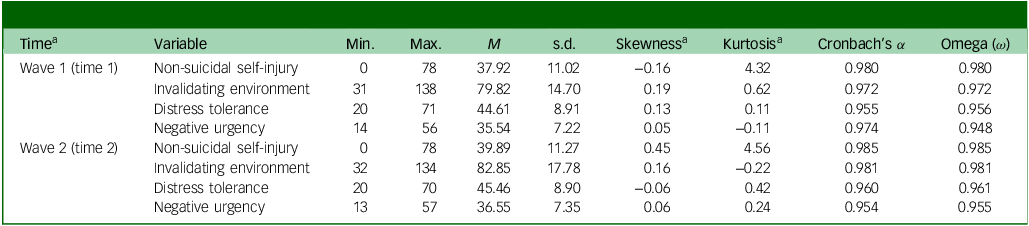
Descriptive statistics, normality indices and reliability coefficients of study variables (N = 300)

Table 1 Long description
The table presents descriptive statistics, normality indices, and reliability coefficients of study variables for 300 participants across two waves. It includes columns for minimum, maximum, mean, standard deviation, skewness, kurtosis, Cronbach’s alpha, and Omega. The variables measured are non-suicidal self-injury, invalidating environment, distress tolerance, and negative urgency. Wave 1 and Wave 2 are compared, with specific values for each variable. For example, non-suicidal self-injury has a mean of 37.92 and a standard deviation of 11.02 in Wave 1, and a mean of 39.89 and a standard deviation of 11.27 in Wave 2. The table also includes skewness and kurtosis values, with skewness for non-suicidal self-injury being -0.16 in Wave 1 and 0.45 in Wave 2. Cronbach’s alpha and Omega values are also provided, indicating reliability coefficients for each variable.
a. Skewness and kurtosis values within ±1 and ±5, respectively, indicate acceptable univariate normality.
Longitudinal associations were examined using a two-wave CLPM in Mplus. The model included autoregressive paths for invalidating environment, distress tolerance, negative urgency and NSSI, along with cross-lagged paths across T1 and T2. Covariances were specified among exogenous variables at T1 and residuals of endogenous variables at T2. Given the two-wave design, mediation was interpreted as prospective longitudinal indirect effects rather than strict longitudinal mediation. Variables conceptually positioned between predictors and outcomes were modelled as mediators within a prospective framework. All constructs were modelled as observed variables using total scores to maintain model parsimony. This approach does not fully account for measurement error; however, high scale reliability partially mitigates this limitation. Reference Raykov30,Reference McDonald31 To examine the longitudinal mediating mechanisms, we tested indirect effects within a CLPM using bootstrapping procedures. In this model, the predictor variables were measured at wave 1 and the outcome variables at wave 2. Distress tolerance and negative urgency were modelled as longitudinal mediators, such that an invalidating environment at wave 1 predicted changes in the mediators at wave 2, whereas the mediators at wave 1 predicted subsequent NSSI at wave 2. Accordingly, the indirect effects represent cross-lagged longitudinal mediation pathways linking wave 1 predictors to wave 2 outcomes. Reference Cole and Maxwell32,Reference Preacher33
Traditional CLPMs provide a parsimonious framework for examination of temporal ordering in two-wave data, although they cannot separate between-person and within-person processes. Reference Hamaker, Kuiper and Grasman34,Reference Orth, Clark, Donnellan and Robins35 Indirect effects were estimated using bias-corrected bootstrapping with 5000 resamples and 95% confidence intervals. Reference Preacher and Hayes36,Reference Hayes37 Supplementary analyses were performed to examine effects of age and gender, with gender differences tested via multigroup models. As participants were nested within classrooms and schools, we conducted a sensitivity analysis by re-estimating the structural model while accounting for the hierarchical data structure. Using the COMPLEX command specification in Mplus, we adjusted for potential non-independence of observations at the classroom and school levels with cluster-robust standard errors and compared the resulting estimates with those from the primary model.
Results
Sample characteristics
The final longitudinal sample consisted of 300 adolescents aged between 13 and 17 years (M = 15.61, s.d. = 1.42). Of the participants, 210 (70%) were female and 90 (30%) were male. The largest age group was 13-year-olds (30%); the remaining groups comprised 17-year-olds (25.3%), 15-year-olds (20.3%), 16-year-olds (15.7%) and 14-year-olds (8.7%). No missing data were observed at either the item or scale level.
Descriptive statistics and preliminary analyses
Descriptive statistics, normality indices and reliability coefficients for all study variables across the two measurement waves are presented in Table 1. On the basis of the descriptive statistics, the mean level of NSSI increased from wave 1 to wave 2. Specifically, the mean NSSI score rose from 37.92 (s.d. = 11.02) at wave 1 to 39.89 (s.d. = 11.27) at wave 2. This pattern is notable because the present longitudinal analyses aimed to explain changes in NSSI over time. In many longitudinal studies, NSSI scores have tended to decline at follow-up owing to regression to the mean; however, the observed increase in the current sample suggests a meaningful change in the outcome variable and provides an appropriate basis for examination of prospective predictors of increases in NSSI. Similarly, perception of an invalidating environment increased from wave 1 (M = 79.82, s.d. = 14.70) to wave 2 (M = 82.85, s.d. = 17.78). Distress tolerance showed a small increase from wave 1 (M = 44.61, s.d. = 8.91) to wave 2 (M = 45.46, s.d. = 8.90), and negative urgency also increased slightly from wave 1 (M = 35.54, s.d. = 7.22) to wave 2 (M = 36.55, s.d. = 7.35).
On the basis of the Inventory of Statements About Self-Injury behavioural assessment, 29% of participants reported a history of at least one non-suicidal self-injury behaviour. Among reported NSSI methods, cutting (35%), severe scratching (28%), and self-hitting (22%) were the most frequently endorsed behaviours, with other methods occurring at lower frequencies.
The distributions of the variables were within acceptable limits of normality. Skewness values ranged from −0.16 to 0.45, and kurtosis values ranged from −0.22 to 4.56 (Table 1); these values fall within recommended thresholds for structural equation modelling. Internal consistency for all measures was excellent across both waves, with Cronbach’s alpha ranging from 0.954 to 0.985 and omega coefficients ranging from 0.948 to 0.985.
Zero-order correlations
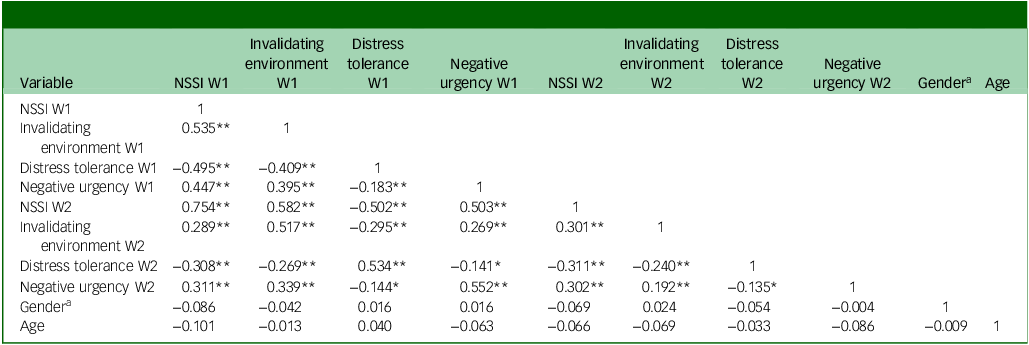
Pearson correlation coefficients among the study variables across the two waves are presented in Table 2. At wave 1, NSSI showed significant positive correlations with an invalidating environment (r = 0.535, P < 0.01) and negative urgency (r = 0.447, P < 0.01), and a significant negative correlation with distress tolerance (r = −0.495, P < 0.01). Similar patterns were observed at wave 2; NSSI was positively associated with an invalidating environment (r = 0.301, P < 0.01) and negative urgency (r = 0.302, P < 0.01) and negatively associated with distress tolerance (r = −0.311, P < 0.01).
Correlation matrix of study variables across two waves (Pearson correlation coefficients; N = 300)

Table 2 Long description
A table with 11 rows and 10 columns presenting correlation coefficients among study variables across two waves. The variables include NSSI, invalidating environment, distress tolerance, and negative urgency, measured at wave 1 and wave 2. The table shows Pearson correlation coefficients with significance levels indicated by asterisks. Row 1: NSSI W1, Invalidating environment W1, Distress tolerance W1, Negative urgency W1, NSSI W2, Invalidating environment W2, Distress tolerance W2, Negative urgency W2, Gender, Age. Row 2: NSSI W1, 1, 0.535**, 1, 0.447**, 0.754**, 0.280**, -0.308**, 0.311**, -0.086, -0.101. Row 3: Invalidating environment W1, 0.535**, 1, -0.409**, 0.395**, 0.503**, 0.269**, 0.534**, 0.302**, 0.076, 0.040. Row 4: Distress tolerance W1, -0.495**, -0.409**, 1, -0.183*, 0.582**, 0.295**, -0.141*, -0.311**, -0.042, 0.040. Row 5: Negative urgency W1, 0.447**, 0.395**, -0.183*, 1, 0.502**, 0.269**, -0.114*, 0.302**, 0.016, -0.063. Row 6: NSSI W2, 0.754**, 0.503**, 0.582**, 0.502**, 1, 0.301**, -0.331**, 0.302**, -0.086, -0.101. Row 7: Invalidating environment W2, 0.280**, 0.269**, 0.295**, 0.269**, 0.301**, 1, -0.144*, 0.552**, -0.069, 0.024. Row 8: Distress tolerance W2, -0.308**, 0.534**, -0.141*, -0.114*, -0.331**, -0.144*, 1, -0.240**, -0.054, -0.033. Row 9: Negative urgency W2, 0.311**, 0.302**, -0.311**, 0.302**, 0.302**, 0.552**, -0.240**, 1, -0.135*, -0.086. Row 10: Gender, -0.086, 0.076, -0.042, 0.016, -0.086, -0.069, -0.054, -0.135*, 1, 0.009. Row 11: Age, -0.101, 0.040, 0.040, -0.063, -0.101, 0.024, -0.033, -0.086, 0.009, 1.
NSSI, non-suicidal self-injury; W1, wave 1; W2, wave 2.
Gender was coded as 0 = male and 1 = female.
*P < 0.05, **P < 0.001.
Cross-wave correlations indicated strong temporal continuity, particularly for NSSI (r = 0.754, P < 0.01), distress tolerance (r = 0.534, P < 0.01), invalidating environment (r = 0.517, P < 0.01) and negative urgency (r = 0.552, P < 0.01), suggesting moderate to high stability across the 6-month interval. Multicollinearity diagnostics indicated no evidence of problematic overlap among predictors. Variance inflation factor values ranged from 1.19 to 1.38 and tolerance values from 0.73 to 0.84; these were well within acceptable limits.
Measurement models and longitudinal invariance
Before estimating the structural model, we examined measurement models for all constructs separately at each wave. Fit indices indicated acceptable to excellent model fit for most constructs (see Supplementary Table 1 available at https://doi.org/10.1192/bjo.2026.12095 for full details). Longitudinal measurement invariance analyses were then conducted to assess the stability of the measurement structure across time. For the NSSI scale, configural invariance demonstrated acceptable model fit (χ 2/d.f. = 2.94, comparative fit index (CFI) = 0.775, root mean square error of approximation (RMSEA) = 0.081), whereas metric invariance showed minimal change in RMSEA (ΔRMSEA = 0.001) and a modest change in CFI (ΔCFI = 0.014). Scalar invariance resulted in a further decline in fit (ΔCFI = 0.021; ΔRMSEA = 0.004) but remained within interpretable limits (Supplementary Table 2).
For the invalidating environment scale, both configural and metric invariance were supported with minimal changes in model fit indices (ΔCFI = 0.005; ΔRMSEA = 0.005), whereas scalar invariance showed a larger reduction in fit (ΔCFI = 0.049) but remained acceptable overall (Supplementary Table 3). Similarly, the distress tolerance and negative urgency scales demonstrated support for configural and metric invariance, with small changes in fit indices between models (Supplementary Tables 4 and 5). Although scalar invariance showed some decline in fit, overall results suggested adequate longitudinal comparability of the constructs.
Stability model
As an initial step, a stability model including only autoregressive paths from wave 1 to wave 2 was estimated. All stability paths were statistically significant (P < 0.001). The strongest temporal stability was observed for NSSI (β = 0.754), followed by negative urgency (β = 0.559), distress tolerance (β = 0.525) and invalidating environment (β = 0.520). These results indicate substantial persistence of each construct across the 6-month interval (Supplementary Table 6).
Cross-lagged structural model
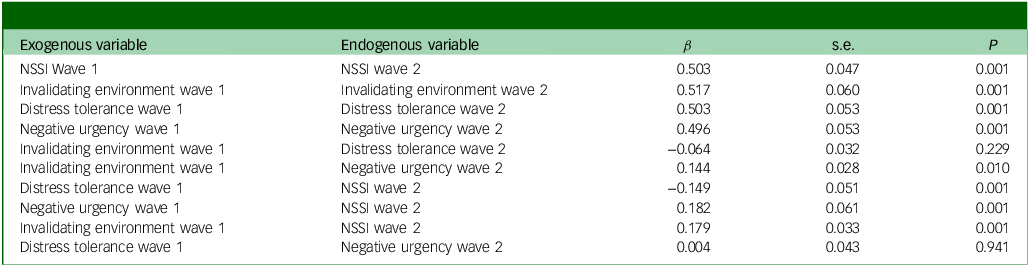
After establishing the stability model, we estimated a CLPM to examine longitudinal predictive relations among the variables. Standardised path coefficients are reported in Table 3. The results indicated that an invalidating environment at wave 1 significantly predicted higher levels of NSSI at wave 2 (β = 0.179, s.e. = 0.033, P = 0.001). In addition, negative urgency at wave 1 significantly predicted an increase in NSSI over time (β = 0.182, s.e. = 0.061, P = 0.001), whereas distress tolerance at wave 1 significantly predicted a decrease in NSSI (β = −0.149, s.e. = 0.051, P = 0.001). Regarding relationships among predictors, an invalidating environment at wave 1 significantly predicted higher negative urgency at wave 2 (β = 0.144, s.e. = 0.028, P = 0.010). However, the cross-lagged path from invalidating environment to distress tolerance was not statistically significant (β = −0.064, P = 0.229). Likewise, distress tolerance at wave 1 did not significantly predict negative urgency at wave 2 (β = 0.004, P = 0.941).
Standardised direct path coefficients for the unidirectional cross-lagged model (N = 300)

Table 3 Long description
A table titled ‘Standardised direct path coefficients for the unidirectional cross-lagged model (N = 300)’ with 12 rows and 5 columns. The columns are labeled ‘Exogenous variable’, ‘Endogenous variable’, ‘β’, ‘s.e.’, and ‘P’. The table presents data on the relationships between various psychological variables measured at two different time points. Each row lists an exogenous variable, an endogenous variable, the standardized path coefficient (β), the standard error (s.e.), and the p-value (P). Notable trends include significant positive predictions of NSSI wave 2 by NSSI wave 1, invalidating environment wave 1, and negative urgency wave 1, as well as a significant negative prediction by distress tolerance wave 1. Additionally, invalidating environment wave 1 significantly predicts higher negative urgency wave 2, but not distress tolerance wave 2. Distress tolerance wave 1 does not significantly predict negative urgency wave 2.
NSSI, non-suicidal self-injury.
Residual covariances among the observed variables were generally small and close to zero (Supplementary Table 7), suggesting that the structural model adequately captured the relationships among the variables.
Reciprocal effects model
A reciprocal model including reverse paths from wave 1 NSSI to wave 2 predictors was also tested. None of the reverse paths from NSSI to invalidating environment, distress tolerance or negative urgency was statistically significant. These findings suggest that the longitudinal relationship between invalidating environment and NSSI is primarily unidirectional, from environmental factors to self-injurious behaviour.
Model comparison
Model comparisons using chi-squared difference tests indicated that the cross-lagged model provided a significantly better fit than the stability model (Δχ 2 = 72.415, Δd.f. = 6, P < 0.001). By contrast, addition of reciprocal paths did not significantly improve model fit (Supplementary Table 8). Therefore, the unidirectional cross-lagged model was retained as the final model. Fit indices for the final model indicated excellent model fit (χ 2/d.f. = 1.11, CFI = 0.999, Tucker–Lewis index = 0.996, RMSEA = 0.020, standardised root mean squared residual = 0.024).
Longitudinal mediation effects
Bootstrapping with 5000 resamples was used to examine indirect effects. As shown in Table 4, the indirect effect of invalidating environment at wave 1 on wave 2 NSSI through negative urgency was statistically significant (β = 0.020, 95% CI [0.006, 0.042], P = 0.002). By contrast, the indirect effect through distress tolerance was not significant (β = 0.007, 95% CI [−0.003, 0.023], P = 0.153). Furthermore, the serial mediation pathway from invalidating environment to NSSI through distress tolerance and subsequently negative urgency was not significant (β ≈ 0, P = 0.768). These results suggest that negative urgency functions as a significant longitudinal mediator linking invalidating environment to later NSSI, whereas distress tolerance did not demonstrate a mediating role across the 6-month period (Fig. 1). Figure 2 presents a forest plot summarising the standardised effect estimates for negative urgency and distress tolerance in relationship between NSSI and invalidating environment.
Bidirectional cross-lagged panel model illustrating the associations between non-suicidal self-injury and an invalidating environment, mediated sequentially by distress tolerance and negative urgency.

Fig. 1 Long description
A diagram of a bidirectional cross-lagged panel model. The diagram includes four main components: Non-suicidal self-injury, Invalidating environment, Distress tolerance, and Negative urgency, each measured at two time points (wave 1 and wave 2). Arrows indicate the directional relationships between these components across the two waves. Each arrow is labeled with a numerical value representing the strength and direction of the association. The diagram shows how these factors influence each other over time, with specific pathways and mediating effects highlighted. The values on the arrows indicate the strength of the relationships, with positive and negative values showing the direction of the influence.
Forest plot of standardised associations for negative urgency and distress tolerance with study outcomes (95% confidence intervals). Predictors were measured at wave 1 and outcomes at wave 2. Distress tolerance and negative urgency were modelled as longitudinal mediators using cross-lagged paths across the two waves. NSSI, non-suicidal self-injury.

Indirect effects between invalidating environment and NSSI (bootstrap 95% CI) (N = 300)

Table 4 Long description
A table with 7 rows and 5 columns. The columns are labeled ‘Wave 1 predictor’, ‘Indirect path’, ‘Wave 2 outcome’, ‘Standardised indirect effect’, ‘95% CI’, and ‘P’. The rows are labeled with different combinations of predictors, paths, and outcomes. Row 1: Invalidating environment, Distress tolerance, NSSI, 0.007, [-0.003, 0.023], 0.153. Row 2: Invalidating environment, Negative urgency, NSSI, 0.020, [0.006, 0.042], 0.002. Row 3: Invalidating environment, Distress tolerance -> negative urgency, NSSI, 0.000, [-0.002, 0.001], 0.768. Row 4: NSSI, Distress tolerance, Invalidating environment, 0.007, [-0.016, 0.046], 0.403. Row 5: NSSI, Negative urgency, Invalidating environment, 0.004, [-0.010, 0.036], 0.442. Row 6: NSSI, Distress tolerance -> negative urgency, Invalidating environment, 0.000, [-0.004, 0.001], 0.512.
NSSI, non-suicidal self-injury.
a. Predictors were measured at wave 1 and outcomes at wave 2. Distress tolerance and negative urgency were modelled as longitudinal mediators using cross-lagged paths across the two waves.
Multi-group analysis
Multi-group analyses were conducted to examine whether the structural relations differed by gender and age. For gender, metric invariance was supported (ΔCFI = 0.001), indicating that the structural paths were comparable between male and female individuals. However, scalar invariance was not supported (ΔCFI = 0.025), suggesting differences in intercepts or variances between genders (Supplementary Table 9). By contrast, invariance testing across age groups did not support metric invariance (ΔCFI = 0.024), indicating that the magnitude of structural relationships varied across age groups (Supplementary Table 10).
Age-specific sensitivity analysis
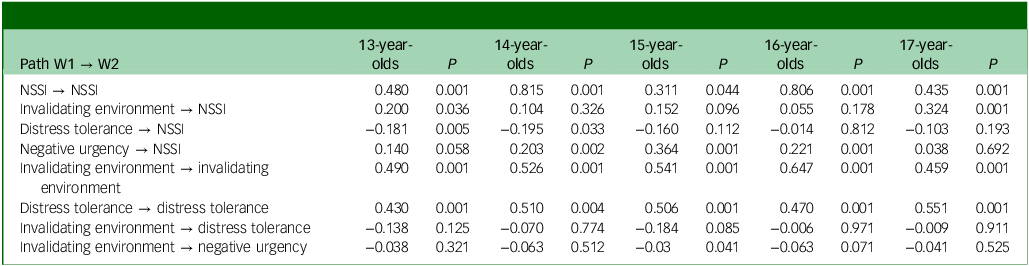
Additional sensitivity analyses were conducted to examine developmental differences across age groups (13–17 years). Stability paths remained significant across all age groups, indicating consistent temporal persistence of the constructs. However, cross-lagged effects varied by age (Table 5). The effect of invalidating environment on NSSI was significant among 13-year-olds (β = 0.200, P = 0.036) and 17-year-olds (β = 0.324, P = 0.001) but not among the middle adolescent groups. Distress tolerance predicted NSSI primarily in early adolescence (13–14 years), whereas negative urgency showed stronger predictive effects during mid-adolescence (14–16 years). These findings suggest that the mechanisms linking environmental invalidation to self-injurious behaviour may differ across developmental stages of adolescence.
Sensitivity analysis of path coefficients across age groups (13–17 years) (N = 300)

Table 5 Long description
A table comparing path coefficients across age groups from 13 to 17 years. The table has 8 rows and 11 columns. Column headers are Path W1 -> W2, 13-year-olds, P, 14-year-olds, P, 15-year-olds, P, 16-year-olds, P, and 17-year-olds, P. Row labels include NSSI -> NSSI, Invalidating environment -> NSSI, Distress tolerance -> NSSI, Negative urgency -> NSSI, Invalidating environment -> Invalidating environment, Distress tolerance -> distress tolerance, Invalidating environment -> distress tolerance, and Invalidating environment -> negative urgency. Each row lists path coefficients and P-values for each age group. Notable trends include significant P-values for NSSI -> NSSI across all age groups, and varying significance of other paths depending on the age group.
NSSI, non-suicidal self-injury; W1, wave 1; W2, wave 2.
Cluster-adjusted structural model
As shown in Supplementary Table 11, accounting for clustering produced only negligible changes in the standardised path coefficients compared with the primary analyses. Robust standard errors increased slightly, as expected, but all statistically significant paths remained significant after adjustment. All significant stability, cross-lagged and direct effects remained statistically significant, whereas non-significant paths remained non-significant. Overall, these findings indicate that accounting for classroom- and school-level clustering did not materially affect the structural relationships or the study conclusions.
Discussion
The present study examined whether adolescents’ exposure to emotionally invalidating environments is prospectively associated with changes in NSSI, and whether this association is consistent with a regulatory pathway involving distress tolerance and negative urgency. The findings of this study, which used a two-wave longitudinal panel design, provide support for a temporally ordered pattern in which perceived environmental invalidation is linked to subsequent variation in NSSI, with negative urgency emerging as a key proximal mechanism. Overall, the findings demonstrate a pattern that is largely consistent with biosocial and developmental models of self-injury; they also help to refine these models by clarifying which regulatory mechanisms seem to be most relevant across adolescence. Reference Linehan10,Reference Preacher and Hayes36 The modest increase in mean NSSI scores across the 6-month follow-up may also reflect normative developmental processes during adolescence. Mid-adolescence is characterised by heightened emotional reactivity, increased exposure to academic demands, interpersonal stressors and ongoing identity development, all of which may contribute to greater vulnerability to self-injurious behaviours over time. In addition, the follow-up period may have coincided with increased academic pressures (e.g. examination periods), although such contextual factors were not directly assessed in the present study. These interpretations remain speculative and warrant investigation in future longitudinal research incorporating contextual and developmental variables.
Consistency with theoretical framework and primary findings
Consistent with the study’s theoretical framework, perceived environmental invalidation was prospectively associated with NSSI, even after we had accounted for baseline levels of self-injury. This finding is consistent with biosocial and developmental perspectives suggesting that repeated exposure to dismissive, critical or punitive responses to emotional expression may increase adolescents’ vulnerability to maladaptive coping behaviours. Reference Linehan10 Previous longitudinal research has similarly shown that emotionally unsupportive interpersonal environments are associated with persistence and escalation of NSSI during adolescence. Reference Adrian, McCauley, Berk and Asarnow3 From this perspective, invalidating environments may function as an ongoing interpersonal stressor that undermines adaptive emotion regulation and increases reliance on maladaptive coping strategies such as self-injury. Reference Fox, Franklin, Ribeiro, Kleiman, Bentley and Nock7,Reference Nock38 Importantly, the persistence of this association after our controlling for baseline NSSI supports the interpretation that environmental invalidation represents a meaningful longitudinal risk context rather than merely a concurrent correlate of self-injury.
Reconsidering the role of distress tolerance
Distress tolerance, which has frequently been conceptualised as a core component of emotion regulation, refers to individuals’ perceived or behavioural capacity to withstand negative emotional states without engaging in avoidance or impulsive behaviours. Reference Simons and Gaher13,Reference Leyro, Bernstein, Vujanovic, McLeish and Zvolensky14 In line with prior literature, lower distress tolerance was associated with higher levels of NSSI in the present study, supporting previous findings linking distress intolerance to self-injurious behaviours. Reference Anestis, Selby and Joiner17,Reference Gratz, Tull and Levy19 However, the hypothesised mediating role of distress tolerance between environmental invalidation and later NSSI was not supported in the longitudinal mediation analyses. Rather than indicating that distress tolerance is irrelevant to NSSI, this finding suggests that distress tolerance may function as a broader emotional vulnerability factor rather than a proximal mechanism through which environmental invalidation influences self-injury over relatively short time intervals.
Theoretically, distress tolerance may reflect cumulative developmental learning processes shaped by long-term emotional experiences rather than immediate contextual influences. Reference Zvolensky and Hogan18 Consequently, changes in distress tolerance may unfold more gradually across development and may be less sensitive to proximal environmental influences within a two-wave longitudinal design. Similar interpretations have been proposed in research indicating that trait-like emotion regulation capacities often show substantial temporal stability during adolescence. Reference Gratz, Tull and Levy19 Thus, the absence of a mediating effect does not contradict theoretical models linking emotion regulation difficulties to NSSI but instead suggests that the pathway between environmental invalidation and self-injury may operate through mechanisms other than distress tolerance in shorter-term longitudinal processes. From a methodological standpoint, the two-wave design and relatively limited timespan may have also constrained our ability to detect changes in distress tolerance sufficient to support mediation.
Negative urgency as the primary mediating mechanism
In contrast to distress tolerance, negative urgency emerged as a significant longitudinal mediator between environmental invalidation and later NSSI. Negative urgency reflects the tendency to act impulsively in response to intense negative emotions Reference Whiteside and Lynam20 and has been consistently associated with self-injurious behaviours and other maladaptive coping strategies. Reference Anestis, Selby and Joiner17,Reference Peckham, Jordan, Silverman, Steele, Björgvinsson and Beard21
The present findings suggest that emotionally invalidating environments may contribute to increases in impulsive responses under distress, which in turn elevate risk of NSSI. When adolescents’ emotional experiences are dismissed or criticised, they may have fewer opportunities to develop reflective emotion regulation strategies and may instead rely on immediate behavioural responses to alleviate distress. In this sense, negative urgency may represent a proximal behavioural pathway through which environmental stressors translate into self-injurious behaviours. Importantly, the persistence of a direct effect of environmental invalidation on NSSI after negative urgency had been accounted for suggests partial mediation, indicating that additional mechanisms such as maladaptive emotional appraisals, interpersonal sensitivity or learned coping scripts may also contribute to the association between invalidation and self-injury. Reference Fox, Franklin, Ribeiro, Kleiman, Bentley and Nock7,Reference Nock38
Developmental specificity and age-related sensitivity analyses
The sensitivity analyses examining age-specific patterns in the associations among the study variables represent an important contribution of the present study. The results of these analyses indicated that the strength of these associations varied across age groups, highlighting the developmental sensitivity of these processes. Notably, the effects observed among adolescents aged 13 years were particularly pronounced. Early adolescence represents a developmental period characterised by heightened emotional reactivity, increased sensitivity to social evaluation and ongoing maturation of cognitive control systems. Reference Lucas39 During this stage, adolescents may rely more heavily on interpersonal feedback to understand and regulate emotional experiences. Consequently, exposure to emotionally invalidating responses during early adolescence may be especially influential, potentially increasing vulnerability to maladaptive coping strategies such as NSSI. Previous developmental research similarly suggests that early adolescence is a critical window during which interpersonal stressors can strongly influence emerging emotion regulation patterns and risk behaviours. Reference Adrian, McCauley, Berk and Asarnow3
These findings underscore the importance of considering developmental timing when examining risk processes for NSSI and suggest that prevention efforts may be particularly important during the early stages of adolescence. As the sample was recruited exclusively from public high schools in Tehran, the findings may not be fully generalisable to adolescents from other regions of Iran or to students attending private schools or not enrolled in school.
Clinical implications
Overall, the findings indicate that negative urgency, rather than distress tolerance, serves as a key mediating pathway linking environmental invalidation to self-injurious behaviour. Moreover, the stronger associations observed among 13-year-old adolescents highlight the importance of developmental timing in understanding the emergence of NSSI risk. From a clinical and preventive perspective, these findings highlight the potential importance of addressing emotionally invalidating interactions within adolescents’ interpersonal environments. Interventions that promote emotional validation and supportive responses to distress may help to reduce regulatory vulnerabilities associated with self-injury. Reference Linehan10 Furthermore, the identification of negative urgency as a key mediating mechanism suggests that interventions targeting impulsive response under distress – such as skills aimed at delaying action, increasing emotional awareness and enhancing regulatory flexibility – may be particularly beneficial for adolescents at risk of NSSI. Reference Peckham, Jordan, Silverman, Steele, Björgvinsson and Beard21
Limitations and future directions
Several limitations should be considered when interpreting the findings of the present study. First, although the two-wave cross-lagged design allowed prospective examination of temporal associations, it is not optimal for testing true longitudinal mediation. Such mediation could be more rigorously evaluated using at least three measurement waves to temporally separate the predictor, mediator and outcome. Accordingly, the mediation findings should be interpreted as evidence of prospective indirect associations rather than definitive causal mediation. Future studies employing three or more waves and advanced longitudinal models (e.g. random-intercept CLPMs) are warranted.
Second, the study relied primarily on self-report measures, which may have been influenced by shared method variance, recall biases or adolescents’ subjective interpretations of interpersonal environments. Although perceptions of invalidation are theoretically meaningful, incorporation of multi-informant data (e.g. from parents, peers or observational assessments) and behavioural measures of emotion regulation would strengthen future research.
Third, the non-significant mediating role of distress tolerance should be interpreted cautiously. It is possible that the relatively short time interval between assessments limited our ability to detect developmental changes in this construct, which may reflect a more stable vulnerability shaped by cumulative experiences. Future studies with longer follow-up periods may help to clarify whether distress tolerance has a more gradual mediating role across development.
Fourth, the potential influence of comorbid psychiatric or medical conditions could not be evaluated, because this information was not systematically assessed. Future studies should examine whether such conditions moderate associations among invalidating environment, distress tolerance, negative urgency and NSSI over time.
A further methodological limitation concerns the use of a conventional CLPM. Although CLPMs allow examination of temporal precedence, they do not distinguish between stable between-person differences and within-person fluctuations, potentially complicating the interpretation of cross-lagged effects. Reference Lucas39 Future studies using random-intercept CLPMs with multiple measurement occasions are needed to clarify whether observed longitudinal associations reflect within-person changes beyond stable individual differences. Reference Mulder and Hamaker40 Another limitation was that adverse childhood experiences were not assessed in the present study. Experiences such as childhood sexual abuse, severe physical abuse and other culturally relevant forms of early adversity may have long-term effects on emotion regulation, coping strategies and vulnerability to NSSI. Future research should examine whether adverse childhood experiences influence or moderate the longitudinal pathways linking invalidating environments, distress tolerance, negative urgency and NSSI.
Finally, the present findings should also be interpreted within the broader cultural context of Iran. Similar to many collectivistic societies across the Middle East, Asia and Africa, Iranian culture places considerable emphasis on family relationships, interpersonal harmony and social cohesion. These cultural values may influence how adolescents express emotional distress, perceive interpersonal interactions and seek support following adverse emotional experiences. Consequently, invalidating interpersonal environments may have particularly salient implications for adolescents’ emotional functioning and coping strategies within this context. Nevertheless, the psychological processes examined in the present study – namely, invalidating environments, distress tolerance and negative urgency – are not assumed to be culturally specific. Rather, they represent transdiagnostic psychological mechanisms that have been documented across diverse cultural settings, including Western populations. Therefore, although cultural norms may shape the expression and contextual meaning of these processes, the underlying longitudinal associations observed in the present study are likely to have broader relevance beyond the Iranian context.
Supplementary material
The Supplementary material is available online at https://doi.org/10.1192/bjo.2026.12095
Data availability
The data from this study cannot be made publicly available, as doing so would violate the ethical protocols approved by the Research Ethics Committee of Kharazmi University, Tehran. However, the data may be made available upon reasonable request to the corresponding author, subject to ethical considerations. The code used for analysis is available from the corresponding author upon reasonable request.
Acknowledgement
We thank all the participants for taking part in this study.
Author contributions
M.A. conceptualised the study, supervised the project, designed the methodology, conducted the statistical analyses, and drafted and revised the manuscript. F.A. assisted with data collection, contributed to data management, and drafted and revised the manuscript. S.M. conceptualised the study, supervised the project, contributed to the study design and reviewed and edited the manuscript. E.A.S. contributed to the conceptualisation of the study, advised on statistical analyses and interpretation of the findings, and edited the manuscript. All authors read and approved the final version of the manuscript.
Funding
The authors received no financial support for the research, authorship and/or publication of this article.
Declaration of interest
None.





 Open access


eLetters
No eLetters have been published for this article.