INTRODUCTION
The shrimp Acetes americanus Ortmann, 1893 is distributed throughout the western Atlantic from the Guayanes Beach in Porto Rico (northern limit) to Rio Grande do Sul, Brazil (southern limit), while Peisos petrunkevitchi Burkenroad, 1945 is distributed from Rio de Janeiro to Rio Grande do Sul in Brazil to the Chubut Province in Argentina (D'Incao & Martins, Reference D'Incao and Martins2000).
Located along the northern coastline of the State of São Paulo, the Ubatuba region is an important area for crustacean research because of its high species richness. For example, from all of the Dendrobranchiata species recorded in Brazilian waters, 33% were found in this region (Costa et al., Reference Costa, Fransozo, Mantelatto and Castro2000, Reference Costa, Fransozo, Melo and Freire2003). Four rivers flow into the bay: Acaraú River, da Lagoa River, Grande de Ubatuba River and Indaiá River. As Ubatuba city is an important tourist destination, its influence on water quality in the bay is significant (CETESB, 1996, 2000; Abessa & Burone, Reference Abessa and Burone2003). According to Burone & Pires-Vanin (Reference Burone and Pires-Vanin2006), large amounts of untreated sewage from the city are discharged into the bay predominantly during the peak summer vacation season (rainy periods).
On the shelf of Ubatuba, South Atlantic Central Water (SACW: T < 20°C and S < 36) enters the region during the summer and spring months, and a strong thermocline is established during the period (Campos et al., Reference Campos, Gonçalves and Ikeda1995; Castro-Filho & Miranda, Reference Castro-Filho and Miranda1998). The opposite occurs during the winter months, when the Tropical Water mass (TW: T > 20°C and S > 36) maintains the region under oligotrophic conditions (Valentin & Monteiro-Ribas, Reference Valentin and Monteiro-Ribas1993).
Environmental factors, such as the texture of sediment, salinity and temperature, are fundamentally important in determining the spatio-temporal distribution of shrimp (Dall et al., Reference Dall, Hill, Rothilsberg and Staples1990). Sergestidae shrimps play an important role in the marine food chain, as they feed on a variety of food items, such as diatoms and copepods; they are preyed upon by the jellyfish Chiropsalmus quadrumanus (Müller, 1859), by crustaceans, such as the shrimp Pleoticus muelleri (Bate, 1888), as well as sciaenid fish (Xiao & Greenwood, Reference Xiao and Greenwood1993; Nogueira Júnior & Haddad, Reference Nogueira Júnior and Haddad2008; Roux et al., Reference Roux, Piñero, Moriondo and Fernández2009).
Penaeid shimps are benthic and will bury themselves in the sediment (Castilho et al., Reference Castilho, Pie, Fransozo, Pinheiro and Costa2008a; Simões et al., Reference Simões, Costa, Fransozo and Castilho2010). Alternatively, Omori (Reference Omori1974) found that the Sergestidae genera of Sergestes, Acetes (H. Milne-Edwards, 1830), Lucifer (Thompson, 1829) and some species of Sergia spp. are epipelagic and mesopelagic, transparent or semi-transparent, and generally occur near the materials associated with ocean floor substrates.
Changes in temperature, salinity, tides, wind, food availability and predator presence can all be responsible for fluctuations in sergestid shrimp catches (Xiao & Greenwood, Reference Xiao and Greenwood1993). Moreover, vertical migration of these shrimps in the water column also occurs, although Williams (Reference Williams1965) and Xiao & Greenwood (Reference Xiao and Greenwood1993) found the greatest abundances of A. americanus (Ortmann, 1893) and Acetes chinensis (Hansen 1919), respectively, near the substrates.
Thus far, few studies have been carried out concerning the life history of pelagic shrimps found off the coast of Brazil, with the majority of studies focused predominantly on biodiversity, systematics and larval development (Calazans, Reference Calazans1994; Oshiro & Omori, Reference Oshiro and Omori1996; Costa et al., Reference Costa, Fransozo, Mantelatto and Castro2000; D'Incao & Martins, Reference D'Incao and Martins2000; Calazans, Reference Calazans2002).
Due to the lack of studies concerning the biology of this group, and because they are an important food resource for many species, the present study was conducted to investigate the spatio-temporal distribution of A. americanus and P. petrunkevitchi across a depth gradient off the coast of Ubatuba, the northern coast of the State of São Paulo, Brazil. Furthermore, we evaluated the influences of temperature and salinity variation on the abundance of these species.
MATERIALS AND METHODS
Sampling
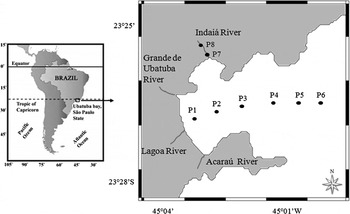
Six collection points with differing depths (P1: 1 m, P2: 5 m, P3: 9 m, P4: 13 m, P5: 17 m and P6: 21 m) in Ubatuba bay and two (P7: 1 m and P8: 1 m) in an estuary that flows into the bay were identified, with sampling conducted during the day at high tide. The points were sampled on a monthly basis from July 2006 to June 2007 (Figure 1).
Map of the Ubatuba region indicating the locations for the collecting points.

Surface and bottom water temperatures and salinity were monitored monthly at each transect using a Van Dorn bottle for water sampling. Water temperatures (°C) at the bottom were taken using a reversing thermometer attached to the Van Dorn bottle and a standard thermometer at the surface, both with a precision of 0.1°C. Salinity values were obtained using a refractometer on water samples taken at the bottom and at the surface.
The samples were collected using an aluminium fishing boat with a 25HP stern drive engine. The shrimp were captured with an otter trawl with a 2-m opening between doors, 3-m mesh length and a height of approximately 1 m (mesh size was 5 mm and 0.5 mm in the cod end). A cup was attached to the extreme end of the net to allow storage of the captured organisms. Each trawl was 50 m in length, and the effort in each transect was 100 m2.
In the laboratory, all the shrimps were identified according to D'Incao & Martins (Reference D'Incao and Martins2000) and Costa et al. (Reference Costa, Fransozo, Melo and Freire2003) and quantified by transect and month in which they were sampled.
Data analysis
The sampling points in the bay were arranged into 2 groups, one with depths from 1 to 9 m corresponding to P1, P2 and P3 (Zone 1) and the other with depths from 13 to 21 m corresponding to P4, P5 and P6 (Zone 2). The shallow region (Zone 1) of the bay is strongly affected by coastal environmental conditions, receiving freshwater drainage from four rivers (Acaraú River, da Lagoa River, Grande de Ubatuba River and Indaiá River), while the deep stratum (Zone 2) is subject to greater oceanic influence.
Tests for homoscedasticity (Levene tests) and normality (Shapiro–Wilk tests) were first performed as prerequisites for the statistical test, and the data were then log-transformed prior to analyses (Zar, Reference Zar1999). Data sets were normally distributed with homogeneous variances.
Abundance (total number of shrimps) was compared among periods (Seasons) and depths (Zones) using analysis of variance (ANOVA Factorial, P < 0.05). The relationship between the environmental factors and the observed abundance patterns in the sergestid species was assessed using canonical correlation analysis (CCorrA). This analysis is a multivariate statistical procedure that directly measures the strength of the relationship between the two sets of variables. The first set used for the CCorrA included the environmental characteristics (salinity, temperature and depth), whereas the second set of variables included the abundance of the studied species (A. americanus and P. petrunkevitchi).
RESULTS
Environmental factors
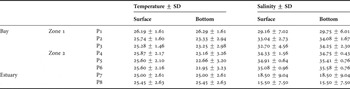
Water surface temperatures did not vary greatly among transects, although the average bottom water temperature was higher in Zone 1 (23.25 to 26.29°C) compared with Zone 2 (21.95 to 23.16°C). In the estuary, there was no variation in temperatures between transects (Table 1).
Average values of temperature (oC), salinity and associated standard deviations (SD) for samples in the Ubatuba bay and in the estuary from July 2006 to June 2007.

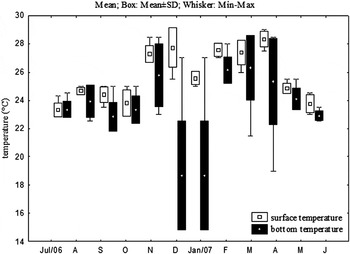
Higher variations between bottom and surface temperatures were observed from December 2006 to January 2007 (end of spring and beginning of summer), which contrasted with the autumn and winter months, when homogeneity was the norm (Figure 2).
Monthly mean values and standard deviations (SD) from July 2006 to June 2007 for bottom and surface water temperatures (°C) with maximum and minimum values in the Ubatuba bay, São Paulo.

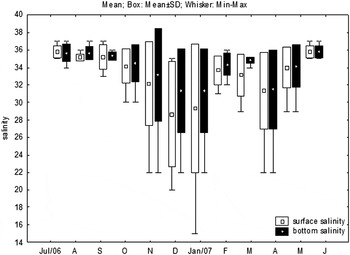
The average values of salinity in the surface were lower in Zone 1 (29.16 to 33.04) than in Zone 2 (34.33 to 35.08). The values of bottom salinity also showed the same pattern, from 29.75 to 34.25 in Zone 1 and from 34.41 to 35.58 in Zone 2. In the estuary, the average salinity of P8 was lower than that of P7 (Table 1). Higher variations in the salinity values between surface and bottom waters were also found for the December 2006 and January 2007 sampling periods (Figure 3).
Monthly mean values and standard deviations (SD) from July 2006 to June 2007 for salinity measures of bottom and surface water with maximum and minimum values in the Ubatuba bay, São Paulo.

Ecological distribution
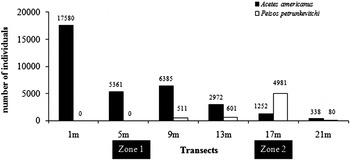
No individuals from the targeted species were captured in the Indaiá estuary from July 2006 to June 2007. However, a total of 33,888 A. americanus specimens were captured in the bay, into which the Indaiá River flows. Shrimp abundance decreased as the depth increased from 1 to 21 m. The P. petrunkevitchi catch was 6,173 individuals, with none found in the shallow transects at depths of 1 and 5 m; however, they were caught at deeper locations (Figure 4).
Number of individuals of Acetes americanus and Peisos petrunkevitchi sampled at depths of 1 m, 5 m, 9 m (Zone 1) and 13 m, 17 m, and 21 m (Zone 2) in the Ubatuba bay, São Paulo.

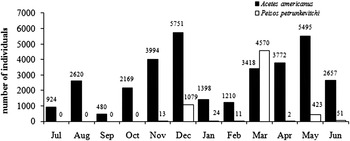
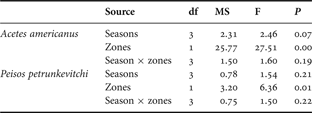
The highest abundances of A. americanus were found in November and December of 2006 and April and May of 2007, corresponding to the spring and autumn seasons. The highest abundances of P. petrunkevitchi were registered in November of 2006 and January, February, April, May and June of 2007 with no individuals captured in the other months (Figure 5). The abundances differed statistically between zones (ANOVA, P < 0.05) (Table 2).
Number of individuals of Acetes americanus and Peisos petrunkevitchi sampled by depth from July 2006 to June 2007 in the Ubatuba bay, São Paulo.

Acetes americanus and Peisos petrunkevitchi. Analysis of variance results for the mean catch by species, season and zone as well as their interactions.

df, degrees of freedom; MS, mean square; F, MS factor/MS residual; P, 0.05.
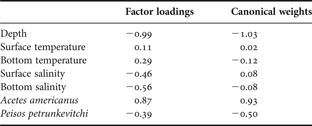
The CCorrA resulted in a canonical correlation coefficient of 0.68 (P = 0.0000001). The first root was statistically significant (P = 0.02); with the canonical factor loadings (the correlation between the canonical and the original variables) and the canonical weights (the partial correlations of the original variables with respect to the canonical root) shown in Table 3. The environmental variable with the highest factor loading is depth (−0.99), followed by bottom and surface salinity, which show similar signs as related to depth (−0.56 and −0.46, respectively). However, given the high level of covariance among these variables, an inspection of their canonical weights can provide an indication of their individual contributions while controlling for other variables. Only depth shows high canonical weight (CW = −1.03), indicating that it most strongly reflects the variation in this environmental condition.
Canonical factor loadings and associated weights based on the canonical correlation analysis of the relationship between environmental characteristics and shrimp abundance patterns.

The variation among environmental factors was strongly associated with the abundance of A. americanus, as revealed by its high factor loading (0.87) and CW (0.93). Interestingly, the variation in abundance of P. petrunkevitchi was inversely related to factor loading (−0.39) and CW (−0.50), as shown in Table 3.
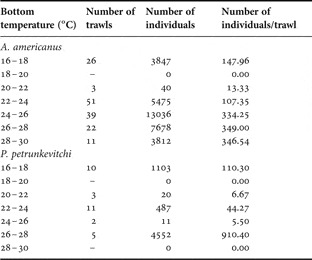
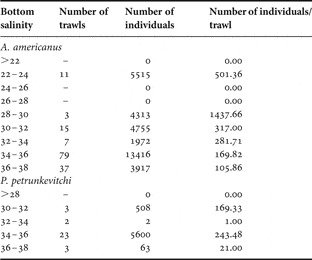
The highest number of A. americanus was found in locations with temperatures higher than 24°C; however, no individuals were found in temperatures from 18°C to 20°C (Table 4). With regard to salinity, a higher number of individuals were found in sites with lower values of salinity from 28 to 30 (Table 5). The highest abundances of P. petrunkevitchi were found in locations with temperature ranges from 16 to 18°C and from 24 to 28°C, and predominantly in sites with salinity values from 30 to 38, with the greatest abundance in salinities from 34 to 36, followed by 30 to 32 (Tables 4 & 5).
Number of individuals, number of trawls and number of individuals per trawl in relation to classes of temperature (°C) observed for Acetes americanus and Peisos petrunkevitchi. The range of each class of temperature was 2°C.

Number of individuals, number of trawls and number of individuals per trawl in relation to classes of salinity observed for Acetes americanus and Peisos petrunkevitchi. The range of each class of salinity was 2.

DISCUSSION
A distinct spatial distribution of both shrimp species was observed in the studied region. This result has also been observed in Penaeoidea shrimps. Primavera (Reference Primavera1998) observed that three shrimp of the genus Metapenaeus (Wood-Mason, 1891) presented spatial partitioning based on different salinities and types of sediments. Macia (Reference Macia2004) and Costa et al. (Reference Costa, Lopes, Castilho, Fransozo and Simões2008) reported that juveniles of different Penaeidae species use different areas for nursery habitat to complete their life cycle. According to these authors, the spatial or temporal differentiation observed in closely related species can be due to avoidance of competition for food and territory. This hypothesis can be applied to both Sergestoidea species in this study.
Peisos petrunkevitchi is restricted to waters of 9 m or deeper with salinities close to 34 and usually where the temperature values drop. Boschi et al. (Reference Boschi, Iorio and Fischbach1981) also observed that on the Argentinean coast individuals were associated with salinities ranging from 33.2 to 33.9. These shrimps were not found near the shallow coastal waters, even during the periods in which the salinity was favourable to the establishment of this species. The combination of lower salinities and higher temperature values, observed in the shallow sites, may have limited the entrance of P. petrunkevitchi to the areas with depths of 1, 5 and 9 m. The same pattern was observed by Costa et al. (Reference Costa, Fransozo and Pinheiro2004, Reference Costa, Fransozo, Castilho and Freire2005) for P. muelleri and Artemesia longinaris Bate, 1888, respectively: both shrimps had geographical distributions similar to that of P. petrunkevitchi.
Additionally, P. petrunkevitchi possesses a distribution associated with colder temperate regions, primarily concentrated off the Argentinean coast in shallow areas, which generally do not surpass 20 m in depth and where water temperatures oscillate from 8 to 24°C (Mallo & Boschi, Reference Mallo and Boschi1982). The highest abundance of P. petrunkevitchi occurred in those months, which showed a decrease in the temperature and salinity values, due to the mass of SACW, possibly triggering the displacement of this species into the study area.
Therefore, P. petrunkevitchi can be considered to be a cold water shrimp similar to the other two species, A. longinaris and P. muelleri, which are typical of the South Atlantic Ocean and were studied by Fransozo et al. (Reference Fransozo, Costa, Castilho and Mantelatto2004), Costa et al. (Reference Costa, Fransozo and Pinheiro2004, Reference Costa, Fransozo, Castilho and Freire2005) and Castilho et al. (Reference Castilho, Costa, Fransozo and Boschi2007, Reference Castilho, Costa, Fransozo and Negreiros-Fransozo2008b) in the same region as this study.
Depth was also a determinant in the spatial distribution of the A. americanus shrimp, which showed a preference for shallow sites with high temperature and lower salinity values. In the field, it was observed that individuals were regularly captured in high quantities when they were aggregated among algae fragments, wood and leaf litter. Fransozo et al. (Reference Fransozo, Castilho, Freire, Furlan, Almeida, Teixeira and Baeza2009) found similar results for the Palaemonidae shrimp Nematopalaemon schimitti (Holthuis, 1950). This species was observed in high numbers only in sites with increased amounts of algae and algal fragments. In shallow coastal waters, where there is constant wave motion, those fragments may offer some protection to the shrimps. The trawl net was always observed containing these fragments, which was also the case for Omori (Reference Omori1974), who found the same to be true for Acetes shrimps, in which most specimens usually occurred associated with fragments and loose leaf litter near the substrate.
Acetes americanus prefers sites with higher temperature values. Xiao & Greenwood (Reference Xiao and Greenwood1993) observed that higher numbers of individuals were found in the warmer months of the year, both in tropical and subtropical regions. Calazans (Reference Calazans1994, Reference Calazans2002) also observed a positive relationship between A. americanus larvae and temperature, i.e. a higher abundance of larvae was observed in warmer months in southern Brazil. Bhattacharya (1988) cited in Xiao & Greenwood (Reference Xiao and Greenwood1993), in a study conducted on Acetes indicus (H. Milne Edwards, 1830), found that this species prefers regions with temperatures ranging from 22 to 25°C and tolerates extremes of 14 and 34°C. These results differed from ours, given that we observed a higher abundance of A. americanus in areas with temperatures from 23.5 to 28.5°C. In contrast, in a study conducted by Chiou et al. (Reference Chiou, Wu and Cheng2000), the density and migration of Acetes intermedius Omori, Reference Omori1975 from the estuary to shallower areas on the coast were related to heavy rains and a high discharge of water into the rivers.
Omori (Reference Omori1975) stated that the genus Acetes occurs in estuarine waters. According to the post-larvae total length (TL) of 2.50 mm (Calazans, Reference Calazans1994) and maturity at approximately 7.50 mm (Simões, Reference Simões2008), it can be summarized that the individuals with TL greater than 3.00 mm are still considered juveniles. As in the present study, the smallest individuals captured for both species had a TL of 4.1 mm, and no individual with this size was captured within the estuarine zones. Therefore, it is probable that most juveniles and adults of these species do not inhabit this environment. In contrast, we cannot confirm that these species do not have a life cycle linked to the estuarine area. Future studies should be undertaken using the appropriate nets to corroborate this hypothesis.
We note that in the summer, there was an increase in the number of individuals of A. americanus that matched an increase in primary production observed by Aidar et al. (Reference Aidar, Gaeta, Gianesella-Galvão, Kutner and Teixeira1993) in Ubatuba. According to Castro-Filho et al. (Reference Castro-Filho, Miranda and Myao1987), the SACW, in addition to transporting cold water, is a rich nutrient source. Once A. americanus shows a pelagic life habitat, the higher number of individuals would likely be related to the increased availability of food.
The assertions above are supported by the present results. Both species of Sergestoidea showed distinct distributions in time and space, and their establishment was related to the environmental factors analysed during the study. Future work involving population dynamics, reproductive traits, and vertical migratory patterns should be conducted to gain a better understanding of the biology of these species.
ACKNOWLEDGEMENTS
We are grateful to the Coordenação de Aperfeiçoamento de Pessoal de Nível Superior (CAPES) and Fundação de Amparo á Pesquisa do Estado de São Paulo (FAPESP) for providing financial support (#09/54675-4, #10/50188-8 and #04/07309-8). We also thank the co-workers of NEBECC for their help during the fieldwork. All experiments conducted in this study complied with the current applicable state and federal laws in Brazil.