Introduction
The literature on populist right-wing parties expanded greatly after the 1980s when such parties began to be successful in national and local elections in several West European countries. Demand-side theories explaining the populist right-wing vote have dominated the field (Kitschelt, Reference Kitschelt1995; de Lange and Mudde, Reference de Lange and Mudde2005; Thijssen and de Lange, Reference Thijssen and de Lange2005) by focusing on individual-level attitudes towards immigration and political elites, as well as citizens’ perceptions of personal or structural socioeconomic changes and their reactions to the emergence of post-materialist values. Supply-side approaches, on the other hand, have concentrated on party platforms (Abedi, Reference Abedi2002; Cole, Reference Cole2005), charismatic leadership (Pedahzur and Brichta, Reference Pedahzur and Brichta2002), party organization (Norris, Reference Norris2005; Arter, Reference Arter2013), the role of the media (Bos et al., Reference Bos, van der Brug and de Vreese2011; van der Pas et al., Reference van der Pas, Vries and van der Brug2013), national traditions and the political opportunity structure (Knigge, Reference Knigge1998; Golder, Reference Golder2003; Kestilä and Söderlund, Reference Kestilä and Söderlund2007). Only since the beginning of the 1990s have supply-side factors come increasingly under scrutiny (van der Brug and Fennema, Reference van der Brug and Fennema2003; van der Brug et al., Reference van der Brug, Fennema and Tillie2005; Goodwin, Reference Goodwin2006). Indeed, the supply-side perspective has raised awareness of political parties and politicians as strategic actors, and has also shed light on the issue of how the context of political system in which the parties operate affects their electoral fortunes and even their persistence in the system.
What populist right parties offer (the supply side) should be examined in relation to the preferences of the populist right electorate (the demand side). We seek to fill a void in the populist right party literature by examining how supply and demand in the electoral market are met by assessing the relative importance of party, party leader, and district-level candidate for populist right-wing voters. First, parties, and particularly those on the verge of institutionalization, should have a convincing and coherent ideology. Although the populist right parties have often been criticized for their strong emphasis on single issues and lack of ideology, some scholars (van der Brug et al., Reference van der Brug, Fennema and Tillie2005; Bos et al., Reference Bos, van der Brug and de Vreese2011) have argued that their support is based on the same ideological and pragmatic considerations as support for other parties, while others (e.g. Betz, Reference Betz1994; Kitschelt, Reference Kitschelt1995; Mudde, Reference Mudde2000) have identified ‘winning formulas’ or combinations of particular ideological ingredients that in many Western European countries are believed to have fuelled the parties’ electoral success. Second, the party leader traditionally holds a prominent position in populist right-wing parties and many voters base their decision on the party leader rather than the party brand (Schumacher and Rooduijn, Reference Schumacher and Rooduijn2013). Further, the personalization of politics thesis stresses the growing importance of the party leader (see e.g. Karvonen, Reference Karvonen2010), which should be beneficial for relatively new parties without a long ideological history (Aardal and Binder, Reference Aardal and Binder2011). Third, the electoral appeal of local or district candidates is a largely unexplored research area for populist parties, even though several scholars argue that a populist party can only attain lasting success if it is well organized and rooted at the local level (Lubbers et al., Reference Lubbers, Gijsberts and Scheepers2002; Norris, Reference Norris2005; Schain, Reference Schain2006).
We stress the need to examine the strengths and directions of the relationships between the triad of factors (party, leader, and candidate) and the right-wing populist vote in systems where voters are allowed to vote for individual candidates within party lists. This study is conducted in an electoral system with open-list/preferential voting in multi-member districts, namely Finland, where all three objects of vote choice may matter. We analyse post-election survey data for the 2011 parliamentary election in which the populist right-wing party, the True Finns, gained almost one fifth of the national vote. To tap the decision calculus of voters, we use rarely employed measures of the reliance on various party, party leader, and district-level candidate characteristics in addition to general like/dislike evaluations ratings of parties and leaders.
It is evident that there are definitional issues related to the connected, yet not synonymous, terms of populism, right-wing populism, and radical right-wing populism (see e.g. Helms, Reference Helms1997) that should be taken into account when analysing a particular party. The dilemma is whether the findings of a study of the True Finns can be generalized to cover all populist parties (e.g. Die Linke), all populist right-wing parties as a subcategory of the former (e.g. Forza Italia, Lijst Pim Fortuyn) or only an even narrower party family of radical right-wing parties (e.g. Front National, Vlaams Belang, Dansk Folkeparti). Populism as a single concept is rather fuzzy: it can cover social movements, like anti-globalization protest, as well as Eurosceptic and far right movements (Taggart, Reference Taggart2004). In the academic literature and public discussion, however, the term is often associated only with the latter, increasing conceptual confusion. Furthermore, non-radical right parties may be included in the category of ‘right-wing populism’ (Mudde, Reference Mudde2004). The unclear usage of the terms has important implications for the generalizability of the findings of case studies and small-N comparisons. As will be discussed in detail later, we define the True Finns as a socio-culturally right-wing, nationalist, EU-critical and populist party, that is, a populist right-wing party. Thus, the theoretical framework developed in the study and the related empirical findings have implications particularly for right-wing populist parties, that is, ‘the new populist’ parties (Canovan, Reference Canovan2004) and to some degree for what we consider to be its subcategory, radical right-wing populist parties.
There are six sections in this study. First, we discuss party- and candidate-centred evaluations and how they are related. Second, we focus on the role of the party, its party leader and its individual candidates for the populist right vote in general and then, third, present our expectations relating to the True Finns in the 2011 parliamentary elections. The fourth part presents our data and the variables and the fifth part the study’s main findings. The sixth and final part provides concluding remarks.
Arriving at a vote choice: party, leader and candidate effects
Party-centred and candidate-centred voting models are often presented as competing models. This distinction is of particular interest in established democracies against the background of what scholars have acknowledged as an increasing personalization of politics over recent decades (see Barisione, Reference Barisione2009; Karvonen, Reference Karvonen2010). Party-based voting means that voters primarily vote for parties, not individual politicians. Candidate-based voting refers to voters choosing candidates on the basis of their personal attributes rather than their party affiliation. Much scholarly work on the personalization of electoral choice has dealt with how feelings towards executives and party leaders at the national level influences party choice (e.g. King, Reference King2002; Aarts et al., Reference Aarts, Blais and Schmitt2011; Bittner, Reference Bittner2011). Leader effects should, however, be distinguished from candidate effects, which refer explicitly to how individual candidates, typically at the district level, enter into the vote calculus of the electorate (Miller and Niemi, Reference Miller and Niemi2002).
There is disagreement as to whether party leader effects have become stronger in recent decades (Barisione, Reference Barisione2009). Indeed, the influence of party leaders on the electoral fortunes of parties can be complex. The causal relationship may be direct, indirect, or even reciprocal. King (Reference King2002) points out that a direct effect is most evident when examining the personality and individual characteristics of a leader, which are largely independent of the party’s image and policy stances. For instance, in her large pooled data set covering 35 election studies across seven countries, and by employing candidate traits rather than leader likeability barometers, Bittner (Reference Bittner2011) finds that leaders’ personal characteristics affect party success and the electoral fortunes of the party. Similarly, Ohr and Oscarsson (Reference Ohr and Oscarsson2011: 212) conclude that ‘politically relevant and performance-related leader traits are important criteria for voters’ political judgments and decisions’. On the other hand, party leadership cannot be fully separated from the party and its ideology. The leader may actively modify his or her party’s policy positions or general image to improve its electoral appeal (King, Reference King2002).
Bellucci et al. (forthcoming) argue that the relationship between leader and party evaluations is most likely reciprocal. For instance, the perceived issue position of a party and its leader’s image may be simultaneously determined. Voters may shape their policy preferences so that they fit the ideology of a party chosen for other reasons, for instance due to the likeability of party leader. Alternatively, the policy positions of a party may lead voters to evaluate its party leader more favourably. Furthermore, Wagner and Wessels (Reference Wagner and Wessels2012) point out the importance of congruence between party and leader evaluations. If voters perceive that parties and leaders match, that is, the leader is an ideal representative of the party in terms of similar policy goals and values, it should reinforce the success of the party when competing in elections. If the leader is disentangled from the core ideas of the party, however, the formal position of party leadership is of no use.
The equation becomes even more complex if we take into account individual candidates at the district level. Such personal voting may be nested within party voting, whereby perceptions of candidates are intertwined with partisan factors such as party ideology and issue representation (Marsh, Reference Marsh2007). Since we cannot assume that evaluations of various political objects are completely independent of each other, we are faced with a potential endogeneity problem. Observational data from a single election do not allow us to disentangle party, leader, and candidate effects. We argue, however, that it is important to assess the relative weight of this triad of factors in terms of predicting voting for a populist right-wing party. Accounting for how voters make qualitative judgments about parties, party leaders and individual candidates provides more specific information than likeability ratings of parties and leaders.
Dissecting the right-wing populist vote
Party effect
In the study of populist right-wing parties, the effect of part or the whole of the party package (e.g. ideology, issue positions and anti-establishment sentiments and competence) is disputed. As Canovan (Reference Canovan1999) puts it, ‘[p]opulism in modern democracies is best seen as an appeal “to the people” against both the established structure of power and dominant ideas and values of the society’ (see also Mudde, Reference Mudde2004). Thus, being against other parties, the ‘political class’ and particularly the incumbents (Schedler, Reference Schedler1996), it follows that ideology and party characteristics as such should be of lesser value for a right-wing populist voter than a voter of a mainstream party with coherent ideology in several policy fields. These views are closely related to single issue and protest voting theses, which argue that right-wing populist voters are largely indifferent as to the party’s ideology (Mudde, Reference Mudde1999; Husbands, Reference Husbands2002). According to the former, populist right-wing parties mainly benefit from the immigration issue and if this theme disappears from the political agenda the party loses its viability. According to the latter, the vote for populist right-wing parties is only a warning to the political establishment and voters do not care whether the party gains power or not (Eatwell, Reference Eatwell2000; Fennema, Reference Fennema2004).
This picture of populist right-wing parties is far too simplistic though. Since the early 1990s, scholars have identified common ideological characteristics on the supply side which fuel the success of the populist right-wing parties. In his earlier work, Kitschelt (Reference Kitschelt1995) accentuates the combination of market liberalism and authoritarian attitudes (cf. Kitschelt, Reference Kitschelt2004), while Betz (Reference Betz1994) argues that economic protectionism combined with cultural protectionism, that is, national populism, provides the most beneficial ideological package (cf. Mudde, Reference Mudde2000). To complicate things, the voters may be captivated both by the party’s ideological and issue positions and the party’s anti-elitism. In other words, they may vote both rationally based on their own ideological position and simultaneously against the political elite (van der Brug and Fennema, Reference van der Brug and Fennema2003). Furthermore, the anti-elitism of populist right-wing voters may be reinforced if their ideological positions are poorly represented. On the demand side, the sociocultural dimension has become increasingly salient, juxtaposing ‘winners’ and ‘losers’ of globalization or modernization processes against each other (Kriesi et al., Reference Kriesi, Grande, Lachat, Dolezal, Bornschier and Frey2008). On the supply side, the left-right dimension still dominates party competition and the mainstream parties have not repositioned themselves in line with the increasingly salient sociocultural cleavage in the electorate (van der Brug and van Spanje, Reference van der Brug and van Spanje2009), which may increase discontent. This does not necessarily mean that populist right-wing parties are indifferent to the socioeconomic dimension. Some scholars argue that positioning on the socioeconomic continuum is crucial for the populist right, particularly in relation to the main right-wing contender (e.g. cf. Lubbers et al., Reference Lubbers, Gijsberts and Scheepers2002; van der Brug et al., Reference van der Brug, Fennema and Tillie2005).
Voting based on past performance is most likely less prevalent due to little or no experience of government responsibility. The established parties generally draw on four types of strategies concerning the rise of a populist right party in the system. They may ignore the party, isolate them from the party system, incorporate some popular themes into their own programs or choose cooperation at the local and national level (Downs, Reference Downs2001). Some populist right parties have joined governments, but cabinet responsibility has often proved difficult for them, either due to internal disagreement or consensus politics, which forces them to tone down their electoral promises. Consequently, several parties have suffered in elections following a stint in government (e.g. Lijst Pim Fortuyn and Freiheitliche Partei Österreichs).
Party leader effect
The suggestion of a leadership effect has been continuously confused by the use and misuse of the concepts of ‘charisma’ and ‘charismatic leadership’. Being a concept extremely difficult to both measure and operationalize (e.g. Conger et al., Reference Conger, Kanungo, Menon and Mathur1997), few studies have taken up the challenge and tried to define charismatic leadership in the context of populist (or radical) right-wing party voting, and even fewer have sought to examine empirically the impact of charismatic leadership on the success of populist right parties. Besides problems in operationalization, one of the main difficulties is the causal relationship when examining charisma: a leader of a successful party is often considered charismatic, and a leader of an unsuccessful party never becomes one (van der Brug et al., Reference van der Brug, Fennema and Tillie2005; van der Brug and Mughan, Reference van der Brug and Mughan2007). In addition, all political parties tend to elect attractive (or even charismatic) leaders (King, Reference King2002) and thus the role of the leader as a determining factor of a party’s electoral fortunes remains questionable.
It is, however, possible to study the leader–follower relationship by leaving the ambivalent notion of charisma aside. By concentrating on the image of the party leader among the Dutch electorate, Schumacher and Rooduijn (Reference Schumacher and Rooduijn2013) find that positive evaluations of the party leader are a central factor in explaining the populist vote, although the same goes for mainstream parties. Sympathy for the party leader may benefit the party at the polls, despite voters disagreeing with the party on policy issues. In a similar vein, by examining Norwegian elections, Jenssen and Aalberg (Reference Jenssen and Aalberg2006) find a modest, yet robust, effect of party leader popularity on party support, including that of the Progress Party.
The diversity of party types has increased significantly in recent decades (e.g. Gunther and Diamond, Reference Gunther and Diamond2003). Accordingly, it has been argued that, depending on the type of party, the importance of leadership will vary greatly. For instance, Lobo (Reference Lobo2008) argues that the voters of mass-based parties (class-mass or denominational) seem less sensitive to leadership effects than voters of catch-all parties, since the latter have become organizationally thin and have thus strengthened the leader’s power and visibility. Why, then, should political leadership matter more for voters of a populist right-wing party than a mainstream party? First, Garzia (Reference Garzia2011) argues that leaders’ ability to identify with their own public has gained growing importance, and partly replaced the idealized conception of leaders as honest and disinterested decision makers. Thus, the importance of the symbolic closeness to the masses of an ‘everyman leader’ is increasing, and voters tend to evaluate their leaders according to criteria similar to those used to evaluate each other. This development has been further enhanced by the media, which narrows the distance between leaders and their audience. The increasing importance of the leader’s closeness to the masses is inherent in the populist ideology. If populism is defined more as a political style than an ideology, a strong leader plays an important role in providing popular policy alternatives and promoting the policy of exclusion, which distinguishes ‘ordinary people’ (like the populist leader herself) from the establishment and intellectuals (Taggart, Reference Taggart1995; Eatwell, Reference Eatwell2000). Second, the concentration of power in the hands of one strong public figure makes the media more accessible for a populist party, narrowing the gap between the leader and the party’s electorate and bringing the leader and his party closer to the ‘ordinary man’. Since populist right-wing parties are often new parties, they are even more dependent upon the media for channels for their ideas and issues, often through the performance of the party leader. Particularly at the initial stage, the political platforms of populist right-wing parties are often underdeveloped and grassroots organizations weak but, as for any party, it is important for a populist right-wing party that it is perceived to be legitimate and effective (Bos et al., Reference Bos, van der Brug and de Vreese2011). In the absence of strong grassroots organization, a strong leader may help emphasize policy goals and in avoiding an extremist label. Third, leadership effects may be conditional upon several institutional, economic and societal constraints and contexts, as well as image variables and individual moderators (Barisione, Reference Barisione2009). Of the contextual factors, the absence of strong party loyalties and a low degree of polarization in particular may generally enhance the leadership effect, and especially the effect of a right-wing populist leader.
Candidate effect
The incidence and effects of local and personal campaigning in general has gained increasing scholarly attention (see Wessels and Giebler, Reference Wessels and Giebler2013). Elections are truly candidate-centred if there is a supply of district-level candidates who actively develop personal reputations in candidate-centred campaigns to attract personal votes, and a demand for candidate information among voters who cast personal votes on the basis of candidate evaluations (Shugart et al., Reference Shugart, Valdini and Suominen2005). Voters may evaluate candidates based on their personal attributes (e.g. demographics, appearance, style, and charisma), performance record (e.g. experience and competence) and political beliefs (e.g. issue positions and ideological orientations).
In the populist right voting literature, the impact of individual district-level candidates on the electoral success of the parties has been of little interest – the only exception being the leadership factor discussed above. However, in proportional elections with either closed or open lists, it is not generally possible for a party leader to stand as a candidate in every electoral district and thus act as a decoy for potential voters, no matter how popular she is (see e.g. Thijssen and de Lange, Reference Thijssen and de Lange2005). Thus, candidate recruitment and strengthening the organization at the grassroots level is as important for a populist right-wing party as any other, since an unstable organization will make the party vulnerable to unexpected shocks like internal organizational splits, difficult transitions, factional rivalries and scandals (e.g. Norris, Reference Norris2005). Strengthening the organization may, however, be a double-edged sword for the leadership. If the party members and local candidates are like-minded, the leader’s powers may be strengthened. If the members are, in contrast, opinionated, increasing their power may be problematic for leadership (Mair, Reference Mair1997; Seyd, Reference Seyd1999).
Predicting the True Finns vote
Finland, particularly in 2011, provides a suitable case to study the interaction of the political supply and demand of right-wing populism. Deviating from its Scandinavian neighbours, Finland was long considered to be immune to right-wing populist appeal, despite the latent immigration-critical and anti-political-establishment attitudes of citizens, comparable to those of other Europeans (Kestilä, Reference Kestilä2006). In 2011, the True Finns partyFootnote 1 under the leadership of Timo Soini responded to this demand by gaining 19.1% of the vote in the ‘earthquake’ parliamentary elections. The mainstream parties had largely excluded the True Finns from political discussion before 2011, and had taken moderate positions on both economic and sociocultural issues. Ideological convergence between the (former) three large parties (the Centre Party, the Social Democratic Party and the National Coalition Party) had made practically all types of government coalition possible since 1987 (see e.g. Arter, Reference Arter2003). By marginally becoming the second largest party, the True Finns broke the hegemony of the big three, but eventually withdrew from further coalition negotiations due to disagreements on European Union policy, particularly the bailouts.
The classification of the True Finns as a party type has not been a simple task. Depending on the author, it has been described as a populist radical right-wing party combining traditional conservatism and ethno-nationalism (Arter, Reference Arter2010), a centre-based populist party (Paloheimo, Reference Paloheimo2011) or a party, which shares some resemblance to the European radical right or populism but which in the Finnish context has adopted rather moderate stances in its argumentation (Raunio, Reference Raunio2012). As noted in the introduction, here we define it as a socio-culturally right-wing, nationalist, EU-critical, and populist party, that is, a populist right-wing party. It shares with its West European counterparts (ranging from the radical Front National to the more moderate Forza Italia) several characteristics of right-wing populism, like an emphasis on charismatic leadership (van der Brug and Mughan, Reference van der Brug and Mughan2007), a focus on the nation and a distinction between ‘the pure people’ and ‘the corrupt elite’ (Mudde, Reference Mudde2004). In contrast, it does not share the ‘radical’ component of the narrower party family strongly (i.e. the rejection of the political system and democratic values and/or the rejection of pluralist values, see Rydgren, Reference Rydgren2007, for a detailed discussion).
The aim of this study is to determine if an average True Finns voter is party-, party leader- or candidate-oriented. Why, then, should we expect that the True Finns differ from the mainstream parties in terms of party, party leader, and individual candidate characteristics? First, the importance of party characteristics such as values, views, and competence for the True Finns vote is not, when compared with a mainstream party vote, entirely clear. The True Finns is the only party in the current parliament that has never had government responsibility, and thus the electorate did not have any benchmark from the past. On the other hand, the most important theme in the electoral campaign of 2011 was EU politics, particularly the European stability fund and support for certain troubled European economies, and this was also the main electoral issue of the nationalist and EU critical True Finns. Thus, it is questionable to what extent the voters turned to the True Finns due to its single policy position and to what extent due to whole ideological package.
Second, the party leader effect is expected to be fairly strong in the case of the True Finns, but it is difficult to predict the size of the effect as compared with mainstream parties. As the election campaigns have become increasingly media-driven, a populist right-wing leader may effectively break the elite consensus, particularly in debates, and the verbally talented party leader Timo Soini certainly benefits from the media practice of using sound bites in broadcasts. However, the True Finns can hardly be characterized as a phenomenon produced by the public media. The party was not a shooting star in the Finnish political sky. Indeed, when it was founded in 1995, it was designed to be a new party, but there was still significant core continuity in the leadership (Arter, Reference Arter2010). After 1997, when Soini took over the helm, he became the incarnation of the party.
Third, in Finland, where the voter casts a single preferential vote for a candidate standing on a party list at the district level, the candidates should individualize their campaigns and, at least in theory, show their record of constituency service. Arter (Reference Arter2010, Reference Arter2013) argues that the breakthrough of the True Finns was also strongly related to the internal dynamics of the party on the supply side, manifested by district-level nomination strategies, and an effective use of various candidate types. The True Finns had full slates of candidates across the 14 mainland electoral districts and for the first time constructed its electoral campaign similarly to the mainstream parties. The party had on average two candidates in the top-10 at the district level, including several locally known as well as some nationally known magnet candidates. Two of the party’s candidates gained most of the votes in their respective districts: the party leader Timo Soini (8.6% of all registered votes in Uusimaa) and incumbent Member of Parliament Pentti Oinonen (6.8% in Pohjois-Savo). Furthermore, the party had three runners-ups and two third-placed candidates who received between 3.3% and 5.3% of the district votes.
Data and variables
The study sample included respondents from the 2011 Finnish National Election Study (FNES), which is a nationally representative post-election survey conducted face-to-face after the parliamentary elections in Finland (Borg and Reference Borg and GrönlundGrönlund, 2011). The total number of respondents in the original data set is 1298, but reduced to about 1000 in our analyses since non-voters and those with missing responses were excluded.
Vote choice: self-reported vote choice provided individual-level information on the dependent variable. The key dependent variable was coded 1 for the respondents who voted for the True Finns and 0 for those who voted for any other party. In our analysed sample, a total of 171 respondents reported that they voted for the True Finns. This corresponds to 17.8% of the party vote which is only 1.3 percentage points below the party’s actual vote share. Seven additional binary dependent variables were created to capture whether (1) or not (0) the respondents voted for any of the other parties represented in parliament: National Coalition Party (KOK), Center Party (KESK), Social Democratic Party (SDP), Left Alliance (VAS), Green League (VIHR), Swedish People’s Party (RKP), and Christian Democrats (KD). We chose to fit a series of binary regression models instead of multinomial ones for reasons of parsimony (there are too many variables if ratings for all parties and party leaders are included in the same model).
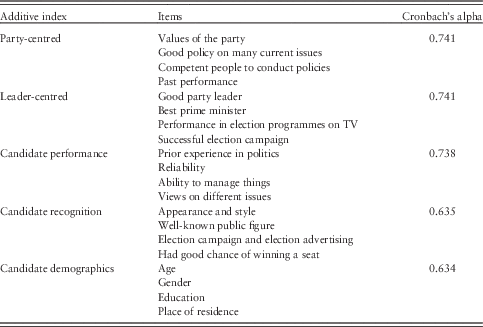
Our key independent variables were selected to assess the relative importance of party, party leader and district-level candidate decision cues for vote choice. First, two summary measures capturing party- and leader-centred voters were created, based on closed-ended questions on how decisive various factors were for the respondents’ choice of party. Using additive indices is more reliable than single indicators. To make the scores easier to interpret, the average of the four ordinal responses was calculated and set to range between 1 (not at all decisive) to 4 (decisive). The first summary measure (party-centred) reflected the decisiveness of a party’s collective competence, past performance, policy views and values. The second variable (leader-centred) incorporated first and foremost the quality of the party leader – good party leader and best candidate to become Prime Minister – but also successful election campaigning of the party and performance of the party’s representatives in election programmes on television (typically the party leader). Factor analysis confirmed that the eight items loaded highly on these two factors and levels of internal reliability (Cronbach’s Alpha) for the two scales were satisfactory (see Table 1).Footnote 2 This is in line with the personalization of politics thesis, which implies that there has been a shift of focus from collectives (parties) to individuals (party leaders) in terms of media coverage, the campaign strategies of parties and voter evaluations (see Karvonen, Reference Karvonen2010; Garzia, Reference Garzia2011). The Finnish parties nowadays place much emphasis on the image of leaders in campaigns: elections are often perceived as races for the post of Prime Minister and the skills of party leaders have become an important factor for vote choice (Paloheimo, Reference Paloheimo2003). Five television debates between the party leaders of four or eight largest parties took place during the campaign in 2011.
Additive indices

Party- and leader-centred evaluations based on the following question: ‘To what extent did the following influence your choice of party in these elections?’ Candidate evaluations based on the following question: ‘To what extent did the following influence your choice of candidate?’. Responses were recorded on a four-point ordinal scale: ‘Decisive factor in my choice’; ‘Rather a lot’; ‘Somewhat’; and ‘Not at all’. Cronbach’s alpha is a measure of internal consistency among items (N=963).
Second, motives for candidate choice were, as above, summary measures of district-level candidate trait evaluations. These evaluations of district candidates are clearly distinct from party leader evaluations both conceptually and empirically (low observed correlations). Twelve candidate-centric decision cues formed three central and distinct dimensions: candidate performance, candidate recognition, and candidate demographics (see Table 1).Footnote 3 The first dimension involved the importance of a candidate’s ability to manage things, reliability, experience, and views on issues. These fall mainly within the category of performance-related criteria as voters evaluate candidates (Ohr and Oscarsson, Reference Ohr and Oscarsson2011). The second dimension captured less cognitively demanding decision-making strategies related to name recognition and candidate viability (Lau and Redlawsk, Reference Lau and Redlawsk2006; Kam and Zechmeister, Reference Kam and Zechmeister2013). These evaluations included the candidates’ likelihood of getting elected, successful election campaigning, appearance and style, and public profile. The third dimension was based on personal stereotypes in terms of age, gender, education, and place of residence. Such voters prioritize candidates with similar demographic traits or use traits as stereotypes to identify qualified candidates (Lau and Redlawsk, Reference Lau and Redlawsk2006).
Third, party and party leader evaluations were based on 11-point feeling thermometer ratings. The respondents were first asked to rate each of the eight parties in parliament on a scale from 0 (strongly dislikes) to 10 (strongly likes). In another battery of questions, the respondents rated the eight party leaders. Both party and party leader evaluations were operationalized as the deviation from the respondent’s mean. A positive value denoted that a specific party (or party leader) was rated more positively than all the parties (or party leaders) on average. As suspected, the party and party leader scores are highly correlated with coefficients (Pearson’s r) ranging between 0.66 and 0.85 for the eight parties and party leaders. Incidentally, the highest correlation is recorded for the True Finns party and its party leader Timo Soini. We calculated tolerance (P about 0.24) and variance inflation factor values (around 4) and the results indicated no severe collinearity problem. Yet we chose to enter party and party leader evaluations in a stepwise manner when predicting the True Finns vote.
Fourth, intra-party competition measured competition between candidates within a party in a given electoral district. The variable was operationalized as the effective number of candidates on a particular party list using the formula N=1/∑ p i 2 p i denotes the i th candidate’s fraction of the party’s list share. A low value indicates that the votes are concentrated on a smaller number of strong candidates within a party, while a high value implies that votes are split across many competing candidates. The scores for the effective number of candidates in Finland were obtained from Arter (Reference Arter2013). Two intra-party competition variables were used: (1) party scores for each of the eight main parties across all electoral districts and (2) district means by computing the average of the intra-party competition scores for all parties within each of the 14 electoral districts. Controlling for the effect of the district mean of intra-party competition is vital for obtaining meaningful results (i.e. variability around the district mean). Our data show that the larger the number of seats in a district, the greater the dispersion of votes between candidates within a party. The number of seats across the electoral districts in Finland varies between 6 and 35 (M=14.2, std. dev.=7.8).
Finally, we also included independent variables to control for the possible influence of sex (1=male, 0=female), age (divided by 10) and its squared term, education (low, medium, and high), left-right position (0=left, 10=right) and its squared term to account for people closer to the middle of the ideological scale.
Results
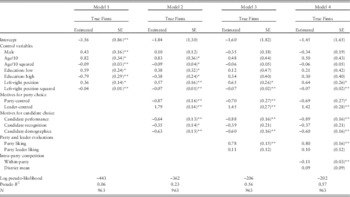
In the multivariate analyses, we investigated party, leadership and district-level candidate effects on the populist vote choice in Finland in 2011. In Table 2, we applied ordinary logistic regression for dichotomous responses (1=True Finns vote, 0=otherwise).Footnote 4 Cluster-robust standard errors were used to account for the clustering of observations at the level of the electoral district, which could violate the independence assumption of the logistic statistical models and lead to understated standard errors and overstated statistical significance. Four blocks of variables were entered into the regressions chronologically so that background variables were controlled prior to the entry of party, party leader, and candidate evaluations: (1) demographic variables and political orientation; (2) decision-making cues; (3) party and party leader likability; and (4) intra-party competition. Descriptive statistics of the variables are listed in the Appendix.
Explaining the True Finns (PS) vote: logistic regression

Model estimates are presented as logit coefficents with their robust standard errors in parentheses. The dependent variable is binary: 1=voted for the True Finns; 0=voted for any other parliamentary party.
**P<0.01; *P<0.05.
Model 1 in Table 2 included socio-demographic factors and position on the left-right ideological scale. Even though the pseudo R 2 value was relatively low (0.06), the directions of the coefficients were as expected. Being male, middle-aged, less educated and on both sides of the middle of the left-right scale predicted the populist vote. In the subsequent regression models, with the introduction of evaluations of the political objects, the effects of the demographic variables vanished while being in the middle of the scale (5) increased in importance.
Model 2 introduced the use of various decision-making cues. The goodness-of-fit was improved, as shown by an increase in the pseudo R 2 value (from 0.06 to 0.23). Voters whose party choice was highly influenced by positive assessments of the party leader (leader-centred motives) were more likely to vote for the True Finns than any other party. The variable was an index variable (1 to 4) composed of four indicators (good party leader, best candidate to become Prime Minister, successful election campaigning, and performance of the party’s representatives in election programmes on television). The log odds of voting for the True Finns increased by 1.79 for a one-unit increase in the index score (P<0.01), all else equal. If the coefficient is transformed to an odds ratio (=β e ), for a one-unit change in the variable, the odds of voting for the True Finns were six times the odds of voting for another party. In contrast to leader-centred motives, the factor scores capturing evaluations of party characteristics and district-level candidate traits were negatively related to voting for the True Finns. Finnish populist voters were apparently less concerned about the competence, performance, policy views, and values of parties than other voters. For a one-unit increase in the party-centred index score, there was a 0.87 point decrease in the log odds of the populist vote (P<0.01). This corresponds to a 58% decrease in estimated odds (100% (1−OR)). In terms of district-level candidates, the log odds of voting for the True Finns decreased by a factor of about 0.6 for a one-unit increase in reliance on candidate performance and demographics. Candidate recognition did neither predict the True Finns vote.
Model 3 included party and party leader approval measures, which can be regarded as very proximate to vote choice, as indicated by a substantial increase in the pseudo R 2 value (from 0.227 to 0.561). The coefficients for decision cues regarding party-centred and leader-centred motives were reduced by a fifth but remain relatively large. With regard to party approval, if the voter rated the True Finns party one point higher than the parties on average on a scale from 0 to 10, the log odds of voting for the party increased by 0.78 units (odds ratio=2.2) relative to voting for another party (P<0.01). On the other hand, if the party leader Timo Soini was rated higher than the other party leaders, the respondents were not as likely to vote for the party since the logit coefficient was very close to zero when controlling for party rating in particular.
Model 4 added intra-party competition within the True Finns Party for each district (together with the district mean). There was some indication that the True Finns party was more successful in districts where intra-party competition was low. The log odds of a True Finns vote decreased by a factor of 0.11 for every 1 unit increase in the effective number of candidates within the party at the district level (P<0.01), which corresponds to a 10% reduction in the estimated odds ratio, other things equal. Introducing the intra-party competition variables did not add much additional explanatory power as indicated by only a small change in the goodness-of-fit deviance statistics.
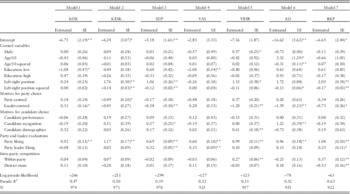
The results in Table 3, which model voting for any of the seven other major parties in Finland, confirm that True Finns voters differ from the supporters of all other mainstream parties in terms of their use of decision-making cues. The reason why the coefficients are mostly non-significant when vote choice for any other party is the dependent variable is that voters of mainstream parties are very similar in terms of party-, party leader- and candidate-based voting. First, leader-centred decision making was prevalent among True Finns voters (Table 2), while the coefficients for the same variable when predicting voting for other parties were negative or non-significant (Table 3). Second, in terms of party-centred decision making, the coefficients were non-significant, while they were negative and statistically significant when predicting the populist vote. Third, evaluating district-level candidates appears to have been equally important among mainstream party voters since the coefficients were in general low, while they were negatively correlated with the True Finns vote. Finally, intra-party competition appears to be a poor predictor in general. Only among voters of the Green League and the Swedish People’s Party did higher intra-party competition at the district level appear to correlate with a greater probability of voting for these parties.
Explaining voting for parliamentary parties: logistic regression

Model estimates are presented as logit coefficents with their robust standard errors in parentheses. The dependent variables are binary and capture whether (1) or not (0) the respondents voted for any of the seven parties in parliament: National Coalition Party (KOK), Center Party (KESK), Social Democratic Party (SDP), Left Alliance (VAS), Green League (VIHR), Christian Democrats (KD) and Swedish People’s Party (RKP).
**P<0.01; *P<0.05.
Discussion and concluding remarks
We explored to what extent party, party leader, and district-level candidate evaluations affected the populist right-wing vote in the 2011 parliamentary elections in Finland. Our results first and foremost show that being guided by the characteristics of the party leader is a much stronger predictor of the True Finns vote than being affected by party or district-level candidate characteristics. The perceived competence and image of the party leader was more important for True Finns voters than other voters, while performance assessments and programmatic evaluations of the party were of much less importance. In fact, a respondent’s emphasis on party characteristics leads to a lower probability of voting for a right-wing populist party.
This goes against the finding that a more positive rating of the True Finns party on an 11 point like/dislike scale is a stronger predictor of a True Finns vote than party leader approval on an identical scale. The same applies for every party in our data, as well as generally in studies of party leader effects in parliamentary democracies. Possible explanations are that traditional party and party leader approval ratings bear too much resemblance to responses about vote choice and that there is a reciprocal or mutually reinforcing relationship. In contrast, measures of the use of information cues about party characteristics and party leader traits may reveal underlying considerations of vote choice. It indeed seems that the uncertainty in academic debate about the impact of leaders on the electoral fortunes of parties has much to do with problems of measurement and conceptualization, as illustrated already in the study by Bittner (Reference Bittner2011).
The absence of strong party-based voting based on programmatic priorities or competence concerns is probably reflected by the fact that most of the party’s supporters were party switchers who had abandoned many different parties located across the left-right ideological spectrum. The largest share, 27%, reported they had voted for the Social Democrats in 2007 according to the FNES. Furthermore, at least 14% of the True Finns voters in 2011 had not voted in 2007. With regard to individual True Finns candidates, most were newcomers to politics and were attracted to the party since its popularity in opinion polls had been on the rise after the 2007 elections and it thus offered a realistic prospect of victory. The only thing that was not new was the party leader. Indeed, it seems that despite beginning the process of party institutionalization of the True Finns at the grassroots, their electorate still rely strongly on the personal characteristics of the party leader Timo Soini as a decision cue for their vote choice.
Neither decision-making cues related to the importance of district-level candidates nor high intra-party competition predicted the right-wing populist vote in Finland. Quite the contrary, True Finns voters did not put much emphasis on the quality of individual candidates at the district level. With regard to intra-party competition, the True Finns party was more successful in districts where intra-party competition was low, which would imply that the existence of either magnet candidates or locally well-known candidates fuelled their success.
The True Finns party is growing fast, illustrated by the fact that almost 40% of its members joined the party in the past 2 years (Niiranen, Reference Niiranen2013). Thus, the former ‘Finnish exception’ seems to offer a vantage point for political scientists to observe an institutionalization process of a strongly centre-directed populist right-wing party and how this process affects the decision cues of the electorate. Furthermore, although recognizing the limitations related to a single case, the study should provide a starting point for comparative empirical studies wishing to analyse to what extent right-wing populist parties in general at different stages of institutionalization rely on party leadership, the party program and the strength of district-level candidates (for a detailed discussion on ‘charismatic party’ institutionalization and its implications, see Pedahzur and Brichta, Reference Pedahzur and Brichta2002). In the current populist right-wing literature, there is a substantial gap related to this topic and the importance of these determinants is often only discussed theoretically.
This study also opens up avenues for two theoretical discussions concerning the way party leadership, candidate selection, and party ideology are intertwined and interact in right-wing populist voting. First, the impact of the personalization of politics and the institutional characteristics of the political system on the populist vote should be further examined. Overall we argue that there is a need to conduct research about the impact of the triad of factors on the populist vote in candidate-centred systems with open lists (e.g. Finland, Denmark, and Switzerland) or semi-open lists (e.g. Austria, Belgium, and Sweden), which allow voters to choose between individual candidates at the district level.
Second, as Wagner and Wessels (Reference Wagner and Wessels2012) point out, to increase the electoral fortunes of a party, the party leader should be an ideal representative of the party, a ‘fitting leader’, whose appearance and actions are in line with the pursued policy goals. Evidently, strong and charismatic leadership has often been considered a mobilizing factor for populist anti-establishment parties, or at least a catalyst for their success (Pedahzur and Brichta, Reference Pedahzur and Brichta2002; Wilcox et al., Reference Wilcox, Weinberg and Eubank2003). A successful right-wing populist party leader is not only able to keep the competing ideological fractions of the party together, but a concentration of power often enables the party to react rapidly to changing conditions in the political climate both inside and outside the party (Eatwell, Reference Eatwell2003). However, in the long run, competing factions often develop inside right-wing populist parties, and the leader may become ‘fitting’ for some but ‘un-fitting’ for others. Thus, an emphasis on candidates at the district level and intra-party competition may increase the power of competing factions inside the party and challenge the hegemony of the leader by reducing his control over the party platform and impact on electoral fortunes (thus also reducing the indirect effect of the leader).Footnote 5 In case a party seeks governmental responsibility, it is often forced to tone down its rhetoric and make compromises, which may further diminish the role of the populist leader conveying ‘the will of the people’ directly to the ‘political elite’. Sudden changes in the political and social environment may unpredictably emphasize the importance of one of the tendencies over another, which may put party unity into question if it is not rooted enough at the subnational level. On the other hand, as Caillaud and Tirole (Reference Caillaud and Tirole1999) point out, ideological bias may also generate a creative conflict with party leadership, which will eventually, with internal democracy, lead to stronger and better-designed party platforms. This will, however, require that the party organization and decision-making procedures are at least somewhat established.
Acknowledgements
The authors would like to thank David Arter and Hannu Nurmi as well as the anonymous reviewers for their valuable suggestions on an earlier version of the article.
Supplementary material
To view supplementary material for this article, please visit http://dx.doi.org/10.1017/S1755773913000283.