Introduction
Cognitive dysfunction is common in individuals with multiple sclerosis (MS), affecting as many as 40–65% of the MS population (Chiaravalloti & DeLuca, Reference Chiaravalloti and DeLuca2008). There is growing evidence that in addition to these traditional domains of cognitive dysfunction, individuals with MS also have impaired social cognition, specifically emotional processing (Kraemer et al., Reference Kraemer, Herold, Uekermann, Kis, Daum, Wiltfang and Abdel-Hamid2013; Phillips et al., Reference Phillips, Henry, Scott, Summers, Whyte and Cook2011; Prochnow et al., Reference Prochnow, Donell, Schäfer, Jörgens, Hartung, Franz and Seitz2011) and Theory of Mind (ToM) (Henry et al., Reference Henry, Phillips, Beatty, McDonald, Longley, Joscelyne and Rendell2009; Mike et al., Reference Mike, Strammer, Aradi, Orsi, Perlaki, Hajnal and Illes2013). Individuals who are impaired in emotional processing and ToM may have difficulty understanding subtle nuances of social interaction, including the understanding of conversation inference, which may take the form of hints, lies, and sarcasm (McDonald, Flanagan, Rollins, & Kinch, Reference McDonald, Flanagan, Rollins and Kinch2003). The current study examined the ability of individuals with MS to understand and interpret conversational inference.
Many studies examining social cognition and emotional processing in MS have used stimuli which are “static” (i.e., photographs of varying facial expressions) (Henry et al., Reference Henry, Phillips, Beatty, McDonald, Longley, Joscelyne and Rendell2009). However, given that situations in which social cognition is needed are dynamic (changing quickly), and are subject to individual differences (McDonald et al., Reference McDonald, Flanagan, Rollins and Kinch2003), there is a need to investigate social cognition in MS using new tools which better mimic real-life social situations. In the current study, we examined the performance of individuals with MS on a task encompassing several areas of social cognition using “dynamic,” or video, format: The Awareness of Social Inference Test (TASIT) (McDonald et al., Reference McDonald, Flanagan, Rollins and Kinch2003). The TASIT assesses social cognition and ToM by means of visually dynamic stimuli (video-taped vignettes) (McDonald et al., Reference McDonald, Bornhofen, Shum, Long, Saunders and Neulinger2006, Reference McDonald, Flanagan, Rollins and Kinch2003). Specifically, the TASIT assesses the ability to understand conversational inference such as the use of lies or sarcasm. The inability to understand sarcasm and lies would likely lead to misunderstandings and social conflict, and thus is an important topic to understand in clinical populations with social cognition impairments (Kipps, Nestor, Acosta-Cabronero, Arnold, & Hodges, Reference Kipps, Nestor, Acosta-Cabronero, Arnold and Hodges2009; McDonald, Darke, Kaye, & Torok, Reference McDonald, Darke, Kaye and Torok2013).
Based on the previous findings that individuals with MS are impaired on tasks of emotional processing and ToM, we hypothesized that individuals with MS would also be impaired on the interpretation of lies and sarcasm using the TASIT. Furthermore, we hypothesized that performance on the TASIT would be correlated with cognitive abilities such as processing speed and working memory.
Methods
The current study included 30 participants: 15 healthy controls and 15 individuals with MS. All research was conducted in accordance with the Helsinki Declaration, including informed consent. MS participants were diagnosed with clinically definite MS according to the McDonald criteria (Polman et al., Reference Polman, Reingold, Banwell, Clanet, Cohen, Filippi and Wolinsky2011). Ten of the MS participants were classified with relapsing-remitting MS, 2 with primary-progressive MS, 2 with secondary-progressive MS and 1 with progressive-relapsing MS. Participants were excluded if they had a history of diagnosed psychological and psychiatric problems (including schizophrenia, bipolar disorder, or depression resulting in patient hospitalization), epilepsy, learning/developmental disability, diagnosis of substance abuse/dependence, brain injury or episodes of loss of consciousness (lasting 30 or more min). We also excluded any participant with MS who experienced an exacerbation within a month before testing or who were taking corticosteroids. The average time since MS diagnosis was 17.98 years (±10.3 SD).
The two groups did not differ significantly on years of education (MHC=14.7, SDHC=2.3 years; MMS=15.0, SDMS=1.8 years; t(28)=.450; p=.656; d=−0.15). The MS group was significantly older (49.5±8.0 years) than the HC group (38.9±13.1 years), (t(23.1)=2.663; p=.014; d=0.98). The groups were also significantly different in gender composition, with the MS group having significantly more females (11/15 females) compared to the HCs (5/15 females), χ2=4.821, p=.028. When appropriate (see analysis section for details), gender and age were added as covariates in the analysis.
Measures
Social cognition
TASIT
The TASIT (see McDonald et al., Reference McDonald, Flanagan, Rollins and Kinch2003 for information on reliability and validity) assesses social cognition and ToM by means of brief vignettes portrayed by actors. The test is comprised of three different parts (Part 1: The Emotion Evaluation Task; EET; Part 2: Social Inference-Minimal Test; SI-M; Part 3: Social Inference-Enriched; SI-E). For the purposes of the current study in which the focus is on the ability to understand sarcasm and lies through conversational inference, only SI-E was administered and analyzed as it focuses on these two abilities. During Part 3 (SI-E), the subject is shown sixteen 15- to 60-s videos. Eight vignettes contain a form of a “white lie” (in which an actor does not literally mean what he/she says to spare the other person’s feelings), while the other eight vignettes are sarcastic items, in which the actors mean the opposite of what they are literally saying, but they intend for their audience to know that. External cues are provided in all vignettes which the subject must use to discern the actual truth. At the end of each trial, the subject is asked to answer four probe questions that assess the ability to recognize what the speaker (who is telling a lie or using sarcasm) is doing (“Do” condition), trying to say (“Say” condition), thinking (i.e., their underlying belief throughout the exchange; “Think” condition), and feeling throughout the exchange (“Feel” condition). Appropriate responses are “yes,” “no,” and “don’t know.” The subject receives one point for each correctly-answered question. Scores are grouped by each of the four questions (“Do,” “Say,” “Think,” and “Feel”), creating a maximum of 16 points for each question type. For the current study, the dependent variables were: Total-Do, Total-Say, Total-Think, and Total-Feel (each collapsed across Lie and Sarcasm conditions), as well as Total (Lie + Sarcasm), which was the total score collapsed across all variables.
Neuropsychological Measures
The following tests were administered to assess premorbid IQ (Vocabulary Test of the WASI-II), working memory (Digit Span subtest of the WAIS-IV), processing speed (Symbol Digit Modalities Test; SDMT), attention (Paced Auditory Serial Addition Task; PASAT), and learning/memory (California Verbal Learning Test; CVLT).
WASI-II vocabulary (Wechsler, Reference Wechsler2011)
Subjects are read a total of 31 words which increase in difficulty and are asked to explain what each word means. The total score is the sum of the scores for each correctly defined word.
WAIS-IV Digit Span (Wechsler, Reference Wechsler2008)
Subjects are asked to repeat back strings of numbers. The test has three conditions: (1) Forward (digits repeated in the same order), (2) Backward (digits repeated in reverse order), (3) Sequencing (digits repeated in numerical order). Total accuracy score was used as the dependent variable.
Symbol Digit Modalities Test (SDMT) – oral version (Smith, Reference Smith1982)
A reference key of numbers and corresponding geometric designs is shown. Using the reference key, subjects must verbally pair each geometric design for 90 s on a page of geometric designs with blank spaces under each design. The sum of the correct responses is calculated to generate an accuracy score, which was used in the current study.
California Verbal Learning Test 2nd Edition (Delis, Kramer, Kaplan, & Ober, Reference Delis, Kramer, Kaplan and Ober2000)
A list of 16 words from four semantic categories presented orally over five trials. At the end of each trial, the subject is asked to repeat as many words as they can remember. Total words recalled in Trials 1–5, as well as short-delayed free recall (SDFR) and long-delayed free recall (LDFR) were used as the dependent variables for this measure.
PASAT (Rao, Leo, Haughton, St Aubin-Faubert, & Bernardin, Reference Rao, Leo, Haughton, Aubin-Faubert and Bernardin1989)
The subject listens to a set of numbers read aloud via compact disk to control the rate of stimulus presentation. Single digits are presented first 3 s apart and then 2 s apart in the next trial. The subject must add each new digit to the one immediately before it. The dependent variable in the current study is the number of correct sums given (out of 60 possible) on the 3-s trial.
Analysis
Covariates
To determine whether age and gender should be used as covariates for all variables (both TASIT and Neuropsychological Tests), several analyses were performed. For age, Pearson correlations were run to determine whether age correlated with test variables. Age significantly correlated with SDMT (r=−.569; p=.001) (younger age was correlated with better performance) and was thus used as a covariate in determining group differences on that variable. To determine whether gender should be used as covariate, t tests and Mann Whitney U tests were run to determine whether males and females differed on the performance of any test variables (Mann Whitney U was used when data were not normally distributed). Gender differences were observed on WAIS-IV Vocabulary (t(28)=−2.167; p=.039) with males (M=40.3; SD=6.3) performing better than females (M=34; SD=9.1); thus, gender was entered as a covariate using analysis of covariance to determine group differences on that variable. Determination of group differences on all other variables was analyzed using t tests.
Correlations between TASIT variables and neuropsychological scores were analyzed using one-tailed Pearson correlation, to test our a priori hypothesis that better performance on the SI-E TASIT would be associated with better neuropsychological performance.
Results
Group Differences on the TASIT-Part 3
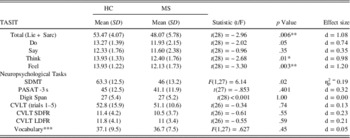
The t-tests revealed group differences on several variables of the SI-E form of the TASIT (Table 1), including Total (Lie and Sarcasm), Total-Think, and Total-Feel, in that the MS group performed significantly worse than the HC group on all of these variables. A group difference in Total-Do was marginally significant (p=.05).
Group differences on The Awareness of Social Inference Test (TASIT) and cognitive variables

* p<.05.
** p<.001.
*** Gender differences were observed on WAIS-IV Vocabulary (t(28)=−2.167, p=.039 with males (M=40.3, SD=6.3) performing better than females (M=34, SD=9.1).
The t-tests were used for all variables, except those which required covariate of age or gender (see methods section for details). In those cases, analysis of covariance was used.
TASIT=The Awareness of Social Inference Test; SDMT=Symbol Digit Modalities Test; PASAT=Paced Auditory Serial Addition Task; CVLT=California Verbal Learning Test; SDFR=Short Delay Free Recall; LDFR=Long Delay Free Recall.
Group Differences on Neuropsychological Measures:
Group differences were only observed on one neuropsychological measure, the SDMT (MS group performed significantly worse than HCs, see Table 1).
Correlations with Neuropsychological Measures
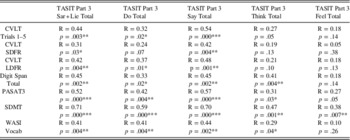
Correlations were run in the MS group only, as the purpose of the current study was to explore the relationship between TASIT performance and cognitive abilities in persons with MS (Table 2). Briefly, the TASIT variables correlated with all cognitive tests, in a consistent direction: better TASIT performance correlated with better neuropsychological test performance.
Correlations between The Awareness of Social Inference Test (TASIT) variables and neuropsychological test performance

* p<.05.
** p<.01.
*** p<.001.
TASIT=The Awareness of Social Inference Test; SDMT=Symbol Digit Modalities Test; PASAT=Paced Auditory Serial Addition Task; CVLT=California Verbal Learning Test; SDFR=Short Delay Free Recall; LDFR=Long Delay Free Recall.
Discussion
The purpose of the current pilot study was to examine the performance of individuals with MS on a task of social cognition: the Social Inference-Enriched subtest of the TASIT. The results indicate that the MS group was significantly impaired on the interpretation of lies and sarcasm compared to HCs, with differences being observed on the “think” and “feel” probe questions, as well as the total scores. The “think” and “feel” probes specifically assess one’s ability to understand what others may know or believe, even if that knowledge or feeling is not obvious. This ability (to understand that one person may have a belief or knowledge that others do not share or have awareness of) is strongly linked to ToM, which has been observed to be impaired in MS. These impairments also significantly correlated with cognitive abilities.
The findings that the MS group was impaired on a task involving the perception of lying indicates that individuals with MS may have difficulty in understanding the subtle nuances of social situations involving deception. These findings replicate what has been found in a study by Ouellet et al. using the “Strange Stories” task (Ouellet et al., Reference Ouellet, Scherzer, Rouleau, Métras, Bertrand-Gauvin, Djerroud and Duquette2010). In this study, it was reported that individuals with MS demonstrated impaired comprehension of written vignettes portraying “white lies” and “irony.” Our findings indicate that dynamic tests of deception interpretation may be useful in assessing this area of social cognition.
The findings also indicated that the MS group was impaired on various aspects of understanding sarcasm. Sarcasm is commonly used in social situations, but it is only successful if both the speaker and listener understand the truth (as opposed to a lie, in which only the speaker understands the truth). Our findings indicate that persons with MS are impaired in understanding the intentions or feelings of the speaker (as indicated by their impairments on the Total-Think and Total-Feel variables). This may possibly lead to significant miscommunication in situations in which sarcasm is being used. Although no studies to our knowledge have examined the ability to interpret sarcasm in MS, these findings are further consistent with previous studies of impaired ToM in MS (Henry et al., Reference Henry, Phillips, Beatty, McDonald, Longley, Joscelyne and Rendell2009).
The ability to understand lies and sarcasm correlated positively with all of the cognitive variables, including premorbid IQ, memory and learning, processing speed, and working memory. Thus, it appears that cognition (assessed by traditional neuropsychological variables) and social cognition are linked in the current study. Of interest, the MS sample was not impaired on any cognitive variable expect the SDMT. There have been inconsistencies in the literature regarding the relationship between cognitive performance and social cognition in MS, with some studies showing that only persons with MS with cognitive impairment had deficits in social cognition (Ouellet et al., Reference Ouellet, Scherzer, Rouleau, Métras, Bertrand-Gauvin, Djerroud and Duquette2010). Others have shown that social cognition impairments in MS remain after controlling for neuropsychological performance (Pöttgen, Dziobek, Reh, Heesen, & Gold, Reference Pöttgen, Dziobek, Reh, Heesen and Gold2013). Thus, an interesting avenue of future research would be to examine TASIT performance in individuals with MS who are impaired across different cognitive domains, as we might expect an even stronger relationship between cognitive abilities and TASIT performance.
Interestingly, better premorbid IQ is associated with better performance on the TASIT. This finding is consistent with previous research indicating higher cognitive abilities are associated with better social cognition (Mathersul et al., Reference Mathersul, Palmer, Gur, Gur, Cooper, Gordon and Williams2009). Additionally, premorbid IQ has been reported to be associated with cognitive reserve in MS, in that individuals who have more brain resources at the start of the disease show symptoms later and to a lesser degree than those with low brain reserve (Sumowski, Chiaravalloti, Wylie, & Deluca, Reference Sumowski, Chiaravalloti, Wylie and Deluca2009). The role of cognitive reserve in protecting against cognitive dysfunction is well-known (Sumowski & Leavitt, Reference Sumowski and Leavitt2013); however, it has not been explored in the realm of social cognition. This study may represent an important step in the examination of how cognitive reserve moderates the effects of neuropathology on the social aspects of cognition.
One limitation of our study was the small sample size. In addition, our sample of HCs were not age and gender matched to our MS group, a significant limitation. Additionally, we did not asses depression in the current study, which may have helped to explain our findings (depression is more common in MS, and individuals with depression have greater difficulty in some aspects of social cognition). However, despite these limitations, the results of the current study represent an important first step in understanding difficulty in interpretation of conversational inference in individuals with MS. Research involving larger samples and matched groups is clearly warranted.
This study is the first, to our knowledge, to use the TASIT to examine higher order social cognition deficits in individuals with MS, specifically in the domains of understanding lies and sarcasm. The correlation of these deficits with cognitive tests, including premorbid IQ, enables us to begin to understand the relationship between cognitive processes typically impaired in MS, and how they relate to ToM and understanding social situations. Additionally, our findings may indicate a new role for cognitive reserve and its importance in protecting the brain from deficits in emotional processing. With the support of future studies, these data may be important in understanding everyday life social impairments in individuals with MS, which may lead to a host of negative consequences including interpersonal issues, social isolation, and emotional issues, such as depression.
Acknowledgments
The authors thank Dr. Jeffrey Zhang for statistical advice. The authors have no financial interests to disclose. This research was supported by a pilot grant funded by the Consortium of Multiple Sclerosis Centers, entitled “Remediation of Emotional Processing Deficits in MS.”