





Introduction
Hypofractionated radiotherapy has become a standard treatment option for localized prostate cancer, supported by multiple randomized phase III trials demonstrating noninferior biochemical control and survival compared with conventional fractionation. Reference Hickey, James, Daly, Soh and Jeffery1–Reference Incrocci, Wortel and Alemayehu4,Reference Avkshtol, Li and Hallman20,Reference Aluwini, Pos and Schimmel21 Consequently, moderate hypofractionation has been widely adopted in routine clinical practice and is increasingly favoured across a broad range of risk groups.
Despite this widespread adoption, patient selection for hypofractionated prostate radiotherapy remains largely guided by anatomical considerations and adherence to dose–volume constraints. Genitourinary (GU) toxicity is among the most clinically relevant adverse effects of prostate radiotherapy and represents a major determinant of long-term quality of life. Reference Michalski, Winter and Purdy5,Reference Tucker, Dong and Cheung6,Reference Sanmamed, Dayes and Catton18,Reference Arcangeli, Saracino and Arcangeli19 Prior investigations have predominantly focused on dose–volume relationships and treatment technique as predictors of GU toxicity, often reporting inconsistent or modest associations, particularly in the contemporary era of image-guided radiotherapy. Reference Fiorino, Valdagni, Rancati and Sanguineti7,Reference Barry, Fowler and O’Leary8
The International Prostate Symptom Score (IPSS) is one of the most widely used instruments for evaluating lower urinary tract symptoms in urologic practice. It is routinely used for the assessment of benign prostatic hyperplasia, treatment response and symptom monitoring. Despite its widespread use in urology, integration of IPSS into radiotherapy decision-making and toxicity prediction models remains inconsistent. Baseline urinary symptom burden, most commonly assessed using the IPSS, is a validated patient-reported measure of lower urinary tract symptoms. Reference Barry, Fowler and O’Leary8 Although several studies have reported associations between baseline urinary symptoms and post-radiotherapy urinary outcomes, most were conducted in conventionally fractionated cohorts, single-institution populations or treatment eras preceding contemporary image-guided hypofractionated radiotherapy. Consequently, whether baseline IPSS retains independent predictive value beyond modern dosimetric parameters in routine hypofractionated practice remains uncertain. If baseline urinary function independently predicts late toxicity, incorporation of IPSS into treatment selection and patient counselling could provide a simple, low-cost and widely available strategy for individualized risk assessment.
With the increasing emphasis on patient-reported outcomes in radiation oncology, there is growing recognition that baseline functional status may capture aspects of normal tissue vulnerability not adequately reflected by dosimetric parameters alone. Reference Fiorino, Valdagni, Rancati and Sanguineti7–Reference Zhu, Joseph and Sidhom9 This limitation may be particularly consequential in the hypofractionated setting, where higher dose per fraction places increased biological stress on late-responding normal tissues; under such conditions, baseline functional reserve—rather than dose exposure alone—may play a critical role in determining individual susceptibility to clinically meaningful late toxicity.
In the modern era, the clinically relevant question is not whether baseline IPSS can be associated with urinary toxicity in general, but rather how pre-treatment urinary symptom burden should inform risk stratification, treatment planning and patient counselling specifically in the context of contemporary hypofractionated prostate radiotherapy. Addressing this question requires evaluation in modern cohorts treated with image-guided techniques and within heterogeneous, real-world clinical practice settings, where variability in planning approaches, fractionation schemes and adjunctive therapies reflects routine care rather than protocol-restricted trial conditions.
Accordingly, a multi-institutional retrospective analysis was conducted to evaluate the association between baseline IPSS and GU toxicity following hypofractionated external beam radiotherapy for localized prostate cancer. The specific aim was to determine whether baseline urinary symptom burden independently identifies the risk of late GU toxicity beyond conventional bladder dosimetry in a contemporary, real-world cohort, thereby clarifying the practical clinical role of IPSS in hypofractionated treatment selection and patient counselling.
Methods
Study design and patient population
This multi-institutional retrospective study included patients with histologically confirmed localized prostate cancer treated with definitive hypofractionated external beam radiotherapy at participating centres within a national radiation oncology collaborative group. The multi-institutional design was deliberately chosen to capture contemporary real-world clinical practice rather than protocol-restricted trial populations, thereby enhancing generalizability.
Eligible patients received moderate hypofractionation using contemporary radiotherapy techniques. Patients with prior pelvic radiotherapy or incomplete toxicity follow-up were excluded. Institutional review board approval was obtained at each participating centre in accordance with local regulations.
Radiotherapy treatment
All patients were treated with moderate hypofractionation, with a median of 20 fractions (range, 20–28) and fraction sizes of 2.5–3.0 Gy. Target volume delineation, treatment planning and image guidance followed institutional standards consistent with contemporary prostate radiotherapy guidelines, and all centres adhered to accepted dose constraints and routine quality assurance procedures.
Androgen deprivation therapy (ADT) was prescribed at the treating physician’s discretion according to disease risk and institutional practice; this pragmatic, non-protocol-mandated approach was intended to reflect real-world decision-making.
Baseline urinary symptom assessment
Baseline urinary symptom burden was evaluated using the IPSS at the time of radiotherapy referral, prior to treatment initiation. Baseline IPSS was available for 156 patients, and all analyses involving IPSS and toxicity outcomes were restricted to this predefined analytic cohort.
Patients with and without documented baseline IPSS had comparable clinical characteristics, treatment parameters and follow-up duration, suggesting minimal selection bias related to IPSS availability. Restricting analyses to patients with documented baseline IPSS prior to radiotherapy minimized misclassification and ensured temporal separation between baseline assessment and subsequent toxicity.
Baseline IPSS was analysed as a continuous variable to preserve statistical power and avoid information loss associated with arbitrary categorization, while sensitivity analyses using alternative parameterizations were performed to confirm the robustness of the findings.
Toxicity assessment and follow-up
Acute and late GU and gastrointestinal (GI) toxicities were graded using radiation therapy oncology group (RTOG) criteria. Acute toxicity was defined as events occurring during treatment or within 90 days of radiotherapy completion and late toxicity as events occurring beyond 90 days, consistent with established radiotherapy toxicity reporting conventions. Reference Aluwini, Pos and Schimmel21 , Reference Heemsbergen, Incrocci and Vens22 Late-grade ≥2 GU toxicity was prespecified as the primary endpoint because grade 2 represents the first level of toxicity associated with clinically meaningful symptoms requiring medical intervention and having the potential to adversely affect quality of life. Examples include urinary frequency, dysuria or obstructive symptoms necessitating pharmacologic treatment or additional clinical management. Moreover, grade ≥2 toxicity has been widely adopted as a clinically relevant endpoint in prostate radiotherapy studies and reflects toxicity levels that may influence patient counselling, follow-up strategies and treatment decision-making. Reference Sanmamed, Dayes and Catton18–Reference Avkshtol, Li and Hallman20
Patients were followed at regular intervals per institutional practice. Prostate-specific antigen (PSA) was monitored for oncologic surveillance; however, the primary objective of the study was toxicity risk assessment rather than evaluation of oncologic outcomes.
Statistical analysis
Descriptive statistics summarized patient, disease and treatment characteristics. Associations between baseline IPSS, dosimetric variables and toxicity outcomes were examined using univariable and multivariable logistic regression models.
Multivariable models adjusted for clinically relevant covariates selected a priori based on biological plausibility and prior literature, including age, baseline PSA, ADT use and duration, and bladder dosimetric parameters. Given the limited number of late-grade ≥2 GU toxicity events, variables were selected according to clinical relevance and events-per-variable considerations, and multivariable models were intentionally restricted to a small number of prespecified covariates to minimize overfitting and ensure stability of effect estimates. Sensitivity analyses were performed to assess the robustness of the association between baseline IPSS and late GU toxicity using alternative model specifications and additional multivariable adjustments. Statistical significance was defined as a two-sided p-value < 0.05.
Results
Patient cohort and follow-up
A total of 509 patients treated with hypofractionated external beam radiotherapy were included for overall cohort characterization, of whom 494 were evaluable for toxicity outcomes. Baseline IPSS was available for 156 patients, constituting a predefined analytic cohort for all IPSS-based analyses. The median follow-up for the overall cohort was 42 months (range, 24–130 months).
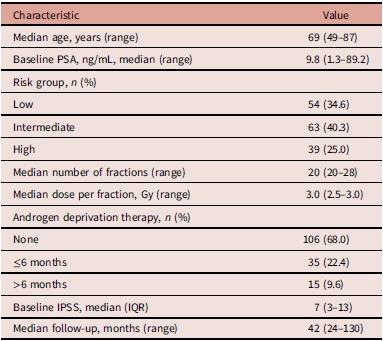
Baseline demographic, disease and treatment characteristics of the IPSS cohort are summarized in Table 1. Patients with and without available baseline IPSS had comparable baseline clinical characteristics and follow-up duration.
Baseline patient and treatment characteristics of the IPSS cohort (n = 156)

Table 1. Long description
A table summarizing baseline demographic, disease, and treatment characteristics of the IPSS cohort. The table has 11 rows and 2 columns. The columns are labeled Characteristic and Value. Row 1: Median age, years (range), 69 (49-87). Row 2: Baseline PSA, ng per m L, median (range), 9-8 (1-3-89-2). Row 3: Risk group, n (percent). Row 4: Low, 54 (34-6). Row 5: Intermediate, 63 (40-3). Row 6: High, 39 (25-0). Row 7: Median number of fractions (range), 20 (20-28). Row 8: Median dose per fraction, Gy (range), 3-0 (2-5-3-0). Row 9: Androgen deprivation therapy, n (percent). Row 10: None, 106 (68-0). Row 11: less than or equal to 6 months, 35 (22-4). Row 12: greater than 6 months, 15 (9-6). Row 13: Baseline IPSS, median (interquartile range), 7 (3-13). Row 14: Median follow-up, months (range), 42 (24-130).
Acute toxicity (overall cohort)
In the overall cohort, acute grade ≥2 GU toxicity occurred in 22.5% of patients, including grade 3 events in 1.6%. Acute grade ≥2 GI toxicity was observed in 10.4% of patients. Baseline IPSS showed only a weak association with acute GU toxicity and was not significantly associated with acute GI toxicity.
Late toxicity (overall cohort)
Late-grade ≥2 GU toxicity occurred in 3.7% of patients, the majority of which were grade 3 events (2.9%). Late-grade ≥2 GI toxicity occurred in 4.0% of patients.
Baseline IPSS and late GU toxicity (IPSS cohort)
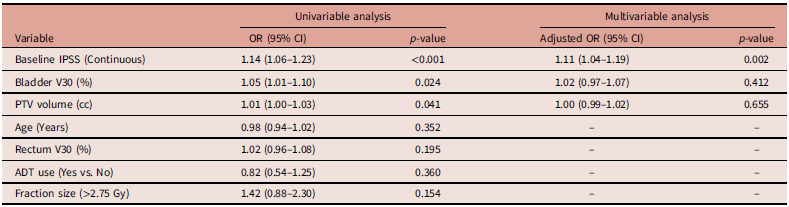
Within the predefined IPSS cohort (n = 156), higher baseline IPSS was significantly associated with an increased risk of late-grade ≥2 GU toxicity. In univariable analysis, baseline IPSS, bladder V30 and planning target volume (PTV) were associated with late GU toxicity (Table 2).
Univariable and multivariable logistic regression analysis of factors associated with late-grade ≥2 genitourinary toxicity in the IPSS cohort (n = 156)

Table 2. Long description
A table comparing factors associated with late-grade genitourinary toxicity in a cohort. The table has 8 rows and 5 columns. The columns are labeled Variable, Univariable analysis, Multivariable analysis, and p-value. The rows are labeled with different variables: Baseline IPSS (Continuous), Bladder V30 (percent), PTV volume (cc), Age (Years), Rectum V30 (percent), ADT use (Yes vs. No), and Fraction size (>2.75 Gy). Each row contains values for OR (95 percent CI), p-value, Adjusted OR (95 percent CI), and p-value. Row 1: Baseline IPSS (Continuous), OR (95 percent CI) 1.14 (1.06-1.23), p-value <0.001, Adjusted OR (95 percent CI) 1.11 (1.04-1.19), p-value 0.002. Row 2: Bladder V30 (percent), OR (95 percent CI) 1.05 (1.01-1.10), p-value 0.024, Adjusted OR (95 percent CI) 1.02 (0.97-1.07), p-value 0.412. Row 3: PTV volume (cc), OR (95 percent CI) 1.01 (1.00-1.03), p-value 0.041, Adjusted OR (95 percent CI) 1.00 (0.99-1.02), p-value 0.655. Row 4: Age (Years), OR (95 percent CI) 0.98 (0.94-1.02), p-value 0.352. Row 5: Rectum V30 (percent), OR (95 percent CI) 1.02 (0.96-1.08), p-value 0.195. Row 6: ADT use (Yes vs. No), OR (95 percent CI) 0.82 (0.54-1.25), p-value 0.360. Row 7: Fraction size (>2.75 Gy), OR (95 percent CI) 1.42 (0.88-2.30), p-value 0.154.
OR, Odds ratio; CI, confidence interval; IPSS, International Prostate Symptom Score.
In multivariable logistic regression adjusting for age and bladder dosimetric parameters, baseline IPSS was the only independent predictor of late-grade ≥2 GU toxicity (adjusted odds ratio [OR], 1.11 per point increase; 95% confidence interval [CI], 1.04–1.19; p = 0.002). Neither bladder V30 nor PTV volume remained independently associated with late GU toxicity in the multivariable model.
The association between baseline IPSS and late GU toxicity persisted among patients who met established bladder dose–volume constraints, indicating that baseline urinary symptom burden provides prognostic information beyond conventional dose–volume parameters.
Subgroup analyses showed a consistent direction and magnitude of effect for baseline IPSS across age groups, bladder dosimetry strata and fraction size. Formal interaction testing confirmed no statistically significant interaction for age (p = 0.735), bladder dosimetry (p = 0.115) and fraction size (p = 0.140), supporting consistency of the IPSS effect across subgroups. Although a statistically significant interaction with ADT use was observed (p = 0.024), the association remained directionally consistent and statistically significant in both subgroups (Figure 1). Baseline IPSS was not significantly associated with late GI toxicity.
Forest plot illustrating the association between baseline International Prostate Symptom Score (IPSS) and the risk of late-grade ≥2 genitourinary (GU) toxicity. The association between baseline IPSS and late GU toxicity remained directionally consistent across predefined subgroups, with no significant interaction observed for age, bladder dosimetry or fraction size. A statistically significant interaction was observed with androgen deprivation therapy (ADT) use, although the association between IPSS and late GU toxicity remained significant in both ADT-treated and untreated patients.

Figure 1. Long description
The image contains a forest plot illustrating the association between baseline International Prostate Symptom Score (IPSS) and the risk of late-grade ≥2 genitourinary (GU) toxicity across different subgroups. The plot includes overall data and subgroups based on age, androgen deprivation therapy (ADT) use, bladder dosimetry, and fraction size. The x-axis represents the odds ratio per 1-unit IPSS increase, ranging from 1.00 to 1.25. The y-axis lists the subgroups: Overall, < 70 years, ≥ 70 years, No ADT, Any ADT, Bladder V30 < 20 percent, Bladder V30 ≥ 20 percent, ≤ 2.75 Gy, and > 2.75 Gy. Each subgroup is represented by a blue dot indicating the odds ratio and a horizontal line representing the 95 percent confidence interval. The overall odds ratio is 1.11 (1.04-1.20). For age, the odds ratios are 1.13 (1.03-1.24) for < 70 years and 1.09 (1.01-1.18) for ≥ 70 years. For ADT use, the odds ratios are 1.15 (1.06-1.25) for No ADT and 1.08 (1.01-1.16) for Any ADT. For bladder V30, the odds ratios are 1.12 (1.04-1.21) for < 20 percent and 1.10 (1.02-1.19) for ≥ 20 percent. For fraction size, the odds ratios are 1.07 (0.99-1.16) for ≤ 2.75 Gy and 1.16 (1.07-1.28) for > 2.75 Gy. The p-interaction values are 0.735 for age, 0.024 for ADT use, 0.115 for bladder V30, and 0.140 for fraction size. The plot shows that the association between baseline IPSS and late GU toxicity remained directionally consistent across predefined subgroups, with no significant interaction observed for age, bladder dosimetry, or fraction size. A statistically significant interaction was observed with ADT use, although the association between IPSS and late GU toxicity remained significant in both ADT-treated and untreated patients.
Sensitivity analyses using alternative IPSS parameterizations and additional multivariable adjustments yielded similar results, confirming the robustness of the association between baseline IPSS and late-grade ≥2 GU toxicity.
Oncologic outcomes
During follow-up, biochemical relapse occurred in 12 patients (4%). No prostate cancer–related or treatment-related deaths were observed.
Discussion
This multi-institutional analysis demonstrates that baseline urinary symptom burden, quantified by the IPSS, is a robust and independent predictor of late GU toxicity following hypofractionated prostate radiotherapy. Importantly, this association remained statistically significant after adjustment for age and bladder dosimetric parameters, suggesting that baseline urinary function captures aspects of normal tissue vulnerability that are not reflected by conventional dose–volume metrics alone.
In contemporary prostate radiotherapy, toxicity risk stratification remains largely dose-centric, with substantial emphasis placed on adherence to dose–volume constraints derived from historical normal tissue complication probability models. Reference Tucker, Dong and Cheung6,Reference Fiorino, Valdagni, Rancati and Sanguineti7 While these parameters are essential for safe treatment delivery, the present findings suggest that dosimetric metrics alone may be insufficient to explain interpatient variability in late urinary toxicity. Bladder V30 and PTV were associated with late GU toxicity in univariable analyses but lost statistical significance in multivariable models, whereas baseline IPSS remained independently predictive. This pattern indicates that patient-specific biological susceptibility may play a more important role than dose exposure alone in determining late urinary toxicity risk, consistent with recent work highlighting the complexity of predicting urinary toxicity beyond standard dose–volume histograms in the era of high-precision radiotherapy. Reference Zhu, Joseph and Sidhom9
The persistence of the IPSS–toxicity association among patients who met established bladder dose constraints further supports this interpretation. In practical terms, a technically optimal treatment plan may still confer a clinically meaningful toxicity risk in patients with compromised baseline urinary function. Baseline IPSS therefore appears to capture elements of functional organ reserve that are not represented in dose–volume histograms, in line with emerging evidence that patient-reported baseline function predicts radiotherapy toxicity. Reference Sanda, Dunn and Michalski10,Reference Bentzen, Parliament and Deasy11
Notably, the association between baseline IPSS and toxicity was restricted to late GU events and was not observed for acute toxicity. Acute GU symptoms during prostate radiotherapy are typically transient and inflammatory, whereas late toxicity reflects more complex processes, including vascular injury, fibrosis and impaired tissue repair. Reference Zelefsky, Levin and Hunt12 The selective association with late, but not acute, toxicity supports a biologically plausible interaction between radiation exposure and pre-existing urinary vulnerability, rather than a simple amplification of transient inflammatory symptoms.
Previous studies have reported associations between baseline urinary symptoms and post-radiotherapy toxicity; however, much of this literature predates widespread adoption of hypofractionated radiotherapy or is limited to single-institution cohorts with relatively homogeneous techniques. Reference Kishan, Dang and Katz13–Reference Juarez and Kishan15 Consequently, the contemporary clinical relevance of baseline IPSS in modern hypofractionated practice has remained incompletely defined. This study extends prior observations by demonstrating the independent predictive value of baseline IPSS in a multi-institutional cohort treated with contemporary image-guided radiotherapy techniques.
These findings support a conceptual ‘double-hit’ model of late GU toxicity. In this framework, radiation dose represents the first insult, while baseline urinary dysfunction—captured by IPSS—constitutes a second vulnerability factor that modifies individual tolerance of the lower urinary tract to radiation exposure. Under this model, two patients receiving comparable dosimetric exposure may experience substantially different toxicity outcomes depending on their baseline urinary function.
Although a statistically significant interaction with ADT use was observed, the direction of the association between baseline IPSS and late GU toxicity remained consistent across both ADT-treated and untreated patients. Given the limited number of toxicity events and the exploratory nature of subgroup analyses, this finding should be interpreted cautiously and considered hypothesis-generating rather than definitive.
From a clinical standpoint, elevated baseline IPSS should not be interpreted as a contraindication to hypofractionated radiotherapy. Rather, it identifies a subgroup of patients who may benefit from individualized strategies. In such patients, planning priorities may be adjusted to further limit bladder dose exposure where feasible, particularly within intermediate dose regions such as bladder V30, and optimization of baseline urinary function prior to radiotherapy—including medical management with alpha-blockers or other lower urinary tract symptom interventions—may represent a pragmatic strategy to mitigate late toxicity risk. Patients with higher baseline IPSS may also benefit from closer post-treatment monitoring to enable earlier identification and management of urinary complications.
The multi-institutional design enhances the generalizability of these findings by reflecting routine clinical practice rather than protocol-restricted trial populations. Despite heterogeneity in treatment techniques, fractionation schemes and institutional planning approaches, the association between baseline IPSS and late GU toxicity remained consistent across sensitivity and subgroup analyses, supporting the robustness of the signal.
Limitations
This study has limitations inherent to its retrospective design. Baseline IPSS was not uniformly collected across centres, reflecting local documentation practices; however, patients with and without IPSS data had comparable baseline characteristics and follow-up, suggesting minimal selection bias.
Toxicity was graded using physician-reported RTOG criteria, which may underestimate patient-experienced burden; however, concordance between baseline patient-reported symptoms and physician-graded late toxicity supports the clinical and biological credibility of the association.
The absolute number of late-grade ≥2 GU events was low (3.7%), reflecting the favourable toxicity profile of contemporary image-guided hypofractionated radiotherapy and potentially limiting power to detect subtle dosimetric effects. Nonetheless, the consistency of the IPSS signal across multivariable, sensitivity and subgroup analyses supports the robustness of the association. The multi-institutional cohort size and median 42-month follow-up provide clinically meaningful insight into late toxicity risk in modern practice.
Prospective validation using standardized patient-reported outcomes and contemporary hypofractionated and ultra-hypofractionated regimens is warranted to refine IPSS-based risk stratification and define evidence-based thresholds for treatment adaptation. Until such data become available, routine baseline IPSS assessment represents a simple and readily implementable approach to support individualized toxicity risk assessment in contemporary prostate radiotherapy practice.
Clinical implications and conclusions
Baseline urinary symptom burden, quantified by the IPSS, is a robust, independent predictor of late GU toxicity after hypofractionated prostate radiotherapy, even when age and bladder dosimetry are taken into account. This association persists in patients meeting accepted bladder dose–volume constraints, indicating that baseline urinary function provides prognostic information beyond conventional dosimetric parameters.
These findings support routine incorporation of baseline IPSS into pre-treatment assessment for men considered for hypofractionated prostate radiotherapy. Rather than serving as a contraindication, elevated baseline IPSS identifies a subgroup at higher risk for late GU toxicity who may benefit from more intensive bladder-sparing planning, optimization of lower urinary tract symptoms (e.g., alpha-blocker therapy) and closer post-treatment surveillance. Incorporating patient-reported urinary function into decision-making represents a practical step beyond anatomy- and dose-based selection alone and can facilitate more personalized, function-informed hypofractionated treatment delivery and counselling. Routine incorporation of IPSS into pre-treatment workflows may also facilitate service-level quality improvement initiatives by enabling systematic identification of patients at increased risk for urinary toxicity.
Despite a low absolute rate of late-grade ≥2 GU events (3.7%), consistent with large phase III hypofractionation trials, the strength and stability of the IPSS signal across multivariable, sensitivity and subgroup analyses support its biological and clinical relevance. Prospective validation using standardized patient-reported outcomes and contemporary hypofractionated and ultra-hypofractionated regimens is warranted to refine IPSS-based risk stratification and to define evidence-based thresholds for treatment adaptation.
Data availability statement
The data presented in this study are available on reasonable request from the corresponding author due to institutional and patient privacy restrictions.
Acknowledgments
Not applicable.
Author contributions
Conceptualization, Z.A. and S.I.; methodology, Z.A.; formal analysis, Z.A.; investigation, Z.A., S.I., S.T.D., M.G., F.S., P.A., Z.G., N.K. and M.K.; data curation, Z.A.; writing – original draft preparation, Z.A.; writing – review and editing, all authors; supervision, S.I.; project administration, Z.A. All authors have read and agreed to the published version of the manuscript.
Financial support
This research received no external funding.
Competing interests
The authors declare no conflict of interest.
Institutional review board statement
The study was conducted in accordance with the Declaration of Helsinki and approved by the Institutional Review Boards of the participating centres.
Informed consent statement
Patient consent was waived due to the retrospective nature of the study.


 Open access

