INTRODUCTION
Biological pollution is a common phenomenon worldwide (Molnar et al., Reference Molnar, Gamboa, Revenga and Spalding2008). The alien species can negatively affect the native ones through predation and direct and indirect competition, can contaminate the native gene pool by the introduction of exotic genes (e.g. through hybridization), can diffuse parasites and pathogens and may modify ecosystem functioning and abiotic features of the environments (Strayer et al., Reference Strayer, Eviner, Jeschke and Pace2006). Thus, the prevention and control of alien species are a priority for conservation of biodiversity. Although marine introductions have been widely documented all over the world (Molnar et al., Reference Molnar, Gamboa, Revenga and Spalding2008), they are very conspicuous in the Mediterranean Sea, where the native fauna is more susceptible to alien pressure due to the higher number of vectors of introductions: transport on ship hulls and/or with ballast water; intentional (aquaculture) and accidental introductions accompanying intentionally introduced species; escape from aquaria; trade, market discards and, mainly, lessepsian migration through the Suez Canal, a pathway peculiar to the Mediterranean and one that has resulted in several hundred introduced species from practically all marine phyla (Galil, Reference Galil2009; Zenetos et al., Reference Zenetos, Gofas, Verlaque, Çinar, Garcia Raso, Bianchi, Morri, Azzurro, Bilecenoglu, Froglia, Siokou, Violanti, Sfriso, San Martin, Giangrande, Katağan, Ballesteros, Ramos-Esplà, Mastrototaro, Ocaña, Zingone, Gambi and Streftaris2010). Invasions seem to be also locally amplified by the effects of global warming, that favours the occurrence and establishment of warm water species in the Mediterranean Sea and increases the possibility of unexpected changes in faunal assemblages including the decline and even collapse of certain marine ecosystems (Bianchi, Reference Bianchi2007; Occhipinti-Ambrogi, Reference Occhipinti-Ambrogi2007; Raitsos et al., Reference Raitsos, Beaugrand, Georgopoulos, Zenetos, Pancucci-Papadopoulou, Theocharis and Papathanassiou2010).
Given the difficulties in stopping invasions, a careful analysis of the present situation may help to correctly understand the ongoing phenomenon. From 2005 to 2010, field data collected by the author, along with an extensive literature survey, revealed three new alien species from Italy (Crocetta, Reference Crocetta2005; Crocetta & Vazzana, Reference Crocetta and Vazzana2008; Crocetta & Turolla, Reference Crocetta and Turolla2011), reviewed the date of the first Italian record for three species (Crocetta et al., Reference Crocetta, Renda and Vazzana2009; Crocetta & Turolla, Reference Crocetta and Turolla2011) and defined more accurately the distribution of twelve species along the Italian territorial seawaters (Crocetta & Soppelsa, Reference Crocetta and Soppelsa2006; Crocetta et al., Reference Crocetta, Renda and Colamonaco2008, Reference Crocetta, Renda and Vazzana2009, Reference Crocetta, Vazzana and Renda2010; Crocetta & Colamonaco, Reference Crocetta and Colamonaco2010, Reference Crocetta and Colamonaco2011; Crocetta & Turolla, Reference Crocetta and Turolla2011).
The aim of the present paper is to review information on alien marine Mollusca collected up to December 2010 in order to enumerate the species recorded from the territorial seawaters of Italy, to report their occurrence (or absence) in the 14 biogeographical sea divisions covering the Italian shores, to establish the date of their first record and their most plausible vector(s) of introduction and to assess their establishment status, therefore giving the state of knowledge as regards the alien molluscan species recorded from Italian marine waters.
MATERIALS AND METHODS
The field survey of the Italian shores during the period 2005–2010, from the supralittoral zone down to a depth of 50 m, provides the main source of results reported here. In addition, SCUBA diver portfolios have been checked in search of alien species and a significant help was offered by researchers and shell collectors of the Società Italiana di Malacologia (S.I.M.), who communicated new findings of alien species and allowed the study of material housed in their private collections. Moreover, records of alien molluscan species from the territorial seawaters of Italy were searched for in the published and grey literature, particularly concerning the faunistics, taxonomy and biogeography of Italian Mollusca.
The definition of alien species used herein follows the International Union for Conservation of Nature: ‘(non-native, non-indigenous, foreign, exotic). Means a species, subspecies, or lower taxon occurring outside of its natural range (past or present) and dispersal potential (i.e. outside the range it occupies naturally or could not occupy without direct or indirect introduction or care by humans) and includes any part, gametes or propagule of such species that might survive and subsequently reproduce’.
Several categories of records were excluded as follows:
• species only recorded on the basis of shells, as well as species reported from Italy based on incorrect classification and/or incorrect geographical distribution;
• species with a complex/unclear taxonomy;
• very old records of exotic species unless supported by clear images or direct examination of specimens, and where there are no doubts on the finding of living specimens;
• possible cryptogenic or vagrant species;
• purely brackish water species;
• translocations of native Mediterranean species in an area where they previously did not occur.
The following data are provided for each alien species recorded from Italy:
• date and literature reference of the first finding of living specimens (species first recorded from Italy with respect to the whole Mediterranean Sea are emphasized and marked with an asterisk);
• most plausible vectors of introduction in Italy, divided into the following categories:
shipping/maritime transport (S/MT): includes introductions via ballast water and transfers of specimens attached as fouling to ship hulls or petroleum platforms and similar structures;
trade (T): includes imports of non-target species and the subsequent discard in the field of live adult specimens from markets or pounds, and aquarium escape or aquarium introduction;
natural dispersal (ND): active dispersal from an area where the species is considered not native;
aquaculture—not intentional (AQ (NI)): non-target species or gametes unintentionally introduced in the field together with target species imported for aquaculture purposes;
aquaculture—intentional (AQ (I)): species intentionally introduced for aquaculture purposes.
The mode of introduction of some alien species is only inferred, while, in other cases, introduction is thought to be facilitated by more than one vector. Species introduced by multiple means (for instance, Pinctada imbricata radiata, probably arrived in Lampedusa Island via natural dispersal from the nearby African shores and in the Gulf of Trieste via shipping fouling) have been included under each one of the suspected mechanisms;
• establishment status, defined on the basis of the following terminology:
established (E): an alien for which, during the surveyed period, at least a self-maintaining population is currently known to occur in the wild (including new recorded species);
not established (NE): an alien that was able to survive and reproduce for a period of time, but for which no self-maintaining population is presently known to occur in the wild;
casual (C): an alien that never spread or reproduced in the area or one recorded on the basis of a single or few specimens, as well as an alien whose field record(s) was closely related to aquarium trade, live imports (e.g. related to fish market) or as ship fouling biota.
When a species has been included with doubt in one of the three categories (as a consequence of the lack of knowledge due to difficulties in sampling or identification and lack of specific field research), its questionable status is indicated by a question mark;
• known distribution from the coastal and offshore territorial seawaters of Italy within the main 14 biogeographical sea divisions after Occhipinti-Ambrogi et al. (Reference Occhipinti-Ambrogi, Marchini, Cantone, Castelli, Chimenz, Cormaci, Froglia, Furnari, Gambi, Giaccone, Giangrande, Gravili, Mastrototaro, Mazziotti, Orsi-Relini and Piraino2011), based on both published and unpublished data (live specimens only).
The list and the data reported are based on valid species records collected up to December 2010, while taxonomy follows WoRMS (World Register of Marine Species. Available at http://www.marinespecies.org/index.php—last accessed 1 November 2011).
RESULTS AND DISCUSSION
Careful attention was given to the reliability of the records, as the number of potential Italian alien molluscan species was recently estimated at around 100 taxa (Crocetta, Reference Crocetta2010a). Critical evaluation of published data revealed misidentifications, records based on empty shells, species recorded on the basis of wrong or speculative distributional data as well as inclusion of cryptogenic species among aliens (see also Crocetta, Reference Crocetta2010b for further discussions on the topic). Examples include: the native Gastrochaena conchyliophila Pallary, 1900, now in synonymy with Rocellaria dubia (Pennant, 1777), recorded from Talamone (Tuscany) as Cucurbitula cymbium (Spengler, 1783), a species of Indo-Pacific origin (legit I. Nofroni in Barash & Danin, Reference Barash and Danin1986); Chrysallida fischeri (Hornung & Mermod, 1925), a pyramidellid species occurring in the Red Sea, first recorded from the Adriatic Sea (Mazziotti et al., Reference Mazziotti, Agamennone and Tisselli2002) and then described as Turbonilla flaianoi (Mazziotti et al., Reference Mazziotti, Agamennone, Micali and Tisselli2005); the record of Erosaria turdus (Lamarck, 1810), an alien cowry reported live from off Lampedusa Island (Castelli, Reference Castelli2005), actually based on empty shells, as it can be seen from the image in the published work itself. It is here excluded also according with field researches (F. Crocetta, personal observation 2009); Finella pupoides Adams, 1860, an Indo-Pacific Scaliolidae, only found in a thanatocoenosis in the Gulf of Taranto in 1999 and never been collected live in the area (Trono, Reference Trono2006); Littorina obtusata (Linnaeus, 1758), reported from Sicilian shores (Parenzan, Reference Parenzan1970), never been found alive or dead in the area; Aplysia parvula Morch, 1863, an opisthobranch with an apparently world-wide distribution in tropical to warm temperate waters, recently recorded in ecological studies, excluded as its presence in the Mediterranean and particularly along the Italian shores is still puzzling (see Bebbington, Reference Bebbington1972, Reference Bebbington1975, Reference Bebbington1977; Bebbington & Brown, Reference Bebbington and Brown1975; Perrone, Reference Perrone1983; Zenetos et al., Reference Zenetos, Çinar, Pancucci-Papadopoulou, Harmelin, Furnari, Andaloro, Bellou, Streftaris and Zibrowius2005) and molecular and anatomical evidence is needed to confirm both its presence in the Mediterranean basin and its inclusion as an alien species; the mytilid Mytilopsis sp., recently recorded from the Adriatic shores (Camerani, Reference Camerani2009), excluded as it cannot survive in full strength seawater (Verween et al., Reference Verween, Vincx, Degraer, van der Velde, Rajagopal and bij de Vaate2010).
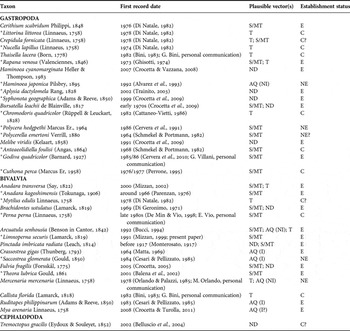
A list of 35 (18 Gastropoda, 16 Bivalvia and 1 Cephalopoda) marine alien molluscan species recorded from the Italian territorial seawaters is given in Table 1. However, despite the extensive sampling carried out during this work, the number of introduced species may be underestimated: further studies will be necessary to confirm the status of species only recorded as shells from Italy, but well known to be established in other Mediterranean countries, and of those species here excluded because considered as cryptogenic. Eighteen out of the 35 alien species listed here were first recorded from Italy, and, of these, 6 are established along the Italian shores and 10 were recorded from additional Mediterranean countries (Zenetos et al., Reference Zenetos, Gofas, Verlaque, Çinar, Garcia Raso, Bianchi, Morri, Azzurro, Bilecenoglu, Froglia, Siokou, Violanti, Sfriso, San Martin, Giangrande, Katağan, Ballesteros, Ramos-Esplà, Mastrototaro, Ocaña, Zingone, Gambi and Streftaris2010). Molecular studies are necessary to detect pathways of diffusion of the latter species as there are some doubts as to the Italian contribution to the spreading of such alien Mollusca in the Mediterranean.
Alien Mollusca recorded from the territorial seawaters of Italy: first record date, plausible vector(s) and establishment status. Vectors: S/MT, shipping/maritime transport; T, trade; ND, natural dispersal; AQ (NI), aquaculture—not intentional; AQ (I), aquaculture—intentional. Establishment status: E, established; NE, not established; C, casual.

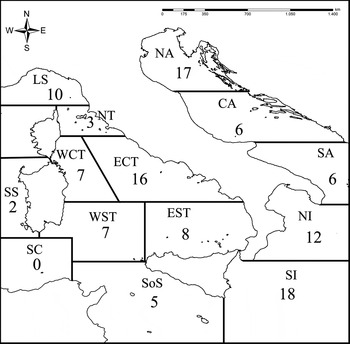
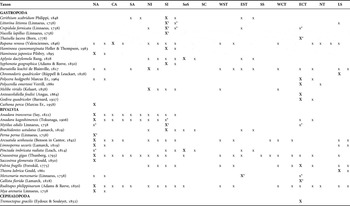
A database of occurrence sites of live alien molluscan species in the 14 Italian biogeographical sea divisions after Occhipinti-Ambrogi et al. (2011) was compiled from literature and from the unpublished data of researchers and collectors. When possible, records were confirmed through examination of published photographs or drawings or by examination of specimens. Voucher specimens and photographs are presently stored in the author's collection and archives (Naples, Italy). Known distributional data are summarized in Table 2 and in Figure 1. The most affected area was the southern Ionian Sea (18 species) followed by the northern Adriatic Sea (17 species) and the eastern-central Tyrrhenian Sea (16 species), although the northern Adriatic accounts for 11 first records from Italian coasts. The southern Ionian Sea, and mainly the Messina Strait area, on the one hand, constitutes a pathway for the spreading of alien species of Indo-Pacific origin to the western Mediterranean (the opisthobranchs Bursatella leachii de Blainville, 1817 and Haminoea cyanomarginata Heller & Thompson, 1983, as well as the bivalve Fulvia fragilis (Forsskål, 1775) presumably entered the Mediterranean Sea throughout the Suez Canal and then reached the Italian shores via secondary spreading), while, on the other hand, is characterized by the presence of lagoon systems, that currently constitute important sites of introduction and spreading of alien species: among them the Faro Lake (Messina) needs a mention, where the veined whelk Rapana venosa (Valenciennes, 1846), the Asian bag mussel Arcuatula senhousia (Benson in Cantor, 1842) and the clam Ruditapes philippinarum (Adams & Reeve, 1850) were recorded, as well as a high number of alien species introduced by subsequent discard of live adult specimens from markets or pounds (Cosentino et al., Reference Cosentino, Giacobbe and Potoschi2010; F. Crocetta & F. Toscano, unpublished data).
Number of alien molluscan species recorded from the coastal and offshore territorial seawaters of Italy, including lagoons, in each of the 14 biogeographical sea divisions after Occhipinti-Ambrogi et al. (2011).

Alien Mollusca from the territorial seawaters of Italy, including lagoons. NA, northern Adriatic Sea; CA, central Adriatic Sea; SA, southern Adriatic Sea; NI: northern Ionian Sea; SI, southern Ionian Sea (including the Messina Strait area); SoS, Strait of Sicily; SC, Sardinia Channel; WST, western-southern Tyrrhenian (excluding the Sicilian shores); EST, eastern-southern Tyrrhenian; SS, Sardinia Sea; WCT; western-central Tyrrhenian; ECT, eastern-central Tyrrhenian; NT; northern Tyrrhenian; LS, Ligurian Sea. First and second column of each sea correspond respectively to published records and material examined (living specimens only). When the record is due to trade or to ship fouling it is followed by an asterisk (*). First Italian record per species is highlighted in bold and with an upper case letter.

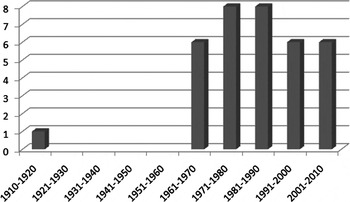
Careful analysis of the literature and interviews with authors led to the correction of some first record dates. As an example, Thaisella lacera (Born, 1778) and Callista florida (Lamarck, 1818), whose first occurrence in Italy was published in 1983 without a finding date (Bini, Reference Bini1983), were first found in 1982 (G. Bini, personal communication). The mytilids Limnoperna securis (Lamarck, 1819) and A. senhousia, whose first occurrence in Italy was often stated as 1992 and 1994 respectively, are here listed as first recorded in 1991 and 1992. L. securis was first recorded from Italy on the basis of a specimen misidentified as Modiolus adriaticus (Lamarck, 1819) in Cesari Reference Cesari(1994: pp. 118–119, table XXX, figures 6 a1–a2), sampled in 1991 (Mizzan, Reference Mizzan1999), while A. senhousia was first recorded as live in 1992 (Bucci, Reference Bucci1994). Melibe viridis (Kelaart, 1858), whose first presence in Italy was often given as 1984, was first recorded in 1991 (see also Crocetta et al., Reference Crocetta, Renda and Vazzana2009). The rate at which first records of live alien molluscan species were reported, estimated per decade, is listed in Table 1 and plotted in Figure 2. The lack of historical series and the general absence of funding for research in molluscan palaeontology and palaeogeography mean that data from before the 1900s are undependable and thus only the decade 1910–1920 seems the first where the phenomenon was studied. The following four decades (1921–1960) are characterized by the absence of molluscan introductions, but this may well be an artefact of the lack of faunal studies attributable to the World Wars and two postwar periods. After that, the increase in commercial activities and the renewal of interest in the study of Italian molluscs result in a steady increase of records, with from 6 to 8 species recorded in the subsequent 5 decades (1961–2010). However, as it can be seen from the data based on published records (see Table 1), the number is expected to increase due to the constant monitoring of Italian shores by researchers, amateur malacologists and diver-photographers who could find new alien species misidentified as native ones in their databases, samples or private collections.
The rate of reporting (as number of species per decade) of alien molluscan species from the Italian territorial seawaters.

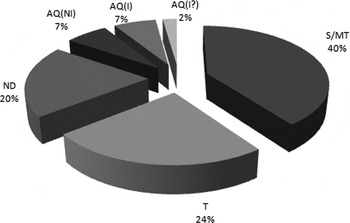
Plausible vectors of introduction listed in Table 1 are shown in Figure 3. Shipping/maritime transport accounts for 40% of the Italian introductions, followed by 24% due to trade and 20% due to natural dispersal. Within shipping/maritime transport, the bivalve F. fragilis has been mainly found near commercial harbours (Crocetta, Reference Crocetta2005; Crocetta et al., Reference Crocetta, Renda and Colamonaco2008, Reference Crocetta, Renda and Vazzana2009; Doneddu, Reference Doneddu2011) and the bivalve Theora lubrica Gould, 1861 has up to now been exclusively recorded from Italy from Leghorn Harbour (Balena et al., Reference Balena, Campani, Coppini and Margelli2002; Campani et al., Reference Margelli, Cuneo, Coppini and Campani2004; Margelli et al., Reference Campani, Coppini, Cuneo and Margelli2004, Reference Margelli, Campani, Coppini and Cuneo2006). Its recent record from a Levantine port (Bogi & Galil, Reference Bogi and Galil2007) is thus not surprising. Within trade, several species seem introduced with Adriatic mussels, live imported in several Italian lagoons: this is the case for the gastropod R. venosa and the bivalve Anadara transversa (Say, 1822). Finally, several species probably arrived in Italy via natural dispersal from neighbouring populations: a recent example is H. cyanomarginata, whose presence seems to be connected with its previous establishment along Maltese shores (Crocetta & Vazzana, Reference Crocetta and Vazzana2008). In addition, only three species were intentionally introduced for aquaculture: the oysters Crassostrea gigas (Thunberg, 1793) and Saccostrea glomerata (Gould, 1850) and the Japanese clam R. philippinarum. These account for 7% of Italian introductions. Recent records of a further species (Mya arenaria Linnaeus, 1758) could be due to illegal seeding activities (Crocetta & Turolla, Reference Crocetta and Turolla2011): if confirmed, intentional introduction will account for 9%.
Alien molluscan species in the territorial seawaters of Italy. Plausible vectors of introduction: S/MT, shipping/maritime transport; T, trade; ND, natural dispersal; AQ (NI), aquaculture—not intentional; AQ (I), aquaculture—intentional.

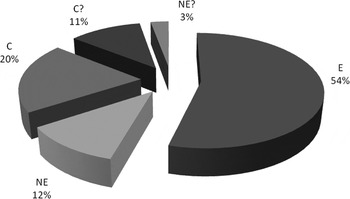
The establishment status of the 35 alien molluscan species listed in Table 1 is shown in Figure 4. Nineteen species (54%) are established and include species locally occurring at high densities, such as A. senhousia, as well as species with a wide distribution such as F. fragilis. The former occurs in densities typically up 10,000 individuals/m2 in the northern Adriatic, where it is threatening indigenous populations of other bivalves and most Adriatic shellfish farms (Mistri, Reference Mistri2003); F. fragilis, widely diffused throughout the entire Mediterranean Sea, was only recently recorded from Italy (live specimens first reported in 2005), but up to now it is known from at least seven different Italian sites (Doneddu, Reference Doneddu2011). In addition, a further five species need comment: the opisthobranch H. cyanomarginata and the bivalve M. arenaria proved to be able to survive, reproduce and develop during the investigated period; the opisthobranch Syphonota geographica (Adams & Reeve, 1850) and the bivalve T. lubrica are known to have occurred in Italy for several years, but their spread seems curtailed by either biochemical or ecological factors and these species are presently confined to the Reggio Calabria area and to the Leghorn area; the opisthobranch Godiva quadricolor (Barnard, 1927) is known to have occurred and to reproduce in the Fusaro Lake (Naples) from 1985/1986 up to the present (G. Villani, personal communication, 2010), but it was often misidentified in the past as Facelina coronata (Forbes & Goodsir, 1839) (see Cervera et al., Reference Cervera, Tamsouri, Moukrim and Villani2010) and there is also the possibility that it is presently undetected in several other Italian lagoons. Four species (12%) are not established. It is the case, for instance, of the opisthobranch Haminoea japonica Pilsbry, 1895 and of the bivalve Mercenaria mercenaria (Linnaeus, 1758). The former soon became locally common from Venice to the Ravenna area (Alvarez et al., Reference Alvarez, Martínez, Cigarrila, Rolán and Villani1993; Delongueville & Scaillet, Reference Delongueville and Scaillet2007), but in 2001 it completely disappeared and was never recorded again (M. Tisselli, personal communication). Also the specimen recently figured by Delongueville & Scaillet (Reference Delongueville and Scaillet2007) was almost certainly collected before 2002 (C. Delongueville & R. Scaillet, personal communication). M. mercenaria was introduced as a discard in several Italian sites (Bini, Reference Bini1983; Orlando & Palazzi, Reference Orlando and Palazzi1985) and was presumably introduced in the Sacca di Goro Lagoon with R. philippinarum seeds (Turolla, Reference Turolla2006), but it did not survive in any of the sites of introduction. One further species is considered not established with doubt: the small opisthobranch Polycerella emertoni Verrill, 1880 has been recorded, in the last decades, from several sites along the central Tyrrhenian shores (Schmekel & Portmann, Reference Schmekel and Portmann1982; Cattaneo-Vietti et al., Reference Cattaneo-Vietti, Chemello and Giannuzzi-Savelli1990). Even if it has not been recently reported in the literature, there could be the possibility that the species is established but undetected in at least one of the sites where it was previously found. A further seven species (20%) are classified as casual. It is the case, for instance, of the gastropods Littorina littorea (Linnaeus, 1758), Nucella lapillus (Linnaeus, 1758) and T. lacera and of the bivalve C. florida, live specimens of which have been introduced in Italy as discards or due to trade (Barsotti & Campani, Reference Barsotti and Campani1982; Di Natale, Reference Di Natale1982; Bini, Reference Bini1983) and of Perna perna (Linnaeus, 1758), recorded alive in the Gulf of Trieste on an oil platform coming from Senegal (De Min & Vio, Reference De Min and Vio1998). These species may be unable to either survive or reproduce. Three more species (11%) are considered as casual with some doubts: the slipper limpet Crepidula fornicata (Linnaeus, 1758), the bivalve Mytilus edulis Linnaeus, 1758 and the cephalopod Tremoctopus gracilis (Eydoux & Souleyet, 1852). Specimens and empty shells of C. fornicata have been recorded from several biogeographical sea divisions (Di Natale, Reference Di Natale1982; Bini, Reference Bini1983; Micali & Giovine, Reference Micali and Giovine1983; Bartolotta et al., Reference Bartolotta, Orlando and Viviano2005; Trono, Reference Trono2006), both as discards and in the field. M. edulis was reported several times from Italy, but a critical analysis of published records revealed objective difficulties in its identification. However, some records of live specimens coming from aquacultures or markets are clearly reliable (Di Natale, Reference Di Natale1982; Bini, Reference Bini1983) as well as the report of its temporary introduction in Venetian waters before marketing (Mizzan, Reference Mizzan1999). Due to the difficulties in identifying this species, it is not possible to say with confidence if it presently occurs or not in Italy. The cephalopod T. gracilis, as for the native congeneric Tremoctopus violaceus Delle Chiaje, 1830, is a pelagic species difficult to sample.
Alien molluscan species in the territorial seawaters of Italy. Establishment status: C, casual; NE, not established; E, established.

A critical review and a state of knowledge about the alien molluscan species recorded from Italy is necessary in the light of the ongoing biological invasion phenomenon and the inclusion of one, or more, molluscan taxonomists within Italian projects on alien species may contribute to its correct understanding. In addition, although on the one hand it is necessary to consistently monitor Italian shores, on the other hand it seems increasingly indispensable to invest in a strong prevention policy and in the creation and maintenance of a network of observatories across the Mediterranean to monitor the changes taking place along Mediterranean coasts.
ACKNOWLEDGEMENTS
Several researchers answered questions, shared with me their own data or encouraged me to complete this project: Renato Chemello (Palermo, Italy), Lucas Cervera (Cadiz, Spain), Serge Gofas (Malaga, Spain), Luca Mizzan (Venice, Italy), Marco Oliverio (Rome, Italy), Francesco Toscano (Naples, Italy), Edoardo Turolla (Goro, Italy), Giorgio Valli (Trieste, Italy), Guido Villani (Naples, Italy) and Argyro Zenetos (Anavissos, Greece). I am grateful to all of them. Moreover, field amateurs greatly helped with material, records and hospitality. In particular, I wish to remember: Gianluigi Bini (Perugia, Italy), Enzo Campani (Leghorn, Italy), Giuseppe Colamonaco (Altamura, Italy), Paolo Crovato (Naples, Italy), Christiane Delongueville (Bruxelles, Belgium), Giuseppe Fasulo (Naples, Italy), Gianni Neto (Bologna, Italy), Italo Nofroni (Rome, Italy), Walter Renda (Amantea, Italy), Morena Tisselli (Ravenna, Italy), Angelo Vazzana (Reggio Calabria, Italy) and Ennio Vio (Trieste, Italy). Massimo Cretella (Naples, Italy), Patrick Schembri (Msida, Malta), Paolo Sordino (Naples, Italy), Francesco Toscano (Naples, Italy) and Angelo Vannozzi (Frascati, Italy) are acknowledged for their critical reading of the manuscript.