Introduction
The lichen biota of Brazil is still incompletely known. However, with over 4750 species recorded to date, it is already a country containing a relatively high number of lichen species. As every year around 200 species are added to this list, about half of which are newly described, it will soon become the country with the highest number of lichen species. Yet there are still whole states and habitats that have not been sampled at all.
The coast of Brazil is mostly known for its wide and long sandy beaches, only interrupted by river estuaries with mangrove forest. In the southern states of Paraná, Santa Catarina and Rio Grande do Sul, these beaches are interspersed with coastal granite rocks that often rise as steep cliffs directly from the sea. The targeted study of the lichen mycobiota on these coastal cliffs began in Reference Vainio1890 (Vainio Reference Vainio1890), to be taken up again in 1984 with the report of some macrolichens (Osorio & Fleig 1984 Reference Osorio and Fleiga , Reference Osorio and Fleigb ), and then subsequently discontinued for many years but taken up again recently, mainly with the study of Parmeliaceae and Cladoniaceae (Benatti et al. Reference Benatti, Marcelli and Elix2008; Benatti & Marcelli 2009 Reference Benatti and Marcellia , Reference Benatti and Marcellib ; Gumboski & Eliasaro Reference Gumboski and Eliasaro2011, 2012 Reference Gumboski and Eliasaroa , Reference Gumboski and Eliasarob ; Gerlach & Eliasaro Reference Gerlach and Eliasaro2012, 2014 Reference Gerlach and Eliasaroa , Reference Gerlach and Eliasarob ).
All over the Northern Hemisphere, as well as in Australia and New Zealand, specialized lichen biota of coastal rocks have been reported, consisting partly of littoral species that are restricted to those coastal rocks (e.g. Arup Reference Arup1995; Gilbert Reference Gilbert2000). Usually, different zones with characteristic lichens can be recognized: a littoral black zone, a supralittoral yellow zone and a grey zone, the latter with some microhabitats such as dry and wet overhangs, exposed rocks and places with run-off. Species from the lower zones and the dry overhangs are generally restricted to maritime habitats. The lichen biota of coastal rocks have rarely been reported from tropical regions.
In 2015, the second author organized an excursion of the Reunião Brasileira de Estudos Liquenológicos in Santa Catarina which allowed the authors to study the lichens on coastal cliffs in the area.
Material and Methods
Identification and descriptive work was carried out in Soest using an Olympus SZX7 stereomicroscope and an Olympus BX50 compound microscope with interference contrast, connected to a Nikon Coolpix digital camera. Sections were mounted in tap water, in which all measurements were also taken. The specimens from this study are preserved in JOI and ABL. The chemistry of selected specimens was investigated by thin-layer chromatography (TLC) using solvent A (Orange et al. Reference Orange, James and White2001).
DNA extraction, amplification and sequencing were carried out in Santander (ALVALAB): total DNA was extracted from dry specimens using a modified protocol based on Murray & Thompson (Reference Murray and Thompson1980). A portion of each sample was blended with the aid of a micropestle in 600 µl CTAB buffer (CTAB 2%, NaCl 1·4 M, EDTA (pH 8·0) 20 mM, Tris-HCl (pH 8·0) 100 mM). The resulting mixture was incubated for 15 min at 65ºC. A similar volume of chloroform:isoamilalcohol (24:1) was added and carefully mixed with the samples until an emulsion formed. It was then centrifuged for 10 min at 13000 g, and the DNA in the supernatant was precipitated with a volume of isopropanol. After a new centrifugation of 15 min at the same speed, the pellet was washed in 70% cold ethanol, centrifuged again for 2 min and dried. It was finally resuspended in 200 µl of ddH2O. PCR amplification was performed with the primers mrSSU1 and mrSSU3R (Zoller et al. Reference Zoller, Scheidegger and Sperisen1999) for the mtSSU region, and LR0R and LR5 (Vilgalys & Hester Reference Vilgalys and Hester1990; Cubeta et al. Reference Cubeta, Echandi, Abernethy and Vilgalys1991) for 28S nrDNA. PCR reactions were performed under a program consisting of a hot start at 95°C for 5 min, followed by 35 cycles at 94°C, 54°C and 72°C (for 45, 30 and 45 s respectively) and a final 72°C step for 10 min. PCR products were checked in 1% agarose gels and positive reactions were sequenced with one of the PCR primers. Chromatograms were checked searching for putative reading errors, and these were corrected.
Phylogenetic analyses
BLAST (Altschul et al. Reference Altschul, Gish, Miller, Myers and Lipman1990) was used to check the most closely related sequences of the family Roccellaceae in INSD public databases and a combined 28S rDNA- RPB2 dataset of this family, similar to that in Ertz et al. (Reference Ertz, Tehler, Irestedt, Frisch, Thor and van den Boom2015), was built. Species of Opegraphaceae were used as outgroups. Sequences were first aligned in MEGA 5.0 (Tamura et al. Reference Tamura, Peterson, Peterson, Stecher, Nei and Kumar2011) software with its ClustalW application and then corrected manually. The final alignment included 405/826 (28S rDNA) and 484/844 (RPB2) variable sites. The aligned loci were loaded in PAUP* 4.0b10 (Swofford Reference Swofford2001) and subjected to MrModeltest v.2.3 (Nylander Reference Nylander2004). The model GTR+Γ+I was implemented in MrBayes v.3.1 (Ronquist & Huelsenbeck Reference Ronquist and Huelsenbeck2003) where a Bayesian analysis was performed (two simultaneous runs, six chains, temperature set to 0·2, sampling every 100th generation) until convergence parameters were met after c. 7000000 generations (after which the Bayesian analyses were carried out), the standard deviation having fallen below 0·01. Finally, a full search for the best-scoring maximum likelihood tree was performed in RAxML (Stamatakis Reference Stamatakis2006) using the standard search algorithm (data partitioned, 2000 bootstrap replications). Significance threshold was set above 0·95 for posterior probability (PP) and 70% bootstrap proportions (BP).
Results
Crustose lichens were found to be abundantly present on the rock faces investigated. Three distinct lichen zones were found: a littoral black zone, a supralittoral yellow zone and a grey zone with species restricted to either exposed granite, dry overhangs, damp overhangs or places subjected to run-off. Therefore the whole range of variation in microhabitat was found to be present.
In the littoral black zone, only one species was found, viz. Stigmidium marinum (Deakin) Swinscow.
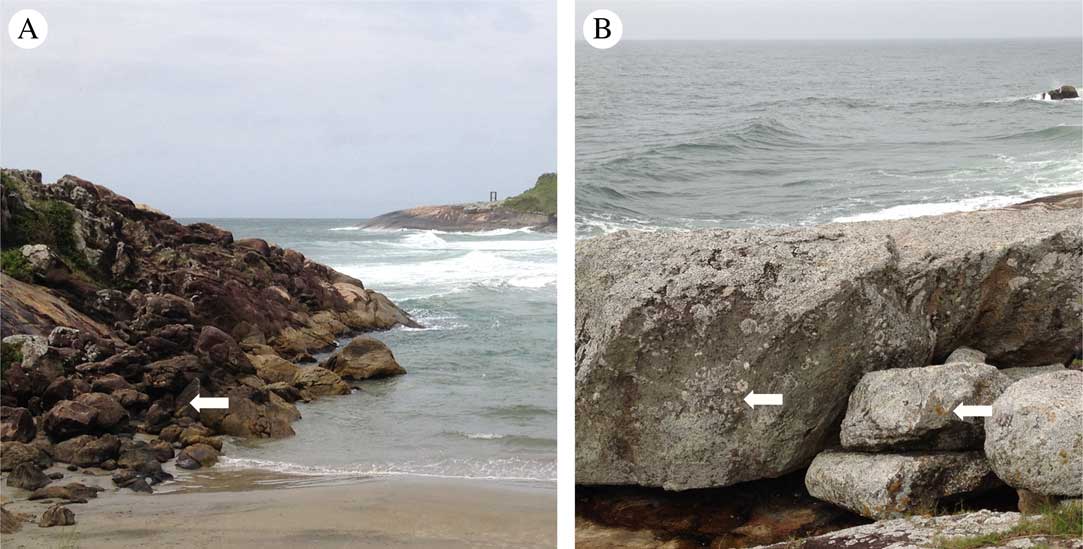
Just above the black zone (Fig. 1A), in the lower supralittoral, there is a zone containing a number of Teloschistaceae with thallus colours predominantly yellow to orange, hence the name “yellow zone”. Several different additional species were found that are yet to be determined. The yellow Teloschistaceae that occur slightly higher up in the intermediate supralittoral belt could all be identified as species which are known from other areas in Brazil.
Coastal rocks in Santa Catarina, Brazil. A, north of Prainha, showing a lower supralittoral zone with algae where the undescribed Teloschistaceae are growing (arrow); B, south of Prainha, showing grey zone, including overhanging parts (left arrow) and some yellow supralittoral Teloschistaceae (right arrow). In colour online.
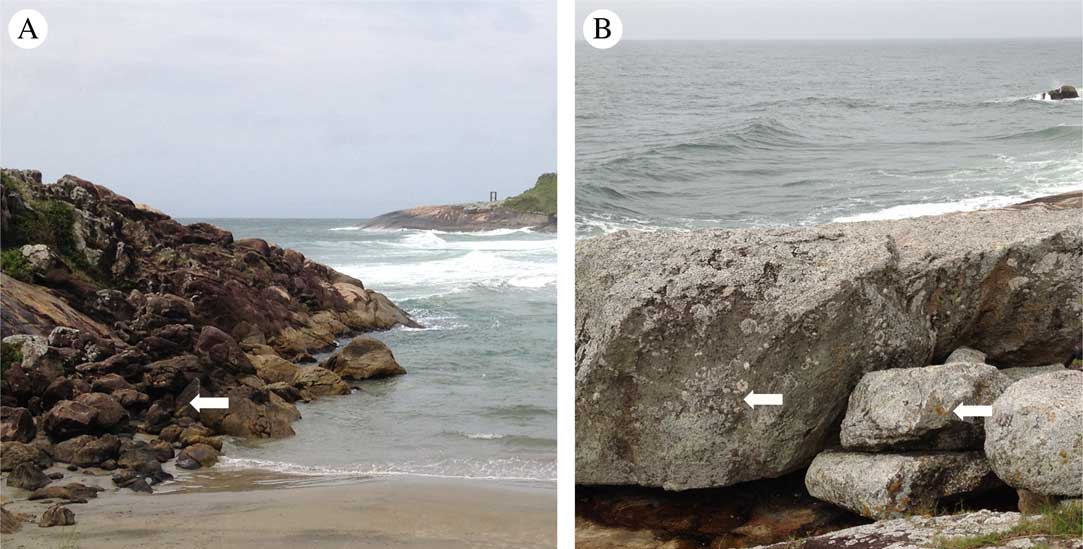
In the grey zone (Fig. 1B), the higher supralittoral belt, several microhabitats can be distinguished such as exposed granite, dry overhangs, damp overhangs or places subjected to run-off. Dry overhangs of maritime rocks in at least warm-temperate regions usually abound with Arthoniales, especially Roccellaceae. The overhangs in southern Brazil are no exception to this, with species of Dendrographa, Enterographa, Lecanographa, Opegrapha s. lat. and Roccellographa. Fruticose Roccellaceae, which can be abundant in such places, were absent but Roccellographa circumscripta (Leight.) Erzt & Tehler (reported by Gumboski & Eliasaro 2012 Reference Gumboski and Eliasarob ) has a partly lobate thallus. Several species from Opegrapha s. lat. were present, of which only O. lithyrga Ach. could be identified with some certainty. The taxonomy of the group is still too poorly known to warrant the description of the other species. The species of Enterographa has only pycnidia present on the thalli and cannot be identified with certainty. The Dendrographa is different from all other species accepted in the genus and is therefore described here as new. It is one of the few crustose species in the genus.
Places that can be classified as wet overhangs are generally shaded and damp. Lichens growing here are usually only partly maritime. In southern Brazil, mostly ubiquitous cosmopolitan species such as Agonimia opuntiella (Poelt & Buschardt) Vězda, Endocarpon pallidulum (Nyl.) Nyl., Flakea papillata O. E. Erikss., Physcia atrostriata Moberg, Porina chlorotica (Ach.) Müll. Arg., Rinodina oleae Bagl. and R. oxydata (A. Massal.) A. Massal. were found in this microhabitat.
In places with frequent run-off, lichens with cyanobacteria were dominant. The pantropical Peltula bolanderi (Tuck.) Wetm., P. clavata (Kremp.) Wetm. and Leptogium isidiosellum (Riddle) Sierk were present, as well as several so far unidentified Lichinaceae (i.e. probably one or more Pterygiopsis species).
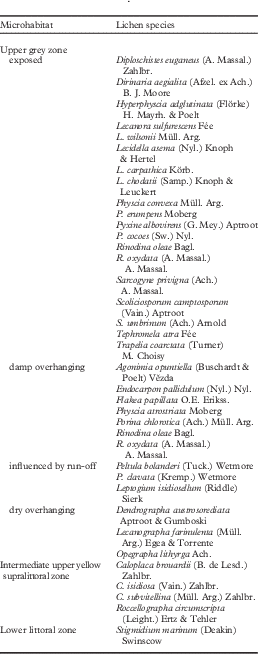
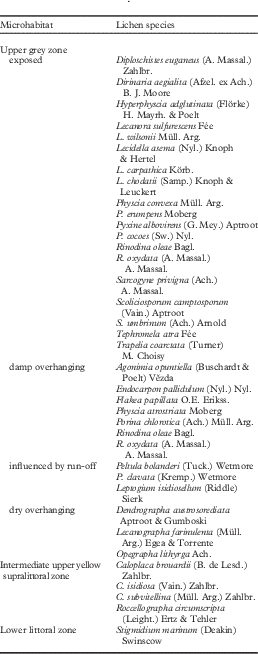
The exposed granitic rocks of the grey zone are the richest in lichen species, just as elsewhere in the world. Here the majority of the macrolichens of the coastal rock also occur. The simple explanation is that the environment is less extreme and harbours many species that can also grow inland. Most of the crustose species identified so far seem to be cosmopolitan, while a considerable number of the reported macrolichens had a more restricted distribution. One Ramalina was present, viz. R. gracilis (Pers.) Nyl. Ramalina is often the dominant lichen on coastal rocks around the world and the species are often partly endemic, just as here, which is rather unusual among lichens. The crustose and microfoliose species found by us are listed in Table 1. The list is far from complete as only a small number of coastal cliffs have been systematically sampled and not all species could be identified.
Crustose and microfoliose maritime lichens on the Santa Catarina coast, Brazil
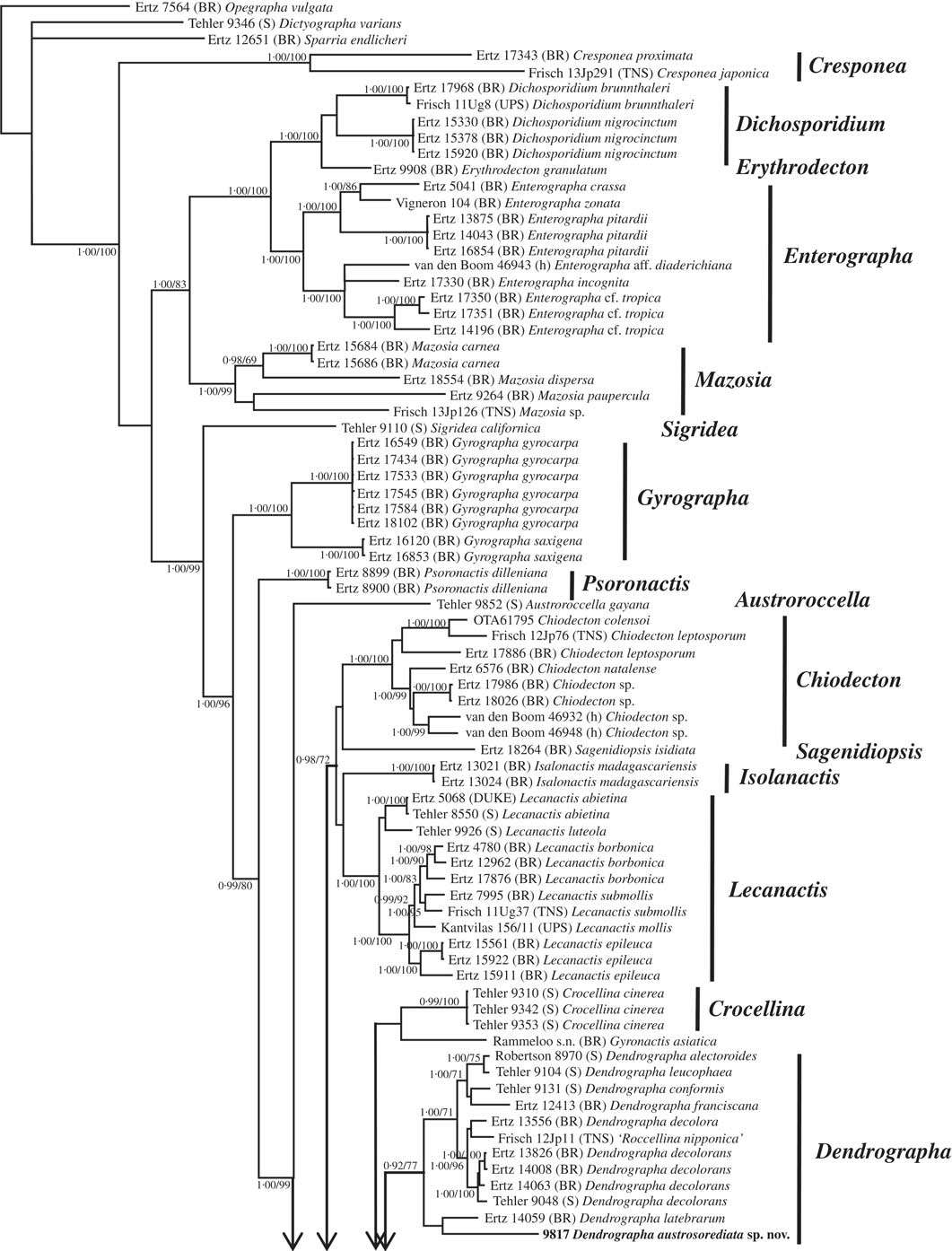
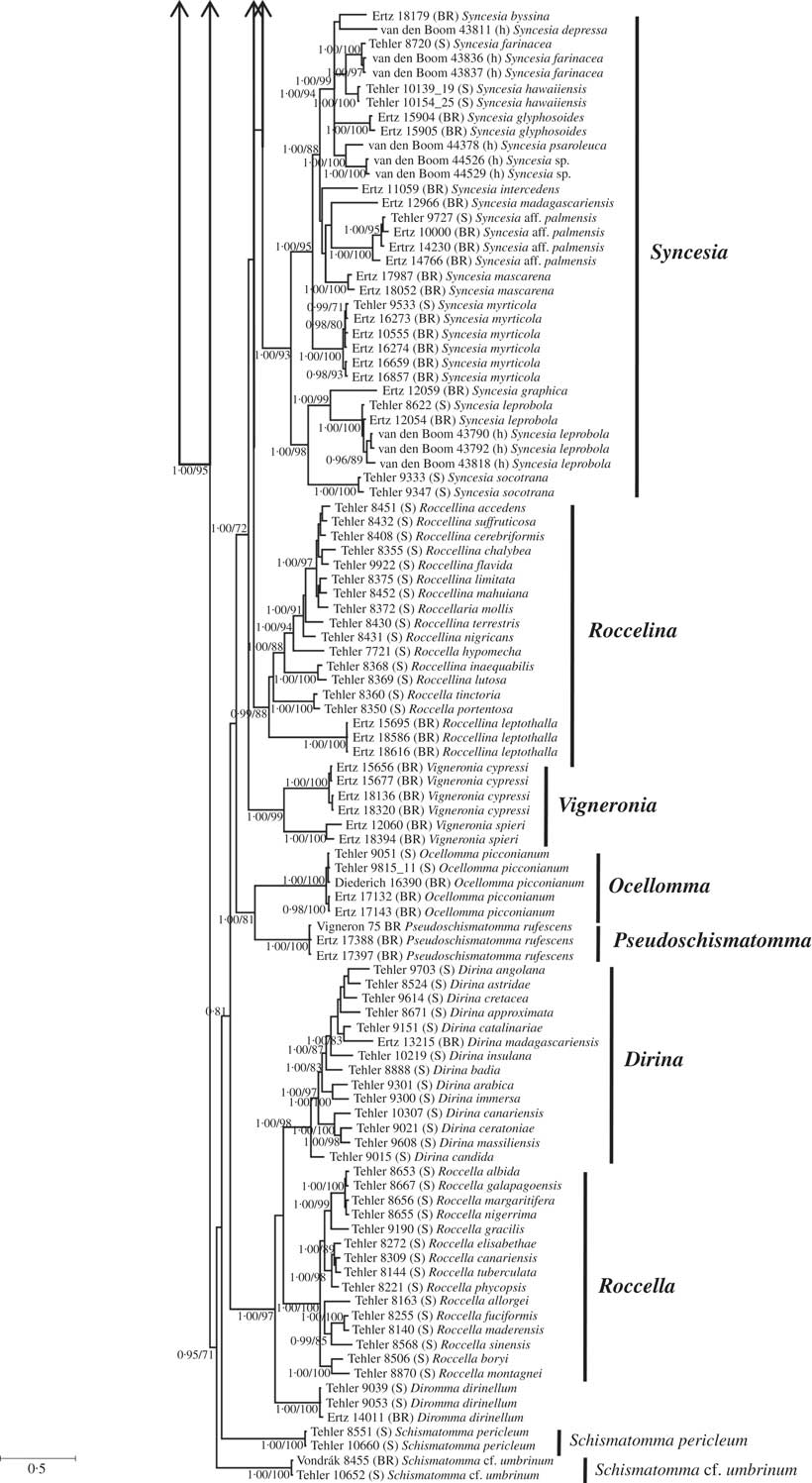
Some of the lichens encountered, including all species in the lower yellow (lower supralittoral) zone, could not be identified as any described species. One undescribed species was found in overhangs. It was sequenced as it was sterile. ITS (KY986702), 28S rDNA (KY986703) and mtSSU (KY986704) sequences were obtained, but we failed to obtain an RPB2 sequence. In the analysis only 28S rDNA was used for our specimen, but RPB2 was used for other taxa from which it was available. Two analyses were carried out: a Bayesian simulation in MrBayes and a ML analysis in RAxML. The tree depicted (Fig. 2) is the Bayesian tree, with nodes annotated with PP (Bayesian) and BP (ML) values.
Phylogenetic position of Dendrographa austrosorediata (shown in bold). Consensus phylogram obtained in MrBayes after the analysis of a combined 28S rDNA and RPB2 dataset. Bayesian PP (set above 0.95) and ML BP (set at 70%) are given adjacent to nodes. Only nodes supported by both analyses are shown.
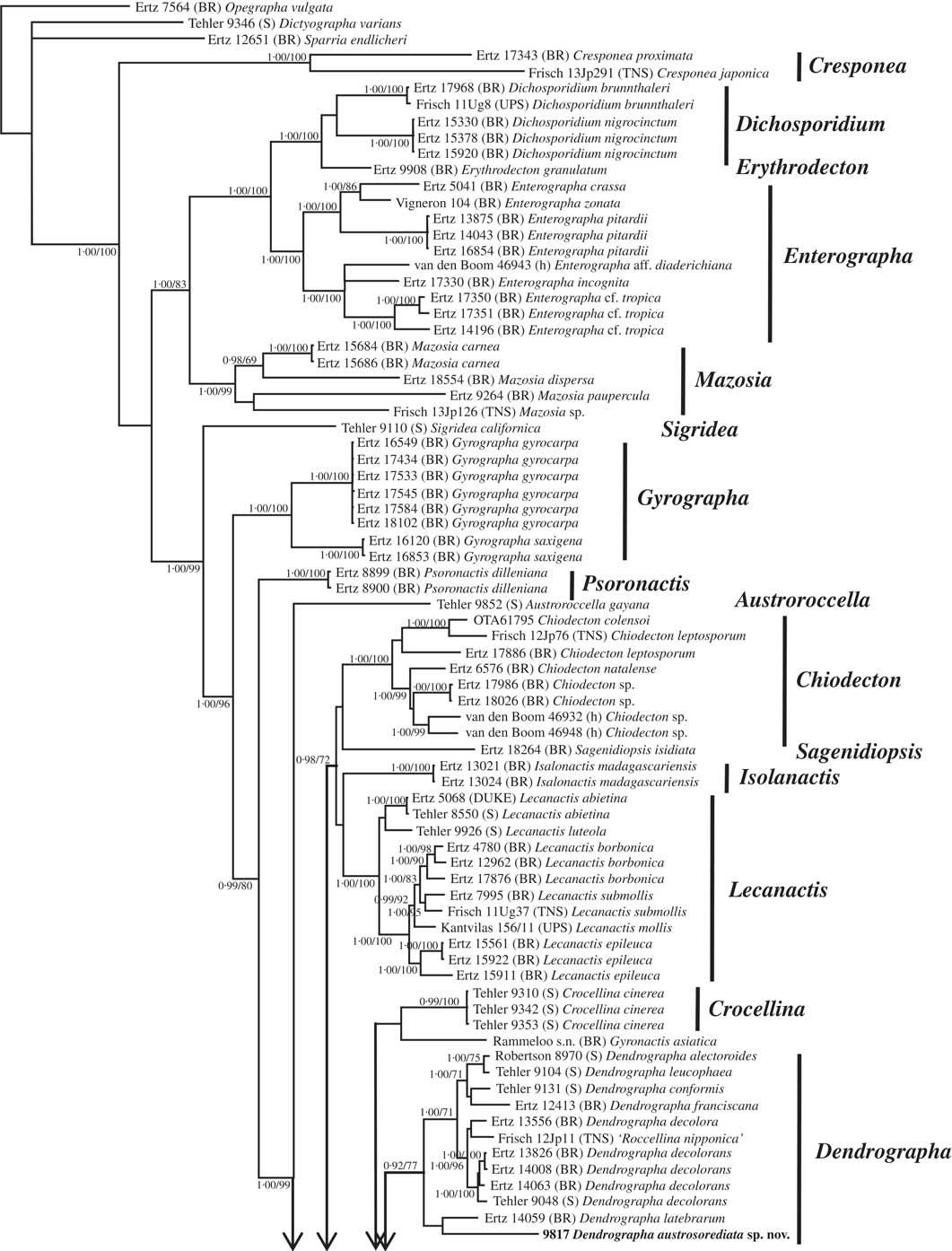
Phylogenetic position of Dendrographa austrosorediata (shown in bold). Consensus phylogram obtained in MrBayes after the analysis of a combined 28S rDNA and RPB2 dataset. Bayesian PP (set above 0.95) and ML BP (set at 70%) are given adjacent to nodes. Only nodes supported by both analyses are shown.
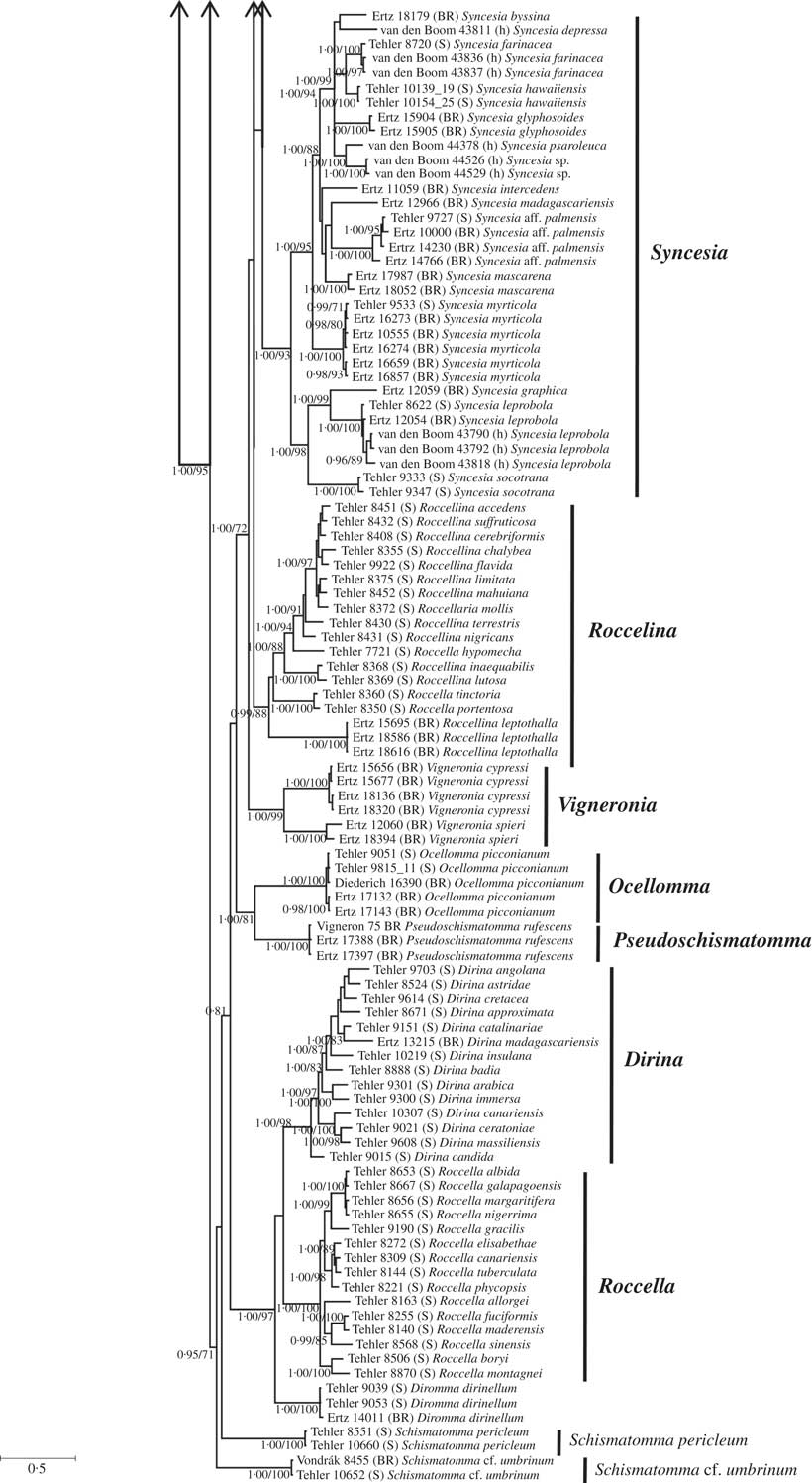
The new species clustered with one of the few other known crustose Dendrographa species, D. latebrarum (Ach.) Ertz & Tehler (Fig. 2), and is described here in that genus.
Dendrographa austrosorediata Aptroot & Gumboski sp. nov.
MycoBank No.: MB 820870
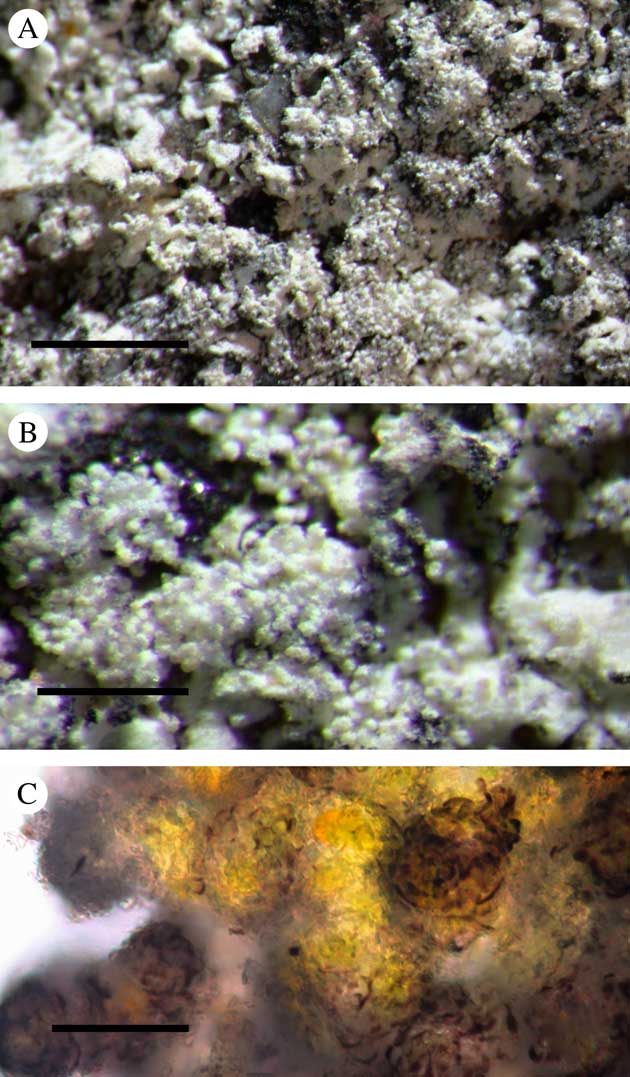
Saxicolous Dendrographa from overhanging coastal rock, with a crustose, flat to partly curling or blister-like thallus which is much dissected, whitish grey, 0·1–0·2 mm thick; surface minutely densely cracked, rimose, with cracks intersecting every c. 0·1 mm; soredia whitish to bluish grey but asymmetrically blackened in the direction facing the light, originating on the thallus surface, in initially discrete convex soralia.
Type: Brazil, Santa Catarina State, municipality of São Francisco do Sul, S of Prainha, 26°14'06''S, 48°30'05''W, on coastal granite, c. 10 m alt., 8 October 2015, M. E. S. Cáceres & A. Aptroot 27936 (JOI—holotype; ABL—isotype).
(Fig. 3)
Dendrographa austrosorediata (holotype). A, thallus; B, detail of thallus; C, soredia. Scales: A=1 mm; B=0·5 mm; C=10 μm. In colour online.
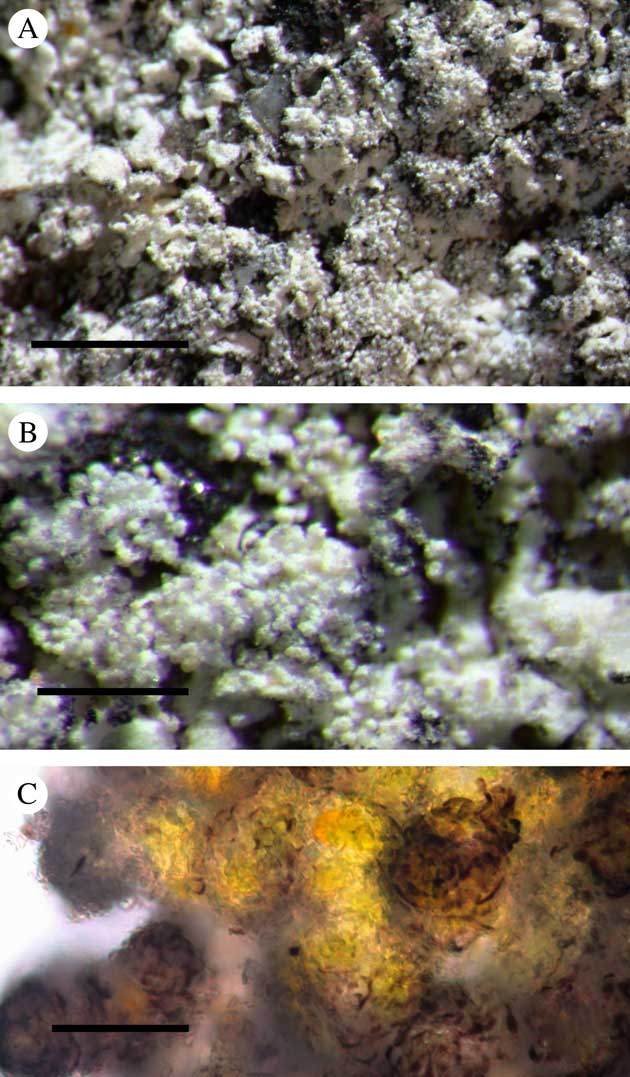
Thallus crustose, individual thalli not distinguishable, colonies indeterminate and covering large areas, flat to partly curling up or blister-like, much dissected, epruinose or slightly pruinose, whitish grey, 0·1–0·2 mm thick; surface minutely densely cracked, rimose with cracks intersecting at each c. 0·1 mm; cortex 20–40 μm thick; medulla not differentiated, sometimes surrounded by a thin, black prothalline line; alga trentepohlioid, c. 6–11 μm diam. Soredia present, whitish to bluish grey, but asymmetrically blackened in the direction facing the light, originating on the thallus surface in initially discrete convex soralia of c. 0·2–0·4 mm diam. and up to 0·3 mm high, later covering most of the thallus; soredia round to ellipsoid, c. 18–32 μm diam., surface hyphae partly blackened.
Apothecia unknown.
Pycnidia not observed.
Chemistry. Thallus and soredia C+ red. TLC: erythrin & lecanoric acid.
Ecology and distribution. On maritime granite, on overhanging rockfaces. Known only from Brazil.
Discussion
In the new phylogenetic classification of the Roccellaceae (Ertz et al. Reference Ertz, Tehler, Irestedt, Frisch, Thor and van den Boom2015), some crustose species are classified in the genus Dendrographa Darb. which traditionally contained only a few fruticose species. The available material of the new species is sterile but characteristic enough to be described and recognized, even in the field. Its placement in Dendrographa is based on a phylogenetic analysis (Fig. 2) using two genes. We present here an analysis of a larger group because ITS produced no matches, with the genera Roccellina and Dendrographa as top results, while LSU was only 90% similar to both genera. Without a broader analysis, it was not possible to decide whether it was a Roccelina or a Dendrographa after the BLAST results (or whether it even belonged to another genus). Moreover, the noise in the LSU sequence could alter BLAST results significantly, making it too risky to decide if it was a Dendrographa without conducting an analysis.
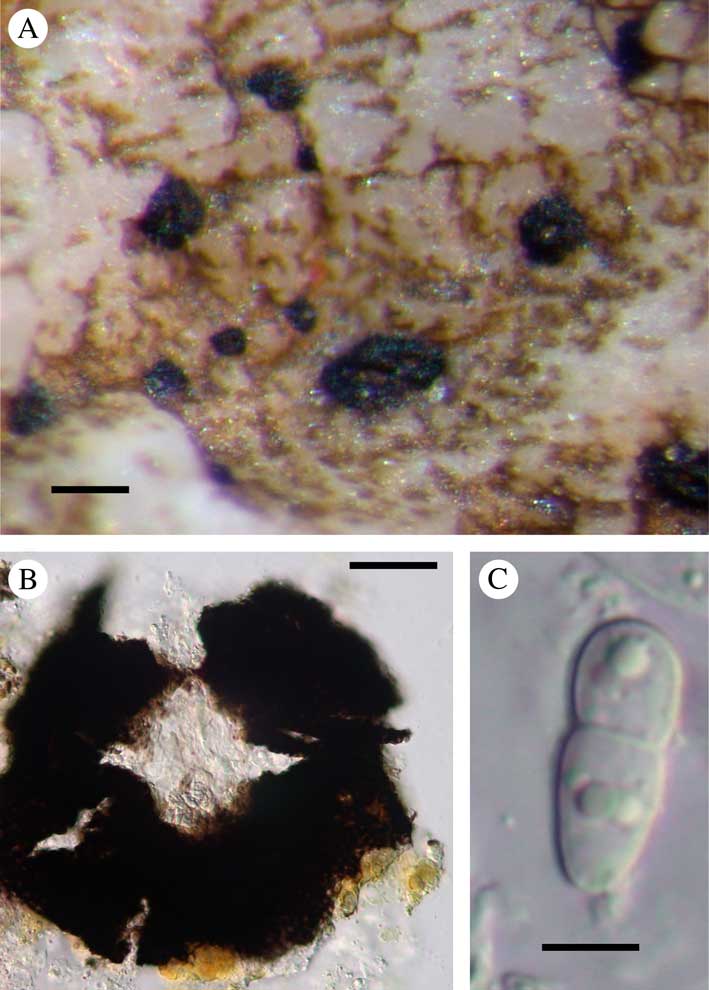
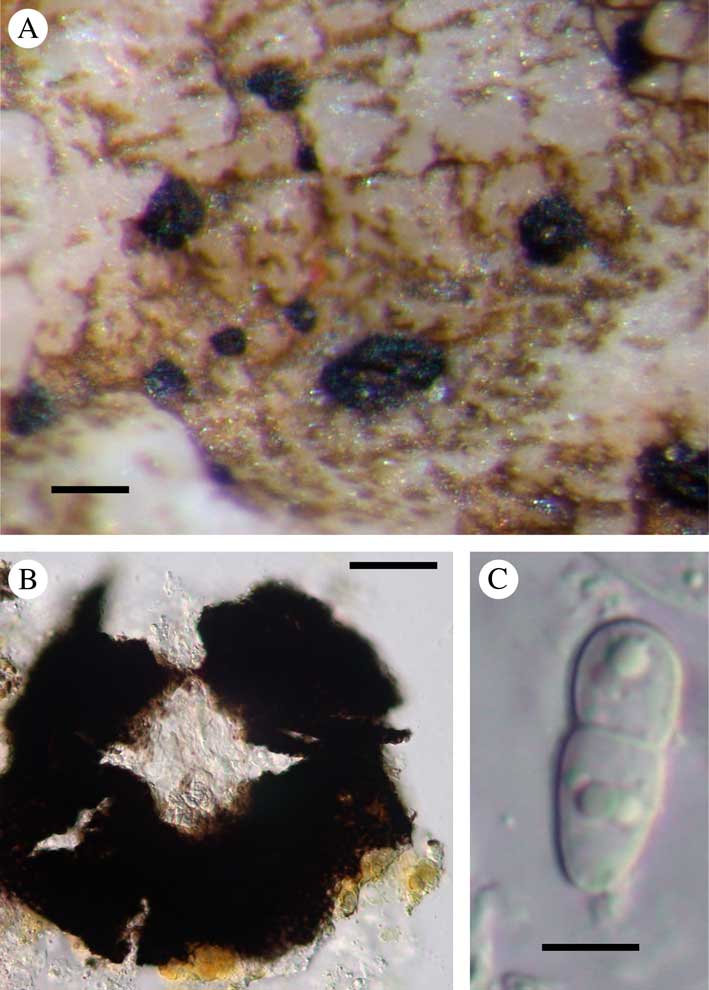
Stigmidium marinum (Fig. 4) is a somewhat surprising find, especially as it is generally regarded as a lichenicolous fungus. It is usually reported as an obligate parasite on some littoral Verrucaria species. However, it has been repeatedly observed occurring as a free-living lichen and is treated as such by van Herk & Aptroot (Reference van Herk and Aptroot2004). Its occurrence in the littoral zone of southern Brazil, thousands of kilometres away from the nearest known occurrence of any purported host, proves once more that this is a lichenized fungus. It is lichenized with Dilabofilum.
Stigmidium marinum (Cáceres & Aptroot 27943). A, thallus; B, flattened perithecium in surface view revealing Dilabofilum algal cells around the margin; C, ascospore. Scales: A=0·1 mm; B=25 μm; C=5 μm. In colour online.
MESC thanks CNPq (Conselho Nacional de Desenvolvimento Científico e Tecnológico) for a research grant (Processo 311706/2012-6); AA thanks the Stichting Hugo de Vries-fonds for a travel grant; ELG thanks the Universidade da Região de Joinville – UNIVILLE for support provided for the event. We are grateful to Pablo Alvarado (ALVALAB, Santander) for carrying out the sequencing and phylogenetic analysis.