Introduction
Post-retirement participation in lifelong learning is considered an important aspect to aid wellbeing in later life (Field Reference Field2012) and defined as extending ‘beyond school and formal education … a learning process that spans the whole of one's life’ (Brown Golding and Foley Reference Brown, Golding and Foley2008: 1). Despite the cradle to grave emphasis of this definition, in practice most policies in the United Kingdom (UK) operationalise lifelong learning as an aid to career development. As a result, fewer lifelong learning initiatives have been instigated for older ‘post-work’ individuals (Davis Reference Davis2001; Findsen Reference Findsen2002; O'Keefe, Atkinson and Pinkerton Reference O'Keefe, Atkinson and Pinkerton2005; Hebestreit Reference Hebestreit2008; Withnall Reference Withnall2008). A developing literature indicates that engagement in lifelong learning post-retirement has potential for physical, psychological and social benefits (Dench and Regan Reference Dench and Regan2000; Narushima Reference Narushima2008). Those engaged in such activities have been found to have lower rates of health dependency and medication costs (Skinner Reference Skinner2006; Soulsby Reference Soulsby2000); an increased ability to cope with illness (Aldridge and Lavender Reference Aldridge and Lavender2000); improved intellectual function (Boulton-Lewis Reference Boulton-Lewis2010; Kirkwood et al. Reference Kirkwood, Bond, May, McKeith and Teh2008; National Institute of Adult Continuing Education (NIACE) 2009; Swindell Reference Swindell2000); and lower incidence of loneliness and isolation (AONTAS 2008; Kump and Krasovec Reference Kump and Krasovec2007). All of which result in greater levels of self-confidence, self-satisfaction, purpose and meaning, and improved quality of life (Dench and Regan Reference Dench and Regan2000; Findsen, McCullough and McEwan Reference Findsen, McCullough and McEwan2011; Hafford-Letchfield Reference Hafford-Letchfield2010; Jenkins Reference Jenkins2011; Skinner Reference Skinner2006). It has been noted, however, that more robust assessment about benefits to older people of engagement in lifelong learning activities is required before definitive claims, particularly about health, can be made (Boulton-Lewis Reference Boulton-Lewis2010; Dench and Regan Reference Dench and Regan2000; Formosa Reference Formosa2000). Despite these findings, the bulk of lifelong learning research and policy ignores those retired from the labour market in favour of focusing on learning among those designated as economically active (Jenkins Reference Jenkins2011; Narushima Reference Narushima2008) and/or leading to vocational qualifications (Findsen Reference Findsen2002; Schuller and Watson Reference Schuller and Watson2009). Kirkwood et al. (Reference Kirkwood, Bond, May, McKeith and Teh2008) stress that the government needs to act regarding lifelong learning in order to prepare society for future challenges brought about by demographic ageing. This places a requirement on policy makers and service providers to take into consideration the extent to which learning can help individuals live healthy and fulfilled lives (McNair Reference McNair2012). The University of the Third Age (U3A), Elderhostel (also known as ‘Road Scholar’), Institutes for Learning in Retirement (ILR) and Men’s Sheds are established lifelong learning programmes aimed at those in the ‘third age’. Elderhostel, ILR and Men’s sheds are predominantly based within their founding countries, the United States of America and Australia, respectively. The U3A is a larger-scale international organisation which has flourishing branches in Europe, the USA, South Africa, China and Australia, adapted to suit alternative cultural audiences (Formosa Reference Formosa2014; Hebestreit Reference Hebestreit2008).
The U3A was founded in France in 1972 with the aim of improving the quality of life of older adults (Glendenning Reference Glendenning2001) and has since gained a positive reputation for ‘democratising lifelong learning’ through recognising the needs of a group usually ‘left out in the cold as far as learning is concerned’ (Formosa Reference Formosa2014: 45). Formosa (Reference Formosa2012a : 114) defines the U3A as ‘socio-cultural centres', allowing older individuals to gain new or validate existing knowledge by providing a platform for older individuals to engage in inexpensive non-formal learning through sharing knowledge among peers, for self-fulfilment not qualifications (Moody Reference Moody and Tulle2004). Thus, the term ‘university’ is not intended to be taken literally but as a reference to the medieval values of universities rooted in ‘the selfless pursuit of knowledge and truth for its own sake’ ( Midwinter Reference Midwinter1984: 4). The ‘third age’ refers to Peter Laslett's (Reference Laslett1987) conceptualisation of a stage of life not bound by chronological or biological parameters (Hebestreit Reference Hebestreit2008), but one in which an individual ‘becomes free to satisfy personal ambitions and needs' after retiring from work and completing the majority of family responsibilities (Williamson Reference Williamson2000: 50).
The British U3A model has existed since 1981 and is primarily based on principles of self-help, self-sufficiency and reciprocity through ‘mutual aid’ (Formosa Reference Formosa2014; Hebestreit Reference Hebestreit2008; Midwinter Reference Midwinter1987). This model rejected the belief promoted by its French counterpart that in order to be credible U3As should avidly maintain and promote the relationship between the group and official universities (Formosa Reference Formosa2014). Shifting away from the traditional ‘top-down’ lectures on offer in France, British U3As adopted and continue to promote a member-centred group-led structure (Formosa Reference Formosa2014). This format encourages individuals to come together and communally assist each other with evident problems, providing a space for mutual support and information exchange (Formosa Reference Formosa2014). Key characteristics of British U3As in comparison with those in other locales are believed to include: study independence, an anti-authoritarian stance, and fluid and flexible forms of learning (Formosa Reference Formosa2014; Huang Reference Huang2006). Currently there are more than 933 locality-based UK U3As comprising some 340,000 members (U3A 2014), with each group offering different programmes (Hebestreit Reference Hebestreit2008; O'Keefe, Atkinson and Pinkerton Reference O'Keefe, Atkinson and Pinkerton2005). However, the actual proportion of older persons' participation in lifelong learning remains low in comparison to younger groups (Findsen and McCullough Reference Findsen, McCullough, Orr, Danaher, Danaher and Harreveld2008; Heisel, Darkenwald and Anderson Reference Heisel, Darkenwald and Anderson1981) and across Europe is described as ‘minuscule’ (Kump and Krasovec Reference Kump and Krasovec2007: 636). In 2014 only 17 per cent of 65–74-year-olds and 8 per cent of those over the age of 75 were engaged in adult learning in England, a much smaller proportion than those of a younger age (89% 17–19, 67% 20–24, 42% 45–54, 30% 55–64) (NIACE 2014: 3). Moreover, participation in U3A activities is highly socially patterned along age, gender, socio-economic status and educational attainment lines (Boulton-Lewis Reference Boulton-Lewis2010; Crossan et al. Reference Crossan, Field, Gallacher and Merrill2003; McGivney Reference McGivney, Chapman, Cartwright and McGlip2006; Midwinter Reference Midwinter1987). Women are much more likely to be involved in both formal and non-formal learning than men (Jackson Reference Jackson2012; Jones Reference Jones2010; Pearce Reference Pearce1991) and participation in lifelong learning is ‘skewed toward the middle classes and those with higher levels of educational attainment’ (Jamieson, Miller and Stafford Reference Jamieson, Miller and Stafford1998: 214). A 2014 survey conducted by the UK's NIACE found that whilst half of higher (AB – 47 per cent) and upper-middle classes (C1 – 48 per cent) were engaged in some form of learning, 32 per cent of lower middle-class individuals (C2) were, with only one-quarter of those from the lowest social classes involved (DE) (NIACE 2014: 1). The same survey found that 47 per cent of individuals that remain in education until 21 go on to engage in learning in later life, compared with only a quarter of early leavers – confirming the ‘key divide’ between those who leave school at the earliest opportunity and others that remain in education (NIACE 2014: 2).Footnote 1
Motivation behind engagement in lifelong learning is complex and influenced by a multitude of factors (Jackson Reference Jackson2012) – economic, demographic, sociological and psychological (Kump and Krasovec Reference Kump and Krasovec2007). Among older people in the U3A and UK, the most recurrently observed motivation for engaging in lifelong learning is a desire to remain cognitively active (Boulton-Lewis Reference Boulton-Lewis2010; Dench and Regan Reference Dench and Regan2000; Findsen, McCullough and McEwan Reference Findsen, McCullough and McEwan2011). Dealing with life transitions, most notably retirement and bereavement, are further motivational factors for engagement (Blair, McPake and Munn Reference Blair, McPake and Munn1995; Crossan et al. Reference Crossan, Field, Gallacher and Merrill2003; Davis Reference Davis2001; Jamieson Reference Jamieson2012; Jamieson, Miller and Stafford Reference Jamieson, Miller and Stafford1998; McGivney Reference McGivney, Chapman, Cartwright and McGlip2006).
Researching collaboratively: context and aims
The founding figures of the U3A stressed the importance of involving older individuals in research – particularly studies aimed at improving later life (Formosa Reference Formosa2012a ). Indeed one of the primary objectives of the U3A is for members to become involved in and co-ordinate gerontological research (Formosa Reference Formosa2010; U3A 2014). Laslett (Reference Laslett1984) stressed that in the UK U3A, ‘every member will be expected, where possible, to have a research project of his or her own, and to write up its results' (U3A 2014). However, in practice, research is typically overlooked in favour of teaching and learning (Lemieux Reference Lemieux1995).
This study is a rare example of research conducted about the U3A by U3A members in collaboration with university researchers. Collaborative research has grown in popularity in recent years as it is believed that co-producing research has the potential to improve the quality of the findings (Cheek Reference Cheek2008; McCann Reference McCann2007; Sillito, Wishart and Gatin Reference Sillito, Wishart and Gatin2008). Gerontological research has embraced this methodology, indeed Fudge, Wolfe and McKevitt (Reference Fudge, Wolfe and McKevitt2007: 499) refer to collaborative research as a ‘growing phenomenon’ in ageing research, particularly in the UK. The increased popularity of collaborative research with older individuals appears to be due to the belief, held by researchers and policy makers, that user involvement in ageing research is ‘necessary to adapt research questions and methods to meet the needs of older people’ (Bindels et al. Reference Bindels, Baur, Cox, Heijing and Abma2014: 951). In doing so, we also acknowledge traditions of feminist and action research which refrains from viewing older people as the objects of research (Ladkin Reference Ladkin, Seale, Gobo, Gubrium and Silverman2007; Roberts Reference Roberts1981). Developing an appropriate methodology collaboratively merged experiential (U3A members) and scientific (university academics) knowledge (Bindels et al. Reference Bindels, Baur, Cox, Heijing and Abma2014) to explore reasons why the socio-demographic profile of a branch of the U3A in North-East England did not reflect that of the local area. This idea formed the basis of a U3A-derived research proposal which won the first, and now annual, North East England ‘Research Ideas from the Third Age’ (RITA) competition in 2012.Footnote 2 The RITA competition aims to promote the involvement of U3A members in developing research ideas. Following collaboration with an academic, the U3A acquired charitable fundsFootnote 3 and Newcastle University fundsFootnote 4 to enable the appointment of a researcher to execute the study jointly. The aims of the research were to explore reasons for low participation in the U3A branch among those with no further education, blue-collar backgrounds and/or those living in social housing; and to identify how such barriers could be overcome. Sixty per cent of residents in the research locality reside in areas considered to be among the most deprived in England (Public Health England 2013), making this an ideal location in which to explore this question.
Methodology and methods for collaborative research
This study was undertaken with five members of a UK U3A branch with limited research experience, working collaboratively with researchers at Newcastle University. Early on it was established that the appointment of a university researcher to manage day-to-day research activities and work closely with the U3A researchers was the preferred collaborative model, as it allowed the amalgamation of both scientific and experiential knowledge in an organised format.
Sampling
Participants were identified and approached through existing groups organised for the ‘third age’ population in the local authority area. A purposive sampling strategy was implemented to ensure participant variation in terms of type of activity group attended (interest, leisure, voluntary or exercise group) and group location. This format allowed recruitment of individuals who, despite being eligible for membership and engaged in at least one activity, did not participate in the U3A. Existent U3A networks and local area knowledge facilitated sampling and the study proved popular with local residents, with many more expressing an interest in participating than it was possible to include due to time and budget constraints.
Data collection
Ethical approval was obtained from Newcastle University Faculty of Medical Science Ethics Committee. Focus groups (N = 8) were conducted jointly by Patterson and a member of the U3A research team following a jointly devised topic guide comprising a set of open-ended questions, whilst interviews (N = 7) were conducted by Patterson. Topics included: experiences of learning activities in retirement; knowledge and experience of groups and opportunities for retirees in the area; and knowledge and experience of the U3A. Interviews were usually conducted within participant's homes and lasted on average 75 minutes (range 34–123 minutes) whereas focus groups took place in private rooms of public buildings including a library and leisure centre, lasting on average 45 minutes (range 28–66 minutes).
Analysis
Transcripts were analysed qualitatively using thematic analysis – ‘a method for identifying, analysing and reporting patterns (themes) within data’ (Braun and Clarke Reference Braun and Clarke2006: 79). The data were read by team members, and emergent themes were noted and discussed by the whole group in order to allow the exploration of various interpretations. Next a period of coding ensued during which tentative codes were applied to each line of text, identifying meaningful features of the data (Braun and Clarke Reference Braun and Clarke2006). Following this the codes were condensed into themes, organising the data into meaningful groups in light of the question and a coding scheme was developed (Braun and Clarke Reference Braun and Clarke2006). Following the application of the coding scheme to the data, a series of descriptive and explanatory themes emerged. These were again considered, modified and agreed by the full research team.
Findings
Participant overview
Sixty individuals took part in this research through seven semi-structured interviews (one or two participants) and eight focus groups (average of six participants). Participants ranged in age from 53 to 88; most participants (N = 46) were aged between 65 and 84 years old. More women (N = 47) than men (N = 13) took part, reflecting the gender spilt in the U3A branch. Participants originated from an almost equal mix of blue- and white-collar professional backgrounds. Male participants had been predominantly employed in blue-collar manual work, whereas women had typically worked in white-collar administrative positions. All participants were white. Most identified that they had lived in the local area their entire life (N = 42) or most of their adult life (N = 10). Only eight participants had moved to the area in the previous 20 years.
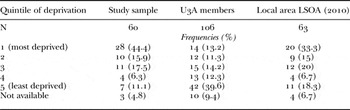
As shown in Table 1, 38 participants lived in areas considered to have high levels of socio-economic deprivation (Office for National Statistics data – use of Index of Multiple Deprivation (IMD) 2010 classification system and lower layer super output area (LSOA) dataFootnote 5 ) (Office for National Statistics 2014).
Quintile of deprivation of study sample, University of the Third Age (U3A) members and the local area

Note: LSOA, lower layer super output area.
The achieved sample was a mirror image of the socio-demographic characteristics of the existing U3A membership and reflected those of the local population.
We begin by examining the ways in which individuals remain active in later life. We then explore general barriers to participation in lifelong learning before examining specific barriers to involvement with the U3A, before finishing with reflections on the research collaboration.
Remaining active in later life
Recognition of the importance of remaining active in older age was apparent among participants who generally made an effort to engage in at least one activity on a weekly basis across a range of social groups, voluntary and physical activities, and learning opportunities. The primary reason for becoming involved in such activities was maintaining physical and mental wellbeing. Other motivations included searching for self-fulfilment, to meet new people and contribute to society:
I go to all their social evenings. Keeps me very busy, I go somewhere every day. When I retired I said to myself, ‘I am not going to be one of those women that sit in the house all day watching the television’. (Grace, 72)
I didn't want to be just watching that [television] because I thought if I do, I won't last long. (George, 84)
When I retired, well when I lost my husband, I thought, ‘I could be inclined to stay in’. I mean, I wouldn't be bored at all. I do crafts. I do all kinds; make cards … I mean, I would never be short of something to do. However, I thought, you have to say to yourself, ‘No, I can't’ … You need to go out. (Rosa, 80)
This study unearthed a greater number of groups for retirees in the area than had been anticipated by U3A research team members (in excess of 100). Participation in specific activities appeared to be somewhat divided along gendered lines. Social groups and voluntary opportunities were predominantly attended by women, while male participants recounted a greater interest in physical activities such as golf and bowls. Although both men and women participated in learning opportunities, women expressed a preference for engaging with formal learning opportunities (e.g. college courses) and men preferred less formal learning through interest groups. Although most participants were interested in learning in later life, a small minority differentiated between remaining active and lifelong learning, with comments such as ‘I'm too old to learn’. Such individuals associated ‘learning’ with formal academic education, rather than non-formal/informal knowledge acquisition. Whilst it was clear that this misapprehension formulated a barrier to lifelong learning for some, reasons for non-participation were multifaceted.
Factors influencing participation in lifelong learning activities
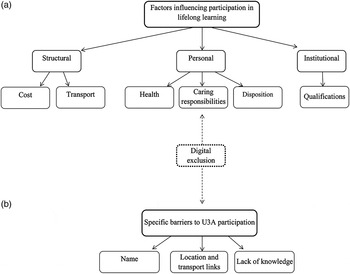
Figure 1a summarises the range of factors influencing participation in general lifelong learning activities as personal, structural and institutional. A number of personal factors acted as barriers to participation in lifelong learning. Firstly, caring responsibilities, such as providing care for ill family members or young grandchildren:
I enjoy it [minding her granddaughter], but I want my own life as well. I am torn there. By the same token, if she had asked anybody else to mind her, I would have been peeved, to say the least. As I say, I enjoy it. It is just that I was enjoying my retirement as well, doing my own thing. (Judith, 65)
Caring responsibilities were not uniformly viewed as restrictive and for some participants becoming a carer had provided different opportunities to meet new people through playgroups, school events and support groups. Some of those looking after ill relatives found that since becoming a carer they had made an effort to be more active in the community as they were in need of periods of respite.
Diagram (a) summarising the factors influencing participation in lifelong learning; (b) illustrating specific barriers to participating in the University of the Third Age.

Physical and mental health problems restricted participation; in particular, reduced mobility had a considerable impact:
I can't do steps. If it's somewhere where you have to climb hundreds of stairs and there's no lift well I wouldn't [attend], I couldn't. (Anna, 68)
I don't really like large groups of people. I don't know whether you would call it a mental illness, or anxiety, but I had a nervous breakdown … and I do find it intimidating with a lot of people. I'm okay in a small circle. (Elizabeth, 66)
Confidence, or lack thereof, was highlighted as a barrier, particularly to going into new situations. Participants spoke of feeling less confident and more vulnerable as they age, highlighting a notable decrease in their ability to manage unfamiliar situations:
As you get older you haven't quite got the confidence that you had … you lose it and going into a room full of strangers for the first time is very intimidating. (Heather, 75)
Most participants reiterated this apprehension by stating that they would be reluctant to start a new activity on their own for a fear of being judged by existing participants. This appeared, in part, to be based on a perception of the closed nature of existing groups. Fear of not being welcomed was commonly expressed. Having endured this experience in the past, some individuals expressed apprehension about engaging in new activities:
I joined [group name] that meets once a month … I used to get irritated because people didn't talk to you … I must have gone for about three or four years and I don't think anybody spoke to me apart from one girl. (Gillian, 70)
The majority noted that having someone to attend with or being able to accompany an existing member would have a positive impact on their desire to participate. A warm welcome was outlined as vital to ensuring future attendance.
Several participants highlighted that some individuals were not predisposed to group activities, pointing out that, ‘some people are not joiners' (Catherine, 70).
Some participants were satisfied with their current level of engagement in activities and were therefore not actively looking to incorporate a new activity into their existing routine. Others defined themselves as socially fulfilled, typically those who were part of an active couple content spending time together and did not feel the need to engage in more activities.
We enjoy each other's company; we don't need a great deal more. We're quite well satisfied with life. (Andrew, 71)
This is illustrative of the influence that partner behaviour can have on an individual in retirement (Van Solinge and Henkens Reference Van Solinge and Henkens2005) and affirms the finding that individuals tend to exhibit greater affinity for participating in activities following the loss of a partner through divorce or bereavement (Blair, McPake and Munn Reference Blair, McPake and Munn1995; Crossan et al. Reference Crossan, Field, Gallacher and Merrill2003; Davis Reference Davis2001; Jamieson Reference Jamieson2012; Jamieson, Miller and Stafford Reference Jamieson, Miller and Stafford1998; McGivney Reference McGivney, Chapman, Cartwright and McGlip2006).
More recently retired participants, primarily aged between 55 and 69, articulated an unwillingness to attend groups offering activities perceived to be synonymous with ‘being old’ (e.g. bowls and bingo). Older participants observed that the ‘younger old’ were more able to maintain social networks independently as they were less likely to be affected by ill health or bereavement and therefore had little need to attend formally constituted groups to ensure social activity in retirement:
The ones who are getting older … reaching 60, over 60, don't want to join these groups. They don't feel old do they? (Emily, 72)
Structural factors included cost of activities which was regularly mentioned as a barrier to participation, particularly rising costs for those on a fixed income:
‘Cost’ has got a lot to do with it [non-participation]. As pensioners, you are on a limited income anyway. (Francesca, 70)
If there was a class where you would go and you had to pay so much a year, I wouldn't mind that as long as it was doing something, something you wanted to do. (Rachel, 62)
Transport to groups was also often highlighted as restrictive. Some participants stressed that inadequate public transport prevented them from joining new groups or caused them to terminate long-standing group memberships. Discontent was specifically expressed towards local bus services which have become seriously depleted in recent years following austerity-related budget cuts. Most highlighted that walking to groups, regardless of locality, was not a desirable alternative for a number of reasons including concern about being outside alone (particularly in the dark) and mobility issues:
I don't like walking out now. At one time it was no bother, but you feel if something happens now ‘what do I do?’ I can't run, so I'm stuck, and other older people are the same. (George, 84)
The introduction of qualification schemesFootnote 6 as a requirement for participation and in some cases, a reduced fee, has become widespread at the more formal end of the adult learning sector in the UK. Participants felt that the introduction of funded training and or/qualifications changed the tone, shifting the focus of the activity from leisure purposes to expectations and ensuing pressurisation:
I didn't want to do exams and do high nationals and get qualifications … Then they brought out that each term you have to pass a certain exam – you had to do exams … you were going to do all these qualifications to get your teaching certificate whereupon the class would finish because nobody would want to go. It was absolutely ludicrous! (Sarah, 75)
In this sense the ‘learning for fun not qualifications' philosophy of the U3A was highlighted as an attractive element, catering to the desires of retirees where other local groups appeared to be failing.
The involvement of U3A members in the focus groups permitted first-hand explanation of the philosophy, purpose and scope of the U3A, and it became apparent that the U3A was viewed in a largely positive light by participants, none of whom were members, particularly the reasonable cost (£20, €25, US $34). Figure 1b summarises the main barriers to engaging in the U3A, the first of these being lack of knowledge. Almost all participants simply had not heard of the U3A despite numerous local information sources including: community centres, notice boards, newspapers, library services and a volunteer development agency, advertising the U3A alongside general activities for those aged over 50.
A second barrier was the name – its constituent parts and the ‘U3A’ abbreviation. Most participants highlighted difficulties discerning what the name meant and expressed that this alone did not encourage them to seek more information, affirming the view that ‘U3A’ is an ‘ill-advised label which requires elaborate explanation’ (Midwinter Reference Midwinter1984: 5). In line with the findings of Swindell (Reference Swindell1993), Formosa (Reference Formosa2000, Reference Formosa2012a ) and Findsen (Reference Findsen2005), some participants felt that the term ‘university’ inferred well-educated middle-class individuals:
U3A I thought was for really clever people, like university people, the middle class … I thought they'd be too clever. (Monica, 64)
Others suggested that the name's ‘highbrow’ connotations would put them off joining due to concerns about ‘like mindedness' and not ‘fitting in’:
I mean we never went to university, so to me the word ‘University’ on something means well it's probably not for me. I think there's still a lot of people the same. (Julie, 69)
Nevertheless, a minority were attracted to the group on the basis of the term ‘university’ alone, reflecting Williamson's (Reference Williamson2000) work in Australia, where women primarily welcomed the opportunity to engage in further education, something they felt they missed out on earlier in life.
The term ‘third age’ was similarly problematic, to a greater extent than has previously been documented. Few participants had heard this term before and whilst some deciphered the concept throughout the interview, expressing a new understanding of its relevance, others remained adamant that it was not easily understood nor was it suitable for the purpose for the group. ‘Third Age’ was a term that appeared ‘airy fairy’ (Julie, 69) and ‘hippie-ish’ (Philip, 72) to those similarly unaware of its meaning. Furthermore, some iterated Midwinter's (Reference Midwinter1984) point that ‘third age’ is too easily confused with ‘third world’.
The final barrier to the U3A outlined on Figure 1b is that of location and transport links. At the time of the study, the U3A monthly meetings were being held in a community centre attached to a church. Association with the church was off-putting for some, particularly so to those of no religious denomination or those of non-Christian denomination. This combined with limited car parking in the vicinity and limited public transport routes directly to the building was a particular problem for those with mobility problems.
For both general lifelong learning and the U3A, there was evidence of digital exclusion (hence its suspension between Figure 1a and 1b). There was scant knowledge of a digital document which detailed most lifelong learning opportunities in the area. Increased reliance on information technology (IT) as a source of information and form of communication was a concern. Many participants, particularly (but not only) those over the age of 70, expressed low levels of confidence regarding computer use – noting that they often become anxious, stressed and frustrated when interacting with new technology:
I don't do computers – terrible! I just couldn't do this ‘mouse’ thing! (Lillian, 77)
I get really annoyed if there's something that people find quite easy [on the computer], and I do it and I can't do it. I get upset. (Helen, 66)
Many participants were apprehensive about engaging with new technology (particularly the internet) and felt disadvantaged when it came to obtaining information. All participants were concerned about what they perceived as a societal assumption that everyone has access to and can use the internet. Several participants recounted approaching the local library for information in a physical format, such as leaflets, books and maps, only to be re-directed to the internet:
There's nothing, no information on there [the internet] if you are looking for something to do … [assumed IT access] is a big problem for people. With no information, if you haven't got a computer, I mean I have but there's nothing on the computer like… (Emma, 62)
Individuals expressed frustration that due to their lack of IT knowledge they are now unable to access the same volume of information they were once able to. Whilst our participants did not use the term ‘digital exclusion’ (Woodward et al. Reference Woodward, Freddolino, Wishart, Bakk, Kobayashi, Tupper, Panci and Blaschke-Thompson2013), it was clear that they experienced its effects.
Moreover, computer-literate participants stressed that they felt online information regarding local groups was of a poor quality, largely out of date and very difficult to find through traditional search engines. The research team initially experienced similar problems obtaining group information online, thus it was not the case that only age and IT experience of participants impacted their ability to locate readily available information. It did not appear that online information sources were sufficiently well-resourced to enable participants to access information about lifelong learning effectively.
Reflections on the collaboration
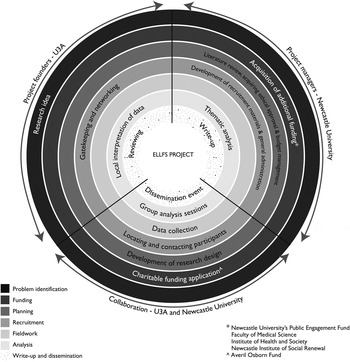
The success of projects that involve collaboration between academics and ‘non-academics' depends on the careful consideration and efficient determination of what has been described as the seven C's of collaboration: cohesion, communication, commitment, contribution, compatibility, consensus and credit (McCann Reference McCann2007). It has been recognised, however, that there are various models of collaboration between older researchers and academic partners (Bindels et al. Reference Bindels, Baur, Cox, Heijing and Abma2014), and whilst these elements proved to be important, our collaborative model was primarily successful because of our appreciation of complementary strengths and skills across seven stages of research – as represented by the concentric circles of Figure 2. The figure illustrates that whilst some tasks were undertaken independently (U3A: research idea, gatekeeping and networking, local interpretation of data, and reviewing data; university researchers: obtaining funds, literature review, ethics, general administration, analysis, writing first drafts of outputs), the bulk of responsibilities were shared. Joint elements included: acquisition of charitable funding, research design, recruitment, fieldwork, analysis (group sessions) and dissemination.
Diagram illustrating the collaborative model adopted for the Enhancing Lifelong Learning for Seniors (ELLFS) project.

Although the origins of this project are firmly rooted in the U3A, with their win at the RITA competition being the catalyst, the introduction of experienced researchers who could undertake a significant portion of the workload and project management enabled the research to be executed and completed within a relatively short timescale. Consensus in the early stages about study approach, responsibility and intended outputs ensured all team members were working towards a common goal in a way that best suited their strengths. This working model afforded the U3A a degree of choice over their involvement, with university researchers taking into consideration the co-researchers' prior commitments and voluntary status. As is postulated by McCann (Reference McCann2007) and Bindels et al. (Reference Bindels, Baur, Cox, Heijing and Abma2014), communicating such preferences throughout proved vital to maintaining group dynamic and minimalising the potential for conflict. Communication outside meetings did initially prove problematic due largely to geographical distance between team members (based over 30 miles apart) and generational preference. Whilst university researchers were heavily reliant on e-mail as their primary method of communication, some members of the U3A preferred telephone and post. This made initial communication slower than had been anticipated. Existent relationships between U3A team members partially aided the resolution of this, allowing messages to be passed on quickly, but the appointment of an academic co-ordinator (Patterson) to mediate telephone calls, develop weekly e-mail updates and send information via post made a significant difference.
As previously highlighted, a key facet of our collaboration model was the recognition of complementary skills of university researchers and U3A members. The amalgamation of scientific (university) and experiential (U3A) knowledge (Bindels et al. Reference Bindels, Baur, Cox, Heijing and Abma2014) greatly enhanced this study. U3A knowledge of the research area and population proved invaluable throughout recruitment, data collection and analysis. Existent U3A networks facilitated the recruitment of a varied sample of participants, including those from lower socio-economic groups and men. U3A team members' input aided data collection through ensuring the development of suitable research materials – in line with the age and demographic profile of participants. Moreover, similar to Bindels et al. (Reference Bindels, Baur, Cox, Heijing and Abma2014), the presence of U3A team members at interviews appeared to put interviewees at ease and encouraged them to engage readily in a dialogue about the U3A. Participants felt free to ask as many questions about the U3A and potential membership as were being posed to them regarding non-participation – this exchange was often more enlightening than responses to questions detailed in the topic guide:
Facilitator 1: There was a lady who was looking at our sheet yesterday and she said, ‘Oh, bridge? I have always wanted to be able to play bridge’.
Female 2: I don't know about it. Don't you have to be clever? (laughter)
Facilitator 2: Well, I am learning, so that proves that you don't have to be clever. (laughter) … We usually have a guest speaker. Tomorrow, we have got a guy who is a retired coroner. It is called ‘45 Years on the Game’. As a coroner, I hasten to add, ladies. (laughter)
Female 7: I did see that advertised. Yes. It sounded interesting, that, actually.
Female 1: It should be interesting to listen to him.
Female 6: Does it cost you money to come to the meetings?
Facilitator 2: No.
Facilitator 1: Not if you are a member.
Facilitator 2: Members: it costs nothing. Guests can come once, just to see what it is like.
Facilitator 1: One doesn't have to be a member.
Facilitator 2: A full year is £20 a year.
Female 5: I don't want to offend anybody, but looking at it, to me, I would say that this was aimed at more middle-class people.
Facilitator 2: Yes, that is another perception.
Female 5: That is the perception I get probably.
Facilitator 2: It isn't, but I wouldn't disagree with you…
Female 2: That normal, ordinary, everyday people wouldn't go to?
Female 1: When you say that … Which category do you put yourself in? Middle class or working class?
Female 5: Working … Working class.
Female 4: Definitely working class.
Facilitator 1: Do you think it is people with money [that attend U3A]?
Female 5: Yes.
Analysing data alongside local people allowed a level of data contextualisation that would not have been possible if the research was undertaken by the university alone. Moreover, merging the findings of several independent analytic assessments of the data increased analytic confidence in the findings (Sillito, Wishart and Gatin Reference Sillito, Wishart and Gatin2008).
Discussion
Participants identified a range of factors that influenced their engagement in lifelong learning, including: health status, personal disposition, time, cost and transport, but their motivations for taking part in these activities were similar to those found elsewhere – a desire to maintain and potentially improve mental and physical wellbeing, attain new knowledge and meet new people (Boulton-Lewis Reference Boulton-Lewis2010; Carlton and Soulsby Reference Carlton and Soulsby1999: 112; Dench and Regan Reference Dench and Regan2000; Jamieson Reference Jamieson2012; Sloane-Seale and Kops Reference Sloane-Seale and Kops2007). Specific barriers to participation in the U3A were: group name, location but primarily lack of knowledge about the organisation itself.
Notwithstanding these significant barriers to participation, the emerging view about the U3A was that the self-help and peer support ethos of the organisation was highly attractive. Indeed, these characteristics epitomise many of the mutual learning associations typically found in traditional working-class communities in the UK throughout the 20th century, before the demise of heavy industry (Dennis, Henriques and Slaughter Reference Dennis, Henriques and Slaughter1969). Among others, Formosa notes that the term ‘university’ has ‘heavy class baggage’, which has prevented ‘working-class elders' from joining (2014: 53). Australian U3As believe this to be so damaging to membership that use of the full name is avidly evaded in favour of focusing on the ‘U3A’ acronym (Swindell Reference Swindell1993: 260). Further, it has previously been proposed that the term ‘third age’ is off-putting, as few appear to understand the relevance of the term.
Whilst it is well documented that the ‘University of the Third Age’ predominantly attracts individuals with relatively high levels of education, our findings indicate that informing those who believe themselves ‘not qualified enough’ to take part (Swindell Reference Swindell1993: 263) of the ethos and practice of the U3A has considerable potential to overcome the elitism associated with the U3A. Indeed the low membership cost was highly attractive to adults more likely to be on lower incomes (Hebestreit Reference Hebestreit2008; Moody Reference Moody and Tulle2004). A further finding of note is that the apparent ‘feminisation’ of the group (Formosa Reference Formosa2014; Williamson Reference Williamson2000), in which women are thought to outnumber men 2:1 in the UK (Bunyan and Jordan Reference Bunyan and Jordan2005), did not deter men from joining, with one joking:
It doesn't faze me at all! At our age, the ladies outnumber the men anyway! (Andrew, 71)
Our findings indicate that the key exclusionary forces to participation in the U3A reflect wider structural factors such as social class, gender and educational level which operate at both conscious and unconscious levels. These forces work in opposition to the democratic, inclusionary and participatory principles of the U3A. Our work suggests that active strategies, such as those undertaken by the U3A researchers and referred to below, are necessary to both acknowledge and redress the impact of such exclusionary forces.
Our study demonstrates the ways in which conducting collaborative research with older individuals can have a positive impact on the research process, highlighting the importance of experiential and local area knowledge. This co-production facilitated the efficient collection of data alluding to ways to improve the social inclusivity of the U3A, under time constraints which would typically hamper the production of high-quality qualitative research. Thus, the collaborative nature of the research methodology evidently needs to be recognised as one of the strengths of this study. Input from local individuals of a similar age to participants proved invaluable throughout recruitment, data collection and analysis – continually facilitating data contextualisation. Producing research in this way improved the rigour of the results, ensuring both generational and community views were effectively assessed during the research process and appropriately represented in dissemination materials. Another strength of this research is its unique quality, both in approach and content. Limited research on UK U3As exists (in comparison with other nations, e.g. Malta and Australia), particularly on branches situated in the North of England. To our knowledge, no UK qualitative research on participation in the U3A has been published. Moreover, although it is argued to be important, for both the U3A organisation (U3A 2014) and research in general (Walker Reference Walker2007), the involvement of older people in ageing research to the extent exhibited in this study is rare, an exception being the work of Bindels et al. (Reference Bindels, Baur, Cox, Heijing and Abma2014).
An immediate impact of this research and one that enabled co-researchers to achieve a key aim was that through unearthing explanations for non-participation, the U3A team formulated tangible solutions to recruitment problems. In an attempt to address inclusion issues, the U3A research team have drawn on their own findings in conjunction with those of Formosa's to implement an engagement plan which involves: outreach within the community (including hosting talks on the U3A), working to counter stereotypes regarding the purpose and remit of the group, and tailoring groups to attract individuals least likely to attend (e.g. men).
Limitations of this study include its small scale and specific locality. Since 60 individuals were interviewed for this study the transferability of the findings is limited, although our findings do mirror research from other settings in other countries (Formosa Reference Formosa2000; Swindell Reference Swindell1993). More significantly in terms of interpreting the findings is that we did not include older people not engaged in any lifelong learning activities as this was beyond the scope and resources of this study. There may be unidentified barriers to participation in lifelong learning in general and the U3A specifically that would emerge from research conducted with less-engaged older adults.
Conclusions
With an approach to learning typifying that of traditional industrial communities, one of self-help and peer-support, the U3A has great potential to be inclusive of all social groups. A collaborative approach to researching questions of social inclusivity within the U3A proved to be successful, outlining three exclusionary factors: lack of knowledge about group presence and purpose (both locally and nationally), organisational name and location. Reflecting the findings of previous studies, it was identified that the U3A was generally perceived as a middle-class organisation for those with high educational attainment. Organisational name appeared to be particularly significant in perpetuating this image. In contrast, results indicated that other factors documented as influential over U3A participation were not classed as significant deterrents among this population, including the cost (low) and feminisation of the group. In line with these findings, a number of engagement strategies were identified which may widen participation in the U3A, including outreach to promote the purpose and remit of the group, and closely tailoring groups to attract alternative social groups. Implementing such strategies will aid in countering the ill-conceived notion that one can become ‘too old to learn’ and thus extend the benefits of learning in later life to include less-engaged individuals.
Acknowledgements
This study was funded by the Averil Osborn Fund (British Society of Gerontology), Newcastle Institute of Social Renewal and Newcastle University's Public Engagement Fund, Faculty of Medical Sciences and Institute of Health and Society. The principle investigator (Moffatt) and primary researcher (Patterson) are based in the Institute of Health and Society. This study was approved by Newcastle University Ethics Committee (00663/2013) and informed consent was given by all participants. MS and JS had the original idea and developed the protocol alongside SM and RP. SM led funding applications. RP, MS, JS, CM, JB and NB conducted focus groups, RP conducted interviews. SM and RP led the qualitative analysis with all contributing. RP and SM drafted the paper. MS, JS, CM, JB and NB reviewed drafts and provided constructive feedback. SM is guarantor. There are no potential conflicts of interest with regards to research, authorship or publication of this study.