





Introduction
CHD affects 1 in 100 live births worldwide, with more than 90% of affected children born in low-and middle-income countries. Reference Van Der Linde, Konings and Slager1,Reference Zimmerman, Smith and Sable2 Many of them present with valvular pathology requiring surgery, yet fewer than 5% of those in need in low-and middle-income countries receive timely care. Reference Vervoort, Meuris, Meyns and Verbrugghe3,Reference Vervoort, Swain, Pezzella and Kpodonu4 The options for valve replacement in young children are uniformly imperfect: mechanical valves require warfarin, a critical barrier in settings with limited international normalised ratio monitoring; bioprosthetic valves degenerate rapidly in children; cryopreserved homografts require tissue banking infrastructure; and the Ross procedure carries a high mortality due to the need to replace both aortic and pulmonary valves. Reference Rajab, Zorrilla-Vaca, Kavarana, Mokashi and Sainathan5 No existing valve replacement provides a living implant that grows with the child.
Partial heart transplantation, first performed in 2022, addresses this unmet need by transplanting valve allografts from donor hearts into recipients with irreparable congenital valve disease and providing viable valve tissue with the capacity for somatic growth. Reference Rajab6,Reference Overbey, Aykut and Kucera7 The early clinical experience of 19 patients has demonstrated evidence of adaptive valve growth. Reference Overbey, Aykut and Kucera7 While partial heart transplantation was developed in a high-resource environment, the greatest population requiring growing valve implants exists in low-and middle-income countries, where children with irreparable valve disease face repeated operations, lifelong anticoagulation challenges, or no surgical option at all. This review examines the specific challenges and potential feasibility of implementing partial heart transplantation in resource-limited settings, with the goal of identifying a realistic pathway to global access.
The need for paediatric valve replacement in low-and middle-income countries
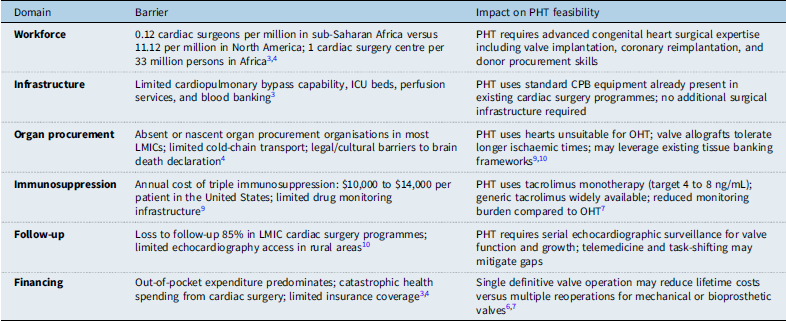
The disparity in access to cardiac surgery between high-income countries and low-and middle-income countries is staggering. Vervoort and colleagues reported that sub-Saharan Africa has approximately 1 cardiac surgery centre per 33 million persons, compared with 1 per 120,000 in North America, and 0.12 cardiac surgeons per million population compared with 11.12 per million in North America. Reference Vervoort, Meuris, Meyns and Verbrugghe3,Reference Vervoort, Swain, Pezzella and Kpodonu4 Of the estimated 1.35 million children born annually with CHD requiring intervention, more than 90% in low-and middle-income countries do not receive surgery. Reference Van Der Linde, Konings and Slager1,Reference Zimmerman, Smith and Sable2 For those who do access care, valve replacement presents a particular hurdle. Across Africa, roughly 90% of patients undergoing valve replacement receive mechanical prosthetic valves. However, anticoagulation management is often inadequate: about 10% of patients discontinue warfarin completely, 12% receive no international normalised ratio monitoring, and 34% undergo only intermittent testing. Reference Zilla, Human and Pennel8 The clinical consequences are severe. In South Africa, thrombosis of mechanical valves accounts for 74% of redo valve surgeries, and 73% of these cases present as surgical emergencies. Reference Zilla, Human and Pennel8 Meanwhile, transcatheter valve therapies remain largely unavailable in low-and middle-income countries. Even when surgical prostheses are accessible, hospitals frequently lack a full range of valve sizes, leaving surgeons without appropriately sized implants for paediatric patients and small adults. Table 1 summarises the major limitations of cardiac surgery in low-and middle-income countries and their implications for partial heart transplantation implementation. Reference Vervoort, Meuris, Meyns and Verbrugghe3,Reference Vervoort, Swain, Pezzella and Kpodonu4,Reference Rajab6,Reference Overbey, Aykut and Kucera7,Reference Baran, Zucker and Arroyo9,Reference Lannon, Nuchovich and Louis10
Barriers to cardiac surgery in low-and middle-income countries and their implications for partial heart transplantation

Table 1. Long description
A table with six rows and three columns. The columns are labeled Domain, Barrier, and Impact on PHT feasibility. The table compares various barriers in different domains and their implications for partial heart transplantation (PHT) feasibility. Row 1: Domain, Workforce; Barrier, 0.12 cardiac surgeons per million in sub-Saharan Africa versus 11.12 per million in North America; 1 cardiac surgery centre per 33 million persons in Africa; Impact on PHT feasibility, PHT requires advanced congenital heart surgical expertise including valve implantation, coronary reimplantation, and donor procurement skills. Row 2: Domain, Infrastructure; Barrier, Limited cardiopulmonary bypass capability, ICU beds, perfusion services, and blood banking; Impact on PHT feasibility, PHT uses standard CPB equipment already present in existing cardiac surgery programmes; no additional surgical infrastructure required. Row 3: Domain, Organ procurement; Barrier, Absent or nascent organ procurement organisations in most LMICs; limited cold-chain transport; legal/cultural barriers to brain death declaration; Impact on PHT feasibility, PHT uses hearts unsuitable for OHT; valve allografts tolerate longer ischaemic times; may leverage existing tissue banking frameworks. Row 4: Domain, Immunosuppression; Barrier, Annual cost of triple immunosuppression: $10,000 to $14,000 per patient in the United States; limited drug monitoring infrastructure; Impact on PHT feasibility, PHT uses tacrolimus monotherapy (target 4 to 8 ng/mL); generic tacrolimus widely available; reduced monitoring burden compared to OHT. Row 5: Domain, Follow-up; Barrier, Loss to follow-up 85% in LMIC cardiac surgery programmes; limited echocardiography access in rural areas; Impact on PHT feasibility, PHT requires serial echocardiographic surveillance for valve function and growth; telemedicine and task-shifting may mitigate gaps. Row 6: Domain, Financing; Barrier, Out-of-pocket expenditure predominates; catastrophic health spending from cardiac surgery; limited insurance coverage; Impact on PHT feasibility, Single definitive valve operation may reduce lifetime costs versus multiple reoperations for mechanical or bioprosthetic valves.
PHT = partial heart transplantation, LMIC = low-and middle-income country, LIC = low-income country, MIC = middle-income country, CPB = cardiopulmonary bypass, OHT = orthotopic heart transplantation, ICU = intensive care unit, INR = international normalised ratio.
Current evidence of partial heart transplantation
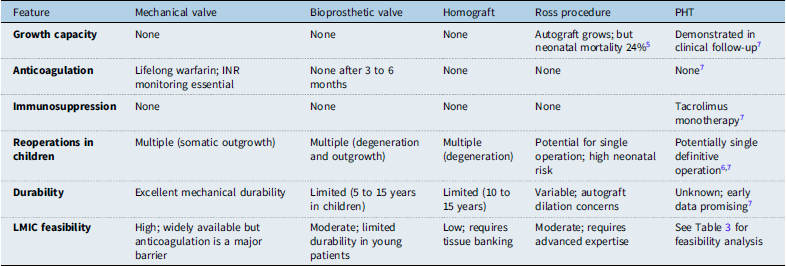
Partial heart transplantation involves procuring the aortic root, pulmonary root, or both from a donor heart and transplanting them into a paediatric recipient. Reference Rajab6,Reference Overbey, Aykut and Kucera7 Unlike cryopreserved homografts, which undergo devitalisation during processing and storage, partial heart transplantation allografts are freshly procured and transplanted with viable cellularity intact, preserved by immunosuppression. Reference Rajab6 The underlying rationale derives from the observation that semilunar valves within orthotopic heart transplantation demonstrate somatic growth over decades without structural deterioration, suggesting that living, immunosuppressed valve tissue retains the biological capacity for growth and self-repair. Reference Dudley, Conaway, McCulloch and Haregu11 The pilot study of 19 patients who underwent partial heart transplantation included neonates and infants with irreparable truncal valves, failed prior valve interventions, and other forms of complex congenital semilunar valve disease like tetralogy of Fallot with pulmonary atresia. Reference Overbey, Aykut and Kucera7 Maintenance immunosuppression consisted of tacrolimus monotherapy with a target trough level of 4 to 8 ng/mL. Reference Overbey, Aykut and Kucera7 No operative mortality occurred, and early echocardiographic follow-up demonstrated preserved valve function and evidence of annular and leaflet growth. Reference Overbey, Aykut and Kucera7 Table 2 compares partial heart transplantation with conventional valve replacement options in the context of low-and middle-income country feasibility. Reference Vervoort, Meuris, Meyns and Verbrugghe3,Reference Vervoort, Swain, Pezzella and Kpodonu4,Reference Rajab6,Reference Overbey, Aykut and Kucera7,Reference Baran, Zucker and Arroyo9
Comparison of paediatric heart valve replacement options with implications for resource-limited settings

Table 2. Long description
A table comparing different pediatric heart valve replacement options and their features. The table has 6 columns and 7 rows, including the header row. The columns are labeled Feature, Mechanical valve, Bioprosthetic valve, Homograft, Ross procedure, and PHT. The rows compare various features such as Growth capacity, Anticoagulation, Immunosuppression, Reoperations in children, Durability, and LMIC feasibility. Each cell contains specific information relevant to the feature and valve type. For example, under Growth capacity, Mechanical valve and Bioprosthetic valve have ‘None’, Homograft has ‘None’, Ross procedure has ‘Autograft grows; but neonatal mortality 24%’, and PHT has ‘Demonstrated in clinical follow-up’. The table provides a detailed comparison of the advantages and limitations of each valve replacement option in pediatric patients.
INR = international normalised ratio.
Feasibility framework for partial heart transplantation implementation in low-and middle-income countries

Table 3. Long description
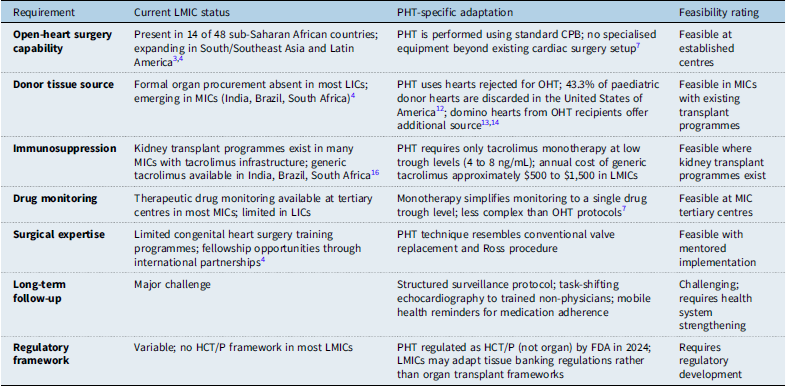
A table comparing feasibility of partial heart transplantation in low-and middle-income countries. The table has 6 rows and 4 columns. Column headers are Feature, Mechanical valve, Bioprosthetic valve, Homograft, Ross procedure, and PHT. Row 1: Growth capacity, None, None, None, Autograft grows; but neonatal mortality 24 percent, Demonstrated in clinical follow-up. Row 2: Anticoagulation, Lifelong warfarin; INR monitoring essential, None after 3 to 6 months, None, None, None. Row 3: Immunosuppression, None, None, None, None, Tacrolimus monotherapy. Row 4: Reoperations in children, Multiple (somatic outgrowth), Multiple (degeneration and outgrowth), Multiple (degeneration), Potential for single operation; high neonatal risk, Potentially single definitive operation. Row 5: Durability, Excellent mechanical durability, Limited (5 to 15 years in children), Limited (10 to 15 years), Variable; autograft dilation concerns, Unknown; early data promising. Row 6: LMIC feasibility, High; widely available but anticoagulation is a major barrier, Moderate; limited durability in young patients, Low; requires tissue banking, Moderate; requires advanced expertise, See Table 3 for feasibility analysis.
PHT = partial heart transplantation, LMIC = low-and middle-income country, LIC = low-income country, MIC = middle-income country, CPB = cardiopulmonary bypass, OHT = orthotopic heart transplantation, HCT/P = human cells tissues, and cellular and tissue-based product, FDA = Food and Drug Administration.
Challenges specific to resource-limited settings
Organ procurement and donor tissue supply
The most significant barrier to partial heart transplantation implementation in low-and middle-income countries is the limited organ procurement infrastructure. Formal organ procurement organisations exist in only a minority of low-and middle-income countries, and legal and cultural frameworks for declaration of death remain absent or contested. Reference Vervoort, Swain, Pezzella and Kpodonu4 The most important sources for partial heart transplantations are paediatric and young adult donor hearts that are discarded Reference Nguyen, Schiazza, Richmond, Zuckerman, Bacha and Goldstone12 and domino hearts from orthotopic heart transplantation recipients, where the explanted native heart may contain usable semilunar valves. Reference Kalfa, Richmond and Cordoves13,Reference Alexander, Contorno, Javed, Callais and Rajab14
Surgical complexity
In many low-and middle-income countries, a single surgeon often manages both adult and paediatric caseloads and may not be familiar with paediatric outflow tracts. Partial heart transplantation entails aortic and/or pulmonary root replacement with coronary reimplantation, a procedure that is considerably more demanding than conventional prosthetic valve replacement or heart transplant. This results in a steeper learning curve and makes mentored and proctored adoption a prerequisite.
Immunosuppression and drug monitoring
Partial heart transplantation requires tacrolimus monotherapy at a target trough of 4 to 8 ng/mL, a substantially simplified regimen compared with the triple immunosuppression (calcineurin inhibitor, antiproliferative agent, and corticosteroids) used for orthotopic heart transplantation. Reference Overbey, Aykut and Kucera7,Reference Baran, Zucker and Arroyo9 The Tacrolimus in Combination, Tacrolimus Alone Compared trial demonstrated that tacrolimus monotherapy in cardiac transplantation achieves comparable rejection rates and 3-year survival to dual therapy. Reference Baran, Zucker and Arroyo9 Generic tacrolimus is now widely available globally, with annual costs in low-and middle-income countries estimated at $500 to $1,500, substantially lower than the $10,000 to $14,000 annual cost of triple immunosuppression in the United States. Reference Baran, Zucker and Arroyo9 Nevertheless, therapeutic drug monitoring infrastructure, while available at tertiary centres in most middle-income countries through existing kidney transplant programmes, remains limited in low-income countries. The potential for future immunosuppression weaning, as partial heart transplantation allografts may develop tolerance over time due to valve immune privilege, could further reduce this burden. Reference Hill, Kwon and Gerry15
Regulatory and ethical considerations
In 2024, the FDA classified partial heart transplantation tissue as human cells tissues, and cellular and tissue-based products under 21 CFR Part 1271. This classification means partial heart transplantation does not compete with hearts allocated for lifesaving orthotopic heart transplantation. For low-and middle-income countries, this regulatory distinction is important: countries may be able to develop partial heart transplantation programmes under simpler tissue banking regulatory frameworks rather than the more complex organ transplant legislation, lowering the regulatory threshold for implementation.
A feasibility framework for implementation
The term low-and middle-income country aggregates health systems of markedly different infrastructure, and the feasibility of partial heart transplantation will therefore vary substantially between countries, with any implementation requiring adaptation to the individual context. Table 3 presents a systematic feasibility analysis mapping partial heart transplantation requirements against current low-and middle-income country capacity. Reference Vervoort, Meuris, Meyns and Verbrugghe3,Reference Vervoort, Swain, Pezzella and Kpodonu4,Reference Overbey, Aykut and Kucera7,Reference Kalfa, Richmond and Cordoves13,Reference Alexander, Contorno, Javed, Callais and Rajab14,Reference Roberts, Kaur, Jewitt-Harris, Ready and Milford16 The analysis suggests that partial heart transplantation implementation is most immediately feasible in established middle-income country cardiac surgery centres that already possess cardiac transplantation or kidney transplantation programmes, providing the necessary infrastructure for organ/tissue procurement, immunosuppression management, and therapeutic drug monitoring. Reference Roberts, Kaur, Jewitt-Harris, Ready and Milford16
A phased implementation strategy is proposed. In the first phase, established middle-income country centres with existing orthotopic heart transplantation programmes (such as those in India, Brazil, South Africa, or Colombia) would initiate partial heart transplantation under international mentorship partnerships, using domino hearts or locally discarded donor hearts as tissue sources. In the second phase, successful middle-income country centres would serve as regional training hubs, extending partial heart transplantation capacity to neighbouring countries through twinning arrangements modelled on existing international congenital heart surgery training initiatives. In the third phase, partial heart transplantation-specific tissue banking protocols would be developed for broader low-and middle-income country implementation, potentially incorporating advances in valve preservation technology that extend cold ischaemic times and facilitate tissue transport across greater distances. Reference Cordoves, Ferrari, Zorn, Bacha, Vunjak-Novakovic and Kalfa17
Conclusions
Partial heart transplantation represents a paradigm shift in paediatric valve replacement by providing the first living, growing valve implant for children with irreparable congenital valve disease. The greatest burden of this disease exists in resource-limited settings, where conventional valve replacement options are most problematic: mechanical valves require anticoagulation monitoring that is unavailable, bioprosthetic valves degenerate too quickly, and homograft banking infrastructure is absent. Partial heart transplantation offers several inherent advantages for low-and middle-income country adaptation, including the use of standard cardiac surgical equipment, simplified immunosuppression with a single generic drug, and tissue sourcing from otherwise discarded donor hearts. While significant challenges remain in organ procurement infrastructure, regulatory development, and long-term surveillance capacity, a phased implementation strategy beginning at established middle-income country cardiac surgery centres with existing transplant programmes offers a realistic pathway. The biology of partial heart transplantations, international collaborative partnerships, generic immunosuppression, and the emerging regulatory distinction between partial heart transplantation tissue and transplant organs collectively create a window of opportunity to bring this transformative technology to the children who need it most.
Data availability statement
No new data were generated or analysed in support of this research.
Competing interests
All authors declare no conflict of interest.

 Open access

