

Debt is a pervasive phenomenon that spans history, geography and multiple dimensions of economic life. Individuals, businesses and nations all rely on debt; inevitably, questions emerge across all of these dimensions when debtors are unable to fulfill their obligations to lenders. Should the original terms of debt contracts be strictly enforced, or should greater flexibility ease the burden of debtors? Policy debates over bank bailouts, sovereign defaults, corporate bankruptcy, mortgage default and student loan repayment often revolve around this core question.
Despite the ubiquity of both debt and debt-related policy debates, not much empirical attention has been devoted to studying how the public feels about debt relief. It is especially noteworthy that, considering the different social contexts in which debt contracts manifest, very little is known about whether the moral intuitions that drive debt-related policy preferences are consistent across these contexts or whether, instead, different moral considerations receive greater weight in certain debt domains. A greater understanding of the context dependence of moral intuitions toward debt relief could aid policy-makers when predicting how the public will respond to debt-related policies across different domains.
This paper presents results from a vignette-based study that examines attitudes toward debt relief across a sovereign-debt context with the debtor and lender being two countries (hereafter, international debt) and a context in which an individual owes a debt to a bank (hereafter, person-bank debt). The vignettes describe a simple situation with a debtor being unable to pay back a lender and a judge choosing to allow debt relief. Participants must rate how fair they find the decision to allow debt relief to be. Information conditions test how lender responsibility, debtor responsibility and the salience of the lender's profit motive affect the perceived fairness of debt relief. The design allows inferences to be made with respect to the overall (main) effects of social context on the perceived fairness of debt relief, as well as with respect to interactions of social context with lender responsibility, debtor responsibility and profit salience.
The study manipulates debtor and lender responsibility for two reasons. First, vignette-based studies have found that preferences for redistribution are stronger (weaker) when respondents perceive that one's situation is within (beyond) one's control (Schokkaert & Overlaet, Reference Schokkaert and Overlaet1989; Schokkaert & Capeau, Reference Schokkaert and Capeau1991; Konow, Reference Konow1996, Reference Konow2001, Reference Konow2003, Reference Konow2009; Faravelli, Reference Faravelli2007; Chavanne, Reference Chavanne2016, Reference Chavanne2018). Additionally, large-scale national or international surveys show a robust relationship between preferences for redistributive policies and perceptions that life situations are products of effort or luck (Fong, Reference Fong2001; Alesina & La Ferrara, Reference Alesina and La Ferrara2005; Boarini & Le Clainche, Reference Boarini and Le Clainche2009). Relatedly, distributive decisions in laboratory experiments show that people are more willing to accept unequal outcomes when inequality is the result of effort rather than luck (Hoffman & Spitzer, Reference Hoffman and Spitzer1985; Hoffman et al., Reference Hoffman, McCabe, Shachat and Smith1994; Konow, Reference Konow2000; Cherry et al., Reference Cherry, Frykblom and Shogren2002; Dickinson & Tiefenthaler, Reference Dickinson and Tiefenthaler2002; Cappelen et al., Reference Cappelen, Hole, Sørensen and Tungodden2007; Oxoby & Spraggon, Reference Oxoby and Spraggon2008; Chavanne et al., Reference Chavanne, McCabe and Paganelli2015). Given the substantial effects that beliefs about responsibility have on redistributive preferences and on distributive decisions, it is important to understand the extent to which the effects extend to issues surrounding debt relief. Second, popular writing during or following debt crises often, implicitly or explicitly, invokes concerns regarding the role of responsibility when describing precipitating events. Those who advocated for some type of homeowner bailout following widespread defaults on subprime mortgages could, for example, have highlighted the failure of local mortgage lenders to do their due diligence (e.g., The Economist, 2013); other factors, such as homeowner autonomy (e.g., Greenhut, Reference Greenhut2012; Perlberg, Reference Perlberg2014) or the role of an economic cycle unforeseen by lenders (Ferreira & Gyourko, Reference Ferreira and Gyourko2015; Adelino et al., Reference Adelino, Schoar and Severino2018), could instead have been emphasized in order to strengthen resistance to bailing out homeowners. Likewise, people who supported bailing out Greece could have pointed to precipitating factors, like private speculation, which were out of Greek government's control (e.g., Boyer, Reference Boyer2012), while those who opposed a bailout could instead have pointed to deliberate economic policies that endangered the Greek economy (e.g., Higgins & Klitgaard, Reference Higgins and Klitgaard2011). Studying how the importance of debtor and lender responsibility varies across social contexts will shed light on whether invocations of debtor and/or lender responsibility are likely to be particularly influential within certain debt domains.
The study manipulates profit salience since, much like notions of responsibility are used rhetorically to shift political support toward one's chosen side in a debate over debt relief, references to lender greed can also be used to strengthen support for debtor-friendly policies. Following the 2008 financial crisis, many accounts emphasized the role of financial incentives within the financial system (Taleb, Reference Taleb2010; Tett, Reference Tett2010; Johnson & Kwak, Reference Johnson and Kwak2011; Lewis, Reference Lewis2011; McLean & Nocera, Reference McLean and Nocera2011). Steinbach (Reference Steinbach2015), connecting contemporary European debt issues to past history, notes the frequency with which lenders have historically been portrayed as greedy speculators. Knight (Reference Knight2012) describes the anti-capitalist narrative that has fueled Greeks who blame the European troika for their country's economic problems. Writing about the Latin American debt crises in the early 1980s, Madrick (Reference Madrick2011) describes the ways in which greed affected individuals and financial institutions. With greed commonly used when describing the motives of individuals, banks and nation states, it is important to understand what sources of information generate perceptions that lenders are acting with greed and whether perceptions of lender greed emerge differently in different social contexts.
The study presented here was motivated by results of an initial study that used equivalent methods to study moral intuitions toward debt relief across two different social contexts. Chavanne (Reference Chavanne2017) compared the perceived fairness of debt relief across a personalized debt context – with the lender and debtor being two individuals – and a corporate debt context – with the debtor and lender being two banks. This initial study's results identify a sharp distinction between responses to corporate and personalized debt. For corporate debt, debt relief was perceived as being fairer when debtors were unlucky and when lenders were careless, regardless of whether the lender's profit motive was made salient. For personalized debt, however, the impact of responsibility was weaker, as lender responsibility had no effect on the perceived fairness of debt relief and debtor bad luck only increased the perceived fairness of debt relief when the lender's profit motive was made salient.
The present study expands upon the first study by systematically examining how lender responsibility, debtor responsibility and profit salience affect moral intuitions toward debt relief within two social contexts that are particularly relevant from a policy perspective – international debt and debt involving an individual borrowing from a bank. To illustrate how the present study follows from questions relevant to policy-makers, consider a European citizen confronted with two separate policy debates, one involving an individual who is unable to pay a mortgage and a second involving a defaulting EU member state. Is he or she more likely to support debt relief in one domain compared to the other, perhaps due to anti-bank sentiment that emerges when banks attempt to force repayment from individuals? Will knowledge that the debtor acted carelessly or that a lender was motivated by greed affect preferences for debt relief similarly across these two contexts, or are people, banks and countries treated differently? An understanding of how the moral intuitions that shape attitudes toward debt relief vary within these contexts can shed light on why the public feels the way it does toward certain debt-related policies, as well as improve predictions of how voters will respond to various policy proposals that confront particular debt crises.
The experimental design is motivated by four fundamental questions, which are analyzed descriptively in the ‘Results’ section. First, in light of the effects of social context identified by Chavanne (Reference Chavanne2017), do attitudes toward debt relief in the practical domains of international and person-bank debt follow the patterns of corporate debt relief – where responsibility is a driving force – or personalized debt relief – where norms for promise-keeping instead seem to dominate? Second, does the salience of a lender's profit motive affect the perceived fairness of debt relief in international and person-bank contexts? Third, do anti-bank sentiments emerge in a person-bank context and, if so, how do they impact the perceived fairness of debt relief? Fourth, how does the perceived fairness of debt relief compare across all four contexts examined across the two studies? Given that the context specificity of the moral intuitions toward debt relief has not been widely studied, the goal of this paper is to provide descriptive results that address these questions and can therefore serve as foundations for future theorizing and empirical tests.
Although the present study and the study described by Chavanne (Reference Chavanne2017) are the first attempts to analyze public perceptions of debt relief using vignettes, the method used in these studies is commonly used in social science research to examine how judgments respond to changes in social context. In addition to the work cited above involving vignette-based studies of the effect of responsibility on redistributive preferences (Schokkaert & Overlaet, Reference Schokkaert and Overlaet1989; Schokkaert & Capeau, Reference Schokkaert and Capeau1991; Konow, Reference Konow1996, Reference Konow2001, Reference Konow2003, 2009; Faravelli, Reference Faravelli2007; Gaertner & Schokkaert, Reference Gaertner and Schokkaert2012; Chavanne, Reference Chavanne2016, Reference Chavanne2018), vignettes have been used to study topics that include, but are not limited to, how fairness judgments respond to price and wage increases (Kahneman et al., Reference Kahneman, Knetsch and Thaler1986), to alternative resource distributions (Yaari & Bar-Hillel, Reference Yaari and Bar-Hillel1984), to changes in causation and culpability (Alicke, Reference Alicke1992; Hitchcock & Knobe, Reference Hitchcock and Knobe2009; Alicke et al., Reference Alicke, Rose and Bloom2011), to changes in criminal sentencing severity (Robinson & Darley, Reference Robinson and Darley1995; Carlsmith et al., Reference Carlsmith, Darley and Robinson2002; Robinson & Kurzban, Reference Robinson and Kurzban2006) and to different degrees of deception (Gneezy, Reference Gneezy2005).
Methods
The study was approved by the Connecticut College Institutional Review Board. Amazon Mechanical Turk (MTurk) was used to recruit participants and administer payments. Participants were paid $0.50 upon completion of the study. The average completion time was four minutes and three seconds. All participants were required to live in the USA and must not have participated in the earlier related study.
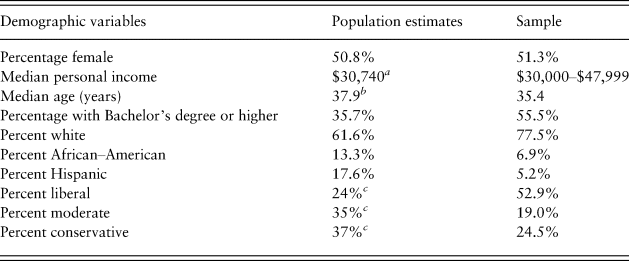
Any participant who incorrectly answered either or both of two comprehension checks was omitted from the data analysis. A total of 3384 participants are included in the analysis of the two social contexts introduced here. Table 1 compares the sample in the present study to US population estimates. The sample is disproportionately higher educated, whiter and more liberal than the overall population. Despite not being perfectly representative, MTurk samples have been found to be more representative than convenience samples typically used in academic studies (Buhrmester, et al., Reference Buhrmester, Kwang and Gosling2011; Berinsky et al., Reference Berinsky, Huber and Lenz2012; Mason & Suri, Reference Mason and Suri2012), have replicated established psychological findings (Paolacci et al., Reference Paolacci, Chandler and Ipeirotis2010; Berinsky et al., Reference Berinsky, Huber and Lenz2012; Goodman et al., Reference Goodman, Cryder and Cheema2013) and have expressed inequality-averse preferences that are consistent with those expressed by university convenience samples (Beranek et al., Reference Beranek, Cubitt and Gächter2015).
Sample compared to US population estimates (all figures taken from the 2015 US Census Bureau estimate unless otherwise indicated).

a 2015 CPS data for personal income of people aged 18 years or older.
b 2016 CIA World Factbook (available online at https://www.cia.gov/library/publications/the-world-factbook/fields/2177.html).
c 2015 Gallop poll (available online at http://www.gallup.com/poll/188129/conservatives-hang-ideology-lead-thread.aspx).
While the effects that personal characteristics have on debt relief are not of primary interest to the analysis presented below, the data do shed light both on how personal characteristics affect the perceived fairness of debt relief in this scenario and on the context dependence of these effects. These results are presented in the paper's online supplementary appendix (Supplementary Tables S2–S4).
Prior to completing the study, participants provided informed consent and were told that they would have to respond to comprehension questions that would ensure that they were paying attention. They were then randomly sorted into a specific treatment. After reading the vignette, participants had to rate their perceived fairness of the judge's decision to allow debt relief on a six-point scale ranging from extremely unfair to extremely fair. They then responded to a series of questions that collected personal characteristics with respect to gender, age, education, annual income, race and political preference. After a short debrief with general information about the study, participants received a confirmation code to submit to MTurk for payment.
Experimental design
The vignette
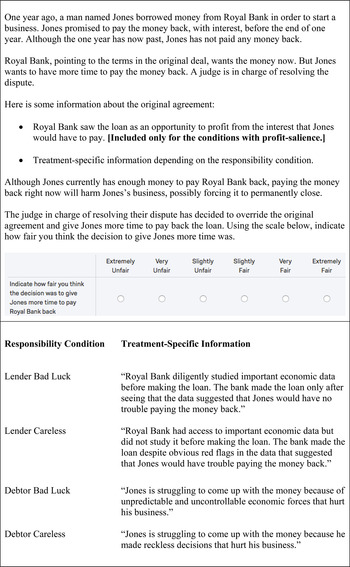
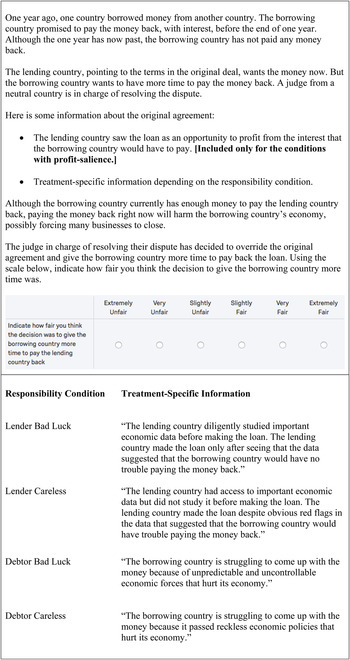
The exact wording used for the debt scenario across the person-bank and international contexts is presented in Figures 1 and 2, respectively. The vignette first tells participants that the debtor borrowed from the lender one year ago. Even though the debtor promised to pay back the money, with interest, before the end of one year, a year has passed and the money has not been paid back. The lender wants to be paid back immediately, the borrower wants to have more time and a judge is in charge of resolving the dispute. The vignette then provides participants with treatment-specific information, described in greater detail below, which (1) either included or omitted a description that made the lender's profit motive salient and (2) noted whether the lender or the debtor was unlucky or careless. Following this information, the vignette states that the debtor has enough money to pay the lender back immediately, but that doing so would have adverse economic consequences. This design choice leads to a scenario in which forced repayment would have adverse consequences, but not be catastrophic, thereby providing space for non-consequentialist moral intuitions to affect how respondents feel about debt relief. Finally, the vignette states that the judge “has decided to override the original agreement and give the borrowing country more time to pay back the loan.” The judge's decision, therefore, reflects a policy decision to allow a specific type of debt relief, which facilitates the study's goal of shedding light on public sentiment toward a debt-relief policy.
The person-bank debt relief scenario.

The international debt relief scenario.

Social context
Vignettes were designed to hold as many details constant as possible, while allowing for inevitable differences to emerge with changes in the different debt contexts. As presented in Figure 1, for person-bank debt, participants are told that “a man named Jones borrowed money from Royal Bank.” For international debt, as presented in Figure 2, participants are told that “one country borrowed money from another country.”
Two sources of difference also emerge across the two social contexts. First, the reason for why money is borrowed is varied in order to make the scenarios as realistic as possible. For person-bank debt, participants are told that “Jones borrowed money from Royal Bank in order to start a business.” For international debt, given that governments borrow money without a specific project in mind, participants are simply told that “one country borrowed money from another country.” Second, although there are adverse consequences attached to requiring debt fulfillment across both contexts, the nature of the consequences must be different across person-bank and international debt. For person-bank debt, participants are told that paying the money back immediately would “harm Jones's business, possibly forcing it to permanently close”; for international debt, paying the money back would “harm the borrowing country's economy, possibly forcing many businesses to close.”
Responsibility
Four responsibility conditions vary whether participants are told that lenders or debtors are unlucky or careless. An unlucky lender “studied important economic data before making the loan” and “made the loan only after seeing that the data suggested that [the debtor] would have no trouble paying the money back.” In contrast, careless lenders “had access to important economic data but did not study it before making the loan” and “made the loan despite obvious red flags in the data that suggested that the [the debtor] would have trouble paying the money back.” Unlucky debtors are “struggling to come up with the money because of unpredictable and uncontrollable economic forces.” Careless debtors, in contrast, are “struggling to come up with the money because he made reckless decisions that hurt his business” (person-bank debt) or “because it passed reckless economic policies that hurt its economy” (international debt).
Profit salience
Treatment-specific information also determines whether the lender's profit motive is made salient. Profit salience is determined by either the presence or absence of a sentence that notes that the lender “saw the loan as an opportunity to profit from the interest that the [debtor] would have to pay.”
With two social contexts, four responsibility conditions and two profit-salience conditions, the design produces a total of 16 treatments. Each participant was randomly assigned to one treatment in a between-subjects design, and sample sizes for each treatment range from 188 to 234.
Results
Results are analyzed graphically and with Mann–Whitney rank-sum tests, which measure differences across treatment distributions. The study's findings are organized into four results. The first two results describe data from the person-bank and international contexts, while the second two results integrate data from these two social contexts with data from the contexts studied previously (personalized and corporate) in order to provide a comprehensive perspective of how moral intuitions toward debt relief vary with social context. Descriptive statistics for each of the 16 treatments (means, standard deviations, sample sizes and the percentages of participants who find debt relief to be fair) are provided in Table S1 of the online appendix.
Result 1: Both debtor and lender responsibility affect the perceived fairness of debt relief in both the person-bank and international debt contexts.
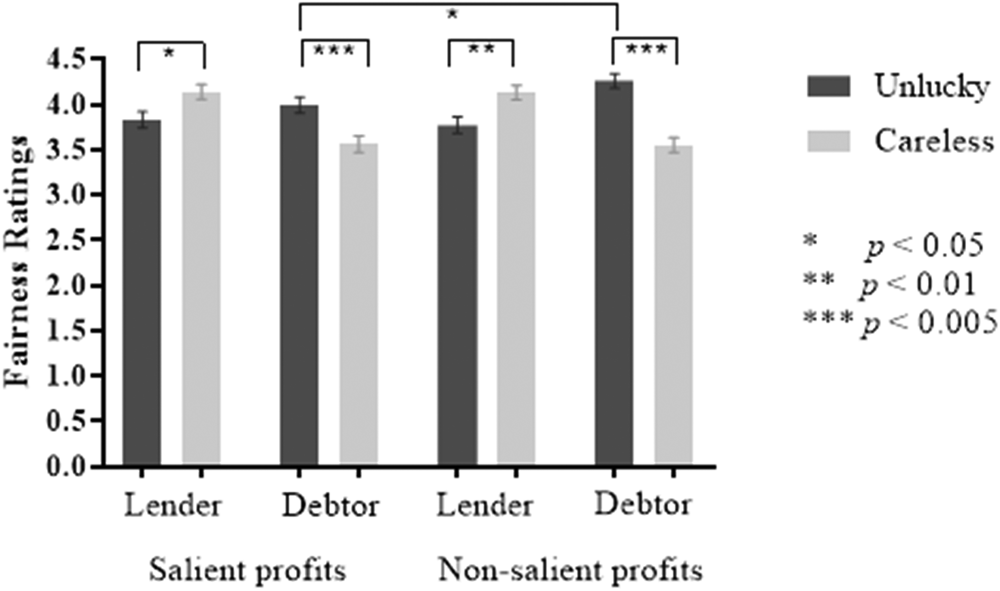
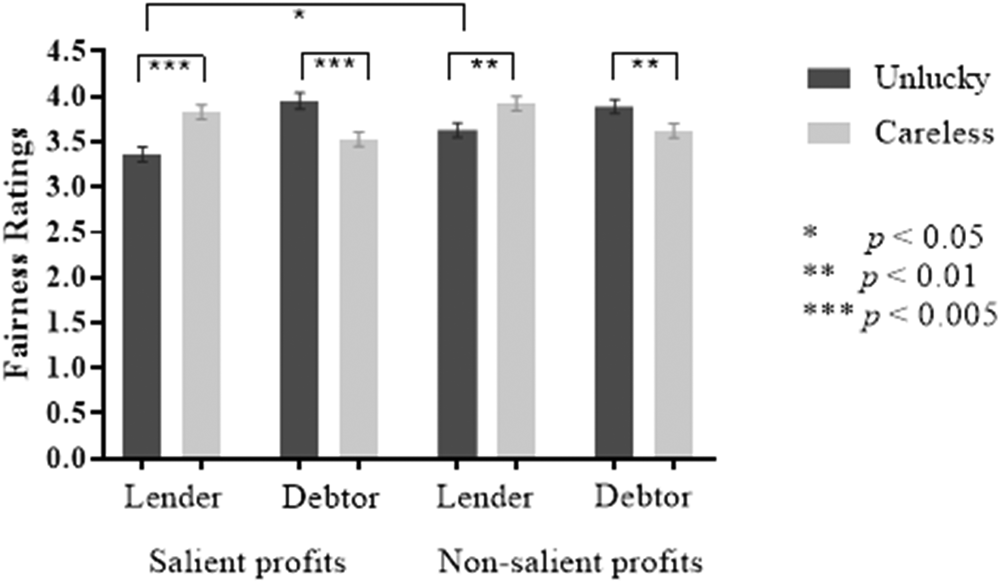
Figure 3 presents mean fairness ratings in the person-bank context for the four responsibility conditions separately for salient and non-salient profits. Figure 4 does likewise for the international debt context. Higher ratings imply a greater perceived fairness of debt relief. Each graph includes results from Mann–Whitney rank-sum tests that compare distributions to test for effects associated with responsibility conditions; standard error bars are also shown in these and in all subsequent figures. Clean tests of the effect of responsibility are achieved by holding profit salience and stakeholder type (debtor or lender) constant and comparing distributions of fairness assessments varying only whether the stakeholder being examined was unlucky or careless (e.g., unlucky lender with salient profits versus careless lender with salient profits; unlucky debtor with non-salient profits versus careless debtor with non-salient profits). For person-bank debt (shown in Figure 3) and international debt (shown in Figure 4), both lender and debtor responsibility significantly affect the perceived fairness of debt relief both with and without salient profits. Across both social contexts, debt relief is perceived to be fairer when lenders are careless and debtors are unlucky and less fair when lenders are unlucky and debtors are careless.
Result 2: Making a lender's profit motive salient does not increase the perceived fairness of debt relief in either the international context or the person-bank context.
Mean fairness ratings, person-bank debt (with standard error bars and statistically significant Mann–Whitney tests comparing responsibility conditions and profit salience).

Mean fairness ratings, international debt (with standard error bars and statistically significant Mann–Whitney tests comparing responsibility conditions and profit salience).

Clean tests of the effect of profit salience are achieved by holding stakeholder and responsibility conditions constant while comparing distributions of fairness assessments with and without profit salience (e.g., unlucky lender with salient profits versus unlucky lender with non-salient profits; careless debtor with salient profits versus careless debtor with non-salient profits). Figures 3 and 4 present statistically significant rank-sum test results for effects of profit salience, holding stakeholder type and responsibility condition constant. (To ease the presentation, only rank-sum test results that do not meet the listed probability thresholds are omitted.) Out of a total of eight tests for profit salience across the two social contexts, only two significant differences are found, both of which point to profit salience causing debt relief to be perceived as less fair. Rather than enhancing the perceived fairness of debt relief by making a lender seem greedy, with person-bank debt, salient profits decrease levels of perceived fairness for unlucky debtors (z = 2.282, p = 0.023); with international debt, salient profits decrease levels of perceived fairness for unlucky lenders (z = 2.422, p = 0.015).
Results that integrate the present study and the earlier study
Additional results emerge when the results from the present study are integrated with the results from the initial study. Graphs depicting mean fairness ratings for the personalized and corporate contexts across the four responsibility conditions and two profit-salience conditions were not presented by Chavanne (Reference Chavanne2017). They are therefore included in this analysis's online supplementary appendix (Supplementary Figures S1 and S2).
Result 3: Anti-bank sentiment significantly impacts the perceived fairness of debt relief when an individual is in debt to a bank.
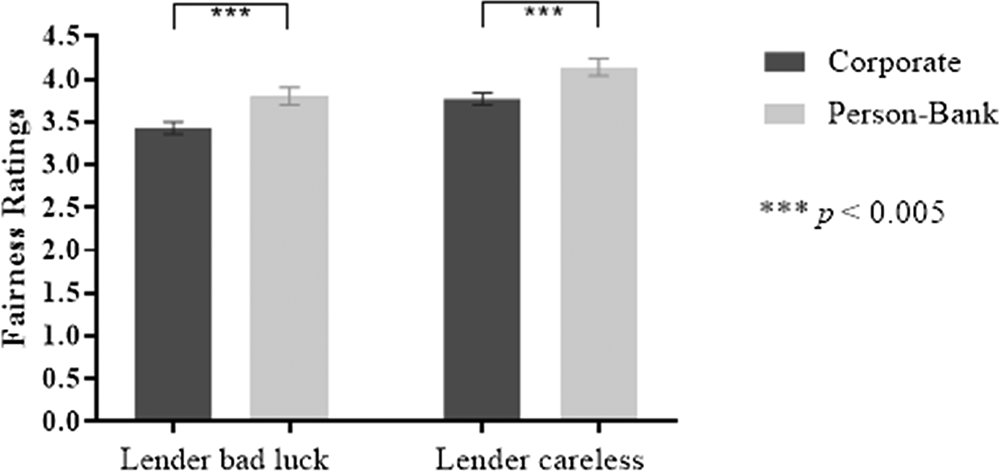
The properties of the personalized, corporate and person-bank contexts allow clean tests for the importance of an anti-bank sentiment. First, consider that lenders are banks in both the corporate and person-bank contexts. Holding the lender responsibility condition constant and comparing the perceived fairness of debt relief across the corporate and person-bank contexts therefore shows the effect of an individual in debt to a bank compared to a corporation in debt to a bank. Figure 5 merges salient and non-salient profits to examine how anti-bank sentiments emerge when a debtor is an individual rather than a corporation. For unlucky lending banks, the mean fairness rating in the person-bank context is 3.80, while the mean fairness rating in the corporate context is 3.43. A rank-sum test shows that levels of perceived fairness with unlucky lending banks are significantly greater when the debtor is an individual compared to a corporation (z = 4.178, p < 0.001). For careless lending banks, the same pattern is observed, as the mean fairness rating in the person-bank context is 4.14, while the mean fairness rating in the corporate context is 3.77. Likewise, a rank-sum test shows that levels of perceived fairness with careless lending banks are significantly greater when the debtor is an individual compared to when the debtor is a corporation (z = 4.352, p < 0.001).
Lending banks across corporate and person-bank contexts (with standard error bars and statistically significant Mann–Whitney tests comparing responsibility).

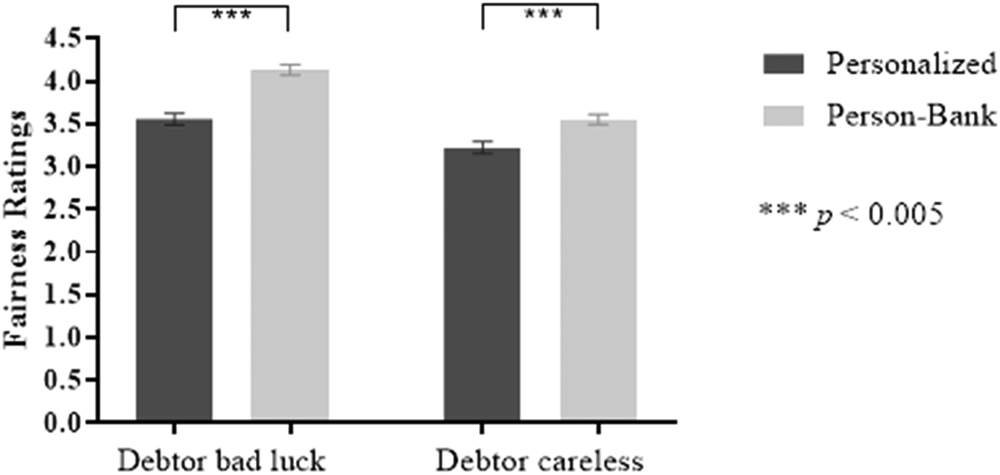
Second, consider that debtors are individuals in both the personalized and person-bank contexts. Holding the debtor responsibility condition constant and comparing the perceived fairness of debt relief across the personalized and person-bank contexts therefore shows the effect of an individual in debt to a bank compared to an individual in debt to another individual. Similarly to Figure 5, Figure 6 merges salient and non-salient profits to examine how anti-bank sentiments emerge when a lender is a bank rather than an individual. For unlucky individual debtors, the mean fairness rating in the person-bank context is 4.13, while the mean fairness rating in the personalized context is 3.55. A rank-sum test shows that levels of perceived fairness with unlucky individual debtors are significantly greater when the lender is a bank compared to another individual (z = 6.719, p < 0.001). For careless individual debtors, the same pattern is observed, as the mean fairness rating in the person-bank context is 3.56, while the mean fairness rating in the personalized context is 3.22. A rank-sum test shows that levels of perceived fairness with careless individual debtors are significantly greater when the lender is a bank compared to when the lender is another individual (z = 3.632, p < 0.001).
Result 4: The perceived fairness of debt relief across each social context can be ranked, from least to most fair, as follows: personalized; corporate; international; person-bank.
Individual debtors across personalized and person-bank contexts (with standard error bars and statistically significant Mann–Whitney tests comparing responsibility).

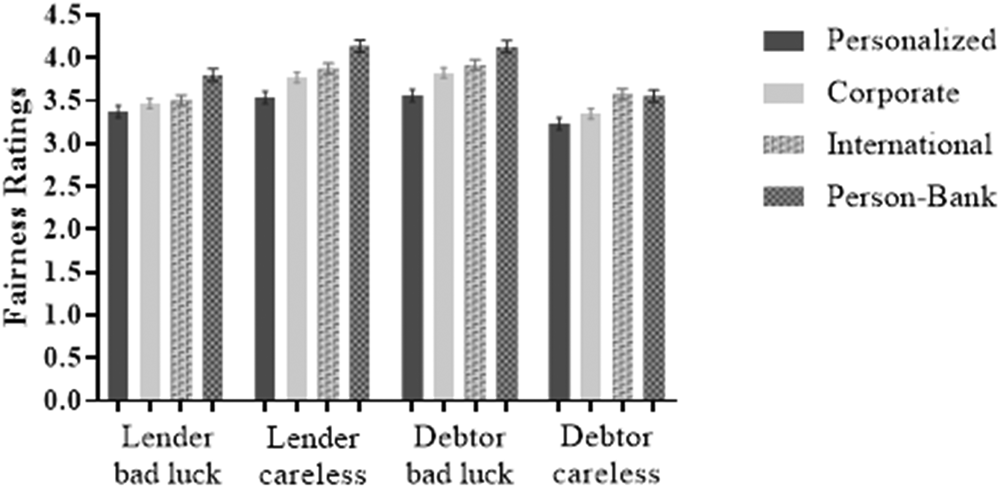
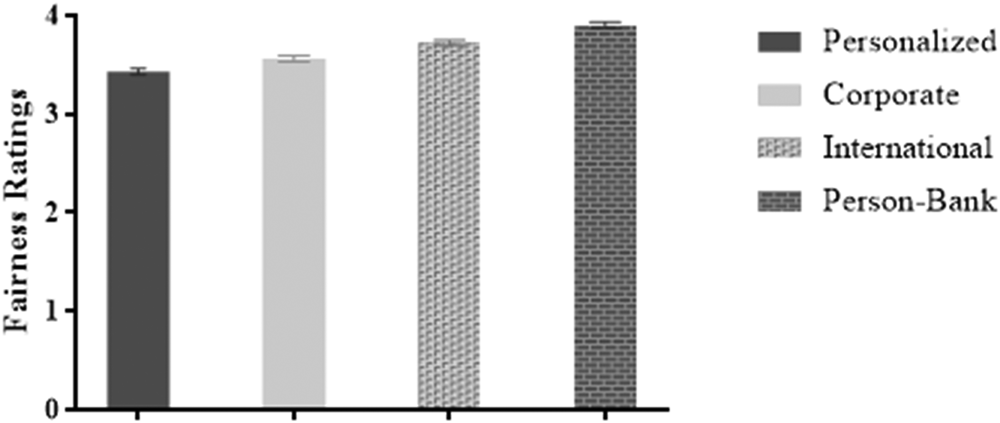
Figure 7 examines how mean fairness ratings vary across the four responsibility conditions for each of the four social contexts examined across the two studies. For simplicity, conditions with and without salient profits are merged. The following general trend in the perceived fairness of debt relief across the social contexts, ranked from least to most fair, is observed: personalized debt; corporate debt; international debt; person-bank debt. The only disruption to this trend is seen with careless debtors, where mean ratings in the international context are marginally greater than in the person-bank context. Figure 8 shows further evidence for the across-context trend by merging all observations across profit-salience and responsibility conditions in each social context. The mean fairness ratings across the personalized, corporate, international and person-bank contexts are 3.42, 3.58, 3.72 and 3.90, respectively. All six pairwise rank-sum tests comparing across-context distributions of fairness ratings (with profit-salience and responsibility conditions merged) are significant at a level of p < 0.001.
Mean fairness ratings merging salient and non-salient profits (with standard error bars).

Overall trends (with standard error bars).

Discussion
Motivated by the prevalence of debt crises and the different social contexts in which debt contracts manifest, this study uses different versions of a vignette, which captures core properties of a dispute over whether to allow debt relief, to examine the context dependence of the perceived fairness of debt relief. The results show that debt relief is perceived as being fairer when debtors are unlucky and when lenders are careless in both the person-bank and international debt contexts, while profit salience has no effect in either social context. The results with respect to responsibility point to the potential importance of both debtor and lender responsibility in shaping attitudes toward debt relief in the externally relevant contexts of person-bank and international debt. Considering the results identified by Chavanne (Reference Chavanne2017), the results presented here also suggest that, when it comes to assessing the importance of responsibility, countries in debt are treated like corporations rather than like individuals. Given how invocations of greed are used rhetorically in debt-related policy debates, this effect of profit salience does not call into question whether beliefs about greed drive attitudes toward debt relief. Instead, the results suggest that alerting someone to a lender's profit motive was not, on its own, sufficient to stir up perceptions of greed in this scenario. In light of the insufficiency of recognition of a lender's profit motive, additional research is needed to determine the types of information that cause perceptions of lender greed to arise and whether this information has context-dependent effects.
When looking at mean fairness ratings either within each responsibility condition (Figure 7) or merging all responsibility conditions (Figure 8), a clear trend emerges. The perceived fairness of debt relief in each social context can be ranked, from least to most fair, as follows: personalized; corporate; international; person-bank. The perceived fairness ratings across the first three social contexts within this sequence may point to context-driven consequentialist reasoning being an important factor, as the economic downside of refusing debt relief is likely seen as being lowest in the personalized context, second lowest in the corporate context and greatest in the international context. The fact that debt relief is seen as being most fair in the person-bank context, however, makes it clear that factors besides consequentialism are driving these aggregated across-context results. More generally, the effects associated with debtor and lender responsibility also clarify that moral intuitions toward debt relief within this scenario are highly sensitive to non-consequential factors. Future work can explore the role that consequentialism can play in driving attitudes toward debt relief, perhaps by explicitly varying the consequences of refusing – or allowing – debt relief within specific social contexts.
The fact that debt relief is perceived to be most fair in the person-bank context is noteworthy for additional reasons, which emerge when comparing the results from the person-bank context to the results from the personalized and corporate contexts. Overall, debt relief within the scenario is considered to be significantly fairer in the person-bank context, and the relationship holds when separately analyzing the different responsibility conditions. Since debtors are individuals in both the personalized and person-bank contexts, the difference when participants are provided with information about debtors must stem from the different views toward individual lenders and lending banks. Likewise, since lenders are banks in both the corporate and person-bank contexts, the difference when participants are provided with information about lenders must stem from the different views toward individual debtors and corporate debtors. These results therefore point to an anti-bank sentiment that significantly affected the perceived fairness of debt relief in the context in which an individual is indebted to a banks. Importantly, however, these anti-bank sentiments do not crowd out the importance of responsibility. Even though people were predisposed to view debt relief within the scenario significantly more favorably in the person-bank context, both debtor and lender responsibility still shape perceptions of fairness. This result suggests that, even in politically charged debt debates involving consumers being indebted to banks, policy preferences are likely to be sensitive to information about the responsibility of both consumers and lenders during the events that precipitated the crisis.
Despite the study's implications, it is important to note its limitations. The vignette described one specific scenario, which presented information regarding the consequences of forced contract enforcement for the debtor and ended with a decision to give a debtor more time to pay back a loan. Additional work is needed to examine the extent to which results generalize under different circumstances, such as when information is presented regarding the consequences of debt relief for a lender or when the scenario ends with a decision to allow other forms of debt relief (e.g., complete debt forgiveness). Given the prevalence and diversity of debt-related policy decisions, future vignette-based studies can serve as valuable mechanisms for flushing out the moral intuitions that drive the public's preferences for different types of debt relief across different debt domains.
This study is the first to show that both debtor and lender responsibility significantly impact the perceived fairness of debt relief in the externally relevant contexts involving international debt and individuals borrowing from banks. As debt crises emerge in these areas, these results suggest that we should expect public opinion to be sensitive to rhetoric pointing to differing notions of both debtor and lender responsibility. Additional work can extend these findings to samples outside of the USA, as it is possible that attitudes toward debt relief within certain social contexts are shaped by events and policy debates specific to one's exposure and experience. Future studies can also examine particular debt relationships more concretely (e.g., student loans, mortgage lending, credit card lending, a specific sovereign default) with the goal of examining how the underlying moral intuitions identified here manifest in a specific policy-relevant domain.
Supplementary material
To view supplementary material for this article, please visit https://doi.org/10.1017/bpp.2019.21