Aims
Locally advanced head and neck (H&N) cancer can be a distressing disease due to a variety of reasons, which include cosmesis, bleeding, pain, airway obstruction and dysphagia. A small proportion of these patients are unsuitable for radical treatment due to either extensive disease that is not resectable, in a distribution that cannot be treated with radical radiotherapy or due to general health/social issues. This retrospective study looks at the tolerability and outcomes for palliative split-course hypofractionated radiotherapy for this group of patients treated in our centre.
Materials and Methods
Between January 2002 and 31 April 2012, 59 patients who had received hypofractionated radiotherapy for incurable histologically/cytologically proven mucosal squamous cell carcinoma of the H&N region, were identified from the electronic oncology database. Data were gathered retrospectively from the electronic database, patient case notes and radiotherapy records.
Patients were immobilised with a thermoplastic shell and treatment planned either with conventional simulation or computed tomography (CT) planned. The primary tumor volume included the primary tumour and involved nodes with a 2 cm margin. Radiotherapy regime was a three phase split-course treatment, giving 14·8 Gy/phase over 1 week, either in four daily fractions or eight fractions treating twice a day with minimum 6-hours gap. This was followed by a 2-week gap and patients were reassessed before proceeding with the next phase. Total dose was 44·4 Gy prescribed to 100% isodose where CT planned and to midpoint where planned on conventional simulator. Treatment was planned with a parallel-opposed pair of fields using 6 MV photons. In cases where the spinal cord was within the treatment volume, the fields were moved ‘off cord’ for the third phase and nodes overlying the cord were treated with a matched electron field in order to limit the total cord dose. Patients were reviewed once during each phase by the radiotherapy support team and in clinic between phases to assess toxicity and response.
Results
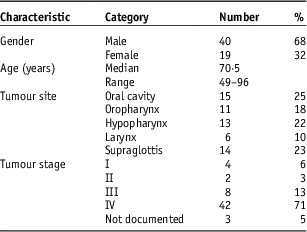
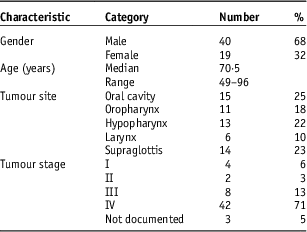
A total of 59 patients were treated with hypofractionated split-course radiotherapy in our centre over a 10-year period. Median age was 70·5 years (range 49–96 years). In all, 42 patients (71%) had stage IV disease and the sites of primary were oral cavity, oropharynx, hypopharynx, larynx and supraglottis. No documentation of stage was available in three patients. Patient demographics are presented in Table 1.
Demographics
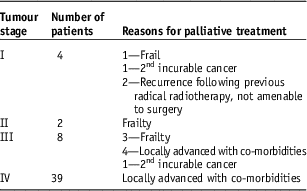
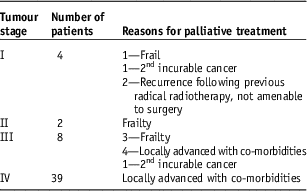
Extent of disease and co-morbidities were the most common reason for this palliative approach. Frailty and synchronous incurable second primary were the other documented reasons. Four patients with stage I disease were treated palliatively due to frailty, disease recurrence from first primary or synchronous second primary (Table 2).
Reason for palliative treatment
Pain and dysphagia (34 patients) were the predominant symptoms needing palliation. Other symptoms were fungation (seven patients), bleeding (two patients), hoarseness (seven patients), stridor (two patients) and cosmetic (enlarged neck nodes—seven patients).
A total of 20 patients received between two and four cycles of initial chemotherapy with either Cisplatin 100 mg/m2 or Carboplatin AUC5 Day 1 and 5FU 4,000 mg/m2 D2-D5 and then proceeded to palliative radiotherapy. The main reason for induction chemotherapy was to deal with troublesome symptoms while awaiting radiotherapy planning. A total of 40 patients (67%) completed all the intended three phases of radiotherapy. In all, 12 patients completed two phases and seven patients could only complete one phase of treatment. The reasons for discontinuing treatment were progressive disease (n=9), refusal to continue (n=2), clinical deterioration due to pre-existing co-morbidity (n=2) and death (n=5). There was no documentation for discontinuation in one patient. No deaths were due to treatment related toxicity.
Toxicities were assessed in all patients treated with this regime. Acute toxicities were documented in 52 patients and were present in nine patients (15%) with mucositis in seven and skin erythema in two patients. Unsurprisingly acute toxicities were mostly seen in patients with higher total dose, that is, those completing all three phases (n=8). A total of 72% patients had no acute toxicities with this treatment of which 66% had completed all three phases. Although no formal grading was documented, it is reassuring that the toxicities were not severe enough to require hospitalisation. Symptomatic late toxicities were seen only in two patients and included xerostomia and dysphagia.
Treatment response was analysed only in the 40 patients who completed all three phases. Documentation of response was based on clinical examination and, where relevant, nasoendoscopy findings. There was no documentation of clinical response in four patients. Of the remaining 36, the response rate was 86% (14 patients (39%) had complete response and 17 (47%) had partial response) and disease stabilisation was achieved in 14% (five patients). Patients were reviewed in clinic 4 weeks after completion of radiotherapy and response of symptoms was documented as none, partial and complete. The palliation rate was 83% (complete and partial), which in some cases was durable. Only five patients had no meaningful palliation having completed all three phases.
The statistical analysis was carried out using Stata software version 10. Local control rate (LCR) was defined as the absence of loco-regional progression (including complete clinical responses), and was defined as being from the date of finishing treatment until documented disease progression or death from disease. Overall survival (OS) was defined as the time from the date of finishing treatment until death, from any cause. Progression free and OS were analysed using the Kaplan–Meier method.
Median duration of local control was 6 months (range: 1–63 months; Figure 1). One, 2 and 5-year estimates of LCRs were 36, 31·5 and 25·2%, respectively. A total of 12 patients had complete control of disease at the time of death or analysis. Median OS was 8 months (range: 1–68 months; Figure 2) and 1, 2 and 5-year estimates of survival were 29·3, 14·7 and 11·7%, respectively. Five patients died of reasons unrelated to the H&N cancer due to cardiac failure, chronic obstructive pulmonary disease, community acquired pneumonia, gastric and oesophageal cancer. Five patients were alive without recurrence at the time of analysis with survival ranging from 6 to 57 months. Of these, four patients had locally advanced disease (stage III or IV) at presentation.
As would be expected, median survival was better (20·5 months, range: 6–68) in patients who had a complete response to treatment (Figure 3). One, 2 and 5-year survival estimates were 70·7, 44·2 and 35·4%. Five patients were alive and disease free at the time of analysis, with a range between 8 and 57 months, since completing treatment.
Discussion
Squamous cell carcinoma of the H&N is largely treated with radical intent. However, in a small number of patients this is not possible. The reasons for this may be tumour or patient related such as advanced stage or bulk, significant co-morbidities and poor patient compliance. Symptoms from advanced H&N cancer can be quite distressing as there is often significant functional limitation such as impairment of speech or swallow in addition to airway obstruction, pain, bleeding and cosmesis. Hence, adequate palliation is vital to ensure quality of life in this cohort. The challenges, however, in this situation are to optimise the balance between adequate palliation of symptoms and avoidance of excess toxicity.
While there has been a large number of trials focusing on the aspects of radical management there is a paucity of prospective data addressing the optimal palliative management. There are a few phase 2 trials and some retrospective case series looking at hypofractionated regimes. Varying regimes have been reported with good palliative outcomes.
A variety of hypofractionated split-course regimes have been reported.Reference Corry, Peters and D’Costa1–Reference Mohanti, Umapathy and Bahadur4 The ‘Quad shot’ trialReference Corry, Peters and D’Costa1 used 14 Gy in four fractions treating twice daily minimum 6 hours apart. This dose was repeated in three phases at 4 weekly intervals. Median survival was 5·9 months and objective response rate was 53%. Using a validated QoL tool prospectively, they reported a 44% improvement in symptoms. Kancherla et al.Reference Kancherla, Oksuz and Prestwich2 used 20 Gy in five fractions over 1 week followed by a further course after a 2-week break. They reported a 79% symptomatic improvement with an objective response of 72%. Grade 3 toxicity was acceptable.
While Agarwal et al.Reference Agarwal, Nemade and Murthy5 and MinatelReference Minatel, Gigante and Franchin6 published good rates of palliation, the incidence of Grade 3 mucositis was high (63 and 46%, respectively). This may have been due to the lack of a gap in-between the course (40 Gy in 16 fractions, escalated to 50 Gy in 20 fractions if good response) and the addition of Bleomycin, respectively. Pearson et al.,Reference Pearson, Bannister-Young and Ivison7 in a letter to the editor, reported an UK audit using the same regimen as us. He reports a 73% rate of completion of all the three phases, with only common toxicity criteria Grade 1 mucositis and fatigue in all patients completing treatment. There was a 58% improvement in pain and 55% improvement in dysphagia at 6 weeks after completing treatment. This is comparable to our data, where 67% had completed all three phases, no severe acute toxicities were witnessed and there was a 57% improvement in dysphagia and pain.
The advantage of the split-course regime is that it enables the clinician to review toxicities and response with a view to stopping treatment in the event of significant side effects or poor response in a cohort of patients whose OS is limited due to advanced disease or co-morbidities. There is also some resolution of acute toxicities before starting the next phase, hence making the total dose more tolerable. This is of particular advantage in H&N cancer as acute toxicity, especially mucositis tends to peak towards the end or after completion of treatment with continuous regimes. This is reflected in our practice where 87% of patients completed at least two phases and 67% completed all three phases. Of note is that there was no withdrawal of treatment due to severe toxicity. Although there are concerns of compromising tumour control due to repopulation, this is less of a concern when the treatment intent is palliative. In addition, as described by Kancherla et al.,Reference Kancherla, Oksuz and Prestwich2 the dose lost due to tumour repopulation from the 2-week break between phases is small.
From the patient’s perspective, hypofractionation allows for fewer treatment visits and also allows for short admissions (if needed) to facilitate this, which reduces pressure on inpatient beds. This is particularly useful for centres covering population over a large geographical area.
We acknowledge that there are a few limitations to this study. First, a significant number of patients received induction chemotherapy. While this was used to initiate treatment promptly, it achieved early palliation and reduced the radiotherapy treatment volume and in turn may have had an impact on reducing radiotherapy related toxicities. Six out of the 12 patients surviving 6 months or more received chemotherapy and while it may have an impact on survival, there are an equal number of patients with comparable long-term survival who did not receive chemotherapy. Hence, its impact on survival is debatable. Second, due to the retrospective nature of this data, it was not possible to assess QoL via validated questionnaires. Although not formally graded, toxicities encountered were recorded as being mild, moderate or severe. The relatively small percentage of acute toxicities, which were not severe enough to require admission, implies that this regime is well tolerated.
Although our numbers are too small to draw any definite conclusions the presence of long-term survivors from the stage III and IV group indicates that this could be a regime worth consideration for local control in poor performance status patients with limited disease who are not fit for radical treatment. This, however, needs further evaluation.
Conclusion
We are the first UK centre to report with long-term data, the use of a palliative three phase regime that provides meaningful palliation with acceptable toxicities. Although not directly comparable, our progression free and OS data is similar to other described hypofractionated regimes. In addition, for some patients, it has resulted in durable long-term control.
Local control (n=40).

Overall survival (all patients, n=40).
Overall survival in patients who had complete response (n=14).
Acknowledgement
The authors thank Dr M. Rauf and Dr I. Sanders for statistical analysis.
Financial Support
None.
Conflicts of Interest
None.