Introduction: sovereignty watch
‘We shall lack the essential tool to our understanding of Australian Antarctica until those with the interest and capacity to write its history are found. And not just one history. Preferably several, or at least a history [and I will argue geography as well] that will provoke debate’ (Stephen Murray-Smith quoted in Griffiths Reference Griffiths2007: 3).
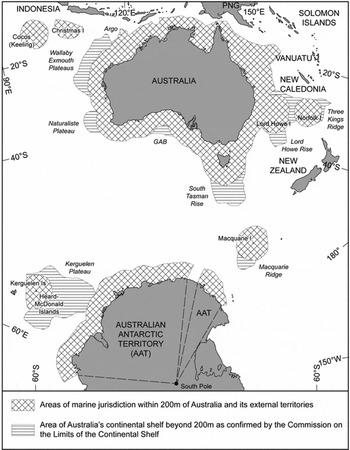
Something quite striking caught my eye in June 2008. Released by Geoscience Australia, it was a short announcement entitled ‘Australia's marine jurisdiction extended’ and an accompanying map of Australia and regional territories (‘Australia's continental shelf jurisdiction’). Furnished in rather garish colours (green and purple to be exact), the map purported to show that Australia had expanded. As the Minister for Resources, Energy and Tourism Martin Ferguson explained, ‘This is a major boost to Australia's offshore resource potential and also to our ability to preserve the marine environment on the seabed’ (Australia 2008). While linking exploitation to conservation (and environmental protection duties for that matter) is not a novel strategy, a recommendation from the UN Commission on the Limits of the Continental Shelf (CLCS) facilitated an extension of Australian sovereign rights over a vast area, something akin, apparently, in size to Western Australia. The accompanying map highlighted how the continental shelf for Heard and MacDonald Islands extends (or to use, as many commentators frequently do, a more gendered term ‘penetrates’) into the Antarctic Treaty region (see Fig. 1).
Australia's continental shelf confirmed by the Commission on the limits of the continental shelf.

The map itself is worthy of some reflection not least because it is a timely reminder that maps are not mimetic representations; that is unproblematic depictions of the earth's surface. Rather as a host of scholars from Brian Harley to Kapil Raj remind us, maps need to be situated within circuits of power knowledge (Harley Reference Harley, Barnes and Duncan1992; Edney Reference Edney1997; Burnett Reference Burnett2000; Raj Reference Raj2007). Maps are politically consequential objects, they provoke. They intervene in the world. The map in question (that is Fig. 1) is being put to ‘work’. It is meant, at the very least, to be seen by others. But the map also does something else. As hinted by Ferguson when he noted that, ‘The truth of the matter is that they have been hardly explored. . . This is potentially a bonanza. We have got unknown capacity up there’ (BBC 2008). Whether ‘up there’ or ‘down there’, there is an explicit imperative to explore and exploit, and while that may not be the case with regard to the continental shelf appurtenant to the Australian Antarctic Territory (AAT), the impulse is nonetheless still there (for an elegant earlier reflection on the AAT, see Griffiths Reference Griffiths2007).
The moment in question was unquestionably a sovereignty performance, and such performances have been an important element in the continuing colonisation of the Antarctic and Southern Ocean, especially in the last hundred years (Collis Reference Collis2004; Dodds Reference Dodds2002, Reference Dodds2010a). If the polar explorer Douglas Mawson and his colleagues carried out their own sovereignty performances at Proclamation Island in 1930, Ferguson was continuing that tradition when he announced that expansion of Australia's continental shelf jurisdiction, some eighty years later albeit himself located in Canberra. Of course, a great deal has also changed in the intervening period. The emergence of the Antarctic Treaty (1959) and the establishment of the Law of Sea regime have played their part in transforming the legal and political geographies of the region. But what is perhaps interesting, notwithstanding the palliative presence of article IV of the Antarctic Treaty, is that these sovereignty performances continue apace. The latter did not cease in June 1961 when the treaty entered into force.
In what follows, I am going to give attention to two aspects of what I call ‘treaty sovereignty’. First, using recent developments pertaining to outer continental shelf (OCS) delineation (or in other cases, delimitation when overlapping entitlements are potentially in play) and later the contested politics associated with whaling, I want to illustrate how claimant states have sought to consolidate their sovereign rights while at the same time becoming ever more anxious about the behaviour of others, something I and Alan Hemmings have termed frontier vigilantism (Dodds and Hemmings 2000; Elden Reference Elden2009). My concern, therefore, is not to replicate either the detailed investigations of the application of the Law of the Sea regime to the Southern Ocean and/or the regime overlap with the Antarctic Treaty (for example, Koivurova Reference Koivurova, Alfredsson and Koivurova2009; Hemmings and Stephens Reference Hemmings and Stephens2010). In essence, I am interested in how the representatives of claimant states ‘speak’ and the discourses and practices they deploy in order to construct their identities as claimants with sovereign rights. My suggestion is that the territorial and resources discourses and practices deployed directly frames and informs a series of behaviours, ranging from the seemingly dramatic such as chasing vessels engaged in illegal fishing in the Southern Ocean to, what Patricia Seed once termed, ‘ceremonies of possession’ (Seed 1995). Even the apparently mundane use of words such as ‘Ours’ participates in expressions of geo-power: the mapping, claiming and colonising of space (Thrift Reference Thrift, Dodds and Atkinson2000). In other words, quite literally, the focus is on the big and small shapers of action and behaviour.
The second aspect of the analysis focuses on the actual first part of the title of this paper, ‘sovereignty watch’. For every sovereignty performance in the Antarctic and the Southern Ocean, there is so often an accompanying anxiety over what others are doing or about to do. Being a claimant state, and as we know there are seven of them, is an expensive and time consuming business. To put it bluntly, the vast majority of the international community do not recognise the claims of Argentina, Australia, Chile, France, Norway, New Zealand and the United Kingdom.
While the Antarctic Treaty is often said to have defused this issue of ownership, it has not removed the need, on the part of the claimant states, for vigilance. This also includes academics working within those claimant states. When Anne-Marie Brady (Reference Brady2010) notes that New Zealand has strategic interests in the Antarctic, she does so by making the following claim:
New Zealand has strong geographic and historical links that tie it closely to Antarctica. These connections mean that New Zealanders have a stronger sense than the citizens of most other Antarctic nations that Antarctica is a part of their national history and heritage.
There are ancient geological ties between New Zealand and Antarctica that can be traced back to Gondwanaland. Fossilised trees found in Antarctica are related to New Zealand's modern beech forests (British Antarctic Survey 2009). Even today, New Zealand is one of the closest and most convenient locations from which to launch an expedition into the Antarctic interior. Unlike most other Antarctic nations, New Zealand's Antarctic researchers need only need to board a plane to visit the Antarctic, and they can go for short and frequent stays, rather than spend a whole season there (Brady Reference Brady2010: 1)
There is a kind of constant ‘sovereignty watch’ at play here. Readers are being reminded that New Zealand has ‘connections’ whether it involve geographical, geological and genealogical factors. So while many of the southern hemispheric claimant states make appeals to proximity (‘need only board a plane to visit the Antarctic’), they are also increasingly worried that others can also board planes and ships precisely because countries like New Zealand are ‘closest and most convenient’. As I tried to show, over a decade ago, arguments over proximity are always highly politicised and should never be simply accepted as bien pensant (Dodds Reference Dodds1997).
This is not just true of the claimants such as Australia and New Zealand but it is the case for the non-claimants such as Russia and the United States. For example, when Australia submitted its materials to the CLCS the following non-claimant states despatched their official reactions to that event in order of timing, the United States, Russia, Japan, the Democratic Republic of Timor, France, the Netherlands, Germany and India. Tellingly, only one claimant state, France, officially responded to the Australian submission. While the United States’ submission recalled the provisions of the Antarctic Treaty, it acknowledged that the Australians had not asked the CLCS to consider continental shelf appurtenant to the Australian Antarctic Territory. The point is not so much the actual content of their note, it is that they and other Antarctic Treaty Consultative Parties such as Germany and India submitted responses in the first place. They engaged in their own sovereignty performances.
The first part of the paper outlines some general themes relating to the relationship between territory, resources and claims with particular emphasis on performance and entrenchment. I use examples from a variety of southern hemispheric states including Argentina, Australia and New Zealand (compare Dodds Reference Dodds1997 and the essays in Kriwoken and others Reference Kriwoken, Jabour and Hemmings2007). Thereafter, the delimitation of the outer continental shelf (OCS) is considered because it has been suggested that it is both settling and unsettling for claimant and non-claimant parties. This might be considered in two ways, first, the extension of the outer continental shelves into the Antarctic Treaty area via sub-Antarctic territories and second, the way in which these debates over the legal status of the seabed combine with unease over the status of claimant states. The example of Australia is used to illustrate these two points, in part because it has arguably been a pioneer when it comes to the mapping and delimitation of the outer continental shelf in the Southern Ocean. Moreover, the contested politics of whaling in the Southern Ocean adds a further dimension not least because it brings to the fore a kind of frontier vigilantism, manifesting itself in public anxiety of China and Japan (as noted earlier, Dodds and Hemmings Reference Dodds and Hemmings2009). Finally, a few words are offered with regard to understanding how discourses on resources and territory continued to stake out fields of action in the Antarctic and beyond. The paper is intended, in short, to be polemical.
Performing and entrenching sovereignty in Antarctica
Patricia Seed, when investigating the manner in which Europeans conquered the so-called new world, considered varied ‘ceremonies of possession’ (Seed 1995). As she comments, ‘[c]olonial rule over the New World was initiated largely through ceremonial practices – planting crosses, standards, banners and coats of arms – marching in processions, picking up dirt, measuring the stars, drawing maps, speaking certain words, or remaining silent. While their military secured their power over the New World, sixteenth and seventeenth century Europeans also believed in their right to rule. And they created these rights for themselves by deploying symbolically significant words and gestures sometimes preceding, sometimes following, sometimes simultaneously with military conquest. But these symbolically significant gestures were not always the same’ (Seed 1995: 2). Explorers were particularly significant here, because as Collis has noted, they were invested with sovereign authority. In the polar regions, as elsewhere in the world, they were empowered to act and behave as if they were invested with monarchical authority (Dodds Reference Dodds2002; Collis Reference Collis2004). These sovereignty performances have to be seen as well. Whether it involves government ministers standing in front of maps (such as Australian minister Martin Ferguson) and/or explorers standing by flagpoles, these bodily performances depended on audiences.
A number of interventions in recent years have sought to connect the colonisation and administration of the Antarctic to wider discussions about colonialism, north-south relations and gender politics (Dodds Reference Dodds2006; Howkins 2009; Rosner Reference Rosner2009). In so doing, at least two things have happened. First, the recognition that in the absence of an indigenous human population, the Antarctic has not been immune from colonial encounters involving possession, territorial competition and even loss. Second, the Antarctic Treaty while often lionized for its achievements did not erase those colonial encounters (Dodds Reference Dodds2006). While it is frequently noted that the territorial-legal tapestry to be found in 1959 was effectively suspended for the duration of the treaty, ceremonies of possession and claiming practices continued nonetheless. The Antarctic was not, overnight, simply turned into a ‘continent of and for science’. Rather a whole series of discourses and practices co-existed uneasily with one another as claimant countries such as Argentina, Australia and Chile continued to champion their claims to domestic and international audiences. And to do so in different ways; whether it be via maps, postage stamps, public education, flag waving, place naming, scientific activity, the regulation of fishing, flying pregnant women to the region and public ceremonies such as commemoration (more generally see Escude Reference Escude1992; Billig Reference Billig1995).
Territorial claims, notwithstanding article IV of the Antarctic Treaty, were/are both performed and entrenched. Performed in the sense of made visible and part of the everyday life of citizens within and beyond those claimant states. In the case of Argentina, Escude (Reference Escude1988, Reference Escude1992) explored how public education, especially from the 1920s onwards, focused via school textbooks on informing the citizen of its southerly territories. In Australia and New Zealand, public institutions such as the visitors’ centres in Hobart and Christchurch respectively play their part in informing citizens of both countries’ territorial remits and their active presence on the ice. And as Brady (Reference Brady2010) notes for New Zealand, citizens also ‘feel’ Antarctica:
The geographic environment in Antarctica and any changes, which may occur there are felt very personally by New Zealanders. When New Zealand weather forecasters talk of a cold southerly sweeping up the country the television weather maps show it as coming from the icy Antarctic zone just to the south of New Zealand. . .For New Zealanders, more than the citizens of most other Antarctic nations, the melting of the poles seems a very real and present threat.
This is not unique to New Zealand per se. Domestic media including the ‘weather report’ contribute, to what Billig (Reference Billig1995) noted, to the reproduction of banal forms of nationalism. So often, as media studies scholars (for example Entman Reference Entman1993) would suggest, these stories are ‘framed’ in particular ways with emphasis given to reminding readers about the existence of an ‘Australian Antarctic Territory’, ‘Argentina Antarctic Sector’ and/or ‘Ross Dependency’. The New Zealand Herald in one news story about scientists in March 2008 begins with the following: [s]cientists and crew of New Zealand's biggest scientific voyage in the Antarctic waters of its Ross Sea dependency have returned with a treasure trove of new fish and other organisms (New Zealand Herald, 20 March 2008). The use of the word ‘its’ is the most significant, underlining as it does, the possessive.
These claims, since the entry into force of the Antarctic Treaty, have become entrenched (Hassner 2007) in at least three senses: first, through the act of repetition. Journalists, academics and political figures within the claimant countries themselves play an important role here in repeating and reiterating the territorial claim/territory in question (for example Brady Reference Brady2010). Over time, the perceived cohesion of the territory heightens, as does a sense of its boundaries. Second, via material investment in the form of scientific stations, infrastructure, place naming, and legal and administrative frameworks extended over the territory. Importantly, this contributes to an active sense that barriers such as distance and remoteness are less significant. The role of place name committees is one of the most, and at times under-appreciated, agents of entrenchment. As the official website for the New Zealand Geographic Board notes:
The New Zealand Geographic Board Ng Pou Taunaha o Aotearoa (NZGB) assigns, approves, alters or discontinues the use of names for geographic features (eg place names), undersea features and Crown protected areas in New Zealand, its offshore islands and its continental shelf and the Ross Sea region of Antarctica (New Zealand Geographic Board 2010).
Finally, there is what one might call symbolic entrenchment (Hassner 2007:117). This includes all those cultural and political factors that help to entrench the links between the polar territory and the homeland of the claimant state. In the past, before the entry into force of the Antarctic Treaty, Argentina, Chile and the UK were all implicated in acts of destruction as rival personnel destroyed evidence of inhabitation and forms of ‘effective occupation’. More latterly, the dispatch of pregnant women to Argentine bases in the Antarctic in the 1970s was a blatant attempt to establish a genealogical record as well as a reminder of the gendered labour performed by men and women (Dodds Reference Dodds2009). One might also note, in this regard, the importance of preservation of bases such as those associated with the ‘heroic era’, especially when they might contribute to discourses and narratives associated with lengthy periods of engagement with and occupation of the Antarctic.
Article IV of the Antarctic Treaty, with its emphasis on preserving the territorial status quo, effectively created the aerial equivalent of a holding pattern. The treaty's articles shaped the field of action and delimited a range of options, which continue to this day and into the future (as the protocol suggests). It also outlines a sense of the acceptable and the unacceptable. In the case of the latter, this included using Antarctica as a militarised space, dumping nuclear materials and/or pressing new territorial claims (Rothwell Reference Rothwell2010). In terms of acceptability, states and their representatives were expected, as outlined in the articles of the treaty to behave in certain ways including undertaking scientific research, sharing information and contributing to generally pacific relations with one another. These were in effect the norms of the treaty. But the treaty did not, of course, control and/or circumvent activities within the domestic territories of claimant and non-claimant states alike. States, like Argentina, continued to remind their citizens that the status of the Argentine Antarctic sector remained unaffected in the post Antarctic Treaty era (Escude Reference Escude1988).
Antarctic Treaty Consultative Parties (ATCPs) to the treaty were expected, in the international sphere at least, to buttress the notion of the Antarctic as a ‘continent of science’, circulate images of peaceful scientific research and scientific stations and engage in practices such as knowledge sharing and consensual decision-making. Indeed, it becomes incredibly important to claim for example that Britain and Argentina were able to collaborate on Antarctic matters in the aftermath of the 1982 Falklands conflict. But this was also put under severe strain in the same decade, when different texts, images and practices challenged the Antarctic Treaty System (ATS), the ATCPs and the legitimacy of territorial claims. One only has to think on the one hand, how NGOs such as Greenpeace used unsettling images of rusting oil drums outside research stations to note how scientific practices were contributing to the pollution of the Antarctic. On the other hand, the challenges posed by Malaysia and others in the UN General Assembly mobilised different kinds of texts and discourses. Malaysia and its allies charged the Antarctic Treaty Consultative Parties of operating a closed club, stained with colonial traces. The rapid accession of countries such as China and India was in large part designed to rebut accusations of exclusivity. Securing the 1991 Protocol on Environmental Protection, in the aftermath of these kinds of image and textual-related assaults, was critical in restoring the moral authority of the ATS.
In 2009, the US Secretary of State Hillary Clinton reminded her audience that the 1959 Antarctic Treaty endured because, ‘[i]t is a land where science is the universal language and the highest priority and where people from different regions, races, and religions live and work together in one of the planet's most remote, beautiful, and dangerous places (Clinton Reference Clinton2009). Her view of science as ‘the universal language’ betray a rather naïve view of Antarctic science, one apparently divorced from relations of power and material interest (Herr 1983). Science, as many historians and other scholars recognise, needs to be seen as an enterprise deeply interwoven into what was called by Senator William Fulbright the military-industrial-academic complex (see, for example, Giroux Reference Giroux2007). As Argentina's recent science strategy document (2009) reminds readers in the first paragraph.
The Argentine Republic claims, on the basis of solid historical, geographical, geological titles, occupation activities, administration, and juridical acts, the sector comprised between meridians 25° and 74°W and from parallel 60°S until the South Geographic Pole. However, without renouncing to this claim, our country is one of the original signatories of the Antarctic Treaty and a foundational permanent member of Antarctic international organizations as the Scientific Committee for Antarctic Research (SCAR), the Committee of Managers of National Antarctic Programmes (COMNAP), the Meeting of Latin American Countries (RAPAL) and the Convention for the Conservation of Antarctic Marine Living Resources (CCAMLR) (Argentina 2009a).
This assertion of sovereignty rights is also repeated in the 2010 scientific, technical and services Antarctic annual plan.
To consolidate Argentine sovereignty rights in the Antarctica, going deeper in the scientific and technical activities aimed at attaining full knowledge of the Antarctic nature, specially the areas related to the country's priorities, promoting conservation and preservation of fishing and mineral resources, environmental protection, Latin-American integration in the Antarctic matters and rendering of services (Argentina 2010).
In claimant countries like Argentina, Australia and Chile, the popular geopolitics of polar sovereignty matters (Dodds Reference Dodds1997). It does so in banal, and more substantive ways, ranging from the inclusion of Antarctic territories in national maps to national media routinely invoking Antarctic sovereignties, when discussing potential challengers, opportunities and threats. This in turn can be highly significant in ensuring that domestic public opinion remains supportive of those claims to polar territory. In order to do so, these distant territories need in Billig's (Reference Billig1995: 93) terms to be quite literally ‘flagged’ within popular discourse. He notes that ‘[a]nd for that, banal words, jingling in the ears of citizens or passing before their eyes, are required’ (Reference Billig1995: 93). This might include both textual references such as ‘Australian Antarctic Territory’ and ‘Argentine Antarctic sector’ but also visual representations such as those of scientific stations, fisheries protection vessels chasing those engaged and indeed prosecuted for illegal, unregulated and unreported (IUU) fishing and/or public ceremonies involving dignitaries and political leaders.
Territorial claims in the Antarctic are problematic in that they are both enabling and restraining. They are enabling in the sense that there is no doubt that the existence of those claims acted as a catalyst to those charged with negotiating an Antarctic Treaty. For both claimant and non-claimant, the very existence of those claims demanded some form of compromise given that there was little public inclination (with the exception of New Zealand in the 1950s) to give up those claims. Moreover, the overlapping claims involving Argentina, Britain and Chile were a genuine worry for those negotiators in the late 1950s. So there was a very real incentive to find some kind of accommodation in the light of geopolitical tension between Britain and its South American rivals. But it was also restraining in the sense that it unquestionably featured in some of the debate and controversy over the minerals regime in the 1980s and the subsequent decision to ban mining in favour of a Protocol on Environment Protection because of the failure to secure sufficient consensus amongst the parties. When two claimant states, Australia and France, decided to walk away from the Convention on the Regulation of Antarctic Mineral Resource Activities (CRAMRA), the progression of this convention was no longer assured. As demonstrated earlier with the creation of the treaty itself, key values, norms and practices (such as shared access, consensual decision-making, mutual restraint and the willingness to reach accommodation on potentially divisive issues such as resources) were arguably reinforced (Stokke and Vidas Reference Stokke and Vidas1996; Vidas Reference Vidas2000).
While being a claimant state in Antarctica might seem a flight of fancy (at least to many non-claimants), the ATCPs have recognised the special status of the seven in the recent past. Under the proposals for CRAMRA, which did not enter force despite being open for signature in 1988, the proposed regulatory committees established for each area identified for potential resource activity were to include any members which assert rights/claims over those said territories. Moreover, the Soviet Union and the US as powerful non-claimants were also included in such committees. While CRAMRA did not enter into force, it is a reminder that the ATS felt that the peculiar status of claimant states needed to be recognised. Indirectly, it also highlighted the marginal role of other original signatories such as Belgium which lack either an actual claim or a reserved rights position.
In other areas involving resources such as whaling in the Southern Ocean, as we will note below, the response by claimant states such as Australia has proved to be rather ineffectual, in the sense of, halting whaling in the Australian whale sanctuary. Whether it be via the legal action pursued by the Humane Society International in the federal courts or the direct action of the Sea Shepherd Conservation Society in the Southern Ocean itself, the target of such manoeuvres (Japan) continues to issue whale permits (Rothwell and others Reference Rothwell, Hemmings, Kaye, Mossop, Stephens and Triggs2009). In the case of IUU fishing, claimant states such as Australia, France, New Zealand and the UK have been active in this matter, but with mixed results. On the one hand, these operations have been costly and, in some cases, have produced arrests of vessels engaging in this activity. As the UK has found, other claimant states such as Argentina may well be failing to act with regard to illegal fishing in disputed areas of the southwest Atlantic. On the other hand, the despatch by New Zealand of the HMNZS Te Kaha to the Ross Sea in 1999 produced unease within the ATS, given the demilitarising nature of the treaty. So the exercise of sovereign authority can have double edged consequences, especially when seen by other parties, and even if all of these activities come under the auspices of the CCAMLR.
Access to resources whether now and/or in the future remains a primary driver of claimant state behaviour. This is critical not only in shaping responses to others in the case of fishing and whaling but also in determining, for example, outer continental shelf delimitation. While claimant states may not be seeking to exploit any resources on the Antarctic continental shelf let alone elsewhere on the continent itself, it nonetheless reminds all concerned that claimant states take seriously their claims and associated senses of entitlements. New Zealand's decision to license fishing for toothfish in the Ross Sea in 1996 was motivated in very large part by commercial and political considerations. The New Zealand government, moreover, wanted to be quite literally ‘seen’ to be a serious claimant state (Ainley Reference Ainley2009).
What is important, moreover, to recognise is that each claimant state had a different relationship with the Antarctic and Southern Ocean as mediated through a whole series of geographical, cultural, environmental, political and economic relations. The UK's attitude towards territory and resources in the Antarctic is partly shaped by broader regional concerns pertaining to the contested Falklands and South Georgia, north of the Antarctic Treaty zone of application. The British Antarctic Territory is an overseas territory whereas the Ross Dependency and the Argentine Antarctic Sector are treated as domestic territories. The relationship between the metropolitan territory and polar possessions is shaped, therefore, as much by geographical proximity as it is by distinct legal-constitutional arrangements. What is true of all seven claimants, especially the southern hemispheric countries, is that their claims are embedded within national/public culture and there is little to no prospect of disappearance or diminution.
Seeing like a state: extending continental shelves, sovereign rights and sub-Antarctic territories
With apologies to Scott (Reference Scott1999), the recent debate over the delimitation of the extending/outer continental shelves is redolent of earlier state-led projects to engineer particular outcomes for its domestic population. In his highly suggestive book, Scott (Reference Scott1999: 2) poses the following. ‘How did the state gradually get a handle on its population and their environments?’ With ample evidence of massive wrongdoing and ecological disaster in Stalinist Soviet Union, he outlines how a series of modernist conceits empowered a raft of projects designed to use science to master nature. Of interest to this analysis is, however, his examination of how territories and populations were made ‘legible’ on the basis of surveys, statistics and mapping. The ability of the state, therefore, to view, administer and appreciate its territory and population emerges as a key feature of the modern state (Dodds Reference Dodds2010b).
Making the seabed legible is critical to the process of delimiting the extended continental shelf. Interested parties have to be able to identify for example the continental shelf, the continental slope, the continental rise and the deep seabed. They have to be able to provide an array of geological and oceanographic data about sea level depth and seabed thickness. The Law of the Sea Convention, and in particular article 76, has invited considerable attention referring as it does to coastal states and their extended continental shelves (ECS). The physical geography of the seabed provides a firm footing for subsequent statecraft. As article 76 (8) notes:
Information on the limits of the continental shelf beyond 200 nautical miles from the baselines from which the breadth of the territorial sea is measured shall be submitted by the coastal State to the Commission on the Limits of the Continental Shelf set up under Annex II on the basis of equitable geographical representation. The Commission shall make recommendations to coastal States on matters related to the establishment of the outer limits of their continental shelf. The limits of the shelf established by a coastal State on the basis of these recommendations shall be final and binding (United Nations 1982).
Coastal states are expected to submit their data to the CLCS and in due course this UN body composed in the main of geologists and geophysicists issues a recommendation relating to the evidence provided. While the submission process is timely and expensive, my interest in this process is related to how coastal states proximate to the Antarctic Treaty region make the continental shelf/seabed legible while being mindful of the status of territorial claims in Antarctica, and the provisions of the treaty. As it well understood, article 4 is the cornerstone of this treaty, which states that for the duration of the treaty the legal status quo is preserved. The endurance of the Antarctic Treaty owes a great deal to this particular article because it enabled both the seven claimant states and non-claimants such as the United States and the Soviet Union to sign up to the treaty, while still preserving their individual and collective future options.
As Hemmings and Stephens (Reference Hemmings and Stephens2009, Reference Hemmings and Stephens2010) have recently noted, this raises potentially troubling concerns as to the extension of individual state rights in ways that might be judged to be antithetical to the spirit of article 4. Thus far, the coastal/claimant states have adopted different strategies with regard to Antarctic and Southern Ocean territories. Since 2004, if not even earlier, all the claimant states with the exception of Chile have, in effect, acted as if they were coastal states in Antarctica, even if they have deferred submitting some relevant materials. In their submission of 2004, the Australian government included the Australian continent, offshore islands and the Australian Antarctic Territory (AAT) (Australia 2004). In an accompanying note, the CLCS was requested not to consider the AAT data in the light of the Antarctic Treaty. Argentina, in its submission of April 2009, made reference to the ‘Argentine Antarctic sector’ and included disputed South Atlantic islands (Argentina 2009b). Unlike Australia, it did not ask the CLCS to avoid considering its Antarctic data. This provoked a number of reactions including one from the United Kingdom pertaining to the Falklands, South Georgia and the Antarctic peninsula region (United Kingdom 2009). New Zealand in its submission of 2006 deliberately excluded the Ross Dependency but noted that it might make a subsequent submission in the future (New Zealand 2006). The UK has made a series of partial submissions with regard to Ascension, the Falklands, South Georgia and South Sandwich Islands. In May 2009, the UK included data that in part entered the Antarctic Treaty region (United Kingdom 2009). France excluded from its submission any reference to its Antarctic territorial claims, while addressing islands such as Kerguelen (France 2009). The Norwegian submission, however, requested the CLCS not to consider its Antarctic territories for the time being even though the submission included reference to them (Norway 2006) If the treaty collapsed, the seven claimant states would, other things being equal, expect to have maritime rights under the Law of the Sea.
It is also important to be clear that the CLCS issue, after careful reflection of any materials submitted by coastal states, ‘recommendations’. They do not issue legal judgements about the efficacy of the submissions per se. While coastal states clearly seek to make the seabed legible, following a series of accepted norms regarding delimitation, the CLCS does not have the competence to adjudicate between competing coastal states for example. The CLCS is clearly a critical agent and coastal states which have received acceptance of their ECS submissions are rarely slow in publicising those ‘recommendations’. Indeed, as noted earlier, government ministers in the Arctic and the Antarctic regions have been seen pointing their fingers at maps as if to show audiences that their national territories are now engorged (Dodds Reference Dodds2010a). Such an expansion, moreover, has significant consequences for the sovereign rights of coastal states to resources on and in those areas concerned.
The mapping of the ECS is an important development not only for the claimant states but also for the wider ATS community (Koivurova Reference Koivurova, Alfredsson and Koivurova2009). In August 1994, for example, Australia declared an exclusive economic zone off the claimed AAT. From the Australian perspective, successive administrations have attempted, wherever possible, to bolster sovereign rights pertaining to the law of the sea as a coastal state both north and south of the Antarctic Treaty area of application. While mindful of not alienating other ATS members, it has arguably brought to the fore overlapping legal regimes, the Antarctic Treaty and the law of the sea. The mere existence of ‘coastal states’ within the Antarctic Treaty region, given the constraints placed on claimant and non-claimant states alike under article 4, is a highly sensitive issue. Jabour has concluded that, ‘the overlap raises uncertainties about the exploitation of those resources and also out of respect for the Antarctic Treaty System and Australia's privileged position within it’ (Jabour Reference Jabour2009: 429).
Hemmings and Stephens (Reference Hemmings and Stephens2010) have also reminded us that these CLCS based activities have had implications for those territories north of the Antarctic Treaty zone of application. The entry into force of the treaty in 1961, transformed the status of a number of islands in the Southern Ocean. Located outside the zone of application, islands such as the Falklands, South Georgia, Prince Edward Islands and Heard and MacDonald were important in two fundamental ways. First, they functioned in the case of the Falklands and South Georgia, as ‘gateways’ to the British Antarctic Territory and the scientific stations located there. Second, the resource value of islands was transformed under the terms and conditions of the evolving law of the sea regime as it emerged in the 1970s. Islands, even remote ones, were capable of generating their own exclusive economic zones. For claimant states such as Britain and Australia, with their own sub-Antarctic islands, it was possible to consolidate and perform one's sovereignty in different ways depending on latitude. What unites these performances is the importance of repetition and visibility; audiences both home and abroad needed to know that remoteness was no barrier to sovereign authority. Most recently, the recommendations from the CLCS have transformed further these sub-Antarctic islands by extending ECS sovereign rights into the Antarctic Treaty region. A reminder as such that coastal state rights under the law of the sea sit uneasily with the collective management system associated with the ATS, as a regime with associated treaties, meetings, norms and values and institutions (Stokke and Vidas Reference Stokke and Vidas1996).
All of this begs the question as to whether these submissions to the CLCS unsettle the ATS and its collective management ethos. Clearly there are different kinds of issues at stake depending on whether one is addressing sub-Antarctic islands and/or the Antarctic continent. It is not anticipated that the CLCS will comment directly on any submissions (or portions of) within the Antarctic Treaty zone of application. Unsurprisingly, in the April 2009 ministerial declaration on the 50th anniversary of the Antarctic Treaty, it was noted that they:
Reaffirm the importance they attach to the contribution made by the Treaty, and by Article IV in particular, to ensuring the continuance of international harmony in Antarctica. . .Reaffirm their commitment to Article 7 of the Environment Protocol, which prohibits any activity relating to mineral resources, other than scientific research (ATCM 2009).
Article 4 of the Antarctic Treaty and Article 7 of the Environment Protocol remain at the heart of the regime stability of the ATS. To date, none of the claimant states have sought to take advantage of their ECS (in terms of mining extraction) pertaining to Sub-Antarctic islands.
What this continuing process reminds us, for now at least, is the capacity and willingness of claimant states to make their sub-Antarctic and indeed Antarctic territories ‘legible’. They have spent millions on this process. They have filled their submissions and, when they received recommendations from the CLCS, they have been swift to announce that their national territories are even larger.
Frontier vigilantism: Australia and the Australian Antarctic Territory
While some international lawyers commenting on outer continental shelf delimitation in the polar regions have taken a sanguine view, another view is possible and the Australian example provides some empirical nourishment (see, for example, Dodds and Hemmings Reference Dodds and Hemmings2009). Coincidentally, perhaps, the Australian submission to the CLCS occurred at a time of growing debate within the country over the status of Australian Antarctic Territory (AAT). In one notable example, published by two high profile commentators (Anthony Bergin and Marcus Haward) and entitled ‘Frozen Assets? Securing Australia's Antarctic Future’, a series of policy-related challenges are set out against a backdrop of a general anxiety that Australia is ‘missing out’ of the benefits of its polar territory (Bergin and Haward Reference Bergin and Haward2007). Worse still, ‘intruders’ are not only violating this southern Australian frontier but also exposing the inadequate capacity for action both onshore and offshore.
Coursing through this report and other newspaper reporting at the time, one detects a kind of frontier vigilantism, especially pertaining to China and Japan. This is not something without historical precedent in the case of Australia and the Antarctic (Haines Reference Haines2002). One of the most striking popular examples was the Australian Broadcasting Corporation's news report, ‘Antarctica: What Lies Beneath’ broadcast in March 2009. The programme was intended to expose the sinister role of China's expedition to build a new base in the Australian Antarctic Territory. As the ABC news website reported.
Now the Chinese are ramping up their efforts in Antarctica in a quest for global scientific prestige. This summer, China launched a massive inland expedition to build a base at the highest and coldest point in Australian Antarctica. (Under the terms of the Antarctic Treaty, they didn't need Canberra's permission to do so.) Corcoran was on hand as the headquarters ship of the Chinese Expedition, the Xue Long (Snow Dragon) dropped anchor off Australia's Casey Station. But are the Chinese driven by climate change science? Or are they – and other energy and revenue hungry nations – staking a claim in the Antarctica's extraordinary untapped riches. The Antarctic Treaty still keeps national ambitions in check – and forbids minerals and energy exploitation, but for how long? And can Australia continue to credibly lay claim 42% of this continent if its once dominant presence is seen to be melting away? (ABC News 2009)
Using these sorts of reports as a starting point, there are a number of issues that pertain to the representation of the polar continent and maritime areas of the AAT. First, many authors, academics and journalists alike, writing on the AAT in the last few years have emphasised vulnerability and the projection of influence of others operating within the Antarctic continent and surrounding ocean including the seabed. The threats facing the AAT include: new research stations established by other parties to the ATS, IUU fishing and, the highly emotive issue of whaling by Japanese vessels. Australia has been active in combating IUU fishing and patrolling the waters north of the Antarctic Treaty area of application. Under the auspices of the CCAMLR, the Royal Australian Navy has been deployed to deter IUU fishing. It has also decided to invest in the creation of a Customs Southern Ocean Maritime Patrol Response Programme (2004). Second, as a consequence, writers such as Bergin and Haward (Reference Bergin and Haward2007) have been in the vanguard calling for the Australian government to take action in the face of the actions of others, whether that involves the actions of Japan, the United States, China and or Russia. Since the decision by the Chinese to establish an automatic weather station in January 2005, there has been arguably greater interest in Chinese involvement in the Antarctic. As Andrew Darby writing in the Sydney Morning Herald in January 2010 reminded his readers:
Watch out for the polar panda. China has just stamped a giant footprint on Antarctica. With the same strength it apparently flexed in the Copenhagen climate talks, Beijing has steamrolled the Antarctic status quo. Previously it was simply not done for any country to say outright that it was interested in Antarctica for the resources it contains. Now China has. China's interest in Antarctica has developed rapidly in the past decade. Two of its three bases are in the Australian Antarctic Territory, and there is a record of growing co-operation on scientific research. Beijing also has an eye on the vast protein bank of Antarctic krill, this summer beginning a five-year marine survey project using two ships (Sydney Morning Herald, 11 January 2010).
Finally, this need for action exceeds the rhetorical, as these observers demand that additional resources are devoted to improving the logistical capability of Australia and the knowledge base of the AAT including its ‘mineral resources’ both onshore and offshore (ABC News 2009b). As the ABC news journalist, Mark Corcoran noted:
When you consider the billions being thrown at defence to counter any potential Chinese ‘peril’ – as opposed to China's very real expanding presence on the ice, which seems to be more about nationalism and flag planting than any immediate security threat – perhaps the Australian Antarctic Division could have done better (ABC News 2009b).
Interestingly, the article is accompanied by two images. The first of the author standing in front of a large Australian flag planted on the ice (as if mimicking earlier explorers such as Douglas Mawson) and the second of an oversized Chinese flag attached to a ship sailing in polar waters. With the first emphasising fixity and territory and the second focussing on mobility and flow, both textually and visually it contributes to a sense of the AAT imperilled.
What this leads to, at the very least, is a kind of double edged Australian discourse on polar territory and sovereignty. On the one hand, Australian officials and media commentators alike invoke the Antarctic Treaty and article 4 as a reassuring presence, especially when others such as China, Russia and the United States are mentioned. As Australian Environment Minister Peter Garrett noted in February 2010:
It is my very strong conviction that as more countries take an active interest in the Antarctic it is important that Australia continues to play a leading role in efforts to realise the global benefits of Antarctic science and environmental protection. The government is well aware that our future role is a critical one, which builds on the foundation of an extensive history of Antarctic engagement and participation (Garrett Reference Garrett2010).
All three states are non-claimants and have reserved their rights, in the case of Russia and the United States to make a possible claim in the future. On the other hand, the submission to the CLCS by Australia was seen as a highly significant expression of sovereign behaviour over areas considered to be within Australian jurisdiction. This needs, as hinted at earlier, to be seen in the wider context of regulation of fisheries activity, and whaling controversies involving Japan, which have taken on a significant international legal dimension (Rothwell and others Reference Rothwell, Hemmings, Kaye, Mossop, Stephens and Triggs2009). In May 2010, it was announced that Australia would file suit with the International Court of Justice (ICJ) over the continuation of Japanese whaling in the Southern Ocean in what was noted as:
Japan's continued pursuit of a large scale programme of whaling under the Second Phase of its Japanese Whale Research Programme under Special Permit in the Antarctic (‘JARPA II’) [is] in breach of obligations assumed by Japan under the International Convention for the Regulation of Whaling (‘ICRW’), as well as its other international obligations for the preservation of marine mammals and marine environment (ICJ 2010).
While the Antarctic Treaty System (the International Whaling Commission is relevant here) does not formally consider the practice of whaling, Australia passed legislation banning whaling in its exclusive economic zones including the AAT. Both countries have been locked into an increasingly bitter legal struggle, and in 2008 the Humane Society International secured an important legal victory in the Australian federal court, which stated that a Japanese whaling company breached Australian law when it killed whales within the Australian whale sanctuary. Despite a Japanese government permit, the activity was judged to be illegal. The former Rudd government did not seek to impose the judgement not least because it would involve a clear act of jurisdictional authority in waters adjacent to the AAT. There was also the small matter of Australian-Japanese trade and other strategic considerations. However, the submission to the ICJ has clearly brought forward new chapter in this saga.
The contested practice of whaling does pose a challenge to the ATS. Both Australia and Japan are original signatories to the Antarctic Treaty (on whaling discourse see Epstein 2003). The root cause of this dispute lies, some twenty years earlier, with the decision of the IWC to adopt in 1986 a moratorium on commercial whaling and subsequently in 1994 the creation of a Southern Ocean whale sanctuary, which prohibits all commercial whaling within its borders. Under article 8 of the International Convention for the Regulation of Whaling, Japan continued to conduct what it called ‘scientific whaling’ in the Southern Ocean. In 2005, Japan launched JARPA II, a large-scale programme and focussed on harvesting nearly 1,0000 minke, humpback and fin whales. While hunting humpbacks has been suspended, the programme is sufficiently larger than the first JARPA exercise that involved harvesting around 300 whales. Critics have argued that Japanese whaling activities have produced little substantial scientific research despite killing more than 10,000 whales. Japan, however, continues to self-issue whaling permits in order to legitimate the continuance of the JARPA II programme.
In 2004, the Humane Society International (HSI) brought a case against Kyodo Senpaku Kaisha Limited, a Japanese company engaged in hunting whales within the AWS. The latter is defined by the Australian Department of Environment and Water Resources as follows.
The Australian Whale Sanctuary protects whales, dolphins and porpoises in the Commonwealth marine area beyond Australia's coastal waters. It includes all of Australia's Exclusive Economic Zone, which generally extends to 200 nautical miles (approximately 370 kilometers) from the coast, but extends further in some areas to cover offshore territorial waters and islands (Australia 2007).
While neither the Japanese government nor the company concerned recognises Australian sovereign authority in this matter, the HSI contended that the Australian federal court had the authority to impose itself over the Japanese whalers given the provisions of the 1999 act. The question in practice became not whether Japanese whalers had violated such an act but rather Australia's authority over the AAT and the corresponding exclusive economic zone (EEZ). After four years of proceedings, the federal court concluded that the 1999 act had been violated and issued an injunction (15 January 2008) against Kyodo from interfering with whales within the AWS. Australia, in effect, became the first country to declare that Japanese whaling was unlawful under its own law. Other states including Japan would contend that Antarctic waters are, in effect, high seas because no recognised coastal states exist within the Antarctic Treaty area.
Since the 2008 ruling, the Sea Shepherd Conservation Society (SSCS) has been at the forefront of attempts to disrupt Japanese whaling in the AWS. Japan has accused the SSCS of eco-terrorism and threatened legal action against the group for harassment. Interestingly, it was reported (in January 2009) that the Japanese vessel, Yushin Maru 2 chose to travel to Indonesia for repairs rather than to seek assistance within an Australian or New Zealand port for fear of arrest. Both Australia and New Zealand have shown no willingness to restrict the activities of SSCS. While ATCPs are mindful of the fraught nature of Australian-Japanese whaling relations, there has been a general reluctance to confront a topic that falls under the remit of the IWC. However, such reticence raises a concern that Japanese whaling might be considered to be undermining, for example, the Protocol on Environmental Protection and specifically article 3 dealing with the protection of the Antarctic environment and associated ecosystems. Moreover, there is an interesting point to be made about whether the current contretemps between Japan and the SSCS does not violate the spirit if nothing else of the preamble of the Antarctic Treaty, which notes that:
Recognizing that it is in the interest of all mankind that Antarctica shall continue for ever to be used exclusively for peaceful purposes and shall not become the scene or object of international discord (Antarctic Treaty 1959)
Regardless of how one might characterise these controversies, the timing of these developments is perhaps not accidental. What I detect in Australia at least is something redolent of the 1950s, when the then Menzies government was eager to bolster its onshore presence in the face of the Soviet Antarctic programme, in the lead up to the IGY. Fifty years later, concern now lies with inter alia Japanese activities in the AWS, and China with its onshore presence, and possible longer term interest in resource exploitation (Sydney Morning Herald, 7 January 2010). Haward has made the point that Australian policy and practice has enjoyed a largely consensual status within domestic politics, especially as it relates to the AAT, with an active participation in the ATS itself (Haward Reference Haward, Galligan and Roberts2007). Under the former Howard administration, the defence of Australia's resource interests and territorial boundaries whether the challenge come from illegal fishing, illegal whaling and/or illegal migration was striking (Dodds and Hemmings Reference Dodds and Hemmings2009).
Conclusion
In the case of recent submissions to the CLCS pertaining to the outer continental shelf in the Antarctic region, we arguably see a continuation of a colonising process initiated at the start of the twentieth century to map, to survey, to claim and to administer polar territory both onshore and offshore (compare Koivurova Reference Koivurova, Alfredsson and Koivurova2009). The creation and entry into force of the Antarctic Treaty was a deliberate attempt to intervene in this process and to impose a legal and political status quo that would neither weaken both the stated positions of the seven claimants and the original five non-claimants. The treaty was not designed to resolve but rather to manage. Some fifty years later, of course, the claimant states find themselves in a minority grouping. If the treaty collapsed, however, states such as New Zealand, Norway and the UK retain a capacity to make an additional submission and a number of Antarctic claimant states have flagged that possibility.
Specifically, the delimitation of the outer continental shelf becomes possible because of calculative mechanisms, which help to make visible polar territories, including the extremely inaccessible such as the seabed. One unhelpful notion (although not to the supporters of the ATS regime of course) that many analysts of article 4 of the Antarctic Treaty have routinely mobilised is ‘freezing’, as if those claims to various segments of the continent and surrounding ocean have not changed. While the actual size of those claimed continental areas have not altered, the Antarctic has witnessed a near continuous expression of what might call ‘treaty sovereignty’, by claimant and non-claimants. In the case of Australia, the former Howard government was at the forefront of a concern to secure the country's maritime frontiers and sovereign rights from intruders intent on exploiting Australia's resources, whether it be fish, biological organisms and/or simply access to its territory for scientific or other purposes. Moreover, given the importance of the mining sector to the Australian economy, resource led debates have piquancy in this part of the world, especially when countries like China are factored into the debate. Non-state actors such as the HSI have used the Australian domestic legal system to project their vision for the Southern Ocean as one free from commercial and scientific whaling, at least in waters within the Australian Antarctic Territory (see the important essays in Kriwoken and others Reference Kriwoken, Jabour and Hemmings2007).
We may well be at an important turning point in the history of the Antarctic Treaty. Fifty years after the signing ceremony in Washington DC, the politics surrounding the Antarctic region is much changed from those early months and years following the entry into force (1961). Over the decades, the ATS has faced numerous challenges ranging from living resource management to representation within the ATS itself. The 1980s, in retrospect, were extremely tense as arguments raged over the political and legal status of the Antarctic within and beyond the United Nations General Assembly (Beck 1986; Stokke and Vidas Reference Stokke and Vidas1996). While article 7 of the Protocol on Environmental Protection is explicit in its prohibition of mining (including offshore hydrocarbon exploitation) there is a mechanism for a possible revision some fifty years after entry into force (for further examination of the protocol and its implementation see Vidas Reference Vidas2000). While it would seem unlikely (as far as I can tell) that any state would approve any kind of exploitation on its Antarctic continental shelf, it does add further piquancy to continuing debates about the management of resource exploitation within and beyond the Antarctic Treaty application area.
While the situation is rather more complex than newspaper reports and television bulletins suggest, activities such as outer continental shelf activity, whaling, scientific station construction are all embedded within wider circuits of nationalism and geopolitical imaginations. These include discourses and practices that emphasise the near constant ‘flagging’ of territorial claims and with due emphasis placed on vigilance, watching and waiting for others to respond to these apparently distant and remote territorial claims. This, I would argue, puts renewed pressure on the provisions of the Antarctic Treaty and related instruments, as claimant states such as Argentina and Australia continue to assert that they have territorial rights in Antarctica (Dodds and Hemmings Reference Dodds and Hemmings2009).
Acknowledgements
I offer my sincere thanks to Timo Koivurova in particular and the referees for their helpful comments on an earlier version of this paper. I also thank Alan Hemmings for our many and varied conversations on the Antarctic over the years. Bridget Robison provided essential research assistance in Australia in 2008 and The British Academy kindly funded my research. Figure 1 was kindly redrawn by Jenny Knyaston and is adapted from the map used by Geoscience Australia. The usual disclaimers apply, however.