Significant outcomes
-
∙ Patients with OCD had abnormal brain activation during the implicit memory retrieval tasks with unpleasant words.
-
∙ The left hemisphere is more sensitive to implicit memory retrieval with unpleasant words than the right hemisphere in patients with OCD.
Limitations
-
∙ The participants consisted of two relatively small groups of 16 patients and 16 healthy individuals.
-
∙ We did not investigate whether medications affected the brain activation patterns associated with implicit retrieval, hence this possibility cannot be excluded.
-
∙ For mapping, clustering with lenient thresholds (uncorrected p<0.001, number of voxels≥30) was used.
Introduction
Obsessive compulsive disorder (OCD) is characterised by intrusive thoughts (obsessive) and repetitive behaviours (compulsive). Patients with OCD routinely question whether they locked the door or turned the range off, and they repeat actions like hand washing or shampooing. These sorts of thoughts and behaviours are the result of feedback from thinking and action. If the level of these actions is above normal in daily life, then it can be diagnosed as OCD, according to the Diagnostic and Statistical Manual of Mental Disorders, 4th Edition, Text Revision (DSM-IV-TR). Treatment for OCD involves behavioural therapy and/or selective serotonin reuptake inhibitors (SSRIs). Traditionally, psychiatric treatment has been performed with the intention of improving the dysfunctional and self-harming behaviours in these patients; although, many different psychological conditions are linked to this disorder, and these must also be addressed to improve the treatment outcome (Reference Zohar, Chopra and Sasson1). Since the 1990s, it has been shown that SSRIs exhibit positive effects in patients with OCD, supporting the pivotal role of neurochemical alterations in this disorder. However, in one study, it was found that a group of patients with OCD did not respond to these medications, while others had some remaining residual symptoms (Reference Greist, Jefferson and Kobak2). For these reasons, studies aimed at discriminating the neural mechanisms and ideal pharmaceutical treatments for OCD are acutely needed.
Additionally, patients with OCD show memory abnormalities. Previous studies (Reference Kuelz, Hohagen and Voderholzer3,Reference Muller and Roberts4) have provided inconsistent results concerning the neural mechanisms of memory in OCD. Memory is the process of encoding and retrieving information associated with impression, perception, and conception. In healthy individuals, the encoding and retrieval processes are different from each other with respect to their functional anatomy and brain laterality (Reference Manenti, Tettamanti, Cotelli, Miniussi and Cappa5). Many current memory studies conform to the multiple memory system theory (Reference Schacter, Wagner and Buckner6), which deviates from the traditional dualised memory system theory that focused on short-term and long-term memory. Long-term memory is typically divided into explicit and implicit memory (Reference Schacter7). The memory system associated with explicit and implicit memories utilises multiple stages and different processes because each of the different nerve structures controls a different memory process (Reference Schacter7). A study (Reference Christensen, Kim, Dysken and Hoover8) concerning explicit memory has reported that verbal explicit memory is not impaired in patients with OCD. Regarding implicit memory, however, patients with OCD showed impaired incidental and implicit learning or abnormally enhanced procedural memory during the early course of learning compared to healthy controls (Reference Deckersbach, Savage and Curran9,Reference Roth, Baribeau, Milovan, O’Connor and Todorov10).
Implicit memory is a type of memory that is involved in performing a task without intentional, conscious awareness of previous experiences (Reference Rauch, Whalen and Curran11). Advanced studies of implicit memory began a few decades ago and have mainly focused on using word completion or word identification tests (Reference Komatsu, Naito and Fuke12). However, until recently, only a few studies on the functional neuroanatomy associated with implicit memory have been performed using functional magnetic resonance imaging (fMRI), which measures brain activity by detecting the associated changes in blood flow, and positron emission tomography (PET), which measures the metabolic activity as it corresponds to regional glucose uptake (Reference Rauch, Whalen and Curran11,Reference Rauch, Wedig and Wright13,Reference Valerius, Lumpp and Kuelz14). Unfortunately, many of the previous studies ignored the neural mechanisms associated with implicit retrieval, including the interaction between emotion and cognition, in patients with OCD.
Based on the hypothesis that negative emotion affects implicit memory dysfunction in OCD, the present study was designed to compare the brain activation patterns associated with implicit memory retrieval between patients with OCD and healthy controls and to discriminate the neural mechanisms underlying memory retrieval using emotionally neutral and unpleasant words.
Material and methods
Participants
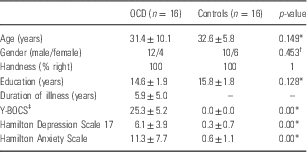
The participants consisted of 16 patients with OCD with illness durations of over 5 years (5.9±5.0) and over 14 years of education (mean age: 31.4±10.1 years). The patients were diagnosed by a psychiatrist at Chonbuk National University Hospital who referred to the DSM-IV-TR. We also recruited 16 healthy controls (mean age: 32.6±5.8 years) with no history of neurological or psychiatric illness. There were no differences in the age or educational levels between the two groups (Table 1). The patients with OCD were recruited from Chonbuk National University Hospital. All of the experimental procedures were clearly explained to the participants before the study began. The protocol for this study was approved by the Chonbuk National University Hospital Institutional Review Board. All subjects provided informed written consent prior to participating in the study.
Demographic information of OCD patients and healthy controls

OCD, obsessive compulsive disorder.
* Independent t-test.
† χ2 test.
‡ Yale-Brown Obsessive Compulsive Scale.
Clinical interviews
All of the participants underwent three clinical interviews with the following scales: Yale-Brown Obsessive Compulsive Scale (Y-BOCS) (Reference Goodman, Price and Rasmussen15), Hamilton Depression Scale 17 (HAM-D 17) (Reference Hamilton16), and Hamilton Anxiety Scale (HAM-A) (Reference Maier, Buller, Philipp and Heuser17). The Y-BOCS is a valid and comprehensive clinical interview for OCD symptoms, with a total score ranging from 0 (no symptoms) to 40 (extreme symptoms), as follows: 0–7 (sub-clinical), 8–15 (mild), 16–23 (moderate), 24–31 (severe), and 32–40 (extreme). The HAM-D 17 measures depression symptoms as follows: 0–7 (normal range), 8–13 (mild), 14–18 (moderate), 19–22 (severe), and over 23 (very severe). Finally, the HAM-A measures the symptoms of anxiety, with a total score ranging from 0 to 56, as follows: 0–13 (normal range), 14–17 (mild), 18–24 (moderate), and over 25 (severe).
Selection of ‘emotionally neutral’ and ‘unpleasant’ words
The experimental stimuli consisted of a series of emotionally neutral and unpleasant words. The words were 160 two-syllable words that are frequently used in Korea, and were extracted from a Korean language dictionary. Then, the words were classified as being emotionally neural or unpleasant according to a list provided by the Korean Dictionary Compilation Committee. From this list, two sets of six neutral and unpleasant words were respectively selected by 15 college students through a questionnaire. After the MRI and fMRI examinations, the participants were asked to rate the emotionally neutral and unpleasant words on an unpleasantness scale (range: 0~10).
MRI and fMRI
T1-weighted images were obtained using a 3-T Magnetom Verio MR Scanner (Siemens Medical Solutions, Germany) with the following parameters: repetition time/echo time=2000/2.35 ms, field-of-view=22×22 cm2, matrix=256×256, number of excitations=1, and slice thickness=1 mm. The total acquisition time was 193s.
The blood-oxygen-level dependent fMRI data were obtained from 25 sagittal planes based on the anterior commissure-posterior commissure line using the gradient-echo echo planar imaging pulse sequence with the following parameters: repetition time/echo time=2000/30 ms, flip angle=90°, field-of-view=22×22 cm2, matrix=64×64, number of excitations=1, and slice thickness=5 mm. The total acquisition time including the two-phase dummy scans was 146s.
Paradigm for brain activation
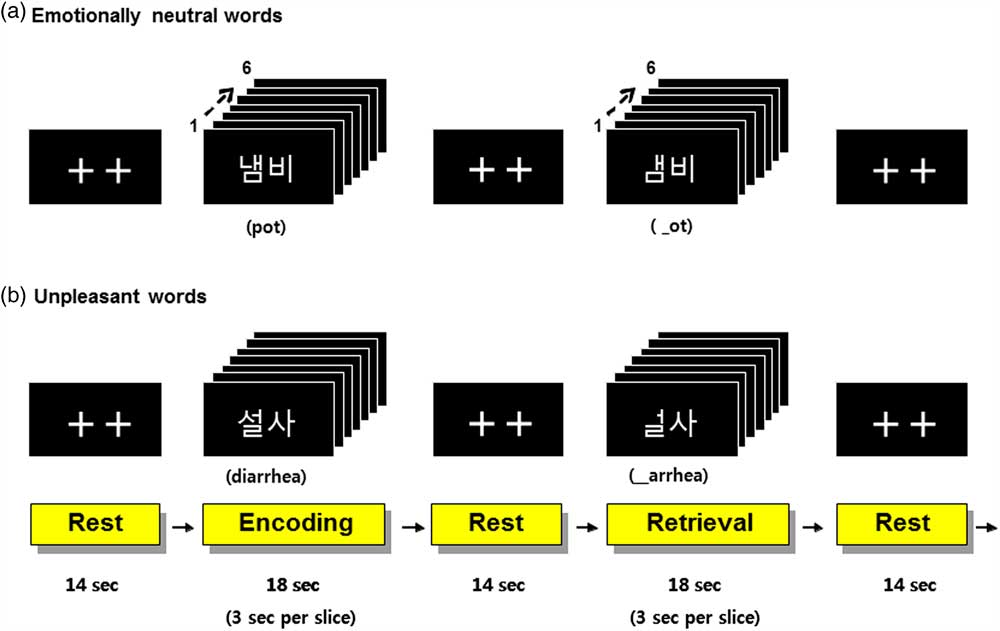
The activation paradigm consisted of the following cycle: rest (14s), first encoding (18s), rest (14s), first retrieval (18s), rest (14s), second encoding (18s), rest (14s), second retrieval (18s), and rest (14s). Emotionally neutral words were used in the first encoding step, followed by unpleasant words in the second encoding step (Fig. 1). In the rest periods, two fixation crosses were displayed. In each encoding period, six different two-syllable words were displayed for 3s. The emotionally neutral words were  (letter),
 (pot),
 (trademark),
 (frame),
 (wardrobe), and
 (window), while the unpleasant words were
 (dust cloth),
 (constipation),
 (diarrhoea),
 (dunging),
 (mouse),
 (armpit smell). In the retrieval periods, the same words, but with the first consonant omitted, were randomly presented. The participants were instructed to press the button as soon as they retrieved the encoded words linked with their first consonant-omitted words. All of the words were displayed on a computer monitor using Superlab Pro 4.5 Software (Cedrus Co., San Pedro, CA, USA).
Activation paradigms consisting of the ‘encoding’ and ‘retrieval’ of emotionally neutral (a) and unpleasant (b) words during implicit memory tasks. In each encoding period, six different two-syllable words, each appearing once, were sequentially presented. In the following retrieval period, the same words, but with the first consonant omitted, were randomly presented once.

Postprocessing and statistical analysis
Functional images were analysed using the SPM8 software (Statistical Parametric Mapping 8; The Wellcome Department of Cognitive Neurology, University College London, UK). The acquired images were realigned to compensate for head movement. Then, whole-brain normalisation was applied to transform all images into the echo planar imaging templates. The normalised images were smoothed with a spatial Gaussian 8-mm full-width-at-half-maximum filter. After specifying the appropriate design matrix, changes in the haemodynamic response produced by the different experimental conditions were assessed at each voxel using a general linear model with a box-car method. Brain activation for the encoding and retrieval steps was quantified by using random effect group analyses with two-sample t-tests (uncorrected p<0.001). The x, y, and z coordinates that were based on the Montreal Neurological Institute brain space provided by the SPM8 software were used to identify the localised brain activity. The activated brain areas were labelled with the help of the Functional and Anatomical Labeling of Brain Activation software (Reference Jeong, Park and Youn18) and BrainInfo 2007 (National Primate Research Center, University of Washington, Washington, USA). The brain laterality was measured with the following equation:
 $$\eqalignno{ {\rm Laterality}\,(\,\%\,) & {\rm {\equals}=(Number}\,{\rm of}\,{\rm activated}\,{\rm voxels}\,{\rm in}\,{\rm the}\,\cr{\rm left}\,{\rm hemisphere } -{\rm Number}\,{\rm of}\,{\rm activated}\,\cr{\rm voxels}\,{\rm in}\,{\rm the}\,{\rm right}\,{\rm hemisphere)} \,/\,{\rm Total}\,\cr{\rm number}\,{\rm of}\,{\rm voxels}\,{\rm activated}\,{\rm in}\,{\rm a}\,{\rm given}\,\cr{\rm anatomical}\,{\rm area}{\times}{\rm 1}00 $$
Results
Demographic characteristics
The demographic information of the OCD and control groups is described in Table 1. There were no differences between the two groups in terms of gender distribution, age, and length of education. The clinical interviews of the patients with OCD showed severe scores on the Y-BOCS (25.27±5.18), but scores in the normal range for both the HAM-A (11.31±7.69) and HAM-D (6.13±3.86). The scores of the control group were within the normal range on the Y-BOCS (0.0±0.0), HAM-A (0.6±1.1), and HAM-D (0.3±0.7).
Emotionality scales of unpleasant and emotionally neutral words
The scores for the unpleasant words were 6.4±1.3 and 6.5±1.3 out of 10 points in healthy controls and patients with OCD, respectively. There was no significant difference in the ratings between the two groups (p<0.526). The scores for the emotionally neutral words were 0.5±0.8 and 0.8±0.9 (p<0.387) in healthy controls and patients with OCD, respectively.
Comparison of the brain activation patterns between patients with OCD and healthy controls
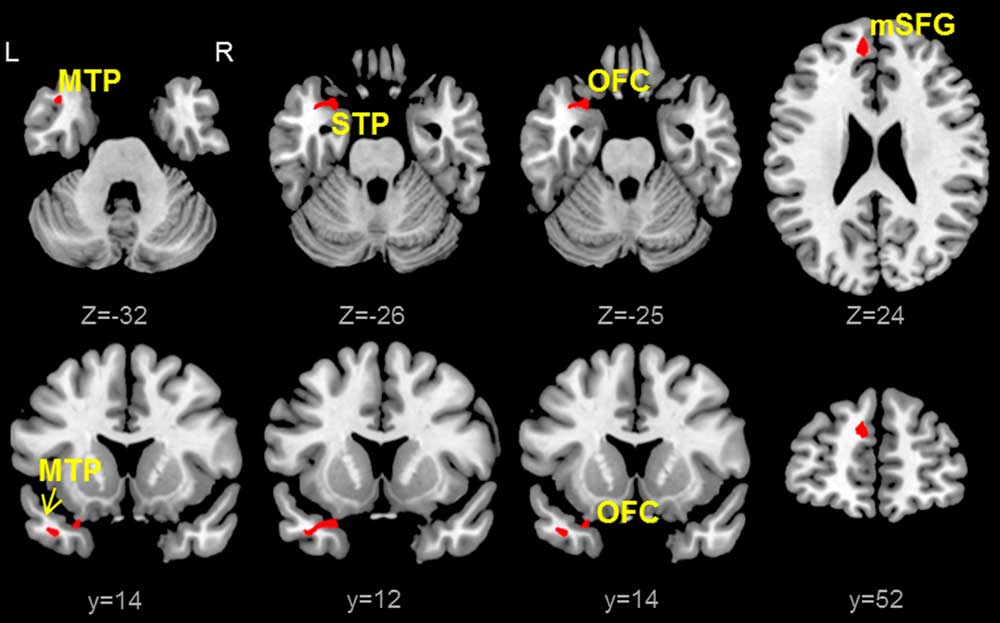
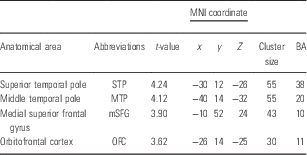
The differential brain activation maps between patients with OCD and healthy controls were obtained by performing two-sample t-tests (uncorrected p<0.001, extent threshold: 30 voxels). During the implicit encoding and retrieval tasks with both the emotionally neutral and unpleasant words, no distinct brain areas showed significant activity in healthy controls when contrasted with patients with OCD. On the other hand, during the implicit retrieval task with unpleasant words, the patients with OCD showed higher activity compared to the healthy controls in the following brain areas: the superior/middle temporal pole (STP/MTP), medial superior frontal gyrus (mSFG), and orbitofrontal cortex (OFC) (Table 2, Fig. 2). However, no differential brain activation was observed in the encoding task with unpleasant words. Moreover, during the encoding and retrieval task with emotionally neutral words, the patients with OCD did not show any distinct areas of activation.
Activation maps associated with the implicit memory retrieval of unpleasant words in patients with obsessive compulsive disorder (OCD) when contrasted with healthy controls. Two-sample t-tests were used (uncorrected p<0.001). L, left; R, right.

Brain activities associated with implicit memory retrieval of unpleasant words in patient with OCD as contrasted with healthy controls: two sample t -test (uncorrected p<0.001)

BA, Brodmann’s area.
Brain laterality
The localised brain laterality was evaluated based on the number of activated pixels in a given brain area. During the implicit retrieval task with unpleasant words, all of the patients with OCD showed left-hemisphere predominant laterality in the STP/MTP (100%), mSFG (100%), and OFC (100%).
Discussion
This study was initiated on the presumption that patients with OCD and healthy controls would show differential brain activation patterns during implicit retrieval with emotionally neutral and unpleasant words. However, during the implicit memory encoding and retrieval tasks with emotionally neutral words, the patients with OCD did not show any distinct activity when contrasted with the healthy controls, which indicates that the emotionally neutral words had no effect during the encoding and retrieval tasks in both groups. On the other hand, although the patients with OCD did not exhibit any differential brain activation in the implicit encoding task with unpleasant words compared to healthy controls, the patients did show distinct brain activity in the STP/MTP, mSFG, and OFC during the implicit retrieval task with unpleasant words compared to healthy controls.
The predominant activity of the STP/MTP, mSFG, and OFC in OCD may be due to higher cognitive and perceptual processing in combination with an iterative process of compulsive thinking and behaviour. Especially, previous studies showed that activation of the prefrontal lobe including the OFC is associated with implicit memory in patients with OCD who were more heavily burdened compared to healthy controls during implicit memory retrieval (Reference Fletcher, Stephenson, Bullmore, Donovan, Williams and Carpenter19,Reference Milad and Rauch20). Thus, the OFC is closely related to the symptoms of OCD. In an fMRI study (Reference Shapira, Liu and He21), when emotionally negative photos were shown to patients with OCD, the patients exhibited hyper activity in the OFC when compared to healthy controls. Additionally, a voxel-based morphometry study (Reference Valente, Miguel and Castro22) concerning patients with OCD demonstrated that abnormalities in OFC volume were associated with OCD symptoms. In this study, it is assumed that the activation of the OFC we observed in patients with OCD indicates that, compared to healthy controls, the OFC in these patients is more sensitive to the negative emotion induced by unpleasant words.
It should also be noted that activation of the SFG is associated with higher cognitive functions including the process of decision making (Reference du Boisgueheneuc, Levy and Volle23). Neurophysiological and neuropsychological studies on OCD have highlighted abnormalities in the fronto-striatal regions (Reference Milad and Rauch20). Furthermore, these regions are involved in mediating the emotion of disgust in patients with OCD (Reference Corcoran, Woody and Tolin24). Our study revealed higher prefrontal activity for unpleasant words in patients with OCD, suggesting that the patients with OCD were affected more by negative emotions than the healthy controls were. The OFC is compositely involved in implicit learning and memory, emotion, and obsessive compulsive symptoms such as compulsive and repetitive behaviours (Reference Volkow and Fowler25). In addition, the striato-thalamo-orbitofrontal circuit has been implicated in the development of addictive behaviour via dopaminergic activation of reward circuits (Reference Volkow and Fowler25). The OFC is also assumed to act as a central hub that integrates and modulates neural activation to monitor and control emotional responses (Reference Rule, Shimamura and Knight26). Therefore, identifying the typical brain activation pattern that occurs in response to a negative condition is important for understanding how OCD symptoms are associated with emotion and cognition.
The other areas that were activated in our study included the STP and MTP. The temporal lobe is known to be involved in processing emotional reactions, as well as auditory information, language comprehension, and memory. An fMRI study revealed that adolescents showed predominant activity in the temporal pole when viewing photographs of fearful faces (Reference Nelson, McClure and Monk27). Thus, the temporal pole is believed to be involved in the reaction to negative emotions such as fear. In a PET study, when healthy males performed an episodic memory retrieval task that used emotional pictures, brain activation, as it corresponded to the regional glucose uptake, was observed in the anterior temporal pole (Reference Dolan, Lane, Chua and Fletcher28). Based on these findings, the temporal pole seems to be closely connected to negative emotional responses, thus the predominant activation of this area that we observed during the implicit memory retrieval task in patients with OCD may be associated with the impact of unpleasant emotion.
The brain lateralisation is also important because of its implications for high-order cognitive functions such as in the implicit memory tasks associated with negative emotion. It should be noted that the patients with OCD in our study demonstrated left-sided laterality in the STP/MTP (100%), mSFG (100%), and OFC (100%) in the implicit memory tasks with unpleasant words. In general, it is well known that the abilities of making inferences and interpreting events are stronger in the left hemisphere than they are in the right (Reference Weber, Kügler and Elger29,Reference Gazzaniga30). In particular, the left temporal lobe is involved in comprehension, naming, and verbal memory and plays an important role in processing the semantics in both speech and vision in humans (Reference Scott, Blank, Rosen and Wise31). Additionally, our findings and those of another similar study (Reference Weber, Kügler and Elger29) demonstrate the left-lateralised response to implicit memory tasks in patients with OCD and healthy controls.
Given our results, it is important to note that the greater brain activity of the STP/SFG, mSFG, and OFC that was observed in response to negative word retrieval in patients with OCD compared to controls suggests that patients with OCD may actually experience hypothetical situations as being real, in contrast with controls, who do not feel such emotions when confronted with the same stimuli. In other words, it is assumed that individuals with OCD-like alterations may be more adaptive than controls, as they are capable of imagining aversive situations and making plans to avoid them, which may be a potential evolutionary origin of OCD symptoms (Reference Feygin, Swain and Leckman32).
However, this study has some limitations. First, the participants consisted of 16 patients, which is a relatively small sample size, and thus provided lenient statistical power to the data. Second, the larger proportion of males to females may have induced a gender-related statistical bias. Third, the duration of illness was not normally distributed and the minimum duration was not more than 5 years. Fourth, since we did not investigate whether medications affected the brain activation patterns associated with implicit retrieval, this possibility cannot be excluded. Although the patients with OCD who enrolled in this study were treated with SSRIs, such as escitalopram or fluvoxamine, only the patients with Y-BOCS scores ≥24 (severe) points were included in this study. Fifth, the statistical threshold we used (uncorrected, p<0.001) was lenient. Further studies using stricter thresholds such as family wise error correction are needed. Finally, this study only focused on neuroanatomical assessments and did not measure behavioural data. In order to further examine the correlation between memory performance and brain activation, an extended paradigm consisting of the memory delay times and performance scores is needed. In addition, future studies should consider using an event-related implicit retrieval task that focuses more specifically on its effects on the cognition-emotion interactions.
In conclusion, this study provides evidence for the differential brain activation patterns between patients with OCD and healthy controls in response to implicit memory retrieval with unpleasant words. These findings suggest that the impact of negative emotion on the implicit memory task may be associated with the symptomatology of OCD, and thus may be helpful for understanding the neural mechanisms underlying the impairments in cognitive and emotional functions that are commonly observed in patients with OCD.
Acknowledgements
Shin-Eui Park, Jong-Chul Yang, and Gwang-Woo Jeong designed the studies and acquired the data. Shin-Eui Park contributed to the analysis and interpretation of the data. Shin-Eui Park wrote the first draft of the manuscript. Gwang-Woo Jeong approved the final manuscript and completed the manuscript. Additionally, all authors are in agreement with the content of the manuscript. All authors met the following authorship criteria: (1) substantial contributions to conception and design of, or acquisition of, data or analysis and interpretation of data, (2) drafting the article or revising it critically for important intellectual content, and (3) final approval of the version to be published.
Financial Support
This work was supported by the National Research Foundation of Korea (NRF) grant funded by the Korea government (MSIP) (2015R1A2A2A01007827) and Chonnam National University Hospital Biomedical Research Institute (CRI 15011-1).
Conflicts of Interest
None.
Ethical Standards
The authors assert that all procedures contributing to this work comply with the ethical standards of the relevant national and institutional committees on human experimentation and with the Helsinki Declaration of 1975, as revised in 2008.