1. Introduction
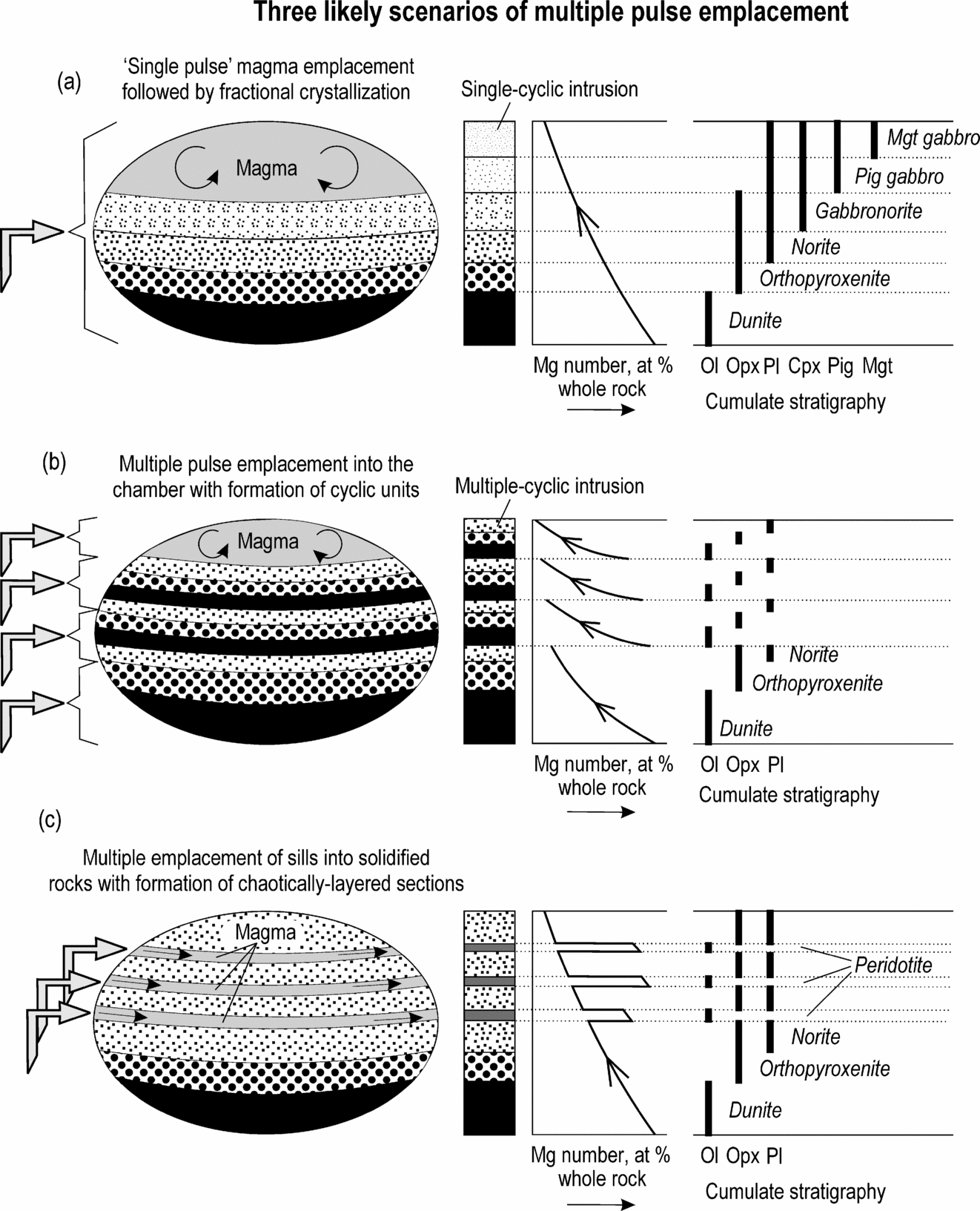
The long-standing dilemma in interpreting plutonic rocks is whether to consider the sequences as due to purely in situ processes or as a result of multiple pulse injection events. Historically, this is almost a philosophical matter in igneous petrology. Given the recent advances in physico-chemical and geochemical tools now available on crystallizing magmatic systems, this question can be approached with far more objectivity and certainty than ever before. In general, it has become currently widely understood that large magmatic bodies are most likely produced by multiple pulse emplacement because there is simply no terrestrial process that is capable of instantly generating and emplacing enormous volumes of magma. However, one cannot but note that in many cases the application of this idea to origin of mafic–ultramafic intrusions appears to be not always well justified. To explain this point, it would be instructive first to briefly describe the cases in which the multiple pulse idea appears to work perfectly for large mafic–ultramafic intrusions. These may be delineated into three most likely scenarios (Fig. 1).
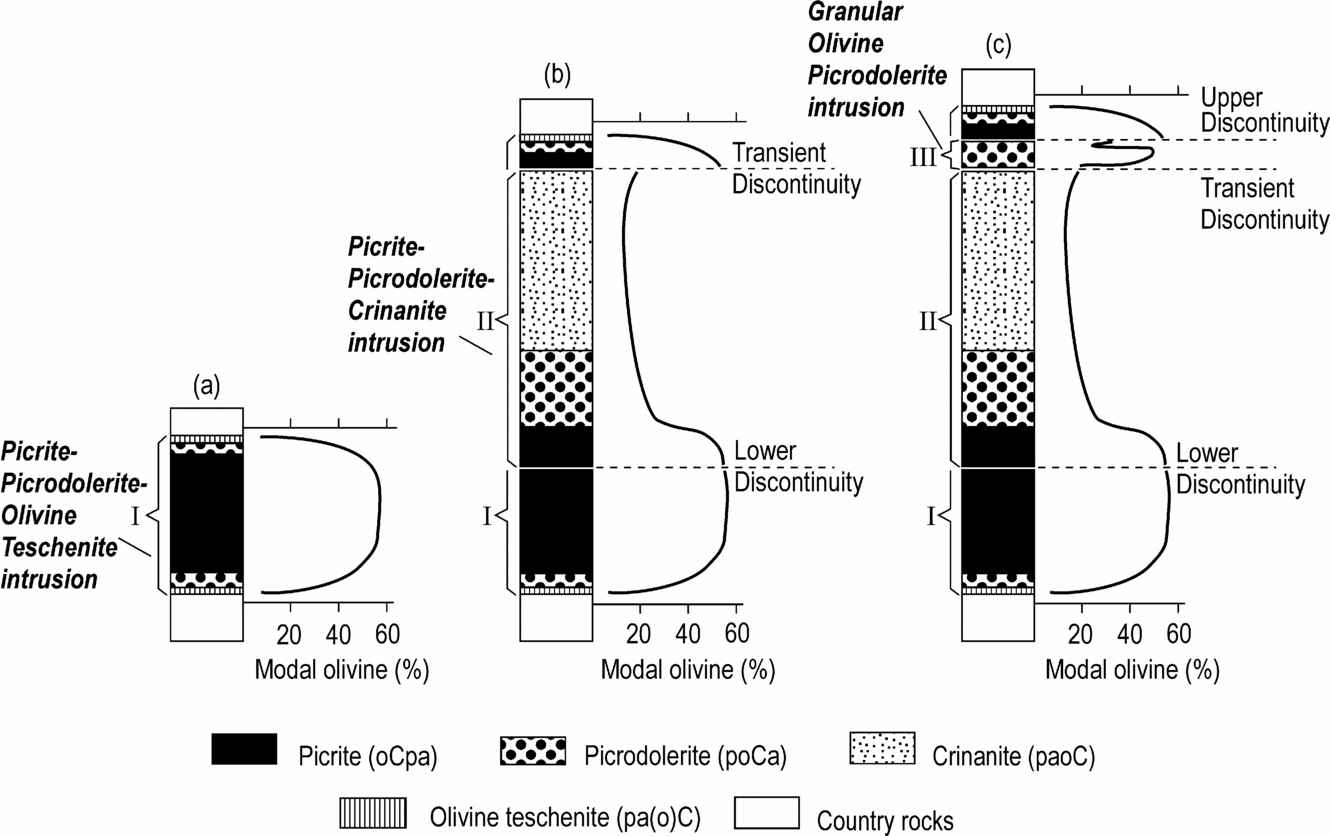
A cartoon summarizing three likely scenarios of multiple pulse emplacement in mafic–ultramafic intrusive bodies: (a) ‘single pulse’ magma emplacement followed by fractional crystallization with formation of a single-cyclic intrusion; by ‘single pulse’ we mean that the intrusion crystallizes from a single large body of homogeneous magma produced by complete mixing of numerous small magma pulses in the chamber prior to onset of crystallization; (b) multiple emplacement of magmas of primitive composition into an evolving chamber, with formation of cyclic units marked by prominent reversals in phase, modal and cryptic layering; (c) multiple emplacement of sills into solidified rocks (a ‘liquid into solid’ intrusive mechanism) with formation of chaotic-looking sections comprising layers of distinctly different composition. See text for discussion. Hereafter in abbreviations of cumulates: o – olivine, p – plagioclase, a – clinopyroxene, c – chromite, C – cumulate. Symbols preceding C denote cumulus phases; those following C denote intercumulus phases. Hereafter in figures and text: Pl – plagioclase, Ol – olivine, Fo – forsteritic olivine, Fa – fayalitic olivine, Opx – orthopyroxene, Pig – pigeonite, Cpx – clinopyroxene, Ne – nepheline, Qtz – quartz, Ap – apatite, Kfp – alkali feldspar, Sp – Cr-spinel, Chr – chromite, Mgt – Ti-magnetite, Ilm – ilmenite, Z – zeolite.

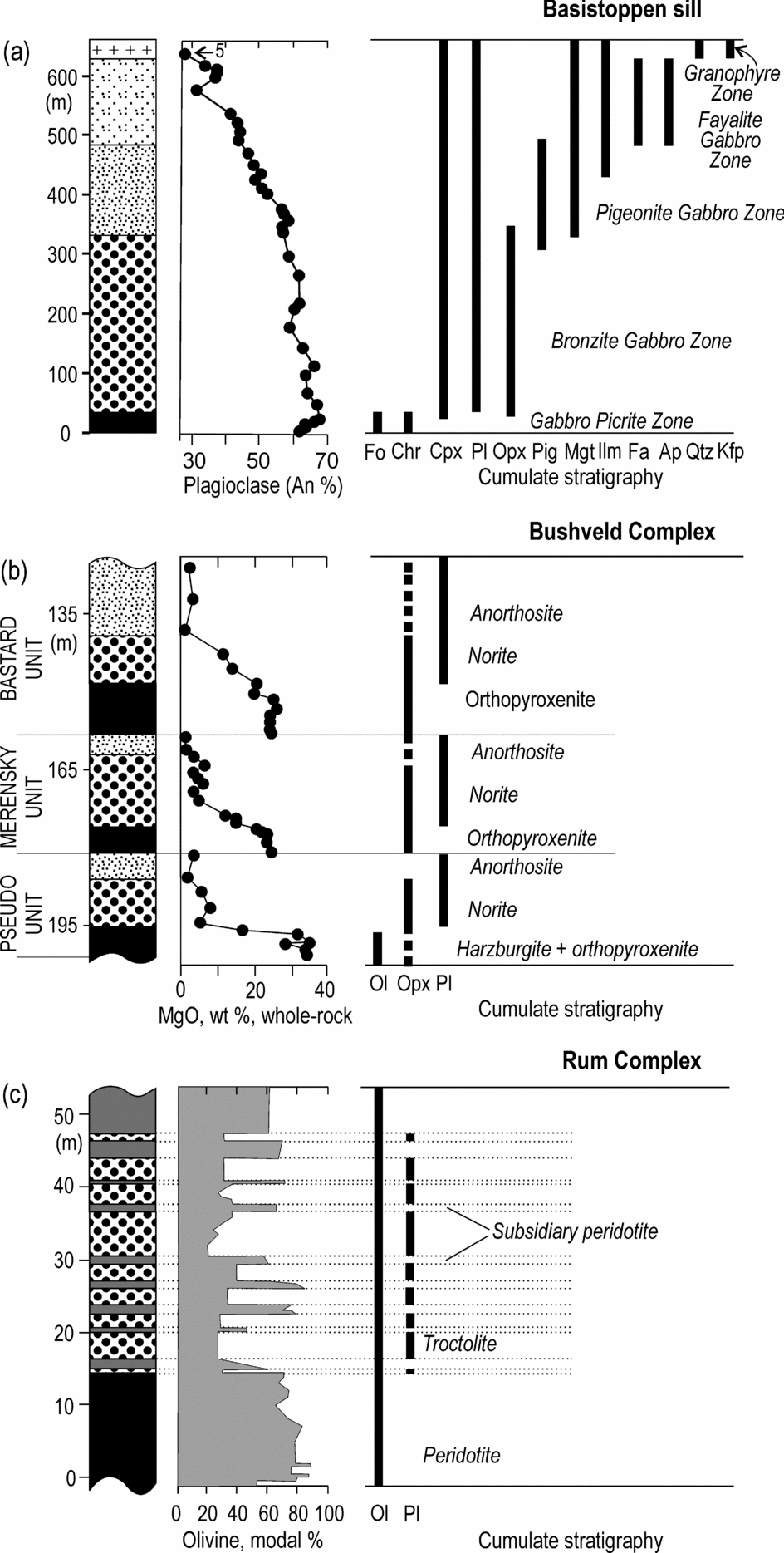
One of the most common cases is when large magma bodies are filled to their present width continuously with many magma pulses of the same composition on a time scale much shorter than that of solidification (Fig. 1a). During this process, new magma fluxes effectively mix with resident magma in the chamber, delaying or impeding the onset of its crystallization. As a result, the bodies finally start crystallization essentially from one large body of homogeneous magma and can therefore be geochemically modelled as having crystallized from a ‘single pulse’ of magma. The most important feature of the bodies produced by this process is the presence of rock sequences recording the progressive fractional crystallization of basaltic magma as predicted by liquidus phase equilibria (e.g. Ol, Opx, Opx+Pl, Opx+Pl+Cpx). Closed system fractionation of basaltic magma is additionally highlighted by systematic continuous changes in composition of minerals (e.g. An in plagioclase) and whole-rock indices of magma differentiation (e.g. Mg number). The most remarkable examples of such bodies are the Skaergaard (McBirney, Reference Mcbirney and Cawthorn1996), Kiglapait (Morse, Reference Morse1969) and Kivakka (Koptev-Dvornikov et al. Reference Koptev-Dvornikov, Kireev, Pchelintseva and Khvorov2001) layered intrusions. In this paper, such intrusions will be referred to as single-cyclic ones because they are essentially composed of one cyclic unit containing a rock sequence expected from liquidus phase equilibria. As an illustration, we present here a typical single-cyclic Basistoppen mafic sill (Fig. 2a).
Stratigraphic sections, compositional variations and cumulate stratigraphy through the Basistoppen mafic sill (a), three cyclic units of the Bushveld Complex (b), and cyclic unit 14 of the Rum Complex (c), illustrating three hypothetical scenarios of multiple pulse emplacement shown in Figure 1a, b and c. Data are from the following sources: Basistoppen mafic sill: Naslund (Reference Naslund1989); Bushveld Complex: Naldrett (Reference Naldrett1989); Rum Complex: Renner & Palacz (Reference Renner and Palacz1987). See text for discussion.

Another common case is when large magma bodies are filled to their present width with many magma pulses of primitive composition on a time scale much longer than that of solidification (Fig. 1b). One of the most spectacular manifestations of multiple pulse activity in such plutonic bodies is the occurrence of cyclic units, each of which is commonly attributed to a new magma pulse refilling the evolving magma chamber. From the base to the top, each cyclic unit shows a systematic change in crystallization sequence (e.g. dunite, orthopyroxenite, norite), accompanied by progressive decrease in whole-rock MgO, Mg number of mafic phases and An content of plagioclase. The boundaries between cyclic units are commonly sharp and very distinctive and are marked by prominent reversals in phase, modal and cryptic layering. Examples include large layered intrusions, such as the Rum Complex (Emeleus et al. Reference Emeleus, Cheadle, Hunter, Upton, Wadsworth and Cawthorn1996), Muskox (Irvine, Reference Irvine1970), Penikat (Alapieti & Lahtinen, Reference Alapieti, Lahtinen and Cabri2002) and the Fox River Sill (Peck et al. Reference Peck, Scoates, Theyer, Desharnais, Hulbert, Huminicki and Cabri2002; Desharnais et al. Reference Desharnais, Peck, Scoates and Halden2004). In this paper, such intrusions will be referred to as multiple-cyclic ones since they are made up of several cyclic units with each exhibiting a rock sequence consistent with liquidus phase equilibria. As an illustration, we present here a section with three well-developed cyclic units from the Bushveld Complex (Fig. 2b).
Finally, a much less common case is when magma bodies are growing by emplacement of sill-like intrusions into partly solidified rocks (Fig. 1c). Such sills are readily recognized in the section since their boundaries with host rocks are commonly sharp and very distinctive. They are marked by prominent reversals in phase, modal and cryptic layering on the background of host intrusive rocks that become progressively more evolved stratigraphically upwards. The distinguishing feature of the bodies formed by this mechanism is their chaotically-layered sections that are not predicted by liquidus phase equilibria. Remarkable examples of such chaotically-layered sections are observed in the Rum Complex, NW Scotland, which crystallized as an open-system magmatic chamber (Emeleus et al. Reference Emeleus, Cheadle, Hunter, Upton, Wadsworth and Cawthorn1996). The complex consists of several roughly bimodal cyclic units, each composed of a lower peridotite layer and an upper troctolite layer. In the troctolitic part of many cyclic units, thin so-called subsidiary peridotite layers are very common and sometimes can comprise nearly half of this part. Field evidence suggests that these subsidiary peridotites are later sills that were intruded into solid and semi-consolidated troctolite, resulting in chaotic alternations of peridotite and troctolite layers (e.g. Renner & Palacz, Reference Renner and Palacz1987; Bédard, Reference Bédard, Sparks, Renner, Cheadle and Hallworth1988; Holness & Winpenny, Reference Holness and Winpenny2009) (Fig. 2c).
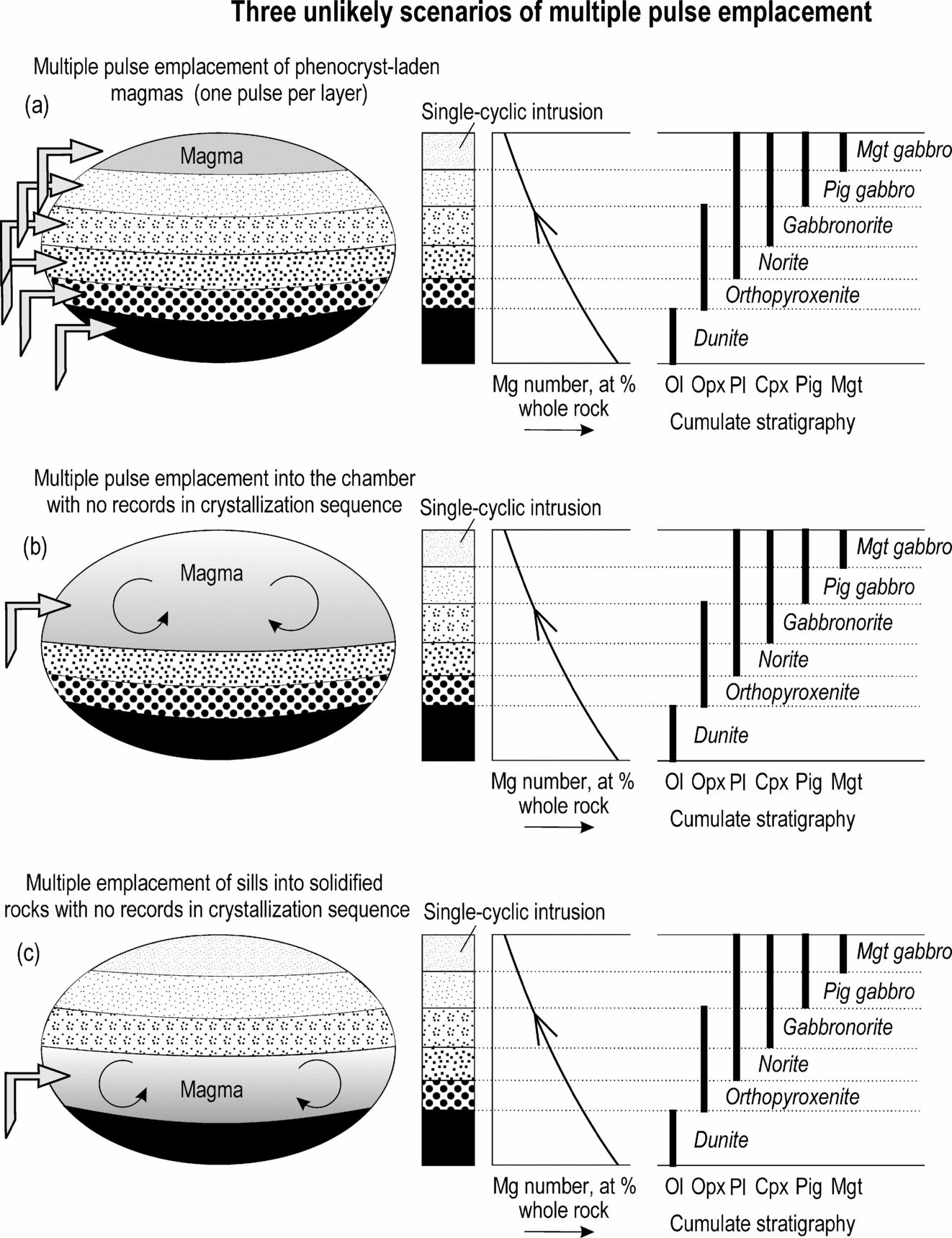
With the above in mind, let us now consider the cases when application of the multiple pulse mechanism to mafic–ultramafic intrusions does not appear to be properly justified. One can distinguish at least three scenarios in which appealing to a complex multiple pulse story is poorly supported by petrology and contradicts liquidus phase equilibria (Fig. 3). The common feature of all these scenarios is that they apply multiple emplacement of magma to produce compositional profiles of single-cyclic intrusions apparently crystallized from a ‘single pulse’ of magma (Fig. 1a).
A cartoon summarizing three unlikely scenarios of multiple pulse emplacement in mafic–ultramafic intrusive bodies to form what appear to be single-cyclic intrusions: (a) multiple emplacement of phenocryst-laden magma pulses (one pulse per layer); (b) multiple emplacement of primitive magmas of primitive composition into an evolving chamber that leaves no record of crystallization sequences and compositional trends; (c) multiple emplacement of sills into solidified rocks (a ‘liquid into solid’ intrusive mechanism) causing no inconsistencies or changes in crystallization sequences and compositional trends relative to a single-cyclic intrusion. See text for discussion.

The most radical concept states that all layered intrusions, including the classical Skaergaard intrusion, form by successive emplacement of phenocryst-laden magma pulses (e.g. Marsh, Reference Marsh1996; Zieg & Marsh, Reference Zieg and Marsh2005; Marsh, Reference Marsh2006) (Fig. 3a). The hypothesis suggests that each stratigraphic zone of a layered intrusion with specific sets of cumulus phases (e.g. Ol, Opx, Opx+Pl, Opx+Pl+Cpx) is produced from a separate magma pulse carrying this particular set of phenocrysts. It is thus not slow cooling and fractional crystallization of magma under closed system conditions, as conventional models imply, but the number and nature of magmatic pulses that lead to formation of layered intrusions. The major weakness of the hypothesis is that it requires a unique sequence of intrusive events to produce compositional profiles of single-cyclic intrusions. It is sufficient to have only one magma pulse emplaced out of the correct order to fail to produce these profiles. Following this logic, one can imagine a huge number of chaotically-layered bodies that can be generated by the random intrusion of phenocryst-laden magma pulses. Their chaotic compositional profiles will have nothing in common with phase equilibria-controlled rock sequences of single-cyclic intrusions. This and some other problems with this hypothesis have already been discussed in detail in a separate paper (Latypov, Reference Latypov2009).
Another hypothesis widely employs multiple emplacement of magmas of primitive composition into the evolving chamber to explain some textural and compositional ‘anomalies’ of single-cyclic intrusions, particularly mafic sills. As an example, the occurrence of basal reversals, upper picrite units and especially a relatively sharp contact between picritic and gabbroic units in the mafic sills of the Noril'sk region, Russia, are usually taken as evidence for their formation by two- or multiphase injection of distinct melts (e.g. Rogover, Reference Rogover1959; Smirnov, Reference Smirnov1966; Czamanske et al. Reference Czamanske, Wooden, Zientek, Fedorenko, Zen'ko, Kent, King, Knight and Siems1994, Reference Czamanske, Zen'ko, Fedorenko, Calk, Budahn, Bullock, Fries, King and Siems1995; Li, Ripley & Naldrett, Reference Li, Ripley and Naldrett2003; Arndt et al. Reference Arndt, Czamanske, Walker, Chauvel and Fedorenko2003; Arndt, Reference Arndt and Mungall2005). The major drawback of this idea is that, unlike a similar case in Figure 1b, the postulated primitive magma pulses leave no records in crystallization sequences and compositional trends (Fig. 3b). Specifically, the common phenomenon of the abrupt drop in olivine content at the boundary between picritic and troctolitic–gabbroic units in mafic sills is often cited as firm evidence for the formation of these units from two pulses of magma of contrasting composition. It seems surprising that the multiple pulse idea is applied to this obvious feature of liquidus phase equilibria reflecting a shift of magma composition from the Ol+L primary field to the Ol+Pl+L cotectic. This and other related issues have already been touched on earlier (Latypov, Reference Latypov2003b; Latypov & Alapieti, Reference Latypov, Alapieti and Eliopoulos2003) and will be addressed in more detail in a separate publication, using Noril'sk-type intrusions as a case study (Latypov et al. unpub. data).
The last concept explains some textural and compositional ‘anomalies’ of single-cyclic intrusions, particularly mafic sills, by multiple emplacement of sill-like intrusions into partly solidified rocks. The major shortcoming of the idea is that, unlike a similar case in Figure 1c, postulated sill-like magma injections do not cause any changes in crystallization sequences and compositional trends (Fig. 3c). This scenario envisages the emplacement of new magma pulses into solidified cumulates and is therefore referred here to as ‘liquid into solid’, to stress that it implies no magma mixing as in the above case. As an illustration, such a multiple pulse mechanism has been applied to Shiant Isles Main Sill, Scotland (e.g. Gibb & Henderson, Reference Gibb and Henderson1996; Henderson, Gibb & Foland, Reference Henderson, Gibb and Foland2000; Foland, Gibb & Henderson, Reference Foland, Gibb and Henderson2000) and the Lugar alkaline sill, SW Scotland (Henderson & Gibb, Reference Henderson and Gibb1987). It has also been suggested that a multiple ‘liquid into solid’ intrusive mechanism may be common for many other mafic sills, such as the Tertiary picritic sills of north Skye, the teschenitic sills of New South Wales and Permo-Carboniferous sills of the Midland Valley of Scotland (Gibb & Henderson, Reference Gibb and Henderson1989, Reference Gibb and Henderson2006).
This paper specifically focuses on examining the latter concept of a multiple pulse ‘liquid into solid’ mechanism. As a case study we will use the classical Shiant Isles Main Sill, Scotland, because it is exceedingly well studied geologically, mineralogically and geochemically (e.g. Gibb & Henderson, Reference Gibb and Henderson1996; Henderson, Gibb & Foland, Reference Henderson, Gibb and Foland2000; Foland, Gibb & Henderson, Reference Foland, Gibb and Henderson2000). It will be illustrated that the compositional profile of this single-cyclic sill is not consistent with the currently accepted idea of its origin by a multiple ‘liquid into solid’ intrusive mechanism, and that a much better alternative appears to be its crystallization from one large pulse of magma under nearly closed system conditions. In a broader context we predict that with further progress in our knowledge of intrachamber magma fractionation processes, many ‘anomalous’ features of single-cyclic mafic–ultramafic sills may find adequate explanation in the framework of a single magma pulse model.
2. Review of ideas on the origin of the Shiant Isles Main Sill
The Shiant Isles Main Sill, located in the Minch in the Hebrides of Scotland, is one of about 20 alkaline mafic sills belonging to the Little Minch Sill Complex that crops out on the Trotternish Peninsular of northern Skye and adjacent islands (Gibb & Gibson, Reference Gibb and Gibson1989). The Shiant Isles Main Sill is probably one of the best-studied alkaline mafic sills in the world (e.g. Walker, Reference Walker1930; Drever, Reference Drever1953; Johnston, Reference Johnston1953; Drever & Johnston, Reference Drever and Johnston1965; Gibb, Reference Gibb1973; Henderson, Gibb & Foland, Reference Henderson, Gibb and Foland2000; Foland, Gibb & Henderson, Reference Foland, Gibb and Henderson2000; Gibb & Henderson, Reference Gibb and Henderson1989, Reference Gibb and Henderson1996, Reference Gibb and Henderson2006) and is widely cited as an excellent example of a large differentiated olivine-rich sill against which models of magmatic processes can be tested (e.g. Gibb & Henderson, Reference Gibb and Henderson1992, Reference Gibb and Henderson1996, Reference Gibb and Henderson2006). In this context, it is instructive to consider how ideas on the origin of the sill have developed through time. Walker (Reference Walker1930) was the first to present a detailed account of the Shiant Isles Main Sill. He interpreted the sill as having formed from a single pulse of crinanitic magma, which underwent post-intrusive gravitational fractionation to produce picrite, picrodolerite and crinanite, showing an upward decrease in olivine content from over 60% in the picrite to about 8% in crinanite. Subsequent detailed field and petrographic studies resulted in the discovery by Drever (Reference Drever1953) and Johnston (Reference Johnston1953) of an abrupt discontinuity between the picrite (~ 60% Ol) and picrodolerite (~ 47% Ol) that could be traced in the field for considerable distances as a result of the differential weathering of the two rock types. This led to the view that the picrite may represent a distinct intrusive unit emplaced slightly earlier than the rest of the sill (Murray, Reference Murray1954).
The Walker hypothesis was later revived, however, by Drever & Johnston (Reference Drever and Johnston1965) and Wager & Brown (Reference Wager and Brown1968). Drever & Johnston (Reference Drever and Johnston1965) concluded that the picrite and picrodolerite were derived from a single pulse of alkaline olivine basalt magma. They attributed the picrite to gravity settling of olivine during and after intrusion and considered that the discontinuity may have arisen from disturbances in the trend of magma crystallization related to release of pressure due to tectonic activity. They cast doubt on the likelihood of a separate intrusion of the picritic unit since there is no unambiguous evidence of any independent movement of rocks above and below the discontinuity. Wager & Brown (Reference Wager and Brown1968) indicated that, although there is a sharp drop in olivine content at the top of the picrite layer (discontinuity), a graphic representation of olivine content versus height in the sill shows the variation to be in the form of a smooth curve with a marked change of slope, rather than a broken sequence. They also argued that the sill appears to provide an excellent example of a body which formed by the gravity settling of olivine from a single pulse of magma.
Gibb (Reference Gibb1973) disagreed with revival of Walker's hypothesis and returned to Murray's idea about the picrite unit as a separate intrusion, but interpreted it as being emplaced slightly later, not earlier, than the rest of the sill. More specifically, it was suggested that the intrusion of the sill was a continuous event, during the later stages of which a plug of flow-differentiated, olivine-rich magma was emplaced into the lower part of the still-evolving sill to form picrite. The discontinuity was interpreted as the upper surface of this olivine-rich plug (Gibb, Reference Gibb1973). The subsequent discovery of another discontinuity in the upper part of the sill (Gibb & Henderson, Reference Gibb and Henderson1984), which separates picrite from underlying crinanite, led to a reappraisal of the mechanism for formation of the sill. Gibb & Henderson (Reference Gibb and Henderson1989) reinterpreted the sill as a multiple intrusion formed from two intrusive phases. An essentially picritic sill was first emplaced and crystallized, followed by a second, olivine-bearing, crinanitic sill that was intruded into the upper part of the picritic sill before it had completely solidified. In developing this idea, it was further suggested, on the basis of more detailed mineralogical, geochemical and isotopic studies, that the sill actually consists of four separate intrusive phases emplaced in a short time span in the sequence olivine teschenite, picrite, picrodolerite–crinanite, and granular olivine picrodolerite (Gibb & Henderson, Reference Gibb and Henderson1996; Henderson, Gibb & Foland, Reference Henderson, Gibb and Foland2000; Foland, Gibb & Henderson, Reference Foland, Gibb and Henderson2000). There is an important difference between the earlier multiple intrusion model (Murray, Reference Murray1954; Gibb, Reference Gibb1973), which implied emplacement of magma into a still-evolving chamber, and the current one (Gibb & Henderson, Reference Gibb and Henderson1996; Henderson, Gibb & Foland, Reference Henderson, Gibb and Foland2000; Foland, Gibb & Henderson, Reference Foland, Gibb and Henderson2000), which suggests emplacement of magma into almost solidified host rocks (an intrusive mechanism ‘liquid into solid’, Fig. 3c). Gibb & Henderson (Reference Gibb and Henderson2006) have recently presented a remarkably comprehensive review of the compositional features of the Shiant Isles Main Sill to endorse their key conclusion that the sill is a prominent example of a class of large (> 50 m thick) mafic sills formed by multiple intrusion. Moreover, they inferred that multiple intrusion may be the rule rather than the exception for mafic sills, and predicted that detailed investigations of their internal compositional variations will reveal the multiple nature of many similar sills elsewhere. Our analysis of this issue shows, however, that there are serious problems with the multiple intrusion model ‘liquid into solid’ in explaining the characteristic features of the Shiant Isles Main Sill. It is instructive to start with a revision of rock lithologies of the sill since it causes much confusion in interpretation of the compositional structure.
3. Internal compositional structure of the Shiant Isles Main Sill
3.a. Some revision of rock lithologies
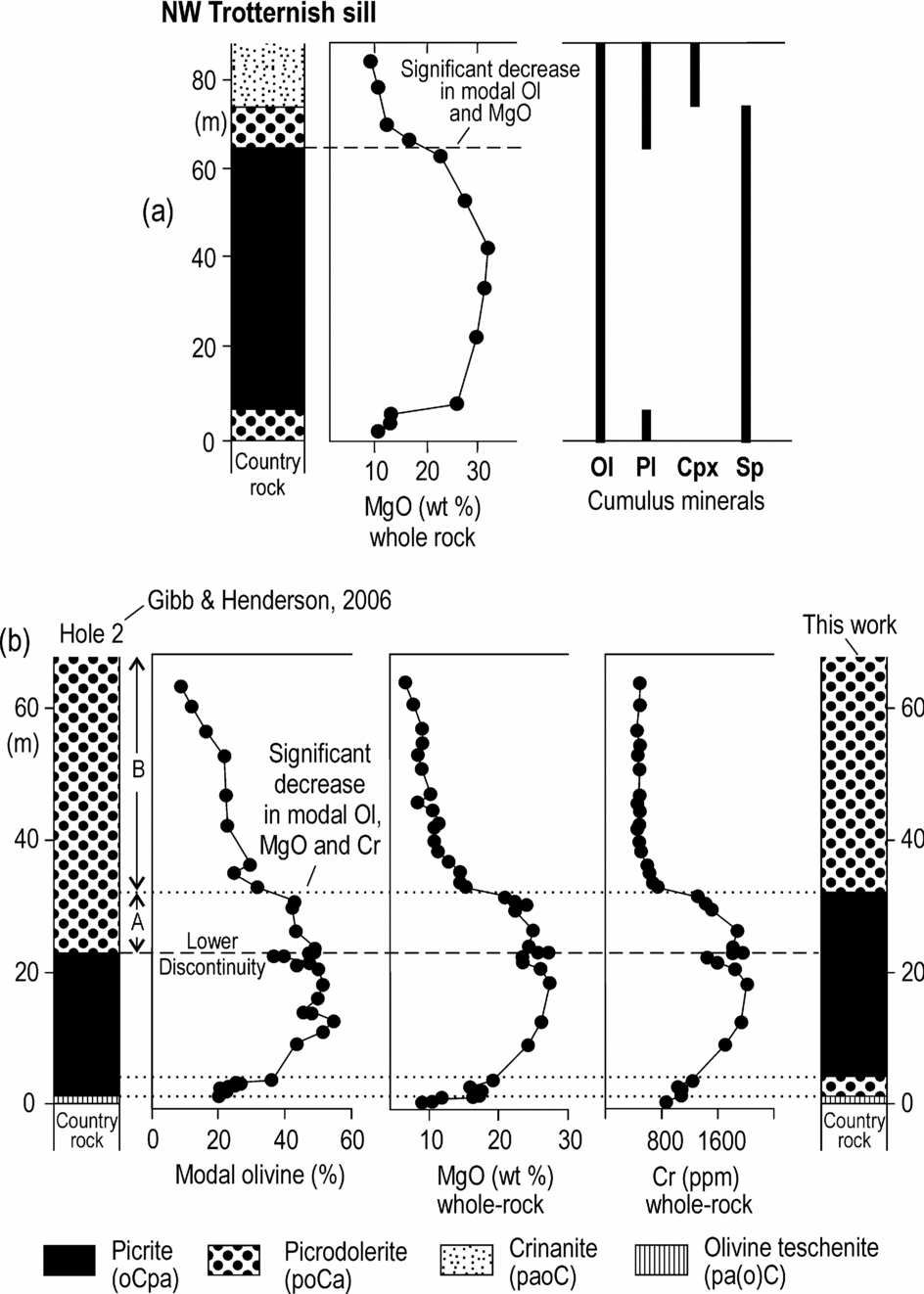
There are some inconsistencies in rock subdivision between the Shiant Isles Main Sill and other similar alkaline sills of the Little Minch Sill Complex that should be resolved before going into details of the internal structure and origin of the sill. In the alkaline sills of the Little Minch Sill Complex, Gibson & Jones (Reference Gibson and Jones1991) recognize three main lithologies: picrite, picrodolerite and crinanite. Mineral compositions of rocks are mostly related to modal variations in olivine, clinopyroxene and plagioclase, with minor contributions from accessory Cr-spinel, Ti-magnetite, ilmenite and analcime. The rock names are given depending on the modal olivine abundance. Picrites are characterized by a very high content of modal olivine (generally 40–60 vol.%), picrodolerites by much lower contents of modal olivine (10–20 vol.%), and crinanites with < 5 vol.%. Following Simkin (Reference Simkin and Wyllie1967), Gibson & Jones (Reference Gibson and Jones1991) placed the boundary between picrites and picrodolerites at a stratigraphic level where the olivine content significantly decreases over a short interval from about 40–45 vol.% (23–27 wt% MgO) to about 20 vol.% (12–16% MgO) (Fig. 4a). Note that this rock subdivision implies an essential gap between picrites and picrodolerites in terms of olivine content. We find this subdivision appropriate since, as will be discussed later, it is deeply rooted in liquidus phase equilibria. In particular, it is consistent with interpretation of the rock succession picrite–picrodolerite–crinanite (Fig. 4a) as reflecting a crystallization sequence from the picritic cotectic Ol+Sp+L (picrite) through the troctolitic cotectic Ol+Pl±Sp+L (picrodolerite) to the olivine gabbroic eutectic Ol+Pl+Cpx+L (crinanite).
(a) Generalized stratigraphic section through the northwest Trotternish alkaline sill, north Skye showing variations in whole-rock MgO and cumulate stratigraphy with height. Note that a transition from picrite to overlying picrodolerite is marked by a significant decrease in modal olivine and whole-rock MgO. Thick continuous lines indicate intervals in which minerals have cumulus status. Cumulate stratigraphy is mainly based on modal data and petrographic descriptions of Gibson & Jones (Reference Gibson and Jones1991) compared with cotectic mineral proportions in rocks expected from a phase diagram Ol–Pl–Cpx. (b) Vertical variations in modal olivine, whole-rock MgO and Cr in sections through the lower part of the Shiant Isles Main Sill (Hole 2). Data is from Gibb & Henderson (Reference Gibb and Henderson2006). Note the difference between the original (Gibb & Henderson, Reference Gibb and Henderson2006) and our (this work) subdivision of the sections into rock types.

Picrites and picrodolerites in the Shiant Isles Main Sill were historically defined otherwise. A reason for this is the discovery of a very distinctive physical junction in the basal part of the sill termed the Lower Discontinuity (Fig. 4b). It was established that the Lower Discontinuity is marked by decrease in olivine content from about 45–60 vol.% in picrites to about 40–47 vol.% in the overlying picrodolerites (e.g. Drever, Reference Drever1953; Johnston, Reference Johnston1953), giving some grounds to parallel this decrease with a much more significant drop in olivine content in other alkaline sills, as described above (Fig. 4a). As a result, the rocks below and above the Lower Discontinuity were defined as picrites and picrodolerites, respectively (Drever, Reference Drever1953; Johnston, Reference Johnston1953; Murray, Reference Murray1954; Drever & Johnston, Reference Drever and Johnston1965). Gibb & Henderson (Reference Gibb and Henderson1984) arbitrarily set the division between picrites (below the Lower Discontinuity) and picrodolerites (above the Lower Discontinuity) at 40% modal olivine, mostly to stress the significance of the Lower Discontinuity as a break between two adjacent petrographic units, which were interpreted as representing separate intrusive phases. Thus, in comparison with other alkaline sills of the Little Minch Sill Complex, in the Shiant Isles Main Sill there is virtually no compositional gap between picrites and picrodolerites and the latter are allowed to contain olivine up to twice as much as in other sills. They subsequently acknowledged, however, some petrographic problems arising from this subdivision (Gibb & Henderson, Reference Gibb and Henderson1996). In particular, it turned out that in some cases the amount of olivine in picrodolerites can be equal to (e.g. Hole 1) or even higher than in the underlying picrites (e.g. Hole 2) (Gibb & Henderson, Reference Gibb and Henderson1996). Despite these inconsistencies, Gibb & Henderson (Reference Gibb and Henderson2006) elected to retain the original terms to allow continuity and distinction between petrographic units as separate intrusive phases.
We consider that the current subdivision of rocks of the Shiant Isles Main Sill is unfortunate and causes considerable confusion. This is illustrated using a section through the lower part of the sill (Fig. 4b). First, it seems unreasonable that rocks at the base of the sill with 20–30 vol.% Ol (16–19% MgO) are here called picrites, whereas those just above the Lower Discontinuity with 43–48 vol.% Ol (24–27% MgO) are termed picrodolerites. The opposite would be more appropriate. Second, the picrodoleritic unit clearly subdivides into two smaller subunits, A and B, that are composed of rocks showing a distinct gap in terms of modal olivine, MgO and Cr contents. Subunit A, extending for about 10 m above the Lower Discontinuity, has approximately 43–48 vol.% Ol, 24–27% MgO and 1400–1700 ppm Cr, whereas the overlying subunit B contains 10–30 vol.% Ol, 8–15% MgO and 160–700 ppm Cr. In addition, the boundary between subunits A and B is marked by rapid changes in the composition of Ti-magnetite (Gibb & Henderson, Reference Gibb and Henderson1996, figs 9, 10) and possibly Cr-spinel (Gibb & Henderson, Reference Gibb and Henderson1996, table 6). It seems hardly justified to ignore this compositional gap by combining the rocks of these two subunits under the same name, picrodolerites. The presence of the compositional gap strongly indicates the necessity of making a distinction between these two lithologies. Third, it should be noted that the significant decrease in olivine content over a short interval (about 5 m), which is accentuated by a notable decrease in whole-rock MgO and Cr contents, occurs not at the level of the Lower Discontinuity, but about 10 m above it. As mentioned above, it is this level with a significant decrease in olivine content over a short interval, that is taken as the petrographic boundary between picrites and picrodolerites in all other alkaline sills of the Little Minch Sill Complex (e.g. Fig. 4a). We therefore fail to see why this decrease should be neglected in the Shiant Isles Main Sill, with the boundary between picrites and picrodolerites being placed at the level of the Lower Discontinuity. The fact that this discontinuity represents a distinctive physical junction does not alone justify changing the names of rocks from picrites (below the Lower Discontinuity) to picrodolerites (above the Lower Discontinuity), because they are similar in terms of modal olivine, whole-rock MgO and Cr contents (Fig. 4b).
To improve the situation, we suggest adjusting the rock subdivision of the Shiant Isles Main Sill to that of other alkaline sills of the Little Minch Sill Complex, as illustrated in the stratigraphic column to the right in Figure 4b. The major modification is that a boundary between picrites and picrodolerites is now placed at the level of a significant decrease in modal olivine (as well as whole-rock MgO and Cr contents) and that the basal olivine-poor picrites are renamed picrodolerites. It should be noted that we are not the first to define the basal rocks of the Shiant Isles Main Sill as picrodolerites; this was previously done by Drever & Johnston (Reference Drever and Johnston1965). As a result, the picrite unit now has picrodolerite units above and below, with the Lower Discontinuity running entirely within the picrite unit. In a similar manner, the upper picritic unit of the Shiant Isles Main Sill is also subdivided into picrodolerites and picrites on the basis of modal olivine and MgO contents.
3.b. Subdivision of the sill into petrographic units and postulated mechanism of their emplacement
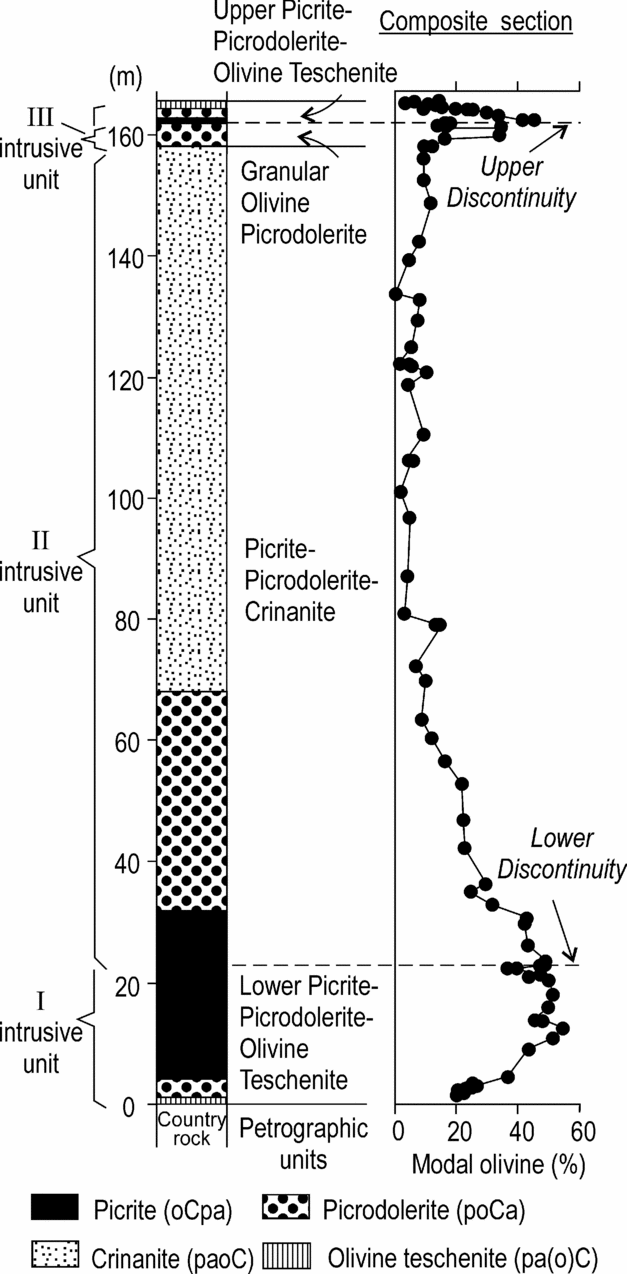
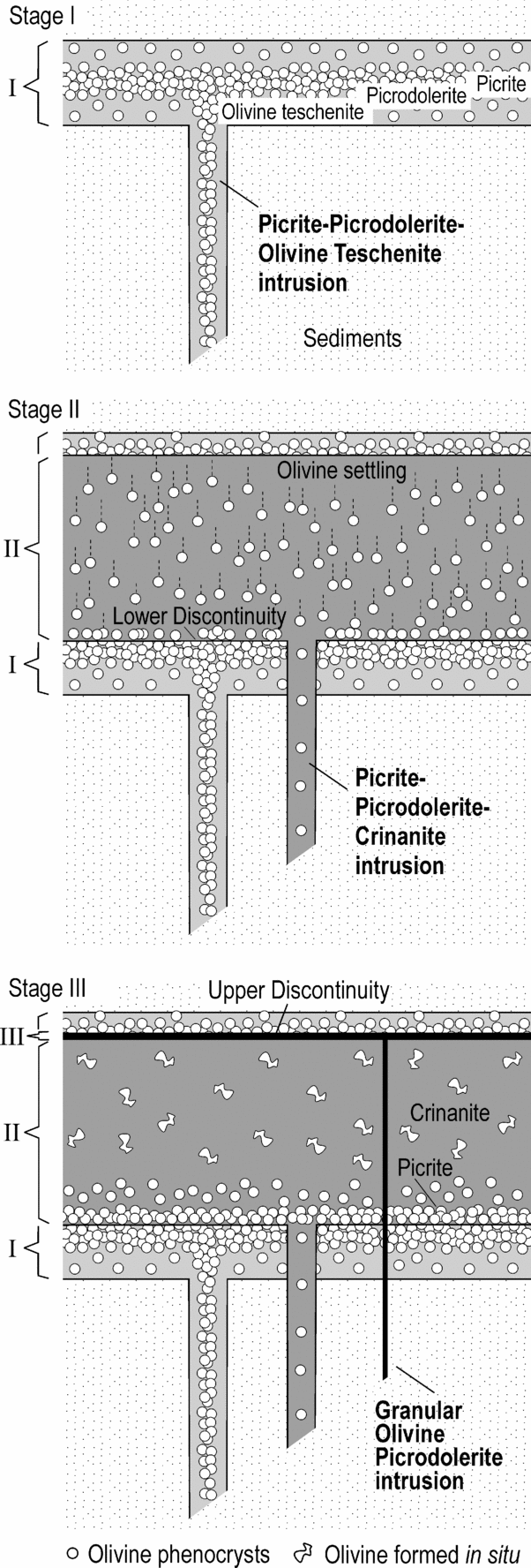
We can now present a revised version of a 165 m thick composite section through the Shiant Isles Main Sill (Fig. 5). The sill is subdivided into four petrographic units: Lower and Upper Picrite–Picrodolerite–Olivine Teschenite, Picrite–Picrodolerite–Crinanite and Granular Olivine Picrodolerite (units are capitalized in the text and figures to distinguish them from rock types). The names of the units differ somewhat from those used by Gibb & Henderson (Reference Gibb and Henderson2006) because of the revision in rock lithologies presented above. The field, petrographic and chemical relations between the petrographic units led to development of a four-phase multiple intrusion model for the Shiant Isles Main Sill (Gibb & Henderson, Reference Gibb and Henderson1989, Reference Gibb and Henderson1996, Reference Gibb and Henderson2006; Foland, Gibb & Henderson, Reference Foland, Gibb and Henderson2000; Henderson, Gibb & Foland, Reference Henderson, Gibb and Foland2000). For the sake of simplicity, the first two intrusions that are thought to have been derived from the same deep magma chamber and emplaced into the sill via the same feeder system (Gibb & Henderson, Reference Gibb and Henderson2006) are considered by us here as a single intrusion. With this minor simplification the proposed sequence of intrusive events appears as follows (Fig. 6).
(1) Stage I: Intrusive unit of Picrite–Picrodolerite–Olivine Teschenite. This was emplaced into the sediments as magma carrying about 10–15 vol.% olivine phenocrysts to give rise to the 2 m thick olivine teschenites. The teschenites were subsequently intruded concordantly by olivine-rich (about 40 vol.%) magma to form (together with olivine teschenites) a 24 m thick picrite sill with a D-shaped modal olivine profile.
(2) Stage II: Intrusive unit of Picrite–Picrodolerite–Crinanite. A substantial intrusion of magma, carrying about 10–15 vol.% olivine, was emplaced high in the picrite unit before the host rock was completely solidified, splitting the picrite into upper and lower portions and resulting in the appearance of the Lower Discontinuity. It should be specifically emphasized that by the time of emplacement there was no resident magma remaining in the chamber. The entire picrite unit had already crystallized and consisted of a rigid crystal mush with some minor amount of interstitial liquid. The intrusive mechanism can therefore be referred to as ‘liquid into solid’ (Fig. 3c). After emplacement, olivine suspended in the magma settled towards the bottom to form the picrites and picrodolerites and overlying olivine-poor crinanites with a total thickness of around 135 m.
(3) Stage III: Intrusive unit of Granular Olivine Picrodolerite. This 4 m thick unit intruded between the second unit (Picrite–Picrodolerite–Crinanite) and an upper portion of the first unit (Picrite–Picrodolerite–Olivine Teschenite) as magma containing over 30 vol.% olivine phenocrysts, again before the host rock was fully solid, resulting in the appearance of the so-called Upper Discontinuity. Again, the intrusive mechanism should be classified as a ‘liquid into solid’ type.
Composite section through the Shiant Isles Main Sill showing the distribution of modal olivine, rock types and petrographic (intrusive) units. Modified from Gibb & Henderson (Reference Gibb and Henderson2006) using our proposed revised rock lithologies.

Schematic illustration of the sequential emplacement of units into the Shiant Isles Main Sill (not to scale). Stage 1, Picrite–Picrodolerite–Olivine Teschenite; Stage 2, Picrite–Picrodolerite–Crinanite; Stage 3, Granular Olivine–Picrodolerite. Modified from Gibb & Henderson (Reference Gibb and Henderson2006).

The emplacement of all three magma pulses was proposed to have occurred over a relatively short time span, because each intrusion was emplaced before its immediate predecessor had completely solidified. This is based on the observation that, after the last intrusion, the sill underwent much of its remaining cooling as a single thermal unit, as evidenced by the continuity of the massive columnar joins across unit boundaries (Gibb & Henderson, Reference Gibb and Henderson1996, Reference Gibb and Henderson2006).
3.c. Subdivision of the sill into structural units based on vertical variations in whole-rock and mineral chemistry
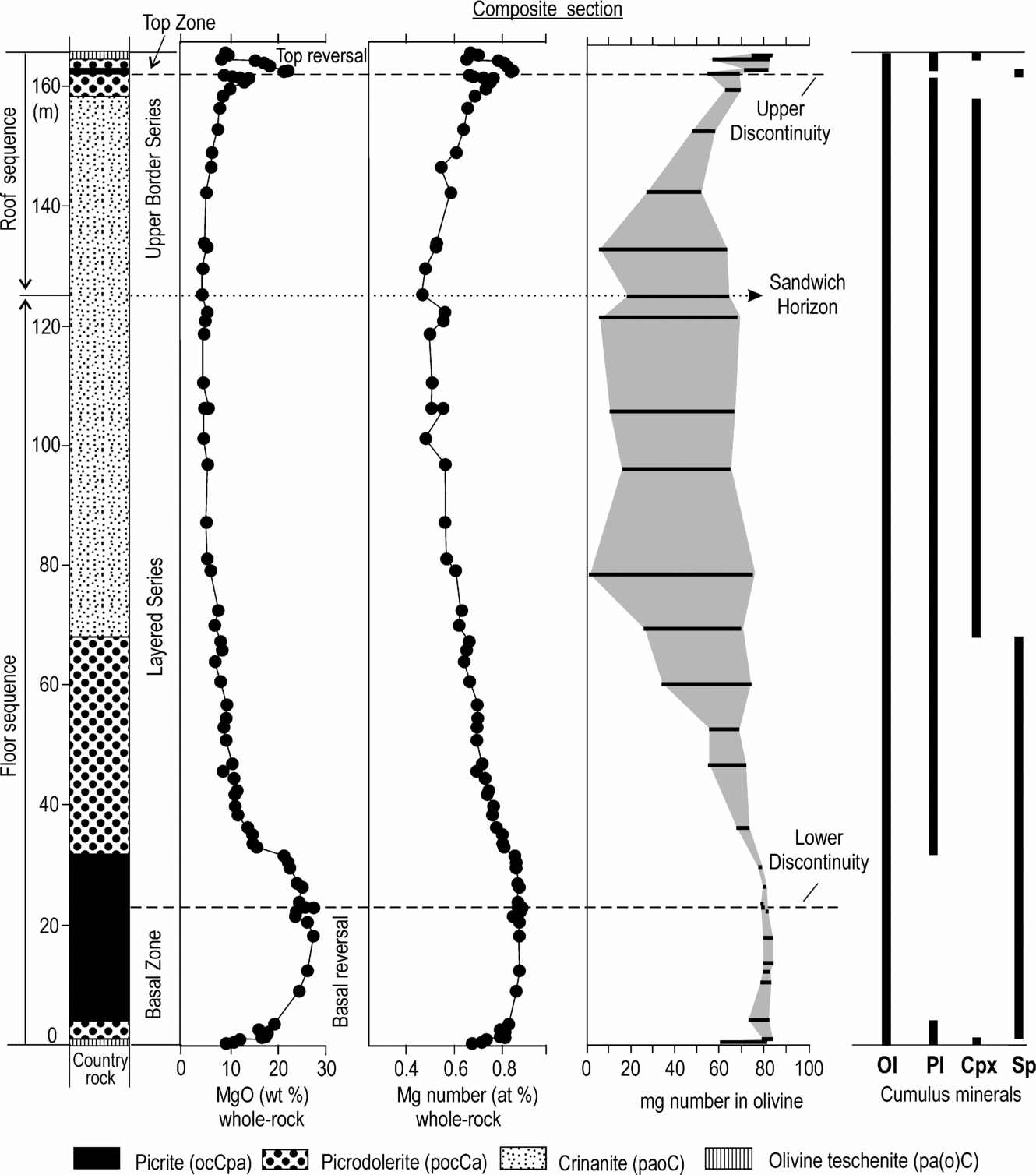
Detailed discussion of vertical variations in mineral composition (Gibb & Henderson, Reference Gibb and Henderson1996; Henderson, Gibb & Foland, Reference Henderson, Gibb and Foland2000) and whole-rock chemistry (Gibb & Henderson, Reference Gibb and Henderson2006) across the Shiant Isles Main Sill can be found in referenced literature and will not be repeated here. We reproduce only the most important section through the entire sill that is relevant for discussion of its major compositional features (Fig. 7).
Composite section through the Shiant Isles Main Sill showing variations in whole-rock MgO, Mg number, mg number in olivine and cumulate stratigraphy with height. The sill shows an M-shaped compositional profile with two prominent maxima (upper and lower) whole-rock MgO and Mg number. The sill is subdivided into a Basal Zone and Layered Series, forming the floor sequence, and a Top Zone and Upper Border Series that constitute the roof sequence. The floor and roof sequences meet at the Sandwich Horizon. The Basal and Top zones tend to be mirror images of the Layered Series and Upper Border Series, respectively, and are therefore referred to as basal and top reversals. Mg number = Mg/(Mg+0.85Fetotal). The compositional ranges of mg number in olivine at any particular height represent mineral zonation. Note that olivine displays no changes in composition across the Lower Discontinuity. mg number = 100*Mg/(Mg+Fe), at %. Modified from Gibb & Henderson (Reference Gibb and Henderson2006).

3.c.1. M-shaped compositional profile
It is important to realize that the above subdivision of the sill into petrographic units (Fig. 5) was elaborated with the tacit intention of emphasizing the ‘multiple intrusive’ nature of the sill (Gibb & Henderson, Reference Gibb and Henderson1996, Reference Gibb and Henderson2006). We prefer to follow another, more traditional, way of subdivision of mafic–ultramafic sill-like intrusions into four principal structural units (e.g. Latypov, Reference Latypov2003a,Reference Latypovb). According to this scheme, in terms of rock stratigraphy the Shiant Isles Main Sill can be classified as having an M-shaped compositional profile with two prominent maxima (upper and lower) in modal olivine, whole-rock MgO and Mg number (Fig. 7). The sill can be subdivided into floor and roof sequences that meet at the level of the Sandwich Horizon. This horizon is located at the approximately 120–130 m level where the sequence reaches its most evolved whole-rock (e.g. Mg number) and mineral composition (e.g. mg number in Ol). A high degree of mineral zoning in this part of the sill hampers identification of the exact position of the Sandwich Horizon. The floor sequence of the sill comprises the Basal Zone and the Layered Series, whereas the roof sequence contains the Top Zone and Upper Border Series. The boundaries between the coupled units of the floor and roof sequences are placed at the crossover maxima exhibiting the most primitive mineral and rock compositions in the entire section of the sill (Latypov, Reference Latypov2003a,Reference Latypovb). These boundaries are difficult to locate unequivocally, however, due to complications caused by the occurrence of the Lower and Upper discontinuities. Fortunately, the exact positions of the boundaries are not critical for the overall conclusions of this study. For the sake of simplicity, we have arbitrarily defined them as being coincident with the Lower and Upper discontinuities. In terms of crystallization sequences, the Basal and Top zones tend to be mirror images of the Layered and Upper Border series sequences, respectively, and are therefore referred to as the Basal and Top reversals (Fig. 7).
3.c.2. Upper and Lower discontinuities
A general M-shaped compositional profile for the Shiant Isles Main Sill (Fig. 7) is complicated by two distinct physical junctions, the Lower and Upper discontinuities, which are marked by abrupt changes in texture, grain size, mineralogy and chemistry (Gibb & Henderson, Reference Gibb and Henderson1989, Reference Gibb and Henderson1996, Reference Gibb and Henderson2006). One of the most surprising features of these discontinuities is that they do not significantly disturb the overall M-shaped compositional profile of the sill. In this connection the Lower Discontinuity is especially illustrative. Rocks across this junction show practically no changes (reversals) in mineral crystallization sequence. Picrites (olivine-spinel cumulates) occur on either side of the Lower Discontinuity, with no phase appearing or disappearing at this level. The undisturbed nature of the crystallization sequence across the Lower Discontinuity is chemically evident from the lack of significant changes in whole-rock MgO and Mg number in the composite section (Fig. 7) and especially in MgO, Al2O3 and CaO in Hole 1 (Gibb & Henderson, Reference Gibb and Henderson2006, fig. 5b). Furthermore, there are no notable breaks in mg number of olivine (Fig. 7) and clinopyroxene and An-content of plagioclase core compositions across the Lower Discontinuity (Gibb & Henderson, Reference Gibb and Henderson2006, fig. 6). To sum up, most compositional characteristics of the rocks and minerals show no changes across the Lower Discontinuity, suggesting the compositional integrity of picrites above and below this physical boundary. The Upper Discontinuity, however, represents a pronounced break in terms of modal olivine (Fig. 5), whole-rock MgO, Mg number and mg number of olivine (Fig. 7). However, even in this case, a compositional break is evident, mostly because of a thin layer of olivine-poor picrodolerites that immediately underlies the picrites (Fig. 5). The remaining picrodolerites, in terms of their modal olivine and mg number of olivine, seem to form a compositional ‘bridge’ between picrites and crinanites. In other words, the picrodolerites (poC) appear to occur exactly where they would need to be to fill compositional and phase equilibria gaps between picrites (oC) and crinanites (paoC) (Fig. 7). It should also be remembered that, unlike the Lower Discontinuity, the Upper Discontinuity has not been documented in the field, but only in one drill hole (Hole 3) through the upper part of the sill (Gibb & Henderson, Reference Gibb and Henderson1989). It therefore remains to be proved that the Upper Discontinuity is not just a local phenomenon specific for this particular drill hole, before incorporating the Upper Discontinuity into a general model for the origin of the sill.
3.c.3. A boundary between picrite and picrodolerite layers in the Layered Series
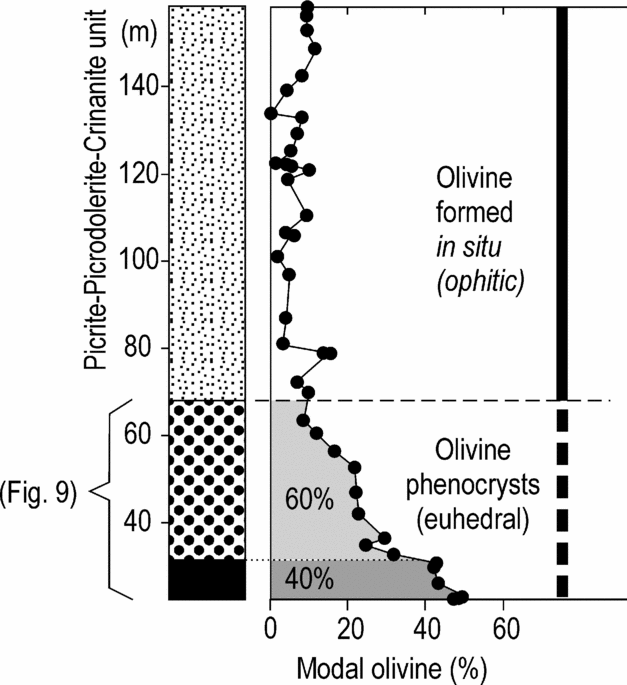
We recall that the Layered Series of the Shiant Isles Main Sill (Figs 5, 7) forms part of the Picrite–Picrodolerite–Crinanite unit that was attributed to intrusion of magma carrying about 10–15 vol.% olivine phenocrysts. Upon emplacement, all olivine phenocrysts are thought to have settled to the base, forming picrite and picrodolerites, whereas the overlying magma gave rise to crinanites (Fig. 6). This interpretation is substantiated by the different morphology of olivine in these rocks. Olivines in picrite and picrodolerites form euhedral/subhedral crystals and are interpreted as representing olivine phenocrysts (Fig. 8). In contrast, olivines in crinanites occur as strongly zoned ophitic crystals and are interpreted as having formed in situ. On closer inspection, however, it becomes clear that this simple olivine phenocryst-based story of the unit is inconsistent with its compositional features.
Section through the Picrite–Picrodolerite–Crinanite unit of the Shiant Isles Main Sill illustrating the distribution of phenocrystic and in situ-formed olivine as inferred by Gibb & Henderson (Reference Gibb and Henderson2006) on the basis of olivine morphology.

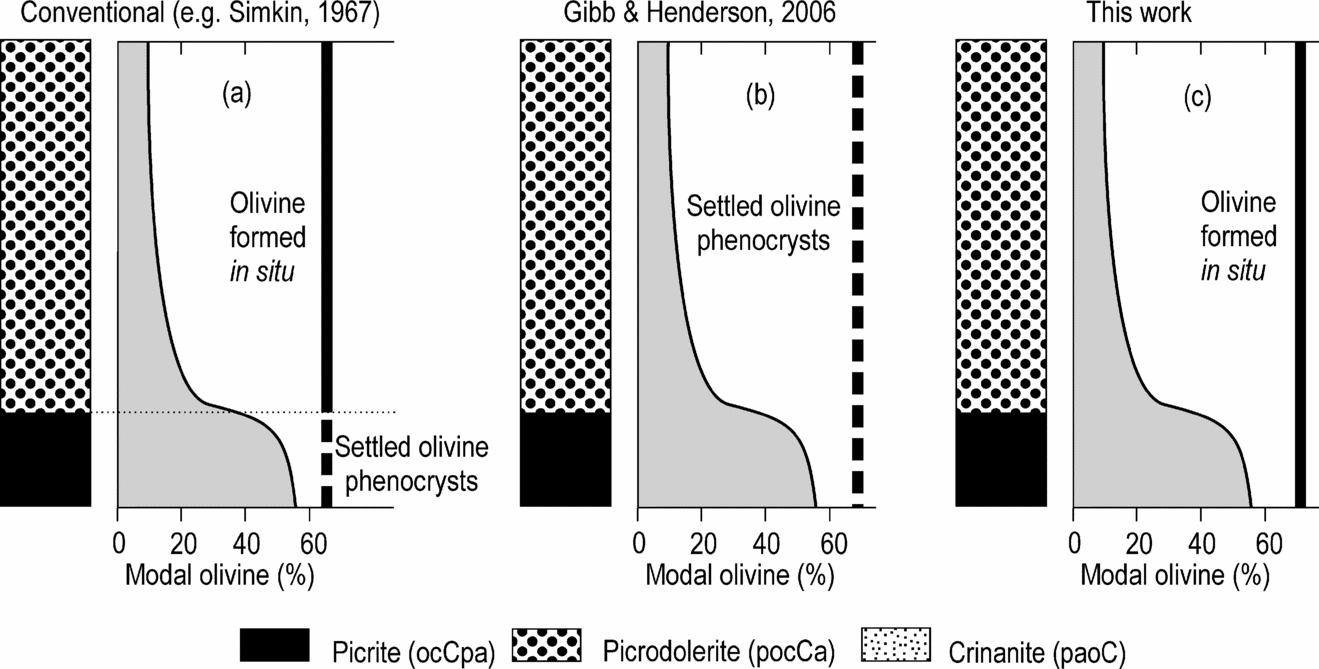
As has been shown above, there is a significant decrease in modal olivine, whole-rock MgO and Cr across a boundary from picrite to picrodolerite (Fig. 4b). It is surprising that, despite being so markedly developed, this boundary has been never discussed in numerous publications on the Shiant Isles Main Sill (e.g. Walker, Reference Walker1930; Drever, Reference Drever1953; Johnston, Reference Johnston1953; Drever & Johnston, Reference Drever and Johnston1965; Gibb, Reference Gibb1973; Henderson, Gibb & Foland, Reference Henderson, Gibb and Foland2000; Foland, Gibb & Henderson, Reference Foland, Gibb and Henderson2000; Gibb & Henderson, Reference Gibb and Henderson1989, Reference Gibb and Henderson1996, Reference Gibb and Henderson2006). In conventional gravity settling models, such a boundary is commonly attributed to the complete removal of olivine phenocrysts from the magma to form basal olivine-rich rocks that pass upwards through an abrupt drop in modal olivine into olivine-poor rocks. This is how Simkin (Reference Simkin and Wyllie1967), for instance, explained the nature of this boundary in other alkaline sills belonging to the Little Minch Sill Complex and Krivolutskaya et al. (Reference Krivolutskaya, Ariskin, Sluzhenikin and Turovtsev2001) accounted for a similar boundary between picrites and olivine gabbrodolerites in Noril'sk-type intrusions. It is important to note that this explanation implies that all olivines in rocks above the boundary represent newly-formed (in situ) crystals (Fig. 9a).
Schematic sections (a–c) through the picrite–picrodolerite part of the Picrite–Picrodolerite–Crinanite unit of the Shiant Isles Main Sill (see Fig. 8) showing three different interpretations of the nature of formation of olivine crystals (phenocrystic versus in situ) in the rocks. See text for discussion.

This conventional interpretation cannot be applied to the case of the Shiant Isles Main Sill, however, since it has been argued that olivines in picrites and picrodolerites are all phenocrystic because of their euhedral/subhedral morphology (Gibb & Henderson, Reference Gibb and Henderson1989, Reference Gibb and Henderson1996, Reference Gibb and Henderson2006) (Fig. 9b). This brings up one interesting question. It can be shown graphically (Fig. 8) that the picrite and picrodolerite contain approximately 40% and 60%, respectively, of 10–15 vol.% olivine phenocrysts, supposedly brought into the chamber with magma parental to the Picrite–Picrodolerite–Crinanite unit. We may then ask: what is the reason for the rapid preferential settling of the first 40% olivine phenocrysts to form the basal olivine-rich picrites, followed by the slow settling of the remaining 60% olivine phenocrysts to form the relatively olivine-poor overlying picrodolerites? One way is to suggest that 60% of the olivine phenocrysts were kept in suspension by convecting magma, delaying their gravitational settling. However, following Marsh (Reference Marsh1996), the existence of natural convection in the sill is denied (Gibb & Henderson, Reference Gibb and Henderson1992, Reference Gibb and Henderson2006). Even if we allow convection to operate, the idea is still not consistent with experimental and theoretical data by Sparks et al. (Reference Sparks, Huppert, Koyaguchi and Hallworth1993), who showed that there is a so-called critical concentration of phenocrysts, above which convection is unable to keep them suspended, so the phenocrysts settle, leaving behind a layer of convecting fluid virtually free of phenocrysts. Such a critical concentration for olivine is only 0.0025% (Sparks et al. Reference Sparks, Huppert, Koyaguchi and Hallworth1993), some 2400–3600 times less than the amount of olivine that is required to be kept suspended (6–9 vol.%, which amounts to 60% from 10–15 vol.% olivine). This has several implications. (1) If the intruding magma was indeed phenocryst-rich, then almost all olivine crystals brought into the chamber must have settled relatively fast to the bottom to form phenocryst-rich olivine picrites. The overlying picrodolerite must therefore consequently be composed of olivine that formed essentially in situ in the chamber. (2) The fact that both picrite and picrodolerite contain similar euhedral/subhedral olivine casts doubt on the validity of the above suggestion and indicates that the shape of olivine crystals cannot be used for discrimination between phenocrystic and in situ-formed olivine in the Shiant Isles Main Sill. (3) A consequence of this is that one could safely suggest that all olivine in picrite, picrodolerite and crinanite may actually have formed in situ (Fig. 9c) and that transitions between these rocks are due to intrachamber fractional crystallization of magma rather than to post-emplacement gravitational settling of intratelluric olivine phenocrysts.
4. Internal compositional profiles of mafic–ultramafic sills predicted by fractional crystallization of a single pulse of magma
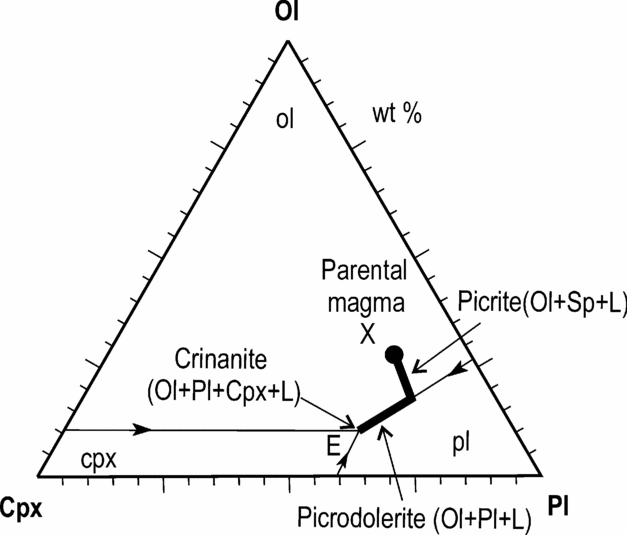
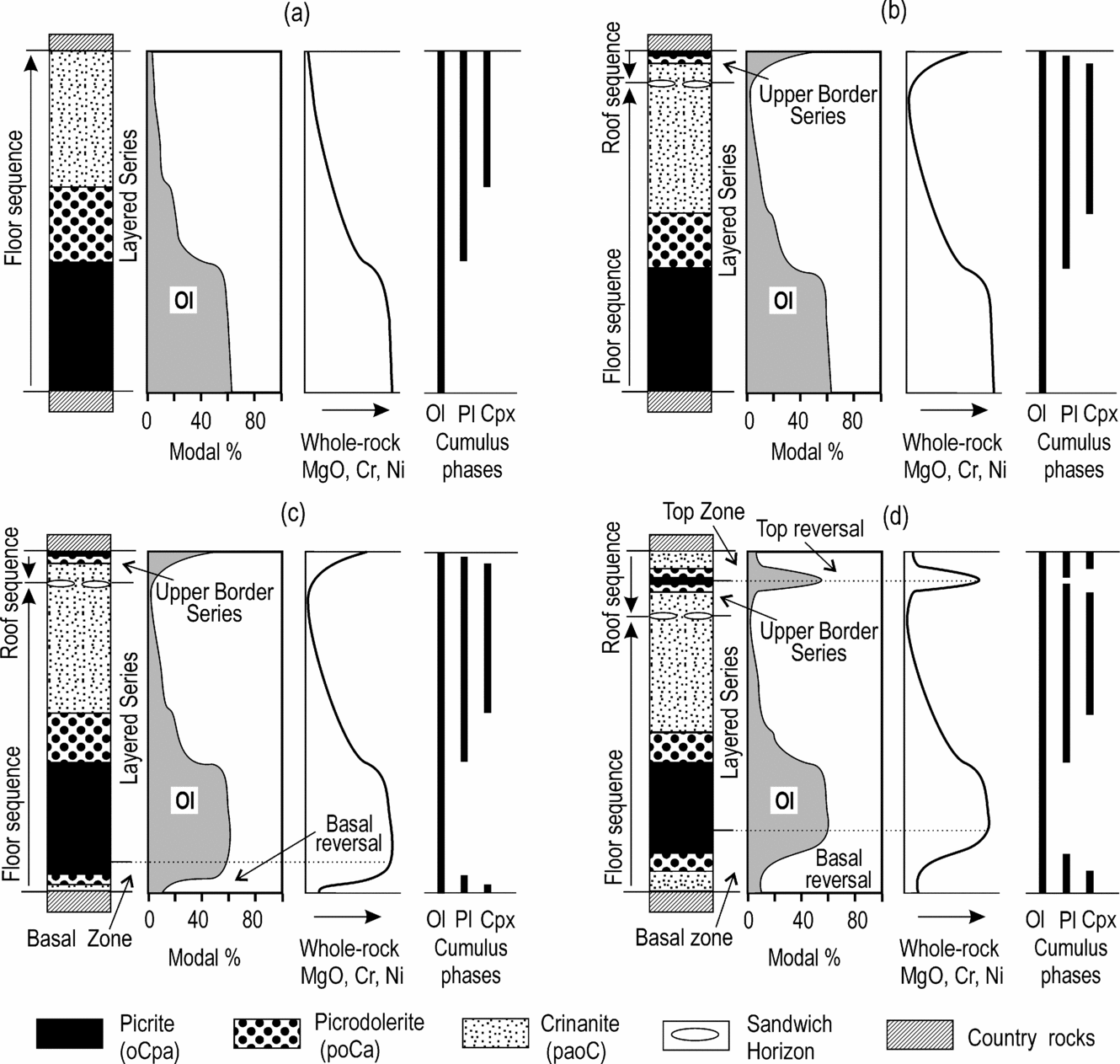
Here we examine compositional profiles of mafic–ultramafic sills expected from classical fractional crystallization of phenocryst-free basaltic magma under closed system conditions, in order to compare them with that of the Shiant Isles Main Sill. A relatively simple silica-undersaturated system Ol–Pl–Cpx (Fig. 10) has been chosen for illustration. This system can safely be used to study the liquid line of descent of natural magma compositions with minor amounts of normative nepheline, as in the case with all alkaline sills of the Little Minch Sill Complex, including the Shiant Isles Main Sill. We consider here four hypothetical sills, in the sequence from the simplest to most complicated, formed from olivine-saturated magma X along a liquid line of descent Ol+L → Ol+Pl+L → Ol+Pl+Cpx+L, which is identical to that of the Shiant Isles Main Sill, as will be discussed later. The sills are subdivided on the basis of available structural units into floor and roof sequences as follows (Fig. 11a–d).
The system Ol–Pl–Cpx illustrating a crystallization path of olivine-saturated parental magma X from primary olivine field Ol+L (picrite) through the troctolitic cotectic Ol+Pl+L (picrodolerite) to the olivine gabbroic eutectic Ol+Pl+Cpx+L (crinanite) to produce compositional profiles of hypothetical mafic sills in Figure 11. The phase diagram is from Dubrovskii (Reference Dubrovskii1998). The primary field of spinel is omitted from the Ol–Pl–Cpx system for the sake of simplicity. Cotectic lines are indicated by one arrow. Arrows point toward decreasing temperature. E is Ol+Cpx+Pl = L; E – eutectic point, L – melt.

Stratigraphic sections illustrating the idea that the M-shaped compositional profile of the Shiant Isles Main Sill is composed of three independent intrusive units (I, II and III), which can be regarded as ‘building blocks’ of the sill. Such an M-shaped compositional profile can only be produced by very specific sequences of intrusive events (e.g. I–II–III or I–III–II). All other variants of intrusive sequences fail to lead to formation of such a profile. See text for further discussion.

4.a. Floor sequence (Layered Series)
It is instructive to start with the simplest example of a mafic sill (Fig. 11a), in which a cumulate pile grows progressively from the bottom upwards, resulting in the formation of a floor sequence only. The floor sequence is represented by the Layered Series, comprising from bottom to top the succession picrite, followed by picrodolerite and then crinanite. Crystallization takes place either at the roof, followed by transfer of crystals towards the floor by density surge currents, or directly in situ at the floor of the sill. The rock sequence of the Layered Series and modal composition of the rocks are both strictly constrained by liquidus phase equilibria. In particular, an abrupt compositional transition from picrite to picrodolerite is a direct consequence of the shift in magma composition from the olivine primary field (Ol+L) to the olivine–plagioclase cotectic (Ol+Pl+L), which is characterized by the strong predominance of plagioclase over olivine. As a result, the olivine abundance must drop here abruptly from 50–60% (the rest is represented by interstitial plagioclase and clinopyroxene) in picrite to as little as 15% in the picrodolerite. In crinanite the proportion of olivine may further fall to 5–10%, since the eutectic point E, where crinanite is produced, contains less olivine than the olivine–plagioclase cotectic. The latter drop in olivine content is, however, relatively small and can therefore be masked by pore material crystallizing from interstitial liquid. The most important point to be made here is that a sudden drop in olivine content from picrites to picrodolerites is an unavoidable consequence of the shift in liquid composition from the olivine primary field to the troctolitic cotectic. There is no need to invoke gravitational settling of intratelluric olivine phenocrysts in the magma upon emplacement to explain this phenomenon. Mafic–ultramafic sills that are composed exclusively of a Layered Series are not very common in nature. Among such rare examples are the Vel'minskii sill, Siberia (Ariskin & Barmina, Reference Ariskin and Barmina2000), the Ivanovskii sill, Russia (Latypov, Reference Latypov2003b), and the Basistoppen sill, Greenland (Naslund, Reference Naslund1989).
4.b. Floor (Layered Series) and roof (Upper Border Series) sequence
In a slightly more complicated case (Fig. 11b), magma may crystallize from both margins, with a cumulate pile at the base advancing much faster than that at the roof. Slow growth of the roof sequence may occur either because of crystal settling from the upper boundary layer (e.g. Morse, Reference Morse1986, Reference Morse1988; Frenkel’ et al. Reference Frenkel’, Yaroshevsky, Ariskin, Barmina, Koptev-Dvornikov and Kireev1988, Reference Frenkel’, Yaroshevsky, Ariskin, Barmina, Koptev-Dvornikov, Kireev, Bonin, Didier, Le Fort, Propach, Puga and Vistelius1989) or because thermal convection leads to higher heat flow through the roof, keeping the boundary layer thin (e.g. Jaupart & Tait, Reference Jaupart and Tait1995; Tait & Jaupart, Reference Tait and Jaupart1996). In such sills, the floor and roof sequences are represented by the Layered Series and Upper Border Series, respectively, with the former typically being 6–7 times thicker than the latter (Jaupart & Tait, Reference Jaupart and Tait1995). The Layered and Upper Border series meet at Sandwich Horizon and show the same inward-directed rock succession (picrite, picrodolerite and crinanite) and crystallization sequence (Ol+L → Ol+Pl+L → Ol+Pl+Cpx+L). It is important to emphasize that the difference in relative thickness of the floor and roof sequences means that an upper dunite will always be much thinner than its lower counterpart (Fig. 11b). We are not aware of good examples of sills with such compositional profiles, because the latter are commonly complicated by basal reversals, as described below. An example among larger intrusive bodies would be probably the Skaergaard Layered Intrusion, if one ignores its unexposed Hidden Zone (Wager & Brown, Reference Wager and Brown1968).
4.c. Floor (Layered Series and Basal Zone) and roof (Upper Border Series) sequence
Further complication comes from the development of a Basal Zone at the floor of the sill, resulting in an S-shaped compositional profile (Fig. 11c). A feature of a Basal Zone is that, in terms of rock succession (crinanite, picrodolerite and picrite), the crystallization sequence (Ol+Pl+Cpx+L → Ol+Pl+L → Ol+L) and compositional trends (increase in MgO, Ni, Cr), it essentially represents a mirror image of the overlying Layered Series and is therefore referred to as a basal reversal. In such sills the floor rock sequence comprises two coupled units: a basal reversal and a Layered Series. A line of demarcation between these units runs through the most primitive mineral and rock compositions. The formation of basal reversals is commonly attributed to complications of a normal trend of fractional crystallization by such processes as magma contamination, supercooling, intratelluric inhomogeneity of magma, trapped liquid shift, etc. (see review in Latypov, Reference Latypov2003a; Latypov, Chistyakova & Alapieti, Reference Latypov, Chistyakova and Alapieti2007). For the purpose of this study we can adopt any of these mechanisms, as long as they allow for production of an S-shaped sill from a single pulse of magma. A key point is that there are no specific features in these sills that would require involvement of multiple intrusions of magma. Good examples of S-shaped sills include the Dæmmenvands sill, East Greenland (Gisselø, Reference Gisselø2001), Vavukanskii and Vilyuiskii sills, Siberia (Frenkel’ et al. Reference Frenkel’, Yaroshevsky, Ariskin, Barmina, Koptev-Dvornikov and Kireev1988), and the New Mountain Sill, Antarctica (Gunn, Reference Gunn1966; see also Latypov, Reference Latypov2003b).
4.d. Floor (Layered Series and Basal Zone) and roof (Upper Border Series and Top Zone) sequence
The most complicated case emerges when one more unit, referred to as the Top Zone, develops at the roof (Fig. 11d). As in the above case, in terms of rock succession (crinanite, picrodolerite and picrite), crystallization sequence (Ol+Pl+Cpx+L → Ol+Pl+L → Ol+L) and compositional trends (increase in MgO, Ni, Cr), it represents a mirror image of the underlying Upper Border Series and is therefore referred to as the top reversal. As a result, in such sills the roof rock sequence comprises two coupled units, the top reversal and Upper Border Series, with a line of demarcation between them running through the most primitive mineral and rock compositions. By analogy with basal reversals, top reversals can be formed by any of the processes mentioned above. Such sills have an ‘M-shaped’ compositional profile. Their most prominent feature is the presence of two picritic units ‘suspended’ between and successively mantled by picrodolerite and crinanite units. It is important to stress once more that there is nothing in the structure of these sills that would require the involvement of multiple magma intrusions. Both S- and M-shaped sills have been successfully modelled from a single pulse of magma by Frenkel’ and colleagues (Reference Frenkel’, Yaroshevsky, Ariskin, Barmina, Koptev-Dvornikov and Kireev1988, Reference Frenkel’, Yaroshevsky, Ariskin, Barmina, Koptev-Dvornikov, Kireev, Bonin, Didier, Le Fort, Propach, Puga and Vistelius1989), in the frame of a gravity settling model, about 30 years ago. More recently, the same types of sills have been modelled from a single pulse of phenocryst-free magma by Latypov (Reference Latypov2003a,Reference Latypovb) in the frame of a concept involving Soret fractionation. Again, for the purposes of this study we can adopt any of these models, as long as they allow for production of these sills from a single pulse of magma. Among sills showing M-shaped profiles are Noril'sk-type intrusions, Russia (Turovtsev, Sluzhenikin & Distler, Reference Turovtsev, Sluzhenikin and Distler2000; see also Latypov, Reference Latypov2003b), the Blackness sill, Scotland (Flett, Reference Flett1931; see also Latypov, Reference Latypov2003b), and the Murotomisaki Gabbroic Complex, Japan (Hoshide, Obata & Akatsuka, Reference Hoshide, Obata and Akatsuka2006).
4.e. Features of mafic sills produced from a single pulse of magma
It is worthwhile summarizing some features of sills (Fig. 11) as typical for bodies formed from basaltic magma under closed-system conditions. These features may appear trivial, but will be of importance for our further discussion. First, an ultramafic (picrite) zone of a floor sequence in a sill is always overlain by a mafic (picrodolerite and crinanite) zone, never vice versa. This is because olivine is the first phase to crystallize from normal basaltic magmas, and its accumulation at the base of the sill (either by crystal settling or in situ crystallization) leads to formation of an ultramafic zone. Second, if a roof sequence is developed, then the lower ultramafic zone is always much thicker (usually 6–7 times) than the upper ultramafic zone. This is because the solidification front at the roof commonly advances much more slowly than at the floor, as discussed above. Third, there are no breaks in crystallization sequences and mineral compositional trends in the sills, apart from the reversals in the Basal and Top zones that most probably result from some complicating processes operating along the margins with country rocks (contamination, supercooling, Soret fractionation, etc.). Both the Layered and Upper Border series of the sills show crystallization sequences that are strictly predicted by phase equilibria (e.g. Ol → Ol+Pl → Ol+Pl+Cpx). In particular, the Layered Series reveals a general upward decrease in modal olivine (plus MgO and Ni) that invariably occurs through the step-like decrease in modal olivine (plus MgO and Ni) when passing from picrite to picrodolerite. These abrupt changes reflect the physico-chemical transition from the olivine field (Ol+L) towards the troctolitic cotectic (Ol+Pl+L) where the proportion of precipitating olivine drastically diminishes.
The major implication of the above analysis for our further discussion is that mafic sills with an M-shaped compositional profile are not anomalous, but rather a normal variety of sill that arises when the Layered and Upper Border series are accompanied by their mirror images in basal and top reversals. It is important to stress that the internal compositional structure of M-shaped sills is fully predicted by liquidus phase equilibria and can, in principle, be produced by closed-system fractional crystallization of a single pulse of basaltic magma with contribution from any of the following processes: contamination, supercooling, intratelluric inhomogeneity of magma, trapped liquid shift, temporal changes in composition of filling magma, Soret fractionation, etc. (Latypov, Reference Latypov2003a,Reference Latypovb; Latypov, Chistyakova & Alapieti, Reference Latypov, Chistyakova and Alapieti2007). More comprehensive analysis of the formation of sills with M-shaped and some other compositional profiles from a single pulse of magma can be found in Frenkel’ et al. (Reference Frenkel’, Yaroshevsky, Ariskin, Barmina, Koptev-Dvornikov and Kireev1988, Reference Frenkel’, Yaroshevsky, Ariskin, Barmina, Koptev-Dvornikov, Kireev, Bonin, Didier, Le Fort, Propach, Puga and Vistelius1989) and Latypov (Reference Latypov2003b).
5. Internal compositional profiles of mafic–ultramafic sills predicted by a multiple intrusive mechanism ‘liquid into solid’
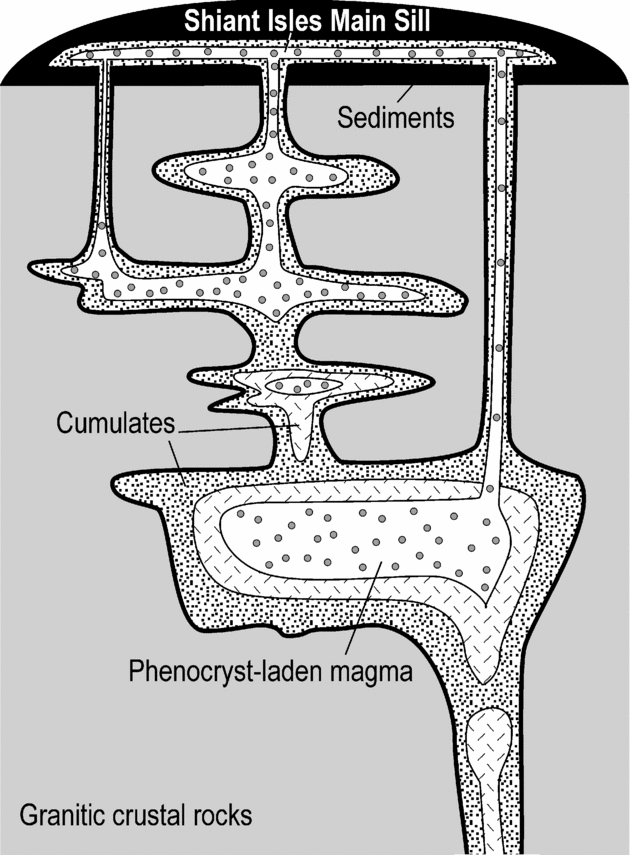
We now examine internal compositional structures of mafic–ultramafic sills that can be produced from the olivine-saturated basaltic magmas (picritic, picrodoleritic and crinanitic) involved in the origin of the Shiant Isles Main Sill by a multiple intrusion mechanism ‘liquid into solid’. In doing so, we will keep in mind that ‘the exact relationship of picritic and crinanitic melt in terms of magma batches, magma chambers and plumbing conduits is obviously uncertain’ and that ‘it is possible that none of the magmas is directly related to any other and that each represents a separate event in the context of melting, migration, and/or crustal history’ (Foland, Gibb & Henderson, Reference Foland, Gibb and Henderson2000, p. 669). It was proposed that the different amounts of olivine suspended in the intruded magmas are likely to be a consequence of either the way in which a zoned, lower level magma chamber was tapped, or extraction from a complex magma chamber system similar to the ‘magmatic mush column’ postulated by Marsh (Reference Marsh1996) (Fig. 12) to occur below highly active volcanic systems (Henderson, Gibb & Foland, Reference Henderson, Gibb and Foland2000). ‘The different sub-chambers in the latter type of magma system, although fed from essentially the same source in the upper mantle, could be at different stages of fractionation so that tapping from different levels could provide magmas with different amounts of olivine phenocrysts, at different stages of evolution, and with different liquid composition’ (Henderson, Gibb & Foland, Reference Henderson, Gibb and Foland2000, p. 788).
Schematic illustration of a postulated magmatic mush column existing beneath the Shiant Isles Main Sill (Henderson, Gibb & Foland, Reference Henderson, Gibb and Foland2000). The mush column consists of a variety of local crystallization environments characterized by contrasting time scale for cooling and contrasting regimes of phase equilibria. It is proposed that the different sub-chambers of such a magmatic mush column can be at different stages of fractionation so that tapping from different levels can provide magmas with different amounts of olivine phenocrysts, at different stages of evolution, and with different liquid composition (Henderson, Gibb & Foland, Reference Henderson, Gibb and Foland2000). The cartoon is mainly based on Marsh (Reference Marsh1996).

Following this logic, we can envisage several parameters that are not strictly predicted or governed by a multiple intrusive mechanism ‘liquid into solid’ and can therefore vary over a wide range during filling of any sill. Among them are: (1) composition of magma pulses in terms of a liquid line of descent (e.g. picritic, picrodoleritic or crinanitic magmas), (2) the number of magma pulses (e.g. from 3 to 10), (3) sequence of their emplacement into the sill (e.g. in any order), (4) time between their emplacements (e.g. 1 day, 100 years or 100 000 years), (5) relative volume of magma pulses (e.g. from 1 m to 150 m in thickness) and (6) stratigraphic location of emplacement into the sill (e.g. contact surfaces between the units, intrusive contacts with country rocks, weak planes inside individual units), (7) amounts of olivine phenocrysts in magmas (e.g. from 0 to 50%), and (8) their composition (e.g. from Fo10 to Fo80) and (9) the manner of distribution of olivine phenocrysts in magma during and after emplacement (e.g. I-, D- and S-type compositional profiles). From this it follows that formation of any mafic sill by a multiple intrusion ‘liquid into solid’ approaches a random process. Under such conditions when so many parameters can vary independently and unpredictably, the internal compositional structure of the resulting mafic sill is also essentially unpredictable.
To demonstrate this, let us return to consideration of the compositional profile of the Shiant Isles Main Sill. The starting point is to appreciate that in the frame of a multiple intrusive mechanism ‘liquid into solid’, the overall compositional profile of the Shiant Isles Main Sill looks like a puzzle consisting of closely matching pieces of three independent intrusive units or sills: Picrite–Picrodolerite–Olivine Teschenite (I), Picrite–Picrodolerite–Crinanite (II) and Granular Olivine Picrodolerite (III) (Fig. 13). These units can be regarded as ‘building blocks’ which must be brought together to produce a general form of an M-shaped compositional profile. It is apparent that the sequence in which these ‘building blocks’ are intruded into the sill is of paramount importance for generation of this profile. As an illustration, among six possible variants, only two intrusive scenarios (I–II–III and I–III–II) can, in principle, give rise to the M-shaped compositional profile of the Shiant Isles Main Sill. The remaining four intrusive sequences (II–III–I, II–I–III, III–II–I and III–I–II) are not able to produce it. This is primarily because they do not allow the required splitting of intrusive unit I (Picrite–Picrodolerite–Olivine Teschenite) into two parts, which is critical for generation of the profile. From this preliminary analysis, it is already clear that formation of the Shiant Isles Main Sill in the frame of the multiple intrusion model would require a great deal of luck. Even if the intrusive sequence proved to be accidentally ‘correct’, say I–II–III, as postulated by Gibb & Henderson (Reference Gibb and Henderson2006), there are still many other conditions that should be met at each stage of the sill formation to produce an M-shaped profile. These are as follows:
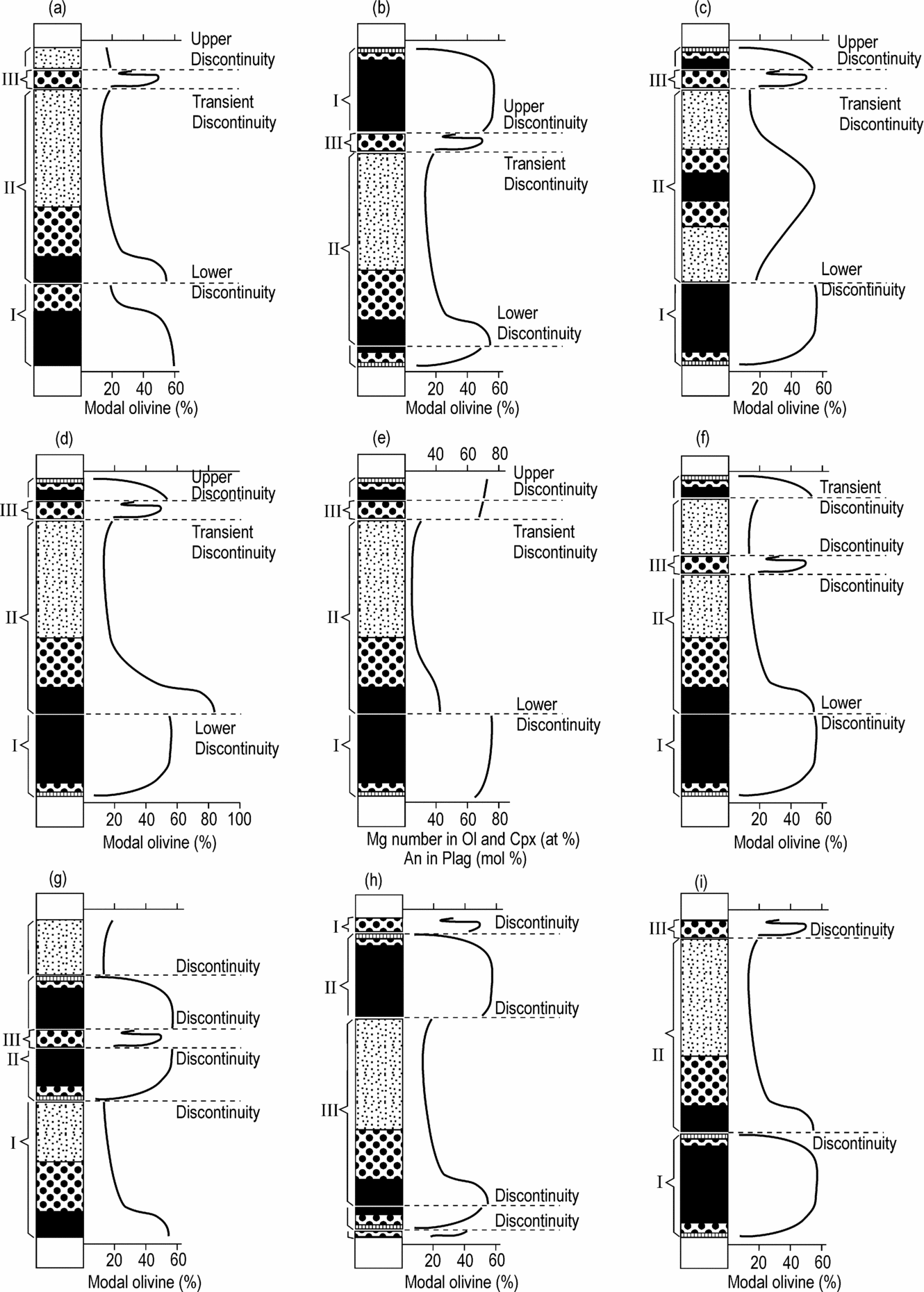
(a) Intrusive unit of Picrite–Picrodolerite–Olivine Teschenite. Intrusive unit I must necessarily produce a D-shaped profile. Such a D-shaped olivine distribution can arise during emplacement as a result of fluid-mechanical redistribution of suspended olivine phenocrysts by flow differentiation or through temporal variations in the amount of olivine phenocrysts in the intruding magma with time, or both. There is no obvious reason, however, why this should necessarily be so. By analogy with the next unit, one can envisage, for instance, a situation in which olivine crystals carried in the emplaced magma will settle towards the base to form a unit with a general increase in olivine content towards the bottom. This would at once make further production of an M-shaped compositional profile of the Shiant Isles Main Sill impossible (e.g. Fig. 14a).
(b) Intrusive unit of Picrite–Picrodolerite–Crinanite. Let us assume for a moment that we were fortunate to produce an intrusive unit I with the required D-shaped olivine profile. To continue constructing an M-shaped compositional profile in the Shiant Isles Main Sill, an intrusive unit II should comply with the following points. First, to make a profile with thick lower picrites and thin upper picrites, magma must necessarily be emplaced into the upper part of intrusive unit I. However, it could be emplaced equally well into its central or basal parts which would at once preclude the further formation of an M-shaped profile (e.g. Fig. 14b). Second, upon emplacement, olivine phenocrysts must settle out to differentiate the unit into picrite passing upwards through picrodolerite into crinanite, but again, this unit may have been formed equally well as a unit with D-shaped olivine profile, for instance, by successive emplacement of primitive batches of magma with temporal variations in olivine phenocryst content. If this happened, the resulting compositional profile would have a form far from the required M-shape (e.g. Fig. 14c). Third, olivine phenocrysts must accumulate at the base of this unit with little or no difference in modal olivine compared with that in the uppermost picrites of intrusive unit I, as implied by the small amount of modal variation across the Lower Discontinuity (Fig. 5; Gibb & Henderson, Reference Gibb and Henderson2006, fig. 6b). This looks more than surprising because of the many processes that could potentially result in a sudden change in modal olivine content across the Lower Discontinuity. One way, for example, would be to make the basal picrite of intrusive unit II much richer in modal olivine by intensive adcumulate growth (e.g. Fig. 14d). Fourth, phenocrystic olivine and in situ-formed clinopyroxene and plagioclase must have compositions practically indistinguishable from those in the underlying picrites of intrusive unit I. Again, there is no obvious reason why this should be so. For instance, if they had more evolved compositions, the M-shaped compositional profile would again become impossible (e.g. Fig. 14e). Fifth, magma must intrude when the host picrites of intrusive unit I are not completely solid to allow physical mixture of interstitial liquids between the units across the Lower Discontinuity. This is thought to explain the notably similar composition of minerals in picrites on either side the Lower Discontinuity (Gibb, Reference Gibb1973; Gibb & Henderson, Reference Gibb and Henderson1989, Reference Gibb and Henderson1996, Reference Gibb and Henderson2006). There is no reason, however, why intrusive unit II could not have been emplaced when the host picrites were already completely solidified, making a mixture of interstitial liquids across the Lower Discontinuity impossible.
(c) Intrusive unit of Granular Olivine Picrodolerite. Again, let us accept for a moment that we were fortunate to produce intrusive unit I with a D-shaped olivine profile and to differentiate intrusive unit II into picrite, picrodolerite and crinanite as required. In order to keep constructing an M-shaped compositional profile, the last magma pulse must be intruded between unit II (Picrite–Picrodolerite–Crinanite) and an upper portion of unit I (Picrite–Picrodolerite–Olivine Teschenite) (Fig. 13). This unit of two-cumulus phase picrodolerites (poCa) seems to be essential here to make the transition from one-cumulus phase picrite (oCpa) to three-cumulus phase crinanite (paoC) physico-chemically justified and compositionally smooth. In other words, it needs to be there to complete the general form of an M-shaped compositional profile. However, in the frame of a multiple model, intrusive unit III may be emplaced at any stratigraphic level, as shown, for instance, in Figure 14f. The probability for intrusive unit III to be accidentally emplaced exactly where it is expected to be from a phase equilibria point of view is negligibly small.
Stratigraphic sections illustrating the idea that the M-shaped compositional profile of the Shiant Isles Main Sill is composed of three independent intrusive units (I, II and III) that can be regarded as ‘building blocks’ of the sill. Such an M-shaped compositional profile can only be produced by very specific sequences of intrusive events (e.g. I–II–III or I–III–II). All other variants of intrusive sequences fail to lead to formation of such a profile. See text for further discussion.

Stratigraphic sections of six hypothetical mafic–ultramafic sills illustrating the idea that formation of an M-shaped compositional profile of the Shiant Isles Main Sill by an intrusive mechanism ‘liquid into solid’ would require a great deal of luck. For example, formation of the profile would be impossible if intrusive unit I differentiated into picrite, picrodolerite and crinanite (a); if intrusive unit II was emplaced into the basal part of the previous intrusive unit (b); exhibited a D-shaped profile of modal olivine (c); had a higher concentration of modal olivine at its base (d); showed much more evolved compositions of phenocrystic olivine and in situ formed plagioclase and clinopyroxene compared to those of the previous intrusive unit I (e); if intrusive unit III was emplaced at any other place except between unit II and an upper portion of unit I (f). In addition, stratigraphic sections of three hypothetical mafic–ultramafic sills (g, h, i) produced by three successively emplaced magma pulses are shown. The compositional profiles of the sills are distinguished by two to four abrupt reversals (discontinuities) in crystallization sequences and distribution of modal olivine. Note that the profiles do not resemble any of those that can be produced by classical fractional crystallization of a single pulse of magma (Fig. 11). Symbols as in Figure 13. See text for further discussion.

In the above treatment, we have deliberately limited ourselves to relatively simple examples involving available ‘building blocks’ of the Shiant Isles Main Sill. In fact, as was pointed out from the very beginning, the multiple intrusive mechanism ‘liquid into solid’ gives us virtually unlimited freedom in constructing multiple sills from intrusive units of any chemical and mineralogical composition. One can therefore envisage an almost unrestricted number of multiple sills with intricate shapes of compositional profiles that will be far from those predicted by phase equilibria in terms of phase, modal and cryptic layering. To illustrate this, we have additionally constructed three multiple sills from three successively emplaced magma pulses (Fig. 14g–i). It is clearly evident that even with ‘building blocks’ similar to those of the Shiant Isles Main Sill, the internal compositional structures of the sills do not resemble any of those that can be produced by phase equilibria-controlled crystallization of a single pulse of magma (Fig. 11). Their compositional profiles are complicated by up to four abrupt reversals (discontinuities) in crystallization sequences, and distribution of modal olivine. Following this logic, thousands of theoretical mafic sills can be constructed with chaotic compositional profiles that have little to do with those expected from closed system fractional crystallization of basaltic magma (Fig. 11).
6. The Shiant Isles Main Sill: multiple or simple intrusion?
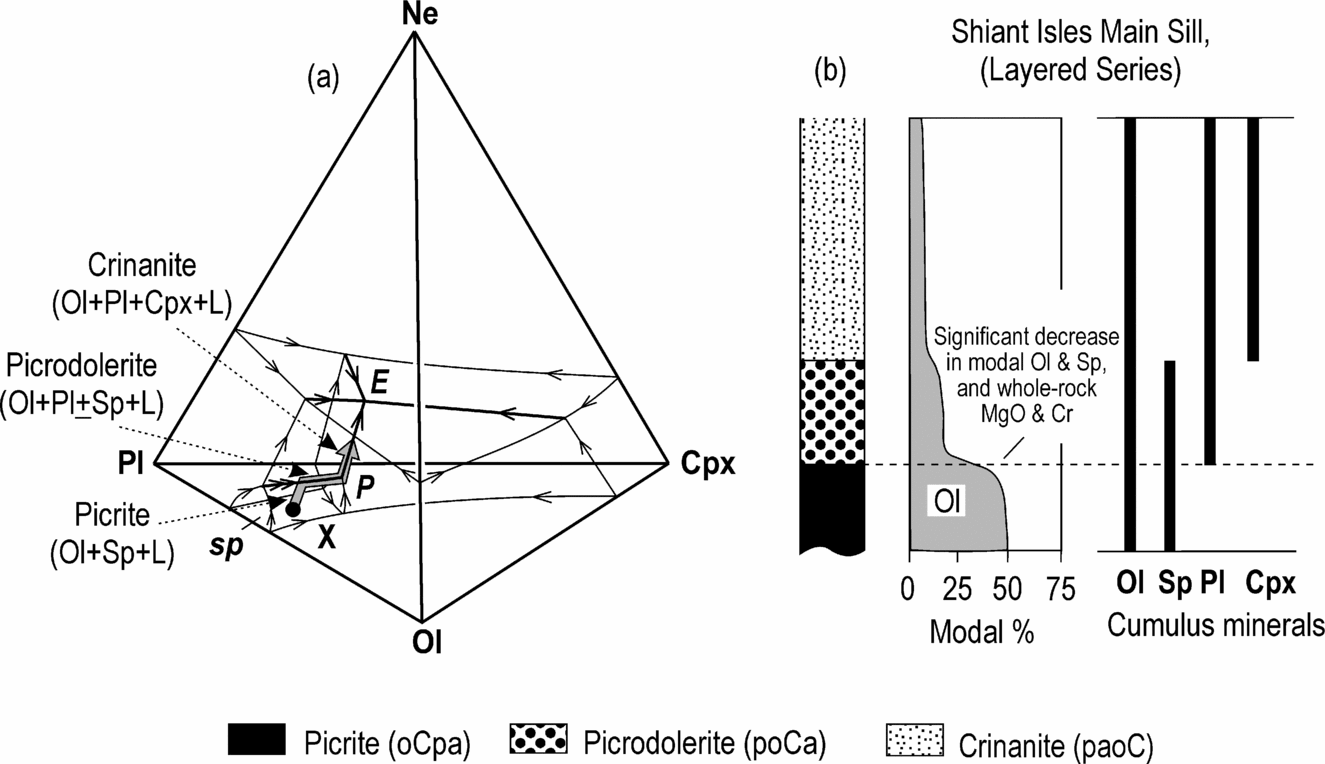
The above analysis clearly illustrates a fundamental difference between compositional profiles that are produced by an internal process of classical fractional crystallization of magma under closed system conditions (Fig. 11) and those that arise from an external, random process of multiple magma intrusion ‘liquid into solid’ (Fig. 14). In this context, the Shiant Isles Main Sill exhibits all the essential features of mafic sills that formed by closed-system crystallization of a single pulse of olivine-saturated parental magma (Fig. 7). First, its ultramafic (picrite) zone occurs in the lower part of the sill and is overlain by a mafic (picrodolerite and crinanite) zone. Second, the floor sequence is much thicker than the roof sequence, with the lower picrite being correspondingly much thicker than its upper counterpart. Third, there are no marked breaks or reversals in crystallization sequences and mineral compositional trends that would imply multiple intrusive activity ‘liquid into solid’. The Shiant Isles Main Sill compositional profile is remarkably similar to an M-shaped profile modelled from a single pulse of magma (Fig. 11d) that arises when Layered and Upper Border series are supplemented by their mirror images in basal and top reversals. In order to appreciate the key role of fractional crystallization in the origin of the Shiant Isles Main Sill, we consider in more detail the general crystallization sequence of its thickest, and most important structural unit, the Layered Series. For this purpose we will use a tetrahedral phase diagram Ol–Pl–Cpx–Ne that allows examination of phase equilibria involving Cr-spinel (Fig. 15a).
Tetrahedron showing the system Ol–Pl–Cpx–Ne (a), illustrating a crystallization path of olivine-saturated parental magma X from the cotectic Ol+Sp+L (picrite) through the troctolitic cotectic Ol+Pl±Sp+L (picrodolerite) to the olivine gabbroic eutectic Ol+Pl+Cpx+L (crinanite). This crystallization path adequately models the rock sequence and cumulate stratigraphy of the Layered Series of the Shiant Isles Main Sill (b). The phase diagram is constructed using experimental data available for its ternary systems. Cotectic and reaction lines are indicated by one and two arrows, respectively. Arrows point toward decreasing temperature. Compositions of the components are expressed in%. E is Ol+Cpx+Pl+Ne = L; P is Sp+L = Ol+Cpx+Pl. E – eutectic point, P – tributary point, L – melt. See text for discussion.

The Layered Series can be viewed as part of a single cyclic unit exhibiting a general rock sequence consistent with a crystallization path Ol+Sp+L (picrite) → Ol+Pl±Sp+L (picrodolerite) → Ol+Pl+Cpx+L (crinanite). Interpretation of liquidus phases of rocks is primarily based on their texture and modal composition compared with liquidus phase equilibria in the system Ol–Pl–Cpx. In particular, picrite (ocCpa) is composed of 40–60% euhedral/subhedral olivine containing Cr-spinel inclusions, with clinopyroxene and plagioclase occurring in the form of large interstitial plates that poikilitically enclose olivine (Ol and Sp are cumulus phases). Picrodolerite (pocCa) contains 10–30% euhedral/subhedral olivine with Cr-spinel inclusions and 50–60% plagioclase laths in a subophitic relationship with the much larger clinopyroxene crystals (Ol, Pl and Sp(?) are cumulus phases). Crinanite (paoC) consists of 5–10% olivine in ophitic or subophitic relationship to the 55–65% plagioclase laths and 25–35% clinopyroxene crystals (Ol, Pl and Cpx are cumulus phases).
A significant decrease in modal olivine and whole-rock MgO and Cr across a boundary from picrite to picrodolerite (Fig. 15b) is a consequence of the physico-chemical transition from the olivine–spinel cotectic (Ol+Sp+L) towards the troctolitic cotectic (Ol+Pl±Sp+L) in which the proportions of precipitating olivine and Cr-spinel drastically fall because of the arrival of liquidus plagioclase. The transition from picrites to picrodolerite is thus not a result of a physical process (reflecting mechanical settling of olivine phenocrysts) but rather of a physico-chemical process (reflecting magma evolution along a liquid line of descent). Further transition from picrodolerite to crinanite reflects the next shift in liquid composition from the troctolitic cotectic (Ol+Pl±Sp+L) to the olivine gabbroic eutectic (Ol+Pl+Cpx+L) that occurs through the tributary reaction point P. The transition is marked by an increase in modal clinopyroxene and further decrease in modal olivine, and a related change of olivine morphology from euhedral/subhedral to ophitic. The latter probably reflects kinetic difficulties involving formation of euhedral crystals below some critical proportions of phase crystallizing from magma. In mafic sills and large layered intrusions, it is not uncommon to observe that cumulus olivine (or orthopyroxene) progressively loses its euhedral shape to become ophitic or oikocrystic with decrease in the modal proportions in gabbroic/gabbronoritic rocks in the upper parts of intrusions.
Returning to the M-shaped structure of the Shiant Isles Main Sill, it is not difficult to infer that the possibility of generating this phase equilibria-predicted profile by a random process of multiple intrusive mechanism ‘liquid into solid’ is insignificantly small. This is because rock sequences and compositional profiles produced by this mechanism are almost unpredictable. There is no reason why, among many thousands of theoretically possible variants, the Shiant Isles Main Sill accidentally could have acquired a profile that is in one-to-one correspondence with that predicted by liquidus phase equilibria. This is augmented by the fact that the Shiant Isles Main Sill is not unique in NW Scotland. It is one of about 20 neighbouring alkaline sills belonging to the Little Minch Sill Complex that Gibb & Henderson (Reference Gibb and Gibson1989, Reference Gibb and Henderson2006) tend to interpret in a similar way to that of the Shiant Isles Main Sill. From the base upwards, these sills show the same general rock succession of picrite, picrodolerite and crinanite, reflecting crystallization sequence Ol+L → Ol+Pl+L → Ol+Pl+Cpx+L (e.g. Fig. 4a). This implies that the sequence of intrusive events, which seems highly unlikely even for the single case of the Shiant Isles Main Sill, must have been reproduced in the same fashion in all the other alkaline sills. The probability of such a large-scale intrusive event apparently approaches almost zero. It should be noted in this connection that Simkin (Reference Simkin and Wyllie1967, p. 64) was the first to raise objections against a multiple pulse model for these alkaline sills, stating that this would require ‘three separate intrusions in the same time and space sequences throughout all north Skye sills’.
The remarkable repetition of crystallization sequences in all alkaline sills of the Little Minch Sill Complex is strongly indicative of some universal differentiation process. The best candidate is classical fractional crystallization of magma constrained by liquidus phase equilibria. On this basis we conclude that the Shiant Isles Main Sill is almost certainly not a multiple intrusion of the ‘liquid into solid’ type but rather a simple intrusion. The M-shaped profile of the sill is fully predicted by phase equilibria and can, in principle, be produced by in situ crystallization of a single pulse of olivine-saturated basaltic magma with or without contribution from intratelluric inhomogeneity of magma, contamination, trapped liquid shift, etc. (Latypov, Reference Latypov2003a,Reference Latypovb).
Gibb & Henderson (Reference Gibb and Henderson2006) also put forward Sr and Nd isotopic data as important evidence for the multiple intrusion origin of the Shiant Isles Main Sill (Foland, Gibb & Henderson, Reference Foland, Gibb and Henderson2000). These demonstrate the involvement of two isotopically distinct magmas in formation of the sill: an isotopically more primitive ‘picritic’ magma that was parental to the Picrite–Picrodolerite–Olivine Teschenite and Granular Olivine Picrodolerite units, and a more evolved ‘crinanitic’ magma which gave rise to the Picrite–Picrodolerite–Crinanite unit. The simplest explanation for this observation is that the Shiant Isles Main Sill did not develop as a perfectly closed system but experienced refilling by new magma pulses which effectively mixed with resident magma in the chamber and changed its isotopic signature, but had little effect on its major and trace element chemical composition and the liquidus phase equilibria. Such a refilling and mixing event with isotopically distinct new magma appears to have taken place at the level of the Lower Discontinuity. It is not, however, recorded in the phase crystallization sequence or mineral compositions of the Shiant Isles Main Sill (Fig. 7), so that it may still be adequately modelled as a simple intrusive body (Figs 11d, 15). The textural changes at the Lower and Upper discontinuities may also mark this refilling event or alternatively, they may well be explained by disturbances in the magma chamber due to tectonically-induced release of lithostatic pressure (or fluid pressure?), as was originally suggested by Drever & Johnston (Reference Drever and Johnston1965). Note that the above scenario, combining prevailing closed system crystallization with some minor refilling events is distinctly different from a ‘liquid into solid’ intrusive mechanism (Fig. 3c).
7. Conclusions
The study illustrates that multiple emplacement of sills into partly solidified rocks (an intrusive ‘liquid into solid’ mechanism) produces magmatic bodies with chaotic-looking compositional profiles showing many prominent reversals in terms of crystallization sequences and mineral compositional trends. Such chaotically-layered bodies have little in common with single-cyclic intrusions whose compositional profiles are controlled by liquidus phase equilibria. The multiple emplacement of sills cannot therefore be considered as a general mechanism for the formation of mafic–ultramafic sills (e.g. Gibb & Henderson, Reference Gibb and Henderson1989, Reference Gibb and Henderson2006), most of which belong to single-cyclic intrusions. As an illustration, the Shiant Isles Main Sill displays a pronounced M-shaped compositional profile similar to that expected from closed-system crystallization of olivine-saturated magma in the system Ol–Pl–Cpx. Its internal structure is difficult to reconcile with its formation by a random process involving a multiple intrusive mechanism ‘liquid into solid’, because it is poorly constrained in terms of bulk magma composition, time of emplacement, volume of magma pulses, phenocryst content of magmas, etc. The best explanation for the origin of the Shiant Isles Main Sill is classical fractional crystallization of one large pulse of magma, with possible involvement of minor refilling events. One should mention that, in contrast to a multiple ‘liquid into solid’ intrusive mechanism, a classical model of fractional crystallization of magma in the chamber is always open for further development, improvement and refinement and therefore potentially able to suggest a satisfactory answer to most features of single-cyclic mafic intrusions.
We must specifically emphasize that this study only became possible because of the exceptionally detailed field, geochemical, mineralogical and isotopic work that resulted in the Shiant Isles Main Sill being one of the best-studied alkaline sills in the world (Gibb, Reference Gibb1973; Henderson, Gibb & Foland, Reference Henderson, Gibb and Foland2000; Foland, Gibb & Henderson, Reference Foland, Gibb and Henderson2000; Gibb & Henderson, Reference Gibb and Henderson1989, Reference Gibb and Henderson1996, Reference Gibb and Henderson2006). We highly rank this work and would like to stress that our reinterpretation of the nature of the sill in no way belittles its significance. Rather it highlights how problematical it can be to decipher a crystallization history of even such a relatively simple geological object as a single mafic sill. We have a general feeling that many of our problems with such sills may actually come from overly narrow interpretations of what is possible in crystallizing magma chambers. It is not unlikely that our common appeal to some external forces such as multiple magma injections to explain various ‘anomalous’ features in sills is simply an indication of our inadequate understanding of the dynamics of differentiation of multi-component natural melts. Much more work needs to be done to understand fully the nature of a wide spectrum of processes operating in crustal magma chambers. In this context, some of the most promising directions of future investigations may be further theoretical, experimental and petrological studies of back-melting processes that can result in the formation of internal discontinuities (e.g. Huppert & Sparks, Reference Huppert and Sparks1989), magma differentiation processes that are capable of causing apparent fractionation of heavy isotopes (e.g. Morse, Reference Morse1983, Reference Morse1988), and novel processes of magma differentiation leading to formation of complex compositional profiles from a single pulse of magma (e.g. Latypov, Reference Latypov2003a,Reference Latypovb; Morse, Reference Morse2008). We predict that with further progress in our knowledge about intrachamber magma fractionation processes, many ‘anomalous’ textural and compositional features of sills will find adequate explanation in the framework of a ‘single pulse’ magma model. The number of mafic intrusions that are currently attributed to origin by multiple pulse emplacement will probably diminish as our understanding of processes operating in crustal magma chambers is improved.
Acknowledgements
This paper would never have been written without strong encouragement from Fergus Gibb. Numerous discussions with him on various aspects of the geology, geochemistry and mineralogy of the Shiant Isles Main Sill were an invaluable source of information. S. A. Gibson is thanked for providing valuable information on the distribution of chromite spinel in the Trotternish alkaline sills. We are grateful to Richard Wilson, Alexey Ariskin and Steve Sparks for many useful suggestions and encouraging comments on the paper as well as for editing (Richard Wilson and Steve Prevec) that led to significant improvement in the wording of the earlier version of the text. A constructive and supportive review by Tony Morse is highly acknowledged. We also thank David Pyle for editorial handling of the paper. The research was supported by grants from the Finnish Academy of Science.