Introduction
During what are known as “technological revolutions” or “long waves,” new technologies diffuse rapidly through the international system and economic growth surges. At other times, the adoption of technology is slow. As researchers studying these patterns stress, such global waves cannot be attributed to economic factors alone. “Any ‘model’ that limits itself to pure economic factors (such as r&d, capital investment or human capital) provides a much too narrow perspective … The transformation of capitalism involves interaction of the economic sphere with other domains, such as science and technology, and institutions.”Footnote 1 Examining what facilitates the global spread of technology is therefore important for understanding countries’ levels of economic development, their military capabilities, and their state capacity.
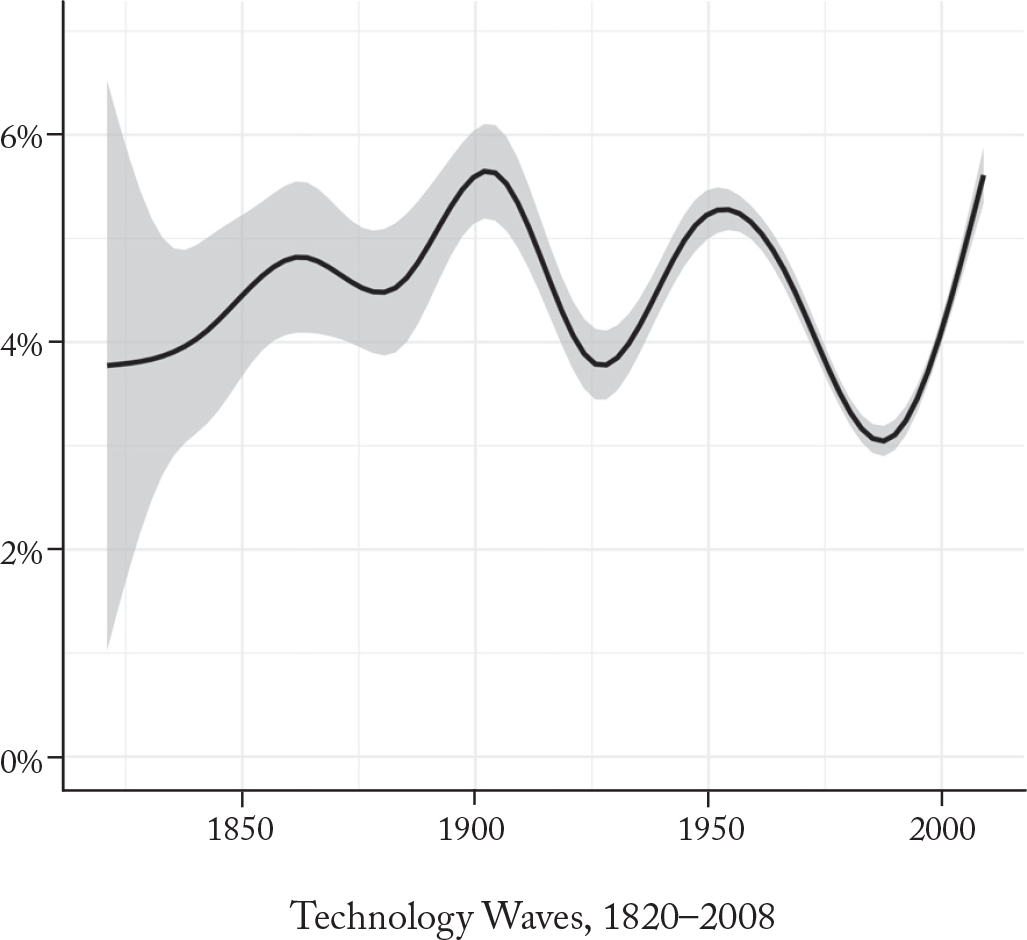
Figure 1 plots the yearly percentage increase in use of twenty of the most important technologies (including railroads, telephones, and agricultural tractors) over almost two hundred years (1820–2008).Footnote 2 These especially important technologies form the basis for our analysis. In the words of Olivier Blanchard, “Though technological progress is smooth, it is certainly not constant. There are clear technological waves.”Footnote 3 We do not seek to explain why some technologies diffuse faster than others, or why some countries adopt technology at a higher pace. Rather, we explain the global waves of technology adoption: why there are periods when many technologies are adopted quickly in many countries at the same time.
Trends in (Δ Log of) Technology units per Capita of Twenty Key Technologies from 1820–2008a
Source: Comin, Dmitriev, and Rossi-Hansberg Reference Comin, Dmitriev and Rossi-Hansberg2013.
aThe plot summarizes more than ninety thousand observations of rates of technology adoption for twenty key technologies over the past two centuries. It shows unexplained yearly increase in the number of technology units per capita, after controlling for country and technology-specific heterogeneity. The grey area shows the 95 percent confidence interval of a loess regression.

Scholars of international relations have suggested that international competition, especially competition short of violent conflict, may have important positive effects in addition to obvious costs. In particular, the prospect of competition for survival or predominance may force countries to change policies to increase their growth. As Kenneth Waltz, among many IR scholars, claims, the “evolutionary pressure” imposed by an anarchic international system forces states to constantly increase their productivity and military prowess to thrive and survive.Footnote 4 One important adjustment is the adoption of new technology. We provide a theory and systematic tests relating the structure of the international system to the speed of technological change.
Our theory argues (1) that external pressures to adopt are not constant over time, (2) that these systemic pressures are related to the distribution of capabilities in the international system, and consequently, (3) that systemic shifts can be linked to global technology waves, that is, cycles of slow or rapid technology adoption involving many technologies in many countries. We are not alone in arguing that external pressures induce changes in economic policy or that competition in the international system varies with the distribution of capabilities, but we combine the two ideas into a theory of global waves of technology adoption. Empirically, our contribution is to expand the most extensive data set on technology adoption at the country technology–year level (adding more than sixteen thousand observations), and to examine whether there are links between technology adoption and the structure of the international system across two centuries, all key technologies, and nearly one hundred seventy countries.
This article begins with a summary of the literature on technology adoption, differentiating adoption from innovation, highlighting the importance of technology sourced from abroad, and noting the key role governments play in affecting technology adoption. We then develop our systemic theory in more detail and present our hypotheses. The subsequent sections contain details on our data, empirical strategy, and results. We conclude with a discussion of these results. Our theory shows how the dispersion of power in the international system incentivizes leaders to change policies to make technology adoption more likely. Our data and case study corroborate this causal story, which is a novel, international system-based explanation of global technology waves.
The empirical literature on technology adoption has established four key conclusions about technological change: (1) Most countries most of the time adopt new technologies from abroad; few countries ever innovate. (2) Adoption is costly and disruptive. (3) Because of (2), most vested interest groups and governments resist new technologies. (4) Governments and their policies are critical factors in slowing down or speeding up technology adoption. As these claims are crucial to our theory, we discuss them below and bring them together with scholarship on international relations.
Research and development efforts are concentrated in a relatively small number of highly developed countries, which means that most countries most of the time rely on adopting technology from abroad. For instance, in 1995, the seven largest industrialized countries accounted for about 84 percent of the world’s R&D spending.Footnote 5 Foreign sources of technology are estimated to account for around 90 percent or more of technology-based productivity growth for most countries. For almost all countries almost all the time, the majority of new technology is developed in other countries.Footnote 6 The pattern of worldwide technological change is thus largely determined by the adoption of technology from abroad. Our focus is on adoption of new technology and not on innovation.
The adoption of technology is not costless, easy, or automatic. A range of empirical evidence indicates that international technology transfers carry significant resource costs.Footnote 7 Furthermore, it is known that the market for new technologies is inefficient due to incentives to misrepresent technologies’ value.Footnote 8
Importantly, adopting new technology disrupts existing economic arrangements and it has been resisted throughout history by selfinterested status quo forces.Footnote 9 From railroads to ride-hailing services, for example, existing industries have lobbied their governments to block adoption. Additionally, consumers voice concerns about safety, voters voice concerns about distributive implications, and workers voice concerns about the loss of jobs. Those who bring new technology to a country must overcome this resistance, and often must do so from a position of weakness. A new technology’s benefits may be very uncertain, and newcomers usually face the realized capabilities of powerful vested interests.
This disruptive quality is important because governments are widely seen as key actors in fostering or deterring technology adoption. As Joel Mokyr writes, “[O]utright resistance is a widely observed historical phenomenon. Precisely because such resistance must work outside the market and the normal economic process, artificial distinctions between the ‘economic sphere’ and the ‘political sphere’ for this class of problems are doomed.”Footnote 10
Governments may facilitate or suppress technology adoption. The promotion of technologies may, like railroads, be undertaken as projects commissioned by national governments, or may, like air travel, necessitate government participation. Subsidies are another critical way in which government action can get a new technology off the ground. But more important may be what a government does not do, such as not erecting or enforcing barriers to technology adoption. Conversely, through policies like restrictions on trade or on imports of certain products, granting monopolies, setting prohibitive safety standards, erecting regulatory barriers, or granting existing industries avenues of legal action, governments have many means to limit the adoption of new technology. Scholars note that the regulatory power of states can have major effects on innovation and adoption.Footnote 11 Even when new technologies can’t be kept out of a country entirely, such policies may significantly affect the intensity with which they are utilized.
Markets and firms are important actors in technological change, but governments are crucial. As firms have grown in size and capital requirements since the nineteenth century, government policy has become more important for facilitating or deterring investments in new technology. In Europe, economic development processes between countries differed considerably in “speed and character”Footnote 12 as a result of government policies. As Alexander Gerschenkron notes in his seminal essay, “The state, moved by its military interest, assumed the role of the primary agent propelling the economic progress in the country.’’Footnote 13
Research attempting to pin down systematic differences in technological adoption rates tends to highlight the importance of domestic politics.Footnote 14 In particular, Diego Comin and Bart Hobijn find that domestic institutional characteristics explain much of the variation in countries’ adoption of technologies with competing predecessor technologies.Footnote 15 They argue that government barriers often hinder adoption of new technologies, and that such barriers are erected when lobbying efforts by vested interests outweigh the benefits of adoption. These effects are large. “[T]he estimated effect of lobbies on technology diffusion represents 50% of the observed variation in technology diffusion.”Footnote 16
Indeed, scholars of technological change frequently argue that the main barrier to it lies in entrenched domestic interests and the policies that governments adopt to protect those interests.Footnote 17 As Mokyr notes, “Technological change involves substantial losses sustained by those who own specific assets dedicated to the existing technology When the new techniques arrive, it is optimal for those groups that stand to lose from technological change to resist them. It is also obvious that they have to use non-market mechanisms to do so.”Footnote 18 He shows that when these conservative groups capture government policy, they can slow or prevent technological change, which explains what has become known as Cardwell’s Law: “No nation has been very creative for more than an historically short period. Fortunately, as each leader has flagged there has always been, up to now, a nation or nations that take over the torch.”Footnote 19 As Mark Taylor summarizes, “Everyone agrees that progress in science and technology is routinely blocked by status quo interest groups.”Footnote 20
The second part of Cardwell’s Law suggests a puzzle. How does technological change ever take place given these domestic vested interests? The answer for Mokyr and Taylor, alluded to in a general economic productivity context by WaltzFootnote 21 and others, is that international factors also matter. A threatening international environment provides a strong incentive for governments to not fall behind—and adopting new technology is one way to do so.
A Counter to Domestic Forces
International relations scholarship tends to assume that variation in economic policies—implicitly, policies affecting the adoption of new technology—responds in some fashion to threats from abroad. Important works, such as those by Charles Tilly,Footnote 22 Paul Kennedy,Footnote 23 and Waltz,Footnote 24 assume that international security competition forces new policies on governments. These scholars claim that military-strategic concerns or “evolutionary pressures”Footnote 25 in the struggle for survival in an anarchic system promote the adoption of new technologies that are militarily relevant (so-called “dual use”), and suggest that military procurement stimulates nascent industries. Other work argues that differential rates of economic growth (implicitly, the adoption of new technology) are a cause for larger global change and conflict.Footnote 26
The importance of international competition is also emphasized in work on economic development more generally. “The remarkable development of Western Europe from relative backwardness in the 10th century to world economic hegemony by the 18th century is a story of a gradually evolving belief system in the context of competition among fragmented political/economic units producing economic institutions and political structure that produced modern economic growth.”Footnote 27
More recent research argues for a close link between external threats and new technology adoption. Based on studies of European economic history, Mokyr argues that international competition in fractured political environments can break the iron hand of domestic vested interests. And Taylor, although focused on technology innovation rather than its adoption, argues that “creative insecurity” generated by a situation in which threats from economic or military forces abroad are greater than the dangers from domestic forces, leads governments to change their policies and institutions in favor of new technologies.Footnote 28 He concludes, “Competition causes innovation, not [domestic] institutions or policies, and the most compelling form of competition is that which takes place between states in the international arena.”Footnote 29
Policymakers explicitly link the need for technology adoption to external pressures. As Joseph Stalin said in 1931, “We are 50 or 100 years behind the advanced countries. We must make good this distance in 10 years. Either we do it, or we shall go under.”Footnote 30 Leaders seek to balance fierce domestic resistance to change with the pressures of their international context. They recognize that in a more competitive international environment, the risks generated by being technologically backward are greater. Falling behind other countries can endanger a nation’s existence, its bargaining position, and its influence. Furthermore, the potential benefits of being more technologically advanced are significant, allowing the extraction of concessions and resources from other states. Political leaders thus have stronger incentives to push for, facilitate, or fund the adoption of new technologies when they perceive the international environment to be more competitive. In sum, as Taylor argues, “creative insecurity” drives states to innovate and to adopt new technologies. External threats and challenges to the government and country must be greater than the cost of overcoming domestic resistance to change.Footnote 31
But which configuration of the international system promotes technology adoption has not been theorized in the literature, and no work explains global temporal variation in new technology adoption. We undertake these tasks in this article. We link the international system to global patterns of technology adoption and show how pressures from a more or less competitive configuration of capabilities can be linked to global technology waves.Footnote 32
Our theory is consistent with the view that threats from abroad assert important pressure on governments to adopt policies that facilitate technology adoption. This pressure is necessary. Such policies are costly and are almost always resisted by the domestic interests favored by the status quo. But we don’t focus on the external environments of particular countries, on how small states with strong neighbors adopt technology faster, or on the security implications of adopting specific technologies. Rather, using facts established by economists and ideas incipient in the ir literature, we bring together a systemic theory of global technology waves—ones that affect many countries at the same time.
Competition in the international system is always present. We focus on temporal variation in how vigorous that competition is. Our contribution is to theorize and show under what conditions the international system matters or more less, and in the process provide an explanation for global variation in technology use.Footnote 33
We argue that a competitive configuration of the international system makes the costs of not adopting new technology greater for all countries. If the system is highly competitive, then states have to worry more about their position. When international competition is strong and leaders face threats to their regimes’ or state’s interests and even survival, they are more likely to facilitate technological dynamism. When the international system does not threaten leaders as much, their tendency may be to give in to domestic elite pressures for retarding technological change. When the international environment is very competitive, the costs of resisting technological change rise along with the benefits of adopting it, making governments more willing to enact policies that foster adoption. It is this temporal and systemic variation in international competition that underlies global technology waves.
Although our research does not seek to explain why certain countries innovate or adopt technology faster than others, it is an important question that many scholars have endeavored to address. Answers have focused on the nature of the domestic environment—its politics, economics, and social relations. The wealth of a country, its population size, military budget, internal and external conflicts, regime type, veto players, government policies toward technology and innovation, economic policies toward market failures, research and development spending, and educational policies are well-known factors.Footnote 34 As Taylor notes, most of these explanations do not hold across time and space because countries have followed and can follow very different policy paths to reach the technology frontier.Footnote 35 Nor do we seek to explain why some technologies diffuse faster than others. Our objective is instead to explain the waves of technology adoption over time across the globe.
A large literature on diffusion helps us to understand how technologies spread. Economists have pointed to many aspects of the domestic environment that support fast diffusion of technologies.Footnote 36 In political science, an extensive literature has focused more on the diffusion of policy or political norms than on technology per se.Footnote 37 These models usually point to emulation, learning, coercion, and contagion as the primary mechanisms leading countries to adopt. With his book, The Diffusion of Military Power, Michael Horowitz is one of a few who focuses on technological diffusion in particular.Footnote 38 As the title makes clear, Horowitz’s interest is military power capabilities, and he postulates that the way that these capabilities are adopted by militaries has a major effect on international politics. His adoption-capacity theory focuses on how the financial and organizational intensity of innovations shapes how they are adopted by states and their militaries, and on how they change national military might and strategy and thus, world politics. Unlike that study, our focus is not on how diffusion pressures operate, but rather on how competition in the international system provides an incentive to adopt new technology. Diffusion is usually seen as a process generated by neighbors or close competitors; for our theory, it is the overall system that matters. We argue that such systemic competition affects all countries in the system and the adoption of all types of technology.Footnote 39 Linking the international system structure to patterns of technology adoption is important not only because of its implications for material welfare, but also because of its theoretical importance in international relations.
Theory: International Competition Spurs Technology Adoption
We propose a formal model linking international competition to government choices to foster or hinder technology adoption. This abstract model combines domestic political interaction in which groups can reward or punish politicians for their policies with leaders’ concerns about the international system. The model is not explicit about the domestic process of aggregating interests; such domestic political institutions are important, but they vary greatly across countries and can have many different effects.Footnote 40 However, policies affecting the adoption of new technologies have implications beyond domestic politics. In particular, they make it more (or less) likely that the government can withstand a challenge from other countries. One contribution of the model is to show that the likelihood of such international challenges exerts a powerful influence on government policy. Another is to show that such challenges are more likely if capabilities are more evenly distributed in the international system.
The model posits a country controlled by a unified government (g), facing firms (f) and consumers (c). The government provides national defense because it values surviving international challenges and it values receiving contributions from these two domestic groups. Firms want the government to refrain from supporting a new technology and to provide national defense so they can survive and prosper. Consumers want the government to provide national defense and to support the new technology because so doing increases their welfare.Footnote 41 The stages of the model are:
–1. Firms and consumers simultaneously announce contribution schedules r f(s),r c(s), which promise a certain level of contributions given to the government for each level of government support for technology adoption, s ∊ [0,1].Footnote 42
–2. The government selects policies and thus s indicates the amount of support for the new technology. At low levels of support, the government actively blocks adoption of the technology.
–3. Firms and consumers contribute the promised levels of contributions, r f(s),r c(s), as a function of s, the implemented level of support for technology adoption.
–4. Technology adoption level Y is realized, a value strictly increasing in government support, s.Footnote 43
–5. The country faces an international system of possible adversaries.
With probability 1 − p the game ends. With probability p, the country finds itself in disagreement with another country and the game enters a conflict subgame. This other country has capabilities λ, a draw from U(−γ, γ), the distribution of capabilities in the international system.Footnote 44
–6. In the conflict subgame, the country and its adversary simultaneously choose whether to back down (payoff = −1) or to escalate. If neither backs down, the disagreement becomes a conflict in which either side has a probability of winning related to its capabilities: π = Φ (s − λ), where Φ is a strictly increasing function between 0 and 1 and A denotes the capabilities of the other country.Footnote 45 However, as James Fearon argues, a conflict entails a cost, here 0 < c <½.Footnote 46 The two sides will then only enter a conflict if both have a great enough chance at succeeding to offset its cost.Footnote 47
–7. If the government loses the dispute, it, as well as consumers and firms in the country, incur s crst, normalized to 1.
We characterize a subgame perfect equilibrium by first solving for equilibrium in the conflict subgame (steps 5–7) and then using the equilibrium utility from this subgame to characterize equilibrium behavior in the technology adoption game (steps 1–4).
We model the process by which countries enter disputes explicitly. In doing so, we show how system concentration is linked to the likelihood of conflict and how, accounting for the fact that greater capabilities brought on by technology adoption can stave off conflict in the first place, lower system concentration is tied to greater support for technology adoption.
We first relate the balance of capabilities to countries’ decisions about whether to escalate a disagreement. We define
 $$\Delta \equiv {\Phi ^{ - 1}}\left( {1 - c} \right).$$
Proposition 1. If  $$\left| {s - \lambda } \right| < \Delta $$, the unique equilibrium of the conflict subgame is for both countries to escalate. If
 $$\left| {s - \lambda } \right| > \Delta $$, the unique equilibrium is for the stronger country to escalate and the weaker to stand down.
The following corollary expresses the utility that the government, firms, and consumers realize in the conflict subgame.
Corollary 1. Equilibrium utility in the conflict subgame is given by
 $$C*\left( {s,\lambda } \right) = \left\{ {\matrix{ 0 \hfill & {} \hfill & {} \hfill & {\lambda < s - \Delta } \hfill \cr {\Phi \left( {s - \lambda } \right) - 1 - c} \hfill & {} \hfill & {s - \Delta < } \hfill & {\lambda < s + \Delta } \hfill \cr { - 1} \hfill & {} \hfill & {} \hfill & {\lambda > s + \Delta .} \hfill \cr } } \right.$$
We use corollary 1 ito derive each domestic actor’s expected utility (over adversary capability, l) in the conflict subgame.Footnote 48 In the event that disagreement occurs, expected utility in the conflict subgame is given by
 $$\mathbb{E}\left[ {C*\left( {s,\lambda } \right)} \right] = \int_{s - \Delta }^{s + \Delta } {{{\Phi \left( {s - \lambda } \right) - 1 - c} \over {2\lambda }}} d\lambda - \left( {1 - {{s + \Delta + \gamma } \over {2\gamma }}} \right)$$
 $$ = {1 \over {2\lambda }}\left( {\int_{s - \Delta }^{s + \Delta } {\Phi \left( {s - \lambda } \right)d\lambda + s + \Delta \left( {2c - 1} \right) - \gamma } } \right)$$
 $$ = {{a\left( s \right) + b} \over {2\gamma }},$$
where $$a\left( s \right) = \int_{s - \Delta }^{s + \Delta } {\Phi \left( {s - \lambda } \right)d\lambda + s + {\rm{and}}\,b = \Delta \left( {2c - 1} \right)\gamma .} $$ We now introduce a new quantity,
 $$\tau \equiv {p \over \gamma }$$, which measure the competitiveness of the international system. Because the country enters into a conflict with probability p, the expected conflict payoff from technology policy to each domestic actor can be expressed as
 $$V\left( {S;\tau } \right) = {\tau \over 2}\left( {a\left( s \right) + b} \right).$$
Note that a(s) is strictly positive and chat b is strictly decreasing in γ. Therefore, V(s;τ) is strictly increasing in τ It is straightforward to check that V(s;τ) is also strictly increasing in s:
 $${d \over {ds}}V\left( {s;\tau } \right) = {\tau \over 2}({d \over {ds}}a\left( s \right)) = {\tau \over 2}({d \over {ds}}(\int_{s - \Delta }^{s + \Delta } {\Phi (s - \lambda )} d\lambda + 1).$$
By Leibniz rule,
 $${d \over {ds}}(\int_{s - \Delta }^{s + \Delta } {\Phi (s - \lambda )} d\lambda ) = 2c - 1 + \int_{s - \Delta }^{s + \Delta } {{\partial \over {\partial s}}\Phi (s - \lambda )} d\lambda $$
because Φ is strictly increasing in its argument,  $${\partial \over {\partial s}}\Phi (s - \lambda ) > 0$$ for all λ. Therefore,
 $$\int_{s - \Delta }^{s + \Delta } {{\partial \over {\partial s}}\Phi (s - \lambda )d\lambda > 0} .$$
It follows that
 $${d \over {ds}}V(s;\tau ) = {\tau \over 2}(2c + \int_{s - \Delta }^{s + \Delta } {{\partial \over {\partial s}}} \,\Phi (s - \lambda )d\lambda > 0.$$
We now analyze the technology adoption stage. We assume that the government’: utility U g, is linear in the support from firms and consumers. Given contribution schedules r f(s) and r c(s), the government’s equilibrium level of technology adoption solves
 $$\mathop {max}\limits_{s \in [0,1]} \,\,V(s;\tau ) + {r_f} + {r_c}.$$
Firms value national defense, dislike: paying more in contributions, and dislike higher levels of technology adoption. Their utility is given by
 $${U_f}\left( {s,{r_f}} \right) = V(s:\tau ) - {r_f} + {g_f}(s),$$
where g f(s) denotes firms’ utility of technology adoption that is strictly decreasing and twice continuously differentiable in s.
Consumers value national defense, dislike paying more in contributions, and like higher levels of technology adoption. Their utility is given by
 $${U_c}\left( {s,{r_c}} \right) = V(s:\tau ) - {r_c} + {g_c}(s),$$
where g c(s) denotes consumers’ utility” of technology adoption that is strictly increasing and twice continuously differentiable in s.
We focus on truthful equilibria in which firms and consumers make strictly positive contributions in equilibrium.Footnote 49 In a truthful equilibrium, consumers and firms use truthful contribution schedules that promise the; government the excess of the group’s welfare relative to a fixed baseline level. If group i ∊ {f, c} – makes a positive contribution both before and after the government changes the level of technology adoption, a truthful contribution schedule for i pays the government exactly the amount that i’s welfare changes. Formally, a contribution schedule is truthful if
 $${r_i}(s) = max\{ 0,V(s;\tau ) + {g_i}(s) - {B_i}\} $$
for some fixed level of welfare B i. Because utility functions for all agents Eire linear m contributions, the equilibrium level of technology adoption is characterized by corollary 1 to proposition 4 in work by Avinash Dixit, Gene Grossman, and Elhanan Helpman.Footnote 50
Proposition 2. In a truthful equilibrium with strictly positive contributions r f(s*), r c (s*) < 0.Footnote 51
 $$s* = \mathop {\arg \max }\limits_{s \in [0,1]} \,3V(s:\tau ) + {g_f}(s) + {g_c}(s).$$
We further note that in an with positive contributions, the government selects an interior level of technology adoption. Consumer welfare, V(s;τ) +g c(s), is strictly increasing in s. Therefore, its truthful contribution schedule, r c(s), must be (increasing) increasing in s. Firms therefore cannot: offer a positive contribution if s* = 1, as they could strictly improve their utility by offering no contributions for any s. Similarly, because r c(s) is weakly increasing s, if the government selects s = 0 in an equilibrium in which r c(0) < 0 then it also adopts s = 0 if consumers deviate and r c(0) =0. This deviation strictly benefits consumers; the same level of technology is adopted as in equilibrium but at a lower cost to consumers in terms of contributions.
Remark 1. In a truthful equilibrium with strictlypositive contributions, s* ∊ (0,1).
Note that the objective function in equation 2 in proposition 2 is the sum of differentiable functions and therefore is itself differentiable. Because s* is interior, it follows that s* satisfies the first order condition:
 $$\frac{\partial }{{\partial s}}[3V(s;\tau ) + {g_f}(s)\, + g{}_c(s)] = 0.$$
We use this condition to examine how s* responds to change) in the concentration of the international system, τ. Because s* is a local maximum, the sign of  $${{\partial s*} \over {\partial \tau }}$$y- corresponds to that of
 $$\frac{{{\partial ^2}}}{{\partial s\partial \tau }}[3V(s;\tau ) + {g_f}(s)\, + g{}_c(s)].$$
It follows from equation 1 that
 $$\frac{{{\partial ^2}}}{{\partial s\partial \tau }}V(s;\tau ) = c + \frac{1}{2}\int_{s - \Delta }^{s + \Delta } {\frac{\partial }{{\partial s}}} \,\Phi (s - \lambda )d\lambda < 0.$$
Proposition 3. The equilibrium level of government support for technology adoption is increasing in the competitiveness of the international system:
 $$\frac{{\partial s*}}{{\partial \tau }} < 0.$$
Two complementary effects underlie this relationship. First, as τ increases, the government sees a larger benefit in increasing its ability to withstand an international challenge; Second, these contribution schedules change; as τ, increases, the relative contributions of firms and consumers change in the favor of the new technology. Firms see less Value in opposing technology adoption, and consumers see mere.
Our theory centers on τ, the competitiveness of the international system and specifically on the systematic source of variation in this probability. We propose that this systemic variation–over time, affecting all countries–underlies global technology waves. τ has two components) the probability that a disagreement will arise (P), and distribution of capabilities in the system (γ).
We next analytically link γ to measures of system concentration. Let us, without loss of generality, let θ × n denote total capabilities in the international system, where n is the number of countries; We then let λ* equal λ + θ, allowing us to more easily relate capabilities to their expected sum. We can then see that
 $\lambda *~U(\theta - \gamma ,\,\theta + \gamma ) \Rightarrow \mathbb{E} {(\lambda *)^2} = {1 \over {(\theta + \gamma ) - (\theta - \gamma )}}{\int_{[\theta - \gamma ,\,\theta + \gamma ]} {\left( {\lambda *} \right)} ^2}dx = {{3{\theta ^2} + {\gamma ^2}} \over 3}.$$
This makes for the following expectation of the sum of the squared proportion of capabilities as a function of γ, denoted HHI (the Herfindahl-Hirschman index):
 $$HHI = \mathbb{E} \left( {n \times {{\left( {{{\lambda *} \over {n\theta }}} \right)}^2}} \right) = {{3{\theta ^2} + {\gamma ^2}} \over {3n{\theta ^2}}} = {1 \over n} + {{{\gamma ^2}} \over {3n{\theta ^2}}} \Rightarrow {{\partial HHI} \over {\partial \gamma }} > 0.$$
Our measure of system concentration (SYSCON, explained in the data section below) and several others tre monotonically increasing in the rum of the squared proportion of capabilities (HHI):Footnote 52 This means there is a positive relationship between γ and system concentration:
 $$\frac{{\partial SYSCON}}{{\partial \gamma }} < 0$$
We thus have multiple effects that combine to produce a negative relationship between system concentration and technology adoption.
Within a country, we know the government’s marginal utility of supporting technology adoption derived from contributions is decreasing in γ, because a high y means less conflict, which shifts contribution schedules in favor of supporting technology. Looking outward, we know that governments’ marginal utility in the conflict game is decreasing in γ. We straightforwardly assume that government support (s) has a positive effect on realized technology adoption (Y). Both domestically and in relations with other countries, the government’s utility from supporting technology adoption is thus decreasing in γ. This combines with the positive relationship between γ and our measures of system concentration, shown in equation 5, to form our main result:
Proposition 4. Equilibrium government support (s*) and realized technology adoption (Y) is decreasing in system concentration.
 $$\matrix{{{{\partial s*} \over {\partial SYSCON}} < 0} \hfill & {} \hfill & \wedge \hfill & {} \hfill & {{{\partial Y} \over {\partial SYSCON}} < 0.} \hfill \cr } $$
This suggests our first hypothesis:
–H1. The less concentrated power capabilities in the international system are, the faster the rate of technology adoption at the country technology-year level.
We argue that H1 is happening not just in many countries and technologies at the same time, but also when measured at the systemic level (averaged across all countries and technologies).
Our second hypothesis:
–H2. The less concentrated power capabilities in the international system are, the faster the global rate of technology adoption.
Our theory does not specify a channel through which government decisions to facilitate technology adoption may affect system concentration, and we do not wish to exclude the possibility of such channels here. We argue that for most countries in the system in the short term, this relationship is unidirectional and causal; changes in the international system precede and impel changes in government policies.
Our third hypothesis:
–H3. In the short term, changes in system concentration Granger-causeFootnote 53 changes in technology adoption, and systemic change and technology adoption should be causally linked as cause and effect in case studies.
Although simple, the model and its results are robust to many natural extensions and complications. For instance, a natural concern is that that governments face challenges of varying severity. This concern may be answered by an interpretation of p as the product of external challenges’ severity times their likelihood.Footnote 54 Deterrence, possibly by technological sophistication, is incorporated as well. “Firms” and “consumers” are common names for groups lobbying for or against policies with economic implications. But some firms may favor the adoption of technology and some consumers may oppose it. Our model is indifferent to this: one can more precisely specify r firms and r consumers as the net cumulative effort of those against or in favor of government policies in support of the new technology. This is not to say that political institutions cannot impact the magnitude of the effects we identify; it is a subject we hope that future work explores.
We propose a link between technology adoption and the international system, and contribute an international relations theory that can explain global technology waves, specifying when and under what conditions we may see the international adoption of technology accelerate across countries and technologies.Footnote 55
To provide support for the underlying assumptions and the conclusions arising from them, we demonstrate links between conflict and system concentration empirically in the supplementary material. We show that lower system concentration is related to more militarized interstate disputes, more worldwide military spending, and more wars. For readers who remain skeptical about the link between system concentration and conflict, we also demonstrate a link between such direct measures of conflict and technology adoption (itself a novel result, see tables S1 and S2 in the supplementary material).Footnote 56 Although our theoretical justification and formal exposition is novel, the suggestions that competitive pressures tend to be lower for most countries in highly concentrated systems have been made before.Footnote 57 Some work links competition to polarity. Bipolar systems in which two states have control over a large share of capabilities are theorized to make predicting how great powers will act easier, as both superpowers tend to intervene on behalf of their allies and have an interest in reducing uncertainty about whether they will do so. The sizable advantage of a few countries makes others less interested in spending resources to catch up.Footnote 58
We present a story that is demand-driven: countries seek more technological prowess when faced with a higher likelihood of a challenge from the international system. A complimentary channel relating system concentration to technology adoption is through supply. As with firms in market economies, the larger the number of powerful actors, the harder it is to coordinate against third parties to maintain dominance and increase profits. Although each actor would like to maintain a technological edge, they also benefit more from selling technology (due to higher demand) in high-competition contexts, and especially if buyers are their adversaries’ enemies. In contrast, when power is concentrated in a few countries, vested interests may find it easier to coordinate to slow down the pace of technology adoption, securing protection for industries that might otherwise become obsolete. A more concentrated system may also make it easier for states or interest groups to collude and to restrict technology transfer to other countries. In this kind of environment, states can afford to forgo individual benefits from selling technology to maintain their collective technology edge. For instance, studies show that during the bipolar Cold War era when the system was very concentrated, the US and USSR cooperated to limit the spread of nuclear technology. As nuclear superpowers, they were able to collude to prevent its spread.Footnote 59
More competition in the system makes it harder for any state to control the spread of technology and to prevent its diffusion. The concentration of capabilities in the system, as with firms in markets, means competitive pressures are diminished. We believe this channel is important especially for cutting-edge technology, such as the technology to create machines that make computer chips, and for technologies intimately tied to crucial military infrastructure, such as missile guidance systems, where our theory might be less applicable. For most of the time period and most of the technologies we investigate, we find that few steps were taken to limit technology transfer, and even if they were taken, they were often overcome. Focusing on the demand side to explain technology adoption broadly is therefore appropriate.
Empirical Analysis
Our focus is on the adoption of new technology, not on innovation or invention. Analysis of international technology adoption has been approached empirically in three ways. The first tracks cross-country citations in patent applications. The second and largest tradition focuses on differences in total factor productivity (tfp). In the latter, the underlying assumption is that the differences between countries’ output when holding factor inputs constant is their use of technology. The third approach tracks (especially recently) both the extent and intensity of technology adoption (for example, the number of radios per capita).
We follow the third path and rely on direct measures of technology use because such measures offer two distinct advantages: wider coverage and higher precision. Whereas the necessary data coverage for TFP calculations is limited and patents are filed in small numbers, direct measures can in principle track all technologies in the countries where their use has a written history. Furthermore, direct measures are more precise because they track technology adoption specifically.
We investigate technology adoption both at the country technology–year and system-year levels. Investigations at the country-technology level allow us to incorporate information about countries and technologies, increasing the amount of information and alternative explanations we can access. Our investigations at the systemic level enable us to explicitly link international system characteristics to global technology waves. Using direct measures of technology, made possible in part by our collection of sixteen thousand new observations of countries’ technology use (detailed below), we systematically test relationships between the international system and technology adoption for a number of countries.
In addition to our quantitative analysis, we investigate technology adoption in a qualitative case, Sweden’s first railroads. This case helps to illustrate our causal mechanism in which calculations about the structure of the international environment make political leaders initiate policies that either slow down or accelerate the adoption of technology. We show that policymakers were motivated by increasing competition in the international system to change their policies, and that these changes were consequential in bringing about the more rapid adoption of the new technology.
Data
Measuring International Technology Adoption
Directly tracking the adoption of technology has been done for many years, but it is only recently that data sets covering a wide range of countries, years, and technologies have become available. Comin and Hobijn’s CHAT data set captures both the presence and, in many cases, the intensity of utilization of many technologies in more than one hundred fifty countries from 1800 to 2003.Footnote 60 We follow Comin, Mikhail Dmitriev, and Esteban Rossi-Hansberg in focusing on twenty of these technology types.Footnote 61 This data set lists the number of technology units (for example, number of television sets, the number of kilometers of railroad tracks, ship tonnage, and electricity) used in a given country in a given year.Footnote 62
We expanded the CHAT data set to include new observations from the years 1990 through 2008, adding about sixteen thousand country technology–year observations. Care was taken to ensure all country-technology data series were matched exactly, which included manually inspecting the join between old and new data for every single country-technology observation series added. In most cases, a source similar (but updated) to the source in the original data set was used, and the source for every new observation is listed explicitly.Footnote 63 We follow Comin, Dmitriev and Rossi-Hansberg in our specification of the dependent variable.Footnote 64
Technology adoption is defined as the yearly change in log number of technology units per capita per year per country:
 $$\Delta {Y_{i,tech,t}} \equiv {\rm{Log}}\left( {\frac{{\# Tech.\,Unit{s_{i,tech,t}}}}{{Populatio{n_{i,t}}}}} \right) - {\rm{Log}}\left( {\frac{{\# Tech.\,Unit{s_{i,tech,t}}_{ - 1}}}{{Populatio{n_{i,t - 1}}}}} \right).$$
We capture only the adoption of new technologies by censoring observation s once a technology becomes outdated, defined as the year the adoption level of the current highest adoption country begins to decline. This ensures, for example, that sending fewer telegrams after the telephone was invented is not seen as adoption failure.
Measuring International System Concentration
As is standard practice, all our measures of systemic concentration are based on the Composite Index of National Capabilities (cinc, fifth edition.)Footnote 65 The scores are created by calculating a state’s average share of the world total for six types of resources: urban population, total population, military expenditure, military personnel, iron and steel production, and total energy consumption. We use these to construct many different measures of system concentration on a yearly basis, providing us with results insensitive to the way concentration is calculated.Footnote 66
For our analysis, we use the popular system-concentration score frequently used in studies of international politics, wherein a higher score means capabilities are more concentrated.
System concentration (SYSCON)Footnote 67 is defined as:
 $$SYSCO{N_t} \equiv \sqrt {\frac{{\sum\nolimits_{i = 1}^n {{{\left( {{\pi _{t.i}}} \right)}^2} - \frac{1}{n}} }}{{1 - \frac{1}{n}}}} $$
where t denotes the year, and πt, i is the share of power resources held by state i in year t, there being n states total. More concentration means less competition, so we expect a negative relationship with international technology adoption.Footnote 68 In the supplementary materials we show that all our results are robust to several alternative measures of concentration (for example, the share hold by the top four states and the number of possible coalitions among great powers).Footnote 69
Control Variables
We include several control variables identified by other studies of technological adoption that might affect a country’s adoption of new technology, and define them below. Civil war is destructive and reduces the efficacy of government policy, and we expect it to reduce technology adoption. Interstate war is also destructive, but it may impel the government to mount additional resources to pursue new technology to increase its chance of survival. The effect is indeterminate. In addition, regime type has been found to be especially important for technology adoption.Footnote 70 Here, regime type may be thought to reflect both the extent to which governments are responsive to firms versus consumers (or to those againstor in favor of adopting; new technology) and these groups’ ability to put pressure on the government (that is, r c(.), and r f(.)). It is important to note that in a wider historical perspective, political pluralism and its global spread have been important, but perhaps are not sufficient or necessary conditions for technological dynamism, as Mokyr stresses.Footnote 71
War, civil wan (both lagged 1 year) art dichotomous variables from the Correlates of War project.
Polity2 score is a country’s political regime type lie a particular year on the autocracy-democracy dimension (−10 to 10 scale, with 10 being fully democratic).Footnote 72
Our theory suggests that the international system pressures governments and that the external pressure has both a systemic and a local component. We therefore include models in which we control for the local country-specific pressure explicitly. We use data from the Correlates of War project on military spending, great powers, and country capital-to-capital distances. For any country i, we consider the change in military expenditure of all countries adjacent to i, plus the change in military expenditure of all great powers, the letter inversely weighted by their distance to country i.
Change in neighboring countries military spending is defined as:
 $$\Delta Local\,threa{t_{i.t}} \equiv \left( {\sum\nolimits_{j \ne i} {Mil.{{\exp }_{j,t}} \times \frac{{1\{ {D_{i.j}} = 0\,Vj \in G{P_t}\} }}{{1 + {\rm{Log(1 + }}{D_{i.j}}{\rm{)}}}}} } \right)$$
 $$ - Log\left( {\sum\nolimits_{j \ne i} {Mil.{{\exp }_{j,t - 1}} \times \frac{{1\{ {D_{i.j}} = 0\,Vj \in G{P_{t - 1}}\} }}{{1 + {\rm{Log(1 + }}{D_{i.j}}{\rm{)}}}}} } \right),$$
wherein Mil.exp j,t is military expenditure D i,j, is a distance matrix, 1 is the indicator function, and GP t is the set of countries of are great powers in year t.Footnote 73
Our theory postulates that the international system affects technology adoption beyond what can be explained by changes in adoption in other countries; diffusion may operate but systemic pressures for adoption are broader and different in kind. To examine this, we control for spatial diffusion of adoption explicitly.
Spatial distance to technology (SDT). The number of technology units in all other countries scaled by their distance to the country in question and exclusive of system-wide shifts in technology adoption. This value is calculated on a country technology–year basis asFootnote 74
 $$SD{T_{i.tech,t}} \equiv \sum\nolimits_{j \ne i} {\left( {{Y_{j.tech,t}} \times {D_{i,j}}} \right)} - {\sum\nolimits_{tech,i} {\overline {SDT} } _{tech,i,t,}}$$
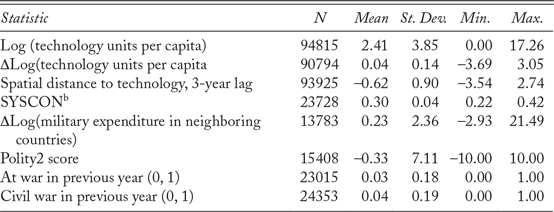
where i is a country, tech is a technology, t is a year, D i,j is a distance matrix (capital in i to capital in j), and  ${\overline {SDT} _t}$computes the worldwide mean SDT by year. Table 1 provides summary statistics.Footnote 75
Summary Statisticsa

a Country technology–year data. N observations are at the country-year level, except technology units and SDT variables. SDT observations are restricted to the country technology–years in which we observe technology use for the country and technology in question (that is, usable observations).
b Singer 1972.
In seeking to explain the pace of technology adoption, including measures of gross domestic product (on an annual or annual per capita basis) as a predictor would bias our estimates. This is because including a productivity measure in the conditioning set would show how fast technology was adopted in ways not reflected in productivity, which is not our objective. Although general economic development as measured by GDP can be an asset in international competition, and one consequence of facilitating technology adoption can be economic development, our outcome of interest is technology adoption, not these related concepts. As expected, replicating our country-technology models with GDP per capita included as a predictor slightly reduces the magnitudes of our effects (and sample size), but all relationships remain statistically significant and in the expected direction.Footnote 76 In our robustness checks, we estimato models with imputed data, add additional controls, and experiment with a large number of different subsamples of technologies, countries, and years. Results ate in all cases robust.
Quantitative Estimation Strategy
All regressions are ordinary least squares, and all models compare changes within a technology and country over time.
To test hypothesis 1, we estimated equations of the form
 $$\Delta {Y_{i,tech,t}} = {\beta _0} + {Z_t}{\alpha _1} + {X_{i,t}}{\beta _1} + {Q_{i,tech,t}}{\beta _2} + { \in _{i,tech,t}},$$
Where ΔY i,tech,t, is change in the natural log of technology adoption level per capita at the country technology-year level; X i,t are country and time varying covariates; Q i,tech,t are our country, technology, and time varying variables; Z t is our systemic variable that changes over time; and ∊ I,tech,t is the standard error term. β 0 is an intercept capturing technology use generally increasing over time.
Recalling our model above, our theoretical expectation is that the coefficient α1 is negative (that is, more system concentration means less systemic competition). Our quantitative estimates thus link directly to our formal model, assuming linearity in the proposed monotonic relationships underlying proposition 4. The terms X i,t β 1 and Q i,tech,t β 2 capture both local sources of variation in p and proxies for g c(.), g f(.), r c(.), and r f(.).
Our outcome of interest, faster technology adoption in many countries, is measured on a within country-technology basis. Testing our theory at the country technology-year level rather them system-year level means that we are able to control for country-specific effects and to retain information from our broad sample of technologies.Footnote 77
We next perform tests at the systemic level. We aggregate the rate of change for all technologies in all countries in a given year (moving from over 80,000 to just 188 observations—one for each year). In addition to testing the aggregate relationships, we report models in which we include an additional control for political change in the period, world average Polity2 scores. The systemic model specification is
 $${\overline {\Delta Y} _t} = {\eta _0} + {Z_t}{\eta _1} + {\overline X _t}{\eta _2} + \overline {{ \in _t}} ,$$
where η denotes coefficients,  $$\overline {\left( . \right)} $$is the yearly mean, and other terms are as defined above.Footnote 78 We also test the relationship using two alternative measures of system concentration, described in Table S3 of the supplementary material.Footnote 79
Last, we test whether there exists a temporal relationship in line with hypothesis 3 by conducting a series of Granger causality tests. We here again construct a yearly series of technology adoption across all countries and technologies.Footnote 80 We construct an alternative set of system concentration and world technology adoption per capita time series, accounting for the effects of war, civil war, and Polity2 score (regime) by summing the residuals of a regression of these variables on SYSCON and technology adoption per capita, respectively.Footnote 81 We then test whether in either set: (1) technology adoption was Granger-caused by changes in the international system and (2) technology adoption Granger-caused changes in the international system.Footnote 82 We did this with and without incorporating covariates, and with a variety of year lags.
Results
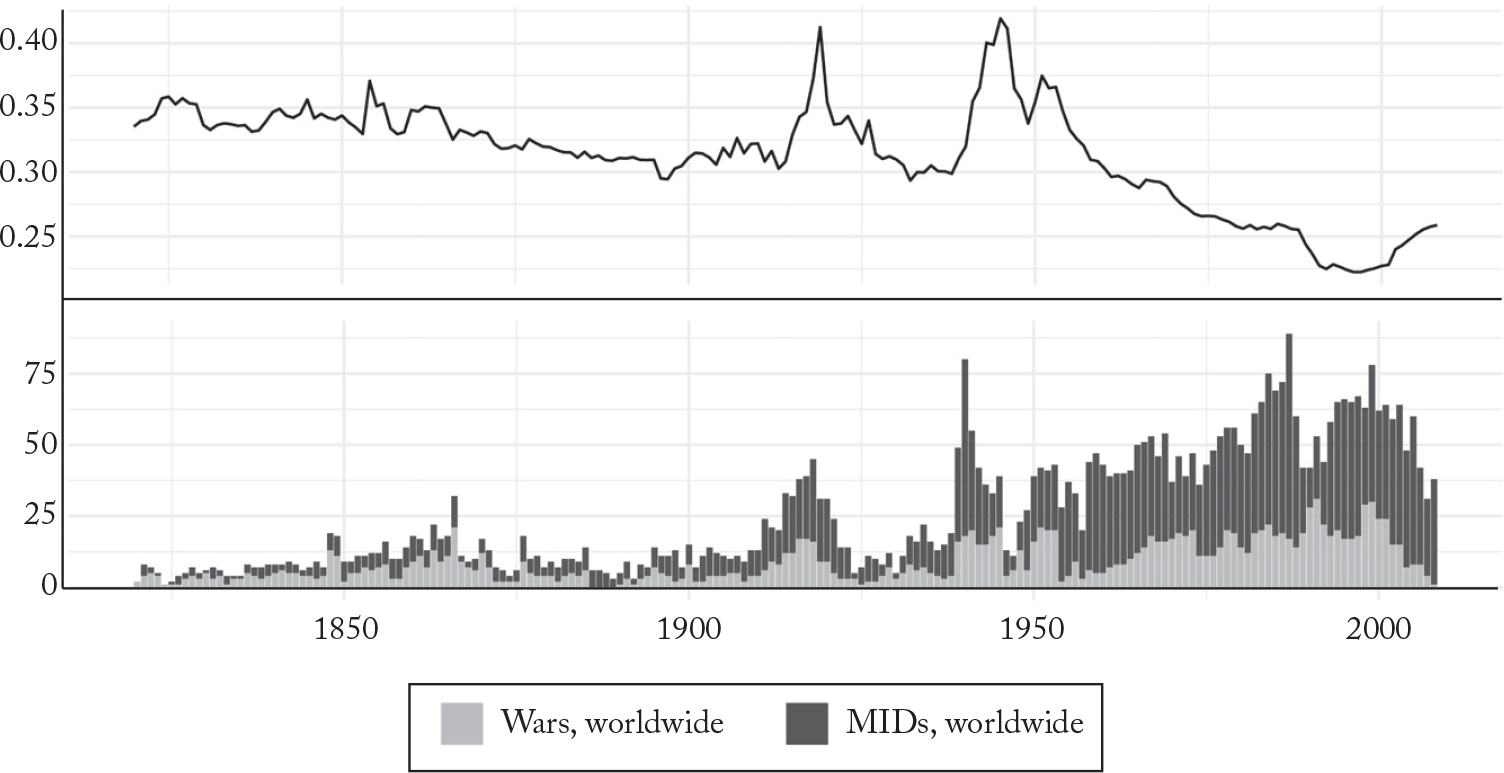
We first plot system concentration and trends in interstate conflict over time, shown in Figure 2. The figure illustrates how our systemic concentration measure has changed over time. We clearly see an inverse relationship between violent manifestations of international competition and system concentration, a relationship we evidence quantitatively in a section on the validity of system concentration as a measure of international competition in the supplementary material.
System Concentration and Interstate Conflict, 1816-2008a
aSYSCON (top) and number of states involved in militarized interstate disputes (MIDs) and wars (bottom), from 1816–2008. As seen, the two appear negatively related. Note that the larger spikes in system concentration appear after peaks in MIDs and wars. We argue that low system concentration is associated with a more competitive international system and hence, more disputes. In the supplementary material, we support this claim statistically, and show that our results are robust to using several alternative measures of the competitiveness of the international system.

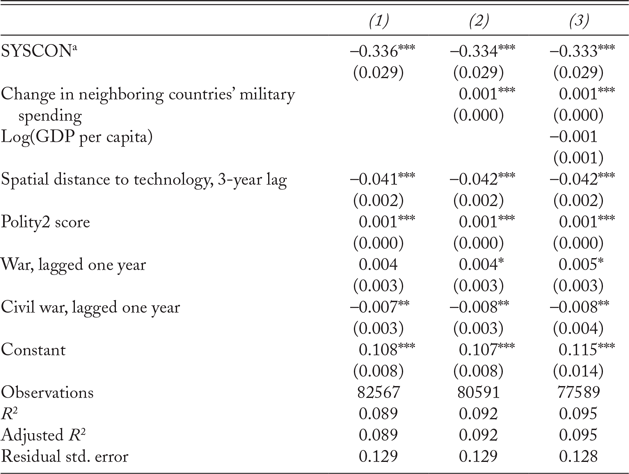
We present the results of our country technology–year analysis in Table 2. We find clear links between lower concentration and faster adoption of technology. For both the intensity of new technology use and pace of new technology adoption, there is an inverse and statistically significant relationship between our measure of system concentration and technology adoption.
Country Year-Technology Tests: Technology Adoption and Systemic Factors (1820–2008)

*p < 0.1, **p < 0.05, ***p < 0.01; country-technology clustered standard errors in parentheses
a Singer 1972.
In line with our expectations, we also find that neighborhood threats tend to be positively related to technology adoption and that civil war is negatively related, while the relationship between interstate war and technology adoption is less clear. As we expect, there is also a link between changes in domestic political institutions and technology adoption, with evidence that as a country becomes more democratic, it adopts new technologies faster and more intensely (consonant with changes in r f(.), r c(.), g c(.), and g f(.),—that is, with consumer and firm’s utility from technology and influence over government policy). Spatial distance to technology has a clear negative relationship, which we hypothesize is linked to g f(.). The benefit of pressuring the government to repress the technology is lower if its use is accelerating in neighboring countries (countries that may decide to export the technology and thus undercut the government’s efforts).
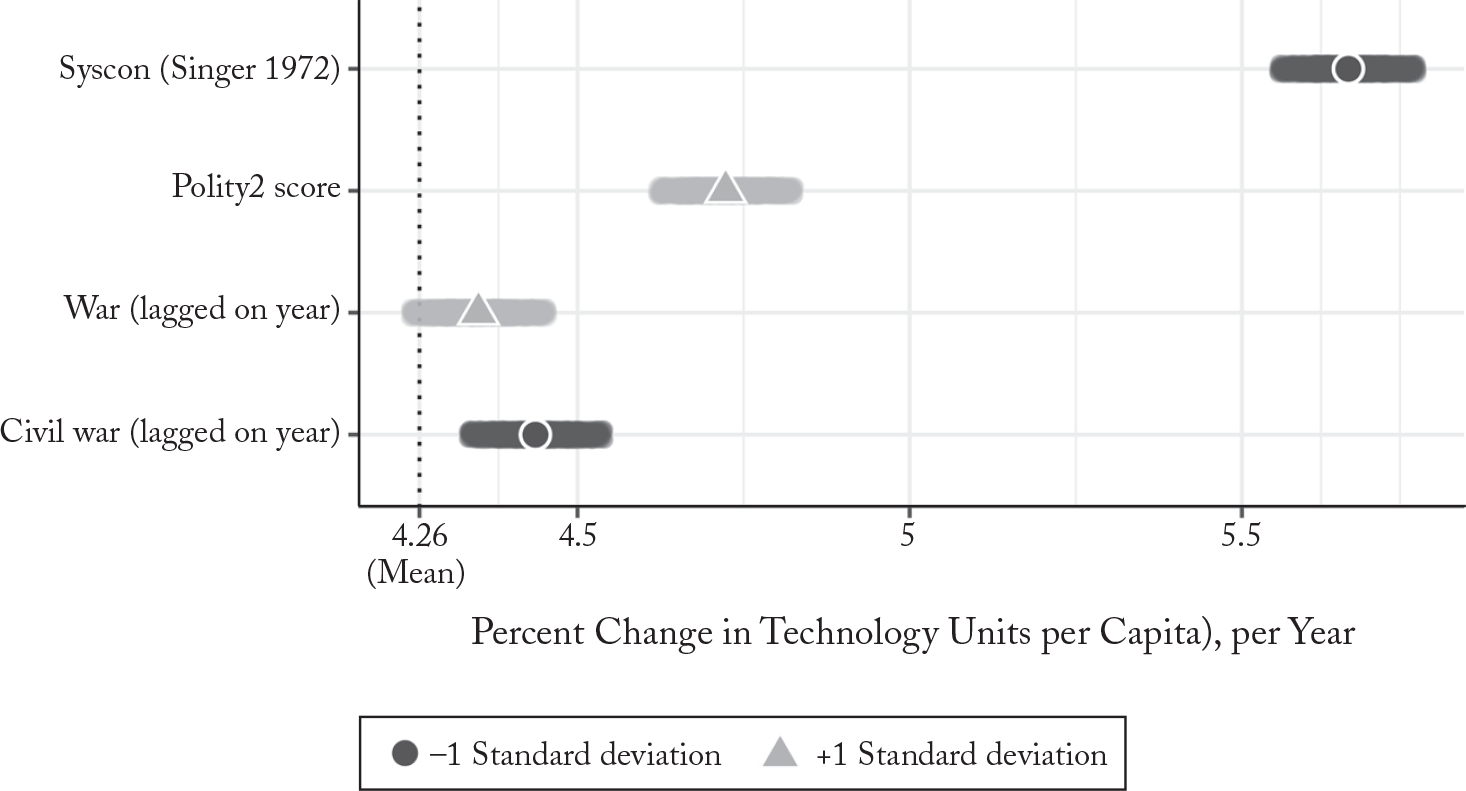
The magnitude of these effects is very large. Figure 3 plots the different expected changes in log number of technology units per capita for different levels (−1 standard deviation, mean, and +1 standard deviation) of our predictors (means of 5,000 simulations each, with 95 percent range of observations indicated by bars).Footnote 83 The effect of a one standard-deviation downward shift from the mean of syscon (from 0.28 to 0.24) is large, and we would expect the technology adoption rate to increase from 4.26 to 5.6 percent per year (≈ 31 percent faster adoption). Note that this is the expected average increase across all new technologies and countries for which we have data, and not just the sum in percentage points. Figure 3 also shows the means and expected changes for a one standard–deviation change in our other independent variables. The systemic effect is larger than that of political regime change, civil war, and interstate war.
substantive Effects: The International system and Technology Adoptiona
aThe plot shows the effect of one standard deviation shifts of our predictors on yearly increases in technology units per capita, using the model shown in Table 2, column 1. Effect estimates based on twenty thousand simulations, the mean of which are indicated by points and the 95 percent range of observations are indicated by bars. The baseline change per year is indicated by the dotted line. Among these variables, changes in system concentration has by far the largest effect. Going from the mean to one standard deviation below takes yearly increases in technology units per capita from about 4.26 to 5.6 percent (difference significant at the p < 0.001 percent level).

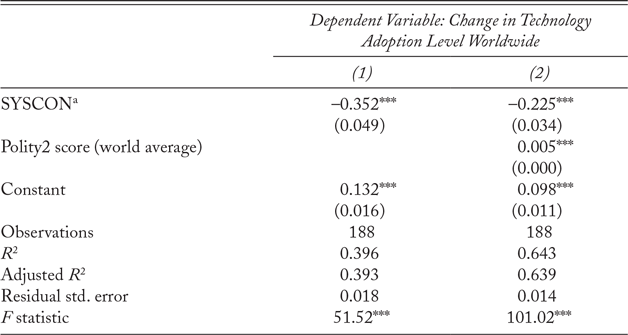
In Table 3, we examine our argument at the systemic level. We move from over 80,000 country technology-years to just 188 system years. We again find clear relationships (p < 0.001) between our various measures of international system concentration and technology waves, with and without controls. In models without other predictors, our measures of system concentration can account for between roughly 50 and 20 percent of the variation in the worldwide pace of technology adoption.
Systemic Tests: Worldwide Technology Adoption and System Concentration

*p < 0.1, **p < 0.05, ***p < 0.01; robust standard errors in parentheses
a Singer 1972.
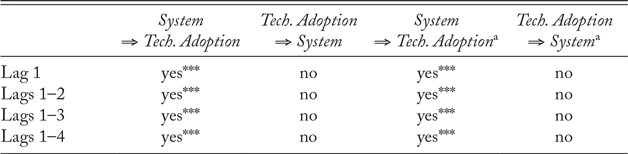
We find that changes in system concentration Granger-cause changes in technology adoption. Although one cannot establish causality in the sense of cause and effect by this technique, we can show that changes in system concentration are related at statistically significant levels to later changes in technology adoption, while the converse is not true.
As shown in Table 4, we can reject the null hypothesis of no temporal relation in all tests of system concentration ⇒ technology adoption, while we fail to reject this hypothesis for any of our tests of technology adoption ⇒ system concentration.Footnote 84 We emphasize that these tests are only evidence of a temporal relation and that the two phenomena are likely interrelated in the long run. Nevertheless, these tests strongly suggest that in the short or medium term, changes in the international system Granger-cause states to respond by adopting new technology.
Granger Causation: Worldwide Technology Adoption and System Concentration

a Accounting for the effects of war, civil war (both lagged one year), and Polity2 via linear model.
A relationship and temporal association between international system characteristics and global technology waves is thus evidenced, as is a link between characteristics of the international system and direct measures of technology use. In our robustness checks and in the illustrative case study below, we detail evidence suggesting a causal relationship between the two.
Robustness Checks, Alternative Samples, and Technology Types
We conduct a large number of checks to assess the robustness of our findings, which we summarize here. Full tables and replication code for all work is provided in the supplementary material and in the World Politics Dataverse page, respectively.Footnote 85
We first replicate our results across subsets of time, technologies, and countries. We investigate the relationship of interest during the years 1900–2000 (N = 68,615), on only minor powers (N = 75,374) and on only major powers (N = 7,193). We consider only European countries (N = 25,421) and only non-European countries (N = 57,146) (all in Table S6). We test our theory on many technology samples, by turns excluding railroad network and passengers, other transportation technologies, communication technologies, and industry-related technologies. In other models, we normalize measures of adoption across technologies (making their standard deviation equal). In all cases, the results remain robust.
To alleviate concerns about coverage and nonrandom patterns in missingness, we replicate our analysis with imputed data (see Table S6, column 1). We also replicate our analysis with additional controls: a binary democracy variable,Footnote 86 population,Footnote 87 and indicators for the Cold War or the five-year interval after a world war (see Table S7). We use the threat measure suggested by Ashley Leeds and Burcu Savun,Footnote 88 which uses information about foreign policy similarity in addition to capabilities. In all aforementioned cases, measures of system concentration remain negatively related to technology adoption at statistically significant levels (p < 0.01).
Our theory linking changes in the international system to policies boosting technology adoption is conditioned on such technology being useful in withstanding a challenge from abroad. This implies that the effects should be magnified if technologies for which that is not the case are dropped from the analysis. Our sample of many different technologies allows us to test this explicitly. We assume that two technologies among the twenty—tvs and ATMs—are less likely to confer an advantage in an international challenge (compared to trucks, railroads, and electricity production facilities). In line with our expectations, the relationship between system concentration and change in technology adoption increases in magnitude by about 20 percent if these two technologies are dropped from the analysis (see Table S6).
Although the invention of the technologies we investigate are quite evenly spread across time, we also test whether measures of system concentration remain robust predictors of technology adoption when we control for the pace of invention of technology. We replicate the specifications in Table 3 adding yearly or five-year average inventions per year as a control. We do this with two samples of inventions, the twenty technologies considered in the main analysis and a larger group of 104 important civil and military technologies (see Table S8). In all cases, the results remain robust.Footnote 89
We next interact our SYSCON measure with our diffusion measure, indicating the spatial distance to technology adoption levels. We find that states become more responsive to the technology adoption of their neighbors when the system is less concentrated (both unconditional effects, including SYSCON, remained statistically significant at the p < 0.01 level).
Our investigation focuses on the adoption of new technologies—increase in their use. A related concept is the intensity of their use. We replicate both our systemic and country technology–year analyses using intensity of use rather than the rate of change as our dependent variable and in all cases include a full set of country-technology fixed effects to account for country-technology fit. In every case, we find that lower system concentration is related to more technology use.
This theory is predicated on the claim that low system concentration brings more international competition. Beyond the evidence provided in this article, in Section 3 of the supplementary material, we investigate this claim quantitatively for the case of violent international competition (using data on militarized disputes, wars, and military spending). We find strong evidence that low system concentration indeed is linked to higher levels of competition (see Table S1).
Measures of concentration are sometimes argued to be overly sensitive to how they are specified. We therefore include a section in the supplementary material that tests the reliability of our claims using alternative measures of concentration, which are insensitive to the number of countries, and to capabilities of the top four countries (see tables S3 and S4). Results are robust. We also replicate our country year– technology analyses with measures of concentration constructed using CINC scores that do not include iron and steel production or total energy consumption as components (that is, we calculated states’ average share of the world total for urban population, total population, military expenditure, and military personnel). Results were unchanged in direction, slightly larger in magnitude, and remained statistically significant at the p < 0.01 level (see Table S9). We estimate models in which system concentration for country i was calculated using data on all countries except i (Table S9). Results were unchanged.
We argue that states adopt technology in more competitive environments to limit their vulnerability to coercion or attack. We argue that states respond to such more competitive environments with policies that go beyond military spending. We therefore ran systemic regressions with the log of world-wide military spending as an additional control (see Table S8). We find that even if we control for military spending at the country level, there remains an independent effect of international system concentration on technology adoption.
We explore the extent to which the impact of system concentration is distributed over time. Table S10 shows models with a lagged dependent variable and in which system concentration remains a strong predictor.
These estimations suggest robust links between international system concentration and the pace of international technology adoption. As our Granger causality tests show, there is also evidence of a temporal relationship, wherein changes in international system characteristics precede changes in worldwide technology adoption. International system concentration and global technology waves are broad concepts, and untangling causal relations between them—however important these might be—will always be fraught with difficulty, which we recognize. To complement our Granger causality tests, we therefore employed two other tools: the internal instruments approach of generalized methods of moments estimators (gmm) and error correction models (ecm). Both approaches, summarized in Tables S11 and S12, respectively, in the supplementary material, support our claim that more system concentration has a negative effect on technology adoption. Specifically, the effect of system concentration retains its sign and statistical significance using the internal instruments of the GMM estimator across nearly all models at the country technology–year level and in each case at the systemic level—results that address concerns about potential endogeneity.
Error correction models suggest that nontransitory changes in system concentration have a long-run effect on the steady state of technology adoption from both the country-technology and systemic perspectives. To elaborate, given a sustained negative change to system concentration (that is, the system becomes more competitive), we expect that it would cause an upward change in the equilibrium value of technology adoption to which it would converge over the subsequent time periods. Given the statistically significant coefficient estimates of long-run effects and speed of adjustment to equilibrium, this suggests that our results are not a product of the spurious long-run correlation issues endemic to time-series analysis with unit-root variables. At the systemic level, we also find (in addition to the extended effects of persistent changes to system concentration) a short-run, albeit quickly dissipating, effect on technology adoption in the presence of transitory shocks to concentration.Footnote 90
Illustrative Case Study: Swedish Government Establishes Railroads
In this section, we provide a concrete example of the theoretical argument. We argue that changes in Swedish government policy (s*) toward a major new technology (railroads) can be traced to changes in the international system, namely the Crimean War, which caused a reduction in system concentration (Z t). We show that these changes in government policy were instrumental to the establishment of a railroad network in the country (Y). The Crimean War marked a breakdown of order in Europe, and states saw themselves as much less secure than they had been previously. As Gordon Craig writes, this “conflict marks a significant turning point in European history. Behind it lay forty years of peace; before it stretched fifteen years in which four wars were fought by the great powers of Europe, with the result that the territorial arrangements of the Continent were completely transformed.”Footnote 91
By 1853, representatives in the Swedish Riksdag had debated and rejected proposals for state funding of railroads for a more than a quarter century. Attempts to bring railroads to Sweden by mobilizing private capital had all also failed, most notably those by Count Adolph Eugene von Rosen in 1845 and in 1847–48, who, in both cases, obtained a royal permission to do so.Footnote 92 As Hans Modig writes, “It was by no means predetermined that the railroad system in Sweden should be erected and organized by public means and under public direction.”Footnote 93 Previous government investments in infrastructure, such as the Gota Canal, had been expensive and unprofitable. Opponents of railroad funding remained active, citing among other things, the possibility that it would spread cholera.Footnote 94 Large landowners, who feared the political ramifications of industrialization brought about by railroads, would continue to oppose their construction for decades to come.Footnote 95
But the Crimean War, which broke out in October 1853, dominated parliamentary sessions that began in late November, and “the relations of Sweden with foreign powers again came to the foreground.”Footnote 96 From 1845 to 1853, international system concentration fell by one-third standard deviation, hitting its lowest point since the 1830s, and the more even distribution of capabilities in the system was becoming obvious.Footnote 97 Previously dominant, Britain and France were concerned about the growing power of Russia and Prussia, where both military expenditures and economic prowess were on a clear upward trajectory. In Stockholm, initial worries were not about direct attacks on Sweden as part of the conflict, but rather were about the indirect consequences of a war more than a thousand miles away between Britain, France, the Ottoman Empire, and Russia.Footnote 98
The decision for large public investments in railroads was soon made (1853) and was framed by its proponents in explicitly geopolitical terms. In a speech made that year to the Swedish Estates Assembly, Johan August Gripenstedt, who would later oversee the financing of railroads as minister of finance (1856–1866), compared railroads to defense fortifications and argued that they were “so important and have so profound effects, that they cannot be separated from the state.”Footnote 99 This shift in policy was not due to a discovery of railroads’ military use (for example, troop movements), which had been known for some time.Footnote 100 Instead, it was because defense had taken on new urgency. As Lena Andersson-Skog writes, “That defense interests contributed to the decision to establish [railroad] trunk lines is clear beyond any doubt.”Footnote 101 “Authoritarian powers” to plan and lead construction of the lines were given to government actors, mainly Nils Ericson, a colonel in the Navy Mechanical Corps, with the lines to be drawn up with careful consideration of defense needs.Footnote 102
In Sweden, state intervention was essential for establishing the railroad network and highlights the importance of government policy for technology adoption. Despite the fact that railroads would cut freight rates by more than half and travel speeds by nine-tenths, it was only when the state decided to invest that the country’s first railroads were built in the latter half of the 1850s.Footnote 103 As system concentration continued to fall throughout the 1860s and early 1870s, Swedish expenditure on railroads kept rising. In the first half of the 1870s, almost 15 percent of all government revenue was spent on building railroads.Footnote 104 And although governments often are important for what they do not do—for example, by erecting barriers to new technology—the Swedish example also shows that they can be important actors in promoting technology adoption. As one study attests, “It was essential, therefore, that the government should not only build the strategic main lines of the system but also help by guaranteeing the loans which the private railway companies issued abroad.”Footnote 105
Discussion
We find that a more competitive international system, as measured by the concentration of resources and as described in the historical record, can be linked to a broad-ranging acceleration of technology adoption. Our large-N analysis indicates a relationship between technology adoption and the structure of the international system. We argue that in the short and medium term, states respond to changes in the international system. Using Granger causality tests, we find that there is a unidirectional temporal relationship in line with our expectations. Our regression specifications are by design sparse. In dealing with this long time frame (1820–2008), there is a sharp trade-off between adding covariates and maintaining good data coverage. More importantly, our estimation strategy relies on tracking changes on a within country–technology basis. This means that country-specific confounding variables would need to be time varying within the diffusion paths of particular technologies within particular countries and at the same time be correlated with our measures of system characteristics. A battery of robustness checks seeks to alleviate concerns about such variables. At the systemic level, we test a range of potential systemic confounders and find our relationship of interest to be robust. We also provide a historical example of how changes in the international system in the latter half of the nineteenth century led to policies that shaped states’ adoption of technologies.
It is difficult to separate capabilities from states’ use of technology. Any reasonable measure of concentration of capabilities must rely on a conceptualization of capabilities that captures states’ resources, and these resources cannot be entirely divorced from the use of technology. We believe that our Granger causality tests and the other tools we employ, GMMs and ECMs, robustness checks with country-specific concentration scores (excluding the contribution of their own capabilities), various subsamples and alternative concentration measures, as well as a historical example, provide multiple sources of support for the relationship in which the competitiveness of the international environment drives adoption decisions in the short and medium term.
The way we measure technology is limited to its physical manifestations. We have not looked at innovations in management practices or education, or the spread of new ideas, for example. Although restricting the scope of our investigation was necessary, we think there is fertile ground for further research on the relationships between competition in the international system and other spheres of knowledge. It is interesting that the Renaissance started in the context of intense competition between city-states in Northern Italy (when for a time, Leonardo da Vinci advised Cesare Borgia) and that what is often named as the most innovative period in Chinese culture and history (475–221 BCE) is known as the Warring States period.
Conclusion
Global waves of technological change seem to occur in the international system, and we have sought to understand what drives these revolutions. Our theory claims that when international system capabilities becomes less concentrated and the system therefore becomes more competitive, governments feel compelled to strengthen their position. They become more likely to change policies that might have constrained their adoption of new technologies or even to enact new policies that promote such adoption. Competitive pressures in the international system thus generate critical incentives in the face of powerful domestic resistance to new technology. We argue that systemic change may lead to waves of technology adoption in many countries. We develop these claims into a series of hypotheses that we then test.
We examine our proposed relationships using many different sources. Our quantitative evidence spans nearly two centuries, twenty technologies, and almost one hundred and seventy countries. We show that when the international system was less concentrated, international technology adoption was faster, accounting for all time-invariant country-technology effects. Our models show statistically significant and sizable correlations, but we need finer data to show the relationship between government choices about technology and system change. Presenting a specific instance of international system change, we link changes in government policies to concerns about a more competitive international environment. This helps to demonstrate the microfoundations for our claims about systemic pressures and provides further evidence of how important government policy can augment technology adoption.
Our work contributes to the study of international relations and technological change in several ways. First, we show that technology adoption by countries, which is a major factor in fostering economic growth, relies to some extent on pressures from the international system. Domestic politics are not the only thing that matters. International pressures on leaders can induce them to override domestic demands preventing technological change and protecting entrenched interests. Indeed, such international pressure may be the most important influence propelling leaders to allow new technologies. Second, we theorize and provide evidence that specific international system characteristics can be related to global technology waves. Third, while some scholars view a more concentrated international system—one of bipolarityFootnote 106 or hegemonyFootnote 107—as most desirable, we show that a more diffuse system may lead to better outcomes with respect to technological change.
Our evidence may also be useful in thinking about how the distribution of capabilities in the international system changes. We argue that competitiveness in the international system makes policymakers more likely to facilitate the adoption of new technology. We also know that these technologies may both disrupt existing economic arrangements and be very costly in the immediate term. Over the long term, however, such costly initial investments may lay the foundations for higher-than-otherwise technological development and economic growth.
Acknowledgments
We thank Dominic De Sapio, Andrew Mack, Thomas Cunningham, and Maria P. Pachon for excellent research assistance. We also thank Eric Arias; Raphael Cunha; Marina Duque; Benjamin Fordham; Naoki Egami; Daniel Gibbs; Amanda H. Kennard; In Song Kim; Korhan Koçak; Ranjit Lall; James Lee; Jack Levy; Marco Martini; Francesca K. Parente; Bryan Schonfeld; Andrey Tomashevskiy; Nicole Weygandt; and participants at the 2018 Princeton International Relations Faculty Colloquium, the 2018 annual meeting of the International Political Economy Society, the 2019 Emerging Trends Seminar at Rutgers University, the 2020 GRIPE webinar, and the 2020 Future of Humanity Institute at the University of Oxford, for helpful comments.
Supplementary Material
Supplementary material for this article can be found at https://doi.org/10.1017/S0043887121000010.
Data
Replication files for this article can be found at https://doi.org/10.7910/DVN/ANNXHW.
Authors
Helen V. Milner is the B. C. Forbes Professor of Politics and International Affairs at Princeton University and the director of the Niehaus Center for Globalization and Governance at Princeton’s School of Public and International Affairs. She can be reached at hmilner@princeton.edu.
Sondre Ulvund Solstad is a senior data journalist at The Economist, in London. He can be reached at sondresolstad@economist.com.