INTRODUCTION
Crying is a typical expression of human emotions and means to shed tears as an expression of distress or due to pain (New Oxford American Dictionary, 2005). It can also be defined in a more biological way. Depending on different scientific contexts, the occurrence of tears and crying has been given different explanations, for example, the protection of the eyes (Patel, 1993) and removal of toxic waste products. Such outbursts of tears will also have an effect on one's mental state (Frey, 1985) and occur when emotions reach a critical level of overflow (Koestler, 1964; Sadoff, 1966), when a person is not able to cope effectively, has given up, or as a sign of helplessness (Efran & Spangler, 1979; Frijda, 1986).
Crying has been studied in different contexts and even experimental situations. In one study, those women who spontaneously cried exhibited more expressive behavior and reported more feelings of sadness and pain (Gross et al., 1994). Generally, women cry more often, longer, and more intensely than men (Williams & Morris, 1996; Mathell et al., 2001; Becht & Vingerhoets, 2002). Women cried when they were criticized, angry, or had problems with their work. Men, on the other hand, showed no tears in these situations (Williams & Morris, 1996). Women are also more prone to crying for both negative and positive reasons (Mathell et al., 2001). Vingerhoets et al. (1993) demonstrated a positive association between weeping frequency and personality, such as neuroticism, in both genders. Studies have also shown cultural and ethnical differences (Williams & Morris, 1996). According to another report, a person's feeling after a crying episode depends on how common crying is in one's culture and on general feelings of shame about crying (Becht & Vingerhoets, 2002).
Many health care studies have not focused on crying as a way of coping with emotions related to the disease in different ways, using coping scales (Stanton et al., 2000; Wengström et al., 2001; Kuo & Ma, 2002) often based on the framework of Lazarus and Folkman (1984). In palliative care, crying is a common phenomenon (Corless, 2001), but not well studied in this context. According to health care professionals, emotional expression is an effective way for patients in palliative care to become more relaxed (Clements-Cortes, 2004). However, it is not only patients and family members who cry. According to breast cancer patients, nurses who show their emotions openly by crying may strengthen the relationship between patients and nurses (Betta, 1993). However, this is not a strict rule. Friedrichsen et al. (2000) pointed out that physicians who cried when breaking bad news to terminally ill cancer patients were perceived as emotionally trying by the patients.
There is knowledge about crying as regards its effect on people, gender, and cultural differences and theories, but the personal significance of crying to patients has not been studied. Encounters with patients in a palliative care context are a highly demanding task for health care professionals. Therefore it is important to strive for a deeper understanding of crying in adults. The aim of this study was therefore to explore the significance and meaning of patients crying in a palliative care context.
METHODS
Setting
The study was performed in three different advanced palliative hospital-based home care units in Sweden. These units provide 24-h service in the patients' own homes and consist of multiprofessional teams including doctors, nurses, auxiliary staff, occupational therapists, physiotherapists, and social workers. When needed, staff are available within half an hour. These services have beds available if needed at the hospital (Beck-Friis & Strang, 1993).
Subjects
A purposeful sampling was used in this study to obtain a variation regarding demographic data, such as age, gender, and diagnosis (Patton, 2004). According to the inclusion criteria, the participants had to be over 18 years of age and admitted to a palliative hospital-based home care unit. They also had to be in satisfactory physical and mental condition to participate, according to their own judgment, accept tape-recording during the interviews, and be able to communicate in Swedish. The data were collected between 2004 and 2005. The palliative care teams approached patients with oral and written information about the study. Patients interested in participating were then contacted by the interviewer (K.R.). A total of 14 patients participated, five men and nine women, aged between 44 and 89 years old. Demographic data are presented in Table 1.
The characteristics of the 14 patients

Data Collection
The interview was much like a conversation even if the interviewer had a few questions to put (Patton, 2004) about the significance of crying, that is, situations when crying arose, feelings, benefits, and negative consequences. Eleven of the interviews were carried out in the patients' homes and three in the palliative care unit. The interviews, which lasted between 30 and 60 min, were tape-recorded and then transcribed verbatim by the interviewer. Permission to carry out the study was received from the Research Ethics Committee, Faculty of Health Sciences, Linköping University (Dnr 03-650).
Hermeneutic Framework
To gain deeper understanding, a hermeneutic analysis and interpretation according to Gadamer (1989) was used. The hermeneutic circle could be described as a continuous movement between the whole and the parts, a dialogue with the text in which the meaning of separate parts is determined by the global meaning of the text. This process involves continual questioning, reflection, and validation within the dialogue between the researcher and text. According to Gadamer (1989), it is only through preunderstanding that understanding is possible, and, by not recognizing this fact, there is a risk of misjudging meaning. In the current study, the preunderstanding was based on other studies and clinical experiences of palliative care. During the data analysis, the researcher's horizons and preunderstanding coincided with the text, and a “fusion of horizons” came about. This understanding is not the only possible interpretation, but it is the researcher's task to show his or her interpretation is more probable than other constructions (Gadamer, 1989).
Analysis
The analysis followed six steps, but these did not reduce the analytical activity to a linear process, but moved back and forth between the steps (Gadamer, 1989; Alvesson & Sköldberg, 1994; Malterud, 2001).
- The transcribed material was read through several times to get a general picture of what the patients were recounting. The first analytical task was to develop a sense of the text as a whole.
- Significant text segments (units of meaning) were identified. Sentences of the units of meaning were concentrated where the large interview text was reduced to a shorter and more concentrated text (decontextualization). Each concentrated unit of meaning was coded.
- When concentrated units of meaning were clustered with matching codes, preliminary categories then emerged. In the preliminary categories, the researcher made a comparison for similarities and differences.
- The process continued by asking questions to initiate a dialogue with each of the interviewees. The researcher tried to be a participant in the different actions of the text, that is, asking questions about the text based on the researcher's own preunderstanding and the patients' narratives.
- The questions were tested through a renewed scrutiny of the categories to open up the inherent meaning of the text. A process back and forth between the whole and the parts of the text continued in order to understand and interpret from two different horizons of meaning, the interpreter's and the patients'.
- Final categories emerged, and these categories were compared with the text from which the initial units of meaning were collected (recontextualization). A final text and modification of the new understanding was made to illustrate both the parts and the whole. “As a whole” concerns the deeper meaning on a more abstract level and constitutes the interpretation of the whole.
Trustworthiness
To ensure trustworthiness, several steps were taken. Seven patients wanted to read the transcribed interview text. To further consolidate the study, a dialogical intersubjectivity was used (Malterud, 2001). Three of the first five interviews were read separately by two of the authors (K.R., M.F.). The coding and development of categories were mainly done by the first author (K.R.). The second author (M.F.) questioned the preliminary analysis and asked questions to obtain the implicit message. Questions were posed; “What, who, and why” are they saying this, and what does it mean to them, but also questions about the content in each category. When the analysis was solid, the third author (P.S.) discussed the findings with the other authors (K.R., M.F.) by supplementing and contesting each statement, which may strengthen the research design (Malterud, 2001).
RESULTS
Parts: Dimensions of crying
Intense and Despondent Crying as a Way of Ventilating Urgent Needs
One type of crying was described as very intense and strong. Patients described expressions of hysteria, screaming, and an intensity of emotion where the body was shaking. Tears and emotions could not be controlled in most cases, as this crying was unstoppable, unmanageable, and involuntary, without any possibility of repressing it in an intellectual way. This type of crying was described with the metaphors “drowning in tears,” “it just breaks through,” or “a great lake that has to be drained off by a steady stream of tears.”
This intense and despondent crying appeared when patients were confronted with events they could not handle, that affected them emotionally. Such events were, for example, “bad news” about the illness, which confronted them with the seriousness of the disease and the awareness of their closeness to death. The thoughts of losing their identity due to diminishing mental and physical activities created feelings of powerlessness, hopelessness, anger, and despair. The own predictable and obvious future was suddenly curtailed, which was incomprehensible. Feelings of fear and sometimes panic appeared.
“This kind of crying, when I received the news about everything with my cancer … well, it was brutal, it was impossible to stop. It just, well, it wasn't possible to stop, as I know what it's like to be ill. It was like a flow and at the end I became quite shaky from this crying. I never thought this could happen to me.” Interview 6.
Some patients described that they needed privacy for this intense type of crying. If they were completely alone, patients could cry without needing to consider the surroundings, focusing on their own emotions. This type of crying was also a situation where patients bared their hearts and became more vulnerable. Therefore, they did not want to express their feelings openly. Others did not want to put any strain on their family or spouse with the intense emotions in this crying. Some patients also felt ashamed of showing their crying and tried to find a private place where they really could release their inner feelings.
“We built that office; I was there and built it. We went down to visit that building … and I had just passed the door when I started to cry, right away in an intense way. I just shook hands and then left…. I went down to my car and cried like a child. I stopped in a parking space and I cried floods of tears.” Interview 7
This type of crying had the effect of ventilating urgent and pressing needs where patients' overwhelming emotional pain was released. This release demanded a lot of physical and psychological energy. Tiredness and exhaustion were expressed afterward and a period of recovery was needed. After the recovery, some patients felt relaxed.
“I'm totally exhausted after my hysterical crying, yes I really am … and after that I just have to lie down and realize that I don't have the energy to do anything. I'll lie down until, well till it's time to get up…. Yes, there is a difference between crying and crying, I think. Yes, there is. This hysterical crying drains me of energy, and the sad crying is more comforting in some way.” Interview 3
Gentle, Sorrowful Crying as a Conscious Release of Emotions
This type of crying was described as a “little,” silent, and calm cry, where tears streamed slowly down the cheeks and where the emotions were released in a controllable manner. Patients expressed that with this type of crying, they still were in command of their feelings. This crying was something they could choose as a conscious way of coping with situations or feelings, a strategy to express feelings that were not easy to describe verbally. Sometimes this crying was described as a little cry, that is, a short cry that could be stopped immediately. Patients could also give signals to family members and health care professionals by crying. When nothing else had been given enough attention, crying could be used as the last resort to be noticed in a disadvantaged or difficult situation.
“They [nurses] must understand the signs … that there must be something else behind it. I mean, if I don't cry when I get out of bed one day, it means I am in pain, when I cry the other day, just because I have more pain. That's a sign they must understand. If they happen to see me crying, then it's serious, he's got pain.” Interview 4
The trigger for starting to cry was thoughts about loss and disappointment, such as losing their importance and meaning to family members or distressing physical symptoms. But also positive factors such as love and tenderness could elicit tears, where feelings of the loss of close relationships caused suffering. Patients also described thoughts of guilt, shame, and futility as triggers. The awareness of it not being possible to stand by their loved one, due to physical weakness or other symptoms, caused frustration and tears.
“I think it's a feeling of disappointment. I wake up and I feel that today I'm really bad and it hurts, and we are supposed to go somewhere tonight. And then I feel, drat! we've planned this, we've been thinking about doing something and then it won't happen. And, my wife, she has cancer herself, and has problems lifting. And then I suffer because she's got to do a lot because of me; she is having a rough time and she is working hard. And then it all comes out. Lately, I've been alone when I cry. It's just for a short while, and that's it, then it's over.” Interview 4
Some patients described this crying as an opportunity to consciously show their worry and fear about death. It was possible to cry together and share feelings with family members or close friends. The effect of this crying was described as a release of emotional barriers and strain, in particular, barriers to communication about existential matters.
“Well, I think that I've got what I wanted, what I felt that I wanted to achieve, by these moments of crying. I've told him [her husband] about death and everything around that … and then I felt quite satisfied, that I've got something out of crying.” Interview 3
This crying was described as having a cleansing effect by healing the body and mind. This was described in metaphors like “a cleansing bath,” “the freshness in the air after a rain,” or as “clouds disappearing.” Patients described a clear cutoff where negative thoughts came to an end and new strength replaced the sad thoughts. This strength made it possible to go on and to see new solutions or just enjoy life for a moment. Patients described feelings of becoming calm and peaceful again. They felt better, and then came a new attack of gloomy thoughts and sad feelings.
“Well, it cleans your body out in some way. It feels easier when you've had a cry and you calm down a bit afterwards … then these nice thoughts are there. You've cleaned your body out in some way, that's what I think.” Interview 12
Quiet, Tearless Crying as a Protection Strategy
This type of crying was described as a feeling of crying inside, but without any tears being visible on the outside, or at the most watery eyes. Tears did not appear even if the patient had strong feelings inside and felt as if on the verge of tears. Due to feelings of shame about showing emotions and weeping, patients felt more secure when their tears were kept inside. Personality, childhood, and education had an influence over whether patients dared to cry openly or in private.
I: “Do you shed tears when you cry?”
R: “No, that's not necessary. Well, I cry, I can sit on the bus and have really sad thoughts. Maybe my eyes are watery or I'm a little bit overcome emotionally, but I don't cry, even if I think that that's a kind of crying.” Interview 9.
Patients described this crying as very personal and stressed the importance of crying by themselves. The reason for not showing their tears was sometimes due to an insecure environment, for example, during a doctor's visit at the hospital. The real crying with tears sometimes had to wait until they were in a secure setting, in the car, at home, or outdoors. Through this crying it was possible to be emotionally protected from making their emotions visible and thereby becoming vulnerable.
R: “It is an emotional thing (crying), it really is. I think it's a big step between the tears coming—to having a cry.”
I: “Do you think so?”
R: “Because sometimes my tears can well up, yes they can, but not any more than that, yes as I said before … I have tried to kind of, cut them off … I know, like my dad was the same. Boys don't cry.” Interview 7
Others said that they kept very sad feelings inside and used silent crying but didn't feel the need to cry openly; they had other ways of coping with their emotions, for example, communicating with others, praying to God, or meditating. Crying openly was not their only way of coping with emotions. A crying process could be going on inside, without any need to show it.
As a Whole: Crying—An Unpredictable Force to Control or Create Balance
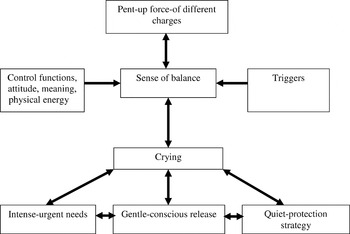
Patients described crying in different ways, but all of them described it as an expression for an inner emotional force that was provoked by different factors and caused a change in their balance (Fig. 1). This pent-up force of different charges is expressed in many ways and may explode, slip out consciously, or be withheld and maintained inside. It may also give positive or negative consequences. This force comprises underlying, incomprehensible, and inaccessible thoughts and feelings about the future with the purpose of temporarily confronting and/or processing hard facts. The force is so tangible and pent up that it demands courage to dare to cry, as it releases unpleasant thoughts and communicates powerful signals to the surroundings. There is a risk of losing, for example, “one's face”, self-control, status, and, thereby, his or her relationship to other people. However, crying may be something useful; a positive crying experience restores the energy and the communication improves, as the people in their surroundings understand the signals. The meaning of crying may be seen as an expression of an inner and independent wisdom of the body and soul that, together with the person, regulates his or her emotional balance. This balance is influenced by different factors, for example the attitude to crying, control functions (the attempt to control their mood, the actual situation), experience of acceptance, meaning of omitting to cry or having enough physical energy. When something is an emotional trigger and creates an imbalance, the pent-up charges demand attention and want to be released by crying. The precise intensity and type of crying emerge to maintain or restore balance. Depending on the situation, crying could vary in intensity. Crying could also start with one sort of crying and then change into another sort. Achieving or maintaining balance was not always obtained by crying openly, but could also be achieved by crying on the inside, but still wanting to express an emotional balance with the surroundings.

A model for crying—force, control functions, triggers and sense of balance and types of crying.
“My crying comes in every possible way, I think it depends on how powerful it is when it comes or what it is, that's made me cry, but it's totally different. I think it's what you need at that moment and your body knows, it knows what you need and what you need to process in the first place.” Interview 9
DISCUSSION
This study has revealed that the act of crying among cancer patients in a palliative phase may be both with and without tears and may release, cover, or provoke distress. The significance of crying with tears is to achieve or maintain balance. Tearless crying is about maintaining balance in the actual situation, to protect oneself and others by covering any observable emotions. Previously, the different dimensions of crying have not been described in a palliative care setting, but partly in other contexts. For example in a principal component analysis, Williams and Morris (1996) distinguished two dimensions of crying among adults, one kind of crying that was intense, long-lasting, and difficult to stop and another type that was more diverse in appearance but more controllable. However, the Williams and Morris study as well as other studies are not based on narratives from people's own descriptions. There is a difference between real narratives and experimental situations where the researcher tries to provoke crying.
Moreover, the method used influences the outcome. The hermeneutic approach gives an alternative perspective on crying, as this methodology goes deeper and analyzes implicit messages, the whole and the dependent parts. In a palliative context it is important to know in which situation crying appears and what its inherent meaning is to those with a severe illness in order to be able to provide optimal care. Crying as a phenomenon may seem simple and obvious; everyone has his or her own experience and own way of handling it. But transferring one's own experience into interpreting the needs of patients is not in line with professional conduct, and therefore more knowledge is needed.
In this study the intense and despondent crying performed the function of releasing of urgent needs and was related to bad news about their terminal illness, which is a demanding situation for all parties involved. To confront death and dying is an existential experience, which may be difficult to cope with. Previous studies have revealed that cancer patients in different stages prefer a physician that is empathic, interested, and caring (Friedrichsen et al., 2000). The need for understanding in such a situation is of importance, as intense crying is to bare oneself. A physician or nurse that confirms and legitimates crying expresses understanding and creates a tolerant, secure, and safe environment in a chaotic situation where patients have lost their self control for a moment. This may ease patients' feelings of embarrassment and vulnerability. For health care professionals it is important to maintain calm and show respect, by having the courage to stay but also to offer space for privacy, letting patients and family members be by themselves for a while. Trying to communicate details about the disease or how they should manage things in this situation is a waste of time and lacking in professionalism. This type of crying needs time, both to finish crying but also to recover and return to a sound level of energy again.
The gentle type of crying had the function of a conscious coping strategy. By means of this type of crying it was possible to receive emotional support and be able to communicate. This crying had a positive significance in the sense that it was a release and gave them new energy. Patients perceived their tears to be filled with sadness and bad thoughts; therefore it was seen as a benefit to be able to cry as the bad thoughts were expelled. A similar result was also seen in another study among Pakistani women (Fooladi, 2005), who described a spiritual healing effect where the body was washed clean from poisons. However, in a palliative context this crying gave only temporary relief. New events will occur and sad thoughts will reappear and a new bout of crying may be needed. Other studies have confirmed that events are of relevance when it comes to the different types of relief after crying. Episode outcomes, that is, feelings after crying, depend on the resolution of the issues that led to weeping in the first place and also the lack of social support (Cornelius, 1997). In a palliative context, issues around death and dying are inevitable and have to be coped with. Gentle crying may be a good coping strategy, as it is beneficial in many ways; it strengthens relationships and opens up important communication.
The third dimension of crying was the quiet tearless type, which is an interesting result, as the very definition of crying includes tears, body movements, and sobbing (Patel, 1993). Still, patients in the current study describe this as a kind of behavior in terms of crying. Another study (Williams & Morris, 1996) describes watery eyes, which is similar to our results. This internal crying may be seen as a need for total privacy and integrity when it comes to emotional matters. Real crying may have to wait until a secure place is found. But there may also be other ways of coping with death and dying. Crying is not the only way of coping, which is of importance for health care professionals to keep in mind. It is not obligatory to cry, and it is not necessary or even desirable to push “the cry button” now and then and expect that this will be what everyone has to go through. Such expectations were found in another study (Ekvall & Ternestedt, 2003) and may be what health care professionals expect to be “normal.” But, it is obvious that patients should not cry to make professionals satisfied. Crying is a private matter and should be respected in all circumstances.
An interpretation of the deeper meaning of crying in a palliative context is that it is the result of an expression of an inner and independent wisdom of the body and mind that regulates our emotional balance, an inner force that encapsulates hard facts about the future and wants to be processed so the person is able to regain his or her balance. But, one can ask why a person needs to process these hard facts? Is it not possible to go on with life without this processing? According to existential philosophers (Yalom, 1980) one of the basic conditions of being human is death, which is a threat to life and may create thoughts of a lack of meaning and existential loneliness. Feelings of anxiety about death may appear due to the forthcoming separation from life. This anxiety may have connection with what this study calls the inner force, a force that has to be released or controlled and has different pent-up power, partly depending on the power of the triggers and patients' own control functions. To be able to live and have a bearable life with meaning close to death, this force is an inner aid that facilitates the creation of emotional balance, for example, by crying. One of the approaches for reaching quality of life for patients near the end of their life is to achieve a sense of spiritual peace (Breitbart, 2002). Spirituality does not necessarily involve religion, just a faith in an external or internal power. The emotional balance in this context may partly be transferable to this spiritual peace. Other authors have also described a sense of wholeness, inner peace (Renz et al., 2005), and balance (Thulesius et al., 2003) in this context. However, crying may not be the only way to reach this status. For example, group therapy, psychotherapy, and music therapy have started and been evaluated to be appropriate ways to encourage patients to find meaning in life (Breitbart, 2002; Ventegodt et al., 2003; Breitbart et al., 2004; Renz et al., 2005). The study population of this study is small, which makes it difficult to directly transfer the results to other settings and groups, as the palliative cancer context and the geographical context of Sweden are specific. On the other hand, it is possible to transfer the results to comparable groups living in a similar context. However, the research of the “obvious” phenomenon of crying is sparse. There is a need for further knowledge, for example about crying among family members and the palliative care team members' approach when meeting crying patients and family members.
CONCLUSION
This study has revealed different dimensions in crying. The intensity of crying varies and each kind of crying is an aid to strive for emotional balance. Triggers for crying are the person's impending death and related existential matters, expressed explicitly or implicitly. To cry is to bare oneself and the best solution is not always to be comforted. Instead, some patients need privacy. Professionals should be aware of this and respect this need.
ACKNOWLEDGMENTS
Financial support was given by the Swedish Cancer Foundation, the Swedish Order of St. John, and the Cancer and Traffic Injury Fund. We are grateful to Tony Carlyle for skillful revision of the English text.