This essay looks at how the question of late-Victorian imperial decline is contested, formulated, and framed within Guy Boothby's A Prince of Swindlers – a popular, yet critically-overlooked, collection of detective stories set in Calcutta and London, that appeared in 1897, the year of Queen Victoria's Diamond Jubilee. There is, of course, a familiar critical narrative about the Victorian fin de siècle that characterises the era as a particularly fraught period “of mounting complexity and contradiction” with regard to empire (Dixon 2). The Berlin Conference of 1885, the failure of British Troops at the Siege of Khartoum, the so-called scramble for Africa, the undermining of Britain's steel manufacturing superiority by German and American competition, and the decline of the Royal Navy relative to the navies of France, Germany, Russia, and Italy all underscored the fragility of British imperial dominion.Footnote 1 As Patrick Brantlinger puts it, “After the mid-Victorian years the British found it increasingly difficult to think of themselves as inevitably progressive; they began worrying instead about the degeneration of their institutions, their culture, their racial ‘stock’” (230).
As a consequence, popular fiction at this time is “saturated with the sense that the entire nation – as a race of people, as a political and imperial force, as a social and cultural power – was in irretrievable decline” (Arata, “Occidental” 622). In popular fiction of the late 1880s and 90s this anxiety about the decline of imperial might is repeatedly voiced in stories and novels preoccupied with the vulnerability of the centre of the British Empire to various types of invasion, miscegenation, and degeneration. In Arthur Conan Doyle's A Study in Scarlet (1887), Bram Stoker's Dracula (1897), George du Maurier's Trilby (1894), H. G. Wells's The War of the Worlds (1897) – which was serialised in Pearson's Magazine, Richard Marsh's The Beetle (1897), and Rider Haggard's She (1887), amongst others, distances between imperial centre and periphery collapse as problematic figures repeatedly travel from various outposts to wreak havoc upon London.Footnote 2 In these fin-de-siècle works the imperial centre comes under attack from a fantastic and gothic assortment of invaders – including cannibals, vampires, aliens, an ancient Central American race, and oriental shape-shifting insects – in which a variety of contemporary anxieties about race, gender, crime, and degeneration are fused. Stephen Arata has termed these types of fictions “narratives of reverse colonization” (Fictions of Loss 108). For Arata these reverse colonization narratives express late-Victorian Britain's colonial fear and guilt. The fear is that the civilized world is on the verge of being attacked by primitive forces, a product of the “cultural guilt” of a “troubled imperial society” where “British culture sees its own imperial practices mirrored back in monstrous forms.”Footnote 3
Arata does not consider crime writing in his study, yet detective fiction of the Victorian period shares reverse colonization fiction's anxieties about the links between criminality, race, nationality, and border transgression. As John MacKenzie has observed, detective fiction as we know it burgeoned at the historical moment in which the internal conflicts contained by the concept of nation were externalised onto the larger field of the empire (204–05). As a consequence of the shared historical genesis of detective fiction and the imperial project, crime writing is thus “often the first voice to respond to new social and cultural encounters generated by the colonial situation” (Knight 25). Indeed, the thematic links between criminality and empire made by crime writers are evident from the very beginnings of the detective genre. In Edgar Allan Poe's “The Murders in the Rue Morgue” (1841), C. Auguste Dupin attributes murder to an orang-utan brought to Paris from Borneo by a sailor (138). And in what is arguably the first English detective novel, The Moonstone (1868), Wilkie Collins interrogates the impact of imperial expansion upon the British domestic world as a “quiet English house” is “invaded by a devilish Indian Diamond” – the diamond itself having been seized in an act of colonial rapacity (47).
In keeping with the sense of malaise that tainted the New Imperialism of the late-Victorian period, detective fiction from the 1880s and 90s responds to the project of empire by expressing anxiety and uncertainty about its potentially negative consequences. Despite Arthur Conan Doyle's enthusiastic personal support of the British imperial project, for instance, his Sherlock Holmes stories and novels clearly betray anxieties about both the possibility of “going native,” and the instability of distances between the empire's domestic core and foreign periphery. In the opening lines of the first Holmes novel, A Study in Scarlet (1887), Doyle strongly articulates an anxiety about the permeability of national boundaries. Before the super-detective is even introduced, Watson famously describes the London to which he has returned as “that great cesspool into which all the loungers and idlers of the Empire are irresistibly drained” (Doyle 11). London is characterised by Doyle, then, not as the stable and impenetrable heart of the empire but rather as a dirty, deregulated space, easily, almost automatically, permeable to foreign substances and things. The newly-permeable imperial metropolitan space resists the possibility of maintaining control of, or policing, the movement of bodies and things across personal and national boundaries. The project of empire, here, is culpable in opening up London to a new type of criminal element – the foreign criminal. Indeed, Doyle repeatedly returned to this imperial theme in the later Holmes Adventures; a common feature of stories such as The Sign of Four, “The Speckled Band,” “The Boscombe Valley Mystery,” “The Gloria Scott,” and “The Crooked Man,” for instance, is the appearance of an Englishman who has experienced moral decline in the colonies, becoming more like the savage natives that surround him. This tainted colonial figure then returns to the imperial centre, where his criminal urges or past cannot be suppressed and where he therefore threatens the peace. In these stories, Holmes's work involves the identification of the invader and his attempts to minimise their threat to the existing social order.Footnote 4 This essay looks at how the question of late-Victorian imperial decline is contested, formulated, and framed within Boothby's critically-neglected A Prince of Swindlers collection, a series of post-Holmes detective stories first published in Pearson's Magazine, which build upon Doyle's anxious imagining of crime facilitated by the spatial links between the imperial core and periphery.
One of the many Strand-inspired periodicals that grew up in the 1890s, Pearson's Magazine, like other family magazines aimed at the lower and middle-classes, largely promulgated a “patriotic, royalist, and imperialistic” viewpoint (Brake and Demoor 485). Arthur Pearson, who founded Pearson's Weekly in 1891, Pearson's Magazine in 1896, and the Daily Express in 1900, proclaimed in the Express's first leader: “Our policy is patriotic, our policy is the British Empire” (24 April 1900: 1). From its first issue, Pearson's Magazine also displays an enthusiastic effort to provide readers with access to the imperial outpost and its inhabitants. Indeed, almost every article has some overt connection to imperial matters. The first four volumes alone, published in 1896–97, include factual articles on “Diamond Digging at De Beers,” “The Native Soldiery of India,” “How the Frontiers of Europe are Kept,” “Rudyard Kipling in India,” “Captain Ronald Campbell's Heroism in the Transvaal,” “Soldiers of the Khedive,” and “A Royal Explorer,” which interviews Price Henri of Orleans about his travels in the French colonies, amongst others. These volumes also include various series of colonial adventure short stories, including Doyle's “Tales of the High Seas,” Cutcliffe Hyne's “The Adventures of Captain Kettle,” Louis Becke's “Mrs Malleron's Rival,” which tells the story of “the only white man on Tarawa [Polynesia],” and Rudyard Kipling's “Captains Courageous” (Becke 102). The stories and articles blend popular late-Victorian fictional forms: they are part travelogue, part colonial adventure story. They all work largely to shore up imperial ideology; in them the racial and moral superiority of the British to the native is central. In Hyne's The Adventures of Captain Kettle, for instance, the eponymous hero is a loveable sea-dog in the merchant marines, with a wife and family in South Shields. Most of the stories follow Kettle in his Smilesian desire to earn fourteen pounds per month to send home to his wife. Kettle is repeatedly constructed as “clean,” “self-respecting,” and “hardworking,” in contrast to an assortment of “lazy” and “dirty” “lesser races” (125). “Englishmen aren't sent into this world to be laughed at by foreigners,” the reader is told, and Kettle sees to it, often by force, that the natives retreat and assent to his natural authority (131). The collection closes in a coda which self-reflexively links the promulgation of imperial ideology with the British print media. Kettle, having been made a hero by the British press, is awarded a KCB by a government eager to yield to popular feeling.
Despite the largely patriotic and even jingoistic nature of much of its material, however, Pearson's Magazine's features and fiction from 1897 betray many late-Victorian fears and anxieties about declining imperial strength through a shared thematic focus on the contemporary invasion of Britain's imperial centre. It has been suggested that the year of Queen Victoria's Diamond Jubilee was “marked by considerably more introspection and less self-congratulation than the [jubilee] celebration of a decade earlier” (Arata, “Occidental” 622). A number of critics have suggested that the countless street parties, processions, balls, and shows put on to celebrate the Diamond Jubilee were merely “a gigantic confidence trick” carried out to distract from “Britain's faltering great power status” and to attempt to boost “flagging national morale” (Judd 140). Indeed, this was a year when even leading public figures appeared to admit, if not concede, that imperial confidence was on the wane: Kipling's “Recessional,” composed on the occasion of Victoria's Diamond Jubilee, famously suggested that “all our pomp of yesterday/Is one with Nineveh and Tyre!” and saw “our navies melt away” (13–15). Likewise, in his first ever political speech, given after his return from India in July 1897, a young Winston Churchill spoke about the public perception that “in this Jubilee year our Empire ha[s] reached the height of its glory and power, and that now we should begin to decline, as Babylon, Carthage, and Rome have declined” (Churchill 774). In Pearson's Magazine's 1897 issues, Wells's War of the Worlds, of course, sees London attacked and destroyed by Martian invaders; the Prince of Swindlers collection follows Simon Carne, an English master-criminal based in India, who travels to London at the time of Queen Victoria's Diamond Jubilee celebrations to commit a series of high-profile robberies; “Donald Penstone's Escape,” a short detective story by V. L. Whitchurch, describes the attack on London and subsequent escape to Australia of a notorious Fenian dynamiter; and even an article on the Thames river police focuses on the accelerated levels of crime resulting from the increased permeability of imperial borders.
Pierre Macherey's notion of symptomatic reading, by which he means an attention to uncovering the ideological contradictions of a literary text, is useful in clarifying the significance of the appearance of these reverse colonization narratives. This essay examines the reasons why these anxieties about imperial decline and attendant fears about vulnerability and the possibility of invasion proliferated in 1897. It shows how Guy Boothby's A Prince of Swindlers, and a number of other articles and stories featured in Pearson's Magazine's 1897 issues, when read symptomatically, stage a number of contradictions between confident late-nineteenth century imperial myth and fears of imperial decline. These articles and stories demonstrate that Pearson's Magazine's relationship with imperial ideology may be more problematic than it first appears, as when they engage with issues of Empire they often expose the fragility of national identity and colonial authority.
My analysis is guided by a number of structuring themes and questions which help to illuminate the formal and ideological variety of these stories. It focuses on how representations of the colonial outpost, and the related ways in which the stories reproduce or disavow imperialist rhetoric, with regard to race and gender, variously conform to or disrupt the usual paradigms by which crime stories explain criminality. It also considers how the stories’ representation of Carne's criminality engages with a number of contemporary late-Victorian theories regarding criminal anthropology, class, and race. It examines how representations of patriotism and nationality work within the stories at times to reinscribe and at times also to unsettle dominant ideologies with regard to national identity. And finally it examines how this narrative of reverse colonization unsettles the ideological position of Pearson's Magazine, and late-Victorian periodical culture more broadly, on nationality and empire. In “The Native Quarter and Trincomalee Liz” I focus on the collection's stories that are based in Calcutta and discuss how Boothby employs, but also inverts, constructions of oriental criminality common to late-Victorian adventure and detective fiction. In “Imperial Cesspools and Tainted Colonials” I look at the ways that Jubilee London is constructed as a site of danger and criminality as a spatial consequence of the colonial project. Lastly, in “Detection and Services to the State” I focus on the collection's only story in which Carne takes on real detecting work as Klimo and saves metropolitan London from a terrorist attack. I examine how this story both reproduces and resists detective fiction's traditional drives towards formal and moral resolution.
Often critically lambasted for his “rough,” “simple-minded,” “careless,” and “unconvincing” production and style, Australian-born Boothby was nonetheless one of the most prolific and commercially successful writers of late-Victorian genre fiction (Rev. of Prince 676; “After Grant Allen” 4). Following his arrival in London from the then British colony of South Australia in 1894, the rise of Boothby's literary career was meteoric. By the end of 1896 he was already established as a popular and prolific author: an 1896 interview with the Windsor Magazine confirms that, after only two years as a professional writer, Boothby was working on his seventeenth novel (“The Creator of Dr. Nikola” 131). Boothby died in 1905, yet in his short lifetime he produced more than fifty “delightful shilling shockers” that were tremendously popular with the reading public (“London Theatrical Talk” 7). Boothby's most successful and enduring fiction, typified by his Dr. Nikola novels, the first of which was A Bid For Fortune (1895), opportunistically blended elements of the detective, adventure, and gothic genres, and took in crime, exoticism, and the occult whilst tracing criminal exploits across various discursive spaces of the Empire.Footnote 5 As an article for the New York Times observed, Boothby's “favourite locale” was Asia and his “favourite” types of protagonist were “persons of tremendous prowess, profound learning and terrible depravity” (“A Guy Boothby Operetta” 4). An article on his Nikola stories that featured in the English Review, and which unsurprisingly was quoted in much of Ward Lock's promotional material, claims that Boothby was “ahead even of Mr Cutcliffe Hyne and Mr Conan Doyle” in the reading public's estimation and “may be said to have topped popularity's pole” (qtd. in Warden 318). In a 1901 interview with the Westminster Review, “bard of empire” Rudyard Kipling similarly attested to the author's popularity, stating that “Boothby's name is large upon hoardings and his books sell like hot cakes” (qtd. in “Contemporary Literature” 712). Indeed, alongside Marie Corelli, Hall Caine, and William le Queux, Boothby was one of the ten most popular writers of the late-Victorian era with his novels and stories appearing on eighteen of The Bookman's bestseller lists in the period 1896–1900 (Bassett and Walter 21).
The Prince of Swindlers collection takes the Nikola novels’ Asian settings, depraved protagonists, and criminal enterprises, and yokes these tropes onto the late-Victorian Doylean detective story. Like Doyle's detective stories they express anxieties about imperial decline and metropolitan invasion. In A Prince of Swindlers, however, Boothby does not reproduce the reassuring closure found in much of Doyle's fiction, and thus he pushes the genre into bolder and more unsettling terrain. The collection opens in India, as master-criminal Simon Carne consorts with a number of Indian criminals and makes plans to travel to London to carry out a number of daring crimes. It then focuses on Carne's return to London, tracing and relating details of how Carne perpetrated the “now-famous 1897 swindles from which scarcely one member of prominent London society escaped” (22).Footnote 6 The collection's narrator is the Earl of Amberley, Viceroy of Calcutta, who introduces Carne to many of the high-profile Londoners who in turn become the targets of his robberies. The collection's subtitle – “the Viceroy's protégé” – draws attention to the importance of Amberley's complicity in and facilitation of Carne's crimes. The role of Viceroy, in real life, entailed being the Queen-Empress's personal representative in India and “in practice the most powerful ruler in Asia” (Seaman 346).Footnote 7 That Carne makes one of the most powerful representatives of Empire in India “complicit” in “a series of felonies” perpetrated upon the Empire's heart illustrates the ways in which, throughout the collection, Boothby suggests that the architecture of Empire facilitates London's crime problems (Prince 7; 22).Footnote 8 Likewise, forces of detection in India are entirely absent from the stories. At the collection's close, Carne escapes back to the imperial outpost where, it is implied, he will easily be able to evade capture.
Despite the fact that the collection's main focus is on a criminal who evades the law, however, Pearson's Magazine's advertising for A Prince of Swindlers chose to foreground links between the stories and Doyle's detective fiction. An advertisement for the January 1897 issue deliberately plays up the connections between the adventures of Carne and Holmes, advising potential readers that Carne's “mysterious schemes bid fair to rival the adventures of the now defunct Sherlock Holmes” (Ad. for Pearson's 3). This was most likely a canny marketing ploy on the part of Pearson's to attract readers who had developed an appetite for Doyle's detective fiction, but one that was not totally without foundation. Whilst in London, Carne also (rather bizarrely) has an alter-ego as super-detective Klimo, who is often called in to solve Carne's robberies and other prominent cases, including one in which he saves metropolitan London from a potentially devastating terrorist attack orchestrated from the imperial outpost.Footnote 9 By including Klimo in the stories, Boothby manages to reproduce a number of the formal and moral conventions of what we might call investigation-driven detective story.Footnote 10 His inclusion of this detective character also gives readers addicted to the Holmesian investigative narrative their fix of this type of story.
Scholarship traditionally sees detective fiction – and Victorian detective fiction in particular – as offering comfort to a predominantly middle-class urban readership, by the delivery of various narrative and moral resolutions. This interpretation is based upon a preoccupation with the reassuring effect of narrative closure and resolution alongside the redoubtable moral code of the investigator or detective. Ernest Mandel, for example, has claimed that “the detective story is the realm of the happy ending” where “The criminal is always caught. Justice is always done. Crime never pays. Bourgeois legality, bourgeois values, bourgeois society always triumph in the end” (47). The most successful detective literature is also taken to provide comforting assurances that the detective “can correct the mistakes and weaknesses of the social order” (Kaemmel 58). The Prince of Swindlers collection, by contrast, negotiates a complicated, perhaps uneven, range of positions and views on issues of crime, and its links with race and empire. On one hand, the stories reproduce the Orientalist assumptions about native criminality and about the possibility of going native whilst in the imperial outpost often found in detective fiction, like Doyle's. Boothby's stories also invert the Doylean formula, however, as, in this collection, the rule of law is largely absent, apart from a faux-detective whose skills are put to malignant, self-serving uses. The hero is a criminal who is not caught, but rather carries out a successful attack on imperial Britain's imperial centre, and escapes back to its periphery at the collection's close. On the other hand, the final story, which features Klimo working on a real detecting case, reproduces the formal and moral drives towards resolution and justice found in traditional investigation-centered detective fiction. In Boothby's stories, then, the detective/criminal binary is blurred throughout; readers are left with an unsettling vision of a violable metropolis easily permeable by foreign criminality and without a detective force capable of protecting its citizens.
This essay suggests that the range of formal and moral positions, genres, and attitudes to race, crime, and empire adopted throughout the collection mean that it could play an important role in a necessary re-evaluation of critical interpretations of late-Victorian colonial detective fiction which often give undue prominence to the genre's repressive and conservative qualities.Footnote 11 The stories’ capacity to unsettle as well as underscore the conventional links between the detective, restoration of order, and morality, represents a largely unexplored link between fin-de-siècle crime writing and the hardboiled genre which came to prominence in the twentieth century. I suggest that this collection begins to deconstruct schematic boundaries between the classic/hardboiled detective, and that one can draw clear parallels between Boothby's Klimo and the twentieth century emergence of a number of amoral detectives who feature in the work of crime writers like Jim Thompson, James Ellroy, or David Peace.
The Native Quarter and Trincomalee Liz
In the collection's opening two stories, India is repeatedly cast by Boothby as a place where the European self is in danger of becoming morally tainted by contact with its low racial Others. “A Criminal in Disguise,” opens in Northern India, where the narrator, the Earl of Amberley, is in his last term of office as Viceroy. The story introduces Carne and outlines the ways that he has been assimilated into the outpost, resulting in a hybrid national and racial identity. Whilst horse-riding in the Indian jungle, the Indian Viceroy becomes lost and encounters a white palace deep in its midst. Amberley is welcomed into the palace by a native servant and introduced to Carne, “an Englishman” (8–9). Despite his Englishness, however, the self/Other boundaries upon which Edward Said and others have argued that imperial subjectivity is constructed become blurred in Boothby's initial descriptions of Carne, therefore problematising his national identity and thus raising questions about his morality. Carne has a handsome, but distinctly European physical beauty, yet he dresses like “a native” (12). His home is a “semi-European” white palace, but it is surrounded by disorientating Indian jungle. He lives in close contact with Indian people, and employs a troupe of Indian servants; he has a history of travel and is intimately acquainted with the geography and topography of the Indian city, slums, and jungle, and he has great knowledge of and admiration for native art. This conflation of oriental and occidental characteristics immediately blurs the boundaries of Carne's national identity and thus, from the collection's outset, marks him as a hybrid creature.
For readers in the late 1800s, hybrid national identity would have been a well-known and often-employed signifier of potential danger. In his study of Europeans in nineteenth-century India, David Arnold notes how, at this time, cross-cultural figures were figures of fear and suspicion. A “European loafer,” for example, who appeared at the Madras Vagrancy Committee in 1867, was described as being “dressed more like a Native than a European,” with “a red fez cap on his head, and native slippers on his feet” (120). This man, and other such cross-dressed figures, Arnold points out, were perceived as scandalous and as potentially dangerous because by “going native” they exposed the fragility of the construction of white European imperial identity and its permeability to what was believed to be the essentially inferior Indian morality and way of life (121). Carne's native characteristics, therefore, would have been an easily-recognisable warning for Boothby's late-Victorian audience of his absorption of the inherent immorality and criminality signified by non-Western Others. Carne is neither self nor Other but somehow simultaneously both, and straddles the clearly-defined boundaries and binaries upon which both nineteenth-century national and criminal identity were constructed.Footnote 12
The collection's second story, “The Den of Iniquity,” opens with Carne and Amberley meeting again at the Government House of Calcutta, where Carne arranges to visit Amberley in London at the time of the Queen's Jubilee celebrations. These plans are soon revealed to be far from innocent, as the story immediately follows Carne's subsequent journey into the city's slums where he visits a prostitute. While with this prostitute – Trincomalee Liz – Carne outlines his plan to use this trip to steal from the wealth collected there for the occasion of the Jubilee. Boothby's descriptions of Calcutta's spaces are structured by the geographical and moral contrasts between the disorderly, dirty, and immoral native quarter and the quiet, clean, orderly colonial quarters. As Gail Chiang-Ling Low has pointed out, the colonial city is always composed of two separate spheres – the civil station and the native quarter. The aesthetically-pleasing civil station is characterised by its order and cleanliness; streets are laid out in a “geometric” pattern, and its public and private spaces are both “cool” and “clean” (Low 163; 159; 165). The native quarter, by contrast, is characterised by its dirt and disorder (165). In his descriptions of Calcutta and renderings of the Indian topography Boothby relies heavily on these binaries, thus reinscribing the symbolic boundaries upon which common Orientalist cultural demarcations are founded. Carne's meeting with Amberley – the embodiment of British rule and order – takes place in the “sacred precincts” of Calcutta's civil station (23). This is immediately contrasted with a lingering description of the squalor of the city's nearby native quarter. This area, Boothby explains, is the site of “the most infamous dens the mind of man can conceive” where many “an exhibition of scented, high-toned, gold-lacquered vice” can be found (25). Carne knows the area well, we are told, and has “been able to master all of the intricacies” of this “rabbit warren” of “countless” “dark . . . lanes, streets and alleys” brimming with “dirt,” “decay,” and a “great number of unsavoury odours” (26–27).
In this story Boothby thus creates a topography of the city of Calcutta upon which an inherent, infectious criminality is inscribed. Following what Upamanyu Pablo Mukherjee, Kate Teltscher, and others have termed the “imperial mythification” of the Black Hole of Calcutta incident of 1756, the city of Calcutta played a particularly important role in the ways in which imperialists constructed the idea of a particularly Indian criminality (Mukherjee 26).Footnote 13 Teltscher notes that “anxieties of colonial rule surface frequently in accounts of Calcutta” (199). Foremost among these is the fear of “dirt and disease” and both physical and moral “contamination and corruption through contact with Indians.” According to Peter Stallybrass and Allon White, in nineteenth-century literature the city was often “produced as a locus of fear, disgust and fascination” where the sewer, the prostitute, and the slum were “recreated for the bourgeois study and the drawing-room” (191). In such literature the “bourgeois subject continuously defined and re-defined itself through the exclusion of what it marked out as ‘low’ – as dirty, repulsive, noisy, contaminating.” The “emphasis on dirt,” in particular, is “central to the discourse which traced concealed links between slum and suburb, sewage and ‘civilisation’” (130). This principle is illustrated by countless works of Victorian fiction which give readers the pleasure of safe access to the dirt and degradation of the London slums. Boothby emulates the effect of this slumming by reproducing the transgressive pleasure of a visit to, in this case, the native quarter of Calcutta. In “The Den of Iniquity,” when Boothby describes the disorder of the exotic slum streets of the native quarter, he allows the reader vicarious access to the thrilling confusion, dirt, and squalor, whilst simultaneously producing some well-known tropes that signify for the reader India's inherent criminality. The threat of the disorder of the native quarter spilling over the boundaries of the civil station is mirrored by the threat of the disintegration of the boundaries between high and low, moral and immoral, self and Other. That Carne is able to navigate the high and the low, the colonial and the native quarters of the city without detection, spatially thematises the dissolution of boundaries that has occurred between his Occidental self and criminal Oriental Other.
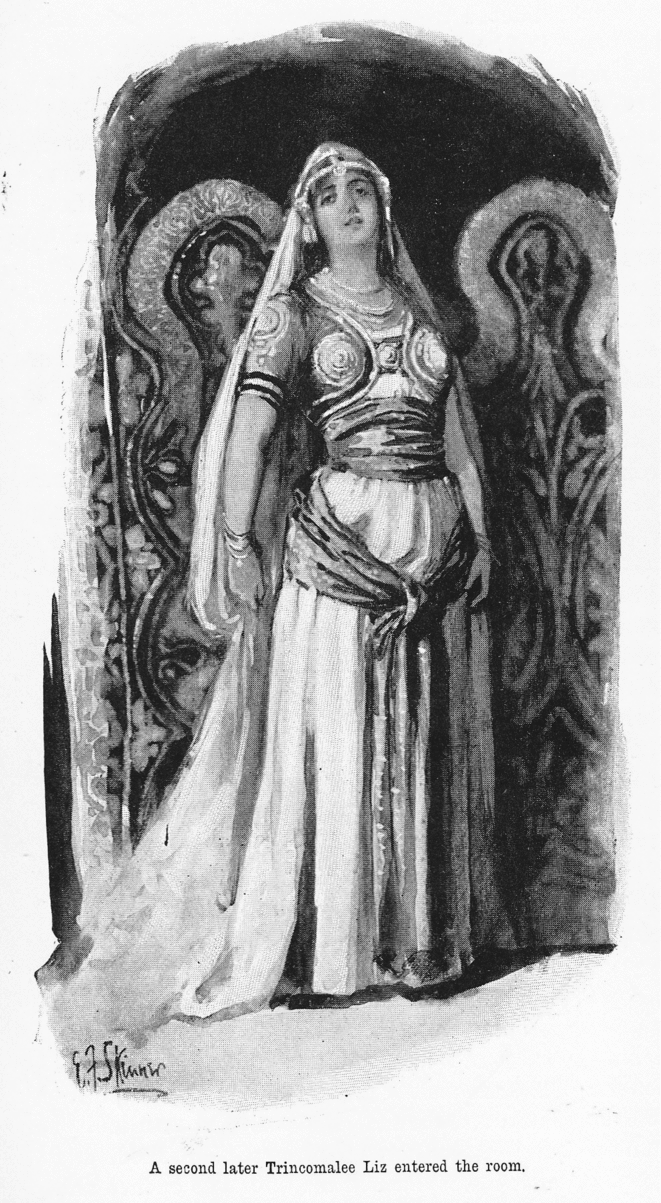
Boothby's characterisation of Trincomalee Liz, the prostitute that Carne visits, and her surroundings also reproduces various connotations of danger and eroticism common to Victorian imaginings of the odalisque, an exotic and seductive woman in a harem setting. The odalisque is simultaneously an object of desire, because of her beauty and sexual availability, and an object of anxiety. The imperial government, in particular, feared that exotic women would prove irresistible to the British men stationed in the contact zone, and that the British military could thus be weakened by the transmission of venereal disease. This fear led to the Contagious Diseases Act of 1864, which was passed in order to curb the effects of sexually transmitted diseases on soldiers stationed in garrison towns.Footnote 14 Boothby rehearses anxieties about sexual contact, disease, and miscegenation in Liz's mixed race and the sexual power of her Indian mother – a courtesan herself, who “was lovelier than the pale hibiscus blossom,” and who used her charms to snare an Italian Count (28–29). The temptation of Liz's sexuality and its inherent danger are indicated for the reader by her apartment's furnishings – with its hookah pipe “curled up . . . in a fashion somewhat suggestive of a snake” connoting both sexuality and danger, and the “comfortable divans . . . inviting repose” more blatantly suggesting the potential for sexual congress (28). The two illustrations of Liz, which appear in the periodical edition of the text, emphasise this tension between desirability and danger. The first shows Liz poised against an exotic and luxurious backdrop, her passive stance inviting the male gaze (Figure 11). The second depicts her lounging improprietously on a divan next to Carne.
E.F. Skinner, illustration of Trincomalee Liz, in Guy Boothby, “The Den of Iniquity.” Pearson's Magazine Jan. – June 1897: 16.

The dangerous consequences of Liz's sexual power are more explicitly outlined in Boothby's prurient revelation that she was “notorious from the Saghalian Coast to the shores of the Persian Gulf” and that “those tiny hands had ruined more men than any other half-dozen pairs in the whole of India” (28). Boothby here links the disruptive potential of Trincomalee Liz's sexual power upon the orderly lives of many Western men with the wider disruptive power of the native upon the settler. In this story, however, Liz's power is not employed in an overtly sexual manner; instead Boothby focuses on how her power affords her the resources to obtain fifty thousand pounds for Carne by the following midday. It also enables her to find and secure the services of Hiram Singh and Wajib Baksh, “the most expert craftsmen in India,” who will accompany Carne to England to pose as servants and help him carry out his criminal plan; to evade the law herself; and to identify the law and warn Carne that it may be on his trail (32). Like Carne, Trincomalee Liz is a border creature – she is of mixed race, she is a prostitute, and she is a criminal. Her hybrid status and her facilitation of Carne's crimes cast her as an opponent of the order, justice, and morality of the empire.
The characterisations of Trincomalee Liz, and the Indian city, then, reinscribe many of the usual paradigms by which colonial crime and adventure stories explain criminality. Like Doyle's colonial detective fiction they play on contemporary fears about the mysteries and dangers that originate from the imperial outpost. In line with Doyle's detective stories, and many of the colonial adventure stories published in Pearson's, Boothby's representations of the colonial outpost and its native inhabitants reproduce many Orientalist depictions of India's inherent lasciviousness, dirtiness, and criminality and contrast these with the inherent order and morality of the English – like Amberley and the civil station. Boothby also begins to disrupt these paradigms, however. In contrast to Doyle's colonial Holmes stories and the Captain Kettle stories, Boothby does not provide a main protagonist with the ability to bring order to the inherently criminal natives, to prevent non-natives stationed in the outpost from becoming tainted by its criminality, or to solve mysteries that originate outside national borders. Instead Boothby's hero Carne is himself an Occidental gone native, not a detective but a thief who is in cahoots with one of the most dangerous native types – an exotic and criminal female. This story therefore begins to suggest that while imperial rhetoric posits the natural superiority and civilising ethos of the colonising race, the discursive economy of the imperial project can operate in two directions. English characters, then, are just as likely to experience a moral decline while stationed in the outpost as to civilise the unregenerate natives with which they are surrounded. The worrying implication for the stories’ readers is that such characters are then free to travel to the imperial centre and to infect it with their criminality.
Imperial Cesspools and Tainted Colonials
As Joseph McLaughlin has noted, in late-Victorian fiction “describing people, places and experiences on the periphery of empire” is often employed as “an effective narrative strategy for imagining the imperial centre” (1). Readers of Joseph Conrad's Heart of Darkness (1899), for example, have long since realised that the novel's title refers to the darkness not just at the heart of the Belgian Congo but also at the heart of imperial London. Similarly, in the remainder of the Prince of Swindlers collection, the links between criminality and empire established in the collection's opening stories construct imperial London as a place easily permeable by foreign criminals. In the remaining stories, Boothby foregrounds and brings together the issues of empire, nation, detection, order, invasion, and crime as the reader learns about the victims and enactment of Carne's crimes in the metropolis at the time of the Diamond Jubilee. The stories thus reproduce and build on Doyle's construction of imperial London as collection point for the dregs of the empire and his motif of the return of the colonial male who has been tainted by criminality in the outpost. Rather than following a detective's attempts to catch the colonial criminal, however, thus restoring order to the imperial centre, Boothby's readers instead follow Carne's arrival in the homeland and the successful accomplishment of his crimes. The collection's remaining stories are structured around a series of invasions: the invasion of London by new cultures, in the form of hybrid Carne and his oriental accomplices; Carne's burglaries of the homes of a series of millionaires; Klimo's invasion of these same homes as faux-detective; and the threat of an attack on London from a group of Irish-American terrorists.
An article on the Thames Police which featured in the January 1897 edition of Pearson's had expressed fears about the potential for crime in Jubilee London, as a result of the permeability of national boundaries at London's docks. The article opens by describing the problems of London's “river piracy,” which results in the robbery of goods worth “more than a third of a million per annum,” mostly from West Indian merchants (Du Plat 18). It moves on to detail the prevalence of smuggling, not only of tobacco, but also of explosives, jewels, and criminals. The “worst offenders,” we are told, are “the crews of a well-known line of packets trading with such ports as Hamburg, Rotterdam, Bordeaux and Ghent” (22). The “most sensational” recent crime facilitated by the river, however, was an “attempt to blow up London Bridge” (23). Two suspicious men had hired a boat and a little later there was an explosion at the bridge, but no one was apprehended. The perpetrators “disappeared” and the boat “was never seen again,” the Thames police superintendent explains (23). The unsettling implication of this article for the reader is that, owing to the flow of goods and people in and out of London's docks, many other criminal enterprises will go on unheeded and undetected.
“The Duchess of Wiltshire's Diamonds,” the third episode in the collection, published in the following edition of Pearson's, plays on many of the same fears about foreign criminality and smuggling raised in the Thames police article. The story opens with Carne's successful penetration of the worryingly-permeable boundaries of the imperial metropolis, as he arrives in Jubilee London from India by sea.Footnote 15 The imperial centre, Boothby suggests, will host many criminals wanting to prey upon the wealthy gathered in the metropolis for the Jubilee. Building upon Doyle's imagining of late-Victorian London as the “cesspool of Empire,” Boothby describes how the “joyous occasion” of the Jubilee celebrations which “filled our hotels to repletion, and produced daily pageants the like of which few of us have ever seen or imagined” also “attracted swindlers from all parts of the globe” (Doyle 11; Boothby 7–8). The story follows Carne's penetration of Amberley's influential London social circle. Carne uses his position of trust to gain access to and steal the duchess's diamond necklace, which is valued at fifty-thousand pounds, and which he has promised to Trincomalee Liz as a gift for her help with his plan.
In “The Duchess of Wiltshire's Diamonds,” Boothby is interested in demonstrating how appearances can be manipulated in order to hide criminality, to exploit the trust of clients, and thus to facilitate the penetration of client's homes and lives. Whilst in India Carne's criminal status was highlighted by his native dress, his knowledge of local art, his familiarity with Calcutta's low quarters, and his consort with local criminals. Once in the imperial centre, however, these native characteristics are replaced with Western appearance, dress, home, servants, and manners. Thus, Carne's colonial invasion of London is framed and hidden by the civilised and familiar. He mirrors the behaviours and appearances of the group he wishes to infiltrate and so assumes the trappings and demeanour of a typical wealthy English gentleman – living in a Park Lane mansion, travelling by “luxurious brougham,” buying a yacht and a racehorse, attending the opera, Jubilee balls, charity events, and gentlemen's clubs, and employing a “grave and respectable” English valet to augment his troupe of exotic servants (43; 40). These signifiers of an outwardly-respectable London life fool his peers into believing that he should share their “distinguished position in the social life of the world's greatest metropolis” (143). “Within twenty-four hours” of Carne's arrival in Britain, we are told, he “was the talk, not only of fashionable, but also of unfashionable, London” (171). Amberley and his wife are “brimming over with praise” for Carne; likewise the Duchess of Wiltshire is “charmed” by Carne and is “full of his praises” (171). Yet, behind the conventional façade of his respectable outward appearance and home, Carne creates an oasis of oriental art and craft: his townhouse is filled with imported Eastern commodities, and is staffed by Indian servants, signifying his lingering Otherness and criminality. We, as readers, are also aware that this lifestyle is funded by ill-gained money, obtained by a foreign prostitute in the imperial outpost. Detective fiction's common tropes of disguise and duplicity here are given an imperial and racial twist.
In this story, then, Boothby is referencing but deconstructing an important convention of late-Victorian scientific discourse common to crime writing – the identification of criminal and moral deficiencies by the application of physiognomic analysis. Underpinning the new late-Victorian science of criminal anthropology which followed the publication of Cesare Lombroso's L'Uomo Deliquente (1876) was the widespread belief that all people should be able instinctively to recognise the physical characteristics of a criminal. J. Holt Schooling's article “Nature's Danger Signals: A Study of the Faces of Murderers” (1898) for the Harmsworth Magazine, for instance, offers just one example of the subsequent popularity of this belief. Schooling advised readers that “when you feel a certain instinctive aversion for a face, even though your reason or your supposed self-interest gives you no warning, then I say let your instinct have its way, and take the warning that Nature is holding up to you as a danger-signal” (660). The work of Ronald R. Thomas has been influential in demonstrating the ways in which late-Victorian detective fiction often draws upon the popularity of criminal physiognomy when dealing with issues of race, identity, and constructions of criminality. Thomas argues that detective fiction – specifically the first three canonical detective novels: Wilkie Collins's The Moonstone, and Doyle's A Study in Scarlet and The Sign of Four – thus frequently evokes criminal threats originating from outside Britain. For Thomas, Lombroso's easily-identifiable definition of a criminal man becomes inscribed in the Sherlock Holmes stories as the criminal figure of the foreigner: in the case of The Sign of Four, for instance, in Doyle's characterisation of the criminal savage, Tonga. Rather than straightforwardly reproducing constructions of foreign criminality in this story, however, Boothby rather daringly demonstrates the potential for such foreign invaders to be hidden behind the most English, and thus respectable, of façades.
In the story, Carne uses his appearance of Englishness to gain a position of trust within Amberley's circle. It therefore goes without question that he is allowed to borrow the duchess's valuable necklace, which her ladyship plans to wear at a Jubilee ball, under the pretence of studying its intricate Eastern case. Once the necklace is in his possession, he has his Indian craftsmen construct a replacement case and imitation paste necklace. He skilfully lays elaborate tracks to implicate that the robbery was committed by an outsider – he has one of his staff pose as a foreigner and visit a well-known pawnbrokers, where the man enquires about selling a diamond necklace to traders in Amsterdam. Finally, Carne suggests that the Wiltshires call in Klimo to investigate the robbery, which he does, for a large fee. Klimo puts the Metropolitan police on the tracks of the fake pawnbroker's client, after sending the real diamonds back to Liz on a trading boat bound for Calcutta. At the story's close Carne joins Amberley and the Duke of Wiltshire at an exclusive gentleman's club where they toast their great friendship and drink to Klimo's deductive skills. Despite the rather far-fetched nature of this story, the various fears about foreign criminality, theft, and crime in the city and its trading ports which “The Duchess of Wiltshire's Diamonds” mobilises, reference the very real fears addressed in the earlier Pearson's article about the Thames police. Even more bizarrely, however, the events in Boothby's story foreshadow almost exactly a real imperial diamond robbery that took place later that year. Newspapers from around the globe, including the New York Times, reported in late May 1897 that the £300,000 “Imperial Diamond,” a Jubilee gift to the Queen from the Nizam of Hyderabad, had been stolen and replaced with a paste imitation whilst en route from Calcutta to London (“Imperial Diamond Stolen” 8). It is unclear whether the diamond was ever found.
Detection and Services to the State
This final section looks more closely at “A Service to the State,” the only story in the collection which follows Klimo engaged in a genuine detecting case. In this story Carne is almost completely absent and we follow Klimo taking on a case which gives him the opportunity to save all sections of metropolitan society from a terrorist attack. Like the collection itself, the story is structured by a number of invasions across various domestic, national, and personal boundaries. Carne's targeting of Jubilee London as depicted in “The Duchess of Wiltshire's Diamonds” is contrasted here with a more dangerous threat to state security. The story opens with Klimo receiving Mrs Eileen Jeffreys, a “frail wisp of a girl,” into his consulting rooms (91). In pointed contrast to the diamond-laden aristocrats who people many of the collection's other stories, Mrs Jeffreys, the wife of a “respectable” Bank Inspector, is “neatly but by no means expensively dressed” and thus seems designed to parallel, and hence appeal to, the less affluent, but nonetheless respectable, readers of Pearson's (105; 91). Mrs Jeffreys, an Irish-American, tells Klimo that she is worried about her father, who recently left America and has taken up residence with her and her husband in their Bloomsbury home. The arrival of a mysterious coded telegram from America, which is undecipherable to all but her father, has caused him great “mental strain,” to be sick with fear, and to be “seized with remorse,” over its undisclosed implications (105; 93).
Like Doyle's colonial detective stories, the narrative space of “A Service to the State” is haunted by the threat of the invasion of an old imperial secret into the modern metropolis. In this case the imperial secret at first seems only to threaten the respectable domestic London space of Mrs Jeffreys and her husband. Klimo deciphers Mrs Jeffreys's coded telegram, however, and it is soon revealed that he has uncovered a threat with repercussions beyond the domestic sphere. He has decoded a message about “one of the biggest Fenian conspiracies ever yet brought to light” (100). A gang of Irish-American terrorists are planning a bomb attack on London during the Jubilee celebrations. The “one aim and object” of the gang, we are told, is “to destroy law and order in this country” (100). The telegram outlines that two men – the principle members of the terrorist organisation and old acquaintances of Mrs Jeffreys's father – are sailing to Britain with fifty-thousand pounds in order to oversee and carry out the bomb plot. The men, Maguire and Rooney, have previously been responsible for “a terrible dynamite explosion in London, in which forty innocent people lost their lives” (103). Klimo's investigation uncovers that they are blackmailing Mrs Jeffreys's father and plan to stay with the Jeffreys family while they carry out their latest bomb attack.
In the opening lines of “A Service to the State,” Boothby employs language which reminds the reader of the links between the Irish terrorists and Carne. The gang intend to take advantage of the opportunity of the Jubilee to strike at “half of the crowned heads, or their representatives, of Europe,” echoing Carne's earlier plans to invade Jubilee London and target “half the sovereigns of Europe” (100; 7). The terrorist invasion, then, recalls Carne's earlier arrival in London, yet the reader is persuaded to see that the Fenians pose a far more serious threat. Carne's imperialist rhetoric in his description of the terrorists emphasises their much greater threat to all citizens of the imperial centre. Carne terms the terrorists “the enemies of law and order,” who have taken advantage of the opportunity of the Jubilee to strike a much greater “blow at the Government and society in general” than that of which he is guilty (100). Boothby spatially links the threat of the impending invasion with a number of London activities – the threat of the bomb, then, preoccupies Carne during a visit to “the wife of the Prime Minister,” a concert at Queen's Hall, and a drive in the busy Hyde Park (97). By linking the idea of the bomb with activities which foreground both the practices of everyday life and the locus of state power in imperial London, Boothby emphasises for the reader the very grave nature of the threat posed by the Fenian terrorists and speaks to readers’ own experiences of terrorist attacks in the 1880s and 90s.
The Fenians, of course, were a real group with which Boothby's fin-de-siècle readers would have been familiar. The Fenians’ first organised political offensive in Britain was the Clerkenwell Prison bombing in 1867, which was followed by a number of bombings and assassinations in Ireland and London throughout the 1880s and 90s. Most famously perhaps, on 24 January 1885, Fenian dynamiters set off near-simultaneous explosions in the Houses of Parliament, the Tower of London, and Westminster Hall. No one was killed, but several tourists were badly injured. Following these events, as Elizabeth Carolyn Miller has pointed out, bombs and terrorism became “new additions to the fabric of life in 1880s and 1890s Britain,” and thus provided a historical basis for the emergence of terrorism in popular fiction (189).Footnote 16 Indeed, “A Service to the State,” is not Pearson's first story published in 1897 to deal with the Irish terrorist threat. In the same edition as “The Duchess of Wiltshire's Diamonds,” “Donald Penstone's Escape,” a short detective story by V. L. Whitchurch, gives an account of the escape of a fictional “celebrated Fenian,” wanted in connection with “some notorious Fenian outrages” (116). These stories’ engagement with terrorism would have been potentially much more unsettling to its readers than those of their detective fiction forebears, which tended to concentrate on threats from fantastically aberrant colonials, such as the one-legged colonial criminal Jonathan Small, and his accomplice Tonga, the pigmy cannibal, who feature in Doyle's The Sign of Four. In Boothby and Whitchurch's stories, by contrast, the authors draw upon the types of criminal threats which had actually disrupted the order and safety of fin-de-siècle metropolitan life. Thus these stories are constructed to play upon very real contemporary fears about the inability of the police to contain criminal networks. In Whitchurch's story, for instance, the forces of detection have been powerless to prevent Penstone's escape. The story ends on a particularly unsettling note, which foregrounds the negative consequences of Britain's spatial links with the imperial outpost. Despite being “shadowed closely” by a number of detectives, the terrorist evades capture and escapes on “a steamer” bound for Australia (116; 120).
Conversely, in the figure of Klimo, Boothby sees that the threat from the Irish terrorists is, at least partially, diffused. Apparently without irony, Carne soliloquises that “as a peaceable citizen of the City of London, and as a humble servant of her majesty the Queen, it is manifestly my duty to deliver these rascals into the hands of the police” (105). Boothby recreates detective fiction's drive to resolution and employs a number of super-detective-esque characteristics which replicate for the reader the narrative and moral reassurance of investigative-centred crime fiction. The remainder of the story, then, follows Carne as he poses as an official policeman, conducts surveillance of the criminals, arrests the terrorists at Mrs Jeffreys's home, and offers the men a form of justice. In his arresting speech Carne ironically attributes his success in catching the criminals to a Holmesian panoptic knowledge of crime and the city. He tells the men that he was “long-since” aware of their travel from America, their terrorist plot, and pretends to them that they “have been shadowed ever since you set foot ashore” (116). Carne offers the terrorists a “choice” between “arrest and appearance at Bow Street, or immediate return to America”: a deal which he tells the men has been “authorised by Her Majesty's Government,” although, of course, it has not (116).
In a collection which blends transgressor and investigative-centred crime fiction, this is probably the collection's most generically conventional story in its reproduction of dominant ideology, its construction of the threats posed by outsiders, and its drive to narrative and moral resolution. At the same time, however, the restoration of order offered by this ending to the story is not quite as neat as much of the investigation-centred detective fiction which it emulates. For one, the terrorists have not been dispatched either officially or permanently, and the real Metropolitan police were never involved. At the story's close, Boothby also distinctly differentiates Carne's morality and motivation from those of Holmes. Boothby ironically echoes and inverts the typical Holmesian moral gesture of refusing money from respectable middle-class clients, to comic effect. Holmes had only rarely accepted fees from clients that he respected. By contrast, Carne's seemingly moral desire “to save the girl and her father” and “the nation” is overridden by a rather more self-interested desire to appropriate the fifty-thousand pounds which the terrorists have in their possession (105). Whilst Carne professes to be happy at the prospect of playing “policeman and “public benefactor,” he admits that his ultimate motivation had been financial: “If it hadn't been for the money I should have had nothing to do with it [the case] at all” (105). When Mrs Jeffreys comes to Klimo to enquire about “the extent of her debt” he beneficently tells her “You owe me nothing but your gratitude. I will not take a half-penny” (118). When she leaves, however, the reader sees him smile and open his pocket-book to reveal forty-five thousand pounds which he has appropriated from the terrorists. “I did not take her money,” he chuckles to himself, “but I have been rewarded in another way” (118).
Despite the very real threat to late-Victorian London that it depicts, then, Boothby's story ends on a comic but unsettling note with Carne admitting that money rather than morality had motivated his actions. The story, then, is complex, perhaps uneven and unconvincing, but exemplifies the ways in which Boothby experiments with different moral positions, genres, and types of closure throughout the collection and the variety of positions into which the reader is projected as a result. At the story's close, Carne reverts to criminality and his invasion of Jubilee London continues. After “A Service to the State,” Boothby's collection contains two further tales of Carne's criminal exploits in London. In the final story, “An Imperial Finale,” Carne commits one last daring robbery before fleeing on his yacht. The collection's final lines underscore his ultimate lack of morality, with Carne directly addressing the reader, saying that he has “no regrets . . . none whatsoever” (124). Amberley, the narrator, tells us that since the escape, “the police of almost every civilised country have been on the alert” to affect Carne's capture (22–23). The collection ends with one final image of uncertainty as the reader is told that Carne has thus far managed to evade the world's greatest law-enforcement agencies and remains at large.
For today's readers, the Prince of Swindlers stories thus provide a fascinating articulation of a range of late-Victorian anxieties about invasion and foreign criminality that attended the end of the century and an interesting inversion of the nascent detective genre's conventions. They reveal how Victorian detective fiction's domestic themes of investigation and disorder are mapped onto wider interrogations of identity construction and safety across national and global boundaries, thus illuminating fin-de-siècle anxieties about the New Imperialism. A symptomatic reading of the 1897 issues of Pearson's has brought to light considerable contradiction and unease in its representation of the imperial project. It has shown that, in contrast to much of the popular fiction which appeared in late-Victorian magazines and periodicals, Boothby's stories, along with those by Wells and Whitchurch, amongst others, expose the expanded imperial world as unregulated and dangerous. In keeping with other narratives of reverse colonization, these stories instead offer contemporary readers a troubling vision of a Jubilee-year metropolis that is easily penetrable by foreign criminals, terrorists, and returned colonials who have gone native whilst in the imperial outpost. The open-endedness of the Prince of Swindlers collection suggests that the ideological and ethical contradictions which it has raised will not be resolved. The oft-cited touchstones of both detective and periodical fiction – success, order, reassurance, and resolution – are shown by Boothby to be deeply problematic and inapplicable to a late-Victorian Britain suffused with anxiety about imperial decline.
One can also easily discern shared thematic and formal properties which link the morally-ambiguous protagonists that populate Boothby's stories with the most popular crime fiction, television, and film of today. The various types of outwardly-respectable anti-heroes, and corrupt or eccentric detectives that populate early twentieth-century hardboiled fiction and film, and so much contemporary crime fiction, television, and film are foreshadowed in the stories examined in this study. Outwardly respectable Carne/Klimo, seems for instance to be an obvious forebear of characters as diverse as Jim Thompson's Lou Ford, the sheriff and murderer in The Killer Inside Me (1952), corrupt LAPD captain Dudley Smith, who features in James Ellroy's L. A. Quartet (1987–92), and Jeff Lindsay's serial killer Dexter Morgan, protagonist of the Dexter novels and Showtime television series (2006–), an outwardly-respectable Miami Police Department investigator who investigates crimes by day and kills unpalatable members of society by night. Boothby's A Prince of Swindlers collection therefore demonstrates the need for a dialogic approach to the genre's history, which recognises the diversity and ambiguity present in some of its earliest incarnations and demonstrates the importance of challenging the assumption that it is only in the last century that the crime genre began to display more radical or unsettling tendencies.