INTRODUCTION
Elizabeth Brumfiel has contributed to the field of Mesoamerican archaeology in a number of arenas, one of which is specialization. Her work addresses broad questions of the distribution of different types of specialized enterprises, the dynamics of the development of specialization, and the relationships between specialization and systems of exchange. She has inquired into both utilitarian and luxury craft production, asking provocative questions and stimulating research on related topics. Here, I pursue one of these: the production of featherwork objects in areas beyond the Aztec imperial core during the height of the Aztec or Triple Alliance empire (Figure 1). The imperial core encompassed the Basin of Mexico, from which the allied city-states of Tenochtitlan, Texcoco, and Tlacopan extended their hegemony into much of central Mexico. The military expansion of this alliance reached its height during the reigns of the Mexica kings Ahuitzotl (r. 1486–1502) and Motecuhzoma Xocoyotzin (r. 1502–1520).
The Aztec empire in 1519 (by Jennifer B. Lozano).

This brief article focuses on the impact of imperial conquest and its attendant economic demands on the production and distribution of feathered objects in conquered areas. This provincial perspective leads naturally to additional issues of how these imperial subjects obtained the materials and acquired the skills integral to the production of these ornate, complex and expensive objects. Featherworking throughout Mesoamerica preceded the period of Aztec expansion. Imperial domination required some adjustments, primarily stylistic, by provincial subjects already accustomed to manufacturing elaborate featherworks. Along with imperial pressure on featherwork production came sustained and probably increasing reliance on markets and traveling merchants to supply necessary raw materials. All of this was consistent with the increasing commercialization of the economy in Late Postclassic times, and these circumstances applied not only to the featherworking industry, but also to other production domains similarly affected by Aztec conquest.
Any discussion of provincial featherwork production is incomplete without a consideration of the impact of the delivery of large quantities of feathers and feathered objects on the Basin of Mexico featherworking artisans and on the imperial consumers of these luxuries. Featherworkers attached to royal palaces benefited from the incoming flow of tribute feathers, while independent featherworkers depended on the successes of their close associates, the professional merchants or pochteca. Already-finished featherwork pieces, delivered in tribute, consisted mainly of warrior costumes and shields—these were intended to be bestowed on achieved warriors and would have impacted the demand on core artisans' production only to a small extent. Neither type of feather artisan was at a loss for consumers. The palace artisans concentrated on constantly renewing the ruler's and deities' regalia, and the independent artisans were at no loss for consumers among the growing ranks of the hereditary and achieved nobility, and could also contribute fancy accoutrements to the frequent flamboyant ceremonial occasions basin-wide.
In general, this investigation of the specialized craft of featherworking during Aztec imperial rule is a little different from studies that have gone before. It deals with artisanry performed both within and beyond the Basin of Mexico, it focuses on a luxury craft, and it has left behind (at least so far) little material evidence of its actual production processes.
There have been numerous and excellent studies of Late Postclassic specialized craft production within and beyond the Basin of Mexico (e.g., Brumfiel Reference Brumfiel, Brumfiel and Earle1987; Brumfiel et al. Reference Brumfiel, Salcedo, Schafer, Hodge and Smith1994; Charlton et al. Reference Charlton, Nichols and Charlton1991; Dykerhoff and Prem Reference Dykerhoff, Prem, Carrasco and Broda1976; Hodge and Smith Reference Hodge and Smith1994; Hodge et al. Reference Hodge, Neff, Blackman and Minc1993; McCafferty and McCafferty Reference McCafferty and McCafferty2000; Otis Charlton Reference Otis Charlton1993; Parsons and Parsons Reference Parsons and Parsons1990; Spence Reference Spence and Folan1985). Most archaeological evidence of specialized production takes the form of ceramics and stone tools and artifacts. Evidence for the production of perishables remains slim—even in the case of spinning and weaving where spindle whorls are all that remain of spinning, and bone picks the only remnants of the widespread and enormously productive weaving activities.
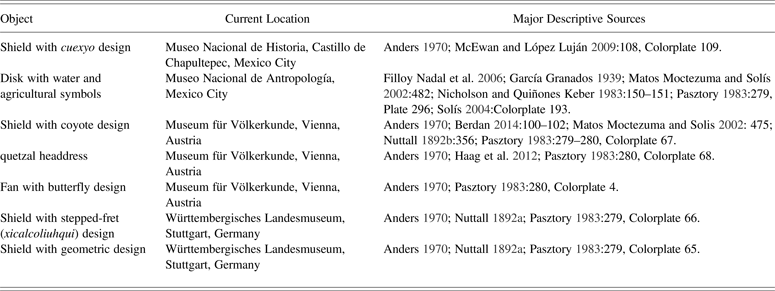
The primary evidence for the presence of featherworking is ethnohistoric documentation (pictorial and textual) and the few extant feathered pieces in Mexico and Europe. Ethnohistoric documentation of featherworking production is especially detailed in the Florentine Codex (Sahagún Reference Sahagún, Anderson and Dibble1950–1982:bks. 9, 10), and codices such as the Codex Mendoza (Berdan and Anawalt Reference Berdan and Anawalt1992:vol. 3), the Primeros Memoriales (Sahagún Reference Sahagún1993) and the Codex Telleriano-Remensis (Quiñones Keber Reference Quiñones Keber1995) stand as mute evidence of the styles and uses of these ornate adornments. The existing pieces of Late Postclassic central Mexican featherwork number only seven, and two of these (the disk in Mexico City and the fan in Vienna) have been questioned as to their pre-Spanish origin. All are without clear provenance. They consist of a limited range of objects: four shields, one disk, one headdress and one fan (see Table 1). A recent detailed study of the feather headdress (“Moctezuma's headdress”) is especially revealing of production materials and manufacturing processes (Haag et al. Reference Haag, de Maria y Campos, Weber and Feest2012). The art of featherworking continued after the Spanish conquest, and the numerous feathered pieces fashioned during the Colonial period also provide manufacturing clues since the essential techniques superceded the Conquest itself. Overall, the ethnohistoric and physical information is sparse and incomplete and unfortunately provides us with only a hint of the full range of featherworking activities and products.
Extant Featherwork Pieces
Some Premises
Nonetheless, I forge ahead in this matter. I will proceed by working through the implications of some basic premises about featherworking activities as they apply to production and distribution in the imperial provinces as well as in the urban capitals. Of consequence here is the manner in which featherworking was embedded in the intertwined dynamics of market exchange, long-distance pochteca trade, and tribute impositions.
Premise 1: Objects fashioned of feathers (even “common” ones) were destined for elite, state, and ceremonial uses
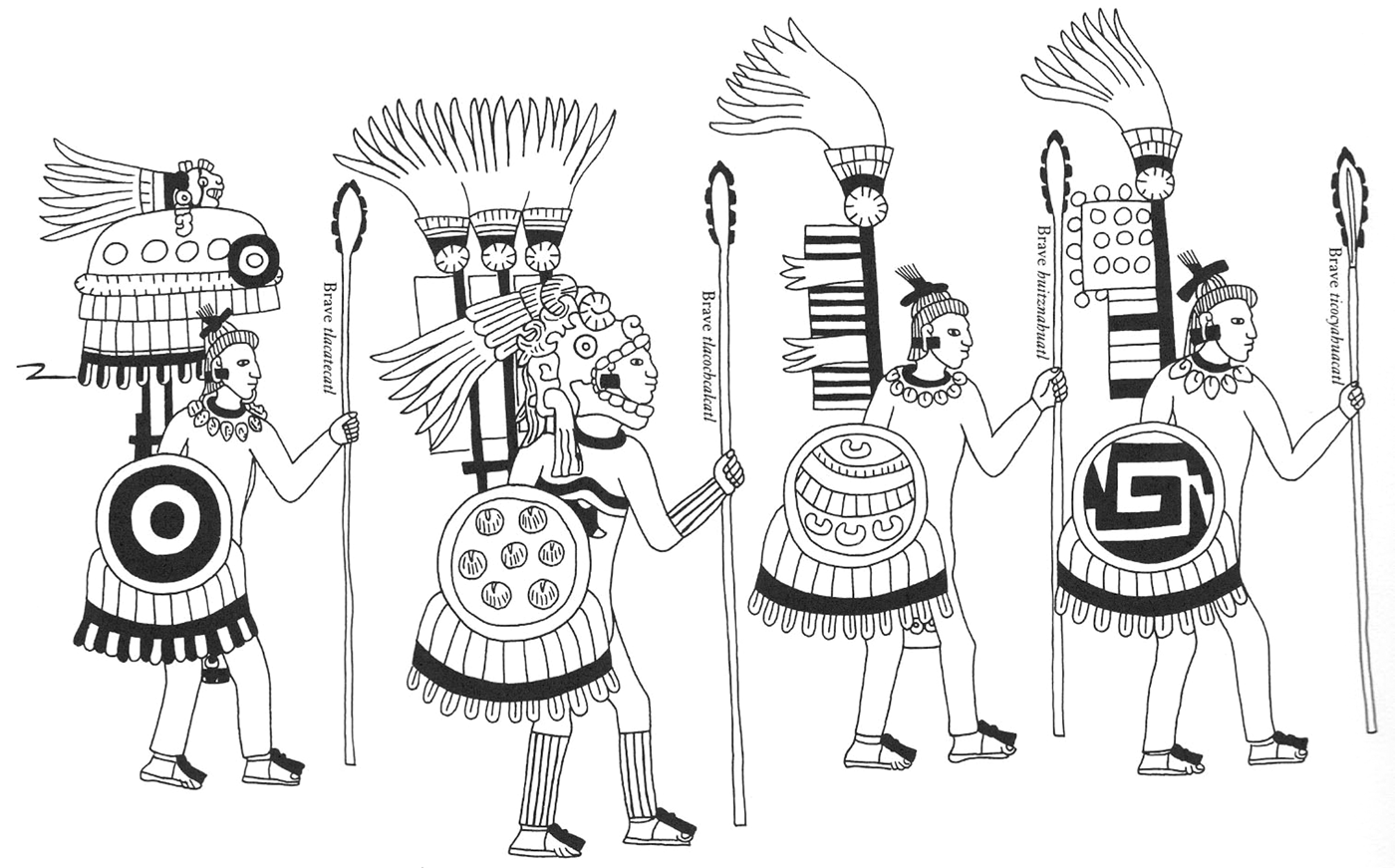
In the Aztec-period Basin of Mexico, objects fashioned from feathers were essentially ornamental: they adorned gods, decorated buildings, bedecked royalty and other nobles, and embellished ceremonial processions and other pageants. Their shimmering, flowing presence added visual glamour and magnificence to high-level images, personages, and events. They were the prerogative of the nobility, who lavishly adorned themselves with shimmering plumes, wagered feathered cloaks and precious feathers in games of chance and skill, impressed enemy and allied nobles with gifts of exquisite feathered articles and received marvelous feathered pieces in turn (for instance, see Durán Reference Durán and Heyden1994:123, 124, 170 173, 290, 322, 348, 406, 417, 468; Sahagún Reference Sahagún, Anderson and Dibble1950–1982:bk. 8, pp. 23–30). Warriors went into heated battle wearing symbolically laden feathered costumes and devices, as seen in Durán (Reference Durán and Heyden1994:Plates 11, 12, 14, 21–23, 27, 31), the Lienzo de Tlaxcala (Chavero Reference Chavero1979[1500]), and the Codex Telleriano-Remensis (Quiñones Keber Reference Quiñones Keber1995:f. 33v, 36v, 37r, 37v, 39v, 42r, 42v, 43r). In this latter codex, while the warriors wear no feathered costumes, they nonetheless conspicuously display feathered headdresses and/or back devices. Rulers reserved the right to reward valiant warriors with status-specific feathered warrior costumes and shields. These rewards were specific to the number of enemy captures achieved by the warrior. They are documented in the Codex Mendoza (Berdan and Anawalt Reference Berdan and Anawalt1992:3:f. 64r, 65r) and described by Durán (Reference Durán and Heyden1994:173). Commoner men who had not excelled on the battlefield, as well as nobles who were too “cowardly” to go to war, were not allowed to wear feathers (Durán Reference Durán and Heyden1994:234). More than simple objects, these adornments sent messages of achievement, wealth, and power (often resembling inalienable wealth, see Berdan Reference Berdan2014:260–268) (Figure 2).
High-ranking personages with their feathered regalia (from Berdan and Anawalt Reference Berdan and Anawalt1992:vol. 4, f. 67r).
Actual articles fashioned of feathers included textiles (especially cloaks and decorative hangings), warriors' costumes, headdresses, back devices, shields, banners, fans, and other miscellaneous adornments. Feathers used in these creations ranged from “ordinary” feathers of ducks, turkeys, crows, and local waterbirds, to “exotic” feathers from macaws, parrots, lovely cotingas, roseate spoonbills, hummingbirds, and especially the esteemed quetzal. While the “ordinary” feathers were often used as underlayers in complex layered mosaic creations, they also stood on their own. For instance, rulers wore cloaks of duck feathers when they went about, and some warriors' costumes were made of crow or turkey feathers (Sahagún Reference Sahagún, Anderson and Dibble1950–1982:bk. 8, p. 24; Reference Sahagún1993:270–271, 274–275).
The consumers of feathered objects were the elite, wherever they lived in Mesoamerica. Sculpted and painted evidence indicate a considerable antiquity for the creation of fancy feathered objects for high-ranking personages, which was well established at least by Classic times. The heads of Classic Maya lords were adorned with flowing quetzal feathers, and those lords and others also carried feathered fans and banners (as seen, for instance, in the murals of Bonampak). Feathers and feathered accouterments were also prominently displayed at other major sites in Mesoamerica such as El Tajín, Monte Albán, Teotihuacan, Cacaxtla, and Tula. At these sites, feathered adornments consistently appear in elite and ceremonial contexts. Featherworking was neither new nor exclusive to the Late Postclassic Basin of Mexico. Indeed, the Aztecs inherited a long and esteemed tradition of featherworking during which skills, designs, and labor arrangements had been honed and perfected for the grandeur and glorification of the aristocracy throughout Mesoamerica.
Premise 2: Featherworking production processes were complicated and expensive
As already seen, featherwork did not originate with the Toltecs despite legendary claims to the contrary (“In ancient times they took charge of the gluing of feathers; and it was really their discovery” [Sahagún Reference Sahagún, Anderson and Dibble1950–1982:bk.10, p. 167]). It is not impossible that the art of glued feather mosaics matured at this late a date (Early Postclassic), although the fashioning of tied feathered creations clearly enjoyed a greater antiquity.
Wherever produced, objects were manufactured from feathers in three ways: (1) feathers were tied together into long, flowing devices such as headdresses and fans, (2) feathers were glued to solid surfaces to produce intricate mosaics such as shields, and (3) feathers were spun and woven into textiles (see especially, Filloy Nadal et al. Reference Filloy Nadal, Olguín, Navarijo, Lupo, Luján and Migliorati2006; Phipps and Commoner Reference Phipps, Commoner, Bier and Perlman2006; Sahagún Reference Sahagún, Anderson and Dibble1950–1982:bk. 9; Reference Sahagún1993:ch. 8). Examination of extant pieces indicates that any particular object could entail more than one of these procedures. For instance, “Moctezuma's headdress” was fashioned through both tying and gluing, and the glued feather mosaic shields in Mexico City and Vienna include tied components. It is likely that any skilled featherworker was capable of performing at least these two skill sets. The spinning of feathers with cotton threads may have been performed by other artisans in addition to (or aside from) the luxury featherworkers (see below).
The acquisition of featherworking skills required extended training, and the detailed documentation for Tenochtitlan and Tlatelolco indicate that parents taught these skills to their children and that there was a well-defined division of labor and hierarchy of skills in this luxury craft (see Berdan and Anawalt Reference Berdan and Anawalt1992:3:f. 71; Berdan et al. Reference Berdan, Stark, Sahagún and Hirth2009; Berdan Reference Berdan, Fargher and Heredia Espinoza2017). This was most likely a household enterprise (Berdan Reference Berdan, Fargher and Heredia Espinoza2017). While the master featherworker oversaw production and undoubtedly performed the most intricate operations, some tasks were allocated to other members of the household: boys made the glues and girls dyed the feathers and were trained to have a keen eye for colors.
Each of these production processes required careful selection of materials (especially the feathers, which varied considerably in color, size, texture and overall quality). Tied objects required deft and firm looping of the feather shafts with twine, while the mosaics were extremely demanding in executing complicated designs with a great variety of both dyed and natural feathers. The manner in which feathered textiles were manufactured is still unclear. Sahagún (Reference Sahagún, Anderson and Dibble1950–1982:bk.10, p. 166), speaks of the fabled Toltec House of Feathers, where feathers of different colors were pasted onto textiles that hung on the walls: “…they pasted—the quetzal feathers, the blue cotinga feathers, to capes or nets [and] then hung them on the wall.” Another possibility might have involved tying, in the manner of South American and Southwestern U.S. feathered textiles that were manufactured by tying feathers to already-woven textiles. A colonial Mexican feathered textile strip in the Cooper-Hewitt Museum in New York was manufactured by spinning together tiny feathers and cotton thread. The specific process of spinning feathers is also suggested by McCafferty and McCafferty (Reference McCafferty and McCafferty2000:47, Reference McCafferty and McCafferty2008:153). The “feather seller” described in the Florentine Codex was also a “feather spinner” who was skilled at spinning the small split back and breast feathers of ducks, and turkeys (Sahagún Reference Sahagún, Anderson and Dibble1950–1982:bk. 10, p. 92). Very small spindle whorls uncovered at Cholula may have served such a purpose (McCafferty and McCafferty Reference McCafferty and McCafferty2000). All of these forms of featherworking required several interrelated stages of production relying on coordination and timing (see Berdan et al. Reference Berdan, Stark, Sahagún and Hirth2009). The extant feathered artifacts visibly demonstrate the meticulous care and finely honed skills applied to their intricate manufacture. And as is generally the case, complex and multi-staged manufacturing efforts also add value to the objects produced, most likely the case here.
Together, complicated production processes and the use of feathered objects as status markers imply expensive investments in full-time specialization and long-term training, wherever performed (Brumfiel et al. Reference Brumfiel, Salcedo, Schafer, Hodge and Smith1994). In addition, this style of production required considerable up-front investments, especially in the acquisition of expensive and often non-local feathers. This was the case whether the featherworkers worked independently (and obtained most or all of their feathers in markets or directly from long-distance merchants) or were engaged in the service of a royal or noble palace (and had access to feathers obtained through tribute as well). Elite personages of the Triple Alliance capitals had the capability to sponsor professional traders (pochteca) and also assure the availability of fine feathers in local and regional markets (see below). By extension, it might be hypothesized that people in conquered city-states followed similar artisan strategies and that rulers and nobles subservient to the empire also engaged in similar types of patronage and control activities to assure their own supplies of status-linked feathered objects as well as to provide tribute payments to their imperial overlords.
Premise 3: Fancy feathers and possibly feathered objects moved widely and apparently without major obstructions throughout the Aztec imperial domain
Featherwork materials were often localized and expensive. This was particularly the case with the striking tropical feathers so prized in featherwork creations. None of these was natively available in the high valleys of central Mexico, yet almost all of the highland imperial provinces paid tribute in feathered warrior devices fashioned from quetzal, yellow parrot, lovely cotinga, red spoonbill and macaw feathers (the exceptions were Malinalco and Xocotitlan to the west of the Basin of Mexico). These tribute payments required access to feathers in marketplaces, through professional trading enterprises, or by way of elite gift-giving and gift-receiving. As an example of this latter, the governor of an area re-populated by Basin of Mexico settlers (Oztoman, Teloloapan, and Alahuiztlan in present-day Guerrero) sent the Mexica ruler Ahuitzotl precious gifts, including feathers, in recognition of his relationship with the imperial ruler. Ahuitzotl reciprocated with gifts of shields, feathers, and weapons (Durán Reference Durán and Heyden1994:348). Many feathers and much featherwork were moving to and fro on this elite level.
Feathers (along with other luxury materials such as precious stones and gleaming metals) moved about “horizontally” from city-state to city-state without necessary “vertical” control or transference through the imperial capitals. The primary mechanisms for these movements were the activities of the long-distance professional merchants who moved high-value, low-bulk goods widely within and beyond the empire. These professional merchants, pochteca, were established in at least 12 Basin of Mexico cities and operated as both state agents and private entrepreneurs. In Tlatelolco, at least, these traveling merchants lived in close proximity to the “independent” featherworkers (amanteca), with whom they enjoyed mutually profitable relations.
As state agents, pochteca traded their rulers' goods in outlying regions for distant goods including quetzal feathers, green feathers, lovely cotinga feathers, trogonorus feathers, and feathers of the roseate spoonbill, the troupial, the blue honeycreeper, and the yellow parrot (Sahagún Reference Sahagún, Anderson and Dibble1950–1982:bk. 9, pp. 17, 18–19). They forged diplomatic ties at the same time through these exchanges. They also operated as private entrepreneurs, becoming wealthy by moving expensive goods from market to market throughout the empire: they traveled “to all the markets of the land, bartering cloth for jewels, jewels for feathers, feathers for stones, and stones for slaves…” (Durán Reference Durán, Horcasitas and Heyden1971:138; Berdan Reference Berdan and Browman1978, Reference Berdan, Josserand and Dakin1988).
This suggests that these merchants frequented numerous markets, although we have only a few specific examples of feathers actually present in particular markets. These include the spectacular market at Tlatelolco, where featherworkers from around the Basin of Mexico could have obtained their precious raw materials (Sahagún Reference Sahagún, Anderson and Dibble1950–1982: bk. 10, p. 61, ill. 112). Farther afield, just prior to its conquest by the Triple Alliance, Coayxtlahuacan (in the Oaxaca area) had a lively market enthusiastically visited by merchants from several Basin of Mexico cities. Available there was a multitude of fancy goods, including feathers (Durán Reference Durán and Heyden1994:182). Fine feathers were also obtainable in the distant Huaxteca region, where the important markets at Tochpan and Tzicoac sat as tempting military targets. At the time of their conquest by the first Motecuhzoma, the Huaxtecs immediately offered “feathers, brilliantly colored parrots and other tropical birds such as macaws” in perpetual tribute to their new overlords (Durán Reference Durán and Heyden1994:165). Similarly, the newly conquered people of Tepeacac offered their conquerors presents that included “fine plumage” (Durán Reference Durán and Heyden1994:155). The availability of tropical feathers in markets throughout central Mexico was probably not only a common occurrence, but also one that preceded Aztec imperial conquest.
The imperial system may have encouraged and eased the movements of feathers from market to market and from region to region. Of the 38 imperial tributary provinces, 29 gave feathered warrior costumes in tribute to their imperial overlords (Berdan and Anawalt Reference Berdan and Anawalt1992:vol. 3). These were paid on an annual basis, the greater quantities and variety being rendered by highland provinces relatively close to the imperial capitals (this geographical distribution probably explained, at least in part, by the bulky and unwieldy nature of these objects). These provinces required considerable quantities of non-local tropical feathers for the manufacture of warrior regalia, and needed to acquire them on an assured, predictable basis (Berdan Reference Berdan, Berdan and Anawalt1992).
Of these 29 provinces, all but two gave warrior costumes that included the flowing green quetzal feathers (Figure 3). Quetzal birds inhabited a localized ecology (in the southern part of the empire, present-day Guatemala and points south), and provinces with these native birds paid tribute in bunches of the birds' prized long tail feathers (Figure 4). However, in addition to serving the direct and indirect needs of the Tenochtitlan ruler, quetzal feathers also had to find their way to numerous other city-states throughout the imperial realm to be built into the locally produced warrior regalia (some of which was then paid in tribute in fully manufactured form). And quetzal feathers were not the only plumes that were needed in these manufactures: feathers adorning warrior costumes and shields from the community of Tepepolco (approximately 50 m northeast of Tenochtitlan) included quetzal, yellow parrot, troupial, heron, red parrot, lovely cotinga, crow, turkey, macaw, bright red, white, and black feathers. White feathers were incorporated into loin cloths (Sahagún Reference Sahagún1993:ch. 4, f. 255r). The tropical feathers, at least, were moving from region to region and from city-state to city-state quite irrespective of centralized imperial control (that is, they did not necessarily pass through Tenochtitlan). Imperial tribute demands stimulated these movements by requiring exotic feathers to be embedded in a conquered province's tribute payments, yet the people of the subject province itself needed to find their own means to acquire the feathers which served as the raw material for their warrior costume tribute. This was most likely achieved through commercial interactions with wide-ranging merchants who frequented the marketplaces serving each city-state and region.
Tribute in quetzal feathered devices (by Jennifer B. Lozano).
Tribute in quetzal feathers (by Jennifer B. Lozano).
There remains some question as to the extent of these feather and featherwork movements. The tribute section of the Codex Mendoza tallies warrior costumes as single items and in units of 20. With the exception of the province of Tepequacuilco (in present-day Guerrero), all of the 20-unit costume payments were made from provinces in and around the Basin of Mexico: highland regions with no native access to exotic tropical feathers. Interestingly, the Codex Mendoza annotator consistently identified the 20-unit costumes as constructed of “ordinary” feathers, while the single payments were uniformly described as made of “rich” feathers. The Codex Mendoza's cognate document, the Matrícula de Tributos, makes no such distinction in feather quality. I am not convinced that the Codex Mendoza annotator should be believed on this count, although in one case (the province of Huaxtepec) he specifies that these feathers were dyed. It is somewhat bothersome to think that warrior costumes linked symbolically to an individual's military achievements (at all levels) would be made of low-grade materials. Perhaps the annotator had difficulty coping with the idea that so many precious feathers could have been involved in these highland tribute payments. In any event, the costumes described as constructed with “ordinary” feathers still included headdresses or back devices of flowing precious feathers, especially from the exotic quetzal bird. Whatever kinds of feathers used, the volume required in this industry remains unknown but was considerable enough to command the attention and energies of those individuals involved in commercial activities, especially the pochteca and other more regionally based merchants.
Many of the Basin of Mexico pochteca were restricted to trafficking within the imperial domain, and they may have found nice economic opportunities in moving precious feathers to these conquered provinces as these imperial subjects adorned their own warriors and fulfilled their tribute requirements. The ability of professional merchants to acquire tropical feathers in the first place was facilitated by the empire's conquest of tropical regions, and by special market regulations established by the empire. The best example of this involves the conquest of Tepeacac; one condition of Tepeacac's subservient status was that it was required to hold a regular market on a designated day, making available all kinds of precious goods including feathers of different colors (Durán Reference Durán and Heyden1994:159). This requirement may well have been instituted to make such rich commodities available to pochteca trafficking within the imperial bounds; from Tepeacac they could carry them from market to market, making them available throughout the imperial domain (see Berdan Reference Berdan, Josserand and Dakin1988:644). The precious feathers probably arrived in the Tepeacac market through the efforts of the more privileged extra-empire pochteca who also frequented that market: the imperial edict further stated that Tepeacac was to assure the safety and well-being of merchants “who trade with Xoconochco and Guatemala and all the land” (Durán Reference Durán and Heyden1994:158).
Markets were essential to sustaining the manufacture of feathered objects. Feathers were not the only materials required in this industry, whether performed by imperial urbanites or provincial subjects. All such artisans, even those attached to palaces and with access to tribute stores, would have needed to bargain in marketplaces for essential tools and auxiliary materials such as obsidian blades, glues, twine and dyes (Berdan Reference Berdan, Fargher and Heredia Espinoza2017). The presence of feathers in these same marketplaces made a trip to the market even more attractive.
Premise 4: The Aztec Empire, through tribute demands and trade sponsorships, impinged on provincial production of specific styles of feathered objects, particularly warrior costumes and shields
In imposing tribute demands, the Aztecs re-channeled some already existing production enterprises. In this present case, feathered objects such as warrior costumes and shields were produced throughout Mesoamerica prior to Aztec military advances. In their battlefield engagements and diplomatic ventures, the Mexica encountered enemies and allies wearing warrior regalia and displaying devices similar but not identical to their own. Apparently, they rather liked what they saw, and sometimes incorporated particular styles into their own repertoire of warrior fashion. Some of these entered into the imperial tribute network as well, although it should be noted that the tribute tallies do not include some feathered objects such as banners and fans. A few small examples demonstrate this Aztec proclivity toward adoption of “foreign” objects and styles into their own world.
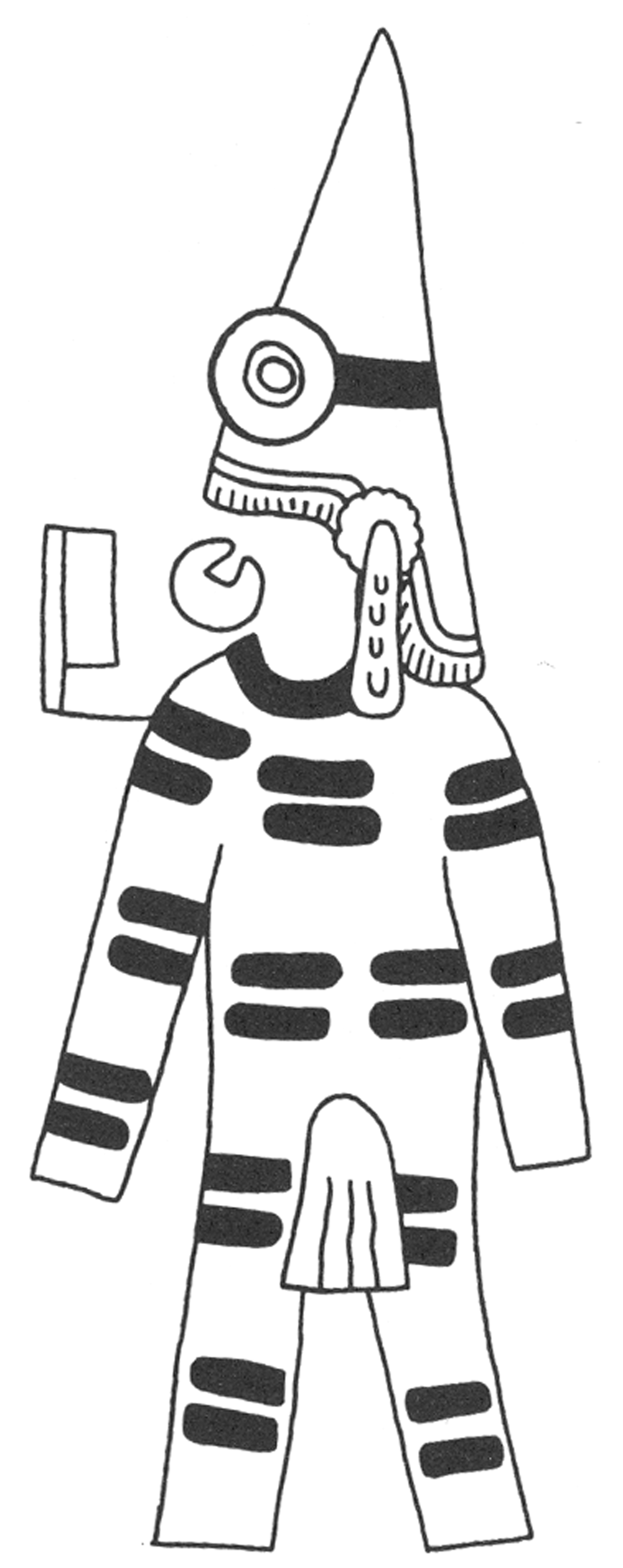
• First, consider the flowing warrior regalia of the region of Xoconochco. When the Mexica professional merchants (pochteca) defeated these southern peoples, they absconded with their feathered warrior regalia which they bestowed on their ruler Ahuitzotl. One device, the quetzalpatzactli, was said to be new to Ahuitzotl, and he adopted it (Sahagún Reference Sahagún, Anderson and Dibble1950–1982:bk. 9, p. 6). In the time of his successor Moctezuma Xocoyotzin, it was required in tribute by nine geographically dispersed Aztec provinces (but not by Xoconochco itself, which gave no warrior costumes in tribute) (Figure 5).
• Second is the curious case of the cuextecatl (Huaxtec) costume (Figure 6). Among the Mexica, these were high-demand items, in that they were awarded to warriors who had captured two enemies in battle (a relatively low number as these things go). Twenty conquered provinces paid their tribute in these costumes; a total of 272 costumes of this style entered Tenochtitlan annually according to the Codex Mendoza (Berdan and Anawalt Reference Berdan and Anawalt1992:vol. 3) (Figure 7). It is by far the most prevalent variety paid, and also appears in a number of other pictorial documents (e.g., Codex Telleriano-Remensis [Quiñones Keber Reference Quiñones Keber1995], Primeros Memoriales [Sahagún Reference Sahagún1993], Florentine Codex [Sahagún Reference Sahagún, Anderson and Dibble1950–1982], Lienzo de Tlaxcala [Chavero Reference Chavero1979[1550]], and the illustrations in Durán's Historia [Reference Durán and Heyden1994[1581]]). It represents the Huaxtecs who, enigmatically (and like the case of Xoconochco above), were not required to pay tribute in their own costume style. Its high demand is easy to understand since it was the most frequently awarded costume among those offered to achieved warriors. However, the choice of this particular style for these bestowals is not so readily understood: the Mexica were not especially awe-struck by the Huaxtecs, so the choice of a Huaxtec costume remains enigmatic.
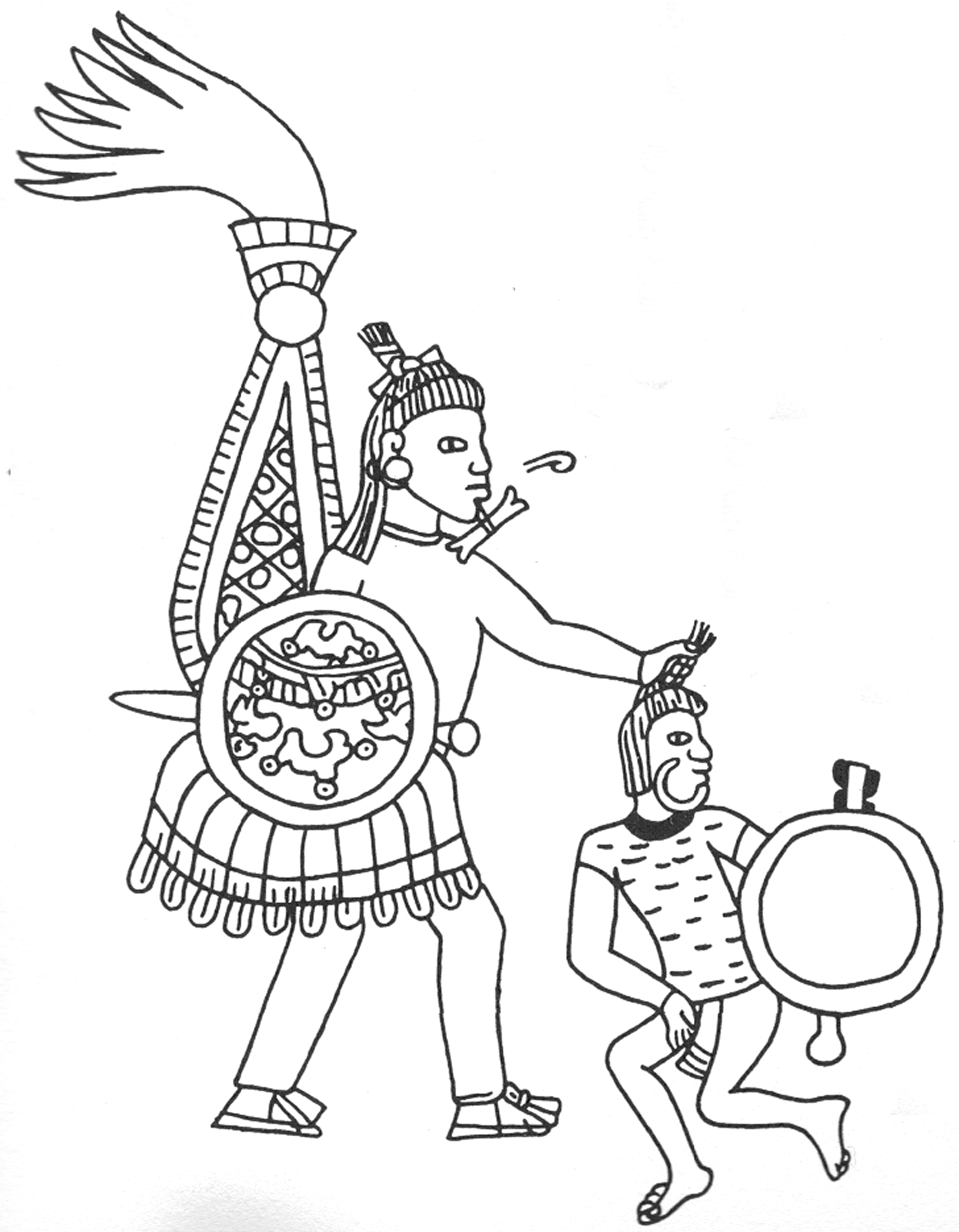
• Third is the xopilli standard. Upon capturing five enemies in battle (an extraordinary achievement), a stalwart warrior was awarded this standard (Figure 8). It represents the Otomi who, like the Huaxtec, were not especially esteemed by the Mexica. These regalia were given in tribute by four provinces (Petlacalco, Acolhuacan, Quauhnahuac, and Huaxtepec), all in or close to the Basin of Mexico and in some areas traditionally inhabited by Otomi. So its distribution is more understandable than that of the cuextecatl or quetzalpatzactli, but its choice as an honorable reward is not readily obvious.
• Fourth, it may seem a bit strange that no eagle costumes were demanded in tribute. Neither are they shown in the Codex Mendoza as rewards for Mexica military achievement. Warriors wearing these costumes were equivalent to jaguar warriors (and 28 jaguar costumes were paid from nine tributary provinces). Eagle costumes were stocked in the Tenochtitlan ruler's coffers (see Sahagún Reference Sahagún, Anderson and Dibble1950–1982:bk. 8, ill. 77) and warriors in eagle array engaged in battles and participated in major ceremonies (e.g., Sahagún Reference Sahagún, Anderson and Dibble1950–1982:bk. 8, ills. 79, 80; bk. 2, ills. 5, 6; Reference Sahagún1993:f. 250r). Indeed, they had their own chamber beside the Huey Teocalli (Templo Mayor) in Tenochtitlan's central ceremonial precinct (López Luján Reference López Luján2006). They must have been manufactured by Tenochtitlan/Tlatelolco featherworkers (most likely those attached to the royal palace in Tenochtitlan), perhaps because of the close symbolic association of the eagle (and sun) with the Mexica patron god, Huitzilopochtli. The Mexica seemed quite content to adopt other styles and require a wide range of diverse peoples to produce those styles for them, yet (at least in this case) they apparently were not particularly keen on having others fashion their own treasured symbol.
Tribute in quetzalpatzactli devices (by Jennifer B. Lozano).
A cuextecatl (Huaxteca) warrior costume (from Berdan and Anawalt Reference Berdan and Anawalt1992:vol.4, f. 34r).
Tribute in cuextecatl (Huaxteca) devices (by Jennifer B. Lozano).
A xopilli, or Otomi feathered costume and back device is awarded to a valiant warrior who has captured five enemies on the battlefield (from Berdan and Anawalt Reference Berdan and Anawalt1992:vol. 4, f. 64r).
These little examples bring to mind another characteristic of featherworking in both the core and the provinces of the Aztec empire. There was a continuous, if not increasing demand for feathered objects throughout the history of the empire. Almost constant warfare fed the demand for warrior costumes, shields, and martial banners, not only among the Mexica but among their allies and enemies as well. Diplomatic events and missions required increasing quantities of splendid feathered attire and accoutrements for impressing enemies, intimidating potential allies, and solidifying always-tenuous alliances. A related issue is the continual wear and tear on feathered objects: in particular, warrior regalia and shields would have suffered serious damage from hand-to-hand combat, and would have had to have been replaced or repaired on a sustained basis. Some feathers and featherwork objects, buried or destroyed with their deceased owners, became removed from the social and political scene entirely (Figure 9). All of these circumstances would have placed an added workload (and job opportunities) on the featherwork industry.
A wealthy deceased merchant is accompanied to the afterworld with his precious wares, including exotic feathers (from Nuttall Reference Nuttall1903:f. 68r).
THE ROLE OF IMPERIAL CONQUEST IN THE PRODUCTION AND DISTRIBUTION OF FEATHERS AND FEATHERED OBJECTS
So what can we make of all this? If accepted, these premises of elite consumption, complicated and expensive production processes, horizontal movements of feathers and featherwork throughout the empire, and imperial impingement on provincial production provide a basis for some tentative conclusions.
It is axiomatic that tribute demands are one-sided and instituted to serve the conquering state and rulership. The Mexica required their conquered subjects to make adjustments to their demands. Prior to Mexica arrival, featherworking was a well-established pursuit throughout Mesoamerica. When the Mexica encountered others at feasts or on the battlefield, these “others” were decked out in their own characteristic feathered attire and regalia. After Triple Alliance conquest, most subdued subjects were required to pay part of their tribute in feathered objects or feathers themselves. But which feathered objects, and what styles, should be demanded in tribute? It is frequently documented that tribute assessments were based on materials or objects readily available to the conquered peoples. Yet, is it likely that 20 geographically dispersed and ethnically diverse provinces were accustomed to fashioning warrior attire in the Huaxtec style and were prepared to pay these in tribute to their overlords? These appear to have been imposed styles, serving the specific need of supplying the Mexica with sufficient items to properly reward their own valiant warriors. Still, non-Huaxtec artisans were required to produce these unless, of course, there was an historically lively and expansive trade throughout the empire in these particular finished costumes. Adjustments in production and/or trade were also required by provinces providing the quetzalpatzactli and, to a lesser extent, the xopilli devices. Unfortunately, we know little along these lines about other types of feathered objects (such as banners, fans and textiles other than warrior costumes) since they do not appear as tribute payments, there are very few extant pieces (either pre-Spanish objects or colonial analogies) and nothing has been found archaeologically pertaining to their production.
Of the available types of manufactured featherwork, the Aztecs only demanded three in tribute: warrior costumes, shields, and noble hair bands (quetzallapiloni). Imperial impact on conquered subjects, therefore, would most readily be perceived with these objects. City-states throughout central and southern Mexico manufactured these and other feathered objects prior to Aztec conquest. Their production was nothing new. And they were certainly familiar with other groups' styles. But, in some cases, imperial conquest required those objects to be fashioned in styles that represented other ethnic groups and not the ethnicity of themselves or of their overlords.
These premises also stress the central role of merchants and markets in the wide scale movements of feathers and featherworking necessities. The Late Postclassic Mesoamerican economy was becoming more and more commercialized. Professional merchants traded throughout the realm and beyond in marketplaces, whether they operated independently, as part of a “guild,” or under the sponsorship of an important lord. Trading and markets were essential in supplying artisans with their raw materials and providing consumers with a convenient venue for the acquisition of ornate objects. Yet these economic activities could become entangled, as rulers were not aloof from commercial events—they sponsored pochteca and proclaimed market regulations, affecting the movements of preciosities such as feathers in their domains.
Feather artisans and others in the imperial capitals would have felt some impact from the arrival of large quantities of feathers to their bustling marketplaces from distant lands, and the delivery of additional feathers and fully manufactured feathered adornments through tribute and state-sponsored trade. The politically motivated deliveries would have gone directly into palatial coffers, to be made available to palace featherworkers (who nonetheless would have still needed to attend markets to obtain other tools of their trade). Palatial patronage reduced to some extent the most expensive “out-of-pocket” investments for these featherworkers. State-level arrivals of feathers and featherwork would have had less impact on the more independent featherworkers, who at least in Tlatelolco maintained convenient intimate relations with their pochteca neighbors. Not just the subservient provinces, but also the dominating core were affected by state involvement in featherworking activities. It is likely that the same dynamics pertained to other luxury crafts such as fine lapidary work and metallurgy.
Elizabeth Brumfiel (Reference Brumfiel, Brumfiel and Earle1987:112) has written that “we should anticipate that Aztec dominance was accompanied by some major changes in the structure of demand.” It can also be suggested that imperial dominance impacted provincial manufacturing and production strategies as well. This sojourn into the featherworking industry is one small case in point.
RESUMEN
Elizabeth Brumfiel ha contribuido sustancialmente a nuestro entendimiento de la especialización del México prehispánico. Especialmente, ella ha concentrada en la dinámica del desarollo de la especialización y en las conexiones entre la especialización y las varias sistemas de intercambio. Este estudio extende sus contribuciones por una investigación de los oficios plumerios durante el posclásico tardío. Enfoca a los contextos económicos, sociales y políticos de la producción plumeria. Trata de los centros urbanos del Valle de México, pero mas importante, concentra en las provincias y las regiones periféricas del imperio azteca. Examina el impacto de las conquistas imperiales en la producción y distribución de los objetos plumerios en estas regiones lejanas (incluyendo los mercados, el tributo, y las actividades de los pochteca).
Este trabajo considera cuatro premisas generales: (1) que los objetos fabricados de plumas (incluso las plumas ordinarias) fueron usados casi exclusivamente por los élites, el Estado y la vida ceremonial; (2) que los procesos de la producción plumeria fueron complicados y costosos (aunque las otras cosas que necesitan los artisanos para su oficio fueron relativamente accesibles y baratas); (3) que las plumas ricas y posiblemente los objetos ya manufacturados fueron llevados sobre largas distancias y sin obstrucciones grandes en todas partes del imperio azteca; y (4) que el imperio azteca, por sus imposiciones tributarias y su patrocinio del comercio de larga distancia, afectó a los procesos de producción provinciales, especialmente en estilos específicos de objetos de plumas (y de estos, particularmente los trajes militares con escudos asociados). Una investigación de estas premisas resulta en una vista de la producción de artículos de lujo (en este caso, los oficios plumerios) que es más complicada y mas dinámica que antes pensaba.