




No CrossRef data available.
Article contents
Mental health status of clients from three HIV/AIDS palliative care projects
Published online by Cambridge University Press: 04 April 2005
Abstract
Objective: To describe mental health status and its correlates among clients of three palliative care programs targeting underserved populations.
Methods: Mental Health Inventory (MHI-5) scores of clients from programs in Alabama (n = 39), Baltimore (n = 57), and New York City (n = 84) were compared.
Results: Mean MHI-5 scores did not differ among sites and were indicative of poor mental health. Significant differences were noted among sites with regard to client sociodemographics, physical functioning, and perceptions of interpersonal relations. Results of multivariate regression models estimated for each site suggest variation in the relative importance of potential predictors among sites. Whereas poorer mental health was primarily associated with history of drug dependence at Baltimore and more physical symptomatology at New York, better mental health was most strongly correlated with more positive perceptions of interpersonal relationships at Baltimore and increasing age and more positive perceptions of meaning and purpose in life at New York.
Significance of results: The data presented suggest the importance of assessing clients' history of and current need for mental health services. Evidence of a relationship between positive perceptions of meaning and purpose and better psychological function underscores the importance of existential issues for the overall well-being of those who are seriously ill.
Information
- Type
- Research Article
- Information
- Copyright
- © 2004 Cambridge University Press
INTRODUCTION
Although advances in treatment have delayed onset of AIDS, prolonged survival, and improved quality of life for many living with HIV/AIDS (Detels et al., 1999; Palella et al., 1998), others have experienced less positive outcomes. Lack of early testing, inability to adhere to therapy, and treatment inefficacy secondary to the development of viral resistance contribute to the ongoing loss of 15,000–16,000 persons annually to the disease in the United States alone (National Center for HIV, STD and TB Prevention, 2001). Even with effective therapy, many experience treatment-related side effects or other difficulties adapting to life with what remains an incurable, life-threatening illness that could be ameliorated with palliative care (World Health Organization, 1990; Gomez-Batiste et al., 1996; O'Neill & Barini-Garcia, 2003). Furthermore, comorbid health conditions such as mental illness, hepatitis C, and cancer, as well as substance abuse and living in a resource-constrained setting, often generate need for a broad range of supportive services (Conviser & Pounds, 2002) including pain control, symptom management, and psychosocial support.
A large number of studies have documented higher rates of psychiatric disorders (Bing et al., 2001) as well as poor psychological and psychosocial outcomes in samples of men and women living with HIV/AIDS (Wachtel et al., 1992; Siegel et al., 1996; 1998a, 2004; Karus et al., 1999; Penzak et al., 2000; Burgoyne & Saunders, 2001) both prior to and since the advent of highly active antiretroviral therapy (HAART). Poorer psychological outcomes, specifically the presence of depressive symptoms, have been found in other studies to be associated with poorer adherence to treatment (Starace et al., 2002) as well as decreased survival and lower overall quality of life in persons with HIV/AIDS (Lesserman et al., 1999; Ickovics et al., 2001).
Research has also consistently documented the importance of greater physical symptomatology (Fleishman & Fogel, 1994; Perkins et al., 1995; Thompson et al., 1996; Siegel et al., 1997a, 1997b) and less/poorer social support (Fleishman & Fogel, 1994; Nott et al., 1995; Rodgers, 1995; Siegel et al., 1997a, 1997b) as correlates of poorer psychological adjustment in this population. In addition to these factors, other studies have found clients' mental health and distress to be correlated with specific risk behaviors for HIV transmission as well as with other client characteristics that are associated with higher or lower prevalence of the disease. For example, one study (Hays et al., 2000) found that poorer mental health outcomes in a sample of persons with HIV/AIDS were associated with intravenous drug use, lower household income, and being Hispanic. Women with the disease have been found more likely to be diagnosed with depression than men (Sambamoorthi et al., 2000). In a sample of nursing home residents with HIV/AIDS, older residents, women, and whites were more likely to have been diagnosed with depression, and currently depressed residents were twice as likely as those who were not depressed to have a history of mental health conditions (Buchanan et al., 2002). Screening positive for a psychiatric disorder has been found to be directly associated with more HIV-related symptoms, illicit drug use in the past year, drug dependence, heavy alcohol use, being unemployed, and/or being disabled (Bing et al., 2001). Conversely, African Americans with HIV/AIDS have been found less likely to be diagnosed with depression (Sambamoorthi et al., 2000).
Persons with HIV/AIDS are disproportionately middle-aged or younger, of lower socioeconomic status, members of a stigmatized group (i.e., male homosexual, intravenous drug user, and/or African American or Latino) (Holtgrave et al., 1998; Sears et al., 2001; National Center for HIV, STD and TB Prevention, 2002a, 2002b, 2002c; Herek et al., 2002). As a result, overall prevalence rates and the sociodemographics of persons living with the disease vary among communities. Given evidence of an association between some of these same patient characteristics with survival (Cascade Collaboration, 2003; McFarland et al., 2003) and mental health, there is also reason to believe that the mental health status of persons seriously ill or dying with HIV/AIDS and its correlates might also vary among communities.
Although research has documented high levels of emotional distress among persons living with the disease and evidence of a relationship between patients' mental health and disease progression and death, little is known specifically about the mental health status and potential need for mental health services among those individuals who continue to develop serious illness and/or die from HIV/AIDS and its complications. There is reason to suspect that emotional distress might be particularly common in this population, given evidence of a link between patients' distress and disease progression and epidemiological data suggesting that individuals who die of HIV/AIDS or its complications are increasingly and disproportionately from medically underserved communities at heightened risk for poorer psychological outcomes. Such information is crucial to inform the provision of appropriate palliative care and other supportive services.
This report seeks to expand our knowledge with regard to four important questions regarding the mental health status of seriously ill HIV/AIDS patients. First, how do self-reports of mental health status by HIV/AIDS clients from underserved populations who are receiving palliative care compare with those from samples of the general population and earlier samples of HIV/AIDS patients with advanced disease? Second, do mental health scores of HIV/AIDS clients from different palliative care programs vary? Third, what are the important correlates of HIV/AIDS clients' mental health scores in this population? Finally, do the correlates of HIV/AIDS clients' mental health scores vary across palliative care programs? This information will inform the development of programs in other settings targeting this population not only to ensure that HIV patients are able to access the full range of psychosocial resources and supports they may require, but also to inform the efficient allocation of existing mental health resources in the current environment of scarce resources.
METHODS
Program Sites
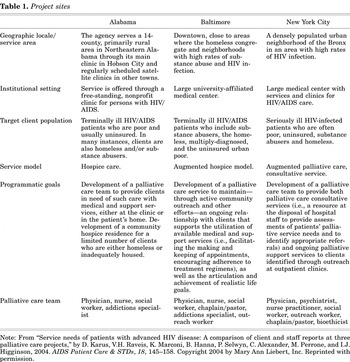
The clients described are from three demonstration programs funded as Special Projects of National Significance through an initiative of the HIV/AIDS Bureau of the Health Resources and Services Administration (HRSA), Department of Health and Human Services (HHS) to provide appropriate palliative care and services to individuals with advanced HIV/AIDS who have difficulty accessing the health care system. Although individual programs were developed and delivered at each site, all projects participated in a multisite study designed to permit comparisons of programmatic experiences and client outcomes. Table 1 presents a brief description of each project site and its programmatic goals. Similarities and differences among the sites with regard to their programmatic elements and client populations have been described in an earlier report (Karus et al., 2004).
Project sites

Measures
All three projects collected a common set of items and measures (Palliative Care Assessment Forms for HIV [PCAF-HIV]). Both the client and a staff member completed appropriate forms of the PCAF-HIV at accrual and at regular intervals thereafter. Analyses presented are based on data from the interviews conducted from June 2000 to October 2002. Institutional Review Boards reviewed the data collection methodology at Alabama and Baltimore; data collection was exempt from review at New York City (NYC).
Included in the PCAF-HIV are forms eliciting basic sociodemographic information (age, gender, race/Hispanic origin, household income, basic household composition [total number, number over 18 years, number 65 or older]), HIV medical status (HIV/AIDS status, CD4+ count, viral load), and a brief history of mental illness/treatment (ever, past 3 months) and alcohol/substance abuse/treatment (ever, past 3 months), as well as a battery of standardized measures.
Psychological functioning was assessed using the Mental Health Inventory (MHI-5) (Berwick et al., 1991). The MHI-5 is a five-item general mental health scale that is analogous to the mental health subscale of the SF-36 (Ware, 1993) and the MOS-HIV (Wu et al., 1997). Clients were asked to report how much of the time during the past 4 weeks they felt very nervous, calm and peaceful, downhearted and blue, happy, and so down in the dumps that nothing could cheer them up. Response options ranged from “none of the time” to “all of the time.” The raw summary score, computed as the sum of individual item scores (coded from 1 to 6 with higher values indicating better mental health), was mathematically transformed to range in value for 0–100 for comparison with other reports. Psychometric properties of the MHI-5 including its validity and reliability are well documented both as a subscale of the SF-36 (Ware, 1993) and, with HIV patients, as a subscale of the MOS-HIV (Wu et al., 1997). Use of the measure as a diagnostic tool has also been demonstrated (Berwick et al., 1991; McHorney & Ware, 1995) and the measure has been used successfully with HIV/AIDS outpatients to identify scores below a cutoff of 52 as indicative of recent major depression (Holmes, 1998). In the present sample reliability of the measure, as assessed using Chronbach's alpha, exceeded 0.8 at all three sites.
Physical functioning was assessed using 15 items from the Rapid Disability Rating Scale (RDRS-2) (Linn & Linn, 1982) modified for clients' self-report. Clients rated their need for assistance with eight activities of daily living and their level of disability in seven areas of physical function on a 4-point scale ranging from none (coded 0) to complete dependence/disability (coded 3). As part of the PCAF-HIV, staff also completed the full version of the RDRS-2, which includes three additional items assessing aspects of the clients' functioning that were either inappropriate for inclusion in the client form (mental confusion, uncooperativeness) or redundant with items from other measures (depression). The correlation between client and staff scores was very high at all sites (0.883 at Alabama, 0.962 at Baltimore, and 0.813 at NYC). To avoid multicollinearity in the regression analyses, and because the other measures included rely on clients' self-reports, we utilized clients' self-reports of physical functioning whenever possible. Furthermore, given the high correlation of client reports with those of staff, we chose to minimize missing data for the regression analyses by substituting staff reports for four clients (one at Alabama, three at NYC) who had not completed the form. Reliability and validity of the full RDRS-2 have been previously demonstrated in a sample of the elderly (Linn & Linn, 1982). Chronbach's alpha for a summary scale, computed as the sum of scores for the 15 items included on both forms, was adequate at Alabama (0.79 client, 0.89 staff), Baltimore (0.90 client, 0.90 staff), and NYC (0.89 client, 0.93 staff).
Physical symptomatology was assessed with a modified version of the physical symptom subscale of the Memorial Symptom Assessment Scale (MSAS) (Portenoy et al., 1994). The MSAS queries respondents regarding the occurrence, frequency (if appropriate), severity, and distress associated with each of 32 symptoms during the past week. Each symptom is assigned a composite score, 0 if the symptom had not occurred during the past week, otherwise the average of response codes to the remaining items related to that symptom, all coded 1 to 4, with higher scores indicative of greater adverse impact. In addition to a summary scale, computed as the average of all symptom scores, the authors of the MSAS have also identified scores of 6 symptoms as comprising a psychological subscale and scores of 12 other symptoms as comprising a physical symptom subscale. We have chosen to rely on the physical symptoms subscale for the remainder of these analyses to avoid the confounding associated with the inclusion of psychological symptoms as a correlate of mental health. For similar reasons, because the distress item used in the computations of symptom scores does not differentiate between physical and psychological distress, we have excluded this item from the calculation of individual symptom scores. Reliability for the modified physical symptom subscale exceeded 0.8 at all three sites.
The client's perceptions of the impact interpersonal relations and transcendence have had on his/her quality of life (QOL) were assessed using subscales of the 15-item version of the Missoula Vitas Quality of Life Index (MVQOLI-15). The MVQOLI-15 was developed as a shorter version of the original 25-item measure to assess QOL of terminally ill patients (Byock & Merriman, 1998). The measure assesses three aspects of five different dimensions of QOL: symptom, function, interpersonal, well-being, and transcendent. For each dimension clients rate their current status (assessment), their feelings with regard to their status (satisfaction), and the degree to which the dimension impacts their QOL (importance). Unweighted dimension scores are computed as the sum of the assessment (coded −2 to 2) and satisfaction (coded −4 to 4) items and can range in value from −6 to 6. Unweighted scores are then multiplied by the value of the importance item (coded 1 to 5) to yield weighted dimension scores reflecting the impact of this domain on the patient's daily quality of life (potential range: −30 to 30). For both weighted and unweighted scores, a value <0 suggests that the dimension is perceived by the client as negatively impacting QOL, whereas a value >0 indicates perception of a positive impact. Due to conceptual overlap of three of the subscales (symptom, function, and well-being) with our measures of physical symptoms, physical functioning, and mental health, respectively, we have chosen to include only the interpersonal and transcendent subscales in the analyses presented.
Data Analyses
As of October 2002, data had been submitted and entered for a total of 322 clients (46 at Alabama, 74 at Baltimore, and 202 at NYC). Analysis was restricted to clients for whom a complete MHI was available (n = 180). The proportion of clients included in the analyses presented varied across sites, from 85% (n = 39) at Alabama and 77% (n = 57) at Baltimore to 42% at NYC (n = 84). For each site, clients included in these analyses were compared to those excluded, with regard to the sociodemographic, medical information, or mental health/substance abuse items assessed at accrual. No significant differences were found among these groups at either Alabama or Baltimore. At NYC only one significant difference was found. Whereas NYC clients included in these analyses were 48% Hispanic, 32% Black, 12% White, and 8% of other/mixed racial/ethnic backgrounds, the comparable figures among those not included were 49%, 46%, 3%, and 3%, respectively (χ2 = 10.457, df = 3, p < 0.015).
One-way analysis of variance (ANOVA) was used to determine whether means of continuous ordinal variables, including scale scores, significantly varied among the three projects. When appropriate, Scheffe's tests were also conducted post hoc to determine if there were significant differences between specific pairs of projects. Comparisons of the distribution of categorical variables among sites were made using χ2 tests. Regression analyses were run predicting clients' total MHI-5 scores with age, gender, history of drug dependence, history of a mental health condition, physical functioning, physical symptomatology, interpersonal relations, and transcendence to assess the relative importance of each as a correlate of clients' mental health scores. Pairwise deletion of missing data was used. The minimum criteria for significance on statistical tests was p ≤ 0.05 unless otherwise noted.
RESULTS
Participants
The median length of time from entry into the program to completion of the client needs assessment was less than 2 weeks at all three sites. All clients were HIV positive and over 92% at all three sites had either received an AIDS diagnosis or reported a CD4+ count less than 200. Although most clients at all sites had test markers indicative of advanced disease, CD4+ counts for clients at Baltimore seemed particularly poor. The median CD4+ count among clients at Baltimore was 12 compared to 36 at Alabama and 45 at NYC. In keeping with their low CD4+ counts, the median viral loads among clients at all three sites were significantly above 50,000 cells/cc (75,000 at Alabama, 92,500 at Baltimore, 64,300 at NYC). The relatively poorer CD4+ counts of clients at Baltimore may be associated with the high proportions of active intravenous drug users and the homeless among clients at the site. Such individuals have been found in previous studies to be diagnosed with and enter treatment for HIV/AIDS at a later stage of the disease than other groups (Somlai et al., 1998; Weinreb et al., 1998; DesJarlais et al., 2000; Culhane et al., 2001; Hwang et al., 2001; Martens, 2001).
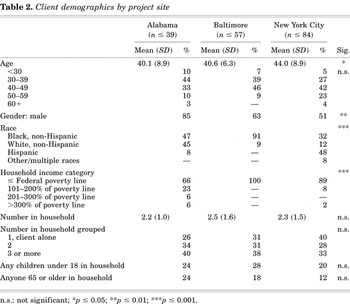
Characteristics of participating clients at the three sites are presented in Table 2. Approximately two-thirds or more of clients at all three sites are in their 30s or 40s. Although a majority at all three sites identify themselves as male, the proportion of males varies significantly among sites (χ2 = 12.690, df = 2, p = 0.002), with this proportion appreciably higher at Alabama (85%). The racial/ethnic distribution of clients is also significantly associated with site (χ2 = 84.062, df = 6, p < 0.001). Whereas nearly all clients at Alabama are either Black (47%) or White (45%), at Baltimore the vast majority of clients are Black (91%), and at NYC clients are primarily Hispanic (48%) or Black (32%). Although clients at all three sites are poor, the distribution of household incomes relative to the 1999 federal poverty line varies significantly among sites (χ2 = 32.187, df = 6, p < 0.001), with a lower proportion of clients below this figure at Alabama (66%) than at either Baltimore (100%) or NYC (89%). Still, only two clients at Alabama reported an income greater than twice the federal poverty line. On average, clients at all three sites live with one to two other persons, although a substantial minority of clients at all three sites live alone. About one-quarter to one-third of the clients at all three sites are living in a household with children, and the proportion of clients living with someone 65 or older ranges from 12% at NYC to 24% at Alabama.
Client demographics by project site

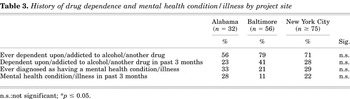
As seen in Table 3, a majority of clients at all three sites report a history of substance abuse. The proportion reporting such a history was lower at Alabama (56%) than at either Baltimore (79%) or at NYC (71%); however, this difference was not statistically significant (χ2 = 5.491, df = 2, p = 0.064). Although the prevalence of substance abuse was substantially lower at all three sites in the past 3 months, recent abuse was still reported by a substantial 41% of clients at Baltimore, 28% at NYC, and 23% at Alabama. It should also be noted that whereas staff at Alabama indicate that substance abuse among its clients is primarily associated with alcohol use, staff at Baltimore and NYC report that although many of their clients abuse alcohol, a high proportion also have histories of or are still abusing other illicit substances, often intravenously.
History of drug dependence and mental health condition/illness by project site

The proportion of clients who had ever been diagnosed with a mental health condition other than substance abuse did not vary significantly among sites (χ2 = 1.750, df = 2, p = 0.417), ranging from 21% at Baltimore to 29% at NYC and 33% at Alabama. Half or more of the clients at each site with such a history reported the presence of the illness/condition in the past 3 months. Although the proportion of clients with a recent mental health condition/illness was appreciably higher at Alabama (28%) than at Baltimore (11%) or NYC (22%), the distribution of recent cases did vary significantly among sites (χ2 = 4.946, df = 2, p = 0.084).
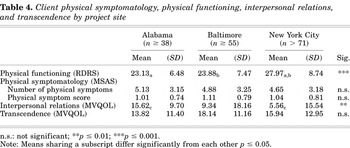
Clients' physical functioning (Table 4) varied significantly among sites (F(2,167) = 6.685, p = 0.002), with the mean score of clients at NYC (mean = 27.97, SD = 8.74) indicative of significantly poorer functioning (p = 0.009) than the mean for clients at Alabama (mean = 23.13, SD = 6.48) and significantly poorer (p = 0.014) than the mean for clients at Baltimore (mean = 23.88, SD = 7.47). This difference is in keeping with the fact that many of the clients at NYC were accrued while in the hospital. On the other hand, with regard to physical symptomatology during the past week, clients at all sites reported, on average, experiencing about 5 of the 12 symptoms comprising the physical symptoms subscale, as well as similar scores on the measure itself. Mean scores of clients on the measure of interpersonal relations varied significantly across sites (F(2,173) = 5.637, p = 0.004). The mean for clients at Alabama (mean = 15.62, SD = 9.70) was suggestive of this dimension exerting a relatively stronger positive effect on clients' overall quality of life than was reported by clients at Baltimore (mean = 9.34, SD = 18.16) and significantly stronger (p = 0.004) than for clients at NYC (mean = 5.56, SD = 15.54). Whereas a majority of clients at all sites perceived their interpersonal relations as having a positive impact on their QOL (not shown in table), the proportion of such clients was 90% at Alabama compared to 66% of clients at Baltimore and 58% at NYC (χ2 = 12.184, df = 2, p = 0.002). On average, clients at all sites indicated that the transcendence dimension exerted a fairly strong positive effect on the overall quality of life, with no significant differences reported across sites.
Client physical symptomatology, physical functioning, interpersonal relations, and transcendence by project site

Mental Health
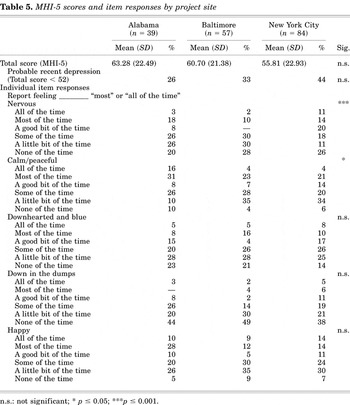
Similar mean scores for the MHI-5 (Table 5) were reported for clients at all three sites (F(2,177) = 1.736, p = 0.179), ranging from 55.8 (SD = 23.0) at NYC to 60.7 (SD = 21.4) at Baltimore and 63.3 (SD = 22.5) at Alabama. The mean scores for all three sites suggest poor adjustment compared to either normative data reported for the general population (mean = 74.7, SD = 18.0; Ware, 1993) or the mean score of 71.45 obtained from a subsample of 3,445 participants from the Medical Outcomes Study (MOS) with chronic medical and/or psychiatric conditions (McHorney & Ware, 1995). The mean of clients in the present study was also as low as the mean reported for a subgroup of 778 participants in the MOS sample who were symptomatic of depression (mean = 63.3), but not as low as the mean of 495 MOS participants with clinical depression (mean = 46.7). Compared with other findings from other samples of HIV-infected individuals, mean scores for all three sites in the present study were appreciably lower than the mean of 69.6 (SD = 22.8) reported for a sample of 35 hospitalized AIDS patients not in intensive care and without evidence of cognitive impairment (Schlenk et al., 1998), but higher than those reported in a study comparing the well-being of AIDS patients given less than a 50% chance of survival for 5 years (mean = 44.7) to that of patients with other serious illnesses who were given a similar prognosis (mean = 38.5; Anderson et al., 1998).
MHI-5 scores and item responses by project site

MHI-5 scores of over a quarter of clients at all three sites were below the cutoff of 52, identifying patients who likely experienced recent major depression. This proportion varied from 26% at Alabama to 33% at Baltimore and 44% at NYC; however, the distribution of cases on the basis of whether they were above or below the cutoff was not significantly associated with site (χ2 = 4.285, df = 2, p = 0.117). A substantial proportion of clients at all three sites who had MHI-5 scores predictive of recent major depression (13% at Alabama, 18% at Baltimore, and 30% at NYC) had never been diagnosed with a mental health condition.
Although the mean total scores on the MHI-5 did not vary significantly among sites, the distributions of clients' responses with regard to items assessing feeling “nervous” (χ2 = 29.197, df = 10, p = 0.001) and “calm and peaceful” (χ2 = 19.003, df = 10, p = 0.040) during the past month did vary significantly. Whereas clients' responses at Alabama and Baltimore were disproportionately indicative of less frequent feelings of nervousness, responses at NYC were more evenly distributed across response categories. On the other hand, a higher proportion of clients at Alabama reported feeling calm and peaceful “most” or “all” of the time than was reported at either Baltimore or NYC (47% vs. 27% and 25%).
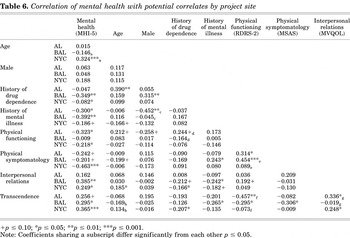
Table 6 presents, for each site, a correlation matrix comprised of client scores on the MHI-5 and its potential correlates. Although differences were noted among sites with regard to statistically significant correlates of mental health, it should be noted that at all three sites, poorer mental health was at least marginally (p < 0.10) correlated with a history of a mental health condition and greater physical symptomatology, whereas better mental health was correlated with more favorable perceptions of meaning and purpose. Furthermore, there was only one instance in which a coefficient between mental health and another variable was not in the same direction at all three sites. Whereas there was a significant and direct correlation between mental health and age at NYC (r = 0.324), the analogous coefficient for Baltimore was negative (r = −0.146) though not statistically significant. This was also the only instance in which the correlation coefficient of mental health scores with another variable differed significantly between two sites.
Correlation of mental health with potential correlates by project site

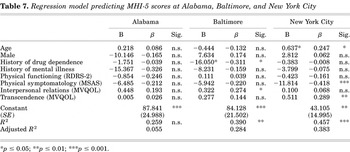
To assess the relative importance of the potential correlates of mental health at each site, separate regression models were estimated for each site (see Table 7). The model estimated for Alabama was not significant (R2 = 0.259, F(8,29) = 1.270, p = 0.297) and none of the eight potential predictors were significantly correlated with mental health scores after controlling for the other independent variables. On the other hand, at Baltimore the overall model explained a significant proportion of the variance in clients' mental health scores (R2 = 0.390, F(8,46) = 3.675, p = 0.002), with scores inversely correlated with a history of drug dependence (B = −16.050, beta = −0.311, p = 0.024) and directly correlated with more positive perceptions of interpersonal relationships (B = 0.322, beta = 0.274, p = 0.032) after controlling for the other independent variables. At NYC the model explained nearly half of the variance in clients' mental health scores (R2 = 0.457, F(8,58) = 6.113, p < 0.001), with better mental health scores inversely correlated with physical symptomatology (B = −11.814; beta = −0.418; p < 0.001) and directly correlated with the client's age (B = 0.637, beta = 0.247, p = 0.018) and stronger positive perceptions of meaning and purpose (B = 0.511, beta = 0.289, p = 0.007).
Regression model predicting MHI-5 scores at Alabama, Baltimore, and New York City

DISCUSSION
The data presented describe similarities and differences in clients' self-reported mental health and its correlates among three palliative care projects serving seriously ill or end-stage HIV/AIDS patients from medically underserved populations. Clients at all project sites were likely to be poor, uninsured, homeless, and/or have histories of substance abuse. Although statistically significant differences were found among sites with regard to the sociodemographic characteristics of clients, a majority at all three sites were male, middle aged or younger, and persons of color. A substantial number at all sites lived alone and many had been diagnosed with a mental health condition/illness. On average, clients at NYC reported significantly poorer physical functioning than clients at either Alabama or Baltimore. Clients' perceptions of their interpersonal relations with friends and family also varied significantly among sites, with more positive perceptions reported by clients at Alabama and less positive perceptions reported by clients at NYC. As noted earlier, the programs also differed with regard to locale, institutional setting, and service delivery model employed
Despite these differences, mean total scores on the MHI-5 at the time of the clients' first assessment did not differ significantly among sites. Means for all three sites were indicative of relatively poor mental health compared to the general population and comparable to the mean reported for a sample with symptoms of depression. Over a quarter of clients at all sites had scores indicative of probable recent depression. These findings underscore the need for programs serving seriously ill persons with HIV/AIDS to provide mental health referrals or services.
A substantial proportion of clients at all three sites had been diagnosed with a mental health condition. However, there was also a substantial group of clients at each site (13–30%) who, although they had MHI-5 scores predictive of a recent major depression, had never received such a diagnosis. This finding suggests an undetected need for mental health services in this population and underscores the importance of periodic assessment of clients' mental health needs. Further research is needed to assess the extent to which this finding reflects ongoing symptomatology that went undiagnosed or symptomatology that is directly or indirectly associated with the clients' present physical condition or recent socioeconomic and situational factors (e.g., active drug use, poverty, homelessness). The fact that the proportion of potentially undiagnosed clients is highest at NYC where clients were more likely to be accrued while hospitalized and with poorer physical functioning than clients at either Alabama or Maryland raises the possibility that at least some of these individuals may be expressing recent symptomatology.
Mean scores of clients at all three sites were lower than mean scores reported for a sample of 35 hospitalized AIDS patients (Schlenk et al., 1998). The authors of that report argued that the relatively higher level of adjustment among the HIV/AIDS clients in their sample might have resulted from a relative lack of psychiatric disorders, the availability of social supports, and the occurrence of few other stressful life events. It is likely that the poorer mental health scores reported by clients of the programs described in this report are due to the fact that these programs are targeting clients who are impoverished and often socially isolated, with a high proportion having histories of substance abuse and/or mental illness.
The differences found among sites with regard to clients' response to individual items of the MHI-5 suggest that the comparable summary scores may mask differences with regard to the prevalence of specific psychological symptoms. The two items for which distributions were found to differ among sites, feeling “nervous” and “calm and peaceful,” are conceptually related to anxiety. It may be that clients' anxiety levels varied among sites due to either the prevalence of ongoing substance abuse and the substance(s) being used, differences with regard to clients' physical functioning, clients' prognosis, and/or cultural variability in the expression and reporting of feelings. For example, an earlier report comparing psychological adjustment of African American, Puerto Rican, and white women living with HIV/AIDS in NYC (Siegel et al., 1998a) found that Puerto Rican women reported significantly greater anxiety than African American women. Unfortunately, tests regarding such differences are beyond the scope of these data.
Similarities and differences found among sites with regard to the correlates of mental health scores suggest various aspects of clients' lives that might be targeted by service providers to enhance mental health at end of life. Schlenk et al. (1998) speculated that some persons living with HIV/AIDS experience self-transcendence and discover new meaning for their lives, which in turn maintains or enhances their well-being. This process could explain why mental health scores were relatively normal in their sample of HIV/AIDS patients. The data presented here provide partial evidence in support of this process. At all three sites a substantial proportion of clients described their perceptions of purpose and meaning as important and better now than before. Furthermore, among clients at all three sites there was a direct bivariate correlation between better perceptions of purpose and meaning and mental health. Although the regression analyses suggest that after controlling for the other independent variables this correlation was significant only among clients at NYC, it is possible that other situational factors mediate the relationship or that the relationship between perceptions of meaning and purpose and mental health is indirect. In either case, this finding speaks to the potential benefit of encouraging or supporting such perceptions for those lacking such support.
The regression analyses suggest additional factors that may be salient for specific client populations or clients of a particular type of program. Results from NYC suggest that seriously ill HIV patients who are older might fare better psychologically than younger clients. This is in keeping with earlier work suggesting that older adults with HIV/AIDS might not feel as cheated or threatened by the disease as younger adults (Siegel et al., 1998b). Results from the Baltimore site suggest that a history of drug dependency (particularly intravenous use) and clients' perceptions of their interpersonal relationships may be particularly important correlates of mental health for some clients. The finding that better mental health was correlated with more positive perceptions of interpersonal relationships may well be reflective of the intense social isolation experienced by many of those targeted by the palliative care programs. This effect remained even after controlling for whether or not the client had a history of substance abuse. At all sites many clients had histories of substance abuse, which may have negatively impacted relationships with friends and family. These findings suggest that working with clients to repair or improve relationships with others in their support networks might prove beneficial to their psychological well-being. They also underscore the relevance of palliative care for this population and demonstrate the need to attend to psychosocial factors in addition to palliating physical symptoms, in an effort to enhance quality of life for individuals with HIV/AIDS who are seriously ill or approaching the end of life. In particular, symptom management and attention to the spiritual/existential needs of clients are basic tenets of good palliative care.
The findings presented should not be interpreted as representative of the experiences of all HIV/AIDS patients receiving palliative care. Rather, they represent only the experiences of clients accrued into demonstration programs developed to address the needs of clients from underserved populations who are perhaps the most vulnerable individuals living with the disease. The fact that each project has both a unique combination of structural factors and a unique mix of clients precludes us from assessing the relative importance of structural factors on patient outcomes and necessitated the estimation of separate regression models for each site. Furthermore, because data collection was conducted by staff at individual project sites, different team members were made responsible for administering the various measures included in the PCAF-HIV. Thus, even when one interviewer was able to complete all of the forms for which he or she was responsible, another interviewer may not have been able to schedule a time with or find the same client to complete one or more of the remaining measures (the MSAS or the MVQOL-15).
The small sample size at individual sites may have resulted in Type II errors, particularly with regard to Alabama, thereby limiting discussion with regard to the impact of potential factors on clients' mental health scores. Given the poor health of many clients, interviews were often conducted over an extended period, and other clients were physically unable or unwilling to complete all forms. Also, some program staff members were initially overprotective of clients and declined to administer the full assessment. As a result, data missing due to clients being too sick or cognitively unable to complete the MHI-5 and/or any of the other structured measures may have engendered biased findings, both with regard to the distribution of summary mental health scores and the correlations found among the dependent and independent variables.
As noted earlier, the proportion of clients for which data were available varied across sites, with especially low completion rates reported at NYC. These differential response rates threaten the comparability of the data collected across sites. Fortunately, only one significant difference (race/ethnicity) was found between clients included in the analyses and clients excluded due to missing data, and that difference was only found with regard to clients at one site (NYC). Similar MHI-5 scores were obtained from clients at all three sites.
Overall, despite the methodological limitations described above, the findings presented have important implications for those providing services to seriously ill clients with HIV/AIDS. They suggest the importance of assessing clients' history of and current need for mental health services. They also suggest the importance of identifying and regularly monitoring the psychological well-being of clients who are at high risk of developing a need for such services. Evidence of a relationship between clients' positive perceptions of meaning and purpose and better psychological function underscores the importance of existential issues for the overall well-being of those who are seriously ill, even for those individuals who are impoverished, marginalized, and socially isolated.
ACKNOWLEDGMENTS
This work was supported by a Special Projects of National Significance grant (4 H97 HA 00148-03-03) funded by the Health Resources and Services Administration, Department of Health and Human Services. The authors acknowledge and appreciate the assistance of Monique Carrero and Karyn Faber in the preparation of the manuscript. We would also like to thank the project staff at the three sites for their efforts on behalf of their clients as well as their dedication to collecting the data described in this report and providing us with insights into their interpretation.
References
REFERENCES
Anderson, J.P.,
Kaplan, R.M.,
Coons, S.J.,
et al.
(1998).
Comparison of the quality of well-being scale and the SG-36 results
among two samples of ill adults: AIDS and other illnesses.
Journal of Clinical Epidemiology,
51,
755–762.Google Scholar
Berwick, D.M.,
Murphy, J.M,
Goldman, P.A.,
et al.
(1991).
Performance of a Five-Item Mental Health Screening Test.
Medical Care,
29,
169–176.Google Scholar
Bing, E.G.,
Burnam, M.A.,
Longshore, D.,
et al.
(2001).
Psychiatric disorders and drug use among human immunodeficiency
virus-infected adults in the United States.
Archives of General Psychiatry,
58,
721–728.Google Scholar
Buchanan, R.J.,
Wang, S., &
Huang, C.
(2002).
Analyses of nursing home residents with Human Immunodeficiency Virus
and depression using the minimum data set.
AIDS Patient Care & STDs,
16,
441–455.Google Scholar
Burgoyne, R.W. &
Saunders, D.S.
(2001).
Quality of life among urban Canadian HIV/AIDS clinic
outpatients.
International Journal of STD & AIDS,
12,
505–512.Google Scholar
Byock, I.R. &
Merriman, M.P.
(1998).
Measuring quality of life for patients with terminal illness: The
Missoula-Vitas Quality of Life Index (MVQOLI).
Palliative Medicine,
12,
231–244.Google Scholar
Cascade Collaboration
(2003).
Determinants of survival following HIV-1 seroconversion after the
introduction of HAART.
Lancet,
362,
1267–1274.Google Scholar
Conviser, R. &
Pounds, M.B.
(2002).
Background for the studies on ancillary services and primary care
use.
AIDS Care,
14(Suppl. 1),
S7–S14.Google Scholar
Culhane, D.P.,
Gollub, E.,
Kuhn, R.,
et al.
(2001).
The co-occurrence of AIDS and homelessness: Results from the
integration of administrative databases for AIDS surveillance and public
shelter utilization in Philadelphia.
Journal of Epidemiology & Community Health,
55,
515–520.Google Scholar
DesJarlais, D.C.,
Perlis, T.,
Friedman, S.R.,
et al.
(2000).
Behavioral risk reduction in a declining HIV epidemic: Injection
drug users in New York City, 1990–1997.
American Journal of Public Health,
90,
1112–1116.Google Scholar
Detels, R.,
Munoz, A.,
McFarlane, G.,
et al.
(1999).
Effectiveness of potent antiretroviral therapy on time to AIDS and
death in men with known HIV infection duration.
Journal of the American Medical Association,
280,
1497–1503.Google Scholar
Fleishman, J.A. &
Fogel, B.
(1994).
Coping and depressive symptoms among people with AIDS.
Health Psychology,
13,
156–169.Google Scholar
Gomez-Batiste, X.,
Fontanals, D.,
Roca, J.,
et al.
(1996).
Catalonia WHO demonstration project on palliative care
implementation 1990–1995: Results in 1995.
Journal of Pain and Symptom Management,
12,
73–78.Google Scholar
Hays, R.D.,
Cunningham, W.E.,
Sherbourne, C.D.,
et al.
(2000).
Health-related quality of life in patients with human
immunodeficiency virus infection in the United States: Results from the
HIV cost and services utilization study.
American Journal of Medicine,
108,
714–722.Google Scholar
Herek, G.M.,
Capitanio, J.P., &
Widaman, K.F.
(2002).
HIV-related stigma and knowledge in the United States: Prevalence
and trends, 1991–1999.
American Journal of Public Health,
92,
371–377.Google Scholar
Holmes, W.C.
(1998).
A short, psychiatric, case-finding measure for HIV seropositive
outpatients: Performance characteristics of the 5-item Mental Health
Subscale of the SG-20 in a male, seropositive sample.
Medical Care,
36,
237–243.Google Scholar
Holtgrave, D.R.,
Pinkerton, S.D.,
Jones, T.S.,
et al.
(1998).
Cost and cost effectiveness of increasing access to sterile syringes
and needles as an HIV prevention intervention in the United States.
Journal of Acquired Immune Deficiency Syndromes,
18(Suppl. 1),
S133–138.Google Scholar
Hwang, S.W.,
O'Connell, J.J.,
Lebow, J.M.,
et al.
(2001).
Health care utilization among homeless adults prior to death.
Journal of Health Care for the Poor & Underserved,
12,
50–58.Google Scholar
Ickovics, J.R.,
Hamburger, M.E.,
Vlahov, D.,
et al.
(2001).
Mortality, CD4 cell count decline, and depressive symptoms among
HIV-seropositive women: Longitudinal analysis from the HIV Epidemiology
Research Study.
Journal of the American Medical Association,
285,
1466–1474.Google Scholar
Karus, D.,
Raveis, V.H.,
Marconi, K.,
et al.
(2004).
Service needs of patients with advanced HIV disease: A comparison of
client and staff reports at three palliative care projects.
AIDS Patient Care & STD's,
18,
145–158.Google Scholar
Karus, D.,
Siegel, K., &
Raveis, V.H.
(1999).
Psychosocial adjustment of women to living with HIV/AIDS.
AIDS Behavior,
3,
277–287.Google Scholar
Lesserman, J.,
Jackson, E.D.,
Petitto, J.M.,
et al.
(1999).
Progression to AIDS: The effects of stress, depressive symptoms, and
social support.
Psychosomatic Medicine,
61,
397–406.Google Scholar
Linn, M.W. &
Linn, B.S.
(1982).
The Rapid Disability Rating Scale-2.
Journal of the American Geriatric Society,
30,
378–382.Google Scholar
Martens, W.H.
(2001).
A review of physical and mental health in homeless persons.
Public Health Reviews,
29,
13–33.Google Scholar
McFarland, W.,
Chan, S.,
Ling, H.,
et al.
(2003).
Low socioeconomic status is associated with a higher rate of death
in the era of Highly Active Antiretroviral Therapy, San Francisco.
Journal of Acquired Immune Deficiency Syndromes,
33,
96–103.Google Scholar
McHorney, C.A. &
Ware, J.E.
(1995).
Construction and validation of an alternate form General Mental
Health scale for the Medical Outcomes Study Short-Form 36-item Health
Survey.
Medical Care,
33,
15–28.Google Scholar
National Center for HIV, STD and TB Prevention.
(2001).
HIV/AIDS Surveillance Report.
Vol. 13(2).
Centers for Disease Control & Prevention.
Available at:
http://www.cdc.gov/hiv/stats/hasr1302.htm.
National Center for HIV, STD and TB Prevention.
(2002a).
Drug-associated HIV transmission continues in the United
States.
Centers for Disease Control & Prevention.
Available at:
http://www.cdc.gov/hiv/pubs/facts/idu.htm.
National Center for HIV, STD and TB Prevention.
(2002b).
HIV/AIDS among African Americans.
Centers for Disease Control & Prevention.
Available at:
http://www.cdc.gov/hiv/pubs/facts/afam.htm.
National Center for HIV, STD and TB Prevention.
(2002c).
Young people at risk: HIV/AIDS among America's
youth.
Centers for Disease Control & Prevention.
Available at:
http://www.cdc.gov/hiv/pubs/facts/youth.htm.
Nott, K.H.,
Vedhara, K., &
Power, M.J.
(1995).
The role of social support in HIV infection.
Psychological Medicine,
25,
971–983.Google Scholar
O'Neill, J.F. &
Barini-Garcia, M.
(2003).
HIV and palliative care. In
A Clinical Guide to Supportive and Palliative Care for
HIV/AIDS,
O'Neill, J.F.,
Selwyn, P.A. &
Schietinger, H., (eds.).
Available at:
http://hab.hrsa.gov/tools/palliative/.
Palella, F.J.,
Delaney, K.M.,
Moorman, A.C.,
et al.
(1998).
Declining morbidity and mortality among patients with advanced human
immunodeficiency virus infection.
New England Journal of Medicine,
338,
853–860.Google Scholar
Penzak, S.R.,
Reddy, S., &
Grimsley, S.R.
(2000).
Depression in patients with HIV infection.
American Journal of Health System Pharmacy,
57,
376–389.Google Scholar
Perkins, D.O.,
Leserman, J.,
Stern, R.A.,
et al.
(1995).
Somatic symptoms of HIV infection: Relationship to depressive
symptoms and indicators of HIV disease.
American Journal of Psychiatry,
152,
1776–1781.Google Scholar
Portenoy, R.K.,
Thaler, H.T.,
Kornblith, A.B.,
et al.
(1994).
The Memorial Symptom Assessment Scale: An instrument for the
evaluation of symptom prevalence, characteristics and distress.
European Journal of Cancer,
30A,
1226–1236.Google Scholar
Rodgers, A.Y.
(1995).
The relationship between changes in social support and adjustment to
AIDS in gay males.
Social Work in Health Care,
20,
37–49.Google Scholar
Sambamoorthi, U.,
Walkup, J.,
Olfson, M.,
et al.
(2000).
Antidepressant treatment and health services utilization among
HIV-infected Medicaid patients diagnosed with depression.
Journal of General Internal Medicine,
15,
311–320.Google Scholar
Schlenk, E.A.,
Erlen, J.A.,
Dunbar-Jacob, J.,
et al.
(1998).
Health-related quality of life in chronic disorders: A comparison
across studies using the MOS SF-36.
Quality of Life Research,
7,
57–65.Google Scholar
Sears, C.,
Guydish, J.R.,
Weltzien, E.K.,
et al.
(2001).
Investigation of a secondary syringe exchange program for homeless
young adult injection drug users in San Francisco, California, USA.
Journal of Acquired Immune Deficiency Syndromes,
27,
193–201.Google Scholar
Siegel, K.,
Karus, D., &
Dean, L.
(2004).
Psychosocial characteristics of New York City HIV-infected women in
two time periods.
American Journal of Public Health,
94,
1127–1132.Google Scholar
Siegel, K.,
Karus, D.,
Epstein, J.,
et al.
(1996).
Psychological and psychosocial adjustment of HIV-infected
gay/bisexual men: Disease stage comparisons.
Journal of Community Psychology,
24,
229–243.Google Scholar
Siegel, K.,
Karus, D., &
Raveis, V.H.
(1997a).
Correlates of change in depressive symptomatology among gay men with
AIDS.
Health Psychology,
16,
230–238.Google Scholar
Siegel, K.,
Karus, D.,
Raveis, V.H.,
et al.
(1998a).
Psychological adjustment of women with HIV/AIDS: Racial and
ethnic comparisons.
Journal of Community Psychology,
26,
439–455.Google Scholar
Siegel, K.,
Raveis, V.H., &
Karus, D.
(1997b).
Illness-related support and negative network interactions: Effects
on HIV-infected men's depressive symptomatology.
American Journal of Community Psychology,
25,
395–420.Google Scholar
Siegel, K.,
Raveis, V.H., &
Karus, D.
(1998b).
Perceived advantages and disadvantages of age among older
HIV-infected adults.
Research on Aging,
20,
686–711.Google Scholar
Somlai, A.M.,
Kelly, J.A.,
Wagstaff, D.A.,
et al.
(1998).
Patterns, predictors, and situational contexts of HIV risk behaviors
among homeless men and women.
Social Work,
43,
7–20.Google Scholar
Starace, F.,
Ammassari, A.,
Trotta, M.P.,
et al.
(2002).
Depression is a risk factor for suboptimal adherence to Highly
Active Antiretroviral Therapy.
Journal of Acquired Immune Deficiency Syndromes,
31,
S136–S139.Google Scholar
Thompson, S.C.,
Manni, C., &
Levine, A.
(1996).
The stressors and stress of being HIV-positive.
AIDS Care,
8,
5–14.Google Scholar
Wachtel, T.,
Piette, J.,
Mor, V.,
et al.
(1992).
Quality of life in persons with Human Immunodeficiency Infection:
Measurement by the medical outcomes study instrument.
Annals of Internal Medicine,
116,
129–137.Google Scholar
Ware, J.E.
(1993).
SF-36 Health Survey: Manual & Interpretation Guide.
Boston:
New England Medical Center.
Weinreb, L.,
Goldberg, R., &
Perloff, J.
(1998).
Health characteristics and medical service use patterns of sheltered
homeless and low-income housed mothers.
Journal of General Internal Medicine,
13,
389–397.Google Scholar
World Health Organization.
(1990).
Cancer Pain Relief and Palliative Care: Report of a WHO Expert
Committee
(Technological Report Series 804).
Geneva:
World Health Organization.
Wu, A.W.,
Revicki, D.A.,
Jacobson, D.,
et al.
(1997).
Evidence for reliability, validity and usefulness of the Medical
Outcomes Study HIV Health Survey (MOS-HIV).
Quality of Life Research,
6,
481–493.Google Scholar
Project sites
Client demographics by project site
History of drug dependence and mental health condition/illness by project site
Client physical symptomatology, physical functioning, interpersonal relations, and transcendence by project site
MHI-5 scores and item responses by project site
Correlation of mental health with potential correlates by project site
Regression model predicting MHI-5 scores at Alabama, Baltimore, and New York City
 You have
Access
- 9
- Cited by