Introduction
Depression and diabetes are both major public health concerns in the elderly population. For example, approximately 10% of adults in England aged 75 years and above have been diagnosed with diabetes (Shelton, Reference Shelton, Craig and Mindell2008). Clinically significant levels of depression are also apparent in 11–25% of the general elderly population (Wancata et al. Reference Wancata, Alexandrowicz, Marquart, Weiss and Friedrich2006). However, the determinants of mental health remain poorly understood.
The hypothesized association between diabetes and depression is theoretically feasible because depression could result from the biochemical changes directly caused by diabetes, its treatment, or from the distress associated with living with diabetes and its often debilitating consequences. For example, preliminary evidence found brain abnormalities, such as reduced white matter volume and enlarged cerebrospinal fluid space, in obese adolescents with type 2 diabetes, which might result from a combination of subtle vascular changes and glucose abnormalities (Yau et al. Reference Yau, Javier, Ryan, Tsui, Ardekani, Ten and Convit2010). A common causal pathway for depression and diabetes is also a possibility, with early factors, such as low birth weight and childhood adversity predisposing individuals to both obesity/type 2 diabetes (Thomas et al. Reference Thomas, Hyppönen and Power2008; de Lauzon-Guillain et al. Reference de Lauzon-Guillain, Balkau, Charles, Romieu, Boutron-Ruault and Clavel-Chapelon2010) and depression (Colman et al. Reference Colman, Ploubidis, Wadsworth, Jones and Croudace2007). However, based on existing evidence the association between diabetes/glucose control and depression is contentious. Patients with diabetes tend to demonstrate a higher prevalence of depression than their diabetes-free counterparts (Ali et al. Reference Ali, Stone, Peters, Davies and Khunti2006; Mezuk et al. Reference Mezuk, Eaton, Albrecht and Golden2008). However, the existing evidence is inconsistent with regards to the associations between glucose control and depression (Georgiades et al. Reference Georgiades, Zucker, Friedman, Mosunic, Applegate, Lane, Feinglos and Surwit2007; Adriaanse et al. Reference Adriaanse, Dekker, Heine, Snoek, Beekman, Stehouwer, Bouter, Nijpels and Pouwer2008; Chida & Hamer, Reference Chida and Hamer2008; Golden et al. Reference Golden, Lazo, Carnethon, Bertoni, Schreiner, Diez Roux, Lee and Lyketsos2008; Icks et al. Reference Icks, Kruse, Dragano, Broecker-Preuss, Slomiany, Mann, Jöckel, Erbel, Giani and Moebus2008; Rhee et al. Reference Rhee, Musselman, Ziemer, Vaccarino, Kolm, Weintraub, Caudle, Varughese, Irving and Phillips2008; Holt et al. Reference Holt, Phillips, Jameson, Cooper, Dennison and Peveler2009; Kivimäki et al. Reference Kivimäki, Tabak, Batty, Singh-Manoux, Jokela, Akbaraly, Witte, Brunner, Marmot and Lawlor2009; Fisher et al. Reference Fisher, Mullan, Arean, Glasgow, Hessler and Masharani2010; Gale et al. Reference Gale, Kivimaki, Lawlor, Carroll, Phillips and Batty2010). Some studies suggest a non-linear association between the two conditions. In the US Multi-Ethnic Study of Atherosclerosis, for example, individuals with impaired fasting glucose or undiagnosed diabetes had a lower risk of incident depression than both non-diabetic individuals and patients with treated diabetes (Golden et al. Reference Golden, Lazo, Carnethon, Bertoni, Schreiner, Diez Roux, Lee and Lyketsos2008). A study from the British Whitehall II cohort reported greater levels of depression in participants with very high and very low fasting glucose (Kivimäki et al. Reference Kivimäki, Tabak, Batty, Singh-Manoux, Jokela, Akbaraly, Witte, Brunner, Marmot and Lawlor2009). These curvilinear associations were not, however, replicated in the Vietnam Experience study (Gale et al. Reference Gale, Kivimaki, Lawlor, Carroll, Phillips and Batty2010). Gaining a better insight into the association between diabetes and depression is therefore crucial, as elevated depression risk at both low and high glucose levels would have important implications for prevention and treatment.
Previous studies have largely utilized a cross-sectional design. With the exception of two prospective studies (Golden et al. Reference Golden, Lazo, Carnethon, Bertoni, Schreiner, Diez Roux, Lee and Lyketsos2008; Pan et al. Reference Pan, Lucas, Sun, van Dam, Franco, Manson, Willett, Ascherio and Hu2010) that have indicated bi-directional associations between diabetes and depression, it is impossible to identify the direction of association from previous cross-sectional work. In order to simplify the interpretation of what is a potentially important relationship, we used data from the English Longitudinal Study of Ageing (ELSA; Economic and Social Data Service (ESDS), 2008), a prospective cohort study of older individuals. Previous analyses from ELSA have demonstrated an associated between depressive symptoms and incident diabetes (Demakakos et al. Reference Demakakos, Pierce and Hardy2010). The aim of the present study was to examine the association of diabetes, levels of fasting glucose, and glycated haemoglobin (HbA1c) at baseline, with new cases of elevated depressive symptoms arising over 2 years of follow-up. We used HbA1c because this biomarker has recently been highlighted as a ‘gold standard’ indicator of diabetes risk (International Expert Committee, 2009).
Method
Study sample and procedures
ELSA is an ongoing cohort study that contains a nationally representative sample of the English population living in households (see ESDS, 2008). The original ELSA cohort consists of men and women born on or before 29 February 1952. The sample was drawn from households that had participated in the Health Survey for England (HSE) in 1998, 1999 and 2001. HSE recruits participants using multistage stratified probability sampling with postcode sectors selected at the first stage and household addresses selected at the second stage.
For the purposes of the present analyses data collected at wave 2 (2004–5) were used as the baseline, when clinical information was first gathered. Follow-up data were collected 2 years later (2006–7). A total of 7666 participants attended the wave 2 (baseline) clinical assessment although 1230 did not attend the follow-up, and a further 2098 of them were excluded because of missing biological data (n=1651) or incomplete data on other measures (n=447), leaving a final sample size of 4338 individuals [aged 62.9 (s.d.=9.0) years, 45.2% men]. Missing biological data were mainly because participants did not consent to give blood or were ineligible (participants with clotting and bleeding disorders, or taking anti-coagulant medication). In comparison with the overall sample, the subgroup used in the present analyses was slightly younger (62.9 v. 63.8 years, p<0.001), from higher socio-economic status groups (e.g. 35.4 v. 27.8%, p<0.001, from managerial/professional level), had a lower prevalence of long-standing illness/disability (50.4 v. 58.1%, p<0.001), and had better health behaviours including lower rates of smoking (13.2 v. 17.9%, p<0.001) and greater physical activity (32.6 v. 23.4%, p<0.001, vigorously active ⩾once/week). In order to account for missing data all analyses were weighted for non-response, which is a standard procedure in order to account for survey non-response and unequal sample selection, thus providing more precise effect estimates (see ESDS, 2008). Participants gave full informed consent to participate in the study and ethical approval was obtained from the London Multi-centre Research Ethics Committee.
Measurements
At baseline, data collection consisted of biological, psychosocial, demographic and health-related information. Demographic and health-related questions included socio-economic status as indexed by occupational social class (categorized as: managerial/professional, intermediate, semi-routine/routine occupations), cigarette smoking (current or non-smoker), the frequency of participation in vigorous, moderate, and light physical activities (more than once per week, once per week, one to three times per month, hardly ever), frequency of alcohol intake (daily, 5–6 times/week, 3–4 times/week, 1–2 times/week, 1–2 times/month, once every couple of months, 1–2 times/year, never) and presence of morbidity (including; doctor-diagnosed heart disease, hypertension, diabetes, cancer, neuromuscular conditions, endocrine/metabolic conditions, epilepsy, bronchitis, asthma and other respiratory disorders, and complaints related to the stomach, digestive system, and bowel). Participants were categorized with diabetes if they reported a doctor's diagnosis and/or use of diabetic medication. In addition, participants with diabetes were asked ‘Do you have sufficient knowledge to manage your diabetes?’ and responses were stratified into two groups (‘everything or most of what I need to know to manage my condition’ and ‘some or a little of what I need to know’). Depressive symptoms were assessed at baseline and follow-up using the eight-item Centre of Epidemiological Studies – Depression (CES-D) scale. As in previous studies, we used a score of ⩾4 to define cases of elevated depressive symptoms (Steffick, Reference Steffick2000).
Nurses collected anthropometric data (weight, height) and blood samples. Blood samples were analysed for C-reactive protein (CRP), cholesterol and HbA1c. In a subsample of participants we collected fasting blood samples for glucose. The analysis of the blood data was carried out at the Royal Victoria Infirmary (Newcastle upon Tyne, UK). Detailed information on the technicalities of the blood analysis, the internal quality control, and the external quality assessment for the laboratory has been described (Graig et al. Reference Graig, Deverill, Pickering, Spronston and Mindell2006).
Statistical analyses
We calculated odds ratios (ORs) and 95% confidence intervals (CIs) for the risk of elevated depressive symptoms in relation to HbA1c using multiple logistic regression. These analyses were performed to examine both the cross-sectional and longitudinal associations. In multivariate models we adjusted for several covariates in a step-wise fashion; model 1 contained basic variables including age, sex and baseline CES-D score; model 2 contained behavioural and social covariates including social status, smoking, alcohol and physical activity; model 3 contained clinical covariates including self-reported diabetes status, CRP, cholesterol and body mass index. This modelling strategy was devised a priori based on existing data linking these covariates with diabetes and mental health. In order to examine curvilinear associations we fitted an HbA1c squared term into the models and calculated the probability of depression by level of HbA1c based on these models to illustrate the shape of the association. In addition, participants were categorized into diabetes categories, which were used to model risk of depression. Diabetes categories were based on fasting glucose and self-report: non-diabetic (fasting glucose <5.6 mmol/l and no self-reported diabetes); impaired fasting glucose (IFG: fasting glucose 5.6–6.9 mmol/l and no self-reported diabetes); and diabetes (fasting glucose ⩾7.0 mmol/l, or self-reported doctor's diagnosis and/or use of diabetes medication). In addition, diabetes status was classified using HbA1c: non-diabetic (HbA1c <6%); impaired glucose tolerance (HbA1c 6.0–6.5%); and diabetes (HbA1c ⩾6.5% or self-reported doctor's diagnosis and/or use of diabetes medication). All analyses were conducted using SPSS version 14 (SPSS Inc., USA).
Results
Demographics
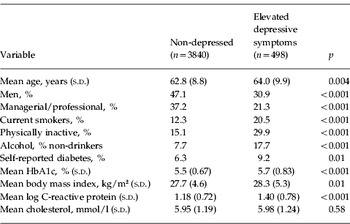
The proportion of the sample that was classified with elevated depressive symptoms (CES-D ⩾4) at baseline and follow-up was 12.7% and 11.5%, respectively. Participants with depressive symptoms at follow-up were older, more likely to be women, smoke, be physically inactive, non-drinkers and come from lower socio-economic groups (Table 1). In addition, they were more likely to have a diabetes diagnosis and higher HbA1c, body mass index and CRP.
Baseline characteristics of participants in relation to depressive symptoms at follow-up

s.d., Standard deviation; HbA1c, glycated haemoglobin.
Cross-sectional associations between diabetes and depressive symptoms
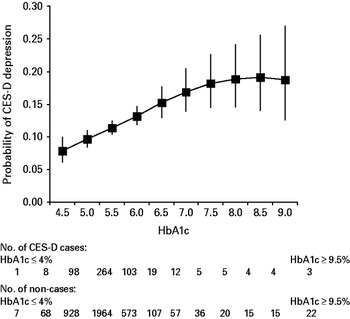
In cross-sectional analyses, HbA1c (p=0.01) and HbA1c2 (p=0.03) were associated with depressive symptoms, suggesting the presence of a curvilinear association. Between the HbA1c range 4.5% to 9.0%, the probability of depressive symptoms increased with increasing HbA1c levels until the value of 8.0% after which there was a plateau (see Fig. 1). The risk of depressive symptoms at baseline was elevated in participants that reported injecting insulin (n=70) (age-adjusted OR 1.84, 95% CI 1.02–3.34) and in diabetic participants who reported limited knowledge about diabetes management (n=44) (age-adjusted OR 3.19, 95% CI 1.48–6.89) compared with those with adequate knowledge.
Association between glycated haemoglobin (HbA1c) and probability of elevated depressive symptoms [eight-item Centre of Epidemiological Studies – Depression (CES-D) score ⩾4] at baseline (n=4338; only HbA1c categories with n>10 are shown). Error bars represent 95% confidence intervals.

Longitudinal associations between diabetes and depressive symptoms
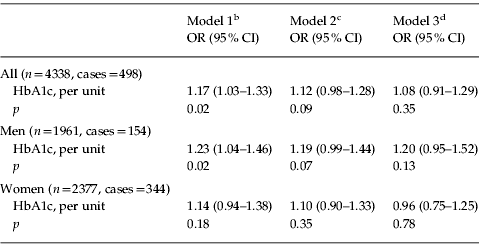
In longitudinal analyses, HbA1c was associated with future risk of elevated depressive symptoms after controlling for depressive symptoms at baseline (see Table 2), although there was no evidence of a curvilinear association. The associations appeared to be slightly stronger in men but the sex–HbA1c interaction term was non-significant (p=0.08). The addition of further covariates to the model attenuated these associations, especially in women. In the fully adjusted model, the association between HbA1c and depressive symptoms no longer remained statistically significant at conventional levels. The removal of participants reporting depressive symptoms at baseline did not change the results. The other independent predictors of depressive symptoms in this sample included non-alcohol drinkers (OR 1.70, 95% CI 1.17–2.46), physical inactivity (OR 1.33, 95% CI 0.97–1.83), lower social status (OR 1.51, 95% CI 1.15–2.00) and higher log CRP (OR per unit increase 1.18, 95% CI 1.03–1.36).
Logistic regression models for HbA1c and risk of future depressive symptoms over 2 years of follow-up in ELSA (n=4338)Footnote a
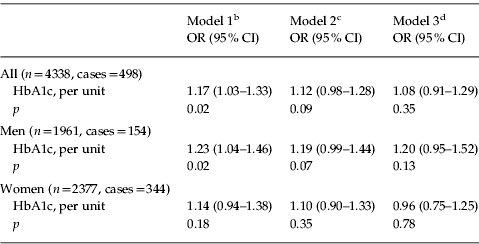
HbA1c, Glycated haemoglobin; ELSA, English Longitudinal Study of Ageing; CES-D, Centre of Epidemiological Studies – Depression; OR, odds ratio; CI, confidence interval.
a Cases defined as a score of ⩾4 on the eight-item CES-D scale.
b Model 1 adjusted for age and baseline CES-D score.
c Model 2 as model 1 plus smoking, alcohol intake, physical activity and social status.
d Model 3 as model 2 plus C-reactive protein, cholesterol, body mass index and self-reported diabetes.
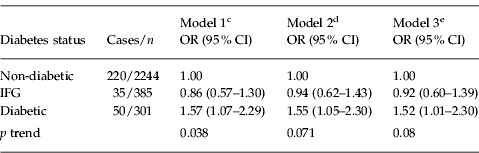
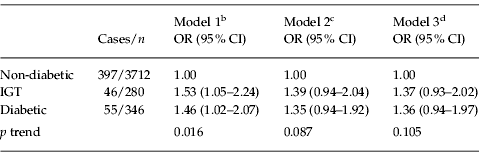
When we examined the risk of depressive symptoms based on diabetes status (Tables 3 and 4), participants with diabetes were at the highest risk of future depression, whether defined using fasting glucose or HbA1c. Impaired fasting glucose, as defined from fasting blood glucose levels, was not associated with future risk of depressive symptoms (Table 3). However, impaired glucose tolerance, as defined from HbA1c, was moderately associated with depressive symptoms (Table 4). There was no statistically significant increased risk of depressive symptoms at follow-up (age- and baseline depression-adjusted OR 1.20, 95% CI 0.58–2.51) in participants that reported injecting insulin at baseline. Similarly, there was no association between knowledge about diabetes management and depressive symptoms at follow-up (age- and baseline depression-adjusted OR 0.94, 95% CI 0.34–2.58).
Association between baseline diabetes status (using fasting glucose)Footnote a and risk of future depressive symptoms (n=2930)Footnote b
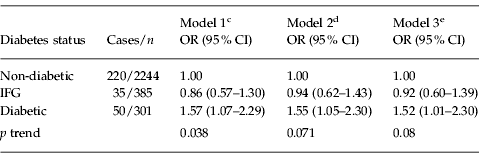
OR, Odds ratio; CI, confidence interval; IFG, impaired fasting glucose; CES-D, Centre of Epidemiological Studies – Depression.
a Diabetes categories based on fasting glucose and self-report: non-diabetic (fasting glucose <5.6 mmol/l and no self-reported diabetes); IFG (fasting glucose 5.6–6 .9 mmol/l); diabetic (based on either fasting glucose ⩾7.0 mmol/l, self-reported doctor's diagnosis or use of diabetes medication).
b Data unavailable in 1408 participants.
c Model 1 adjusted for age and baseline CES-D score.
d Model 2 adjusted as model 1 plus for sex, smoking, alcohol intake, physical activity and social status.
e Model 3 adjusted as model 2 plus for C-reactive protein, cholesterol and body mass index.
Association between baseline diabetes status (using HbA1c)Footnote a and risk of future depressive symptoms (n=4338)
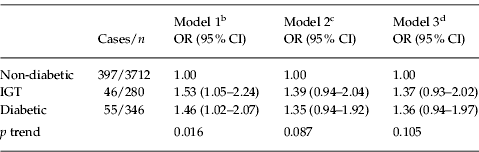
HbA1c, Glycated haemoglobin; OR, odds ratio; CI, confidence interval; IGT, impaired glucose tolerance; CES-D, Centre of Epidemiological Studies – Depression.
a Diabetes categories based on HbA1c values and self-report: non-diabetic (HbA1c <6% and no self-reported diabetes); IGT (HbA1c 6.0–6 .5% and no self-reported diabetes); diabetic (based on either HbA1c >6.5%, self-reported doctor's diagnosis or use of diabetes medication).
b Model 1 adjusted for age and baseline CES-D score.
c Model 2 adjusted as model 1 plus for sex, smoking, alcohol intake, physical activity and social status.
d Model 3 adjusted as model 2 plus for C-reactive protein, cholesterol and body mass index.
Discussion
In the present study we examined the longitudinal association between glucose metabolism and depressive symptoms in a large cohort of older British adults. We showed that HbA1c was associated with incident elevated depressive symptoms over 2 years of follow-up, especially in men.
Cross-sectionally, the probability of depressive symptoms increased with increasing HbA1c levels until approximately the value of 8%, after which there was a plateau. In longitudinal analyses, we found a modest association between diagnosed diabetes at baseline and depressive symptoms at follow-up. The magnitude of this association is comparable with a recent study that employed data from general practices to examine the association between diabetes and subsequent risk of depression (Aarts et al. Reference Aarts, van den Akker, van Boxtel, Jolles, Winkens and Metsemakers2009). Injecting insulin and limited knowledge about diabetes management were both associated with a greater risk of reporting depressive symptoms at baseline, but these factors did not predict subsequent depression at follow-up after taking into account the baseline association. Consistent with cross-sectional findings from other recent studies (Adriaanse et al. Reference Adriaanse, Dekker, Heine, Snoek, Beekman, Stehouwer, Bouter, Nijpels and Pouwer2008; Gale et al. Reference Gale, Kivimaki, Lawlor, Carroll, Phillips and Batty2010), participants with impaired glucose metabolism at baseline were at risk of subsequent depression. However, in several other studies impaired glucose tolerance or undiagnosed diabetes was associated with a lower risk of depression (Golden et al. Reference Golden, Lazo, Carnethon, Bertoni, Schreiner, Diez Roux, Lee and Lyketsos2008; Icks et al. Reference Icks, Kruse, Dragano, Broecker-Preuss, Slomiany, Mann, Jöckel, Erbel, Giani and Moebus2008) or not associated with depression at all (Knol et al. Reference Knol, Heerdink, Egberts, Geerlings, Gorter, Numans, Grobbee, Klungel and Burger2007; Rhee et al. Reference Rhee, Musselman, Ziemer, Vaccarino, Kolm, Weintraub, Caudle, Varughese, Irving and Phillips2008; Aujla et al. Reference Aujla, Abrams, Davies, Taub, Skinner and Khunti2009; Holt et al. Reference Holt, Phillips, Jameson, Cooper, Dennison and Peveler2009). Indeed, when we used fasting glucose as an indicator of impaired fasting glucose there was no association with depression. Therefore these discrepancies might possibly be explained by differences in the methods to assess glucose metabolism, and also characteristics of the samples and measures of depression. However, given that the majority of previous studies have been cross-sectional, the prospective nature of our study adds considerably to the current evidence base.
The highest probability of depression was observed at HbA1c levels of 8–9%, which might reflect unrecognized, pre-clinical diabetes and the presence of undiagnosed symptoms. We did not observe increased risk of depressive symptoms among individuals with very low glucose levels. Such an association was previously observed in the Whitehall II cohort (Kivimäki et al. Reference Kivimäki, Tabak, Batty, Singh-Manoux, Jokela, Akbaraly, Witte, Brunner, Marmot and Lawlor2009), but not in the Vietnam Experience Study, where study participants were, on average, 20 years younger (Gale et al. Reference Gale, Kivimaki, Lawlor, Carroll, Phillips and Batty2010). The reason for this discrepancy was suggested to be a higher prevalence of underlying chronic conditions that potentially relate to low glucose and increased depression risk in Whitehall II. However, the participants in the present study were older than those in both previous studies and we observed no elevation in depression towards the low end of the HbA1c distribution. Lastly, slightly stronger associations between HbA1c and depressive symptoms were observed among men, although these sex differences were not statistically significant (p=0.08 for sex interaction). The reasons for this possible sex difference remain unclear and the findings are not consistent with a recent study in women (Pan et al. Reference Pan, Lucas, Sun, van Dam, Franco, Manson, Willett, Ascherio and Hu2010). The mechanisms linking diabetes and depression also remain unclear. Depression could result from the biochemical changes directly caused by diabetes, its treatment, or from the distress associated with living with diabetes and its often debilitating consequences. For example, preliminary evidence found brain abnormalities, such as reduced white matter volume and enlarged cerebrospinal fluid space, in obese adolescents with type 2 diabetes, which might result from a combination of subtle vascular changes and glucose abnormalities (Yau et al. Reference Yau, Javier, Ryan, Tsui, Ardekani, Ten and Convit2010). A common causal pathway for depression and diabetes is also a possibility, with early factors, such as low birth weight and childhood adversity, predisposing individuals to both obesity and type 2 diabetes (Thomas et al. Reference Thomas, Hyppönen and Power2008; de Lauzon-Guillain et al. Reference de Lauzon-Guillain, Balkau, Charles, Romieu, Boutron-Ruault and Clavel-Chapelon2010) and depression (Colman et al. Reference Colman, Ploubidis, Wadsworth, Jones and Croudace2007).
The strengths of this study include the sampling of a large, representative general population-based group, and the well-characterized study members, which facilitates insights into the role of potential confounding factors, and the prospective element of the study design. The limitations of the present study should also be recognized. Participants retained in our analyses generally reported lower levels of depressive symptoms and better health compared with the overall sample, although the analytic approach that we used accounted for missing data in estimating the association between glucose indicators, diabetes and depression. In fact, weighting for non-response actually had a minimal impact on the results, providing evidence against bias due to selective sample retention. Although the definition of diabetes was not only based on self-report but also on objective blood measures, we were unable to differentiate between types 1 and 2. However, it is likely that the majority of cases were type 2 since this is by far the most prevalent condition in the general adult population.
Conclusions
These data from the English Longitudinal Study of Ageing suggest that diabetes is associated with an excess risk of future depressive symptoms in older adults. Considering the totality of data from this study and previous investigations, there seems to be no convincing evidence to support an elevated risk of depression at low levels of fasting glucose and HbA1c. Our findings support the current recommendations of the American Diabetes Association (2008) to screen diabetic patients for depression.
Acknowledgements
The data were made available through the UK Data Archive. ELSA was developed by a team of researchers based at University College London, the Institute of Fiscal Studies and the National Centre for Social Research. The funding was provided by the National Institute on Aging in the United States (grants 2RO1AG7644-01A1 and 2RO1AG017644) and a consortium of UK government departments coordinated by the Office for National Statistics. M.H. is supported by the British Heart Foundation (RG 05/006); G.D.B. is a Wellcome Trust Career Development Fellow (WBS U.1300.00.006.00012.01); M.K. is supported by the National Heart, Lung, and Blood Institute (R01HL036310-20A2) and the National Institute on Aging (R01AG034454-01), US National Institutes of Health and the Academy of Finland. The Medical Research Council (MRC) Social and Public Health Sciences Unit receives funding from the UK MRC and the Chief Scientist Office at the Scottish Government Health Directorates.
The funders had no role in the study design; in the collection, analysis and interpretation of data; in writing of the report; or in the decision to submit the paper for publication. The developers and funders of ELSA and the Archive do not bear any responsibility for the analyses or interpretations presented here.
Declaration of Interest
None.