Introduction
Cognitive impairment is a core feature of schizophrenia, and essentially all cognitive domains are frequently impaired in schizophrenia (Heinrichs & Zakzanis, Reference Heinrichs and Zakzanis1998). Moreover, cognitive deficits are strongly associated with lower levels of psychosocial functioning (Bowie et al., Reference Bowie, Depp, McGrath, Wolyniec, Mausbach, Thornquist and Pulver2010). Consequently, several psychological treatment strategies have been developed to improve cognitive function and are now subsumed under the term cognitive remediation (McGurk, Twamley, Sitzer, McHugo, & Mueser, Reference McGurk, Twamley, Sitzer, McHugo and Mueser2007; Wykes, Huddy, Cellard, McGurk, & Czobor, Reference Wykes, Huddy, Cellard, McGurk and Czobor2011). Cognitive remediation has been shown to improve cognition and can generalize to functional outcome, particularly when cognitive remediation is combined with comprehensive rehabilitation.
Although there is considerable evidence for the efficacy of cognitive remediation in schizophrenia, little is known about potential predictors of a favorable treatment response. The few studies conducted vary considerably in outcome measures and training interventions. Overall, there is some evidence that even severe cognitive impairment at baseline does not preclude gains through cognitive remediation (Medalia & Richardson, Reference Medalia and Richardson2005). A recent study has even reported stronger improvement for patients with lower baseline cognitive performance and symptom severity during a compensatory cognitive training intervention (Twamley, Burton, & Vella, Reference Twamley, Burton and Vella2011). In contrast, other studies suggest that baseline attention, working memory, and executive function deficits might limit the gains from cognitive remediation (Fiszdon, Cardenas, Bryson, & Bell, Reference Fiszdon, Cardenas, Bryson and Bell2005; Kurtz, Seltzer, Fujimoto, Shagan, & Wexler, Reference Kurtz, Seltzer, Fujimoto, Shagan and Wexler2009; Vita et al., Reference Vita, Deste, De Peri, Barlati, Poli, Cesana and Sacchetti2013). Other authors have argued that intrinsic motivation and treatment adherence might play a more important role for treatment success than cognitive variables (Medalia & Saperstein, Reference Medalia and Saperstein2011). In an important recent study, Vita and colleagues have emphasized the potential negative predictive value of antipsychotic dose at baseline (Vita et al., Reference Vita, Deste, De Peri, Barlati, Poli, Cesana and Sacchetti2013). Finally, shorter illness duration and younger age have been reported to be associated with stronger improvement during cognitive remediation (Bowie, Grossman, Gupta, Oyewumi, & Harvey, Reference Bowie, Grossman, Gupta, Oyewumi and Harvey2014; Kontis, Huddy, Reeder, Landau, & Wykes, Reference Kontis, Huddy, Reeder, Landau and Wykes2013). All of these authors have highlighted the need for future studies to address the question which patient is most likely to benefit from cognitive remediation. Importantly, it is unknown whether different variables predict success of different types of remediation interventions, in particular when different cognitive constructs are addressed through training.
We address this question using data from a randomized controlled trial examining the effects of problem-solving training versus training of basic cognition (Rodewald et al., Reference Rodewald, Rentrop, Holt, Roesch-Ely, Backenstrass, Funke and Kaiser2011). In this trial strong differential effects were observed on problem-solving capacity as assessed with Plan-a-Day, a new instrument to assess complex planning and problem-solving ability. This is of particular relevance, because Plan-a-Day emulates real-world situations and Plan-a-Day performance has been shown to be a good predictor of global functioning (Holt et al., Reference Holt, Rodewald, Rentrop, Funke, Weisbrod and Kaiser2011). In the present study, we asked which baseline variables predict improvement of problem-solving ability as assessed by Plan-a-Day in response to either a specific problem-solving training or a general training of basic cognition.
Methods
Clinical Trial Design
We carried out a single-blind randomized trial comparing a training of planning and problem-solving ability (PLAN) against basic cognitive training. All participants received training interventions and a 3-week course of inpatient work therapy at an inpatient rehabilitation clinic. Patients fulfilled DSM-IV criteria for schizophrenia or schizoaffective disorder as confirmed by the MINI International Neuropsychiatric Interview. Further inclusion criteria were (1) age between 18 and 45, (2) being in a non-acute phase of illness (defined by all PANSS positive items <5), and (3) having an estimated IQ of 80 or above. Exclusion criteria were (1) diagnosis of a neurological disorder, (2) illicit substance use during the last month, and (3) a current comorbid Axis-I disorder.
Patients (n = 77) engaged in 10 training sessions of computer-based cognitive exercises over 3 weeks either targeting planning and problem-solving or basic cognition. Average treatment attendance was 8.4 of 10 sessions. Both training regimes were implemented with the RehaCom Software Package (Hasomed GmbH, Germany). Each session lasted 45 min and took place in small groups. The experimental group trained planning and problem-solving via PLAN, a training concept that was originally developed by Funke and Krüger (Reference Funke and Krüger1995). It focuses on training participants to use a small set of simple but effective planning and decision-making heuristics (e.g., “most important tasks always first” or “maximize number or errands completed”) that provide effective strategies for dealing with common goal-conflict situations in Plan-a-Day and everyday life. The basic cognition group trained three different tasks: processing speed, attention/concentration and topological memory.
A more detailed description of the study design has been published in another study that describes a differential improvement in functional outcome based on two different cognitive trainings (Rodewald et al., Reference Rodewald, Rentrop, Holt, Roesch-Ely, Backenstrass, Funke and Kaiser2011). The study was approved by the local ethics committee and all participants provided written informed consent. The clinical trial registration number is NCT00507988 (clinicaltrials.gov).
Criterion Variable: Problem-solving Ability
Planning and problem-solving ability in a complex real-world scenario was measured with the Plan-a-Day test. The Plan-a-Day test and the PLAN training are both based on a daily errands scheduling paradigm, but differ in user interface, task sets, available operators, and solution strategies required. We have previously shown that the Plan-A-Day test accounts for more variance in the Global Assessment of Functioning than other planning tests (Holt et al., Reference Holt, Rodewald, Rentrop, Funke, Weisbrod and Kaiser2011).
Predictors: Cognitive Functions
The following cognitive functions were assessed: working memory maintenance: digit span forward (Von Aster, Neubauer, & Horn, Reference Von Aster, Neubauer and Horn2006), corsi block tapping forward (Schellig, Reference Schellig1993); working memory manipulation: digit span backward (Von Aster et al., Reference Von Aster, Neubauer and Horn2006), letter-number-sequencing (Von Aster et al., Reference Von Aster, Neubauer and Horn2006), corsi block tapping backward (Schellig, Reference Schellig1993); processing speed: Trail Making Test A (Reitan, Reference Reitan1992), Stroop neutral condition (color naming) (Markela-Lerenc, Kaiser, Fiedler, Weisbrod, & Mundt, Reference Markela-Lerenc, Kaiser, Fiedler, Weisbrod and Mundt2006), shifting: Trail Making Test B (Reitan, Reference Reitan1992), Stroop incongruent condition (Markela-Lerenc et al., Reference Markela-Lerenc, Kaiser, Fiedler, Weisbrod and Mundt2006), planning: Zoo-Map (Ufer, Reference Ufer2000), planning test (Kohler & Beck, Reference Kohler and Beck2004) and premorbid intelligence: multiple choice vocabulary test—MWT-B (Lehrl, Reference Lehrl2005). Scores were Z-transformed and summarized for the above described domains.
Predictors: Clinical Variables
Symptoms were assessed by trained research psychologists using the Positive and Negative Syndrome Scale – PANSS. We used the consensus factor model proposed by Wallwork, Fortgang, Hashimoto, Weinberger, and Dickinson, (Reference Wallwork, Fortgang, Hashimoto, Weinberger and Dickinson2012).
All patients were treated with atypical antipsychotic medication. Medication dosage was transformed to chlorpromazine equivalents (Andreasen, Pressler, Nopoulos, Miller, & Ho, Reference Andreasen, Pressler, Nopoulos, Miller and Ho2010).
Predictors: Training Variables
The number of attended training sessions was recorded. Furthermore, for the PLAN training group we extracted the participant's progress through the training program. Finally, participants filled out a questionnaire to assess task motivation at the end of the training (Rheinberg, Vollmeyer, & Burns, Reference Rheinberg, Vollmeyer and Burns2001). We summarized the questionnaires’ subscales “interest,” “challenge,” and “probability of success,” because they best reflect the construct of intrinsic motivation.
Statistical Analysis
We calculated Pearson correlations between potential predictors at baseline and change in problem-solving capacity pre-/post-training separately for both training groups. Cognitive and clinical variables at baseline as well as training related variables were regarded as potential predictors (see Table 2 for overview). We used SPSS Version 16 for statistical analyses. All statistical tests were two-tailed, and significance was determined as p < .05.
Results
Comparison of Both Groups at Baseline
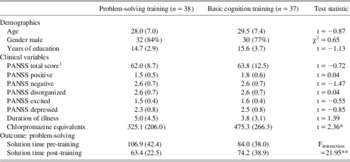
The training groups did not show significant differences for demographic and symptom variables (see Table 1). However, antipsychotic dose was higher in the basic cognitive training group.
Baseline characteristics of training group and change in problem-solving

1For the Positive and Negative Syndrome Scale (PANSS) the sum of all item scores is given. In contrast, for factor scores average item scores are given to provide a more intuitive grading of symptom severity.
*p < .05, **p < .001.
Change in Problem-Solving Ability
The main focus of the original study was a differential effect of two training interventions on cognition and functional capacity. As reported by Rodewald and colleagues, both groups improved on measures of cognitive functioning and functional capacity (Rodewald et al., Reference Rodewald, Rentrop, Holt, Roesch-Ely, Backenstrass, Funke and Kaiser2011). The planning and problem-solving training led to stronger improvement on Plan-a-Day solution time (see Table 1). In an exploratory analysis, we found a significant time by group interaction for reaction time in the neutral condition (color naming) of the Stroop test (F[1,69] = 8.22; p < .01), suggesting an advantage for basic cognitive training.
Correlational Analysis within the Problem-Solving Training Group
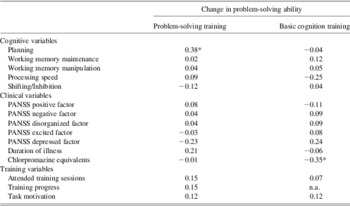
An overview of the correlational analyses is given in Table 2. Pearson correlations yielded a significant relationship only between the change in problem-solving ability and pre-training planning ability, that is, the summarized Z-score for solution time in the Tower of London analogue and the Zoo-map task. In other words patients who were most impaired in the planning domain showed the strongest benefit from a domain specific training. No other cognitive, clinical (including antipsychotic dose) or training variable was significantly correlated with change in problem-solving ability.
Correlational Analysis within the Basic Cognition Training Group
In the basic cognition training group only the medication dosage in chlorpromazine equivalents was significantly correlated with change in problem-solving ability, indicating less improvement with higher baseline antipsychotic dose (see Table 2). No significant correlations were found between change in problem-solving ability and any other demographic, cognitive (including pre-training planning ability) or clinical variable.
Correlations between change in problem-solving capacity and cognitive, clinical and training variables

*p < .05.
To assess whether antipsychotic dose was related to clinical or cognitive variables we calculated correlations with all PANSS factor scores and all cognitive domain scores at baseline. Antipsychotic dose was not significantly correlated with any of these variables including processing speed (all p > .1).
Discussion
The present study shows that the predictors of improvement in problem-solving ability during cognitive remediation depend on the type of remediation program used. When patients trained planning and problem-solving, their improvement in this domain was predicted only by planning ability at baseline. Planning impairment was associated with stronger benefit from specific problem-solving training. In contrast, for the basic cognition training improvement of problem-solving ability was negatively predicted by antipsychotic medication dosage. This dissociation of predictors indicates that the predictive effect of planning ability at baseline does not merely reflect regression to the mean. Instead, it suggests a genuine interaction of baseline variables and the type of remediation treatment. These findings have several implications.
First, our findings suggest that—in the planning domain—patients benefit from training a specific cognitive function that has been identified as impaired. This relates to an ongoing discussion about the optimal strategy for cognitive remediation regarding whether one should specifically attempt to improve impaired functions (Silverstein & Wilkniss, Reference Silverstein and Wilkniss2004). An important recent trial suggests that there might be little difference between a generic approach and remediation targeted toward areas of individual impairment (Franck et al., Reference Franck, Duboc, Sundby, Amado, Wykes, Demily and Vianin2013). While there are considerable differences between studies, our findings suggest that for the domain of planning and problem-solving an individualized approach specifically targeting this impairment could be of value.
Second, considering that both training forms were of comparable effectiveness (Rodewald et al., Reference Rodewald, Rentrop, Holt, Roesch-Ely, Backenstrass, Funke and Kaiser2011), the presence of training-specific moderator variables suggests different neurocognitive mechanisms underlying the training gains. Since the planning and problem-solving training is largely a cognitive strategy training, it may be particularly suited to compensate specific strategy deficits as reflected in baseline planning ability. In contrast, the basic cognition training is more strongly aimed at enhancing basic cognitive capacity independent of specific strategies.
Third, in the basic cognition group, improvement on planning and problem-solving was dependent on baseline antipsychotic dose. This association of cognitive remediation effects with antipsychotic dose is a recent finding and has to our knowledge only been reported in a recent study by Vita and colleagues (2013). This study found a negative impact of higher baseline antipsychotic dose for both training programs used. However, a direct comparison between studies is difficult, because of major differences in the interventions. In line with Vita et al., we propose two possible reasons for the negative impact of antipsychotic dose on treatment success. First, higher antipsychotic dose could characterize more severely impaired patients, but neither the Vita study nor our own study provides any direct evidence for this assumption. In our study antipsychotic dose was not related to clinical or cognitive variables at baseline. Second, antipsychotic medication could have a negative impact on learning processes required for successful remediation. Preclinical and clinical studies have long suggested a negative effect of dopamine antagonists on incentive and reinforcement learning (Cutmore & Beninger, Reference Cutmore and Beninger1990; Ettenberg, Reference Ettenberg1989). This might be particularly relevant in our basic cognitive training, in which learning from positive feedback is essential for improving performance.
In addition to the observed predictors, it is also important to briefly address the variables not found to predict improvement during training. We did not find any relationship between baseline symptoms and improvement during training, which is in line with previous reports (Kurtz et al., Reference Kurtz, Seltzer, Fujimoto, Shagan and Wexler2009). We were particularly interested in the effects of motivation as its role has been recently emphasized in the literature (Medalia & Saperstein, Reference Medalia and Saperstein2011). However, we did not find an effect of negative symptoms or intrinsic motivation, which capture different aspects of motivation. Furthermore, in contrast to previous reports the number of attended training sessions did not predict improvement (Medalia & Richardson, Reference Medalia and Richardson2005). The missing effect of motivation and attendance is most likely related to the fact that our study was conducted in an inpatient rehabilitation setting with high treatment adherence (Scheu et al., Reference Scheu, Aghotor, Pfueller, Moritz, Bohn, Weisbrod and Roesch-Ely2013).
The current study has some important limitations. First, the cognitive and functional impairments in our patient sample were not as severe as in some previous studies, which might limit generalizability of the findings. Second, our remediation program was short in comparison with most current studies and focused on a narrower range of cognitive functions. However, meta-analyses have suggested that even short interventions are effective (McGurk et al., Reference McGurk, Twamley, Sitzer, McHugo and Mueser2007; Wykes et al., Reference Wykes, Huddy, Cellard, McGurk and Czobor2011). Nevertheless, it is an open question whether our findings can apply to longer, more comprehensive interventions. Third, randomization resulted in a higher antipsychotic dose at baseline in the basic cognitive training group, which could contribute to its differential predictive power in this group. Finally, the study was conducted in an inpatient rehabilitation program, which limits generalization to less structured outpatient treatment settings.
Overall, the present study shows that improvement in problem-solving ability is differentially predicted depending on the training program used. In the problem-solving group, the most impaired patients in this domain showed the strongest benefit. In contrast, in the basic cognition training group remediation success was predicted by antipsychotic dosing. To our knowledge, this is the first study to show that the predictors of remediation success strongly depend on the remediation program used. Although the present study is focused on two specific interventions in a restricted setting, our findings have clear implications for further research. Predictors of cognitive remediation will have to be found specifically for each type of training program to allow for an optimal individualization of treatment. Furthermore, regarding the development of individualized cognitive remediation our results suggest that at least in the planning domain patients with impaired performance benefit particularly from a specific intervention.
Acknowledgments
Funding of this study was provided by the German Federal Ministry of Education and Research (Bundesministerium für Bildung und Forschung), grant number 01GW0639. Michael Liebrenz was financially supported by the Prof. Dr. Max Cloëtta foundation, Zurich, Switzerland and the Uniscientia foundation, Vaduz, Principality of Liechtenstein. Daniel Holt and Joachim Funke receive royalties for the PLAN training program from Schuhfried GmbH, Austria. Matthias Weisbrod, Daniela Roesch-Ely and Stefan Kaiser receive royalties for other cognitive test and training software from Schuhfried GmbH, Austria. All other authors report no potential conflict of interest.