Introduction
Canine heartworm disease (dirofilariosis) caused by the Dirofilaria immitis is a zoonotic parasitic disease inhabiting the right ventricle and pulmonary artery of infected dogs. Dirofilariosis is a disease with worldwide distribution, endemically seen in temperate, tropical and subtropical countries (Marquardt et al., Reference Marquardt, Demaree and Grieve2000). In recent years, many epidemiological studies have been performed in many countries, including Tanzania (Matola, Reference Matola1991), Japan (Hatsushika et al., Reference Hatsushika, Okino, Shimizu and Ohyama1992), USA (Theis et al., Reference Theis, Stevens, Thedoropoulos and Ziedins1999; Nelson et al., Reference Nelson, McCall, Rubin, Buzhardt, Dorion, Graham, Longhofer, Guerrero, Robertson-Plouch and Paul2005), Spain (Aranda et al., Reference Aranda, Panyella, Eritja and Castella1998), Canada (Klotins et al., Reference Klotins, Martin, Bonnett and Peregrine2000), Italy (Cringoli et al., Reference Cringoli, Rinaldi, Veneziano and Capelli2001), Argentina (Rosa et al., Reference Rosa, Ribicich, Betti, Kistermann, Cardillo, Basso and Hallu2002; Vezzani et al., Reference Vezzani, Eiras and Wisnivesky2006), South Korea (Song et al., Reference Song, Lee, Hayasaki, Shiramizu, Kim and Cho2003), Brazil (Reifur et al., Reference Reifur, Thomaz-Soccol and Montiani-Ferreira2004), Europe (Genchi et al., Reference Genchi, Rinaldi, Cascone, Mortarino and Cringoli2005) and South America (Labarthe & Guerrero, Reference Labarthe and Guerrero2005).
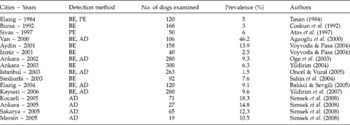
It is also known that Turkey is an endemic region for dirofilariosis. Several studies have been reported regarding the prevalence of dirofilariosis in dogs from different regions of Turkey (table 1). It is of interest to determine the geographical distribution of the disease, which may be associated with ecological factors, such as existence of water, rich vegetation and mosquitoes all year round, that are important for the biological cycle of D. immitis (Rosa et al., Reference Rosa, Ribicich, Betti, Kistermann, Cardillo, Basso and Hallu2002). In this study, the purpose was to determine the prevalence of D. immitis and the risk factors of canine heartworm disease in Hatay province.
Prevalence of D. immitis in dogs previously reported in different provinces of Turkey.

AD, antigen detection of adult D. immitis; BE, blood examination for microfilariae detection; and PE, post-mortem examination for adult D. immitis detection.
Materials and methods
Study areas and sampling
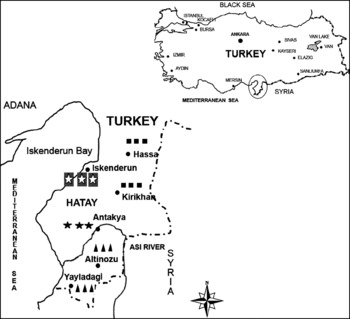
Hatay province is located in the south of Turkey on the east Mediterranean coast. The climate of this province is typical of the Mediterranean region, with warm, wet winters and hot summers with high humidity (higher than 69%). A total of 269 owned dogs (older than 6 months) were randomly selected from six districts of Hatay province in this multi-centre survey. Iskenderun (shoreline area), Antakya (riverside area), Kirikhan and Hassa (lowland area), and Yayladagi and Altinozu (mountainous area) were selected for sampling between March and July 2006 (fig. 1). A 4 ml blood sample was withdrawn from the cephalic vein of each dog, and transferred to an EDTA-containing tube during daytime. Whole blood samples were centrifuged at 3000 rpm at room temperature, and the plasma samples obtained were stored at − 18°C until analysis. A questionnaire was recorded regarding the dog's age, sex, breed (large breed or small breed) and housing (indoor or outdoor), and prophylactic measures, if used for heartworm disease.
Location of study areas in Hatay province and the different cities of Turkey shown in table 1: (black star) riverside; (white star in black rectangle) shoreline area; (black rectangle) lowland areas; and (black triangle) mountain areas of Hatay province.

Questionnaire
A total of 269 owned dogs with ages ranging from 6 months to 14 years were examined in the present study: 221 dogs (82.2%) were male and 48 dogs (17.8%) female; 196 dogs (72.9%) were of larger breeds heavier than 20 kg (Kangal dog, pointer, collie, german shepherd, boxer, setter, dalmatian, husky, golden retriever, and mixed breed) and 73 dogs (27.1%) were of smaller breeds (terrier, poodle, cocker, Yorkshire terrier, pincher, and mixed breed). One hundred and five dogs (39.0%) were aged 0.5–2 years, 103 (38.3%) were 2–4 years old, 26 (9.7%) were 4–6 years old and 35 (13.0%) were older than 6 years; 212 dogs (78.8%) were living outdoors and 57 dogs (21.2%) were living indoors. None of the dogs had received specific heartworm prophylaxis.
Detection of microfilariae and D. immitis adult antigen
One millilitre of each blood sample was processed using a modified Knott method (Georgi et al., Reference Georgi, Georgi and Theodorides1990). The identification of filarial species was based on well-established morphological criteria (Watson et al., Reference Watson, Testoni and Porges1973). Circulating D. immitis antigen was detected by use of a commercial antigen enzyme-linked immunosorbent assay (ELISA) kit (DiroCHEK, Synbiotics Corp., San Diego, California, USA) with spectrophotometry, according to the manufacturer's instructions. DiroCHEK canine heartworm antigen test kit is an enzyme immunoassay designed to detect the presence of circulating antigen from adult females of D. immitis.
Statistical analysis
The chi-square test was performed to compare the prevalence of D. immitis according to sex, age, district, housing and breed categories (large breed or small breed).
Results
Prevalence of infection
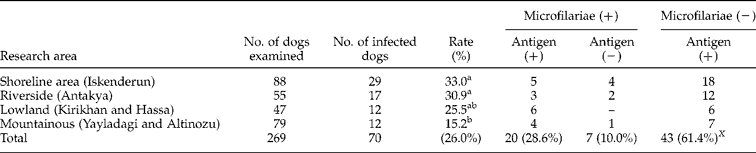
Seventy out of 269 tested dogs (26.0%) were positive for D. immitis infection with microfilariae and/or antigen detection tests. The individual results of the DiroCHEK heartworm antigen and microfilariae tests are shown in table 2. Sixty-three (23.4%) out of 269 samples tested positive with the antigen-detecting ELISA. In addition, 43 (61.4%) of the positive dogs were determined to have occult D. immitis infection; however, seven dogs (10.0%) were antigen negative but microfilariae positive. The regional distribution of canine heartworm disease in Hatay province is also shown in table 2. Canine heartworm prevalence showed a heterogeneous pattern in different regions of Hatay province. The highest rates were detected in the shoreline area (33.0%) and riverside (30.9%), followed by lowland (25.5%) and mountainous (15.2%) areas.
Overall heartworm prevalence in Hatay province.
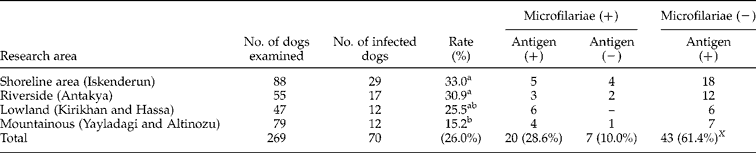
a,b The different letters indicate a significant difference among groups by chi-square test (P < 0.05).
X Prevalence rate of occult Dirofilaria immitis infection.
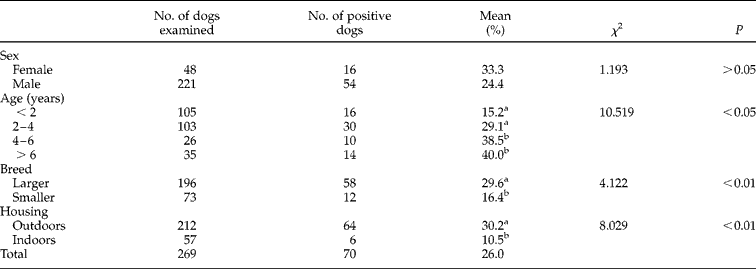
The results of the association analysis of different factors with heartworm disease are presented in table 3. No differences in prevalence were observed between the sexes (females, 33.3%; males, 24.4%, P>0.05). The mean overall positivity rates of D. immitis infection were 15.2% in the 0.5–2-year-old group, 29.1% in the 2–4-year-old group, 38.5% in the 4–6-year-old group, and 40.0% in the group older than 6 years. In the present study, the prevalence of dirofilariosis in heavier dogs (>20 kg) (29.6%) was found to be statistically higher compared to that of lighter dogs (16.4%, P < 0.05). The prevalence rates of dogs kept outdoors (30.2%) and indoor dogs (10.5%) were statistically different (P < 0.05).
The prevalence of D. immitis correlated with sex, age, breed (large breed or small breed) and housing.
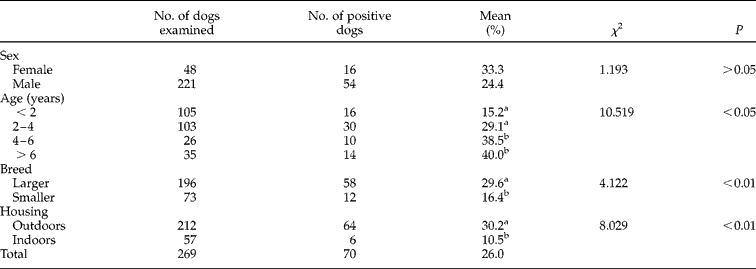
a,b The different letters indicate a significant difference among groups by chi-square test.
Discussion
Dirofilariosis is a serious disease and has long been known to spread from tropical and subtropical provinces to temperate-zone countries such as Turkey. The geographical distribution of the disease is important for the biological cycle of D. immitis (Rosa et al., Reference Rosa, Ribicich, Betti, Kistermann, Cardillo, Basso and Hallu2002). The weather is a critical factor affecting the prevalence of this disease. Hot weather and suitable temperatures are necessary for the development of mosquitoes to produce third-stage larval development in the intermediate host; the worm needs temperatures higher than 18°C for nearly 1 month (Montoya et al., Reference Montoya, Morales, Ferrer, Molina and Corbera1998). Hatay is located in a temperate zone with a hot and humid environment from April to November (17.2–32.4°C) and the mean humidity is higher than 69% throughout the year (Turkish State Meteorological Service, 2008). This is conducive for growth and reproduction of mosquitoes. In Turkey, the prevalence of D. immitis ranges from 1.5 to 46.2% (table 1). These different prevalence rates may reflect different testing methodologies (post-mortem inspection, detection of microfilariae and serological testing) or regional differences. In the present study, it was found that D. immitis had a high prevalence (26.0%) in the dogs from Hatay province. This result showed that Hatay province was the second highest prevalence following the Van province, located in Van Lake (46.2%), and the value is close to that of shoreline areas like Kocaeli province (18.3%). However, the lowland areas of Turkey (Kayseri, Elazig and Ankara) presented a lower prevalence of heartworm infection compared to our result (nearly 10%).
The prevalence of canine heartworm disease varied regionally, with higher values in shoreline areas and riversides and lower values in the lowland and mountainous areas. The geographic distribution of D. immitis is mainly on riverside and shoreline areas with an extended habit over a large tropical part of the world (Theis et al., Reference Theis, Stevens, Thedoropoulos and Ziedins1999). A previous study of dirofilariosis demonstrated that prevalence was significantly higher in coastal areas than in urban and mountainous areas (Song et al., Reference Song, Lee, Hayasaki, Shiramizu, Kim and Cho2003). Rosa et al. (Reference Rosa, Ribicich, Betti, Kistermann, Cardillo, Basso and Hallu2002) reported that an increase in prevalence may occur in dogs that live in riverside areas because of the higher probability of being exposed to additional risk factors (types of confinement and presence of intermediary hosts). The present data revealed higher values in shoreline (33.0%) and riverside areas (30.9%), followed by the lowland (25.5%) or mountainous (15.2%) area.
Diagnosis of dirofilariosis is usually based on concentration techniques for detecting microfilariae in the blood. Immunodiagnostic techniques have recently been developed, enabling the diagnosis of occult infections. Occult dirofilariosis is defined as the presence of parasite antigens, indicating the presence of adult worms, and the absence of microfilariae. Occult infections may occur in up to 30% of infected dogs (Rawlings et al., Reference Rawlings, Dawe, McCall, Keith and Prestwood1982). In the present study, sixty-three (23.4%) out of 269 samples, tested positive with the antigen-detecting ELISA. In addition, 61.4% of positive dogs had occult D. immitis infection. This result is close to the previous report by Alves et al. (Reference Alves, de Almeida Silva, Faustino, McCall, Supakonderj, Labarthe, Sanchez and Caires1999) (57.1%). The high percentage of occult infection is not uncommon and has also been reported by several other researchers (Labarthe et al., Reference Labarthe, Almosny, Guerrero and Araujo1997; Reifur et al., Reference Reifur, Thomaz-Soccol and Montiani-Ferreira2004). Occult infections may be due to different causes, including treatment with macrocyclic lactones or immune-mediated reactions that are able to eliminate the microfilariae or to decrease the fecundity of adult worms. In the present study, none of the dogs had received specific heartworm prophylaxis; however, some of the dog may have received ivermectine injections as antiparasitic treatment against ectoparasites. Labarthe et al. (Reference Labarthe, Almosny, Guerrero and Araujo1997) suggested that the abusive use of microfilaricidal agents contributed substantially to the elevated rate of occult dirofilariosis. Therefore, veterinarians should be aware of the risk of misdiagnosing heartworm patients when testing them only for microfilariae, especially if microfilaricidal drugs are used for the control of ectoparasites (Alves et al., Reference Alves, de Almeida Silva, Faustino, McCall, Supakonderj, Labarthe, Sanchez and Caires1999). In the present study, seven dogs (10.0%) were antigen negative but microfilariae positive, as well. The status of being antigen negative but microfilariae positive may be explained by undetectably low levels of heartworm antigen. It has been reported that commercial ELISA kits may have low sensitivity when the parasite burdens are below five D. immitis adult parasites (Martini et al., Reference Martini, Capelli, Poglayen, Bertotti and Turilli1996; Klotins et al., Reference Klotins, Martin, Bonnett and Peregrine2000; Atkins, Reference Atkins2003). Furthermore, immune clearance of antigen–antibody complexes (Menda, Reference Menda1989) and the presence of microfilariae for 1–3 years after the death of adult females, would cause negativity against adult D. immitis while being microfilariae positive.
When evaluating the prevalence of D. immitis in terms of sex, there are contradictory results. According to some of the researchers, no significant differences have been detected between the sexes (Oge et al., Reference Oge, Doganay, Oge and Yildirim2003; Song et al., Reference Song, Lee, Hayasaki, Shiramizu, Kim and Cho2003; Simsek et al., Reference Simsek, Utuk, Koroglu and Rishniw2008). Whereas, some researchers (Selby et al., Reference Selby, Corwin and Hayes1980; Montoya et al., Reference Montoya, Morales, Ferrer, Molina and Corbera1998) have reported that male dogs had higher infection rates. The generally higher infection rates in male dogs may be due to their stronger attraction to mosquitoes. However, in the present study, there was no statistically significant difference in prevalence between males (24.4%) and females (33.3%).
Regarding the prevalence of D. immitis in terms of age, the results of the present study were similar to those of Yildirim et al. (Reference Yildirim, Ica, Atalay, Duzlu and Inci2007), that older dogs have more time and more opportunities to become infected with heartworm. The likelihood of heartworm infection has been found to increase with an increased period of exposure to mosquitoes (Lee, Reference Lee1993; Rosa et al., Reference Rosa, Ribicich, Betti, Kistermann, Cardillo, Basso and Hallu2002).
In the present study, the prevalence of D. immitis infection in the larger dogs was found to be higher compared to that of smaller dogs. This result was consistent with other research (Butts, Reference Butts1979; Selby et al., Reference Selby, Corwin and Hayes1980). Selby et al. (Reference Selby, Corwin and Hayes1980) showed an increased prevalence of heartworm infections in hunting, sporting dogs. They speculated that this was because of their use for field training or hunting purposes, which likely contributes to an increase of the exposure risk to the infected mosquitoes (Theis et al., Reference Theis, Stevens, Thedoropoulos and Ziedins1999). Similarly, in the present study most of the infected dogs were sheepdogs, hunting dogs or guard dogs, which were living outdoors.
In conclusion, this survey demonstrated that canine dirofilariosis is prevalent in Hatay province (26.0%) of Turkey, especially in shoreline and riverside areas (more than 30% prevalence). Since dirofilariosis is a zoonosis and is frequently diagnosed in dogs in the Hatay province, preventive treatments for dogs should be considered, to decrease the incidence of canine dirofilariosis.