All over the world, immigrant families are faced with the challenge of passing on their heritage language to their children. In Germany, it is the Turkish language that many families are striving to pass on. Over 2 million people of Turkish heritage constitute one of the largest ethnic and linguistic minorities in Germany (Statistisches Bundesamt, 2010). There is accumulating research that suggests children growing up in immigrant families may benefit from learning both the majority language and their heritage language, as bilingualism is associated with positive outcomes in cognitive, academic and socioemotional domains (e.g., Adesope, Lavin, Thompson, & Ungerleider, Reference Adesope, Lavin, Thompson and Ungerleider2010; Bialystok & Craik, Reference Bialystok and Craik2010; Han, Reference Han2010; Han & Huang, Reference Han and Huang2010; Hesse & Göbel, Reference Hesse, Göbel, Gogolin and Neumann2009). For Turkish immigrant families, however, it may also have a personal meaning whether the children become proficient speakers not only of German but also of Turkish. Many later generation immigrants choose a spouse who has grown up in Turkey (González-Ferrer, Reference González-Ferrer2006). For the children of these couples, Turkish language skills are a simple necessity for communicating at home. If the first generation parent speaks little German and the child knows little Turkish, there is no real means of communication. The possible detriments of such a lack of a common language in immigrant families have been vividly illustrated; this situation may result in estrangement and alienation between parents and children (Fillmore, Reference Fillmore2000). However, there is very little support for the Turkish language in terms of bilingual school programs; a 2008 review counted four public elementary schools offering Turkish bilingual programs in Germany (Neumann, Reference Neumann, Rosen and Farrokhzad2008). In consequence, the immigrant family is the main source of Turkish language learning. How families use their resources to support their children's Turkish language development is a pressing issue; however, despite the size of the Turkish immigrant population in Germany, research on the Turkish language development of this group is still scarce.
This study examined the language skills of children of Turkish heritage in Germany. We focused on Turkish vocabulary as a language outcome. A solid vocabulary base is a prerequisite for effective oral communication and also an early predictor of later literacy development (e.g., Davison, Hammer, & Lawrence, Reference Davison, Hammer and Lawrence2011; Lee, Reference Lee2011). Research on bilingual language acquisition has shown that how much and what kind of input children receive in their respective languages have a large impact on their vocabulary and language development (Patterson & Pearson, Reference Patterson, Pearson and Goldstein2004; Pearson, Reference Pearson2007). Two concepts that tap into the amount and quality of children's language input are the home literacy environment and families’ language use. We were interested in investigating whether the home literacy environment and families’ language use are related to immigrant children's Turkish vocabulary. Moreover, we wanted to examine whether the home literacy environment and families’ language use act as mediators between family background factors, such as parents’ education and generational status and children's language skills.
HOME FACTORS ASSOCIATED WITH VOCABULARY: HOME LITERACY ENVIRONMENT AND LANGUAGE USE
The home literacy environment is one context for vocabulary learning that parents can shape. It can be conceptualized as the exposure to reading materials, learning activities, such as storybook reading, and parents’ own literacy habits. The home literacy environment and its constituting elements have been linked to young children's developing language and literacy skills (e.g., Burgess, Hecht, & Lonigan, Reference Burgess, Hecht and Lonigan2002; Raikes et al., Reference Raikes, Alexander Pan, Luze, Tamis-LeMonda, Brooks-Gunn and Constantine2006; Sénéchal & LeFevre, Reference Sénéchal and LeFevre2001; Sénéchal, LeFevre, Hudson, & Lawson, Reference Sénéchal, LeFevre, Hudson and Lawson1996). Meta-analyses have established that exposure to books and storybook reading predict children's vocabulary (Bus, van IJzendoorn, & Pellegrini, Reference Bus, van IJzendoorn and Pellegrini1995; Mol & Bus, Reference Mol and Bus2011). Joint storybook reading in particular is an ideal activity for teaching new words. During storybook reading, caregivers use a large array of words, tend to ask many questions, and frequently label illustrations (Hoff, Reference Hoff2006). However, there are other mechanisms through which the home literacy environment can become effective. For instance, being drawn into literacy activities by parents may heighten children's interest in books and increase their vocabulary skills (Farver, Xu, Eppe, & Lonigan, Reference Farver, Xu, Eppe and Lonigan2006). A larger vocabulary may make storybook reading even more pleasurable and further intensify children's intrinsic motivation for storybook reading, thereby creating a self-reinforcing cycle (e.g., Bus et al., Reference Bus, van IJzendoorn and Pellegrini1995; Mol & Bus, Reference Mol and Bus2011). Another perspective is that reading parents act as models from whose behavior children infer that reading is an enjoyable activity (Burgess et al., Reference Burgess, Hecht and Lonigan2002).
The home literacy environment may be one crucial factor in explaining why children from a higher socioeconomic status (SES) background tend to outperform their lower SES peers on language and reading tests. On average, families with a higher SES tend to provide a richer home literacy environment, which in turn is related to children's language and reading skills (e.g., Aikens & Barbarin, Reference Aikens and Barbarin2008; Raikes et al., Reference Raikes, Alexander Pan, Luze, Tamis-LeMonda, Brooks-Gunn and Constantine2006). Yet, it is important to note that there is considerable variation in children's home literacy environment in lower SES families (e.g., van Steensel, Reference van Steensel2006).
Several of the studies on the effects of the home literacy environment include subsamples of children who are bilingual or come from immigrant families (e.g., Aikens & Barbarin, Reference Aikens and Barbarin2008; Niklas & Schneider, Reference Niklas and Schneider2010; Raikes et al., Reference Raikes, Alexander Pan, Luze, Tamis-LeMonda, Brooks-Gunn and Constantine2006; Sénéchal et al., Reference Sénéchal, LeFevre, Hudson and Lawson1996). However, there is also mounting evidence from studies focusing more specifically on bilingual children that the home literacy environment predicts vocabulary size. For instance, a study of Spanish–English bilingual toddlers showed that storybook reading was related to vocabulary size in the same language over and above the effect of mere language exposure (Patterson, Reference Patterson2002). Another study of bilingual Latino preschool-age children showed that parents’ literacy involvement (storybook reading, teaching the alphabet, etc.) was related to vocabulary in children's dominant language by way of the children's interest in literacy (Farver et al., Reference Farver, Xu, Eppe and Lonigan2006).
In contrast, there are a number of studies that suggest the connection between home literacy environment and vocabulary is less clear-cut for bilingual children. For example, for Turkish–Dutch and Moroccan–Dutch bilingual toddlers, being read to in a certain language was not related to vocabulary in either of the child's languages. Instead, oral language activities, such as singing, storytelling and conversations, were more relevant predictors of vocabulary (Scheele, Leseman, & Mayo, Reference Scheele, Leseman and Mayo2010). Another study found that the number of books at home and the frequency of parental reading were not connected to Latino fifth graders’ Spanish or English vocabulary (Duursma et al., Reference Duursma, Romero-Contreras, Szuber, Proctor, Snow and August2007). It was only what the authors termed “personal literacy support,” such as being read to, being told stories, and receiving help with homework in English, that was connected to English vocabulary for a subsample who had received their initial schooling in English (rather than in Spanish). Overall, in the study, families’ language use was more relevant than the home literacy environment (Duursma et al., Reference Duursma, Romero-Contreras, Szuber, Proctor, Snow and August2007).
This leads to an important point: studies on the connection between the home literacy environment and vocabulary for bilingual children should simultaneously consider children's exposure to each language, as this has repeatedly been shown to be a very important predictor of vocabulary. In a seminal study, Pearson, Fernandez, Lewedeg, and Oller (Reference Pearson, Fernandez, Lewedeg and Oller1997) showed that for Spanish–English bilingual infants, the relative proportion of exposure to Spanish (vs. English) was directly related to the proportion of their vocabulary that was in Spanish. Subsequent research looking at families’ language use has produced similar findings. For instance, children of Turkish heritage in Germany had smaller German vocabularies if their parents used the Turkish language frequently (Becker, Reference Becker2011). It is interesting that heritage or minority languages appear to be especially affected by the language use in the family, while the majority language may sometimes be less or even completely unaffected (Hammer, Davison, Lawrence, & Miccio, Reference Hammer, Davison, Lawrence and Miccio2009; Klassert & Gagarina, Reference Klassert and Gagarina2010; Mancilla-Martinez & Lesaux, Reference Mancilla-Martinez and Lesaux2011). However, this may also have to do with the children in these samples having had plenty of access to the majority language outside of the family (Hammer et al., Reference Hammer, Davison, Lawrence and Miccio2009).
HOME LITERACY ENVIRONMENT AND LANGUAGE USE IN FAMILIES OF TURKISH HERITAGE
A German study of the home literacy environment in families of Turkish heritage produced findings that warrant further investigation. Parents’ education and the home literacy environment they provided were closely related (Jäkel, Schölmerich, Kassis, & Leyendecker, Reference Jäkel, Schölmerich, Kassis and Leyendecker2011). However, a relationship between home literacy environment and children's language skills was only found for a subsample of young preschoolers whose parents were comparably highly educated (Jäkel et al., Reference Jäkel, Schölmerich, Kassis and Leyendecker2011). In this study, language skills were assessed in a very general manner by asking parents whether children were capable of basic language skills, such as the ability to use pronouns, regardless of what language the child showed this capability in. Families’ language use was not controlled for. Other studies have shown that families of Turkish heritage in Germany currently predominantly use Turkish, even though many families also use German alongside Turkish (e.g., Caspar & Leyendecker, Reference Caspar and Leyendecker2011; Haug, Reference Haug2008).
PARENTAL EDUCATION, GENERATIONAL STATUS, AND VOCABULARY
For monolingual children, the link between SES, or parental education as its proxy, and children's vocabulary is well established (Hoff, Reference Hoff2006). For children from immigrant families, the situation is somewhat more complicated (Fuligni & Yoshikawa, Reference Fuligni, Yoshikawa and Bornstein2002; Pearson, Reference Pearson2007). For the majority language, a higher SES may be associated with a larger vocabulary. However, there is not necessarily such a clear effect of SES on the heritage language. Depending on the vocabulary outcome, there may be no or even a negative relationship (Oller & Eilers, Reference Oller and Eilers2002). This means that children from families with a low SES may have the largest heritage language vocabulary. One explanation for such surprising effects is that lower SES immigrant parents may use more of the heritage and less of the majority language than higher SES parents (Oller & Eilers, Reference Oller and Eilers2002).
There is little research on how demographic background factors relate to children's Turkish heritage language skills. Due to language use shifting toward the majority language over immigrant generations (e.g., Fishman, Reference Fishman, Bhatia and Ritchie2004), it is likely that a first generation parent exposes the child to more Turkish than a later generation immigrant. One study of preschoolers of Turkish heritage linked parents’ generational status to their children's German vocabulary. However, when further variables, such as parents’ education, language use, and skills were controlled for, the vocabulary differences associated with generational status nearly disappeared (Becker, Reference Becker2011).
Taken together, these findings point to the importance of examining whether and by what pathways family background variables, such as parents’ education and generational status, are connected to children's heritage language skills (Fuligni & Yoshikawa, Reference Fuligni, Yoshikawa and Bornstein2002). Identifying such pathways allows us to discern both whether certain demographic groups require additional support to maintain their heritage language and what kind of support they require.
HYPOTHESES
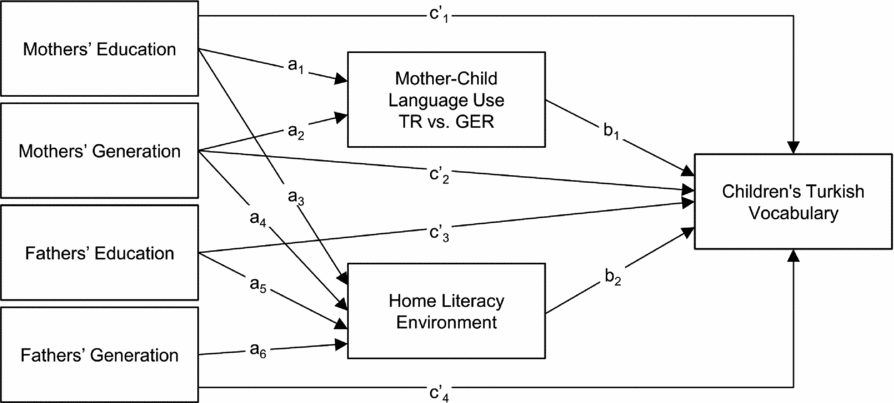
To contribute to existing knowledge on how to pass on heritage languages, we tested a mediation model. We were interested in (a) whether the home literacy environment and parents’ language use were related to Turkish vocabulary and (b) whether they mediated effects of family background factors on Turkish vocabulary. As information on fathers’ language use was only available for a subsample of participants, we concentrated on mothers’ language use and investigated whether it covaried with fathers.’ We considered mothers’ and fathers’ education and generational status as family background factors. Furthermore, we explored two different age groups’ Turkish vocabulary: children in their final year before school enrollment and fourth graders in their final year before the transition to secondary school. This allowed us to make inferences on whether the family's influence on Turkish vocabulary differs with age.
The mediation model (illustrated in Figure 1) tests a set of hypotheses that are supported by the literature:
The theoretical model of the relationships among family background, the home literacy environment, mothers’ language use, and children's Turkish vocabulary.

-
1. There is a positive relationship between the home literacy environment and children's Turkish vocabulary.
-
2. There is a positive relationship between mothers’ Turkish language use and children's Turkish vocabulary.
-
3. Higher educated parents provide a richer home literacy environment.
-
4. Later generation mothers use less Turkish with their children.
-
5. The home literacy environment mediates between parents’ education and children's Turkish vocabulary.
-
6. Mothers’ language use mediates between their background and children's Turkish vocabulary.
Furthermore, we also explored whether there was a connection between parents’ generational status and the home literacy environment and whether there were any remaining direct effects of parents’ background factors on Turkish vocabulary.
METHOD
Participants
Participants were drawn from a larger investigation on resilience and positive development of children of Turkish heritage in Germany. In total, 245 families participated in the study. Two children from each of 18 families participated in the study: a preschooler and a fourth grader. Data analyses were carried out for each age group separately, thus, these children were kept in the analysis. Two pairs of twins participated in the study. To eliminate the problem of nonindependence of observations, 1 child was chosen randomly from each of these families and the other 2 were excluded. All but 6 children were born in Germany. Three that came to Germany as infants or toddlers were retained in the sample; 3 others that immigrated after being enrolled in school in Turkey were excluded, as they had spent very few years in Germany. The final sample for this study was made up of 119 children of Turkish heritage in their final year before school enrollment (they are referred to as preschoolers as all but 5 attended preschool) and 121 fourth graders, as well as the children's mothers. On average, the preschoolers were 6 years old (M = 74 months, range = 65–87 months, SD = 4) and the fourth graders were 10 years old (M = 125 months, range = 112–144 months, SD = 6). Sixty-four of the preschoolers and 67 of the fourth graders were girls.
The mothers and fathers were evenly divided over the first and second generation: 45% of the mothers and 52% of the fathers in the preschool sample were first generation immigrants; for the fourth-grade sample, 52% of the mothers and 49% of the fathers were first generation immigrants. (See sections below for definitions of generational status and education levels.) Forty-two percent of the preschoolers’ mothers and 54% of their fathers were highly educated. Thirty-three percent of the fourth graders’ mothers’ and 49% of the fourth graders’ fathers were highly educated. Monthly median net equivalent household income was 812 € for the families in the preschool sample and 833 € for those in the fourth-grade sample (calculated according to the modified Organization for Economic Co-operation and Development equivalence scale; Hagenaars, de Vos, & Zaidi, Reference Hagenaars, de Vos and Zaidi1994). Ninety-five percent of the preschoolers and 92% of the fourth graders lived in two-parent households; the remaining children lived in other arrangements (e.g., alternating between two households).
Procedure
Recruitment
Data were collected in 2010 and 2011 in the Ruhr area, a highly industrialized region in Northwest Germany. We employed a number of recruitment strategies. Initially, potentially eligible families were identified through municipal records, but response rates were extremely low. Subsequently, we obtained permission from the school administration to cooperate with schools and preschools in the area. School and preschool teachers handed out information and collected the enclosed response cards. We also started a campaign to raise awareness for the project through posters, flyers, and newspaper articles, presentations at mosques and community centers, and attending community meetings. In addition, we asked community leaders and organizations for their endorsement. Because parents heard of the project through multiple channels and repeatedly, it is difficult to trace how each family was recruited.
All participants that responded and were eligible were included in the sample. Participants were screened via telephone by bilingual research assistants and considered eligible if the mother or the mother's parents or grandparents were born in Turkey. In addition, eligible children had to be born after 32 weeks gestational age, had to come from families without severe psychological difficulties, and could not be currently living in a foster family. Furthermore, none of them had a referral to a special needs school. Ten children whose mothers described their ethnicity as Kurdish and indicated that the family language was Kurdish instead of Turkish were excluded in order to obtain a more homogeneous sample with Turkish as a heritage language.
Measures
Turkish vocabulary
We chose to assess receptive over expressive vocabulary because we assumed that some heritage language speakers might have very limited expressive vocabulary. Furthermore, bilingual children may have difficulty accessing their expressive vocabulary (Gibson, Oller, Jarmulowicz, & Ethington, Reference Gibson, Oller, Jarmulowicz and Ethington2012). As there is no standardized Turkish vocabulary test available that covers all age groups included in the larger investigation, Turkish receptive vocabulary was assessed with a computer-based and adapted research version modeled on the Peabody Picture Vocabulary Test, Fourth Edition (PPVT-4; Dunn & Dunn, Reference Dunn and Dunn2007; Glück, Reference Glück2009). Items were translated and adapted by a team of speech–language professionals that included native speakers of Turkish. Cultural and linguistic differences between the United States and the Turkish immigrant community in Germany were considered, and in some cases a different target picture was chosen. In the computer-based research version, the child hears an audio recording of a Turkish word while it is presented with four color illustrations on the screen: one target and three distractors. The child is instructed to click on the matching drawing or on a green square if he or she does not know the answer. Testing was conducted on laptops. Younger children were assisted by the interviewer in handling the mouse. Because of efforts to standardize the test adaptation for Turkish language heritage speakers, the children were not tested using the regular procedure, in which items are ordered by increasing difficulty and a basal and ceiling level are determined. The reason for this is that translation and adaptation of the items leads to changes in item difficulty. Instead, fixed sets of 97 items were used for the preschoolers and 95 items for the fourth graders, both with mixed difficulty levels. The Spearman–Brown split half reliability (odd vs. even items) was 0.88 for the preschoolers and 0.89 for the fourth graders. On average, the preschoolers completed the vocabulary test within 18 and the fourth graders within 16 min.
Mother interview and questionnaire
The mother interview and questionnaire contained demographic questions as well as questions on the home literacy environment and parents’ language use. The interview and questionnaire included questions about the mother, father, and child, but they were all answered by the mother. Both the mother interview and questionnaire were available in Turkish and German.
PARENTS’ GENERATIONAL STATUS
From birthplace and, if applicable, age of migration, we determined parents’ generational status according to an adaptation of the procedure described by Rumbaut (Reference Rumbaut2004). First generation parents were at least 13 years old when immigrating to Germany; thus, they received very little or none of their education in Germany. Second generation parents were born in Germany or were younger than 7 years at immigration; thus, they received all of their education in Germany. Parents of the 1.5 generation immigrated between the ages of 7 and 12 and, thus, may have received part of their education in Turkey and part in Germany. We dichotomized generational status into first (≥13 years at immigration) and second generation (<13 years at immigration or born in Germany), as only very few parents were of the 1.5 generation.
PARENTS’ EDUCATION
Information on vocational training and education (in Germany and Turkey) of the mothers and fathers were combined and mapped onto the International Standard Classification of Education (Organization for Economic Co-operation and Development, 1999). We used a dichotomized measure where all categories below upper secondary education (e.g., primary education, German Hauptschule/Realschule, Turkish Orta Okul/Lise) were collapsed into the category “low” education. The remaining categories above and including upper secondary education (e.g., German Abitur, advanced vocational training, university degrees) were collapsed into the category “high” education.
HOME LITERACY ENVIRONMENT
The home literacy environment was assessed by four items that measure how often mothers and fathers read to themselves and how often they read storybooks to their children. Response categories ranged from 1 = once a month or less often to 4 = every day. In addition, we asked about the number of books and children's books in the household (2 items) with the response categories ranging from 1 = 0–10 to 4 = more than 100 for books in general and 1 = less than ten to 3 = more than thirty for children's books. We chose this approach over a print exposure checklist (e.g., Sénéchal et al., Reference Sénéchal, LeFevre, Hudson and Lawson1996) as such a checklist is hard to devise for Turkish language books in Germany; it is not clear what books are available in retail. The six items were adapted from the National Institute of Child Health and Human Development Study of Early Child Care and Youth Development and were shown to load on one factor and to have reliably assessed the home literacy environment in a previous study of families of Turkish heritage in Germany (Jäkel et al., Reference Jäkel, Schölmerich, Kassis and Leyendecker2011). Internal consistency was satisfactory for both age groups (preschoolers α = 0.73, fourth graders α = 0.72). The home literacy environment index could take on values ranging from 1 to 3.83. We also assessed the language used in storybook reading with two items. As these two items showed low internal consistency and preliminary analyses revealed no significant moderating effect on the connection between the home literacy environment and Turkish vocabulary, they were not included in the path models.
FAMILY LANGUAGE USE
All mothers in the sample provided information on what language they usually spoke to their child. Responses were given on a 5-point Likert-type scale, with 1 = only Turkish, 3 = both languages equally often, and 5 = only German. For a subsample of preschoolers (n = 68) and fourth graders (n = 81) that were tested in 2011, we also asked what language the father usually spoke to the child.
Home visits
Most families were visited at home; a small number of families chose to come to the university instead. Home visits lasted between 1 and 4 hr. The preschoolers’ sessions lasted approximately 1.5 hrs, and care was taken to ensure sufficient breaks. Trained staff conducted the interviews in the mother's preferred language: Turkish or German. When Turkish was preferred, the interviewer was a Turkish–German bilingual. Testing was conducted in separate rooms for the mother and child. Mothers gave their informed consent and children gave their assent. Mothers then filled out questionnaires and were interviewed (interviewers wrote down mothers’ replies). If requested, the questionnaire was read out loud to them. Meanwhile, the children were administered the Turkish vocabulary test among a battery of further psychological tests for the larger investigation. Families received a compensation of 25€ and a small toy for each participating child.
Analytical strategy
Fathers’ language use with their children was only available for a subsample of the study. Consequently, for explorative purposes correlational analyses were conducted for the subsample to investigate the associations of fathers’ language use with mothers’ language use and Turkish vocabulary. We then tested our main hypotheses depicted in Figure 1 in a confirmatory fashion with the data available for the full sample. Children's gender and age were controlled for. Path analyses were conducted with diagonally weighted least square estimation. They were conducted separately for the two age groups, because they had been tested with different vocabulary item sets. We used the approach advocated by MacKinnon (Reference MacKinnon2008) and others to test mediation (Hayes, Reference Hayes2009; Rucker, Preacher, Tormala, & Petty, Reference Rucker, Preacher, Tormala and Petty2011). According to this approach, mediation is defined as a significant indirect effect. The indirect effect is approximately the product of the coefficients connecting the independent variable and the mediator, and the mediator and the dependent variable (the product of ai and bi in Figure 1). We controlled for possible dependencies between the two potential mediators by allowing their residuals to correlate with each other.
All reported coefficients for the path model are unstandardized. Because the mediator variable mothers’ language use was ordinally scaled, all the effects involving this variable as a dependent variable were calculated with probit regressions (MacKinnon, Reference MacKinnon2008; Muthén & Muthén, 2012). Thus, the coefficients for mothers’ language use with their children as a dependent variable are z-score distributed.
We assumed to have at least a missing at random data pattern and therefore missing values in the data set were handled with multiple imputations (Enders, Reference Enders2010). As recommended by Lachaud and Renaud (Reference Lachaud and Renaud2011), 20 data sets were imputed. Path analyses were conducted with the software Mplus Version 7 (Muthén & Muthén, Reference Muthén and Muthén1998–2012). Mplus combines results across imputed datasets to obtain a single set of results for model fit indices, regression coefficients, and their standard errors.
RESULTS
Descriptive statistics
Both preschoolers and fourth graders showed considerable variance in their Turkish vocabulary. The preschoolers responded correctly to 12%–69% of the target words (M = 36.85, SD = 11.54), and the fourth graders to 26%–83% of the target words (M = 50.10, SD = 11.19). Mean differences between preschoolers’ and fourth graders’ vocabulary scores could not be tested as they were administered different item sets (the highest possible score was 97 for preschoolers and 95 for fourth graders).
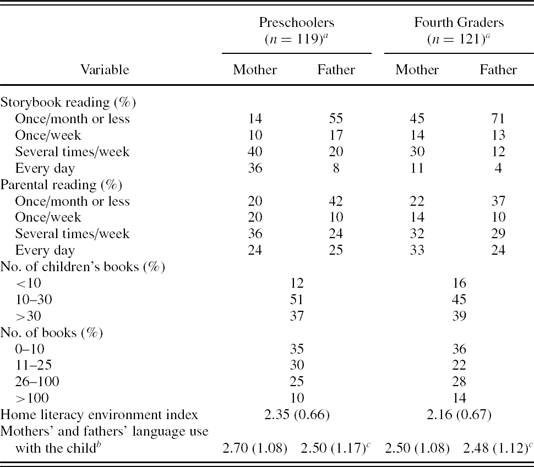
Preschoolers’ mothers read to their children more frequently than fourth graders’ mothers did (Table 1); the same difference was marginally significant for fathers’ storybook reading. This was also reflected in a lower home literacy environment index for the fourth graders. However, in both age groups the majority of children had access to more than 10 children's books. On average in both age groups, mothers and fathers used more Turkish than German when speaking to their children.
Descriptive statistics for the home literacy environment and mothers’ and fathers’ language use with the child in percentages and means (standard deviations)

Note: There was a significant difference between the preschoolers and fourth graders only for the frequency of maternal storybook reading (χ2 = 36.71, p <. 001), the home literacy environment index (t = 2.05, p = .04), and a marginally significant difference for paternal storybook reading (χ2 = 6.46, p = .09).
a Maximum n due to missing values.
b 1 = only Turkish, 2 = more Turkish than German, 3 = equal amounts of Turkish and German, 4 = more Turkish than German and 5 = only German.
c For a subsample of n = 68 preschoolers and n = 81 fourth graders.
Bivariate correlations
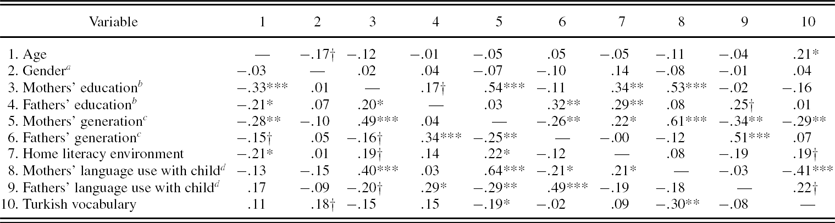
Bivariate correlations for the full sample are given in Table 2. Correlation patterns were very similar for the two age groups. There were connections between parents’ background variables. Mothers’ and fathers’ education was positively associated, but there was a negative association between their generational statuses: A first generation parent was likely to have a second generation spouse and vice versa. Second generation status was associated with higher education and less use of Turkish (vs. German). For mothers, second generation status was associated with a richer home literacy environment. Turkish vocabulary was marginally associated with a richer home literacy environment only for preschoolers but negatively related to mothers’ use of German (vs. Turkish) and mothers’ generational status.
Correlations among study variables

Note: Coefficients are above the diagonal for preschoolers and below the diagonal for fourth graders. Maximum n = 119 preschoolers and n = 121 fourth graders. Correlations with language use variables are for a subsample of n = 68 preschoolers and n = 81 fourth graders.
a 0 = male, 1 = female.
b 0 = low and 1 = high education (see description of measures for details).
c Generational status coded as 1 = first generation, 2 = second generation.
d Higher values indicate more use of German versus Turkish.
†p < .10. *p < .05. **p < .01. ***p < .001.
Regarding the exploratory analysis for fathers’ language use, there were two important results. First, fathers’ use of German (vs. Turkish) with their children was marginally significantly positively related to preschoolers’ Turkish vocabulary. Second, as fathers’ language use with their children was negatively but nonsignificantly correlated with mothers’ language use, it was not possible to view mothers’ language use as an indicator for parents’ language use in general.
Path models
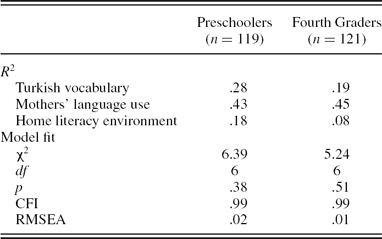
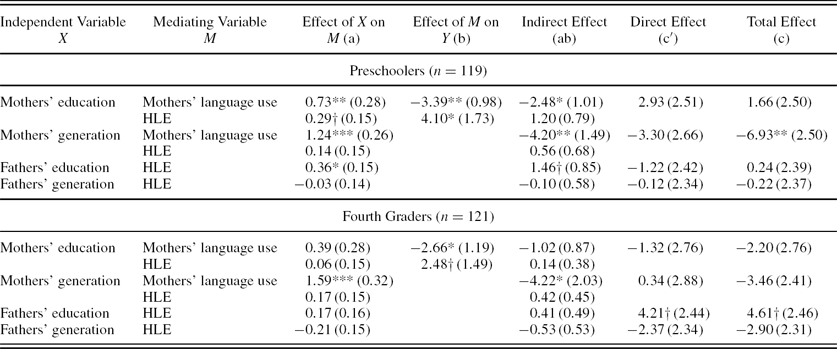
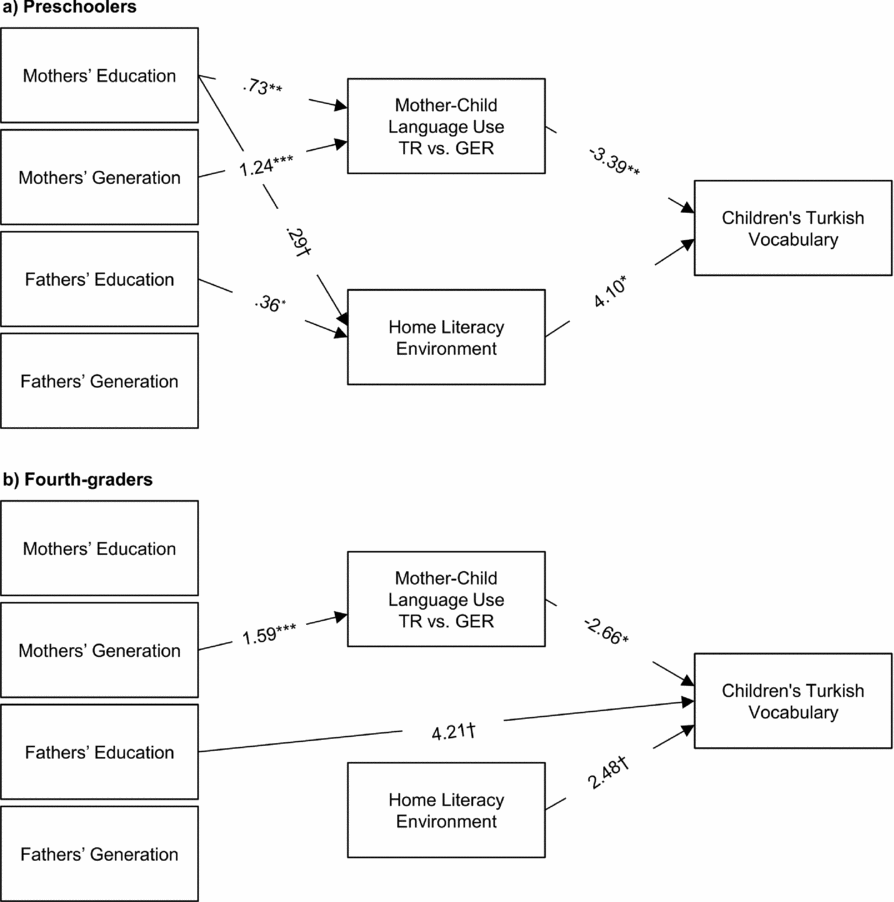
The path models served to establish (a) whether the home literacy environment and mothers’ language use were related to Turkish vocabulary, (b) whether they were predicted by the family background, and (c) whether they mediated effects of family background factors on Turkish vocabulary. The model for the preschoolers and the model for the fourth graders both fit well (Table 3). For preschoolers, the model explained 28% of the variance in Turkish vocabulary. For fourth graders, the model explained 19% of the variance. Figure 2 illustrates the results of the models for the preschoolers (top) and the fourth graders (bottom) with the significant direct effects. Table 4 shows these effects further decomposed into total, specific indirect, and direct effects.
Explained variance and model fit for the path models

Note: CFI, comparative fit index; RMSEA, root mean square error of approximation.
Unstandardized effects (standard errors) for the path models

Note: HLE, Home literacy environment. Parents’ education is coded as 0 = low and 1 = high. Generational status coded as 1 = first generation, 2 = second generation. Effects for mothers’ language use as a dependent variable are probit coefficients (z-score distributed).
†p < .10. *p < .05. **p < .01. ***p < .001.
Path models of the relationships among family background, the home literacy environment, mothers’ language use, and Turkish vocabulary. Only significant unstandardized regression coefficients are shown. Generational status is coded as 1 = 1st generation, 2 = 2nd generation. Mothers’ language use coded as 1 = only Turkish to 5 = only German. See Method Section for coding of education. Preschoolers, n = 119; fourth graders, n = 121. †p < .10. *p < .05. **p < .01. ***p < .001.

Preschoolers
For the preschoolers, both a richer home literacy environment and mothers’ use of Turkish (vs. German) predicted a larger Turkish vocabulary (Figure 2a). Furthermore, there were significant connections between the family background and the two potential mediators. Higher educated and second generation mothers used less Turkish (vs. German) when speaking to their child. Higher educated fathers provided a richer home literacy environment, and the same effect was marginally significant for higher educated mothers (Table 4). There were also indirect effects of parents’ background (Table 4). The effects of mothers’ education and generational status on children's Turkish vocabulary were both mediated by their language use with their children; higher educated and second generation mothers used less Turkish (vs. German), and in turn, their children had smaller Turkish vocabularies. An indirect effect of fathers’ education by way of the home literacy environment was only marginally significant. This was the case despite families’ with higher educated fathers providing a richer home literacy environment, and a richer home environment predicting a larger Turkish vocabulary. There were no direct effects of parents’ backgrounds on children's Turkish vocabulary (Table 4).
Fourth graders
For the fourth graders, a richer home literacy environment only marginally predicted a larger Turkish vocabulary. Just as for the preschoolers, mothers’ use of Turkish (vs. German) with their children predicted a larger Turkish vocabulary (Figure 2b). Furthermore, just as for the preschoolers, second generation mothers used less Turkish (vs. German) when speaking to their child (Table 4). However, there was no such connection between mothers’ education and use of Turkish (vs. German). The home literacy environment was not predicted by the family background. There was an indirect effect of mothers’ generational status. Specifically, second generation mothers used less Turkish (vs. German) with their children, and this in turn was connected to a smaller Turkish vocabulary. There was no indirect effect of mothers’ education or fathers’ background on Turkish vocabulary. Fathers’ education had a marginally significant direct effect on children's vocabulary: higher educated fathers had children with a larger Turkish vocabulary (Table 4).
DISCUSSION
The purpose of our study was to investigate whether the home literacy environment and parents’ language use were related to Turkish vocabulary and mediated effects of the family background. Our results showed that mothers’ use of Turkish (vs. German) with the child and a richer home literacy environment predicted a larger Turkish vocabulary for both age groups. However, the effect of the home literacy environment was only marginally significant for the older children. For both age groups, there were indirect effects of the mothers’ background by way of their language use.
The home literacy environment as a resource for heritage language vocabulary
Children living in an environment rich with books and frequent reading activities knew more Turkish words than did their peers who had less access to literacy activities. This is in accordance with previous findings showing that the home literacy environment and storybook reading are positively related to vocabulary for bilingual children (e.g., Farver et al., Reference Farver, Xu, Eppe and Lonigan2006; Patterson, Reference Patterson2002).
However, this positive effect of the home literacy environment was smaller and only marginally significant for the older children in our sample. This is in agreement with a meta-analysis that found that correlations between the home literacy environment and language outcomes were weaker for older children (Bus et al., Reference Bus, van IJzendoorn and Pellegrini1995). It is also possible that other features of the home literacy environment that were not assessed here are more closely connected to older children's Turkish vocabulary. For example, older children's vocabulary may be more strongly affected by more active participation in literacy such as own reading. Accordingly, future studies should consider alternative operationalizations of the home literacy environment and include children's own reading habits as well as opportunities to communicate about their reading experiences with social partners. Furthermore, the relationship between being read to by parents and vocabulary may be complicated for older children: Being read to instead of reading by oneself may help build a vocabulary, but it may also be an indicator that a child is a weak reader for his or her age, with a relatively small vocabulary.
For preschoolers, the home literacy environment was predicted by fathers’ education and marginally significantly by mothers’ education. This supports previous research showing that, on average, more-educated parents provide a richer home literacy environment (e.g., Jäkel et al., Reference Jäkel, Schölmerich, Kassis and Leyendecker2011). In contrast, for the fourth graders, none of the family background variables were related to the home literacy environment. One possible reason is that the home literacy environment, as we assessed it, is a rather broad construct. Different features of this construct may be differently associated with parents’ education for older children.
We had expected mothers’ and fathers’ education to be connected with their children's Turkish vocabulary by way of the home literacy environment (Aikens & Barbarin, Reference Aikens and Barbarin2008; Raikes et al., Reference Raikes, Alexander Pan, Luze, Tamis-LeMonda, Brooks-Gunn and Constantine2006). This was only partially supported by our results. There was only a marginally significant indirect effect of fathers’ education on Turkish vocabulary for the preschoolers. One statistical reason this indirect effect did not reach significance is that the connection between fathers’ education and the home literacy environment was not strong enough. Again, this may have to do with the home literacy environment being a broad construct. It might have taken a more differentiated assessment of mothers’ and fathers’ separate participation in literacy activities to ascertain the mediating role of the home literacy environment more definitely. There is also the possibility that when investigating the heritage language of bilingual children, the existence of such indirect effects is conditional upon further variables, such as the language in which literacy activities take place. A detailed assessment of the latter variable should be included in further studies.
Mothers’ language use as a resource for the heritage language
For both preschoolers and fourth graders, mothers’ language use with the child was an important predictor of Turkish vocabulary. The more Turkish mothers used when interacting with their children, the larger their child's vocabulary. This is in line with previous research demonstrating the importance of family language use for the heritage language (Hammer et al., Reference Hammer, Davison, Lawrence and Miccio2009; Klassert & Gagarina, Reference Klassert and Gagarina2010; Mancilla-Martinez & Lesaux, Reference Mancilla-Martinez and Lesaux2011). The size of the coefficients connecting our self-report measure of language use with Turkish vocabulary further stresses the importance of family language use. A change of 1 unit in mothers’ language use (on a scale of 1 to 5) was associated with a 2- to 3-point change in Turkish vocabulary (of 97/95 points maximum score). Hence, for the preschoolers, this single item measure explained nearly as much variance in Turkish vocabulary as the more elaborate, and thus more reliable, home literacy environment index.
It is interesting that bivariate correlations between fathers’ language use with the child and the child's Turkish vocabulary showed a marginally significant opposite effect in a subsample. Fathers who used less Turkish (vs. German) had children with larger Turkish vocabularies. One explanation for this is that in Turkish immigrant families in Germany, there are many marriages in which one partner is a first and the other a second generation immigrant (González-Ferrer, Reference González-Ferrer2006). Thus, the true effect of fathers’ Turkish use on younger children may be overshadowed by a stronger effect of a mother using a lot of German. This shows that bivariate analyses may not be sufficient to uncover the complex relationships between family language use and vocabulary. It also shows that it is important to include separate assessments of each family member's language use, especially if several immigrant generations are represented in the family.
We also examined whether mothers’ background affected their language use. Second generation mothers used less Turkish and more German when speaking to their children. This is concordant with previous findings on how the heritage language loses importance over immigrant generations (e.g., Tseng & Fuligni, Reference Tseng and Fuligni2000). We also found that less-educated mothers of preschoolers used more Turkish. One explanation is that less-educated mothers tended to be first generation immigrants (as indicated by the bivariate correlations). Moreover, mothers with less education may have less access to employment and thus less contact with the majority society and language.
The significant indirect effects of mothers’ backgrounds on children's Turkish vocabulary establish mothers’ language use as a mediator. Mother's language use is the link between mother's generational status and (for preschoolers) mothers’ education and children's Turkish vocabulary. This brings us closer to understanding the processes of how family background affects children's heritage language development. However, we need longitudinal follow-up studies to examine further potential mediators and whether the pathways we uncovered are indeed causal.
Family background and heritage language vocabulary
Our findings indicate that the family background is related to children's heritage language vocabulary through multiple pathways. Depending on the age group, we found different indirect effects, but mothers’ generational status was an important characteristic for both groups. Furthermore, there was a marginally significant direct effect of fathers’ background. Children of higher educated fathers had larger Turkish vocabularies. We do not yet know what processes were responsible for this relationship. Two possible routes are that higher educated fathers may provide lexically richer input (Hoff, Reference Hoff2006) or value the heritage language more (Lambert & Taylor, Reference Lambert and Taylor1996; Pearson, Reference Pearson2007). From our results on fathers’ language use it is not quite clear whether it is likely to mediate the relationship.
The positive connection between fathers’ education and children's vocabulary is in contrast to the negative effects of mothers’ education mediated by their language use. Furthermore, it contradicts findings showing that parents’ SES is positively related with the majority language but not the minority language (Oller & Eilers, Reference Oller and Eilers2002). Our finding indicates that parents’ education may have both positive and negative effects on children's learning a heritage language, depending on what mediators it is associated with.
Our results also indicate that fathers’ backgrounds may have an impact over and above mothers’ backgrounds, even though we need larger samples to confirm the marginally significant effects. This is in accord with recent research highlighting the importance of fathers for their children's language development (e.g., Cabrera, Shannon, & Tamis-LeMonda, Reference Cabrera, Shannon and Tamis-LeMonda2007; Jäkel et al., Reference Jäkel, Schölmerich, Kassis and Leyendecker2011; Pancsofar & Vernon-Feagans, Reference Pancsofar and Vernon-Feagans2006, Reference Pancsofar and Vernon-Feagans2010). It also casts further doubt on using mothers’ education as a lone proxy for SES. It may be important to examine the effects of mothers’ and fathers’ education separately. Furthermore, it is important to note that the great majority of children in our sample were living in two-parent households; however, further studies should take a closer look at how the family background affects children living in nontraditional arrangements.
In conclusion, our findings on the connections between family background and children's vocabulary tie in with research showing that the relationship between SES and children's outcomes are much more complex in immigrant than in nonimmigrant families, and many mediators have to be considered (Fuligni & Yoshikawa, Reference Fuligni, Yoshikawa and Bornstein2002). It takes close examination of the multitude of parents’ behaviors and attitudes that can be associated with a certain background characteristic to untangle these relationships.
Strengths and limitations
We used an objective receptive vocabulary test to gain insight into the children's lexical development. The advantage of such a test is that it is easy to administer by non-Turkish speakers and feasible for larger samples. To expand our understanding of heritage language vocabulary development, we need further studies with more elaborate and specifically tailored tasks probing vocabulary depth (Ordóñez, Carlo, Snow, & McLaughlin, Reference Ordóñez, Carlo, Snow and McLaughlin2002), as well as observations in naturalistic communication settings.
To assess the home literacy environment and language use, we relied on self-reports. Prior research shows that, despite possible bias, self-reports of these constructs do explain variance in language outcomes (e.g., Bus et al., Reference Bus, van IJzendoorn and Pellegrini1995; Mancilla-Martinez & Lesaux, Reference Mancilla-Martinez and Lesaux2011). However, observation methods provide greater validity and permit a greater level of detail.
We could show that the home literacy environment had an effect when simultaneously considering mothers’ language use with their children. Detailed information on the families’ language use was only available for a subsample in our study. Further investigations should consider whether the home literacy environment still has an effect when pitted against a more detailed measure of language use in the family.
We assessed language use on a unidimensional scale with the endpoints only Turkish and only German. This makes sense insofar as there is only a limited amount of time that can be devoted to either German or Turkish. Families may differ greatly in the amount they speak to their children (e.g., Hoff, Reference Hoff2006). Nevertheless, it is unlikely that, on average, bilingual families produce just as much speech in both languages as monolinguals, as that would mean the average bilingual family talks twice as much as the average monolingual family (Hoff et al., Reference Hoff, Core, Place, Rumiche, Señor and Parra2012). However, a more detailed multidimensional assessment may be able to uncover highly frequent use of both languages at once as well as code switching.
All our results are correlational and cross-sectional. Longitudinal and intervention studies can provide more insight into the direction of causality and the size of the actual effect of the home literacy environment. This is particularly important because there is indication of a reciprocal relationship between the home literacy environment and vocabulary (Raikes et al., Reference Raikes, Alexander Pan, Luze, Tamis-LeMonda, Brooks-Gunn and Constantine2006). It is also very likely that children's language skills and use affect their parents’ language use with them (Prevoo, Mesman, Van IJzendoorn, & Pieper, Reference Prevoo, Mesman, van IJzendoorn and Pieper2011).
It should be pointed out that our model focuses on one detail of the entire picture. A comprehensive model of heritage vocabulary development would include other features of the home literacy environment, such as the frequency of storytelling, singing, wordplay and conversations (e.g., Scheele et al., Reference Scheele, Leseman and Mayo2010), and the language primarily used for literacy activities, as well as parents’ beliefs and children's interest in literacy. Equally important, it would encompass further parameters of the language environment at home, in school, and in preschool, such as the richness and complexity of parents’ speech (Bowers & Vasilyeva, Reference Bowers and Vasilyeva2011; Pan, Rowe, Singer, & Snow, Reference Pan, Rowe, Singer and Snow2005), the amount of language mixing (Byers-Heinlein, Reference Byers-Heinlein2012), and parents’ language proficiency (Place & Hoff, Reference Place and Hoff2011). The latter is hard to grasp in questionnaire studies. Additional possibly relevant family factors are parents’ scaffolding in use of the heritage language (Park, Tsai, Liu, & Lau, Reference Park, Tsai, Liu and Lau2012), parents’ and children's emotional attachment to the heritage language, and the parent–child relationship (Tseng & Fuligni, Reference Tseng and Fuligni2000). Beyond the family, the children's social network and peer group are also likely to affect vocabulary development (Oller, Jarmulowicz, Pearson, & Cobo-Lewis, Reference Oller, Jarmulowicz, Pearson, Cobo-Lewis, Durgunoğlu and Goldenberg2011). Community and societal factors, such as the neighborhoods’ ethnic make-up, institutional support for the heritage language, and its status relative to the majority language, are also important (Pearson, Reference Pearson2007). Such elaborate models require very large samples, which in turn make it hard to obtain detailed observation measures of the assessed constructs.
CONCLUSION
Our study provides important insights into Turkish heritage vocabulary development. The results demonstrate that the home literacy environment has strong potential to stimulate vocabulary learning in heritage language learners. However, we may have to take a closer look at what features of the home literacy environment are especially important to older children who are able to read by themselves. Furthermore, it was important for heritage language learners’ vocabulary that their mothers spoke Turkish to them. In fact, the families’ backgrounds affected children's vocabulary primarily by the amount of Turkish mothers used. We could not fully confirm that the home literacy environment mediates effects of the background in families of Turkish heritage in Germany.
The practical implication is that heritage language and literacy interventions targeting immigrant children should very specifically consider the resources available to their families. First, parents with little education and first generation parents may not need to be reminded of the importance of using the heritage language, but they may welcome support in helping their young children explore the world of books and reading. Second, higher educated parents may provide more opportunities to explore the world of literacy, but they also need to be aware that using Turkish in everyday communication and thereby encouraging their children to use Turkish is important for fostering the heritage vocabulary. Parents need to be aware that if they do not use their heritage language with their children, it is very unlikely that someone else will. Considering all the pressure to focus on their children's German skills, it may be hard to continue using Turkish. It is a challenge to find a balance between the heritage and the majority languages. However, in the long run, it is very likely to be the minority language and not the majority language that is endangered (Oller et al., Reference Oller, Jarmulowicz, Pearson, Cobo-Lewis, Durgunoğlu and Goldenberg2011).
There is not much data on where their linguistic journey leads children of Turkish heritage. Anecdotal evidence shows that many children grow up to reach everyday communicative competence in Turkish, but they may need support with more complex linguistic endeavors (Treffers-Daller, Özsoy, & van Hout, Reference Treffers-Daller, Özsoy and van Hout2007). Promoting heritage vocabulary development is a promising avenue for improving everyday communication as well as laying the groundwork for more advanced language skills, such as literacy. By encouraging families to appreciate and draw on their resources, we can help them raise their children to become capable speakers of their heritage language.
ACKNOWLEDGMENTS
We sincerely thank the participating families for welcoming us so kindly. This research was supported by NORFACE Era-Net Grant 292 to Birgit Leyendecker, Judi Mesman, and Brit Oppedal. Portions of this work were presented at the 48th Conference of the German Society of Psychology, Bielefeld, Germany, September 2012, and the Biennial Meeting of the Society for Research in Child Development, Seattle, Washington, April 2013.