Introduction
Cannabis is the most frequently used illegal drug, and cannabis-related admissions to psychiatric hospital increased by approximately 300% during the last decade (Sundhedsstyrelsen, 2012).
Previous studies indicate that frequent cannabis use is associated with more psychotic relapses, more hospitalizations, worsening of psychotic symptoms and reduced compliance to treatment (Archie et al. Reference Archie, Rush, Akhtar-Danesh, Norman, Malla, Roy and Zipursky2007; Petersen et al. Reference Petersen, Jeppesen, Thorup, Ohlenschlaeger, Krarup, Ostergard, Jorgensen and Nordentoft2007; Miller et al. Reference Miller, Ream, McCormack, Gunduz-Bruce, Sevy and Robinson2009; Faridi et al. Reference Faridi, Joober and Malla2012; Schimmelmann et al. Reference Schimmelmann, Conus, Cotton, Kupferschmid, McGorry and Lambert2012; van Dijk et al. Reference van Dijk, Koeter, Hijman, Kahn and van den Brink2012).
Especially reduced adherence to medical treatment seems to represent a problem, since it has been shown that medical treatment can reduce psychotic symptoms in first-episode psychotic patients despite continued cannabis exposure (Faridi et al. Reference Faridi, Joober and Malla2012). Moreover, it is well documented that early adolescent cannabis exposure is related to earlier onset of psychosis (Large et al. Reference Large, Sharma, Compton, Slade and Nielssen2011; Zammit et al. Reference Zammit, Owen, Evans, Heron and Lewis2011) and psychosis-like symptoms (Compton et al. Reference Compton, Kelley, Ramsay, Pringle, Goulding, Esterberg, Stewart and Walker2009; Anglin et al. Reference Anglin, Corcoran, Brown, Chen, Lighty, Brook and Cohen2012; Dragt et al. Reference Dragt, Nieman, Schultze-Lutter, van der Meer, Becker, de Haan, Dingemans, Birchwood, Patterson, Salokangas, Heinimaa, Heinz, Juckel, Graf von Reventlow, French, Stevens, Ruhrmann, Klosterkötter and Linszen2012; van Dijk et al. Reference van Dijk, Koeter, Hijman, Kahn and van den Brink2012), especially if cannabis use starts before the age of 14 years (Schimmelmann et al. Reference Schimmelmann, Conus, Cotton, Kupferschmid, Karow, Schultze-Lutter, McGorry and Lambert2011). Psychosis is also found to be correlated with the frequency of cannabis use (Moore et al. Reference Moore, Zammit, Lingfjord.Hughes, Barnes, Jones and Lewis2007). This finding has been confirmed in a large study of siblings, which reduces the likelihood that unmeasured confounding explains the findings (McGrath et al. Reference McGrath, Welham, Scott, Varghese, Degenhardt, Hayatbakhsh, Alati, Williams, Bor and Najman2010). There is some support for these findings in animal studies as well (Rubino et al. Reference Rubino, Zamberletti and Parolaro2012; Zamberletti et al. Reference Zamberletti, Prini, Speziali, Gabaglio, Solinas, Parolaro and Rubino2012).
In a review from 2008 regarding cannabis use in psychotic patients, it was concluded that the statistical power in studies within this area is limited, and that future research should have a longitudinal design, with repeated measures of psychopathology, use of cannabis, alcohol and other drugs, as well as baseline measures of function, illness severity and other characteristics that are known to be associated with poorer outcome in schizophrenia (Zammit et al. Reference Zammit, Moore, Lingford-Hughes, Barnes, Jones, Burke and Lewis2008). Hitherto, these points have only been addressed in rather small studies (Faridi et al. Reference Faridi, Joober and Malla2012; Schimmelmann et al. Reference Schimmelmann, Conus, Cotton, Kupferschmid, McGorry and Lambert2012; van Dijk et al. Reference van Dijk, Koeter, Hijman, Kahn and van den Brink2012).
Aim
The aim was to analyse the association between the pattern of cannabis abuse and a range of clinically important outcome measures among the patients with first-episode schizophrenia spectrum disorders who were included in the Danish OPUS trial (Petersen et al. Reference Petersen, Jeppesen, Thorup, Abel, Ohlenschlaeger, Christensen, Krarup, Jorgensen and Nordentoft2005; Bertelsen et al. Reference Bertelsen, Jeppesen, Petersen, Thorup, Ohlenschlaeger, le Quach, Christensen, Krarup, Jorgensen and Nordentoft2008).
We hypothesized that cannabis use would be associated with higher levels of such clinical symptoms as psychotic, disorganized and negative symptoms. We also hypothesized that the number of days spent in a psychiatric ward and days living in supported psychiatric housing would be increased by cannabis use, and that level of function would be decreased. Patients with substance abuse have been reported to be more likely not to adhere to antipsychotic medication (Kamali et al. Reference Kamali, Kelly, Clarke, Browne, Gervin, Kinsella, Lane, Larkin and O'Callaghan2006; Quach et al. Reference Quach, Mors, Christensen, Krarup, Jorgensen, Bertelsen, Jeppesen, Petersen, Thorup and Nordentoft2009), and this can independently affect the above-mentioned outcome measures. We hypothesized treatment compliance to be deficient in patients with cannabis use and that this could explain differences in clinical outcome to some degree.
We wanted to analyse how clinical and social outcome measures were affected in patients with different patterns of cannabis use. We wanted especially to investigate four different groups of patients: abstainers, stoppers, starters and continuers, categorized according to whether they had no use of cannabis or stopped, started or continued cannabis use during the 5-year period.
Method
All patients participated in the OPUS trial, a randomized clinical trial comparing specialized assertive early intervention treatment with standard treatment in first-episode psychosis. In this paper, we analyse all the patients as one cohort. Since the aim of this paper is not to investigate the effect of standard treatment versus specialized assertive early intervention services (OPUS), it is not relevant to describe the two types of treatment in detail (Petersen et al. Reference Petersen, Jeppesen, Thorup, Abel, Ohlenschlaeger, Christensen, Krarup, Jorgensen and Nordentoft2005; Thorup et al. Reference Thorup, Petersen, Jeppesen, Ohlenschlaeger, Christensen, Krarup, Jorgensen and Nordentoft2005).
Patients aged between 18 and 45 years were included if they met the criteria for International Classification of Diseases, 10th Revision (ICD-10) diagnoses within the schizophrenia spectrum (F2). All patients had to be able to speak and understand Danish; none of the patients had been treated with antipsychotic medication for more than 12 weeks; and the psychiatric symptoms were not due to any organic condition. Use of psychoactive drugs did not cause exclusion as long as the psychotic condition was not solely explained by poisoning or a withdrawal state.
As described in previous papers (Bertelsen et al. Reference Bertelsen, Jeppesen, Petersen, Thorup, Ohlenschlaeger, le Quach, Christensen, Krarup, Jorgensen and Nordentoft2008; Nordentoft et al. Reference Nordentoft, Ohlenschlaeger, Thorup, Petersen, Jeppesen and Bertelsen2010), 578 patients were included from January 1998 until December 2000. Of these, 314 participated in the 5-year follow-up, 17 had died, one disappeared, 10 moved out of the country and 236 declined to participate or could not be traced.
Baseline use of cannabis was not associated with not participating in follow-up interviews. Among those who used cannabis at baseline, 52% participated in the 5-year follow-up versus 55% of those who had used no cannabis during the last year or had used it less than monthly (p = 0.4).
Assessment and data collection
All patients were interviewed and assessed by trained assessors who were blind to treatment allocation at entry and after 5 years.
As part of a comprehensive interview, several instruments were used to collect data. The variables listed below were derived from data obtained from interviews, register-based information and medical records.
Use of cannabis
Use of cannabis was assessed using Schedule for Clinical Assessment in Neuropsychiatry (SCAN) interviews, versions 2.0 and 2.1 (since 1999) (Wing et al. Reference Wing, Babor, Brugha, Burke, Cooper, Giel, Jablenski, Regier and Sartorius1990). Cannabis use was extracted from the SCAN interview, chapter 12, dichotomizing ‘use of cannabis previous year’ (item 12.007) into ‘use’ defined as any use in the previous year. Based on information about cannabis use (any cannabis use versus no cannabis use) during the previous year (chapter 12, item 12.007 in the SCAN interview), at entry, and at the 5-year follow-up interview, patients were divided into four groups: (1) abstainers – no use of cannabis at baseline and at 5-year follow-up; (2) stoppers – stopped cannabis use within the last 5 years; (3) starters – started cannabis use within the last 5 years; and (4) continuers – continued use of cannabis throughout the 5 years.
Sociodemographic information
Sociodemographic information on education, civil status, children and accommodation was extracted from interviews.
Psychopathological symptoms
Psychopathological symptoms were assessed using the Scale for the Assessment of Positive Symptoms (SAPS) and the Scale for the Assessment of Negative Symptoms (SANS). These were summarized in three psychopathological dimensions (Arndt et al. Reference Arndt, Andreasen, Flaum, Miller and Nopoulos1995): psychotic dimension (mean global scores for hallucinations and delusions); disorganized dimension (mean global scores for bizarre behaviour, formal thought disorder, and the single item ‘inappropriate affect’); the negative dimension (mean global scores for affective flattening, alogia, avolition and anhedonia). These three dimensions were used as measures of psychopathology, ranging from zero to five. Inter-rater reliability between the assessors was measured with intra-class correlation coefficients, 0.90 for negative symptoms and 0.92 for psychotic symptoms, which reflect very good agreement (Bertelsen et al. Reference Bertelsen, Jeppesen, Petersen, Thorup, Ohlenschlaeger, le Quach, Christensen, Krarup, Jorgensen and Nordentoft2008).
Insufficient medication
Patients were divided into two groups based on information about prescriptions for antipsychotic medication and compliance. Patients were classified as insufficiently medicated if they had not started or had discontinued medication or took medication irregularly, or if they had psychotic symptoms at a mild level or worse and no prescription for antipsychotic medication. Patients who had no psychotic symptoms, and patients who reported taking medication regularly as prescribed, were classified as sufficiently medicated. Blind researchers made the global measure of medication compliance based on structured interviews with the patients, information from the primary case manager and psychiatrist, and through systematic examination of the case notes and prescription cards.
Remission of symptoms
Patients were classified as being in remission with regard to negative symptoms, if none of the global scores in SANS exceeded the mild level of severity. Regarding psychotic symptoms, patients were considered remitted if the global scores for both hallucinations and delusions did not exceed the mild level of severity (Andreasen et al. Reference Andreasen, Carpenter, Kane, Lasser, Marder and Weinberger2005).
Course of illness
Course of illness was assessed with the Life Chart Schedule. Patients who had less than 6 months without psychotic symptoms within the last 2 years were classified as having continuous psychosis. Patients were classified with ‘episodic psychotic illness’ if they had psychotic symptoms during the last 2 years but did not fulfil the criteria for continuous psychosis. Patients were classified as ‘not psychotic’ if they had no psychotic symptoms during the last 2 years (WHO, 1992).
Duration of untreated psychosis
Duration of untreated psychosis was counted in weeks, and was assessed at entry to the study using the Interview for Retrospective Assessment of Onset of Schizophrenia (Häfner et al. Reference Häfner, Riecher-Rössler, Hambrecht, Maurer, Meissner, Schmidtke, Fätkenheuer, Löffler and van der Heiden1992).
Pre-morbid functioning
Pre-morbid functioning was assessed retrospectively by the Premorbid Adjustment Scale (PAS) (Cannon-Spoor et al. Reference Cannon-Spoor, Potkin and Wyatt1982), based on an interview with the patient. The PAS conceptualizes good pre-morbid adjustment as the achievement of certain age-appropriate developmental goals. Several reports of factor analyses confirm that the PAS covers two discrete areas of functioning: academic (‘scholastic performance’, ‘adaptation to school’) and social (‘sociability and withdrawal’, ‘peer relations’, and ‘socio-sexual aspects’) (Larsen et al. Reference Larsen, Friis, Haahr, Johannessen, Melle, Opjordsmoen, Rund, Simonsen, Vaglum and McGlashan2004; Jeppesen et al. Reference Jeppesen, Petersen, Thorup, Abel, Ohlenschlaeger, Christensen, Krarup, Jorgensen and Nordentoft2008). Both factors are multiplied by 10, thus ranging from 0 to 10; 0 being optimal function, 10 being worst possible.
Symptoms and level of social functioning
The Global Assessment of Functioning (GAF) is a global measure of symptoms and level of social functioning. We used the split version of the GAF, divided into two scales: symptoms and level of social functioning. The scale ranges from 1 to 100, where 100 is the best and 1 is the worst (Pedersen et al. Reference Pedersen, Hagtvet and Karterud2007).
Pre-morbid intelligence
The Danish Adult Reading Test (DART) is a Danish version of the National Reading Test (Nelson & Willison, Reference Nelson1982; Russell et al. Reference Russell, Munro, Jones, Hayward, Hemsley and Murray2000). The scores on the test are indicators of pre-morbid intelligence. This measure was applied at the 5-year follow-up interview.
Dosage of antipsychotic medication
Dosage of antipsychotic medication was measured by haloperidol equivalents.
Number of family and friends
The number of family and friends is based on the social network scale – the number of friends and family members with whom the patient has been in contact during the last month (Dunn et al. Reference Dunn, O'Driscoll, Dayson, Wills and Leff1990).
Hospitalizations and days in supported psychiatric housing
Register-based information about hospitalizations and days in supported psychiatric housing facilities was extracted from Danish national longitudinal registers (Pedersen et al. Reference Pedersen, Gotzsche, Moller and Mortensen2006; Mors et al. Reference Mors, Perto and Mortensen2011; Nordentoft et al. Reference Nordentoft, Pedersen, Pedersen, Blinkenberg and Mortensen2012).
Statistical analysis
SPSS statistics version 19 (IBM, USA) was used for the statistical analyses. To analyse qualitative data, χ2 tests were used; for the analyses of normally distributed data, two-tailed t tests were applied. The Mann–Whitney test was used to analyse duration of untreated psychosis, due to its skewed distribution. Logistic and linear regression analyses were used to evaluate whether differences in age could explain baseline differences in level of education. Univariate general linear model analyses were used to analyse the differences in 5-year outcome between the four groups with different patterns of use. These analyses were adjusted for baseline values of the scales, for sufficient antipsychotic medication and for age. Values of p lower than 0.05 were considered significant.
Results
Baseline data
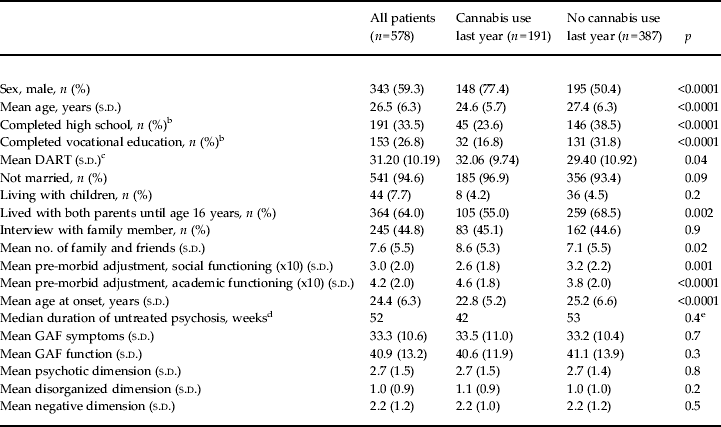
Baseline data are shown in Table 1. Patients with cannabis use were predominantly males. They were 2.8 [95% confidence interval (CI) 1.8–34.9] years younger than the non-users, and they had an earlier age of onset of psychosis of 2.4 (95% CI 1.3–3.5) years. Fewer had lived in a family with both parents until 16 years of age (55.0% v. 68.5%, p = 0.002).
Clinical and social factors among 578 patients with first-episode psychosis with at least monthly cannabis use compared with no use or less than monthly use a

s.d., Standard deviation; DART, Danish Adult Reading Test; GAF, Global Assessment of Functioning.
a Almost all patients were able to complete the whole interview, but there are minor differences in the number for whom information is available.
b The DART was used only at the 5-year follow-up. Therefore, results of this test are available only for the patients who participated in the 5-year follow-up.
c Difference in the proportion of who completed high school and vocational education was significant even after adjusting for age.
d Patients with schizotypal disorder were excluded from this analysis.
e Mann–Whitney U test.
The educational level for the cannabis users was significantly lower than among those with no use of cannabis. The proportion that completed high school was 23.6% v. 38.5% (odds ratio 0.49, 95% CI 0.33–0.73, p < 0.0001), and the proportion that completed vocational education was 16.8% v. 31.8% (odds ratio 0.43, 95% CI 0.28–0.67, p < 0.0001). Age differences between the two groups did not explain the difference in the proportion completing high school or completing a vocational education. Cannabis users had 29.40 correct answers in the DART compared with 32.06 among those with no use of cannabis (mean difference 2.66, 95% CI. 0.14–5.18, p = 0.04). In the PAS, the cannabis users had a significantly worse score on the academic dimension (mean difference 0.93, 95% CI 0.54–1.32, p < 0.0001) and a significantly better score on the social dimension (mean difference 0.59, 95% CI 0.1–0.98, p = 0.003). They also had significantly more contact with family and friends during the month before the baseline interview (8.6 v. 7.1, p = 0.02).
At entry, there was no significant difference in the psychotic, negative or disorganized symptoms between the two groups.
Follow-up at 5 years
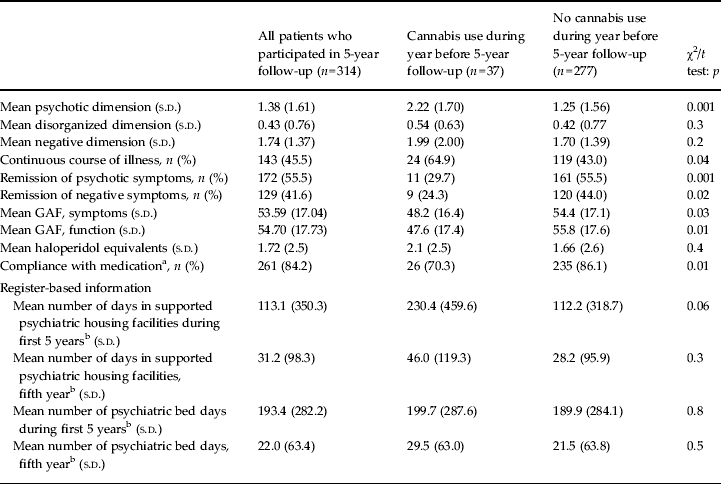
The 5-year follow-up data are presented in Table 2. Compared with the patients with no use of cannabis, patients with cannabis use had a significantly higher level of psychotic symptoms (difference in psychotic dimension 0.97, 95% CI 0.41–1.53, p = 0.001), and a smaller proportion had remission of psychotic symptoms (29.7% v. 55.5%, p = 0.001) and negative symptoms (24.3% v. 44.0%, p = 0.02). The cannabis users were more likely to have a continuous course of illness (64.9% v. 43.0%, p = 0.04), and they had a higher level of symptoms and lower level of social functioning; thus, the difference in the GAF symptom dimension was 6.21 (95% CI 0.29–12.14, p = 0.04) and in the GAF social dimension 8.26 (95% CI 2.13–14.39, p < 0.01). A significantly lower proportion was classified as receiving sufficient antipsychotic medication (70.3% v. 86.1%, p = 0.01). In order to investigate possible age differences between cannabis users and non-users, all significant differences were analysed in logistic and linear regression models with age as a covariate. This did not change the results substantially.
Clinical status, service use, and compliance with medication among first-episode patients with at least monthly cannabis use compared with no use or less than monthly use at 5-year follow-up

s.d., Standard deviation; GAF, Global Assessment of Functioning.
a Compliant with antipsychotic medication or no prescription and not psychotic.
b Use of bed days in psychiatric departments and use of days in supported psychiatric housing facilities extracted from complete longitudinal Danish registers. The remaining variables in this table were extracted from 5-year follow-up interviews with minor differences in the number of patients for whom the information was available.
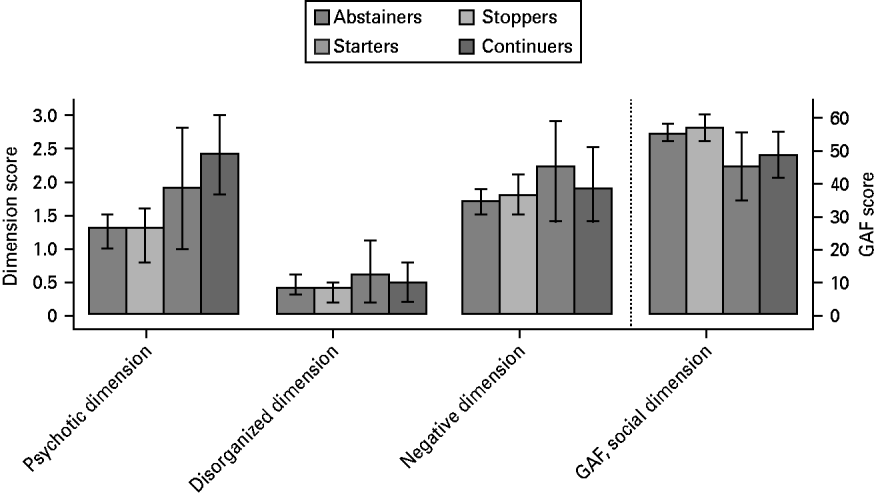
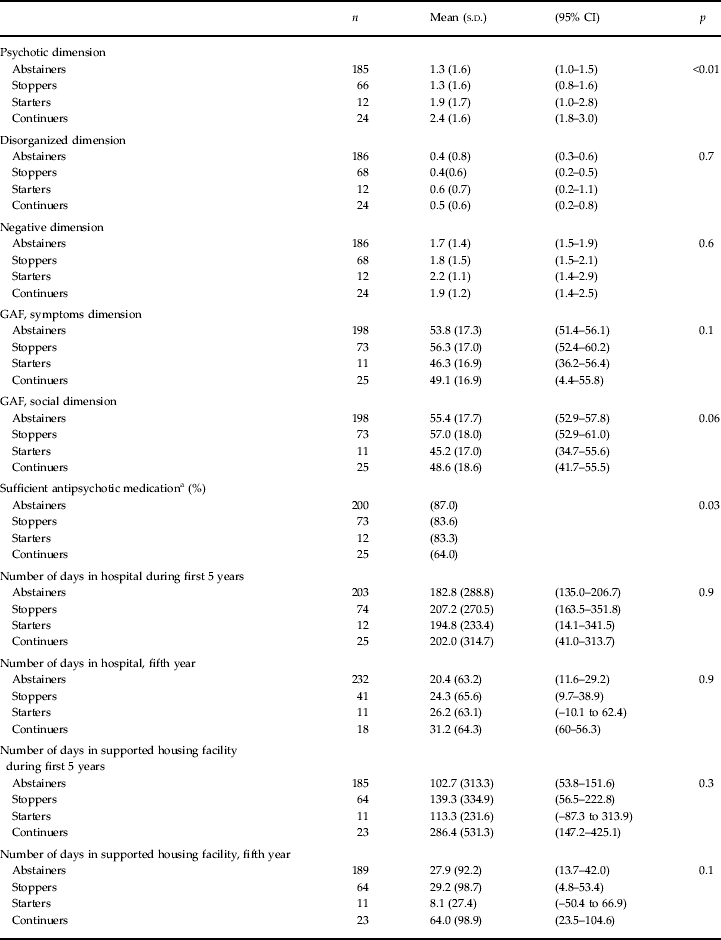
In Table 3, the outcome measures are shown for the patient group. The patients are divided into four groups (‘abstainers’, ‘stoppers’, ‘starters’ and ‘continuers’) based on the pattern of development of cannabis use. The level of psychotic symptoms varied according to pattern of use (p < 0.01), and so did treatment with antipsychotic medication (p = 0.03). Neither the levels of disorganized symptoms nor the levels of negative symptoms were affected by patterns of cannabis use. Fig. 1 presents the clinical and social outcome for the four groups.
Clinical and social outcome after 5 years among 314 patients included in the OPUS trial with first-episode psychosis. The patients are divided into abstainers, stoppers, starters and continuers on the basis of their pattern of cannabis use. Values are means, with 95% confidence intervals represented by vertical bars. GAF, Global Assessment of Functioning.

Clinical and social outcome after 5 years among 314 patients with first-episode psychosis included in the OPUS trial, divided into abstainers, stoppers, starters and continuers based on their pattern of cannabis use

s.d., Standard deviation; CI, confidence interval; GAF, Global Assessment of Functioning; abstainers, no use of cannabis at baseline and at 5-year follow-up; stoppers, stopped cannabis use between baseline and 5-year follow-up; starters, started cannabis use between baseline and 5-year follow-up; continuers, used cannabis at baseline and at 5-year follow-up.
a Taking prescribed antipsychotic medication or no prescription and not psychotic.
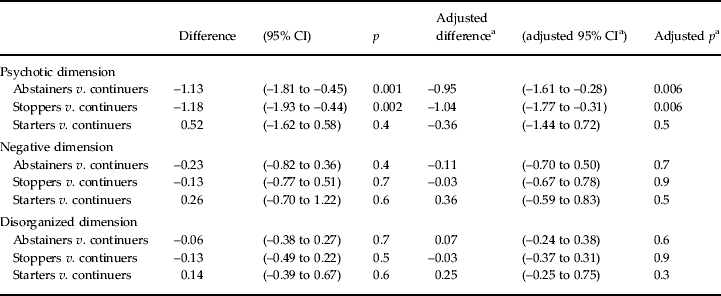
Differences in clinical outcome for ‘abstainers’, ‘stoppers’ and ‘starters’ compared with ‘continuers’ are presented in Table 4. Results of analyses with baseline value of the scores included as covariates, and analyses also adjusted for insufficient treatment with antipsychotic medication are presented. There were significantly lower scores on the psychotic dimension for ‘abstainers’ and ‘stoppers’ compared with ‘continuers’ (p = 0.006). These findings were still significant when the analyses were adjusted for insufficient antipsychotic medication. Further adjustment for age did not substantially change the results (data not shown).
Differences in clinical and social outcome after 5 years among 314 patients with first-episode psychosis included in the OPUS trial, divided into abstainers, stoppers and starters versus continuers, based on their pattern of cannabis use

CI, Confidence interval; abstainers, no use of cannabis at baseline and at the 5-year follow-up; stoppers, stopped cannabis use within the last 5 years; starters, started cannabis use within the last 5 years; continuers, continued use of cannabis throughout the 5 years.
a Adjusted for treatment with antipsychotic medication.
For the whole sample of 550 patients who were alive and living in Denmark at the 5-year follow-up, we were able to analyse differences in the number of days admitted to psychiatric hospital and the number of days in psychiatric housing facilities for the patients with cannabis use at entry compared with those with no cannabis use. For this total sample, we do not have data on cannabis use after 5 years, due to drop-out; therefore, we can only analyse the association with cannabis use at entry. Patients with cannabis use at entry spent 221 (s.d. = 271) days in hospital compared with 180 (s.d. = 251) days for the other patients during the 5 years (p = 0.1), and 167 (s.d. = 377) v. 114 (s.d. = 302) days in psychiatric housing facilities (p = 0.1).
Discussion
At the 5-year follow-up, cannabis users had higher scores on the psychotic dimension and a lower level of GAF social functioning compared with the patients with no cannabis use. Those who stopped using cannabis between entry and 5-year follow-up had a significantly lower level of psychotic symptoms at 5-year follow-up compared with those who had a continuous use of cannabis. As recommended by the previously mentioned review from 2008 (Zammit et al. Reference Zammit, Moore, Lingford-Hughes, Barnes, Jones, Burke and Lewis2008), we included baseline values of the outcome measures as covariates. We found that the association with severity of psychotic symptoms was significant, even after controlling for the baseline level of psychotic symptoms, and it was also significant when adjusted for insufficient antipsychotic medication and age. On this basis, we can conclude that continued frequent cannabis use is associated with a higher level of psychotic symptoms, and this is only partly explained by a larger proportion of cannabis users having insufficient antipsychotic medication. Therefore, it is likely that the higher level of psychotic symptoms is a separate effect of continued use of cannabis.
We found a significantly lower level of adaptation to school, measured as the academic dimension of the PAS, among those who used cannabis at entry compared with no use. The most likely explanation for this finding is that young people with poor academic performance are more likely to start using cannabis (Macleod et al. Reference Macleod, Oakes, Copello, Crome, Egger, Hickman, Oppenkowski, Stokes-Lampard and Davey2004). However, it is also possible that some had started cannabis use very early and that the use affected their school performance.
Our findings regarding effects of cannabis use on negative symptoms are contradictory. When analysed as a continuous outcome measure, we cannot find any significant effect of continuous use of cannabis, but analyses of remission as a dichotomous outcome indicate that compared with users, non-users of cannabis at 5-year follow-up have better chances of achieving remission of negative symptoms. However, this could be a spurious finding, since the results are contradictory and the number of cases is rather low.
Even though the differences in use of psychiatric beds and supported psychiatric housing facilities in the 5-year follow-up period did not reach statistical significance due to large variation, it cannot be overlooked that frequent cannabis use at entry is associated with higher levels of service use in the 5-year follow-up period.
Strengths
We were able to utilize data from a large, thoroughly assessed cohort of patients with first-episode psychotic disorder followed up after 5 years, and to include clinical conditions at entry in the study. We could also include information about antipsychotic medication in our analyses of associations between clinical conditions and pattern of cannabis use.
Use of cannabis was evaluated according to chapter 12, item 12.007 in the SCAN interview. We have recently shown that in non-penalizing settings, self-reports are a reliable measure of cannabis use (Hjorthoj et al. Reference Hjorthoj, Fohlmann, Larsen, Arendt and Nordentoft2012a ,Reference Hjorthoj, Hjorthoj and Nordentoft b ).
Limitations
The variables we used as determinants in the analyses were rather crude in that we only separated cannabis use into no use versus any use. Evaluation of dose–response effect could be considered, and maybe also including data on the strength of the cannabis used, as studies have shown that the amount of the active ingredient Δ9-tetrahydrocannabinol in the cannabis smoked also has been shown to have an impact on psychosis severity (D'Souza et al. Reference D'Souza, bi-Saab, Madonick, Forselius-Bielen, Doersch, Braley, Gueorguieva, Cooper and Krystal2005; Di Forti et al. Reference Di Forti, Morgan, Dazzan, Pariante, Mondelli, Marques, Handley, Luzi, Russo, Paparelli, Butt, Stilo, Wiffen, Powell and Murray2009).
Implications
Even though reverse causality cannot be excluded, the baseline differences between the patients with use of cannabis compared with no use justify a warning against the use of cannabis, since it can be associated with triggering psychotic disorder and poor academic performance.
Our study does indicate that cannabis, as such, worsens the risk of having a continuous psychotic condition, as this association was significant even after adjusting for insufficient antipsychotic medication as a mediating factor. Patients with use of cannabis should be offered treatment in order to facilitate reduction or discontinuation of cannabis use, since continued use of cannabis is associated with insufficient medication, higher level of psychotic symptoms and reduced social functioning, as well as lack of remission.
Acknowledgements
We would like to thank the anonymous reviewers for valuable comments. The project received grants from the Danish Ministry of Health (jr.nr. 96-0770-71), Danish Ministry of Social Affairs, the University of Copenhagen, Copenhagen Hospital Cooperation, the Danish Medical Research Council (jr.nr. 9601612 and 9900734), Slagtermester Wørners Foundation and the Stanley Wada Research Foundation.
Declaration of Interest
None.